

Global Apparels, Footwear, and Leather Goods (AFL) Testing, Inspection, and Certification (TIC) Market
Apparels Footwear and Leather Goods (AFL)Testing Inspection and Certification (TIC) Market is estimated to be valued at USD 7,006.5 Mn in 2026 and is expected to reach USD 10,124.7 Mn in 2033, exhibiting a compound annual growth rate (CAGR) of 5.4% from 2026 to 2033.
Key Takeaways
- Based on Service Type, the Testing Services segment is projected to account for 48.4 % share of the market in 2026, due to strict global regulations, rising consumer focus on safety, durability, and sustainability, and the need for chemical, physical, and colorfastness checks.
- Based on Industry, the Footwear segment is expected to hold the largest share of the market in 2026, due to strict safety, durability, and chemical compliance requirements.
- Based on Region, Europe is expected to lead the market, holding a share of 37% in 2026. While, North America is anticipated to be the fastest growing region, with a market share of 29. 8% in 2026.
Market Overview
The market analysis for testing, inspection, and certification (TIC) services in the apparel, footwear, and leather goods (AFL) sector examines various types of testing, including physical, chemical, and colorfastness testing. Additionally, it covers certification services, as well as third-party audits and inspections. The global AFL TIC market is experiencing growth due to the increasing disposable income and rapid urbanization in emerging economies.
Current Events and Its Impact
Current Event | Description and its Impact |
EU Digital Product Passport and ESPR Implementation |
|
Sustainability and ESG Compliance Requirements |
|
Industry Trends and Innovations in the Apparels, Footwear, and Leather Goods (AFL) Testing, Inspection, and Certification (TIC) Market
Industry Trends
- E-commerce Expansion: The rapid growth of online shopping has increased the demand for TIC services to ensure product authenticity and quality, building consumer trust in digital marketplaces.
- Sustainability and Ethical Sourcing: Consumers' growing preference for sustainable and ethically produced goods is pushing brands to adopt eco-friendly practices and obtain relevant certifications.
- Global Trade Compliance: As the apparel, footwear, and leather goods industries are highly globalized, adherence to international standards and regulations is crucial for smooth trade and effective supply chain management.
Innovations in TIC Services
- Technological Advancements: The integration of artificial intelligence (AI), big data analytics, automation, and the Internet of Things (IoT) is transforming the TIC market, improving efficiency and enhancing product offerings.
- Digital Solutions: Emerging technologies such as blockchain are being utilized for supply chain transparency and product authentication, ensuring the integrity of products from manufacturing to retail.
- Advanced Testing Methods: Innovations in testing, including advanced material analysis and performance testing, are enhancing the accuracy, efficiency, and speed of product evaluations.
- Current Industry Events of 2026
- Market Size Estimation
- Regional Breakdown
- Competitive Landscape
- Customer Intelligence
- Segmental Analysis
- Pricing Analysis
- Key Market Drivers, Challenges & Future Trends
- Customized Insights Section
Segmental Insights
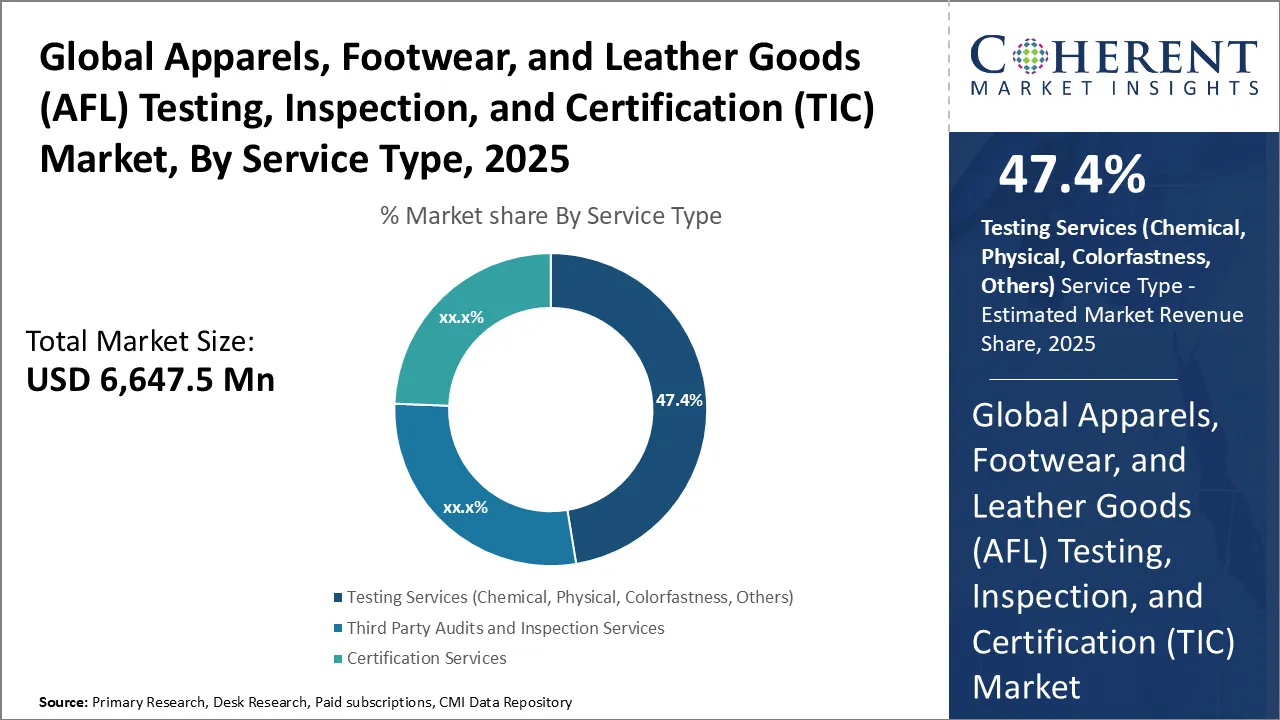
Apparels, Footwear, and Leather Goods (AFL) Testing, Inspection, and Certification (TIC) Market Insights, By Service Type - Testing Services is Dominating as Strict Regulations and Consumer Demand for Safety Drive Compliance Needs
In terms of service type, the testing service segment is estimated to holds the 48.4% share of the market in 2026, due to strict global regulations, rising consumer focus on safety, durability, and sustainability, and the need for chemical, physical, and colorfastness checks. Global brands increasingly demand rigorous quality assurance to meet compliance, protect reputation, and ensure eco-friendly practices, driving strong demand for testing across apparel, footwear, and leather goods.
For instance, in January 2025, the Bureau of Indian Standards (BIS) inaugurated its Hyderabad branch laboratory dedicated to testing specialized textile products. The facility is equipped with a Universal Testing Machine and soon to include yarn-testing capabilities, aims to strengthen quality control, enforce standards, and bolster India’s textile sector.
-testing-inspection-and-certification-(tic)-market-by-industry.webp "Apparels, Footwear and Leather Goods (AFL) Testing, Inspection and Certification (TIC) Market, By Industry")
Apparels, Footwear, and Leather Goods (AFL) Testing, Inspection, and Certification (TIC) Market Insights, By Industry - Footwear Demands Through Stringent Safety, Quality, And Compliance Requirements
In terms of industry, the footwear segment is expected to command the largest share in 2026 due to strict safety, durability, and chemical compliance requirements. Rising global trade, sustainability concerns, and consumer expectations for quality and comfort necessitate rigorous testing. Brands also rely on third-party inspections and certifications to ensure regulatory adherence, ethical sourcing, and international market acceptance.
For instance, in August 2024, India’s Ministry of Commerce and Industry issued the Footwear Made from Leather and Other Materials (Quality Control) Order, 2024,. The mandate requires specified types of footwear to meet Indian standards and display the Bureau of Indian Standards (BIS) mark after certification. Compliance is now essential for market access.
Regional Insights
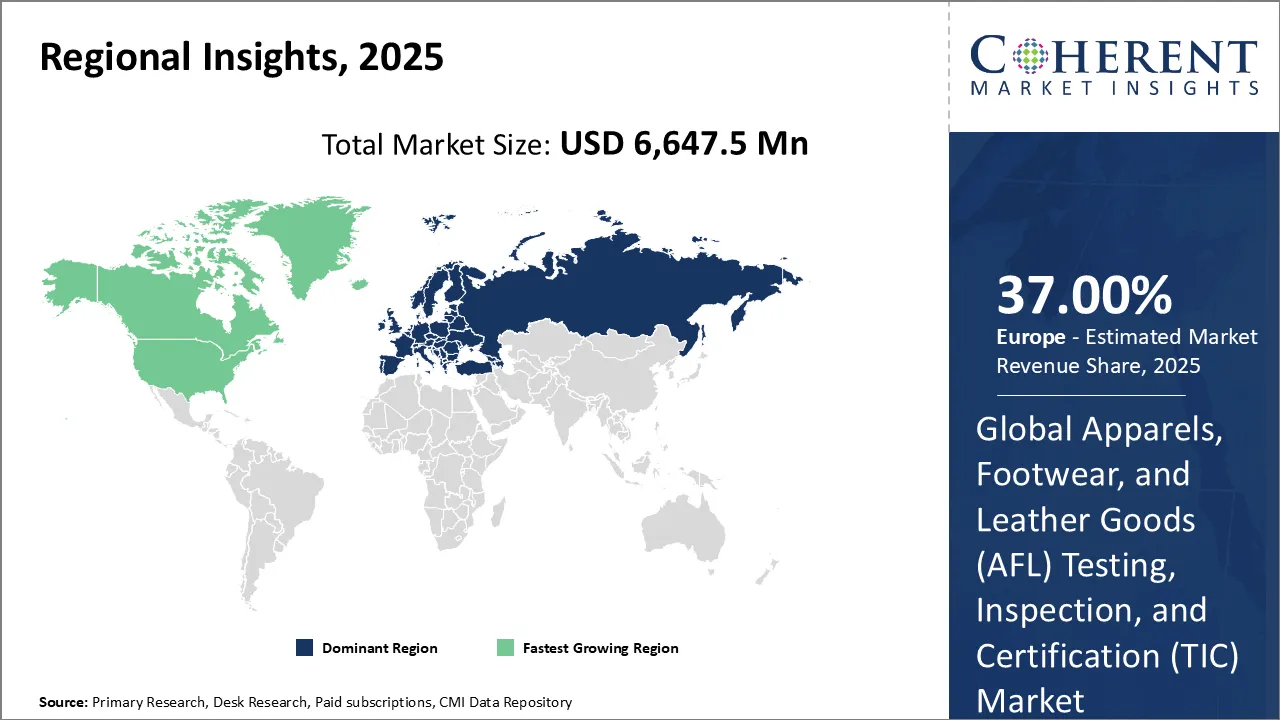
Europe Apparels, Footwear, and Leather Goods (AFL) Testing, Inspection, and Certification (TIC) Market Analysis & Trends
Europe’ dominance in the global apparels, footwear, and leather goods (AFL) testing, inspection, and certification market, with an estimated share of 37% in 2026, is primarily due to stringent EU regulations on product safety, chemical usage (REACH compliance), and sustainability standards. Growing consumer awareness of ethical sourcing and eco-friendly products drives brands to ensure transparency and quality. Additionally, Europe’s strong fashion and luxury goods industry further amplifies the need for rigorous TIC services.
For instance, in June 2026, the European Commission introduced new Product Environmental Footprint Category Rules (PEFCR) for apparel and footwear. Developed with input from industry, NGOs, and national authorities over five years, the science-based framework assesses environmental impact across a product’s lifecycle from raw materials to end-of-life to foster sustainable design and support a circular economy.
North America Apparels, Footwear, and Leather Goods (AFL) Testing, Inspection, and Certification (TIC) Market Analysis & Trends
North America region is expected to exhibit the fastest growth in the global apparels, footwear, and leather goods (AFL) testing, inspection, and certification market with 29.8% share in 2026 due to strict regulatory standards, strong consumer focus on product safety, and rising sustainability requirements. Growth in apparel and footwear imports, coupled with leading global brands headquartered in the region, drives reliance on TIC services to ensure compliance, quality assurance, and brand reputation protection.
For instance, in November 2024, ASTM International, in collaboration with NIST and AATCC, released a report outlining essential standards for advancing textile circularity. The "Standards Needs for Circular Textiles Workshop Report" identifies key areas such as terminology, sorting, grading, recycling, labeling, and design for circularity. The report emphasizes the importance of standardized practices to enhance recycling efficiency and product lifecycle transparency in the textile industry.
Apparels, Footwear, and Leather Goods (AFL) Testing, Inspection, and Certification (TIC) Market Outlook Country-Wise
The U.S. Apparels, Footwear, and Leather Goods (AFL) Testing, Inspection, and Certification (TIC) Market Trends
The U.S. Apparels, Footwear, and Leather Goods (AFL) Testing, Inspection, and Certification (TIC) Market is driven by strict federal and state regulations, including CPSC, FTC, and EPA mandates, alongside rising consumer demand for safe, sustainable, and ethically produced goods. Garment factories must obtain certifications like WRAP, GOTS, OEKO-TEX, and ISO to meet buyer expectations, avoid fines, and maintain retail partnerships, boosting demand for testing and certification services.
For instance, in February 2026, forever 21 recalled approximately 24,700 children's pajamas due to non-compliance with federal flammability standards, posing a burn risk. The recall includes 20 styles of pajama pants, shorts, and sets sold in sizes 5/6 to 13/14. Consumers are advised to stop using the garments, destroy them, and contact Forever 21 for a refund. No injuries have been reported.
Germany Apparels, Footwear, and Leather Goods (AFL) Testing, Inspection, and Certification (TIC) Market Trends
The Apparels, Footwear, and Leather Goods (AFL) Testing, Inspection, and Certification (TIC) market is highly demanding in Germany due to strict national and EU regulations on product safety, chemical compliance, and environmental standards. Rising consumer awareness for sustainable and ethically produced garments, coupled with Germany’s large manufacturing and export-oriented apparel sector, drives reliance on TIC services to ensure quality, regulatory adherence, and market access.
For instance, in July 2026, Global Standard, the non-profit organization behind the Global Organic Textile Standard (GOTS), initiated a public consultation for its new voluntary sustainability framework, the Global Responsible Textile Standard (GRTS). The consultation invites input from companies, NGOs, consumers, and certification bodies to ensure the new standard reflects real-world needs and expectations.
Market Report Scope
Apparels, Footwear and Leather Goods (AFL) Testing, Inspection and Certification (TIC) Market Report Coverage
| Report Coverage | Details | ||
|---|---|---|---|
| Base Year: | 2025 | Market Size in 2026: | USD 7,006.5 Mn |
| Historical Data for: | 2020 To 2024 | Forecast Period: | 2026 To 2033 |
| Forecast Period 2026 to 2033 CAGR: | 5.4% | 2033 Value Projection: | USD 10,124.7 Mn |
| Geographies covered: |
| ||
| Segments covered: |
| ||
| Companies covered: | Intertek Group plc., Bureau Veritas SA, TUV Rheinland Group, SGS S.A., Underwriters Laboratories Inc., TÜV SÜD, CTC Groupe, Eurofins Scientific, QIMA, and Hohenstein | ||
| Growth Drivers: |
| ||
| Restraints & Challenges: |
| ||
Global Apparels, Footwear, and Leather Goods (AFL) Testing, Inspection, and Certification (TIC) Market Drivers
Global Trade and Supply Chain Management
The leather goods, footwear, and apparel industries are highly globalized, with products produced and distributed worldwide. Various standards and regulations must be adhered to in international trade, and TIC services assist businesses in meeting these requirements.
Apparels, Footwear, and Leather Goods (AFL) Testing, Inspection, and Certification (TIC) services are in high demand as they ensure compliance with international standards, allowing for smooth trade and effective supply chain management. For instance, the REACH (Registration, Evaluation, Authorization, and Restriction of Chemicals) regulation, which restricts the use of certain hazardous substances in products, is one of the stringent regulations in place in the European Union.
Growing Focus on Sustainability and Ethical Practices
With the increasing awareness of environmental issues and labor rights, there is a rising demand for sustainable and ethically produced apparels, footwear, and leather products. Testing, Inspection, and Certification (TIC) services are being employed to verify compliance with environmental regulations, assess the use of eco-friendly materials such as hemp, wool, organic cotton, soy silk, bamboo fabrics, jute, and corn fibers. These materials are considered as eco-friendly fabrics as they are derived from nature without any harmful effects of chemical or toxics. They also ensure fair labor practices throughout the supply chain. For instance, organic cotton is produced without the use of GMOs, synthetic fertilizers, or pesticides. Its production conserves water, encourages biodiversity, and avoids the use of harmful chemicals. Due to its lower impact on the environment, organic cotton-based products are increasingly in demand.
Global Apparels, Footwear, and Leather Goods (AFL) Testing, Inspection, and Certification (TIC) Market Opportunities
Collaboration with Industry Stakeholders
New opportunities for TIC (Testing, Inspection, and Certification) providers can be created through collaborations with stakeholders in the apparel, footwear, and leather goods industries. The creation of individualized solutions, the expansion of service offerings, and access to new markets can all result from forming partnerships with retailers, manufacturers, and associations representing the industry. In addition, collaborative efforts have the potential to boost innovation, facilitate the sharing of knowledge, and raise industry standards.
For instance, in February 2025, Kyrgyzstan partnered with KyrgSert and China's Xinjiang Tianyu Engineering Testing to establish a textile and apparel testing laboratory. The facility will assess compliance with international and national quality standards, issue health and environmental safety certifications, provide consulting services, and support the adoption of international certification standards.
Emerging Markets and Global Expansion
The Apparels, Footwear, and Leather Goods (AFL) Testing, Inspection, and Certification (TIC) Market is witnessing significant growth in emerging markets, driven by rising disposable incomes, urbanization, and changing consumer lifestyles. Global markets present opportunities for AFL TIC service providers to expand their presence and cater to the increasing demand for quality, safe, and compliant products. For instance, India's rapid urbanization and rise in disposable incomes have altered consumer lifestyles and increased demand for fashionable and high-quality footwear and apparel. A growing demand for AFL TIC services to ensure compliance with international standards and regulations arises as consumers become more concerned about product safety and quality.
For instance, in September 2024, Guwahati's NEHHDC head office now houses Northeast India's first NABL-accredited textile testing laboratory. This milestone, announced by the North East Council, enhances the region's textile industry by ensuring compliance with national and international standards. Previously, local producers had to send samples to Kolkata; now, they have immediate access to high-quality testing services.
Global Apparels, Footwear, and Leather Goods (AFL) Testing, Inspection, and Certification (TIC) Market Trends
Rapid Growth of E-commerce Sector
The growth of online shopping, especially for Apparels, Footwear, and Leather Goods (AFL products), has created new challenges for quality control and product authenticity. TIC services are increasingly utilized to verify the quality and authenticity of AFL products sold online, helping build trust between online retailers and consumers.
Advancements in Testing Technologies
Technological advancements are transforming the global Apparels, Footwear, and Leather Goods (AFL) Testing, Inspection, and Certification (TIC) market. New testing methods, such as advanced material analysis, chemical testing, and performance testing, are being developed to enhance the accuracy, efficiency, and speed of product testing. Automation and digitization are also playing a significant role in streamlining testing processes.
Analyst Opinion (Expert Opinion)
The AFL TIC market is moving from transactional compliance toward strategic risk control and brand-protecting assurance. Regulatory pressure, concentrated recall activity, and an accelerating insistence on verifiable sustainability credentials are shifting buyer behaviour: brands and retailers are no longer buying single tests; they are buying programme-level assurance that reduces recall risk, protects reputation, and supports product claims across complex global supply chains.
Heightened chemical scrutiny now dominates testing priorities. Official EU data recorded 70 chemical risk alerts for textiles in 2023, with roughly 85% classified as human-health risks and over 60% of those alerts related to chromium (VI) exceedances, a recurring failure mode in leather articles. This pattern is not isolated; the EU Safety Gate reported thousands of product alerts in the most recent year, underscoring persistent non-compliance hotspots in AFL items. These facts make regulatory chemistry screening (Cr (VI), APEOs, certain azo dyes, formaldehyde, selected flame retardants and, increasingly, PFAS suites) the highest-value test cluster for importers and brand compliance teams.
Demand for credible sustainability and chemical-management labels is quantifiably increasing and is re-shaping how TIC is procured. Independent certification bodies are scaling: OEKO-TEX reported a marked rise in issued certificates (well into the tens of thousands annually) and expanded control-testing efforts (thousands of retail samples and tens of thousands of tests per cycle). That growth signals that brands view third-party certification not as a marketing vanity but as a practical control lever to limit supply-chain risk and to meet retailer/platform onboarding thresholds. Consequently, TIC suppliers that can combine standardized chemical screens with traceable, certificate-backed provenance services command premium pricing and deeper, multi-year engagements.
Speak to the analyst
Want personalized insights?
Take the findings above to one of our principal consultants, or have the report rebuilt around the segments, geographies and competitors you actually track.
Key Developments
- In June 2025, Shein announced a significant enhancement to its product safety standards, aiming to conduct 2.5 million safety tests. This initiative includes stricter compliance measures, such as increased verification of test reports, labels, and certifications like RoHS for the EU market. The move underscores Shein's commitment to improving product quality and consumer safety.
- In December 2024, Ardmel Group, a Scotland-based machinery specialist, launched 'The Comparator,' a groundbreaking textile testing technology. This machine, developed in collaboration with the American Association of Textile Chemists and Colorists (AATCC), measures fabric condensation in humid microclimates. Unlike traditional dry-condition tests, The Comparator offers a more accurate assessment of fabric performance in real-world conditions, particularly benefiting outdoor and sportswear applications.
- In December 2024, Cotecna inaugurated a state-of-the-art Softlines Testing Laboratory in Tirupur, Tamil Nadu. Spanning 12,000 sq. ft., the facility offers comprehensive testing, quality control, and certification services tailored to the textile and apparel industries. This expansion aims to support manufacturers in meeting both domestic and international quality standards.
Market Segmentation
- Global Apparels Footwear and Leather Goods (AFL) Testing Inspection and Certification (TIC) Market, By Service Type (Revenue, USD Mn, 2021 - 2033)
- Testing Services
- Chemical Testing
- Physical Testing
- Colorfastness Testing
- Others
- Third Party Audits and Inspection Services
- Certification Services
- Testing Services
- Global Apparels Footwear and Leather Goods (AFL) Testing Inspection and Certification (TIC) Market, By Industry (Revenue, USD Mn, 2021 - 2033)
- Footwear
- Apparels
- Leather Goods
- Global Apparels Footwear and Leather Goods (AFL) Testing Inspection and Certification (TIC) Market, By Region (Revenue, USD Mn, 2021 - 2033)
- North America
- U.S.
- Canada
- Latin America
- Brazil
- Argentina
- Mexico
- Rest of Latin America
- Europe
- Germany
- U.K.
- Spain
- France
- Italy
- Russia
- Rest of Europe
- Asia Pacific
- China
- India
- Japan
- Australia
- South Korea
- ASEAN
- Rest of Asia Pacific
- Middle East
- GCC Countries
- Israel
- Rest of Middle East
- Africa
- South Africa
- North Africa
- Central Africa
- North America
- Global Apparels, Footwear, and Leather Goods (AFL) Testing, Inspection, and Certification (TIC) Market Companies Insights (Revenue, USD Mn, 2021 - 2033)
- Intertek Group plc
- Bureau Veritas SA
- TUV Rheinland Group
- SGS S.A.
- Underwriters Laboratories Inc.
- TUV SUD
- CTC Groupe
- Eurofins Scientific
- QIMA
- Hohenstein
Sources
Primary Research — Interviews
Stakeholders (broad groups)
- Apparel, footwear, and leather-goods manufacturers (factory owners, QA/QC managers, production managers)
- Third-party testing laboratories and accreditation bodies (lab directors, senior chemists, lab technicians)
- Certification bodies and standards teams (compliance managers, certification auditors)
- Brand compliance, sourcing and sustainability teams (global sourcing heads, compliance officers)
- Retail procurement and quality teams (category heads, store QA managers, e-commerce quality leads)
- Raw-material suppliers (tanneries, leather processors, textile mills, chemical suppliers)
- Logistics, warehousing and customs compliance officers (export/import compliance leads)
- Regulatory authorities and government testing labs (standards officers, lab heads)
- Trade union / worker safety representatives and CSR leads (factory welfare officers, sustainability leads)
- Large-scale contract manufacturers and CMT (cut-make-trim) operators
Specific stakeholders / example interview targets
- Compliance & sourcing heads at global apparel and footwear brands
- Head of QA / Product Safety at large retailers and marketplaces
- Technical managers at major tanneries and leather processors
- Laboratory directors at national/international textile and leather testing labs
- Accreditation officers at national accreditation bodies
- Head of compliance at major footwear OEMs and contract manufacturers
- Regulatory officials at ministries of textiles / commerce
- Procurement & sustainability leads at fast-fashion and large retail chains
- Customs testing and inspection officers at major ports/airports and export hubs
- NGO / industry initiative leads working on toxic-chemical phase-outs and worker safety
Databases & Trade / Regulatory Statistics
- UN Comtrade (international trade flows for apparel, footwear, leather goods)
- WTO Trade Statistics (tariff and trade data)
- ITC Trade Map (trade flows, partners, HS-code level detail)
- OTEXA / U.S. Department of Commerce — Office of Textiles and Apparel (export/import & trade data)
- Eurostat (EU imports/exports, production statistics for textiles & leather)
- China Customs Statistics (export volumes and HS-level detail)
- Korea Customs Service data portal (regional trade flows)
- Japan External Trade Organization (JETRO) trade statistics
- Directorate General of Commercial Intelligence & Statistics (DGCIS), India / DGFT (export performance & policy notifications)
- Bangladesh Bureau of Statistics / Bangladesh Bank (apparel export performance)
- National accreditation bodies’ public registries (lists of accredited testing labs)
Industry Magazines & Trade Media
- Apparel Resources (industry & compliance coverage)
- Just-Style / Sourcing Journal (sourcing, compliance, testing developments)
- Fibre2Fashion (industry news, testing, chemicals)
- Footwear News (global footwear industry trends & compliance)
- Leather International / LeatherBiz (leather industry, processing, standards)
- Textile World (technical textiles, testing methods)
- Ecotextile News (sustainability, chemical management, restricted substances)
- Vogue Business — Retail & Supply Chain reporting (quality and compliance features)
Academic & Technical Journals
- Textile Research Journal (testing methods, material science)
- Journal of the Textile Institute (testing, standards, processes)
- Journal of Cleaner Production (sustainability, chemical management in textiles/leather)
- Journal of Footwear Science & Engineering / Leather and Footwear Journal (material testing & durability)
- Materials & Design / Polymer Testing (performance testing relevant to footwear & coated materials)
- Journal of Fashion Marketing and Management (quality, consumer safety perspectives)
Newspapers & Business Press
- The Wall Street Journal — Business & Tech sections (global retail / supply chain developments)
- Financial Times — Apparel & Retail reporting
- The Economic Times / Business Standard (India — textiles, export policy, labelling & compliance news)
- The Hindu Business Line (industry & export developments)
- Nikkei Asia (supply-chain, manufacturing shifts affecting apparel/leather)
- South China Morning Post (China manufacturing & regulatory changes)
Standards & Public-domain Regulatory Sources
- ISO standards (textile and leather test methods: e.g., ISO textile testing series)
- ASTM International (textile/footwear testing standards)
- Bureau of Indian Standards (BIS) — textile, leather and product safety standards and lab accreditation guidance
- European Commission — REACH (chemical restrictions impacting apparel/leather) and EU textile labelling rules
- U.S. Consumer Product Safety Commission (CPSC) / CPSIA (children’s clothing safety, lead limits)
- National Institute of Occupational Safety & Health (NIOSH) and labour safety guidance where relevant
- National Accreditation Board for Testing and Calibration Laboratories (NABL), India — public registry & guidelines
- Government Ministries: Ministry of Textiles (India), Ministry of Commerce (export control notices), equivalent ministries in key markets (Bangladesh, Vietnam)
- Customs & excise public circulars on import lab testing and pre-shipment inspection requirements
Associations & Industry Bodies
- American Apparel & Footwear Association (AAFA) — compliance & standards guidance
- Leather Working Group (LWG) — sustainability and facility audits for leather supply chains
- International Textile Manufacturers Federation (ITMF) — industry data & technical committees
- Textile Exchange (supply-chain and material standards)
- International Labour Organization (ILO) — worker safety, compliance frameworks
- Bangladesh Garment Manufacturers & Exporters Association (BGMEA) — industry guidance for testing & compliance
- Confederation of Indian Industry (CII) — textiles & leather forums
- Footwear Distributors & Retailers associations (regional bodies)
- Association for Materials Protection & Performance (AMPP) — when coatings/finishes testing applies
Technical / Testing Focus Areas
- Restricted Substances Lists and chemical testing guidance (REACH, ZDHC-style RSLs, national chemical limits)
- Physical performance testing: abrasion, tensile, seam strength, colorfastness protocols (ISO / ASTM / AATCC methods)
- Leather-specific tests: chromium VI testing, tanning residuals, tensile/tear tests, fastness tests
- Footwear durability/fatigue testing standards (ISO / ASTM footwear protocols)
- Flammability and safety testing (national standards for apparel and children’s wear)
- Lab proficiency testing & inter-laboratory comparison reports from accreditation bodies
Public Domain Reports & Government Publications
- Ministry of Textiles (Government of India) reports, schemes and testing infrastructure lists
- U.S. International Trade Commission (USITC) reports on textile & apparel trade impacts
- European Commission market reports on textiles and product safety communications
- National standards bodies’ (BIS, ANSI, BSI) publicly available standards and guidance documents
- Reserve Bank / commerce ministry reports on textile export earnings (for market context)
Proprietary / Internal Elements
- CMI Data Analytics Tool, and Proprietary CMI Existing Repository of information for the last 8 years
Get access to 250+ pages report
Every segment, forecast, competitor profile and data table behind the analysis above — available for instant download.
- ESOMAR Member
- ISO 9001:2015 Certified
- D-U-N-S Registered
- GDPR & CCPA Compliant
Missing comfort of reading report in your local language? Find your preferred language:
Transform your Strategy with Exclusive Trending Reports
Frequently Asked Questions
The Apparels Footwear and Leather Goods (AFL)Testing Inspection and Certification (TIC) Market is estimated to be valued at USD 7,006.5 Mn in 2026, and is expected to reach USD 10,124.7 Mn by 2033.
The CAGR of the Apparels Footwear and Leather Goods (AFL)Testing Inspection and Certification (TIC) Market is projected to be 5.4% from 2026 to 2033.
Market players across the globe are Intertek Group plc., Bureau Veritas SA, TUV Rheinland Group, SGS S.A., Underwriters Laboratories Inc., TÜV SÜD, CTC Groupe, Eurofins Scientific, QIMA, and Hohenstein
Global Trade and Supply Chain Management, Growing Focus on Sustainability and Ethical Practices are the major factors that is expected to propel the market growth over the forecast period.
There has been increasing awareness regarding latest market trends among shoppers. Consumers opt for products that are made from high quality materials, which, in turn, has boosted the demand for high quality products. This is one of the major factors that is influencing the adoption of market globally.