

Global Nano Drones Market Size and Forecast – 2026 - 2033
The Global Nano Drones Market is estimated to be valued at USD 3.56 Bn in 2026 and is expected to reach USD 14.01 Bn by 2033, exhibiting a compound annual growth rate (CAGR) of 21.6% from 2026 to 2033.
Key Takeaways of the Nano Drones Market
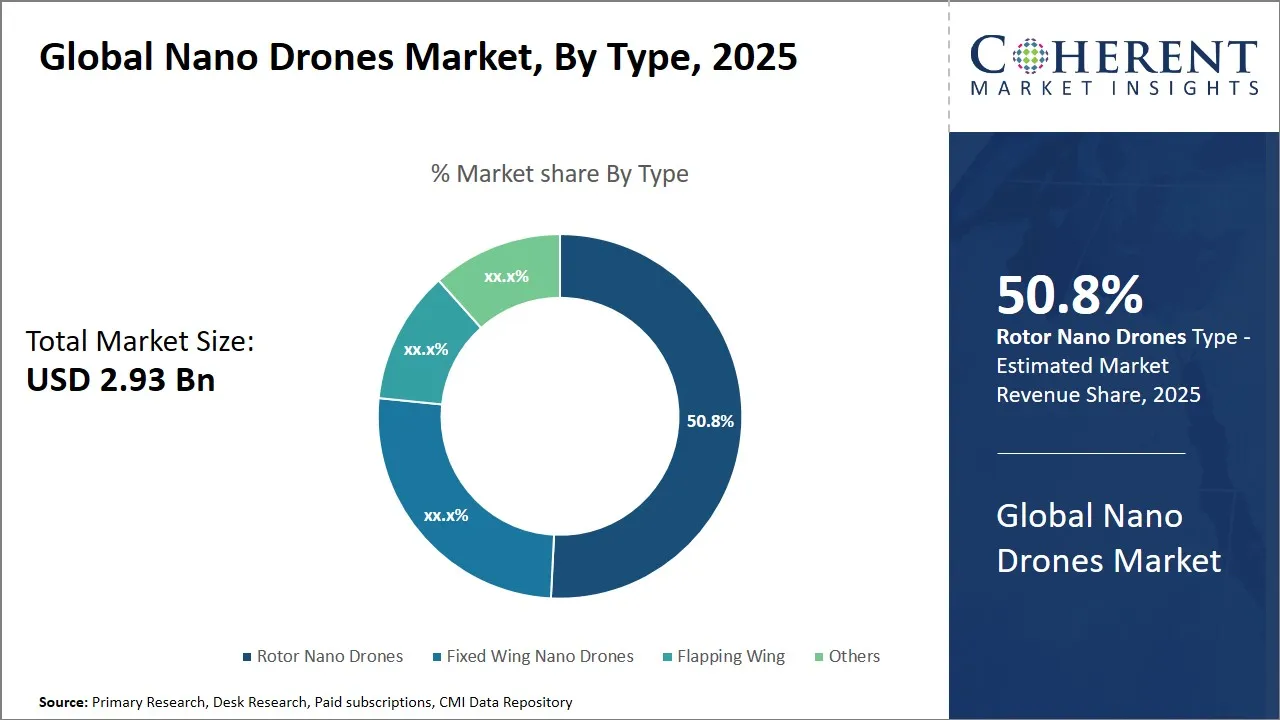
- The Rotor Nano Drones segment leads the market holding an estimated share of 51.8 % in 2026.
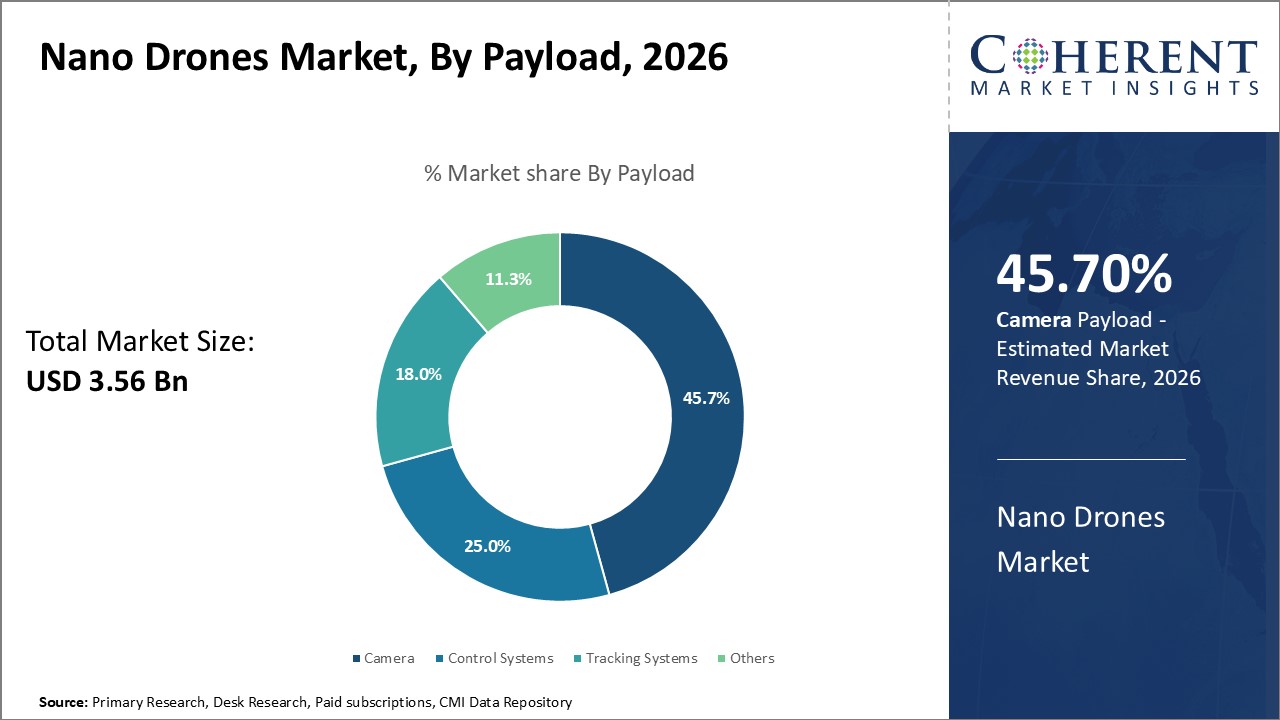
- The camera payload segment leads the market holding an estimated share of 45.7 % in 2026.
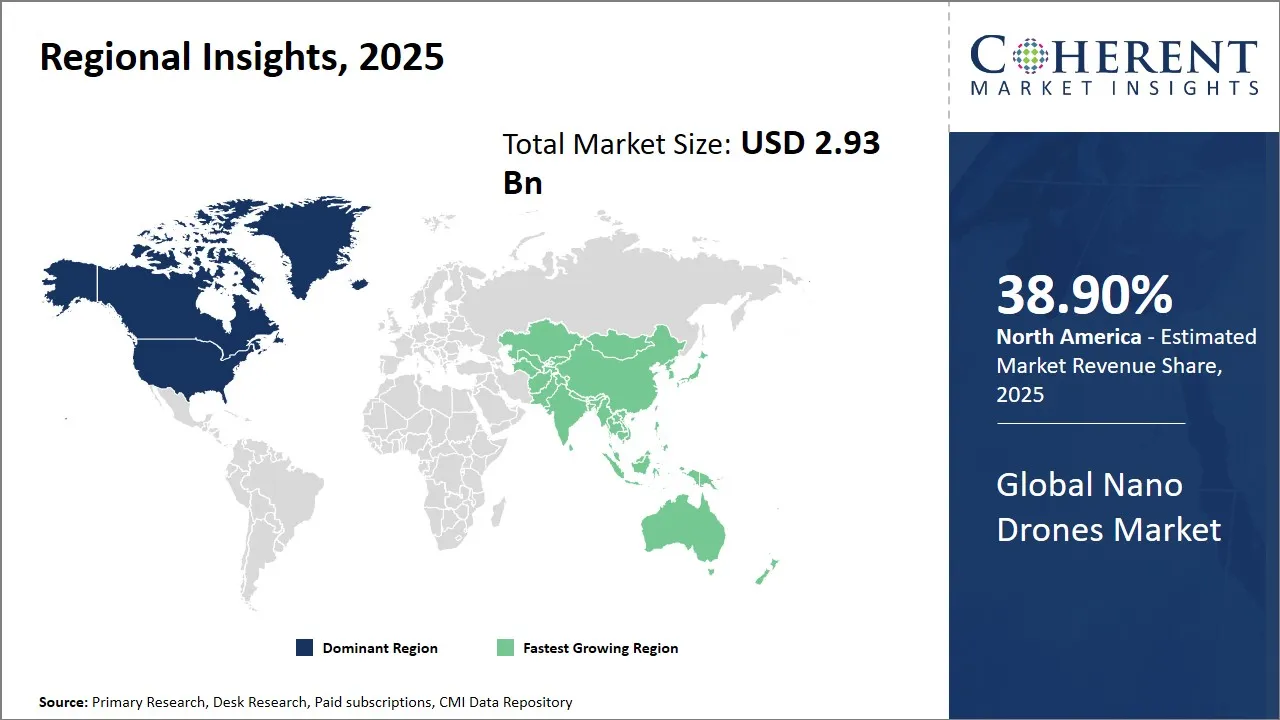
- North America is estimated to lead the market with a share of 38.9 % in 2026.
- Asia Pacific, holding a share of 29.6 % in 2026, is projected to be the fastest growing region.
Market Overview
Market trends indicate a rising adoption of AI-powered nano drones that offer improved navigation and data collection capabilities. Also, industries are using these drones for precision agriculture, environmental monitoring, and security surveillance, adding to their demand. The use of advanced sensors and real-time analytics is benefitting the market, while growing investments in research and development will help introduce innovative features, adding to market expansion in the coming years.
Current Events and Its Impact
Current Events | Description and its impact |
U.S.–China Export Controls & High Tariffs (2025) |
|
U.S. Commerce Department Investigations |
|
Ukraine–Russia Drone Warfare & Innovation Surge |
|
Russia–Iran Drone Collaboration |
|
Segmental Insights
- Current Industry Events of 2026
- Market Size Estimation
- Regional Breakdown
- Competitive Landscape
- Customer Intelligence
- Segmental Analysis
- Pricing Analysis
- Key Market Drivers, Challenges & Future Trends
- Customized Insights Section
Global Nano Drones Market Insights, by Type - Rotor Nano Drones Lead Owing to Their Superior Maneuverability and Versatile Applications
Rotor nano drones, holding an estimate share of 51.8% in 2026, dominate the global nano drones market. Rotor nano drones come with multiple rotors, making possible vertical takeoff and landing (VTOL), hovering, and rapid directional changes. The multi-rotor design allows these drones to hover steadily, facilitating operations such as detailed aerial photography, infrastructure inspection, and precision farming.
Technological advancements have further propelled the rotor nano drone segment. The development of lightweight materials and miniaturized electronic components has resulted in highly efficient rotor systems that consume less power while providing superior performance. This energy efficiency extends flight duration, a crucial factor in market preference.
Additionally, rotor nano drones are widely favored for their scalability and modularity. Users can customize these drones with various sensors and payloads, tailoring them to specific needs without extensive redesigns. Regulatory trends also support the expansion of rotor nano drones. Their generally smaller size and lower risk profile compared to larger UAVs make them more amenable to relaxed regulatory constraints in many countries.
Global Nano Drones Market Insights, by Payload - Camera Segment Leads, Driven by Growing Demand for Real-Time Visual Data and Aerial Imaging Applications
The camera payload segment is projected to hold the largest share of 45.7% in the global nano drones market in 2026. Cameras are essential payloads on nano drones, enabling critical capabilities such as surveillance, reconnaissance, mapping, and entertainment, thereby driving demand significantly. Law enforcement agencies, private security firms, and even individuals rely on camera-equipped nano drones for monitoring large areas, detecting threats, and gathering intelligence in inaccessible or hazardous environments. The compact size of nano drones equipped with cameras allows discreet operation, making them ideal for covert surveillance tasks.
In industrial and commercial contexts, cameras serve vital functions in asset inspection, infrastructure maintenance, and precision agriculture. For example, nano drones fitted with cameras can inspect pipelines, power lines, or crop fields, capturing detailed images and videos that help identify faults, pests, or irregularities without the need for manual intervention.
Technological advancements in camera miniaturization and image processing technology also contribute to the dominance of this segment. Lightweight, high-definition cameras with features like thermal imaging, night vision, and 4K resolution are now commonplace on nano drones. The rise of social media and content creation is another significant driver. Enthusiasts and professionals alike use nano drones with cameras to capture aerial shots and videos, enhancing visual storytelling and marketing efforts. This, in turn, fuels demand for more sophisticated camera payloads.
Impact of AI on the Nano Drones Market
Artificial Intelligence (AI) is revolutionizing the nano drones market by enabling enhanced autonomy, real-time decision-making, and advanced functionalities in miniature aerial systems. AI-powered nano drones can perform complex tasks such as object recognition, obstacle avoidance, path planning, and swarm coordination without constant human input. This is especially critical in defense and surveillance applications where AI algorithms allow drones to analyze terrain, detect threats, or follow targets with high precision in GPS-denied environments. For example, the U.S. military has been testing AI-integrated Black Hornet drones—manufactured by Teledyne FLIR—that can autonomously scout urban areas and relay actionable intelligence in real time with minimal operator input.
In the commercial sector, AI is being integrated into nano drones for use in logistics, agriculture, and infrastructure inspection. A recent instance is ZenaDrone’s 2025 launch of its IQ Nano series, which uses onboard AI and computer vision to navigate tight indoor spaces for warehouse inventory monitoring and asset tracking.
Regional Insights
North America Nano Drones Market Analysis and Trends
North America, holding an estimated share of 38.9% in 2026, dominates the global nano drones market, largely attributed to a well-established market ecosystem characterized by advanced technological infrastructure and a mature aerospace and defense industry. The region benefits from strong government support, particularly from the U.S. Department of Defense and Federal Aviation Administration (FAA), which have initiated progressive policies and frameworks to integrate drones into commercial and military airspace safely.
Additionally, North America is home to several leading drone manufacturers and technology innovators such as AeroVironment, Parrot (U.S. operations), and Teledyne FLIR. These companies contribute significantly by driving innovation in nano drone design, sensor technologies, and AI-based controls. AeroVironment unveiled the Black Hornet 4 in October 2023, the latest iteration of its nano drone series widely used by NATO forces. This version integrates edge AI processing, allowing it to identify targets, assess threats, and make tactical decisions autonomously in real-time.
Asia Pacific Nano Drones Market Analysis and Trends
The Asia Pacific, holding an estimate share of 29.6% in 2026, exhibits the fastest growth within the Nano Drones Market, driven by rapid industrialization, increasing adoption of automation in manufacturing and agriculture, and expanding defense modernization programs. Countries like China, India, Japan, and South Korea are investing heavily in drone technology research and manufacturing, supported by favorable government initiatives such as ‘Made in China 2026’ and India’s ‘Drone Promotion Policy’. The region’s growing middle class alongside strong e-commerce and logistics sectors has further increased the demand for nano drones for delivery and surveillance applications.
Notable companies include DJI (China), which leads in commercial nano drone innovation, and Korea Aerospace Industries. The presence of extensive manufacturing capabilities at competitive costs also fuels rapid production and export opportunities, enhancing the region’s footprint in the global market.
Global Nano Drones Market Outlook for Key Countries
U.S. Nano Drones Market Analysis and Trends
The U.S. is driven by a versatile ecosystem blending private sector innovation and strong government funding in defense and infrastructure monitoring. Companies such as AeroVironment and FLIR Systems have pioneered nano drone applications in tactical reconnaissance and environmental surveying. The FAA’s evolving regulatory framework aims to streamline commercial drone operations, creating a conducive environment for startups and established firms. The U.S. also benefits from collaborations between tech giants and defense contractors, pushing the envelope in drone autonomy and miniaturized sensor technology.
China Nano Drones Market Analysis and Trends
China continues to lead the Asia Pacific nano drone market due to its dominant role as both a manufacturer and innovator. DJI, headquartered in Shenzhen, is globally recognized for developing compact, consumer-friendly drones with advanced imaging and stabilization technologies. Chinese government policies actively support drone tech through subsidies, expansive testing zones, and integration of drones in smart city initiatives. The thriving e-commerce sector also drives demand for delivery solutions, promoting continual advancements in nano drone payload and flight management systems.
India Nano Drones Market Analysis and Trends
India's market exhibits rapid expansion fueled by government initiatives to promote drone adoption across sectors such as agriculture, defense, and public safety. The Ministry of Civil Aviation’s liberalized drone rules enhance market accessibility, encouraging local entrepreneurship and foreign investment. Players like ideaForge and Asteria Aerospace are making strides in tactical nano drone applications, including surveillance and disaster response. Additionally, the growing start-up ecosystem and focus on Make in India initiatives have led to increased production of indigenous nano drone platforms.
Japan Nano Drones Market Analysis and Trends
Japan continues to lead in technological sophistication within the Asia Pacific market. Companies like Sony and Toshiba are actively venturing into drone-related technologies, focusing on miniaturized sensors, AI integration, and energy-efficient designs tailored for nano drones. Japan’s government supports research through programs targeting smart agriculture and infrastructure inspection, boosting demand for nano drones. The country’s tight regulatory environment ensures safety while allowing innovation, enabling a steady expansion driven by collaboration between technology firms and academic institutions.
Market Players, Key Development, and Competitive Intelligence
Key Developments
- On July 24, 2025, ZenaTech, Inc., a business technology solution provider specializing in AI drones, Drone as a Service (DaaS), Enterprise SaaS, and Quantum Computing solutions, announced that its subsidiary ZenaDrone has signed a strategic partnership agreement with Eagle Point Funding, a specialized consultancy for technology and defense-focused companies, to help win U.S. defense contracts.
- In May 2025, Ascent AeroSystems, a global leader in the design and manufacture of rugged, compact, high-performance unmanned aerial systems, and Gremsy, a provider of advanced gimbals and payloads, announced a memorandum of understanding (MoU) to explore sensor integration and development opportunities that leverage the complementary capabilities of both companies.
- In February 2025, ideaForge Technology Limited, a global leader in drone technology, announced its strategic investment and partnership with Vantage Robotics, Inc., a cutting-edge nano and micro UAV provider based in Silicon Valley, California, U.S. This partnership will help ideaForge complete its ISR solution offerings to end customers, from nano drones to tactical drones.
- In October 2024, ZenaTech, Inc., a technology company specializing in AI drone solutions and enterprise Software-as-a-Service (SaaS) solutions, announced that its subsidiary, ZenaDrone, is launching its IQ Nano product, part of the IQ series of indoor/outdoor drones. The IQ Nano is designed for customers in sectors such as warehousing and logistics to save costs and improve productivity while performing indoor inspection, monitoring and tracking processes including inventory management.
Top Strategies Followed by Nano Drones Market Players
- Established players dominate the market through substantial investments in research and development, driving innovations that result in high-performance, feature-rich nano drones.
- AeroVironment, a global leader in tactical unmanned systems, continues to invest significantly in R&D. In 2023, the company launched the Black Hornet 4, a next-generation nano drone featuring AI-based autonomous navigation, enhanced low-light imaging, and encrypted real-time data sharing for military operations.
- Mid-level players in the global nano drones market adopt a different strategy focused on delivering cost-effective solutions that strike a balance between quality and affordability.
- Indian drone manufacturer ideaForge has focused its growth strategy on providing cost-effective, durable, and mission-specific UAVs for domestic and international markets.
- Small-scale players in the nano drones sector distinguish themselves by focusing on niche segments and innovative product offerings. Often specializing in unique features such as ultra-lightweight materials, specialized sensors, or customized software solutions, these firms cater to specific customer needs that larger competitors may overlook.
- ZenaDrone, a smaller U.S.-based startup, has carved a niche by specializing in AI-powered nano drones for indoor inventory management and smart infrastructure monitoring.
Market Report Scope
Nano Drones Market Report Coverage
| Report Coverage | Details | ||
|---|---|---|---|
| Base Year: | 2025 | Market Size in 2026: | USD 3.56 Bn |
| Historical Data for: | 2020 To 2024 | Forecast Period: | 2026 To 2033 |
| Forecast Period 2026 to 2033 CAGR: | 21.6% | 2033 Value Projection: | USD 14.01 Bn |
| Geographies covered: |
| ||
| Segments covered: |
| ||
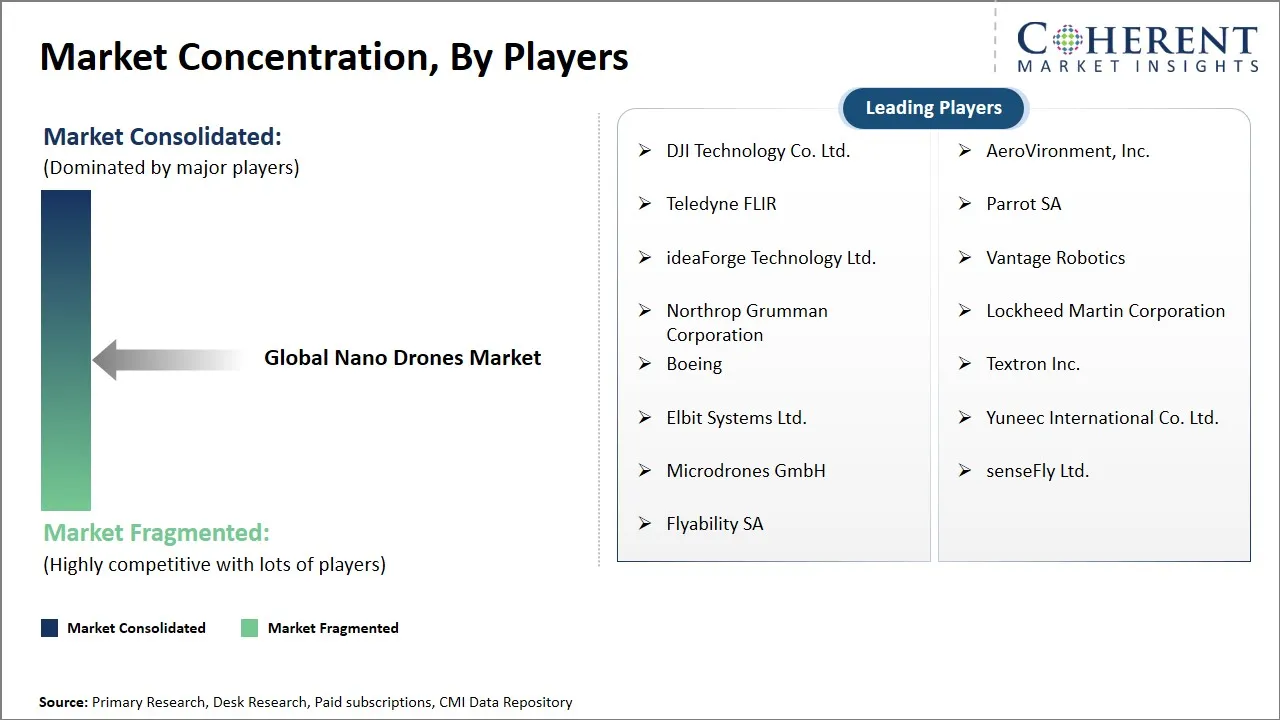
| Companies covered: | DJI Technology Co. Ltd., AeroVironment, Inc., Teledyne FLIR, Parrot SA, ideaForge Technology Ltd., Vantage Robotics, Northrop Grumman Corporation, Lockheed Martin Corporation, Boeing, Textron Inc., Elbit Systems Ltd., Yuneec International Co. Ltd., Microdrones GmbH, senseFly Ltd., and Flyability SA | ||
| Growth Drivers: |
| ||
| Restraints & Challenges: |
| ||
Market Dynamics
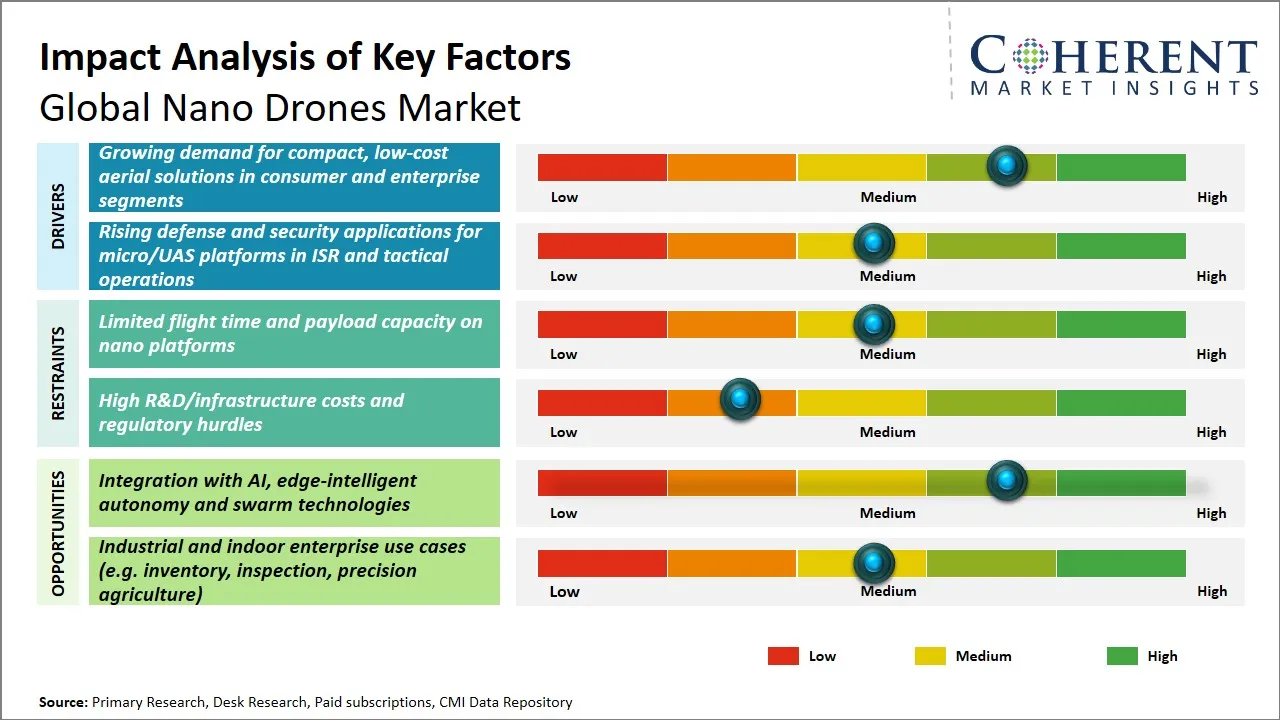
Global Nano Drones Market Driver - Growing Demand for Compact, Low ‑ Cost Aerial Solutions in Consumer and Enterprise Segments
The increasing need for versatile and affordable aerial technologies has significantly propelled the adoption of nano drones across various sectors. Consumers are drawn to nano drones for recreational use, photography, and educational purposes due to their small size, ease of operation, and lower price points compared to larger drones. At the same time, enterprises are leveraging these compact devices for applications such as indoor inspections, inventory management, precision agriculture, and event monitoring, where maneuverability in tight spaces and discreet operation are crucial.
The convergence of advancements in miniaturized sensors, improved battery efficiency, and enhanced flight stability has further enabled nano drones to perform tasks that previously required more complex and expensive equipment. Insta360, a company known for its action cameras, is entering the consumer drone space with a leaked prototype called the “Antigravity Drone” (2025). This ultra-compact, lightweight drone is expected to compete directly with DJI’s mini-series by offering advanced stabilization and cinematic capabilities at a lower price point.
Global Nano Drones Market Opportunity – Integration with AI, Edge ‑ Intelligent Autonomy, and Swarm Technologies
Incorporating AI enables nano drones to perform complex tasks with enhanced precision, including real-time data processing, autonomous navigation, and adaptive decision-making in dynamic environments. Edge-intelligent autonomy further empowers these drones by reducing reliance on centralized cloud computing, allowing rapid, on-device analysis that minimizes latency and improves operational efficiency, especially in remote or communication-constrained areas.
Additionally, swarm technology facilitates coordinated operations among multiple nano drones, enabling applications such as large-area surveillance, search and rescue missions, agricultural monitoring, and military reconnaissance to be conducted more effectively and economically. In 2024, ZenaDrone launched its IQ Nano Drone Series, embedded with AI-powered autonomous navigation, vision-based object recognition, and swarm coordination capabilities.
Analyst Opinion (Expert Opinion)
- The miniaturization of drone hardware combined with AI-powered navigation is unlocking indoor use-cases that were once out of reach. Nano drones are now capable of operating in GPS-denied environments such as warehouses, factories, and office complexes—performing automated inventory scanning, security patrols, and infrastructure inspections. Companies like ZenaDrone and ideaForge are leading this shift by offering edge-intelligent UAVs capable of autonomous flight paths, object recognition, and data relay in real-time, eliminating the need for manual oversight.
- Defense agencies are rapidly deploying nano drones for reconnaissance and situational awareness in hostile or cluttered environments. Their small size makes them ideal for stealth operations and urban combat. The Black Hornet 4 by AeroVironment, now field-tested and integrated into NATO and U.S. units, exemplifies how real-time ISR (Intelligence, Surveillance, Reconnaissance) capabilities in a palm-sized platform are redefining modern infantry tactics—bridging the gap between satellites and soldier-level visibility.
- The integration of swarm intelligence into nano drone systems is evolving from theoretical research to operational testing. Swarms of nano drones working cooperatively can cover wide areas quickly, conduct search-and-rescue missions, or map interior structures after natural disasters. This is particularly relevant for military and disaster response teams. The emergence of AI-based coordination protocols, as seen in ZenaDrone’s IQ Nano Swarm trials, suggests a future where large-scale autonomous drone collectives become central to both civilian and defense operations.
Speak to the analyst
Want personalized insights?
Take the findings above to one of our principal consultants, or have the report rebuilt around the segments, geographies and competitors you actually track.
Market Segmentation
- Type Insights (Revenue, USD Bn, 2021 - 2033)
- Rotor Nano Drones
- Fixed Wing Nano Drones
- Flapping Wing
- Others
- Payload Insights (Revenue, USD Bn, 2021 - 2033)
- Camera
- Control Systems
- Tracking Systems
- Others
- Regional Insights (Revenue, USD Bn, 2021 - 2033)
- North America
- U.S.
- Canada
- Latin America
- Brazil
- Argentina
- Mexico
- Rest of Latin America
- Europe
- Germany
- U.K.
- Spain
- France
- Italy
- Russia
- Rest of Europe
- Asia Pacific
- China
- India
- Japan
- Australia
- South Korea
- ASEAN
- Rest of Asia Pacific
- Middle East
- GCC Countries
- Israel
- Rest of Middle East
- Africa
- South Africa
- North Africa
- Central Africa
- North America
- Key Players Insights
- DJI Technology Co. Ltd.
- AeroVironment, Inc.
- Teledyne FLIR
- Parrot SA
- ideaForge Technology Ltd.
- Vantage Robotics
- Northrop Grumman Corporation
- Lockheed Martin Corporation
- Boeing
- Textron Inc.
- Elbit Systems Ltd.
- Yuneec International Co. Ltd.
- Microdrones GmbH
- senseFly Ltd.
- Flyability SA
Sources
Primary Research Interviews
Stakeholders
- UAV Systems Engineers and Designers (e.g., R&D leads from drone companies)
- Military Procurement Officials (e.g., U.S. DoD, Indian MoD)
- Consumer Drone Retailers and Distributors
- Drone Manufacturing Firms
- Commercial Drone Users (e.g., warehouse automation heads, telecom site managers)
- AI and Edge-Computing Integration Experts
Databases
- FAA UAS Data Exchange
- Ministry of Electronics and Information Technology (India)
- Open Skies Database (UK CAA)
- UN Office for Disarmament Affairs (UAV Reports)
- Global Unmanned Aerial Systems Inventory
- Commercial Drone Flight Logs (GovData DE)
Magazines
- UAV Digest
- Drone Industry Today
- Defense Tech Weekly
- Aerospace & Robotics Review
- Digital Surveillance & Mobility Magazine
- DroneTech Asia-Pacific Journal
Journals
- Journal of Autonomous Vehicle Systems
- International Journal of Robotics & UAV Applications
- Journal of Military Technology and Innovation
- UAV Operations & Engineering Journal
- Journal of Edge Computing and Swarm Intelligence
Newspapers
- DefensePost Global
- The Asia-Pacific Defense Review
- Unmanned Systems Times
- The Washington Tech Gazette
- Tech Chronicle (Singapore)
- Drone Frontier News
Associations
- International Association for Autonomous Systems (IAAS)
- Drone Federation of India (DFI)
- Unmanned Aerial Systems International (UASI)
- U.S. Small Drone Manufacturers Alliance (USDMA)
- Asia-Pacific Drone Innovation Council (APDIC)
Public Domain Sources
- U.S. Federal Aviation Administration (FAA)
- EUROSTAT
- Indian Directorate General of Civil Aviation (DGCA)
- United Nations Institute for Disarmament Research (UNIDIR)
- World Bank Open Data
- ResearchGate
Proprietary Elements
- CMI Data Analytics Tool, Proprietary CMI Existing Repository of information for last 8 years
Get access to 250+ pages report
Every segment, forecast, competitor profile and data table behind the analysis above — available for instant download.
- ESOMAR Member
- ISO 9001:2015 Certified
- D-U-N-S Registered
- GDPR & CCPA Compliant
Missing comfort of reading report in your local language? Find your preferred language:
Transform your Strategy with Exclusive Trending Reports
Frequently Asked Questions
The global nano drones market is estimated to be valued at USD 3.56 billion in 2026 and is expected to reach USD 14.01 billion by 2033.
The CAGR of global nano drones market is projected to be 21.6% from 2026 to 2033.
Growing demand for compact, low‑cost aerial solutions in consumer and enterprise segments and rising defense and security applications for micro/UAS platforms in ISR and tactical operations are the major factors driving the growth of global nano drones market.
Limited flight time and payload capacity on nano platforms and high R&D/infrastructure costs and regulatory hurdles are the major factors hampering the growth of global nano drones market.
In terms of Type, Rotor Nano Drones are estimated to dominate the market revenue share in 2026.
Nano drones are compact unmanned aerial vehicles (UAVs), typically under 250 grams, designed for tasks like surveillance, inspection, and reconnaissance in tight or GPS-denied environments.
Key adopters include defense and security forces, logistics and warehouse operators, infrastructure inspection firms, and consumer tech enthusiasts.