

North America Greywater Recycling System Market Size and Forecast – 2026 To 2033
The North America greywater recycling system market is expected to grow from USD 1,081.8 Mn in 2026 to USD 2,030.4 Mn by 2033, registering a compound annual growth rate (CAGR) of 9.4% from 2026 to 2033. The North America greywater recycling system market is driven by increasing introduction of stringent municipal water conservation regulations. On April 23, 2026, California’s regulations for onsite treatment and reuse of nonpotable water became effective, establishing risk-based water quality requirements for onsite reuse in multifamily residential, commercial and mixed-use buildings.
Key Takeaways of the North America Greywater Recycling System Market
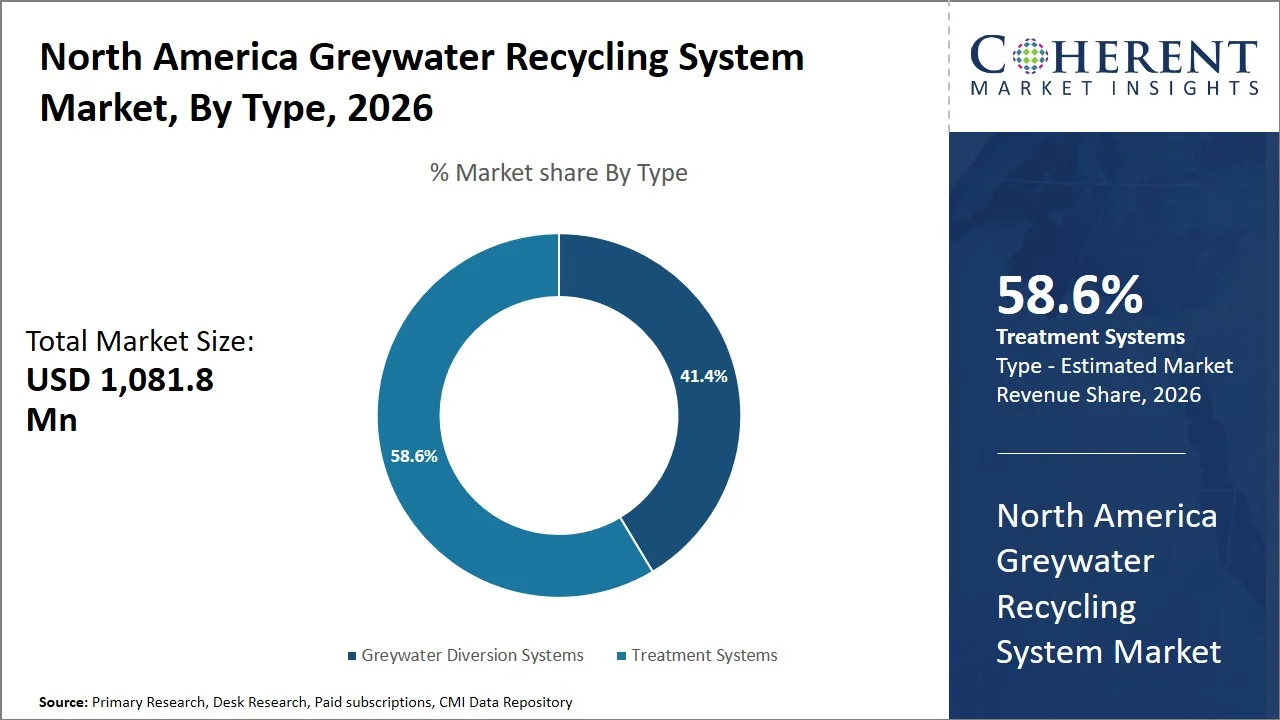
- The Treatment Systems segment is expected to account for 58.6 % of the North America greywater recycling system market share in 2026. Growing commercial and residential demand for water reuse is driving the growth of the segment. In February 2026, Ecovie announced that its commercial greywater recycling system had achieved NSF/ANSI 350C certification, positioning the company as the only U S provider it identified as offering a commercial greywater system with this certification at the time of the announcement.
- The Small Scale Systems (< 5,000 liters/day) segment is estimated to capture 47.7 % of the market share in 2026. Expansion of smart water management technologies is majorly driving the growth of the segment. On March 24, 2025, Badger Meter’s ORION Cellular endpoint became the first smart water device certified under Ericsson and CTIA’s IoT Network Certified for Smart Connected Infrastructure program.
- The Modular Expandable Systems segment is estimated to capture 56.6 % of the market share in 2026. Increasing investment in sustainable commercial infrastructure is driving the growth of the segment. On October 7, 2025, CBRE partnered with Ecolab to improve water efficiency and water quality across commercial real estate properties, with the initiative targeting sectors such as data centers, life sciences and advanced manufacturing.
Segmental Insights
Why Does Treatment Systems Dominate the North America Greywater Recycling System Market?
The treatment systems segment is expected to account for 58.6% of the North America greywater recycling system market share in 2026. Treatment systems are leading the greywater recycling systems market due to importance of turning wastewater from showers, sinks and laundry into water that can be properly reused for uses such as toilet flushing and landscape irrigation. Increasing emphasis on water conservation, stricter water quality regulations and wider usage of decentralized water reuse systems are motivating building owners and developers to concentrate on reliable treatment methods. Advanced filtration, biological treatment and disinfection systems are an essential part of greywater recycling installations in residential, commercial and institutional buildings and provide enhanced water quality and operational reliability. On March 17, 2025, Hydraloop launched the Hydraloop Upfall Shower at ISH 2025, the world’s biggest trade expo for HVAC and water. This revolutionary circular shower technology provides a high-flow comfort shower while reducing shower water and energy consumption by up to 80%, a big step forward in sustainable water solutions.
- Current Industry Events of 2026
- Market Size Estimation
- Regional Breakdown
- Competitive Landscape
- Customer Intelligence
- Segmental Analysis
- Pricing Analysis
- Key Market Drivers, Challenges & Future Trends
- Customized Insights Section
Why is Small Scale Systems (< 5,000 liters/day) the Most Preferred System Capacity?
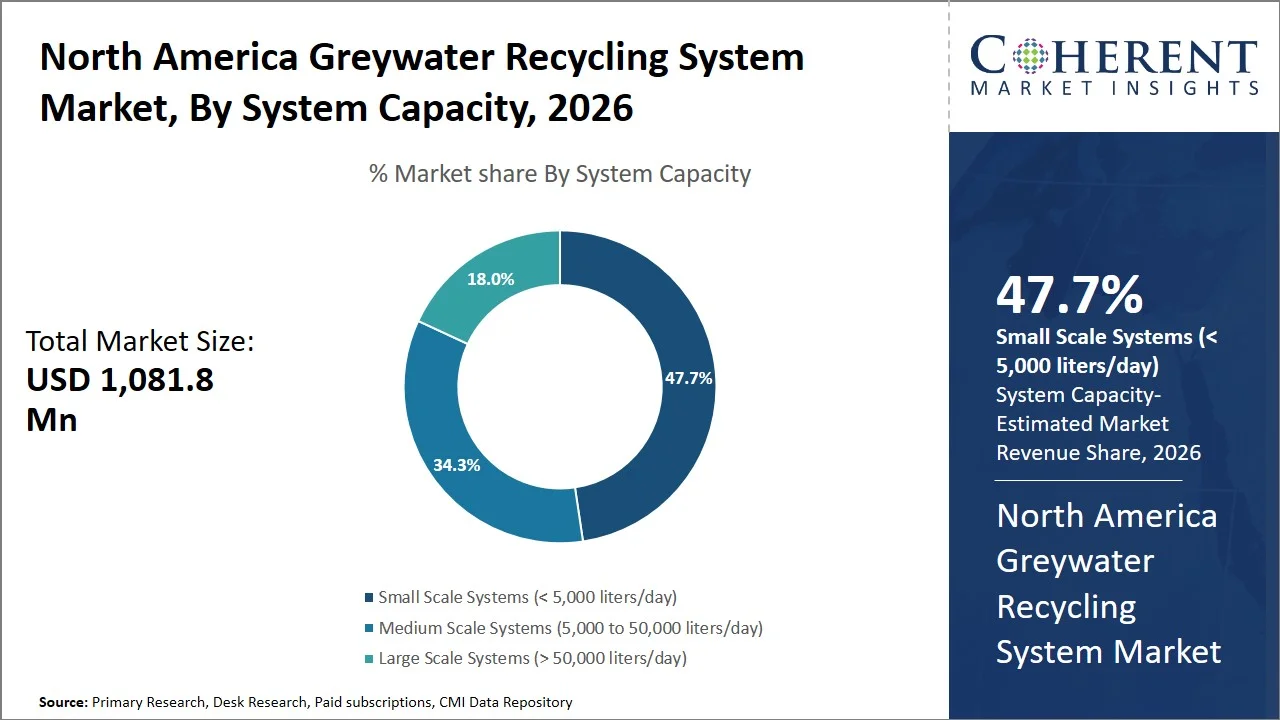
The small scale systems (< 5,000 liters/day) segment is expected to account for 47.7% of the North America greywater recycling system market share in 2026. Small scale systems of less than 5,000 liters per day capacity are chosen since they can handle the relatively low greywater generation volumes of residential buildings, small commercial properties, hotels and institutional facilities without the need for costly infrastructure. Their compact design typically requires less installation area, less pumping and easier plumbing arrangements than bigger systems. This makes them well suited for decentralized water reuse projects and building-level applications. The range of capacity also allows more flexibility in integrating greywater treatment into new construction and certain retrofit projects where space and wastewater volumes are constrained. For instance, Dehoust provides GWR and GWM systems with submerged ultrafiltration for quantities from 300 to 3,000 liters per day, especially for private residential development. The company highlights reuse for toilet flushing, laundry, cleaning and garden irrigation, demonstrating continued development of treatment systems below the 5,000-liter-per-day threshold.
Modular Expandable Systems Dominates the North America Greywater Recycling System Market
The modular expandable systems segment is expected to account for 56.6% of the North America greywater recycling system market share in 2026. Modular expandable systems are increasingly preferred because they allow building owners and developers to increase greywater treatment capacity as water demand and building occupancy grow without replacing the entire installation. Their modular design allows for the installation of further treatment modules, storage units and processing capacity to existing systems, rendering them ideal for residential complexes, hotels, commercial buildings and institutional facilities with shifting demands. This scalability can also help with project planning as it can allow the capacity to be grown over time minimizing the requirement for a large initial installation and helping long term water reuse techniques. On July 6, 2026, Hydraloop introduced a configuration combining its Cascade system with a post-treatment unit that adds buffer storage, boosting and residual disinfection for higher-demand developments.
Current Events and their Impact
Current Events | Description and its Impact |
Washington State Greywater Reuse Rule |
|
British Columbia Building And Plumbing Requirements For Greywater Reuse |
|
North America Greywater Recycling System Market Dynamics
Market Drivers
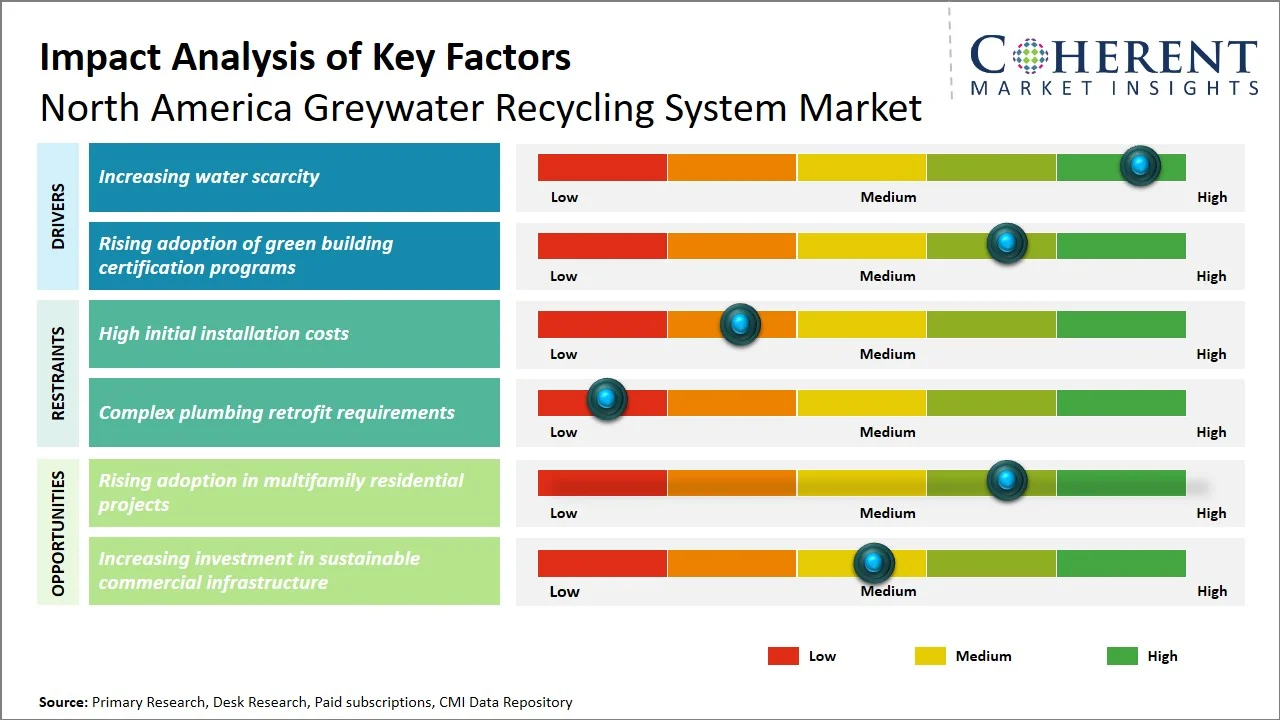
- Increasing Water Scarcity: Increasing water scarcity in some parts of North America is prompting residential, commercial and institutional establishments to use greywater recycling systems as an alternate water management solution. Drought conditions and pressure on municipal water supplies in water-stressed areas are particularly increasing the need to reduce the consumption of potable water. Greywater recycling allows for the reuse of treated wastewater from showers, sinks and laundry operations for toilet flushing, irrigation and other non-potable applications. This helps building operators to lower the demand for fresh water and to make better use of the water resources available. On January 23, 2025, H2O innovation announced that it has opened a 9,600-square-foot WaterHub facility at the University of Texas at Austin designed to treat and reuse wastewater onsite and reduce the university’s reliance on potable water by around 40%.
- Rising Adoption Of Green Building Certification Programs: Increase in adoption of green building certification programs is driving developers and building owners to integrate greywater recycling into sustainable building designs. Certification frameworks are increasingly emphasizing water efficiency, conservation and responsible resource management. This provides incentives to projects to incorporate technology that reduce potable water usage and wastewater output. Hence, residential complexes, commercial buildings, hotels, educational facilities and institutional projects aiming at improved environmental performance and certification outcomes are incorporating greywater recycling systems. On April 9, 2026, Kilroy Realty announced that 70% of its portfolio was LEED certified, 59% was ENERGY STAR certified and 48% was Fitwel certified in 2025, with a goal of achieving 85% LEED certification by 2030.
Emerging Trends
- Integration of smart monitoring and automation: Greywater recycling systems are increasingly incorporating sensors, automated controls, and remote monitoring capabilities to monitor flow rates, water quality, tank levels, and equipment performance for more efficient operation and reducing the need for manual intervention.
- Growing adoption of modular and scalable systems: Manufacturers are developing modular treatment configurations that can accommodate additional filtration, disinfection and storage capacity as building occupancy and water reuse needs grow, making these systems particularly appropriate for multifamily housing, hotels and commercial facilities.
- Expansion of decentralized water reuse solutions: Building owners and developers are increasingly implementing onsite greywater treatment to reduce reliance on centralized water supplies and water treatment infrastructure, especially in areas suffering from drought, water supply constraints or increased water utility costs.
- Development of compact and advanced treatment technologies: A growing emphasis on compact systems that employ membrane filtration, biological treatment, ultraviolet disinfection and automated water quality controls to enable greywater recycling in buildings with limited available installation space, whilst still ensuring consistent treatment performance.
North America Greywater Recycling System Market - Treatment Technology Adoption (2025)
Treatment Technology | Estimated Adoption Share |
Biological treatment | 31% |
Membrane filtration | 27% |
Physical filtration | 20% |
UV disinfection | 14% |
Chemical disinfection | 8% |
How is Rising Adoption In Multifamily Residential Projects Creating New Growth Opportunities in the North America Greywater Recycling System Market?
Rising adoption in multifamily residential projects is creating growth opportunities because a single greywater recycling installation can capture wastewater from multiple apartments and redirect it toward common-area toilet flushing, landscape irrigation and other non-potable requirements. Developers of high-density apartment complexes can therefore achieve greater water reuse from centralized systems than would typically be possible through individual household installations, while modular treatment configurations allow capacity to be matched with the number of dwelling units and expanded as properties grow. The opportunity is particularly relevant for new multifamily developments in water-stressed areas, where dedicated plumbing can be incorporated during construction, reducing the complexity and cost associated with retrofitting existing buildings. On December 11, 2024, Epic Cleantec announced it will install their OneWater system at Kuilei Place, a 43-story, 1,005 unit multi-family residential building in Honolulu. The system is meant to recycle up to 8.5 million gallons of greywater yearly for toilet flushing and landscape irrigation, and it demonstrates how huge residential projects are becoming major applications for centralized onsite water reuse.
Market Players, Key Development, and Competitive Landscape
Key Developments
- On February 26, 2025, Hansgrohe Group partnered with Hydraloop to launch an advanced greywater recycling system. This system is an integral component of Hansgrohe's broader water-conscious bathroom concept. Hydraloop’s treatment technology also ties in with bathroom water management, an indication of a shift to integrate greywater recycling into bathroom and building infrastructure directly, rather than as a separate equipment installation.
- On November 21, 2024, Epic Cleantec completed its Series B investment round of USD 12 million. This investment will enable Epic to accelerate the deployment of its industry-leading water reuse and resource recovery solutions across a growing portfolio of projects, making Epic one of the fastest growing providers of water reuse systems for commercial and residential real estate in the world.
Competitive Landscape
The North America greywater recycling system market is becoming increasingly focused on modular treatment, compact installation and digital monitoring, with Hydraloop representing a notable technology-focused player through its H300, H600 and Cascade product portfolio. The company is targeting apartments, multifamily buildings, hotels and other larger facilities by combining biological and physical treatment with UV disinfection and internet-connected monitoring, while its Cascade architecture allows multiple H600 units to be configured for larger projects. Hydraloop has also developed recycle-ready installation guidance that specifically addresses dedicated greywater drainage, overflow connections and remote monitoring requirements, indicating a strategy centered on making its systems easier to incorporate into new construction and renovation projects.
Market Report Scope
North America Greywater Recycling System Market Report Coverage
| Report Coverage | Details | ||
|---|---|---|---|
| Base Year: | 2025 | Market Size in 2026: | USD 1,081.8 Mn |
| Historical Data for: | 2020 To 2024 | Forecast Period: | 2026 To 2033 |
| Forecast Period 2026 to 2033 CAGR: | 9.4% | 2033 Value Projection: | USD 2,030.4 Mn |
| Segments covered: |
| ||
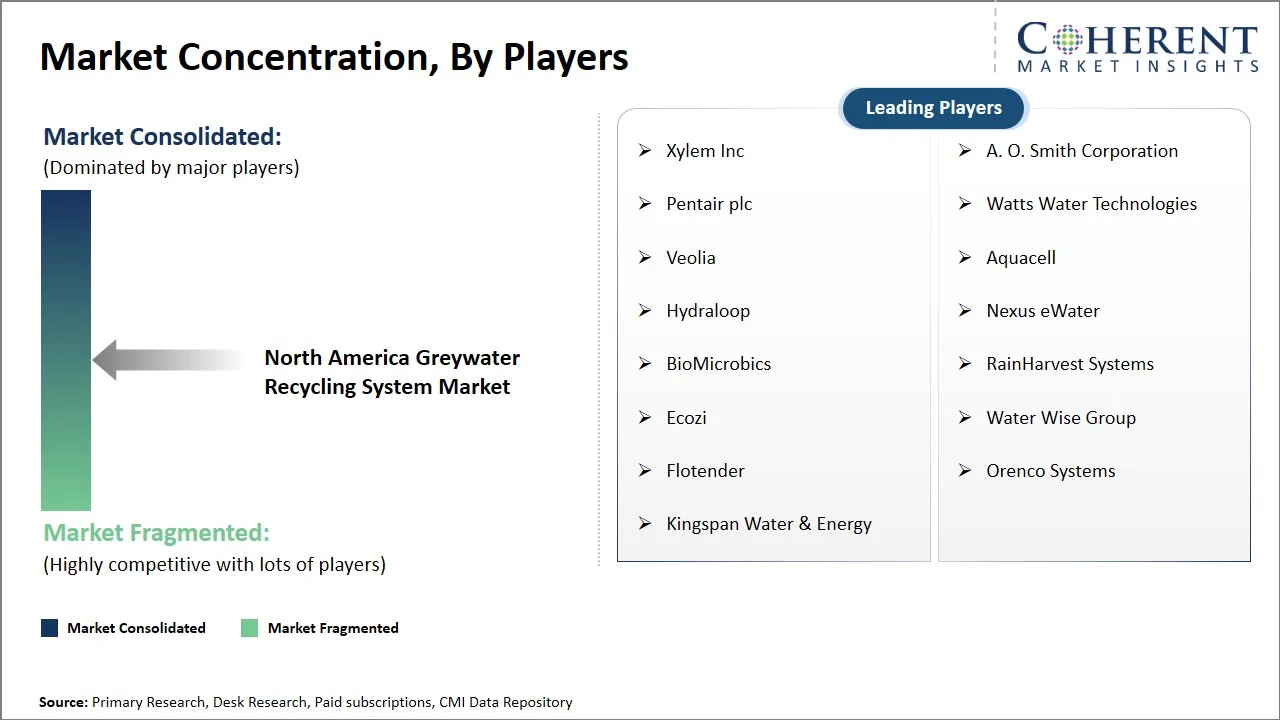
| Companies covered: | Xylem Inc, A. O. Smith Corporation, Pentair plc, Watts Water Technologies, Veolia, Aquacell, Hydraloop, Nexus eWater, BioMicrobics, RainHarvest Systems, Ecozi, Water Wise Group, Flotender, Orenco Systems, Kingspan Water & Energy | ||
| Growth Drivers: |
| ||
| Restraints & Challenges: |
| ||
Analyst Opinion (Expert Opinion)
- The future of the industry is expected to move toward building-level water recycling rather than isolated household systems, particularly where new construction allows dedicated greywater plumbing to be incorporated from the design stage. Multifamily residential buildings, student housing and hospitality properties are likely to represent strong opportunities because several units or rooms can feed a centralized treatment system, improving the utilization of recycling equipment and creating a clearer business case for developers.
- The strongest opportunity is expected in modular greywater recycling systems for multifamily residential and hospitality applications in water-stressed U.S. states, particularly projects where separate greywater collection infrastructure can be incorporated during construction. Systems capable of scaling through additional treatment modules, such as Hydraloop's Cascade configuration, are well positioned for these applications because capacity can be matched to project requirements rather than requiring a completely different system for each building size.
- To gain an edge, market players should focus on reducing installation complexity rather than competing only on treatment performance. Manufacturers that combine compact equipment, standardized plumbing requirements, remote diagnostics, certification for North American applications and modular capacity expansion can address several of the practical barriers faced by developers, while partnerships with multifamily developers, architects, plumbing contractors and green-building specialists can help incorporate greywater recycling at the design stage instead of attempting costly retrofits later. Hydraloop's emphasis on recycle-ready plumbing guidance and connected system monitoring illustrates this direction.
Speak to the analyst
Want personalized insights?
Take the findings above to one of our principal consultants, or have the report rebuilt around the segments, geographies and competitors you actually track.
Market Segmentation
- Type Insights (Revenue, USD Million, 2021 - 2033)
- Greywater Diversion Systems
- Treatment Systems
- Conventional Biological Treatment Systems
- Membrane Bioreactor Based Systems
- Physical Chemical Only Treatment Systems
- Advanced Multi Stage Treatment Systems (Hybrid)
- System Capacity Insights (Revenue, USD Million, 2021 - 2033)
- Small Scale Systems (< 5,000 liters/day)
- Medium Scale Systems (5,000 to 50,000 liters/day)
- Large Scale Systems (> 50,000 liters/day)
- Modularity and Scalability Insights (Revenue, USD Million, 2021 - 2033)
- Fixed Capacity Systems
- Modular Expandable Systems
- Application Insights (Revenue, USD Million, 2021 - 2033)
- Toilet flushing & non-potable services
- Landscape irrigation & landscaping supply
- Cooling & utility reuse
- Cleaning (laundry, vehicle washing, general)
- Industrial & auxiliary reuse
- Agricultural irrigation
- Others (fire protection, decorative, construction)
- Installation Type Insights (Revenue, USD Million, 2021 - 2033)
- New Construction
- Retrofit/Existing Buildings
- End User Insights (Revenue, USD Million, 2021 - 2033)
- Residential
- Commercial
- Hospitality (Hotels, Resorts, Water Parks, Pools, etc.)
- Offices & Retail Complexes
- Educational Institutions
- Others (Airports & Transportation Facilities, etc.)
- Public & Municipal
- Community Housing / Public Buildings
- City / Utility Infrastructure
- Others (Parks & Recreational Facilities, Community Housing, etc.)
- Industrial
- Oil & Gas
- Power Generation
- Chemical & Petrochemical
- Manufacturing (General)
- Others (Food & Beverage, Pharmaceutical, etc.)
- Key Players Insights
- Xylem Inc
- O. Smith Corporation
- Pentair plc
- Watts Water Technologies
- Veolia
- Aquacell
- Hydraloop
- Nexus eWater
- BioMicrobics
- RainHarvest Systems
- Ecozi
- Water Wise Group
- Flotender
- Orenco Systems
- Kingspan Water & Energy
Sources
Primary Research Interviews
- Greywater System Manufacturers and Technology Providers
- Municipal Water Utility Executives and Water Conservation Managers
Magazines
- Water Environment & Technology
- Treatment Plant Operator
Journals
- Journal of Environmental Management
- Environmental Science & Technology
- Resources, Conservation and Recycling
Associations
- Water Research Foundation
- American Water Works Association
Public Domain Sources
- U.S. Environmental Protection Agency
- U.S. Bureau of Reclamation
Proprietary Elements
- CMI Data Analytics Tool
- Proprietary CMI Existing Repository of Information for the Last 10 Years
Get access to 250+ pages report
Every segment, forecast, competitor profile and data table behind the analysis above — available for instant download.
- ESOMAR Member
- ISO 9001:2015 Certified
- D-U-N-S Registered
- GDPR & CCPA Compliant
Missing comfort of reading report in your local language? Find your preferred language:
Transform your Strategy with Exclusive Trending Reports
Frequently Asked Questions
The North America greywater recycling system market is expected to stand at USD 1,081.8 Mn in 2026 and is expected to reach USD 2,030.4 Mn by 2033.
The CAGR of the North America greywater recycling system market is projected to be 9.4% from 2026 to 2033.
Green building programs encourage water-efficiency measures that can increase the incorporation of greywater recycling into sustainable construction projects.
Advanced filtration combined with biological treatment and disinfection is gaining importance because it enables more consistent treatment performance in building-level applications.
Decentralized systems allow wastewater to be treated and reused close to its point of generation, reducing reliance on centralized water supplies for selected applications.
Sensors, automated controls and remote monitoring are improving system management by providing real-time information on water quality, flow and equipment performance.
Increasing water scarcity and rising adoption of green building certification programs are the major factors driving the growth of the North America greywater recycling system market.