

Global Water Treatment Technology Market Size and Forecast – 2026 To 2033
The global water treatment technology market is expected to grow from USD 47.25 Bn in 2026 to USD 89.50 Bn by 2033, registering a compound annual growth rate (CAGR) of 9% from 2026 to 2033. The global water treatment technology market is primarily driven by growing concerns regarding water treatment and health security.
For instance, on April 21, 2026, legal action was initiated by the U.S. Justice Department toward Washington, D.C., alongside its water and sewer authority, due to an incident involving a pipeline failure. Resulting from this breach, vast quantities of untreated waste entered the Potomac River. Financial sanctions are now being pursued as part of the response. The complaint stems from a massive leak in a 72-inch pipeline, called the Potomac Interceptor.
Key Takeaways of the Global Water Treatment Technology Market
- The membrane filtration segment is expected to account for 36.1% of the global water treatment technology market share in 2026. Adoption of digital solutions is a major driver for the growth of the segment. In May 2025, Hyderabad’s water authority introduced an intelligent auditing setup relying on internet-connected flow sensors along with self-regulating valves. (Source: Times of India)
- The primary treatment segment is estimated to capture 34.3% of the market share in 2026. The increasing need for industrial water treatment is a driver for primary treatment segment. In 2024, a shift occurred at Tata Steel’s Ferro Alloys and Minerals Division when it joined forces with FluxGen Sustainable Technologies from Bangalore. The partnership transformed existing pipelines into digitally monitored circuits using remote feedback loops. (Source: TATASteel)
- The Point-of-Use (POU) segment is projected to hold 42.4% of the global water treatment technology market share in 2026. The demand for POU is driven by the constant need for safe drinking water. On May 4, 2026, an article by Times of India highlighted a severe drinking water shortage in Kazhakkoottam and Technopark has disrupted daily life for residents and IT professionals, with many now relying on tanker supply for survival. With the onset of summer, around 50 tanker lorries are currently deployed to meet the needs of Technopark, which houses nearly 490 companies. (Source: Times of India)
- Asia Pacific is expected to dominate the global water treatment technology market in 2026 with a market share of 35.9%. The growing pressure on urban water supplies to accommodate increasing population is a major growth factor. In November 2025, the Delhi Jal Board (DJB) and IIT Kanpur signed a Memorandum of Understanding to develop India’s first AI-enabled water management system. (Source: IITKanpur)
- North America is expected to account for 28.9% share in 2026 and is projected to record the fastest growth over the forecast period. Constant upgrading of water networks is a major factor for the regional market. On August 18, 2025, Verizon, in collaboration with Chicago's Center for Neighborhood Technology and a Michigan-based startup, equipped the city of Chicago, U.S., with technology that will give officials and residents the ability to track urban flooding in real time. (Source: PhysOrg)
- Treatment of Municipal Water Supply: Water systems in cities grow smarter when digital tools track usage through connected devices. Owing to problems like leaks show up faster, fixes happen sooner. Real-time data guides how water moves across neighborhoods.
- Use of Water Treatment Technology in Industrial Manufacturing: Water use gets monitored automatically across sectors like steel, power, or chemical production through intelligent control setups. This networking reuses discharged fluids, adjusting how cooling and manufacturing steps function over time.
Segmental Insights
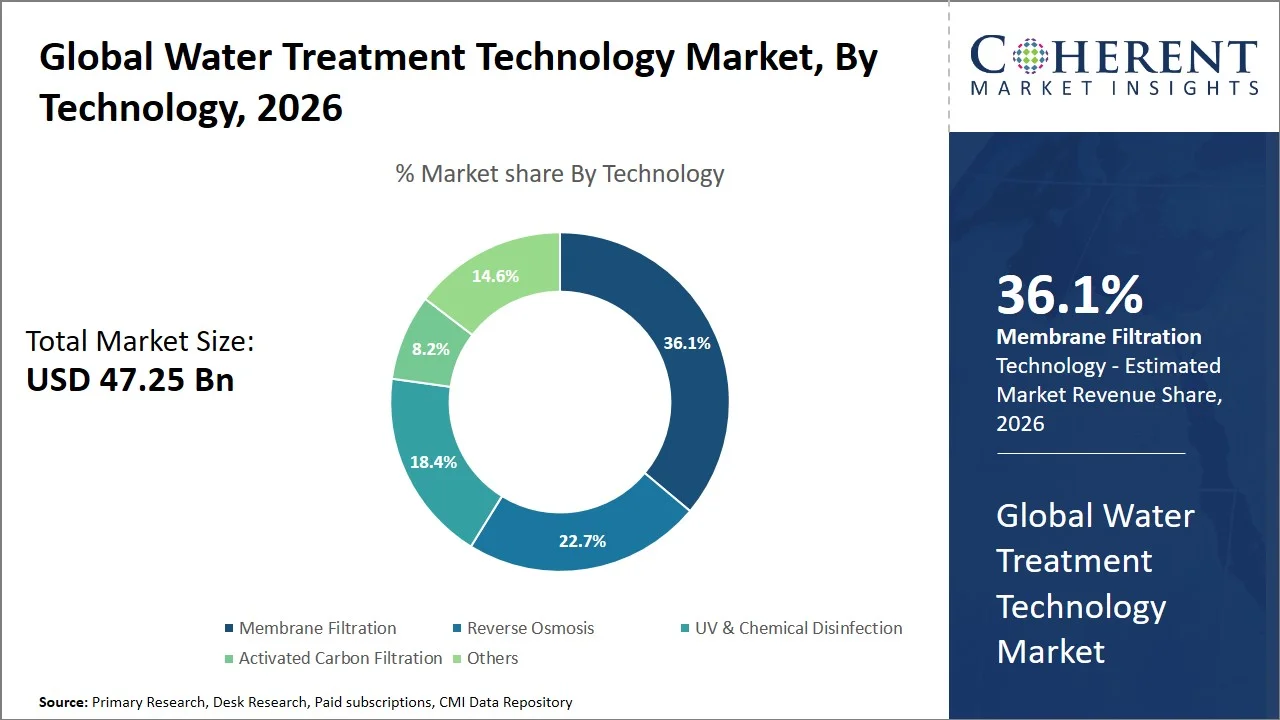
Why Does the Membrane Filtration Segment Dominate the Global Water Treatment Technology Market?
The membrane filtration segment is expected to account for 36.1% of the global water treatment technology market share in 2026. The increasing need of digital solutions has provided an impetus for membrane filtration. Moreover, the integration of smart meters with membrane filtration sensors are also gaining importance steadily. On December 12, 2025, SUEZ reported that it has registered 7 million meters connected worldwide and over 1,500 customers using its Smart Water systems and platforms. From leak detection and breakdown prediction to intervention prioritization, AI brings a new level of responsiveness to increasingly demanding networks and strained resources. (Source: SUEZ)
- Current Industry Events of 2026
- Market Size Estimation
- Regional Breakdown
- Competitive Landscape
- Customer Intelligence
- Segmental Analysis
- Pricing Analysis
- Key Market Drivers, Challenges & Future Trends
- Customized Insights Section
Why is Primary Treatment the Most Preferred Process Type?
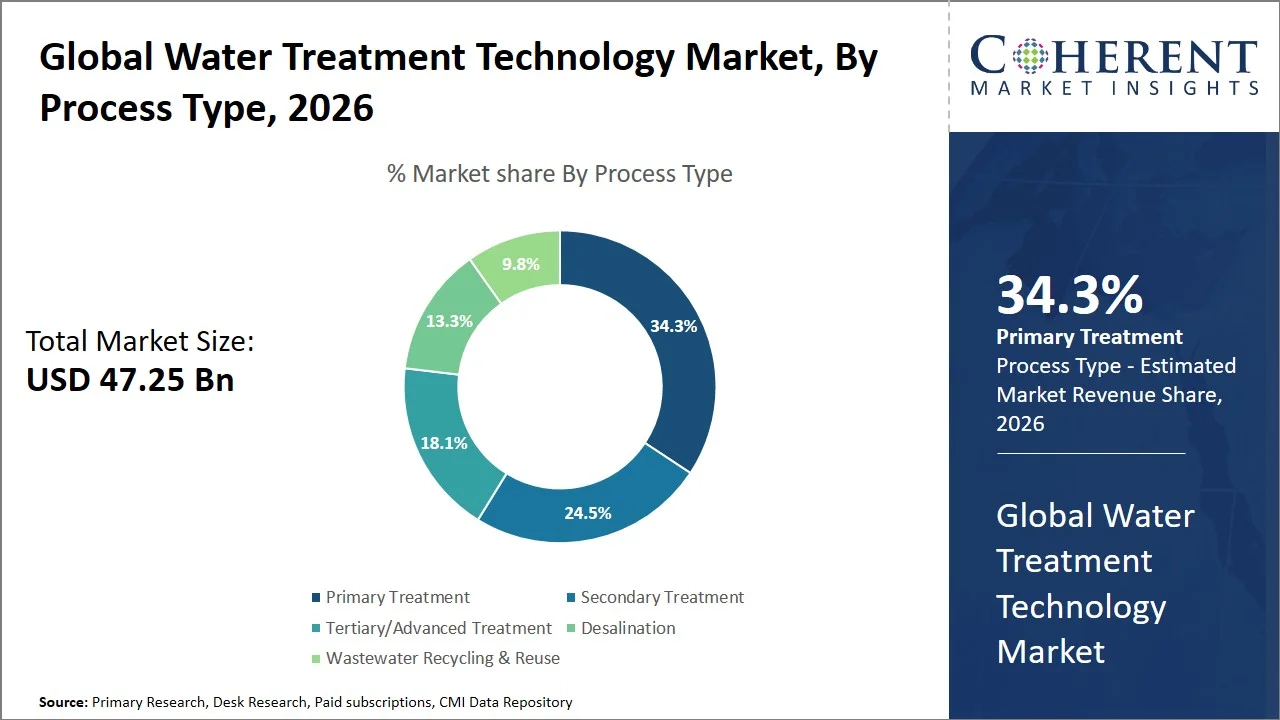
The primary treatment segment is expected to account for 34.3% of the global water treatment technology market share in 2026. The growing requirement for treating industrial wastewater is mainly driving the need for primary treatment. Heavy operations like steel production, energy generation, electricity plants, and chemical factories require vast amounts of water. Owing to this demand, oversight becomes essential. On July 31, 2024, as part of its GreenUp strategic plan, Veolia expanded its leading Hubgrade portfolio by launching Hubgrade Water Footprint, an innovative digital solution designed to help industries reduce their water footprint, water-related energy use, and greenhouse gas emissions. (Source: Veolia)
Point-of-Use (POU) Segment Dominates the Global Water Treatment Technology Market
The Point-of-Use (POU) segment is expected to account for 42.4% of the global water treatment technology market share in 2026. The ever-growing need of fresh and clean drinking water is a major factor driving the growth of the segment. On May 4, 2026, a report by Times of India highlighted that almost 89,000 people in rural Pune, India, solely depend on water tankers for supply of drinking water. According to data from the Zilla Parishad (ZP) administration, tankers currently supply drinking water to 256 hamlets across 50 villages in the tehsils of Purandar, Bhor, Haveli, Khed, Ambegaon, Junnar, and Shirur. Ambegaon has emerged the worst-affected region, followed by Junnar and Khed, where groundwater levels have plummeted due to soaring temperatures and depleting natural sources. (Source: Times of India)
Currents Events and their Impact
Current Events | Description and its Impact |
Water Purification System (Regulation of Use) Rules, 2023 |
|
Water (Prevention and Control of Pollution) Amendment Act, 2024 |
|
Global Water Treatment Technology Market Dynamics
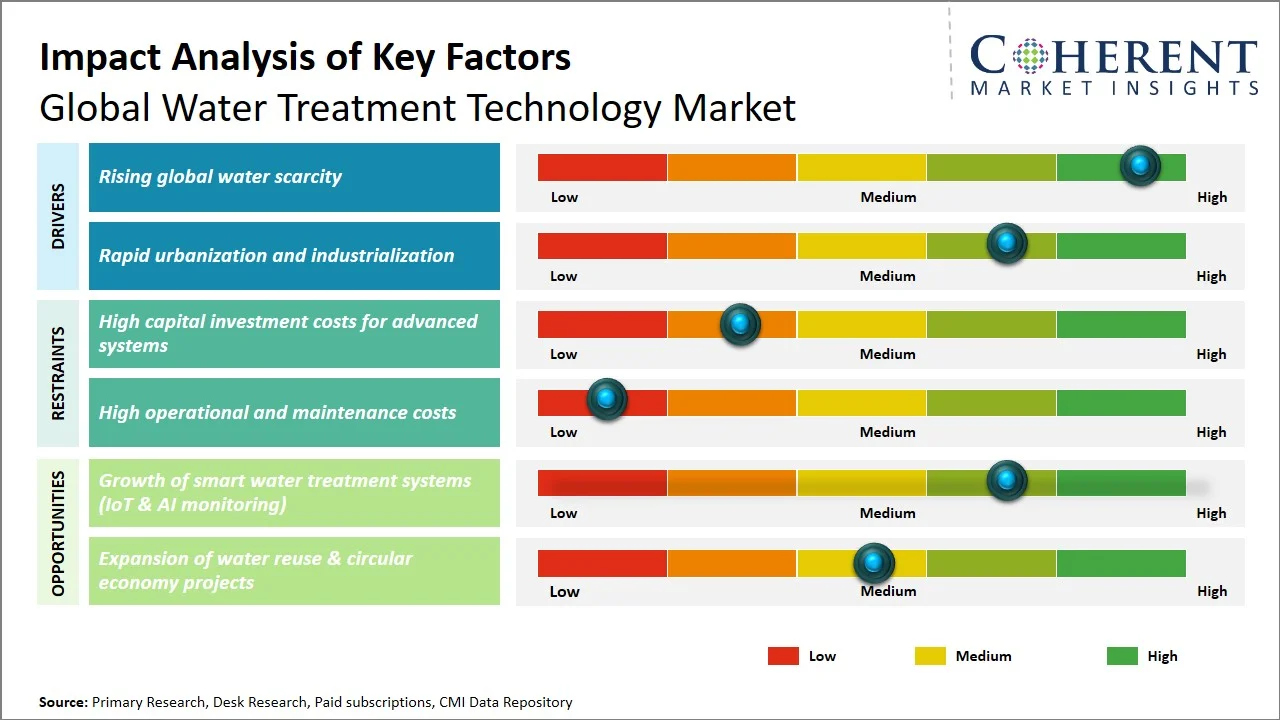
Market Drivers
- Rising global water scarcity: Rising global water scarcity is a major driver of the water treatment technology market, as increasing population, urbanization, climate change, and industrial demand are putting pressure on limited freshwater resources; governments and organizations such as United Nations highlight growing water stress worldwide, which is accelerating investments in desalination, wastewater recycling, and advanced purification technologies to ensure sustainable and reliable water supply. On April 30, 2026, NPR reported that Corpus Christi, just off the Gulf of Mexico, is facing an unprecedented water shortage after years of drought made worse by climate change. The city has already restricted water use for more than a year. Lawn watering is banned, and washing cars or watering plants at home is restricted to a specific "watering day.”
- Rapid urbanization and industrialization: Rapid urbanization and industrialization are key drivers of the water treatment technology market, as expanding cities and growing industrial activities significantly increase water consumption and wastewater generation; this rising pressure on water infrastructure, especially in fast-developing economies like India and China, is forcing governments and industries to invest in advanced treatment, recycling, and pollution control technologies to ensure sustainable water management. On May 2, 2026, MYCELX Technologies began deploying specialized water treatment systems in the Permian Basin, to manage produced water and boost oil recovery efforts. The technology uses a unique polymer to bond hydrocarbons without chemical additives or emissions. (Source: MRT)
Emerging Trends
- Shift toward water reuse and zero liquid discharge (ZLD): Industries are increasingly adopting advanced treatment systems such as membrane filtration and evaporation to recycle wastewater and achieve minimal or zero discharge, driven by stricter regulations and water scarcity, which is accelerating demand for high-efficiency, closed-loop water management solutions.
- Integration of smart and digital water technologies: The adoption of IoT, AI, and real-time monitoring systems by companies like Xylem Inc. and Veolia is enabling predictive maintenance, optimized treatment processes, and reduced operational costs, transforming traditional water treatment into data-driven, automated systems.
Regional Insights
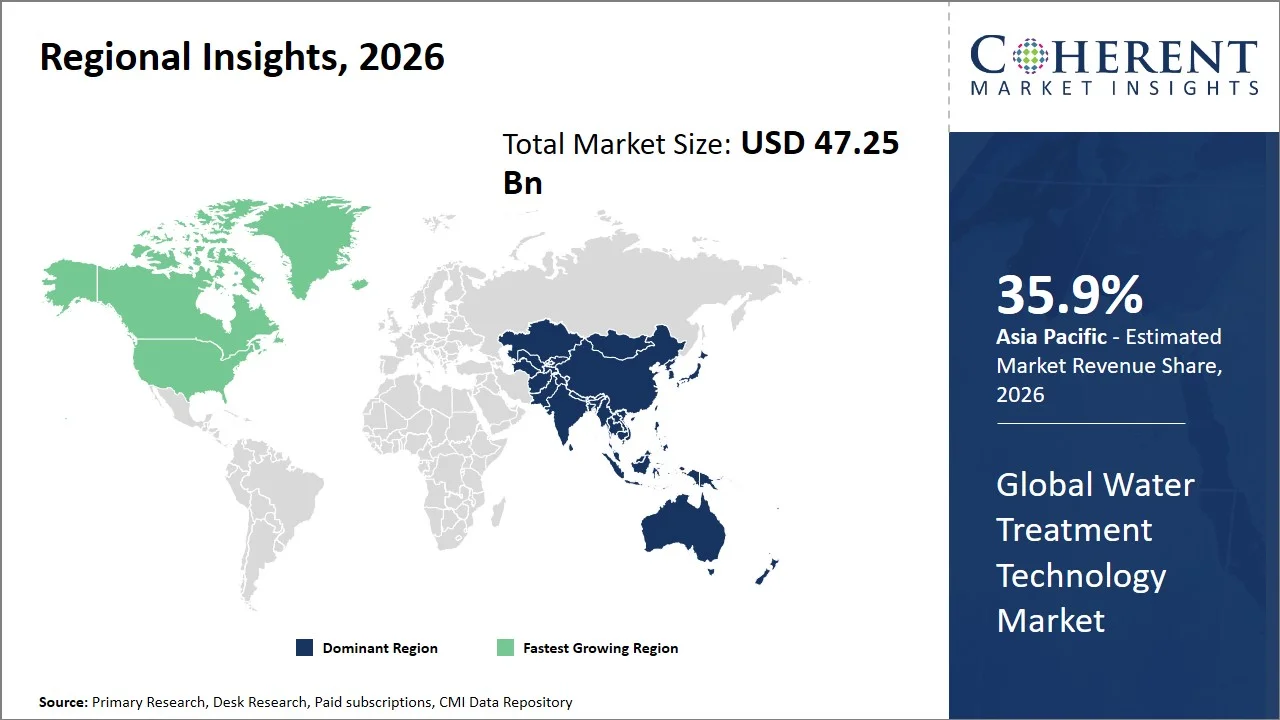
Why is Asia Pacific a Strong Market for Water Treatment Technology?
Asia Pacific is expected to account for a market share of 35.9% in 2026. Across Asia Pacific, real-time analytics shape water treatment technology adoption in clear ways. Asia Pacific is a strong market for water treatment technology due to its rapid urbanization, industrial expansion, and severe water stress across countries like India and China, where rising population and manufacturing activity are significantly increasing water demand and wastewater generation; coupled with tightening government regulations and large-scale investments in infrastructure, this is driving widespread adoption of advanced treatment, desalination, and water reuse solutions across the region.
In March 2025, the GSMA in partnership with the WASH Innovation Hub at the Administrative Staff College of India, convened the Digital Urban Utilities Forum (DUUF) in response to Bengaluru’s escalating water crisis, bringing together water sector experts, ecosystem enablers and startups, to explore digital innovations for sustainable solutions to the city’s water challenges. The forum’s discussions centered on emerging technology solutions from AI-driven groundwater monitoring and IoT-enabled borewell management to smart metering and water reuse. (Source: GSMA)
Why Does North America Water Treatment Technology Market Exhibit High Growth?
North America is expected to account for a market share of 28.9% in 2026 and is expected to register the fastest growth rate over the forecast period. North America exhibits high growth in the water treatment technology market due to aging water infrastructure, increasing industrial water demand, and frequent drought conditions in regions such as the western U.S., which are intensifying the need for efficient water management; additionally, strict environmental regulations enforced by agencies like the United States Environmental Protection Agency, along with strong adoption of advanced technologies such as smart monitoring, membrane filtration, and wastewater recycling, are accelerating investments in modern water treatment solutions across the region.
On December, 12, 2025, Xylem expanded its U.S. footprint through partnerships that blend data with field operations. A recent pilot with Esri helped one utility report USD 70 million in savings and a fourfold reduction in pipeline failures. Grundfos, meanwhile, bolstered its North American presence in August 2025 by acquiring modular treatment firm Newterra, integrating real-time monitoring with energy-efficient purification. (Source: SmartWaterUtilities)
Why is China Emerging as a Major Hub in the Water Treatment Technology Market?
China is emerging as a major hub in the water treatment technology market due to large-scale industrial wastewater challenges from its heavy manufacturing and petrochemical clusters, especially in regions like the Yangtze River Delta, where strict enforcement of the “Water Ten Plan” is forcing rapid installation of advanced treatment systems such as membrane bioreactors and high-efficiency reuse plants; additionally, massive municipal investments in cities like Shanghai and Shenzhen to upgrade sewage networks and expand reclaimed water use for industrial cooling and urban landscaping are accelerating demand for high-capacity, technology-intensive water treatment solutions.
Is U.S. the Next Growth Engine for the Water Treatment Technology Market?
The U.S. is emerging as a major hub in the water treatment technology market due to growing water stress from drought-prone regions, rising industrial and energy sector demand, and large-scale upgrades of aging water infrastructure; combined with strong regulatory pressure from agencies like the United States Environmental Protection Agency and rapid adoption of advanced solutions such as membrane filtration, desalination, and smart water management systems, this is driving continuous innovation and investment in the sector.
India Water Treatment Technology Market Analysis and Trends
India water treatment technology market is being shaped by specific on-ground pressures such as industrial clusters in Gujarat (chemical and textile hubs in Ahmedabad–Vapi–Dahej belt) and wastewater-heavy pharma zones in Hyderabad, where Zero Liquid Discharge (ZLD) systems are increasingly being mandated and deployed; at the same time, urban utilities in cities like Delhi, Bengaluru, and Chennai are expanding tertiary treatment and reuse networks to supply treated wastewater for construction and industrial cooling, while government-driven river rejuvenation projects like Namami Gange are pushing large-scale investments in advanced membrane-based and biological treatment systems rather than conventional plants.
Germany’s water treatment technology market is being shaped by strict industrial discharge compliance under the EU Water Framework Directive, driving advanced treatment upgrades in chemical and automotive hubs like North Rhine-Westphalia (Ruhr industrial region), where companies are investing in high-performance membrane filtration and advanced oxidation systems to meet tighter effluent limits; additionally, water utilities such as Berlin Wasserbetrieb are expanding digitalized treatment plants with real-time monitoring and energy-efficient sludge management, while increasing reuse of treated wastewater in industrial cooling processes is gaining traction to reduce reliance on freshwater withdrawals in water-stressed river basins like the Rhine.
Global Water Treatment Technology Market - Wastewater Reuse Penetration & Industrial Circular Water Economy
Segment | Wastewater Treated (%) | Wastewater Reused (%) | Industrial Reuse Rate |
Global Average (All Sectors) | ~52% | ~11% of total wastewater | ~22% of treated wastewater reused |
Industrial Wastewater | ~60% safely treated | ~20–25% reuse potential | ~38% treated |
Power Sector (Cooling water systems) | ~70–90% treated (site-dependent) | ~25–40% reuse (mainly cooling loops) | High internal recycling in closed-loop cooling systems |
Chemical Industry | ~60–85% treated | ~30–50% reuse | Medium–high reuse in process water recycling |
Textile Industry | ~40–70% treated | ~10–25% reuse | Low–medium reuse, rising with ZLD adoption |
How is Growth of Smart Water Treatment Systems (IoT & AI monitoring) Creating New Growth Opportunities in the Global Water Treatment Technology Market?
The growth of smart water treatment systems using IoT and AI is creating new opportunities in the market by enabling real-time monitoring of water quality, predictive maintenance of equipment, and optimization of chemical dosing and energy use, which significantly improves operational efficiency and reduces costs. Companies such as Xylem Inc. and Veolia are deploying digital water platforms that help utilities and industries detect leaks, prevent system failures, and manage water networks more efficiently, thereby driving demand for intelligent, data-driven treatment solutions across municipal and industrial applications. On October 31, 2025, Brabant Water announced a partnership with global water technology company Xylem to create one of Europe’s largest digital water networks, serving 2.6 million residents and businesses. To meet rising demand and strengthen resilience, Brabant Water is deploying a digital twin of its network and rolling out smart metering. (Source: H2O)
Market Players, Key Development, and Competitive Intelligence
Key Developments
- On September 11, 2025, the cities of Mexico City and Monterrey announced a collaboration with Xylem Inc. and Amazon to deploy Xylem Vue, an advanced software platform that applies data and analytics to detect leaks, cut water losses and improve residents’ water supply. The projects are estimated to save upwards of 800 million liters of water a year in Mexico City and 560 million liters a year in Monterrey.
- On May 13, 2024, Siemens expanded its software portfolio for the water industry, enabling its customers to optimize its plant operations using artificial intelligence - without the need for technical expertise. These self-service solutions enable users to address the most pressing issues in water and wastewater operations: reducing water loss, preventing pollution from sewers, and ensuring the reliability of treatment assets.
Competitive Landscape
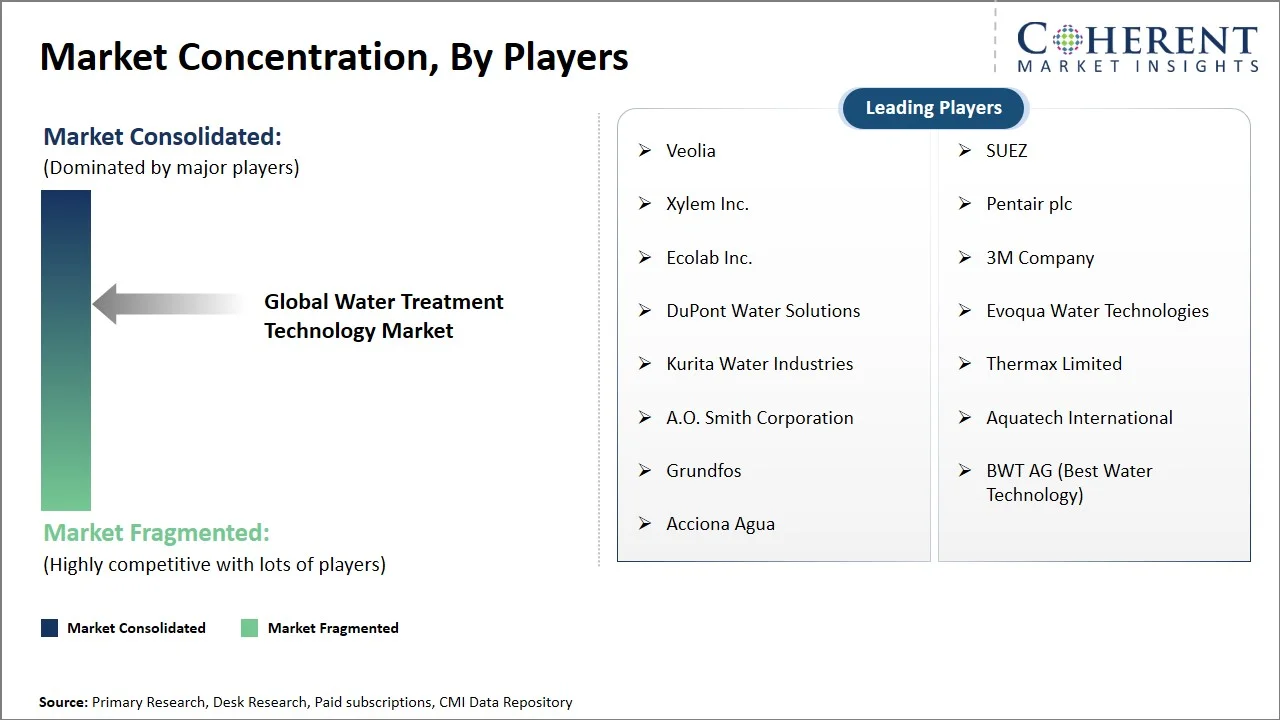
The competitive landscape of the global water treatment technology market is moderately consolidated, with global players such as Veolia, Xylem Inc., and SUEZ dominating large-scale municipal and industrial projects through integrated solutions spanning treatment, reuse, and digital water management; alongside these, specialized technology firms like membrane and filtration providers compete in niche segments such as desalination, Zero Liquid Discharge (ZLD), and smart IoT-based monitoring systems, while regional players in Asia Pacific and Europe intensify competition through cost-effective and localized solutions tailored to regulatory and industrial requirements.
Market Report Scope
Water Treatment Technology Market Report Coverage
| Report Coverage | Details | ||
|---|---|---|---|
| Base Year: | 2025 | Market Size in 2026: | USD 47.25 Bn |
| Historical Data for: | 2020 To 2024 | Forecast Period: | 2026 To 2033 |
| Forecast Period 2026 to 2033 CAGR: | 9% | 2033 Value Projection: | USD 89.50 Bn |
| Geographies covered: |
| ||
| Segments covered: |
| ||
| Companies covered: | Veolia, SUEZ, Xylem Inc., Pentair plc, Ecolab Inc., 3M Company, DuPont Water Solutions, Evoqua Water Technologies, Kurita Water Industries, Thermax Limited, A.O. Smith Corporation, Aquatech International, Grundfos, BWT AG (Best Water Technology), and Acciona Agua | ||
| Growth Drivers: |
| ||
| Restraints & Challenges: |
| ||
Analyst Opinion (Expert Opinion)
- The water treatment technology market is a structurally strong, long-term growth sector driven by accelerating water scarcity, stricter environmental regulations, and rapid industrial and municipal infrastructure upgrades; reports consistently highlight that demand is being reinforced by expanding applications in industrial wastewater treatment, municipal reuse systems, and advanced membrane technologies such as reverse osmosis and ultrafiltration, with growth expectations supported by double-digit adoption of digital water solutions and steady investment cycles across regions like North America and Asia Pacific . At the same time, while near-term volatility may occur due to project delays or macroeconomic pressures, the sector remains defensive and resilient, with utilities and technology providers benefiting from non-discretionary demand for clean water and compliance-driven upgrades.
- The future prospects of the water treatment technology market are highly positive, with strong expansion expected as global market value is projected to nearly double over the next decade, driven by rising industrial water reuse, smart water infrastructure, and large-scale municipal investments in wastewater recycling and desalination systems. Growth will increasingly be shaped by adoption of AI- and IoT-enabled smart water networks, tighter environmental enforcement, and rising industrial water intensity from sectors such as chemicals, energy, and manufacturing, while emerging opportunities in water-as-a-service models and decentralized treatment systems are expected to redefine how water infrastructure is financed and operated globally.
Speak to the analyst
Want personalized insights?
Take the findings above to one of our principal consultants, or have the report rebuilt around the segments, geographies and competitors you actually track.
Market Segmentation
- Technology Insights (Revenue, USD Billion, 2021 - 2033)
- Membrane Filtration
- Reverse Osmosis
- UV & Chemical Disinfection
- Activated Carbon Filtration
- Others
- Process Type Insights (Revenue, USD Billion, 2021 - 2033)
- Primary Treatment
- Secondary Treatment
- Tertiary/Advanced Treatment
- Desalination
- Wastewater Recycling & Reuse
- System Type Insights (Revenue, USD Billion, 2021 - 2033)
- Point-of-Use (POU)
- Point-of-Entry (POE)
- Centralized Treatment Plants
- Portable Treatment Systems
- Application Insights (Revenue, USD Billion, 2021 - 2033)
- Municipal Water Treatment
- Industrial Water Treatment
- Residential Water Purification
- Commercial Buildings
- Others
- Regional Insights (Revenue, USD Billion, 2021 – 2033)
- North America
- U.S.
- Canada
- Latin America
- Brazil
- Argentina
- Mexico
- Rest of Latin America
- Europe
- Germany
- U.K.
- Spain
- France
- Italy
- Russia
- Rest of Europe
- Asia Pacific
- China
- India
- Japan
- Australia
- South Korea
- ASEAN
- Rest of Asia Pacific
- Middle East
- GCC Countries
- Israel
- Rest of Middle East
- Africa
- South Africa
- North Africa
- Central Africa
- North America
Sources
Primary Research Interviews
- Smart water technology solution providers
- Water utility companies and municipal authorities
- IoT and sensor technology manufacturers
- System integrators and software developers
Magazines
- Water & Wastewater International
- Smart Water Magazine
- Water Technology Magazine
- Municipal Water Leader
Journals
- Journal of Water Resources Management
- Water Research Journal
- Smart Cities and IoT Journal
Associations
- International Water Association (IWA)
- Water Environment Federation (WEF)
- American Water Works Association (AWWA)
- Smart Cities Council
Public Domain Sources
- EPA Water Infrastructure Reports
- UN Water Development Reports
- OECD Water Governance Reports
- Government water management policies
Proprietary Elements
- CMI Data Analytics Tool
- Proprietary CMI Existing Repository of information for last 10 years
Get access to 250+ pages report
Every segment, forecast, competitor profile and data table behind the analysis above — available for instant download.
- ESOMAR Member
- ISO 9001:2015 Certified
- D-U-N-S Registered
- GDPR & CCPA Compliant
Missing comfort of reading report in your local language? Find your preferred language:
Transform your Strategy with Exclusive Trending Reports
Frequently Asked Questions
The global water treatment technology market is expected to stand at USD 47.25 Bn in 2026 and is expected to reach USD 89.50 Bn by 2033.
The CAGR of the global water treatment technology market is projected to be 9% from 2026 to 2033.
Rising global water scarcity and rapid urbanization and industrialization are the major factors driving the growth of the global water treatment technology market.
High capital investment costs for advanced systems and high operational and maintenance costs are the major factors hampering the growth of the global water treatment technology market.
In terms of technology, membrane filtration is estimated to dominate the market revenue share in 2026.
ZLD is a system that ensures no liquid waste leaves a facility by fully recycling and reusing wastewater.
It uses IoT and AI to monitor water systems in real time, reduce leaks, and optimize operations.