

Lithium Hydroxide Market Size and Forecast — 2026 - 2033
The Global Lithium Hydroxide Market size is estimated to be valued at USD 4.3 billion in 2026 and is expected to reach USD 11.1 billion by 2033, exhibiting a compound annual growth rate (CAGR) of 14.2% from 2026 to 2033.
Overview
Lithium hydroxide (LiOH) is a strong alkaline compound made of lithium, oxygen, and hydrogen. It appears as a white, crystalline solid and is highly soluble in water, forming a basic solution. Lithium hydroxide is commonly produced from lithium-containing minerals such as spodumene and is widely used in industrial applications. One of its most important uses is in manufacturing lithium-ion batteries for electric vehicles and portable electronics. It is also used in air purification systems to absorb carbon dioxide, especially in spacecraft like NASA missions. Additionally, lithium hydroxide plays a role in producing lubricating greases and ceramics.
Key Takeaways
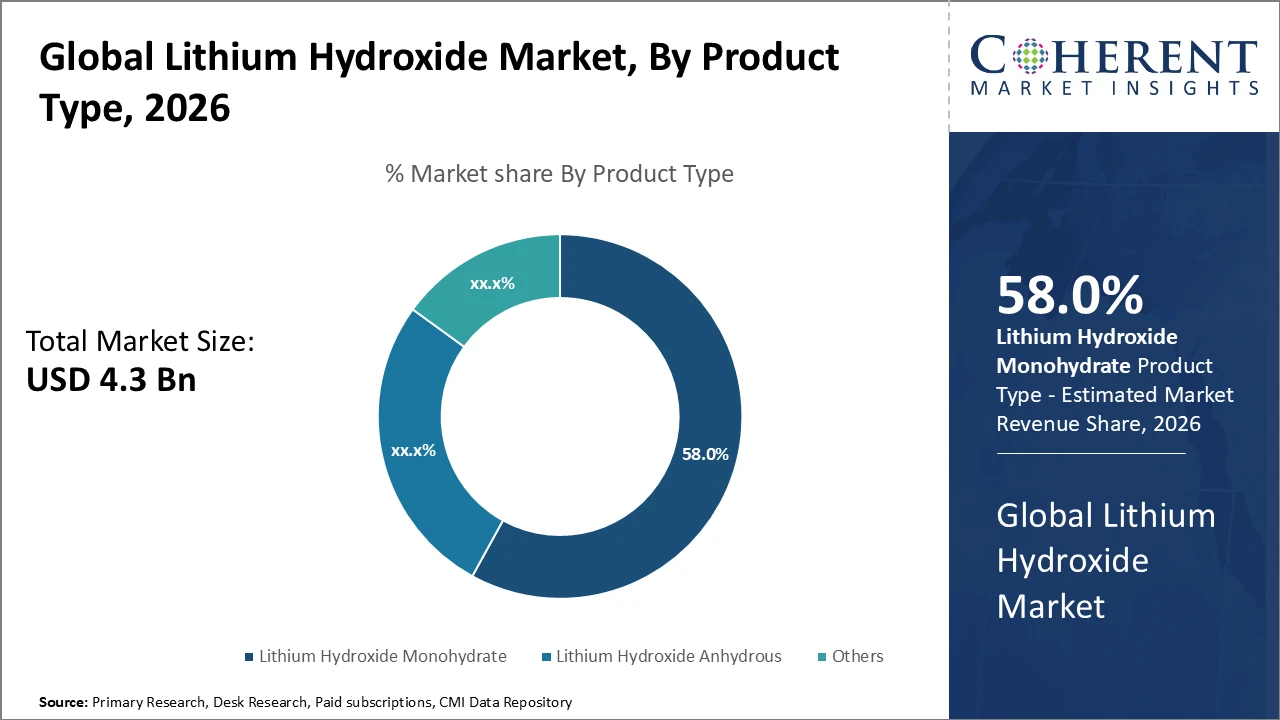
In the product type segment, lithium hydroxide monohydrate holds the dominant industry share accounting for 58%, driven by its optimized use in battery manufacturing, whereas lithium hydroxide anhydrous exhibits the fastest growth due to specialized applications requiring high purity. Other product variations maintain niche demand.
Among applications, electric vehicle batteries lead market growth, representing the largest segment by volume, propelled by surging EV production. Energy storage systems are expanding rapidly, showcasing the fastest CAGR attributed to increased renewable integration. Consumer electronics and industrial uses remain steady but secondary contributors.
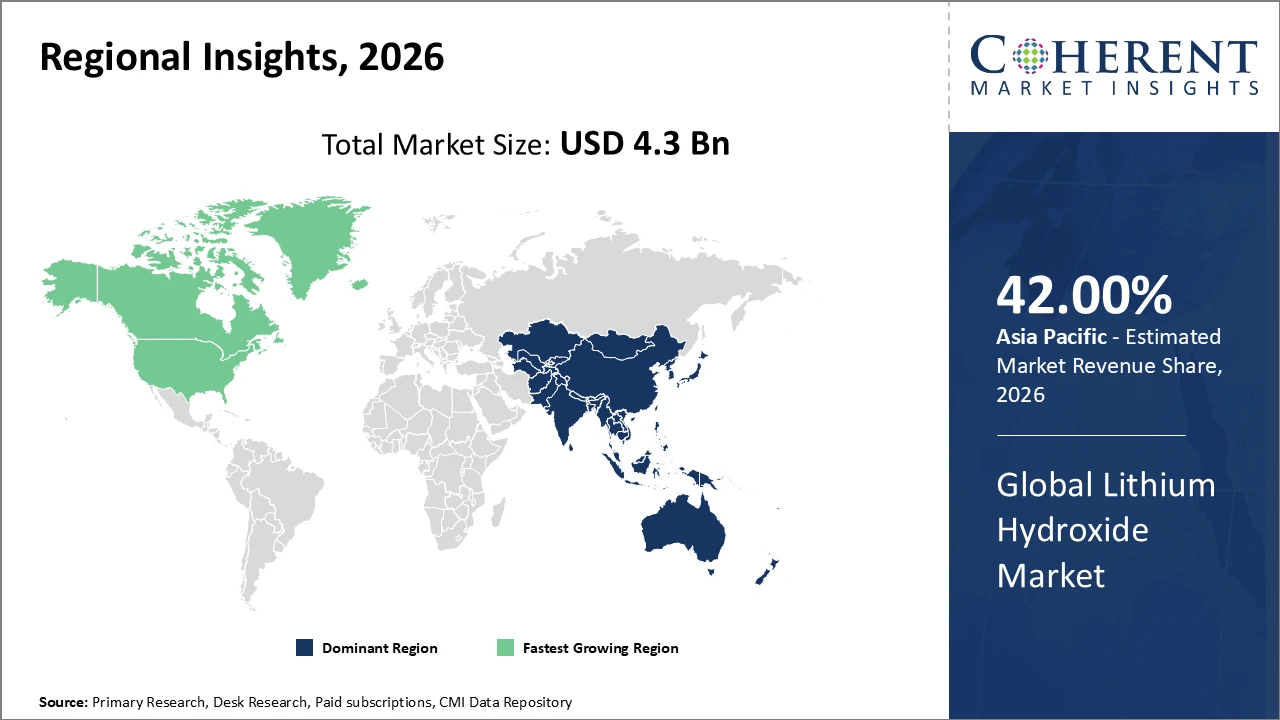
Asia Pacific dominates the overall market owing to aggressive EV adoption in China and South Korea.
Lithium Hydroxide Market Segmentation Analysis
Lithium Hydroxide Market Insights, By Product Type
Lithium Hydroxide Monohydrate dominates the market, accounting for approximately 58% of the total share. The monohydrate form is widely preferred due to its stability, ease of handling, and broad acceptance in battery manufacturing processes, particularly for cathode material synthesis in electric vehicle batteries. Its well-established production infrastructure and compatibility with advanced cathode chemistries further reinforce its leading position. In contrast, Lithium Hydroxide Anhydrous represents the fastest-growing subsegment, driven by specialized applications that demand higher purity levels and lower moisture content, including specialty battery cathodes and premium electronic components. Other subsegments, such as technical-grade lithium hydroxide, hold comparatively smaller volumes but remain relevant for specific industrial and chemical processing applications.
Lithium Hydroxide Market Insights, By Application
Electric vehicle batteries account for the largest share of the lithium hydroxide market, supported by accelerating global EV adoption and the transition toward low-emission transportation. The growing lineup of electric models utilizing nickel-rich cathode chemistries, which rely heavily on lithium hydroxide, reinforces this segment’s dominance. Government incentives, stricter emission standards, and expanding charging infrastructure further stimulate demand. In comparison, consumer electronics represent a substantial but smaller segment, driven by the need for compact lithium-ion batteries in smartphones, laptops, and wearable devices. However, growth in this category is relatively moderate due to market maturity and saturation in many developed economies worldwide.
Lithium Hydroxide Market Insights, By End-User Industry
The automotive sector overwhelmingly dominates this segment’s market share, primarily driven by the rapid electrification of transportation and stringent global mandates aimed at reducing vehicle emissions. As leading automakers accelerate electric vehicle production, the demand for lithium hydroxide rises significantly, particularly for nickel-rich lithium-ion battery chemistries used in EVs. Expanding battery manufacturing facilities and long-term supply agreements further strengthen consumption trends. The automotive industry’s production cycles, innovation in battery technologies, and strategic sourcing initiatives directly shape market dynamics, compelling lithium hydroxide producers to enhance capacity, secure raw material access, and establish resilient supply chains to meet growing and sustained demand.
Lithium Hydroxide Market Trends
The market has witnessed a strong rise in the use of lithium hydroxide monohydrate for battery manufacturing, primarily driven by the growing adoption of nickel-rich cathode chemistries in electric vehicles, which require high-purity lithium hydroxide for enhanced performance and energy efficiency.
In 2025, demand for high-purity lithium hydroxide products increased by nearly 30%, supported by advancements in battery energy density requirements and the expansion of large-scale electric vehicle production globally.
Sustainability initiatives are accelerating lithium hydroxide recycling efforts, with recovery rates improving by approximately 12% year-over-year in key markets such as Europe and China.
Cost optimization strategies and circular economy goals are encouraging battery manufacturers to invest in closed-loop recycling systems to secure long-term lithium supply.
Geopolitical trade shifts, including export restrictions in lithium-rich regions and rising tariffs, are reshaping global supply chains, leading to new trade alliances and regional production hubs, particularly across Asia Pacific.
Lithium Hydroxide Market Insights, By Geography
Asia Pacific Lithium Hydroxide Market Analysis and Trends
Asia Pacific leads the lithium hydroxide market, accounting for approximately 42% of global share, supported by abundant lithium mineral reserves and well-established battery manufacturing ecosystems across China, South Korea, and Japan. Strong government policies promoting electric mobility, coupled with substantial investments in lithium refining and processing infrastructure, reinforce regional dominance. Major industry participants such as Ganfeng Lithium and LG Chem play a pivotal role by expanding production capacities and entering long-term supply agreements with global automakers. These strategic initiatives strengthen supply chains and solidify Asia Pacific’s leadership in the global lithium hydroxide industry.
North America Lithium Hydroxide Market Analysis and Trends
North America is emerging as the fastest-growing region in the lithium hydroxide market, registering a CAGR exceeding 16%, driven by accelerating electric vehicle adoption supported by federal clean energy incentives and policy initiatives. The United States plays a central role, with expanding lithium extraction projects in Nevada and Texas strengthening domestic raw material availability. Companies such as Albemarle Corporation are actively investing in capacity expansion and forward integration strategies to support local battery supply chains. These developments are fostering supply chain localization, reducing reliance on imports, and improving overall market resilience amid evolving global trade dynamics.
Lithium Hydroxide Market Outlook for Key Countries
USA Lithium Hydroxide Market Analysis and Trends
The United States lithium hydroxide market remains strong, largely propelled by the rapid expansion of electric vehicle manufacturing and sustained government support for clean energy adoption. Investments in domestic lithium mining and refining have increased by more than 25% since 2024, with major players such as Albemarle Corporation significantly expanding capacity in Nevada and Arkansas. Federal initiatives promoting sustainable battery production and infrastructure development further accelerate supply chain localization efforts. As a result, the U.S. is playing a strategic role in reshaping the North American lithium hydroxide landscape by boosting output volumes and advancing quality standards required for next-generation EV battery chemistries.
Germany Lithium Hydroxide Market Analysis and Trends
Germany’s lithium hydroxide market is driven by its strong automotive and industrial sectors, particularly the country’s focus on electric vehicle production and stringent emission regulations. The growing adoption of nickel-rich cathode batteries in EVs boosts demand for high-purity lithium hydroxide. Local battery manufacturing initiatives, supported by government incentives and EU sustainability policies, encourage investment in refining and recycling infrastructure. Companies are also exploring circular economy models to recover lithium from spent batteries. While automotive applications dominate, industrial uses in ceramics, lubricants, and specialty chemicals provide steady demand. Overall, Germany remains a key market for lithium hydroxide in Europe.
Analyst Opinion
The surge in lithium hydroxide production capacity is a key supply-side driver, with new facilities launched in 2024 and 2025 collectively increasing global capacity by approximately 18%, enhancing supply resilience and contributing to a decline in pricing volatility in early 2026, making the market more accessible.
Demand growth is driven by expanding lithium-ion battery applications in electric vehicles and grid storage. Global EV sales rose over 42% in 2025, with lithium hydroxide-based batteries comprising nearly 75% of the battery chemistry used, while applications in consumer electronics and industrial storage continue to support market expansion.
Regional import-export trends indicate dynamic trade shifts: Asia Pacific’s lithium hydroxide imports rose 23% in 2025 due to strong demand from battery manufacturers in China, Japan, and South Korea, while North American exports increased 15%, reflecting enhanced mining, refining activities, and strategic trade partnerships.
Specialty-grade lithium hydroxide demand is rising for high-purity applications in advanced cathode production, with 2024 data showing a 12% annual increase in purchases by premium automotive battery manufacturers, emphasizing a trend toward finer-quality products for improved battery safety and performance.
- Current Industry Events of 2026
- Market Size Estimation
- Regional Breakdown
- Competitive Landscape
- Customer Intelligence
- Segmental Analysis
- Pricing Analysis
- Key Market Drivers, Challenges & Future Trends
- Customized Insights Section
Market Scope
| Report Coverage | Details | ||
|---|---|---|---|
| Base Year: | 2025 | Market Size in 2026: | USD 4.3 billion |
| Historical Data for: | 2020 To 2024 | Forecast Period: | 2026 To 2033 |
| Forecast Period 2026 to 2033 CAGR: | 14.2% | 2033 Value Projection: | USD 11.1 billion |
| Geographies covered: |
| ||
| Segments covered: |
| ||
| Companies covered: | Albemarle Corporation, LG Chem, Keliber Oy, AMG Lithium, Nemaska Lithium Inc., Neo Lithium Corp., Livent Corporation, Orocobre Limited, Pilbara Minerals Limited, Mineral Resources Limited | ||
| Growth Drivers: |
| ||
Lithium Hydroxide Market Growth Factors
The adoption of electric vehicles is the primary driver of lithium hydroxide market growth, with global EV sales surpassing 15 million units in 2025, generating significant demand for lithium-based battery materials. Concurrently, the transition toward renewable energy storage has boosted the use of lithium hydroxide in grid-scale battery systems, broadening its application base. Advances in battery chemistry, enabling longer lifecycles and higher energy density cathode materials, rely heavily on lithium hydroxide, further expanding market potential. Supportive government incentives and emission-reduction regulations, particularly in Europe and North America, accelerate growth, while expanding lithium mining and refining capacities in South America strengthen supply chains amid rising demand.
Lithium Hydroxide Market Development
In January 2026, Tesla North America and Elon Musk announced that the U.S. now has its biggest and most advanced lithium refining facility, which has started operations near Corpus Christi, Texas. The new Tesla lithium refinery represents a major step toward building a domestic lithium supply and lessening dependence on China’s leading role in the market.
Key Players
Leading Companies of the Market
Albemarle Corporation
LG Chem
AMG Lithium
Keliber Oy
Nemaska Lithium Inc.
Neo Lithium Corp.
Livent Corporation
Orocobre Limited
Pilbara Minerals Limited
Several leading companies have increasingly pursued forward integration strategies to strengthen their positions in the lithium hydroxide market. For example, Albemarle Corporation invested in lithium hydroxide refining to capture higher-margin segments, resulting in a 12% revenue increase in 2025. Similarly, Ganfeng Lithium focused on forming strategic partnerships with automakers to secure long-term supply agreements, contributing to a 20% rise in production output in 2026. Market participants are also investing heavily in R&D to enhance product quality and reduce production costs, thereby strengthening competitiveness in the rapidly growing industry.
Lithium Hydroxide Market Future Outlook
The future outlook for the lithium hydroxide market remains highly promising, driven by sustained growth in electric vehicle adoption, renewable energy storage expansion, and technological advancements in battery chemistries. Demand for high-purity lithium hydroxide is expected to rise, particularly for nickel-rich cathodes and next-generation solid-state batteries. Investment in domestic production, refining, and recycling infrastructure will continue to strengthen supply chains and reduce dependence on imports. Geographic diversification, especially in North America, Asia Pacific, and South America, will shape global trade dynamics. Overall, regulatory support, technological innovation, and strategic partnerships position the lithium hydroxide market for robust long-term growth through 2033 and beyond.
Lithium Hydroxide Market Historical Analysis
The lithium hydroxide market has experienced significant growth over the past decade, primarily driven by the rapid expansion of the electric vehicle and energy storage sectors. Historically, demand was concentrated in consumer electronics and specialty industrial applications, but the surge in EV production shifted consumption toward battery-grade lithium hydroxide. Major producers in China, Australia, and South America scaled up extraction and refining capacities to meet global requirements, while technological improvements in cathode chemistries increased product specifications and purity standards. Trade patterns evolved with Asia Pacific emerging as the dominant consumer, shaping global supply chains and establishing the foundation for the market’s future expansion.
Sources
Primary Research Interviews:
Lithium and battery chemical manufacturers
Mining and refining companies
Battery and EV manufacturers
Energy storage system developers
Chemical engineers and process consultants
Databases:
Benchmark Mineral Intelligence – Lithium & Battery Materials
Roskill – Lithium Market Analysis
Magazines:
Battery Materials Review
Lithium Today
Mining Journal
Chemical Engineering & Processing
Journals:
Journal of Power Sources
Journal of Energy Storage
Minerals Engineering
Electrochimica Acta
International Journal of Minerals, Metallurgy & Materials
Newspapers:
Financial Times – Energy & Materials
The Wall Street Journal – Chemicals & EV Industry
Reuters – Lithium & Battery Markets
Bloomberg – Renewable Energy & EV Supply Chains
Nikkei Asia – Electric Vehicles & Battery Chemicals
Associations:
International Lithium Association (ILA)
European Battery Alliance (EBA)
International Electrotechnical Commission (IEC) – Battery Standards
Lithium Producers Association
Global Battery Alliance
Get access to 250+ pages report
Every segment, forecast, competitor profile and data table behind the analysis above — available for instant download.
- ESOMAR Member
- ISO 9001:2015 Certified
- D-U-N-S Registered
- GDPR & CCPA Compliant
Missing comfort of reading report in your local language? Find your preferred language:
Transform your Strategy with Exclusive Trending Reports
Frequently Asked Questions
The market is dominated by companies such as Albemarle Corporation, Livent Corporation, AMG Lithium, and LG Chem all of which have substantial production capacities and strategic partnerships shaping market dynamics.
The lithium hydroxide market is projected to grow from USD 4.3 billion in 2026 to USD 11.1 billion by 2033, signifying a CAGR of approximately 14.2% driven by expanding EV and energy storage sectors.
Automotive Sector represent the largest growth opportunity segment, accounting for the majority of lithium hydroxide market revenue due to the ongoing electrification trend in the automotive industry.
Market trends indicate a pivot towards higher-purity lithium hydroxide for advanced battery chemistries, increasing recycling initiatives, and a shift in regional supply chains influenced by geopolitical trade adjustments.
The competitive landscape is characterized by strategic capacity expansions, forward integration by major market players, and intense R&D activities. Market challenges include supply chain volatility, resource availability, and evolving regulatory frameworks.
Common strategies involve joint ventures with battery manufacturers, investment in refining capabilities, geographic diversification of production hubs, and innovation in lithium hydroxide purity and performance enhancements.