

Waterborne Adhesives Market Size and Share Analysis - Growth Trends and Forecast (2026 - 2033)
The global waterborne adhesives market is estimated at USD 9.0 Bn in 2026 and is projected to grow at a CAGR of 6% during the forecast period (2026-2033), reaching USD 13.5 Bn by 2033. This growth is mostly due to increasing demand for low-VOC and environmentally friendly adhesives, stringent regulations limiting solvent-based adhesive emissions, and rising adoption across packaging, construction, woodworking, and automotive industries.
Key Takeaways from the Waterborne Adhesives Market Report
- Polyacrylate emulsions are expected to lead the market with a share of 36.8 % in 2026 due to excellent adhesion, water resistance, durability as well as extensive use in packaging, construction, pressure-sensitive labels, and automotive applications. Acrylic pressure-sensitive adhesives contribute to more than 45 percent of the entire pressure-sensitive adhesives produced in Europe.
- Packaging is slated to account for 34.5 % of the global waterborne adhesives market share in 2026, owing to rising demand for flexible packaging, paperboard, corrugated boxes, labels, and e-commerce shipping materials. According to Henkel, water-based adhesives are widely used in corrugated board, labels, and flexible packaging due to their strong bonding.
- Asia Pacific is expected to have a dominant share of 42% in the global water-based adhesives market by 2026, owing to rapid growth of industries such as packaging, construction, and auto manufacturing along with the strict laws on VOCs in countries like China and India. The Chinese Standard GB 33372-2020 has specified VOC levels for adhesive products.
- North America, holding a share of 27.8 % in 2026, is poised to offer lucrative growth opportunities to waterborne adhesive manufacturers during the forecast period, thanks to thanks to rising demand for eco-friendly adhesives across packaging, construction, and automotive industries.
Waterborne Adhesives Market Overview
The global waterborne adhesives market is projected to register steady growth during the forecast period. This growth is primarily driven by rising demand for sustainable adhesives, stringent emission regulations, and ongoing advancements in high-performance waterborne adhesive technologies.
Waterborne or water-based adhesives use water as a carrier or dispersing medium and generally offer low VOC emissions compared with solvent-based adhesives. The performance of waterborne adhesive products depends on their chemical composition, with resins, fillers, and antifoaming agents being common components.
Waterborne adhesives offer advantages such as low toxicity, reduced VOC emissions, good bonding performance, and ease of application. These properties have increased their adoption across various industries. Waterborne adhesives can bond materials such as wood, metal, concrete, and plastics. This is making them suitable for applications including packaging, automotive, construction, and other industrial uses.
Expansion of construction and woodworking activities is expected to fuel demand for waterborne adhesives during the forecast period. Waterborne adhesives are increasingly being used in residential construction, infrastructure projects, flooring, and furniture production because of their low odor, safety advantages, and compatibility with indoor applications.
Rising adoption in automotive and transportation applications is also boosting waterborne adhesive demand. Increasing use of lightweight materials and demand for efficient assembly solutions are supporting the adoption of waterborne adhesives in automotive interiors, components, and manufacturing processes.
Global vehicle production reached 96.4 million units in 2025, showing steady growth in automotive manufacturing, according to the This growth is expected to increase demand for advanced adhesive solutions used in vehicle assembly during the forthcoming period.
Technological advancements in adhesive formulations are expected to support market growth in the coming years. Manufacturers are developing high-performance waterborne adhesives with improved adhesion strength, faster curing, better moisture resistance, and wider application capabilities.
Segmental Insights
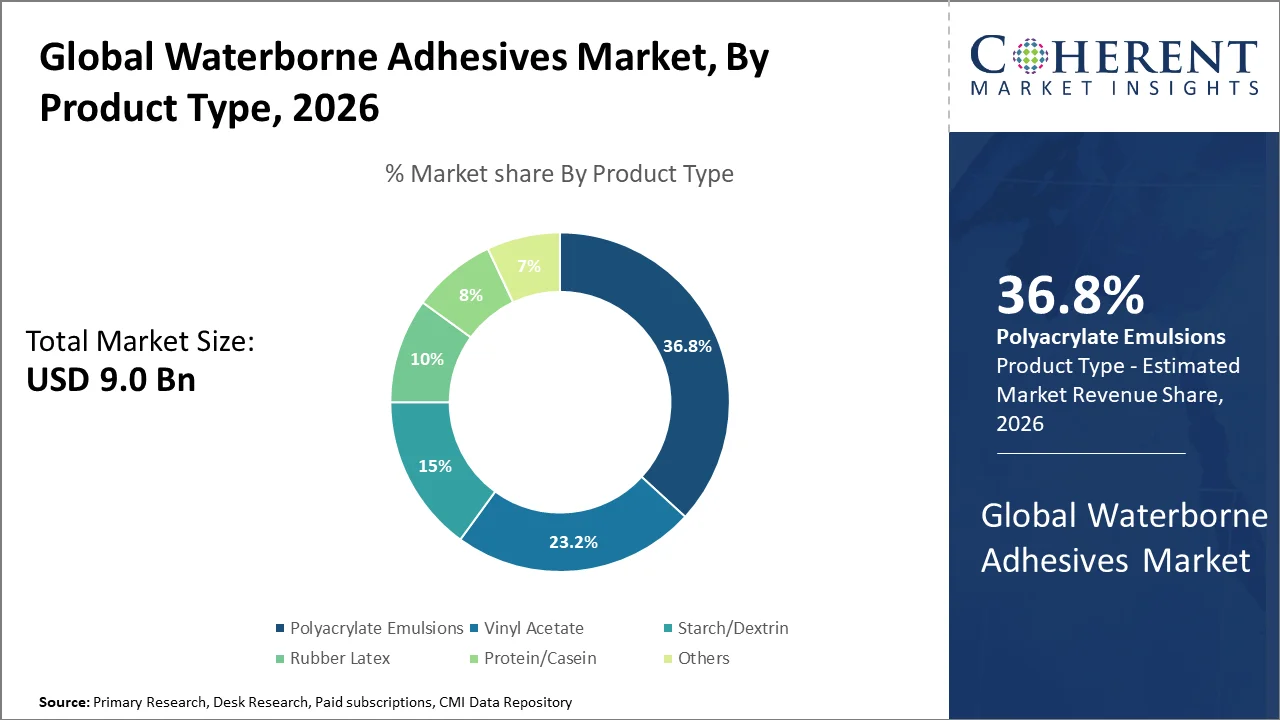
Which Product Type Leads the Global Waterborne Adhesives Market?
Polyacrylate Emulsions Lead the Market with More Than One-Third Share in 2026
As per Coherent Market Insights’ latest waterborne adhesives market analysis, polyacrylate emulsions are set to lead the market, accounting for a revenue share of 36.8% in 2026. This dominance can be attributed to their excellent bonding strength, fast drying properties, low volatile organic compound (VOC) emissions, and strong resistance to moisture and chemicals.
Polyacrylate emulsion adhesives are widely used in paper and packaging, woodworking, construction, automotive, and textiles due to their versatility as well as compliance with increasingly stringent environmental regulations. Growing demand for sustainable and high-performance adhesive solutions, especially in packaging and building industries, is also supporting adoption of polyacrylate emulsions worldwide.
For instance, in September 2025, Arkema received a U.S. patent for a waterborne laminating adhesive composition based on a water-based acrylic polymer emulsion for flexible packaging applications. The patent highlights continued innovation in acrylic waterborne adhesive technologies.
- Current Industry Events of 2026
- Market Size Estimation
- Regional Breakdown
- Competitive Landscape
- Customer Intelligence
- Segmental Analysis
- Pricing Analysis
- Key Market Drivers, Challenges & Future Trends
- Customized Insights Section
What Application Accounts for the Largest Share of Waterborne Adhesives Market?
Packaging to Remain the Largest Application Segment
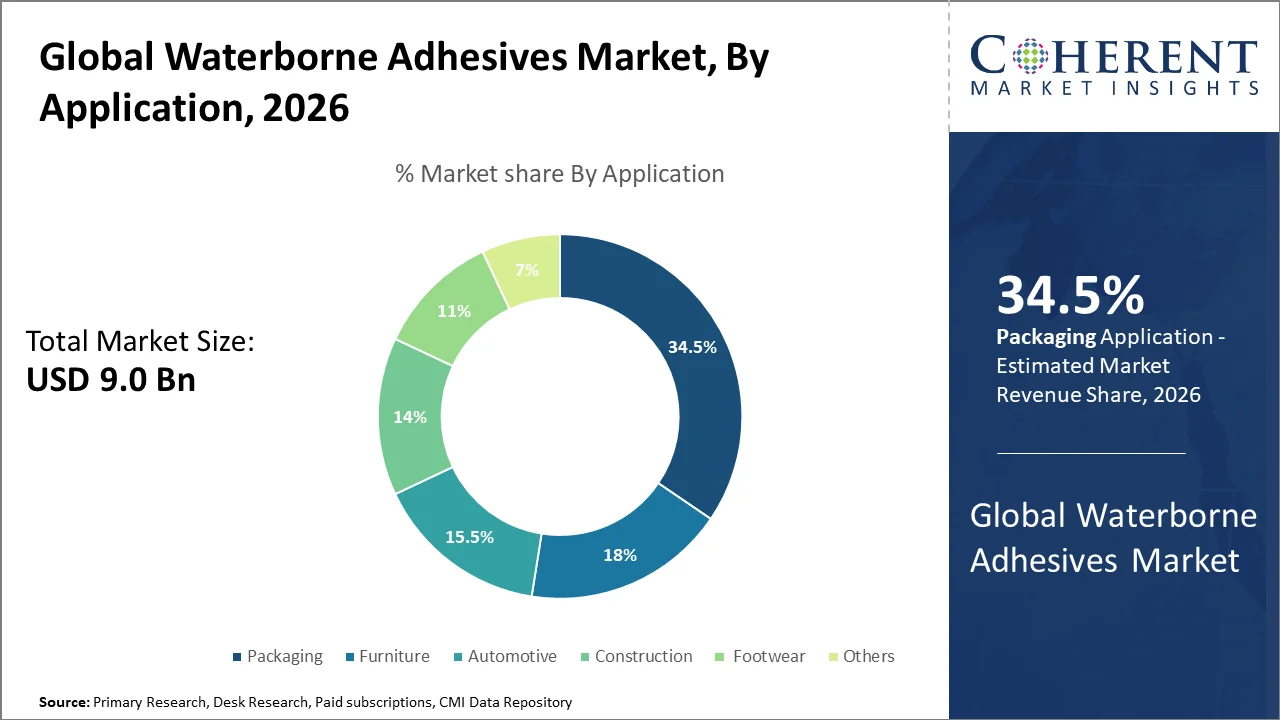
By application, packaging segment is expected to account for 34.5% of the global waterborne adhesives market share in 2026. This is mostly due to increasing demand for sustainable and recyclable packaging solutions across food and beverage, e-commerce, pharmaceutical, and consumer goods industries.
Waterborne adhesives are widely preferred for packaging because they have low volatile organic compound (VOC) emissions, strong bonding performance, and comply with stringent environmental regulations. Rising adoption of paper- and paperboard-based packaging, along with the shift away from solvent-based adhesives, is also driving demand for waterborne adhesives in packaging applications.
Market Dynamics
Waterborne Adhesives Market Growth Drivers
Rising Demand for Low-VOC and Eco-friendly Adhesives: Shifting preference toward eco-friendly solutions is providing a strong impetus for the growth of waterborne adhesives market. Stricter environmental regulations and growing demand for sustainable products are encouraging industries to replace solvent-based adhesives with waterborne adhesives, which generally produce lower volatile organic compound (VOC) emissions. This trend is expected to drive the adoption of waterborne adhesives during the forecast period.
Waterborne Adhesives Market Opportunities
Booming Packaging Industry: Expansion of packaging industry across the world is creating lucrative growth opportunities for the waterborne adhesives market. Rising demand for flexible packaging, labels, cartons, and e-commerce packaging is driving the adoption of waterborne adhesives due to their strong bonding performance and suitability for sustainable packaging solutions. More packaging companies are increasingly using waterborne adhesives as they help meet sustainability goals and comply with environmental regulations related to VOC emissions.
Waterborne Adhesives Market Trends
Replacement of Solvent-Based Adhesives with Waterborne Alternatives: Solvent-based adhesives are increasingly being replaced by waterborne adhesives due to rising VOC emission regulations, stricter environmental standards, and growing demand for sustainable manufacturing solutions. Industries such as packaging, construction, automotive, and woodworking are shifting toward water-based adhesives as they offer lower emissions, improved workplace safety, and compliance with environmental regulations.
Current Events and Their Impact
Current Event | Description and its Impact |
U.S. EPA Expands PFAS Control Measures for Water Systems (2026) |
|
EPA Launches PFAS OUT Initiative (2026) |
|
Regional Insights
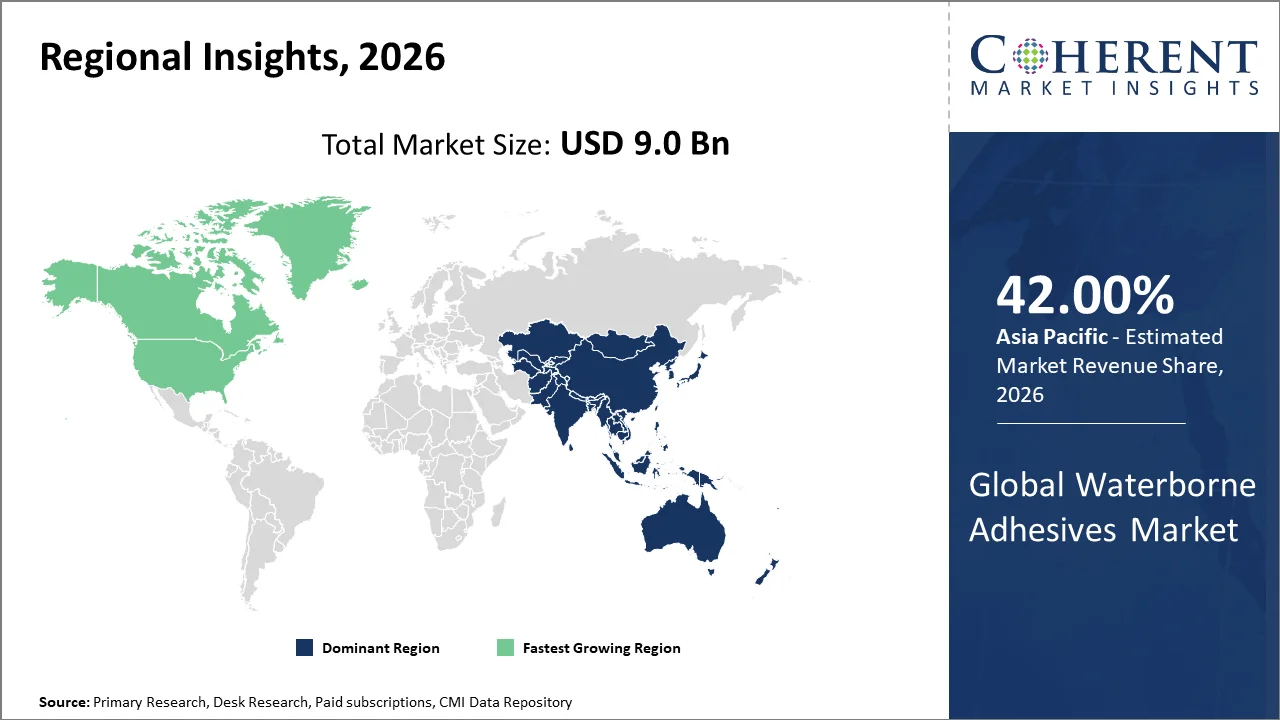
Asia Pacific Remains the Most Dominant Market for Waterborne Adhesives
Asia Pacific is projected to lead the global waterborne adhesives market with a share of 42% in 2026. This dominance is attributable to rapid expansion of the packaging industry, rising e-commerce activities, increasing manufacturing output, and growing adoption of sustainable adhesive solutions in nations like China, India, and Japan. The shift toward low-VOC and environmentally friendly adhesives is also supporting market growth across packaging, construction, automotive, and consumer goods industries.
Expanding packaging sector is playing a key role in boosting sales of waterborne adhesives across Asia Pacific. Growing demand for flexible packaging, paper-based packaging, and labels is encouraging manufacturers to use water-based adhesive technologies. This, in turn, is providing stimulus for Asia Pacific waterborne adhesives market.
North America Offering Lucrative Growth Prospects for Waterborne Adhesive Companies
North America is expected to hold 27.8% share of the global waterborne adhesives market in 2026. This can be attributed to implementation of strict environmental regulations, increasing demand for sustainable packaging solutions, and rising adoption of low-emission adhesive technologies across industries. The replacement of solvent-based adhesives with waterborne alternatives is gaining momentum as manufacturers focus on reducing VOC emissions and improving product sustainability.
Rising demand for sustainable packaging products is leading to innovations in waterborne adhesives in North America. Adhesive companies have come up with new adhesive technologies that can meet their performance standards while complying with environmental demands. One such company is
Waterborne Adhesives Market Outlook – Country-wise
China Waterborne Adhesives Market Forecast
China is expected to remain a leading market for waterborne adhesives during the assessment period. This can be attributed to rapid expansion of packaging, construction, and automotive manufacturing sectors, along with increasing adoption of low-VOC adhesive solutions due to environmental regulations. The country’s large-scale manufacturing base and growing demand for sustainable materials are also encouraging the replacement of solvent-based adhesives with waterborne alternatives. In 2025, China's manufacturing sector generated RMB 34.67 trillion, growing 6.1% year-over-year and accounting for 24.7% of the country's GDP.
U.S. Waterborne Adhesives Market Trends
The United States waterborne adhesives market is poised to exhibit steady growth throughout the forecast period. This is mainly due to rising demand for sustainable packaging solutions, increasing use of waterborne adhesives in building and renovation activities, and growing preference for environmentally compliant adhesive technologies across industries. Presence of advanced manufacturing and strong focus on reducing VOC emissions are also supporting market growth.
Who are the Major Companies in the Waterborne Adhesives Market?
Some of the major players in waterborne adhesives market are BASF SE, Sika AG, Henkel AG, The 3M Company, Evonik Industries, DowDuPont Inc., Ashland Inc., Arkema S.A., Avery Dennison Corporation, and Bayer AG.
Key Strategies Adopted by Industry Players
Leading manufacturers of waterborne adhesives are adopting various organic and inorganic strategies to boost their revenue as well as gain a competitive edge in the industry. These include new product launches, increasing investments in R&D, mergers, collaborations, partnerships, and acquisitions, and distribution agreements.
- In July 2025, Henkel AG & Co. KGaA launched its Loctite Liofol LA 7837/LA 6265 adhesive system for flexible packaging applications. The solvent-free adhesive system is designed to provide high performance and durability for demanding packaging uses, including retort packaging.
- In September 2024, Covestro introduced new waterborne adhesive solutions for the footwear and automotive industries. The solutions include Dispercoll U and Dispercoll U PLUS polyurethane-based adhesives designed for high-performance applications.
Market Report Scope
Waterborne Adhesives Market Report Coverage
| Report Coverage | Details | ||
|---|---|---|---|
| Base Year: | 2025 | Market Size in 2026: | USD 9.0 Bn |
| Historical Data for: | 2020 To 2024 | Forecast Period: | 2026 To 2033 |
| Forecast Period 2026 to 2033 CAGR: | 6% | 2033 Value Projection: | USD 13.5 Bn |
| Geographies covered: |
| ||
| Segments covered: |
| ||
| Companies covered: | BASF SE, Sika AG, Henkel AG, The 3M Company, Evonik Industries, DowDuPont Inc., Ashland Inc., Arkema S.A., Avery Dennison Corporation, and Bayer AG. | ||
| Growth Drivers: |
| ||
| Restraints & Challenges: |
| ||
Analyst Opinion (Expert Opinion)
- Environmental rules are encouraging the use of waterborne adhesives because they release lower VOC emissions than solvent-based products. This is increasing demand from the packaging furniture and construction industries.
- Paper and flexible packaging demand continues to support market growth. More brands are choosing waterborne adhesives to meet sustainability goals as well as improve recyclability of packaging materials.
- According to the U.S. Environmental Protection Agency (EPA) packaging and containers account for about 28.1% of total municipal solid waste generated in the U.S. This highlights the large packaging industry where waterborne adhesives are widely used creating steady market demand.
- Ongoing developments in water-based adhesives, which include faster drying, greater strength and improved heat resistance, are contributing to their growing use in place of solvent-based adhesives in industry.
Speak to the analyst
Want personalized insights?
Take the findings above to one of our principal consultants, or have the report rebuilt around the segments, geographies and competitors you actually track.
Market Segmentation
- By Product Type (Revenue, USD Bn, 2026–2033)
- Starch/Dextrin
- Protein/Casein
- Vinyl Acetate
- Rubber Latex
- Polyacrylate Emulsions
- Others
- By Application (Revenue, USD Bn, 2026–2033)
- Packaging
- Furniture
- Footwear
- Construction
- Automotive
- Others
- Global Waterborne Adhesives Market, By Region: (Revenue, USD Bn, 2026-2033)
- North America
- U.S.
- Canada
- Latin America
- Brazil
- Mexico
- Argentina
- Rest of Latin America
- Europe
- Germany
- U.K.
- France
- Italy
- Spain
- Russia
- Rest of Europe
- Asia Pacific
- China
- India
- Japan
- Australia
- South Korea
- ASEAN
- Rest of Asia Pacific
- Middle East
- GCC
- Israel
- Rest of Middle East
- Africa
- South Africa
- Central Africa
- North Africa
- North America
- Key Players
- BASF SE
- Sika AG
- Henkel AG
- The 3M Company
- Evonik Industries
- DowDuPont Inc.
- Ashland Inc.
- Arkema S.A.
- Avery Dennison Corporation
- Bayer AG
Sources
Primary Research interviews
- Waterborne adhesive manufacturers
- Raw material suppliers
- Chemical distributors
- Packaging and construction industry professionals
- Automotive and woodworking manufacturers
- Industry experts and technical specialists
Databases
- Eurostat
- UN Comtrade Database
- U.S. Census Bureau
- OECD Data
- World Bank Open Data
- International Trade Centre (ITC) Trade Map
Magazines
- Adhesives & Sealants Industry (ASI)
- Coatings World
- PCI Magazine
- Chemical Week
- European Coatings Journal
Journals
- International Journal of Adhesion and Adhesives
- Progress in Organic Coatings
- Journal of Applied Polymer Science
- ACS Applied Polymer Materials
- Journal of Coatings Technology and Research
Newspapers
- Financial Times
- The Wall Street Journal
- The New York Times
- The Economic Times
- Nikkei Asia
Associations
- Adhesive and Sealant Council (ASC)
- FEICA (Association of the European Adhesive and Sealant Industry)
- American Coatings Association (ACA)
- European Coatings Association
- Society of Chemical Manufacturers & Affiliates (SOCMA)
Public Domain sources
- U.S. Environmental Protection Agency (EPA)
- European Chemicals Agency (ECHA)
- U.S. Department of Commerce
- U.S. Bureau of Labor Statistics (BLS)
- Organisation for Economic Co-operation and Development (OECD)
- World Bank
- International Energy Agency (IEA)
- International Trade Centre (ITC)
- United Nations Industrial Development Organization (UNIDO)
Proprietary Elements
- CMI Data Analytics Tool, Proprietary CMI Existing Repository of information for last 10 years
Get access to 250+ pages report
Every segment, forecast, competitor profile and data table behind the analysis above — available for instant download.
- ESOMAR Member
- ISO 9001:2015 Certified
- D-U-N-S Registered
- GDPR & CCPA Compliant
Missing comfort of reading report in your local language? Find your preferred language:
Transform your Strategy with Exclusive Trending Reports
Frequently Asked Questions
The global market is estimated to be valued at USD 9.0 Bn in 2026.
The global Waterborne Adhesives Market value is expected to reach USD 13.5 Bn by 2033.
The global market is poised to exhibit a CAGR of 6% from 2026 to 2033.
Polyacrylate emulsions are expected to lead the market with a share of 36.8% in 2026.
Major growth factors include rising demand for low-VOC and eco-friendly adhesives, stricter environmental regulations, and growing demand from the packaging and construction industries.
Some major companies in the waterborne adhesives market include BASF SE, Sika AG, Henkel AG, The 3M Company, Evonik Industries, DowDuPont Inc., Ashland Inc., Arkema S.A., Avery Dennison Corporation, and Bayer AG.
Asia Pacific, with a 42% share in 2026, is set to lead the market during the forecast period.