

Thermal Spray Coatings Market Size and Forecast – 2026-2033
The global thermal spray coatings market is estimated to be valued at USD 12.72 Bn in 2026 and is expected to reach USD 20.57 Bn by 2033, growing at a compound annual growth rate (CAGR) of 7.1% from 2026 to 2033.
Key Takeaways
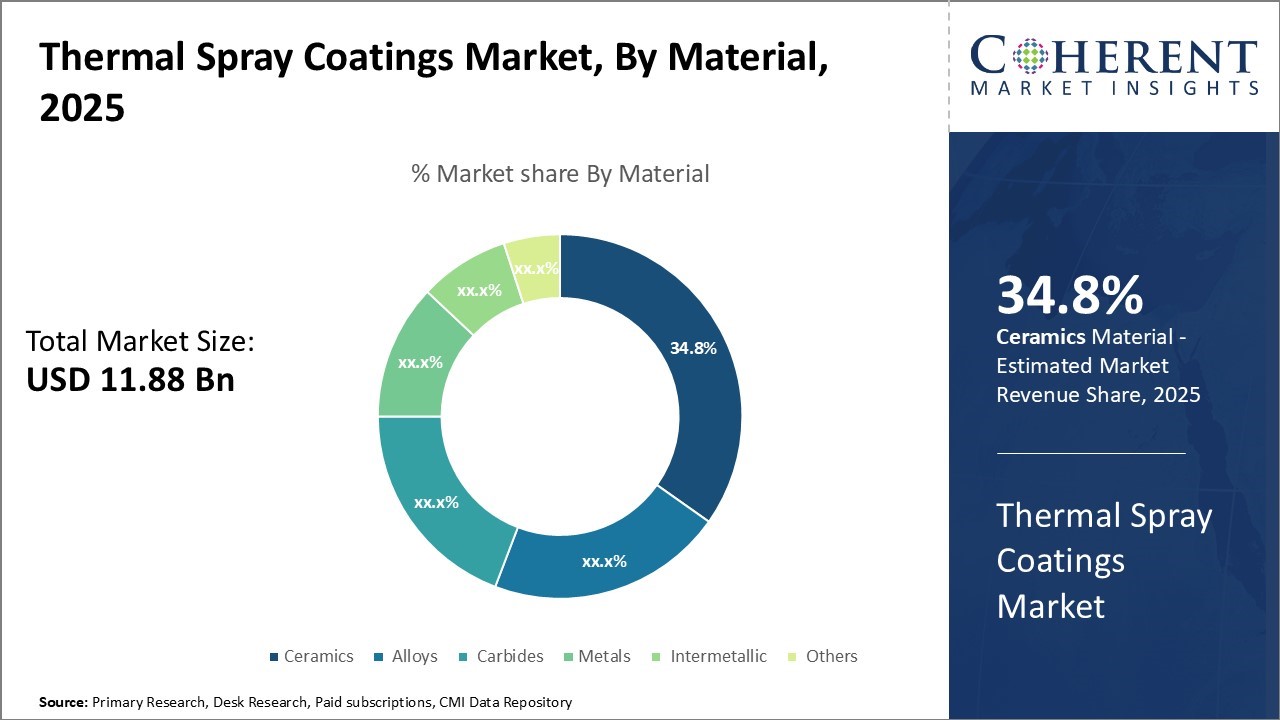
- Based on Material, the Ceramics segment is expected to lead the market with a 35.8% share in 2026, owing to its superior thermal conductivity, corrosion resistance, and durability.
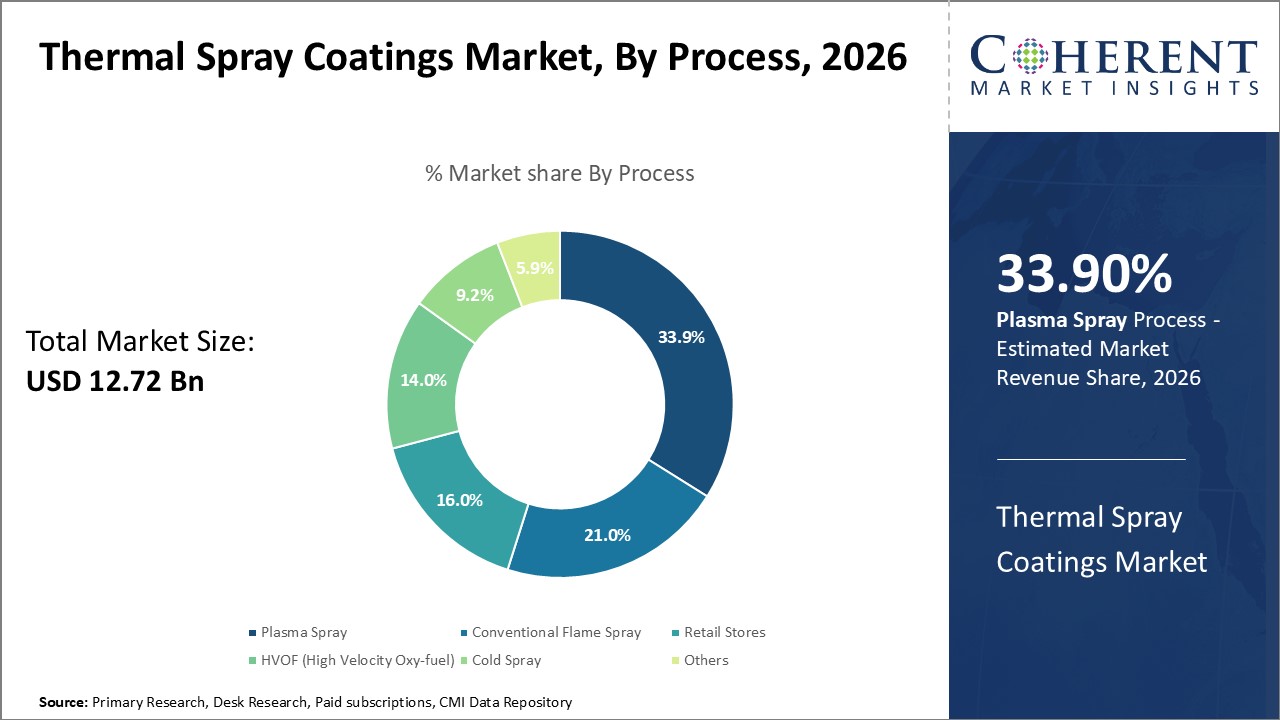
- Based on Process, the Plasma Spray segment is projected to hold a 33.9 % share in 2026, driven by its versatility, ability to spray a wide range of materials, and capacity to produce dense, high-quality coatings.
- Based on Application, the Aerospace segment is anticipated to dominate the market with a 39.1 % share in 2026, as thermal spray coatings are essential for protecting components exposed to extreme operating conditions in jet engines and aircraft structures.
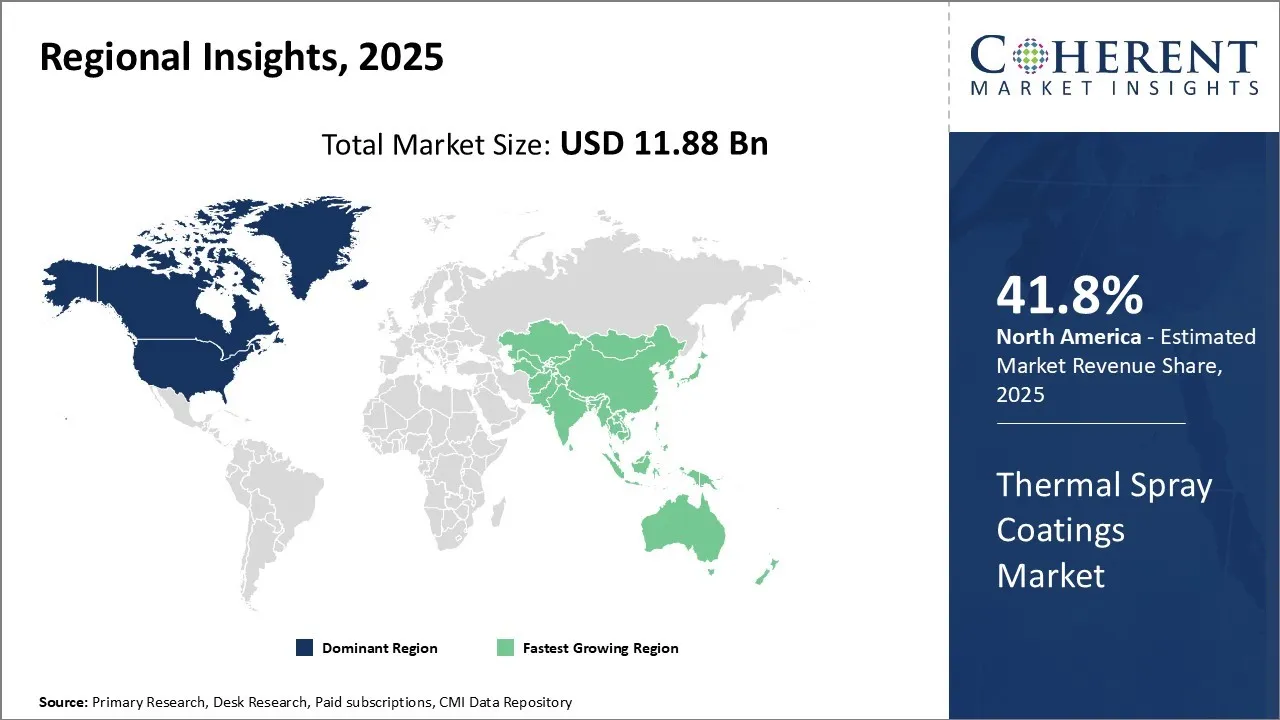
- Based on Region, North America is set to lead the global thermal spray coatings market with 41.8% share in 2026. While, Asia Pacific is anticipated to be the fastest growing region.
Market Overview
The growing infrastructure and construction industry is driving the demand for thermal spray coatings that provide protection against corrosion, abrasion, and high-temperatures. These coatings are ideal for applications in industries, such as aerospace, industrial gas turbines, automotive, and healthcare, where increased component performance and longevity are important. New product developments catering to requirements across different end-use industries will further aid the market expansion. Increasing R&D investments by key players to develop sustainable and environment-friendly thermal spray technologies will boost the adoption of these coatings.
Current Events and Its Impact
Current Events | and its impact |
Global Energy Transition and Green Technology Push |
|
China's Industrial Policy Shifts and Supply Chain Restructuring |
|
Automotive Industry Electrification and Regulatory Pressures |
|
Segmental Insights
- Current Industry Events of 2026
- Market Size Estimation
- Regional Breakdown
- Competitive Landscape
- Customer Intelligence
- Segmental Analysis
- Pricing Analysis
- Key Market Drivers, Challenges & Future Trends
- Customized Insights Section
Thermal Spray Coatings Insights, By Material - Ceramics Is Driven By Superior Thermal Conductivity And Corrosion Resistance
In terms of material, ceramics contributes 35.8% share of the market in 2026 owing to its superior thermal conductivity and corrosion resistance properties. Ceramic coatings like aluminum oxide and zirconium oxide are highly tolerant of high temperatures compared to other materials. They effectively resist heat transfer which makes them highly suitable for applications involving extreme operating temperatures like gas turbines, diesel engines, and furnace components. Ceramic coatings do not conduct electricity as well, providing vital insulation in these contexts. In addition, ceramic coatings are highly corrosion and wear resistant. The strength and durability of ceramic microstructures allow them to withstand abrasive environments and harsh chemicals found in industries like oil & gas, steel manufacturing, and pharmaceutical production. They protect metal substrates from degradation and prolong product lifecycles.
Ceramic coatings form hard, smooth surfaces that reduce friction and prevent galling, scoring or scratching. Their resistance to slurry erosion, and cavitation erosion fosters reliability in pumps, pipes, and hydro-turbine components. The bio-compatibility of certain ceramics like hydroxyapatite has also increased their use in medical implants, joint replacements and dental applications. Ceramic coatings prevent cytotoxicity and mimic natural bone structures. Their inertness avoids adverse tissue reactions while mechanical properties like high compression strength and toughness provide long-term fixation of implants. Superior tribological performance further enhances device lifetimes.
For instance, in September 2024, Neo Performance Materials, Inc. launched a next-generation zirconia-based ceramic coating with ~15% higher thermal-shock resistance for gas-turbine components.
Thermal Spray Coatings Insights, By Process - Plasma Spray Is Driven By Versatility and Quality
In terms of process, plasma spray contributes 33.9% of the market share in 2026 owing to its outstanding versatility and ability to spray a wide range of materials. Plasma spraying uses an arc or radio frequency to ionize an inert gas like argon to generate speeds over 10,000°F. This transfers kinetic energy to propel powder particles onto a substrate where they flatten and form a coating. Plasma spraying accommodates most metallic, ceramic, and some plastic powders. It produces dense coatings with low oxide contamination levels for increased corrosion and wear resistance. Plasma spraying can spray nano-sized powders to form coatings with tailored properties. It imparts less thermal stress on components than flame spraying due to its more localized heat source. This minimizes distortion and cracking.
Coatings produced by plasma spraying demonstrate high bonding strength, minimal porosity, and uniform micromorphologies. They deliver longer lifetimes in challenging use cases. The consistent, repeatable character of the plasma spray process also ensures reliable quality between batches and facilities. Overall, plasma spraying stands out versus alternative processes due its unmatched flexibility and ability to manufacture advanced, high-performance coatings.
For instance, in September 2025, Plasmatreat GmbH announced that at “The Battery Show North America 2025” they demonstrated their Openair-Plasma® and PlasmaPlus® technologies to address EV battery module surface challenges (adhesion, corrosion, insulation) using plasma processes.
Thermal Spray Coatings Insights, By Application - Aerospace Is Driven By Extreme Operating Conditions
In terms of application, aerospace contributes 39.1% of the market share in 2026 owing to thermal spray coatings playing a critical role in facilitating operations under extreme environmental conditions within jet engines and aircraft structures. Gas turbine engine components like turbine blades, nozzles, and shrouds experience harsh environments with centrifugal loads, high temperatures up to 3,000°F, and corrosion from combustion gases.
Aerospace structures are also subjected to rain, debris, and bird impacts along with temperature fluctuations between high altitude and ground operations. Thermal sprayed aluminum and anti-corrosion coatings protect aircraft skins and edges and seal fastener joints from environmental degradation. They ensure the long-term integrity of rivets and stringers. As extreme performance and reliability are essential for safety in aerospace, stringent material qualification testing is required.
Thermal spraying suppliers have developed extensive process validation to certify that coatings will perform as designed under simulated engine conditions and survive lifecycles. This technical ability and certification readiness makes thermal spraying mission critical for leading aircraft and jet engine OEMs seeking lowest cost of ownership.
For instance, in June 2024, Oerlikon established a new Advanced Coating Technology Center in Westbury, NY, to service the aerospace and industrial gas turbine industries. The facility integrates thermal-spray and PVD capabilities helping develop “next-generation high-temperature materials and coatings, for aerospace and gas turbine industries
Regional Insights
North America Thermal Spray Coatings Market Analysis & Trends
North America has been the largest and most developed regional market for thermal spray coatings globally with 41.8% of the market share in 2026. The region has a strong presence of major coating manufacturers as well as end-use industries such as aerospace, healthcare, automotive, etc. Moreover, the region has witnessed high industrial research spending over the years to develop advanced thermal spray technologies. Major manufacturing countries like the U.S. and Canada have a robust coating application infrastructure to support thermal spray coating processes for new product development as well as repair and maintenance activities.
For instance, in June 2024, Oerlikon announced the establishment of an Advanced Coating Technology Center in Westbury, New York (USA), integrating thermal spray and PVD capabilities to serve aerospace and gas turbine industries in North America
Asia Pacific Thermal Spray Coatings Market Analysis & Trends
Asia Pacific region has emerged as the fastest growing market for thermal spray coatings in recent years. The thermal spray coatings market in the region is driven by increasing industrial and manufacturing activities across industries like power generation, oil & gas, electronics, etc. Countries like China, India, Japan, and South Korea are at the forefront of this growth due to rising manufacturing output, foreign investments, and evolving coatings application needs of local industries. The availability of low-cost skilled labor and raw materials in the region allows coatings manufacturers to offer competitive pricing for thermal spray coatings. Additionally, growing exports of finished products from the region have also augmented the demand for coatings application services to maintain high product quality. Overall, strong growth momentum across key end-use sectors coupled with favorable government policies supporting local manufacturing are positioning the Asia Pacific region as the future leader in the global thermal spray coatings market.
Thermal Spray Coatings Market Outlook Country-Wise
U.S. Thermal Spray Coatings Market Trends
The U.S. thermal spray coatings market is expanding in 2026 due to strong demand from aerospace, defense, automotive, and industrial gas turbine sectors. Advanced coating solutions that provide thermal, wear, and corrosion resistance are increasingly adopted to enhance engine efficiency, protect critical components, and reduce maintenance costs. Investments in local R&D centers, facility expansions, and collaborations with OEMs are driving innovation in high-performance ceramic, metallic, and composite coatings. Regulatory pressures and the shift away from traditional coatings are further accelerating the adoption of environmentally friendly and high-durability thermal spray solutions.
For instance, in June 2024, Oerlikon announced the establishment of an Advanced Coating Technology Center in Westbury, New York (USA) to integrate thermal‑spray and PVD capabilities for aerospace and industrial gas turbine industries.
China Thermal Spray Coatings Market Trends
China’s thermal spray coatings market is growing in 2026 due to rising aerospace manufacturing, adoption of lightweight alloys, and expansion in automotive, power generation, and industrial machinery sectors. Local innovation centers and regional service facilities are enabling the development of high-performance coatings tailored to domestic industrial and aerospace applications. Increasing use of corrosion-resistant, wear-resistant, and thermal barrier coatings supports the growth of indigenous aircraft and engine programs.
For instance, in November 2024, BASF Chemetall showcased at Airshow China 2024 a one‑stop aerospace surface‑treatment portfolio, including coatings suited for aircraft structures and engine components, via its local Asia‑Pacific Innovation & Technology Center in Zhejiang Province.
Market Report Scope
Thermal Spray Coatings Market Report Coverage
| Report Coverage | Details | ||
|---|---|---|---|
| Base Year: | 2025 | Market Size in 2026: | USD 12.72 Bn |
| Historical Data for: | 2020 To 2024 | Forecast Period: | 2026 To 2033 |
| Forecast Period 2026 to 2033 CAGR: | 7.1% | 2033 Value Projection: | USD 20.57 Bn |
| Geographies covered: |
| ||
| Segments covered: |
| ||
| Companies covered: | Praxair Surface Technologies, H.C. Starck, Bodycote PLC, Oerlikon Metco, Surface Technology International Ltd, ASB Industries Inc., A&A Coatings, Flame Spray Technologies, Metallisation Ltd, TWI Ltd, Metallizing Equipment Co. Pvt. Ltd., Plasma-Tec, Inc., Integrated Global Services, Progressive Surface, FST Coatings Inc., Thermion Inc., Oerlikon Balzers, Tafa Incorporated, Metallizing Equipment Co. Pvt. Ltd., and TST Coatings, Inc | ||
| Growth Drivers: |
| ||
| Restraints & Challenges: |
| ||
Thermal Spray Coatings Market Driver
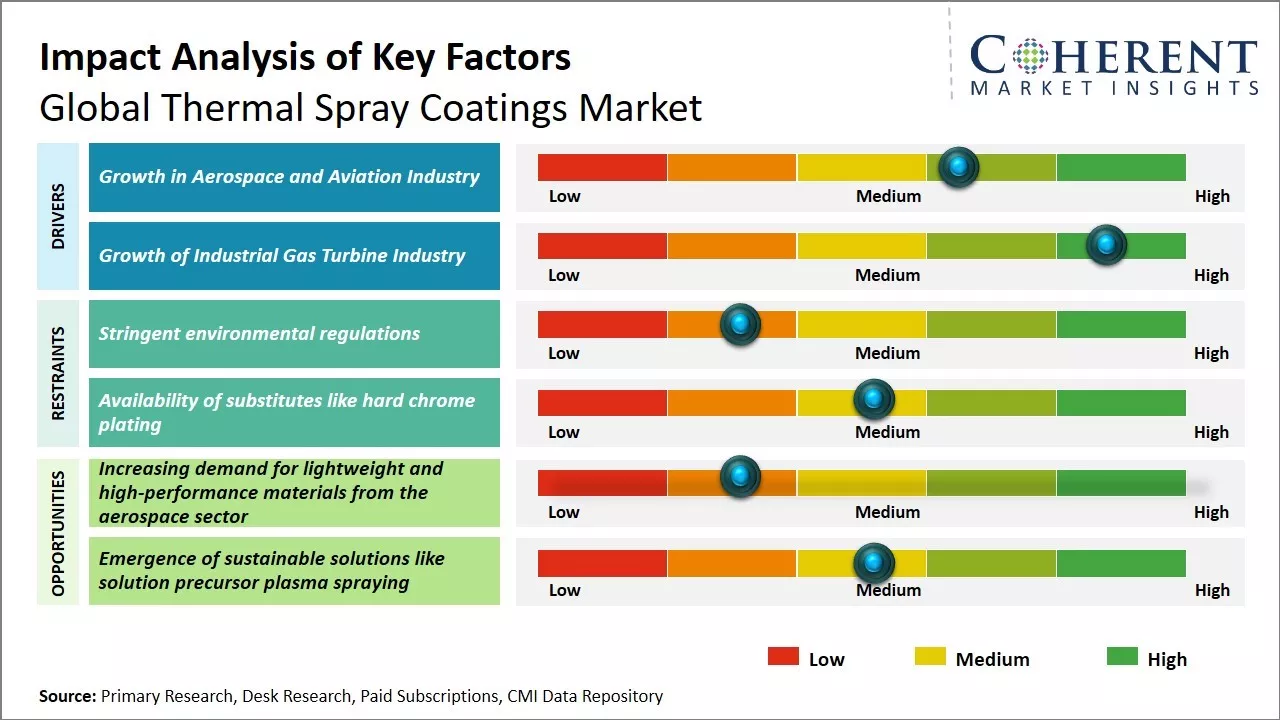
Growth of Industrial Gas Turbine Industry
Gas turbines are widely used in the power generation, marine propulsion, and oil & gas industries. In power generation, gas turbines play a crucial role in meeting rising electricity demands, especially in developing countries lacking sufficient grid infrastructure. They provide cost-effective, nimble power solutions. Furthermore, industrial gas turbines are gaining popularity in the marine sector to propel large cargo and cruise ships. In offshore oil & gas platforms as well, gas turbines reliably supply power. All key components of gas turbines that endure high stresses and temperatures, such as turbine blades, nozzles, and combustion chambers require special coatings for maximizing performance and lifespan. Thermal barrier and abradable seal coatings are essential in gas turbines. Hence, the continuous growth of the industrial gas turbine industry is propelling the demand for thermal spray materials and services across various applications and components. Many gas turbine OEMs rely on thermal spray coatings to manufacture durable, high-performance products.
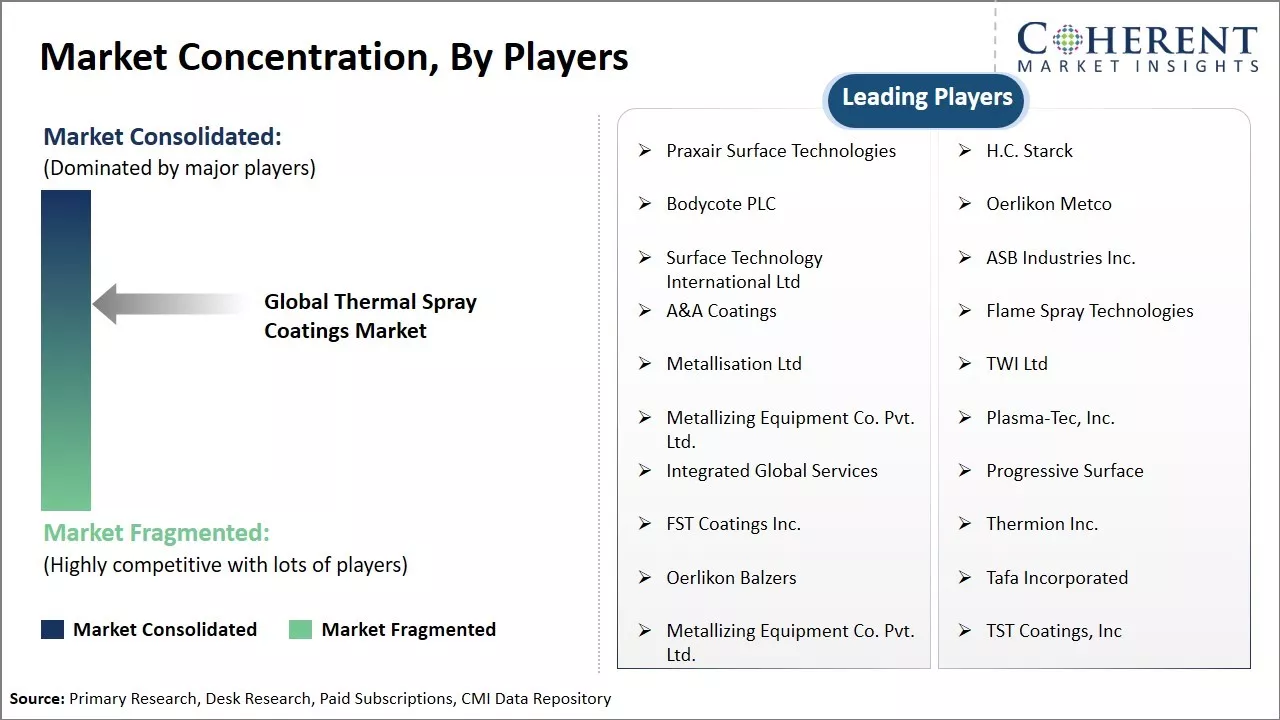
Market Concentration and Competitive Landscape
Thermal Spray Coatings Market Opportunities
Increasing demand for lightweight and high-performance materials from the aerospace sector
The increasing demand for lightweight and high-performance materials from the aerospace sector can drive growth. In addition, Thermal spray coatings offer corrosion and wear resistance and help increase product lifetime. The growing oil and gas industry and a focus on maintenance, repair and overhaul activities also offer prospects.
Analyst Opinion (Expert Opinion)
The thermal spray coatings market is entering a transformative phase driven by extreme performance requirements and the shift toward high-value, long-lifecycle components in aerospace, energy, and industrial machinery. Regulatory and operational pressures, such as the FAA’s stringent certification standards for jet engine coatings and the Department of Energy’s focus on high-efficiency gas turbines, are accelerating adoption of advanced ceramic and composite coatings. For instance, plasma-sprayed zirconia-yttria thermal barrier coatings now consistently extend turbine blade lifetimes by over 30%, reducing maintenance downtime and operational costs, while coatings like MCrAlY alloys are increasingly used to resist oxidation in gas turbines and aero engines.
Industrial players are strategically integrating in-house thermal spray capabilities with robotic automation and nano-structured powders to tailor coatings for extreme wear, corrosion, and high-temperature resistance. Companies such as Oerlikon and Sulzer are setting benchmarks by combining multi-material, functionally graded coatings with localized testing, enabling customized solutions that outperform traditional hard chrome or HVOF coatings.
End-users, particularly in aerospace and power generation, are showing clear preference for suppliers who provide not only coating performance but also reproducible, certified processes, creating a distinct competitive divide. Firms that fail to invest in precision surface engineering and process validation risk losing contracts, as engine OEMs increasingly demand coatings capable of surviving thousands of thermal cycles without delamination.
Speak to the analyst
Want personalized insights?
Take the findings above to one of our principal consultants, or have the report rebuilt around the segments, geographies and competitors you actually track.
Thermal Spray Coatings Industry News
- In March 2024, Hardide Coatings launched a new range of components with copper nozzles for High-Velocity Oxy Fuel (HVOF) thermal spray coating
- In 2023, Applied Materials India Collaborates with IIT Ropar to Establish Centre of Excellence in Thermal Spray Coatings.
- In June 2024, Oerlikon Establishes Advanced Coating Technology Center, Elevating Aerospace and Gas Turbine Industries.
Market Segmentation
- Material Insights (Revenue, USD Bn & KT, 2021 - 2033)
- Metals
- Alloys
- Carbides
- Ceramics
- Intermetallic
- Others
- Process Insights (Revenue, USD Bn & KT, 2021 - 2033)
- Conventional Flame Spray
- Plasma Spray
- Retail Stores
- HVOF (High Velocity Oxy-fuel)
- Cold Spray
- Others
- Application Insights (Revenue, USD Bn & KT, 2021 - 2033)
- Aerospace
- Industrial Gas Turbines
- Automotive
- Medical
- Others
- Regional Insights (Revenue, USD Bn & KT, 2021 - 2033)
- North America
- U.S.
- Canada
- Latin America
- Brazil
- Argentina
- Mexico
- Rest of Latin America
- Europe
- Germany
- U.K.
- Spain
- France
- Italy
- Russia
- Rest of Europe
- Asia Pacific
- China
- India
- Japan
- Australia
- South Korea
- ASEAN
- Rest of Asia Pacific
- Middle East & Africa
- GCC Countries
- Israel
- Rest of Middle East & Africa
- Key Players Insights
- Praxair Surface Technologies
- H.C. Starck
- Bodycote PLC
- Oerlikon Metco
- Surface Technology International Ltd
- ASB Industries Inc.
- A&A Coatings
- Flame Spray Technologies
- Metallisation Ltd
- TWI Ltd
- Metallizing Equipment Co. Pvt. Ltd.
- Plasma-Tec, Inc.
- Integrated Global Services
- Progressive Surface
- FST Coatings Inc.
- Thermion Inc.
- Oerlikon Balzers
- Tafa Incorporated
- Metallizing Equipment Co. Pvt. Ltd.
- TST Coatings, Inc
Sources
Primary Research Interviews from the following stakeholders
Stakeholders
- Interviews with thermal spray coating manufacturers, equipment suppliers, aerospace and automotive component OEMs, industrial maintenance heads, R&D managers, and quality control specialists across major regional markets.
Specific stakeholders
- R&D and innovation heads at leading thermal spray coating manufacturers (e.g., Oerlikon Metco, Bodycote, Praxair Surface Technologies)
- Procurement and production managers at aerospace and automotive OEMs (e.g., Boeing, Airbus, General Motors, Volkswagen)
- Operations and plant managers at industrial machinery and energy equipment providers using thermal spray coatings (e.g., turbines, pumps, dies)
- Materials engineers and process specialists in research labs and universities focused on surface engineering
- Quality assurance and inspection teams at component suppliers ensuring thermal spray coating performance under extreme conditions
- Sustainability and maintenance leads in oil & gas, power generation, and steel manufacturing sectors
- Engineers and specialists in biomedical and medical device companies applying ceramic coatings for implants
Databases
- United Nations Comtrade Database
- World Trade Organization (WTO) Trade Statistics
- Eurostat – Industrial and Materials Data
- U.S. Census Bureau – Manufacturing and Industrial Coatings Data
- China Customs Statistics
- Directorate General of Commercial Intelligence and Statistics (DGCIS), India
- Japan External Trade Organization (JETRO)
- Korea Customs Service Data Portal
- U.S. Environmental Protection Agency (EPA) – Coatings and Industrial Materials Section
- Indian Ministry of Commerce & Industry – Industrial Exports Data
Magazines
- Thermal Spray Today
- Surface Coatings International
- Coatings World
- Industrial Heating
- Advanced Materials & Processes (ASM)
- Materials Performance
- Powder Coating & Thermal Spray Journal
- Journal of Thermal Spray Technology (Magazine Section)
- Aerospace Manufacturing & Design
- Manufacturing Engineering
Journals
- Journal of Thermal Spray Technology
- Surface & Coatings Technology (Elsevier)
- Progress in Organic Coatings (POC)
- Journal of Materials Processing Technology
- Wear (Elsevier)
- Tribology International
- Materials Science and Engineering
- International Journal of Refractory Metals & Hard Materials
Newspapers
- The Wall Street Journal – Manufacturing & Aerospace
- The Economic Times – Industrial Materials & Manufacturing
- Business Standard – Engineering & Coatings Industry
- Financial Times – Industrial Innovations
- Nikkei Asia – Materials & Advanced Manufacturing
- The Hindu Business Line – Manufacturing & Aerospace
- South China Morning Post – Materials & Coatings Industry
- The Guardian – Industrial Technology and Materials
Associations
- American Thermal Spray Association (ATSA)
- International Thermal Spray Association (ITSA)
- ASM International – Surface Engineering Group
- European Thermal Spray Society (ETSS)
- Society of Automotive Engineers (SAE) – Surface Coatings Division
- American Society of Mechanical Engineers (ASME) – Materials & Surface Engineering Section
- Indian Institute of Metals (IIM) – Coatings and Surface Technology Committee
- British Surface Engineering Association (BSEA)
- Powder Metallurgy Association (PMA)
Public Domain Sources
- U.S. Department of Energy (DOE) – Industrial Coatings and Surface Engineering Reports
- European Environment Agency (EEA) – Industrial Materials and Coatings Data
- Ministry of Industry and Information Technology (MIIT), China – Industrial Coatings Policies
- Japanese Ministry of Economy, Trade and Industry (METI) – Surface Engineering Reports
- Organisation for Economic Co-operation and Development (OECD) – Industrial Materials and Technology
- Central Pollution Control Board (CPCB), India – Industrial Waste Management Data
- European Commission – Industrial Coatings and Surface Engineering Reports
- United Nations Environment Programme (UNEP) – Industrial Material Sustainability Reports
- S. National Institute of Standards and Technology (NIST) – Materials Science Publications
- Department for Promotion of Industry and Internal Trade (DPIIT), India – Industrial Coatings Initiatives
Proprietary Elements
- CMI Data Analytics Tool, and Proprietary CMI Existing Repository of information for last 8 years
*Definition: Thermal spray coatings market provides protective, corrosion, and wear resistant coatings to improve the performance and lifespan of metal components. Thermal spray coatings are applied as a molten or semi-molten material onto a substrate through processes like flame spraying, plasma spraying, or others. Common thermal spray materials include alloys of aluminum, copper, nickel, chromium, and others. They are used across industries like aerospace, automotive, oil & gas, mining, steel, turbines, and others. This market caters to large cosmetic brands as well as small and private label producers worldwide.
Get access to 250+ pages report
Every segment, forecast, competitor profile and data table behind the analysis above — available for instant download.
- ESOMAR Member
- ISO 9001:2015 Certified
- D-U-N-S Registered
- GDPR & CCPA Compliant
Missing comfort of reading report in your local language? Find your preferred language:
Transform your Strategy with Exclusive Trending Reports
Frequently Asked Questions
The Thermal Spray Coatings Market is estimated to be valued at USD 12.72 Bn in 2026, and is expected to reach USD 20.57 Bn by 2033.
The CAGR of the Thermal Spray Coatings Market is projected to be 7.1% from 2026 to 2033.
Growth in aerospace and aviation industry and growth of industrial gas turbine industry are the major factors driving the growth of global thermal spray coatings market.
Stringent environmental regulations and availability of substitutes like hard chrome plating are the major factors hampering the growth of the global thermal spray coatings market.
In terms of material, ceramics is estimated to dominate the market revenue share in 2026.
Praxair Surface Technologies, H.C. Starck, Bodycote PLC, Oerlikon Metco, Surface Technology International Ltd, ASB Industries Inc., A&A Coatings, Flame Spray Technologies, Metallisation Ltd, TWI Ltd, Metallizing Equipment Co. Pvt. Ltd., Plasma-Tec, Inc., Integrated Global Services, Progressive Surface , FST Coatings Inc., Thermion Inc. , Oerlikon Balzers , Tafa Incorporated , Metallizing Equipment Co. Pvt. Ltd., and TST Coatings, Inc are the major players.
North America is expected to lead the global thermal spray coatings market.