

North America Music Therapy Market Size and Forecast – 2026 To 2033
The North America music therapy market is expected to grow from USD 3,282.2 Mn in 2026 to USD 6,517.1 Mn by 2033, registering a compound annual growth rate (CAGR) of 10.3% from 2026 to 2033. The market for North America music therapy is poised for significant expansion, fueled by the growing demand for mental-health treatment and complementary therapeutic interventions.
According to the U.S. Centers for Disease Control and Prevention, 19.3% of U.S. adults took medication for their mental health and 14.0% received counseling or therapy from a mental-health professional in 2024, highlighting the substantial and growing need for mental-health services that can support demand for complementary approaches such as music therapy.
Key Takeaways of the North America Music Therapy Market
- Mental health and behavioral disorders are projected to hold 28.5 % of the North America music therapy market share in 2026, making it dominant application segment, supported by the substantial prevalence of mental-health conditions and the resulting need for therapeutic interventions. For instance, the U.S. Substance Abuse and Mental Health Services Administration (SAMHSA) reported that 61.5 million U.S. adults, or 23.4%, experienced any mental illness in 2024, highlighting the large addressable population for complementary approaches such as music therapy.
- Growing adoption in dementia and Alzheimer’s care – The aging population is creating demand for non-pharmacological interventions, with evidence showing music-based therapy can improve depressive symptoms and behavioral problems in people with dementia. This creates opportunities for music therapy providers in senior-care facilities, memory-care centers, and community programs.
- Expansion into autism and pediatric behavioral health – Increasing integration of music therapy into autism, developmental-disability, and child behavioral-health programs offers an underpenetrated growth opportunity across schools, pediatric hospitals, clinics, and community settings. The American Music Therapy Association specifically identifies autism and child/adolescent behavioral health as priority application areas.
Segmental Insights
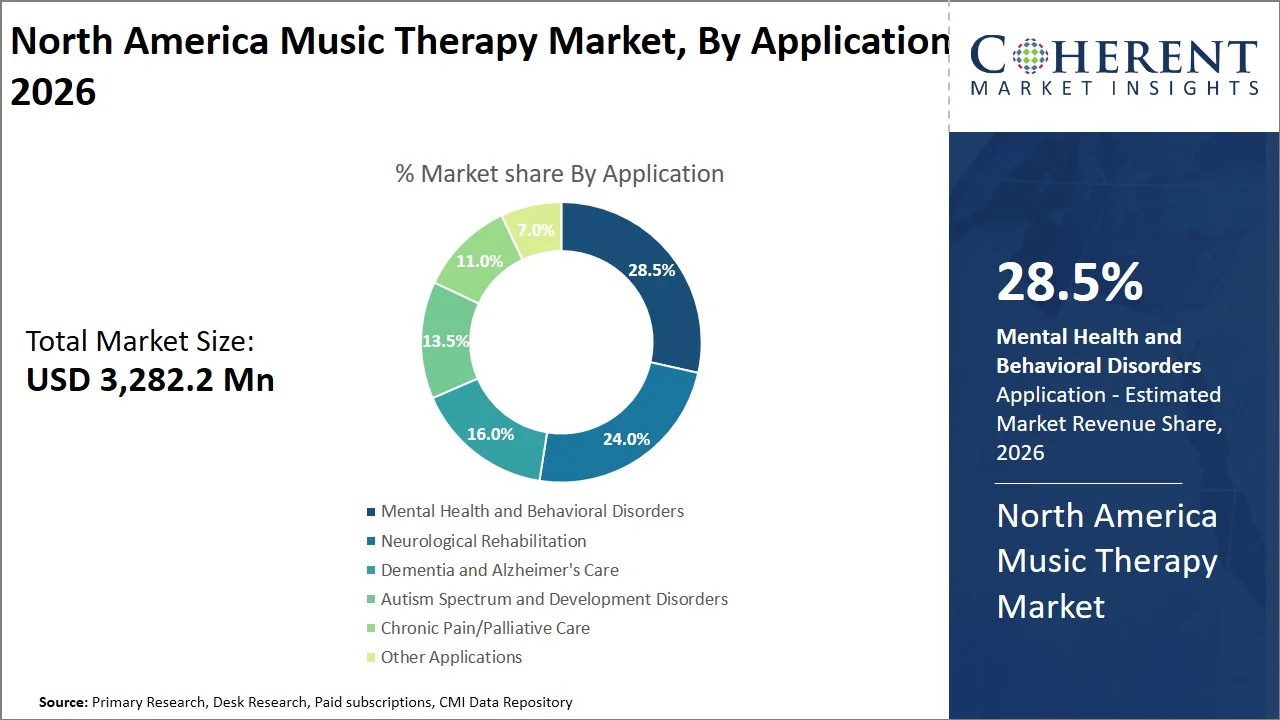
Why Do Mental Health and Behavioral Disorders Dominate the North America Music Therapy Market?
Mental health and behavioral disorders are projected to hold the market share of 28.5% in 2026, due to the growing use of non-pharmacological approaches to treat conditions such as anxiety disorders, depression, trauma, and other behavior-health concerns. Furthermore, the individually centeredness of music-based applications makes music therapy very useful to target emotional, cognitive, and social needs of varied populations. For instance, in March 2025, the U.S National Endowment for the Arts profiled an Indiana-program that integrates music therapy to augment treatment for women with substance-use disorder, underscoring the programs growing integration in the behavioral-health landscape.
- Current Industry Events of 2026
- Market Size Estimation
- Regional Breakdown
- Competitive Landscape
- Customer Intelligence
- Segmental Analysis
- Pricing Analysis
- Key Market Drivers, Challenges & Future Trends
- Customized Insights Section
Currents Events and their Impact
Current Events | Description and its Impact |
NEA Highlights VA-Funded Music Therapy Research for Chronic Pain (June 2026) |
|
Creative Forces Expands Music Therapy in Traumatic Brain Injury Care (July 2025) |
|
NEA Highlights Integration of Music Therapy into Substance-Use Treatment (March 2025) |
|
North America Music Therapy Market Dynamics
Market Drivers
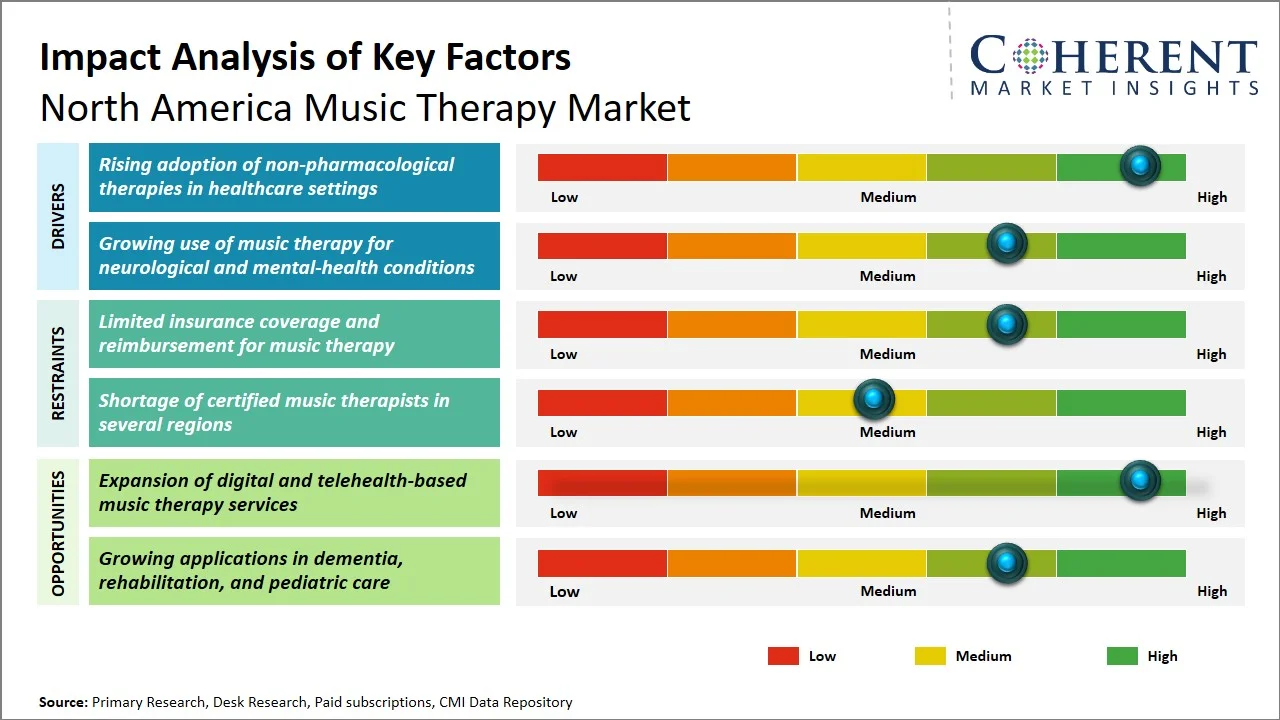
- Rising adoption of non-pharmacological therapies in healthcare settings: The rising adoption of non-pharmacological therapies in healthcare settings is supporting demand for music therapy as providers increasingly incorporate evidence-based complementary interventions into multidisciplinary care. Music therapy is being applied across mental health, neurological rehabilitation, pain management, and supportive care, offering individualized interventions without relying solely on medication. For instance, in November 2025, the U.S. Department of Veterans Affairs introduced a weekly sound-therapy intervention at the VA San Diego Healthcare System as part of its Experiential and Recreation Therapy Program, combining sensory stimulation with HRV biofeedback for veterans
- Growing use of music therapy for neurological and mental-health conditions: The growing use of music therapy for neurological and mental-health conditions is expanding its role across rehabilitation, PTSD, depression, anxiety, traumatic brain injury, and other neuropsychiatric care settings. For instance, the U.S. Department of Veterans Affairs’ national practice framework recognizes music therapy as an evidence-based clinical intervention addressing cognitive, motor, neurological, communication, and mental-health goals, supporting its integration into multidisciplinary care.
- Growing Integration of Music Therapy into Neurological Rehabilitation: The increasing integration of music therapy into neurological rehabilitation is creating new demand across stroke, Parkinson’s disease, traumatic brain injury, and other neurological conditions. Its use for motor, cognitive, speech, and emotional rehabilitation is expanding the addressable application base for music therapy. For instance, a 2025 clinical study involving a neurologic inpatient setting in Canada identified music therapy as a feasible intervention within acute neuroscience and neurorehabilitation care, with patients and healthcare professionals reporting perceived benefits for patient outcomes.
Emerging Trends
- Expansion of Telehealth and Hybrid Music Therapy: Telehealth music therapy is evolving from a pandemic-driven alternative into a supplementary care model, improving access for remote patients and supporting continuity of care. Hybrid models combining in-person and virtual sessions are expected to gain further adoption.
- Integration of Digital and Technology-Enabled Interventions: Music therapy is increasingly incorporating digital applications, adaptive technologies, and interactive tools to personalize interventions and extend therapy beyond conventional clinical settings. These technologies are particularly relevant to neurological rehabilitation and dementia care.
- Growing Application in Dementia and Neurological Care: Music therapy is expanding across dementia, Alzheimer’s disease, and neurological rehabilitation, with technology-supported interventions being explored to improve engagement, cognitive outcomes, and caregiver support. Recent research is also examining practical frameworks for delivering music therapy remotely to people with Alzheimer’s disease.
Music Therapy Workforce and Service Rates in the United States
Indicator | Latest Available Data (2025) |
Board-certified music therapists | 9,483 |
Average individual session rate | USD 62.06/hour |
Average group session rate | USD 67.49/hour |
Average assessment rate | USD 77.50/hour |
How is the expansion of digital and telehealth-based music therapy services creating new growth opportunities in the North America music therapy market?
The growth of digital and telehealth-based music therapy provides opportunities to expand music therapy services beyond a traditional, in-person setting and provides increased accessibility for those in rural, underserved populations. Telehealth music therapy has also benefitted for the continuation of services for clients with impaired mobility and those in long-term rehabilitation. For instance, to accommodate the new initiatives to better care for veterans and expand telehealth access in creative arts, the U.S. Department of Veterans Affairs is offering telehealth through VA Video Connect that permit eligible veterans to engage in therapy program activities from their own residence.
Market Players, Key Development, and Competitive Landscape
Key Developments
- In May 2025, Rhythm & Relief launched a national umbrella initiative in the U.S. to support nonprofit organizations using music therapy and music-based interventions to improve health and well-being. The initiative brings together organizations providing services across healthcare and community settings, potentially expanding funding and visibility for music therapy programs.
- In May 2022, Biogen and MedRhythms entered into a license agreement to develop and commercialize MR-004, an investigational prescription digital therapeutic combining sensors, software, and music-based rhythmic auditory stimulation to address gait deficits in people with multiple sclerosis. The agreement included a USD 3 million upfront payment and up to USD 117.5 million in potential development and commercial milestones, highlighting growing investment in technology-enabled music therapy for neurological rehabilitation.
Competitive Landscape
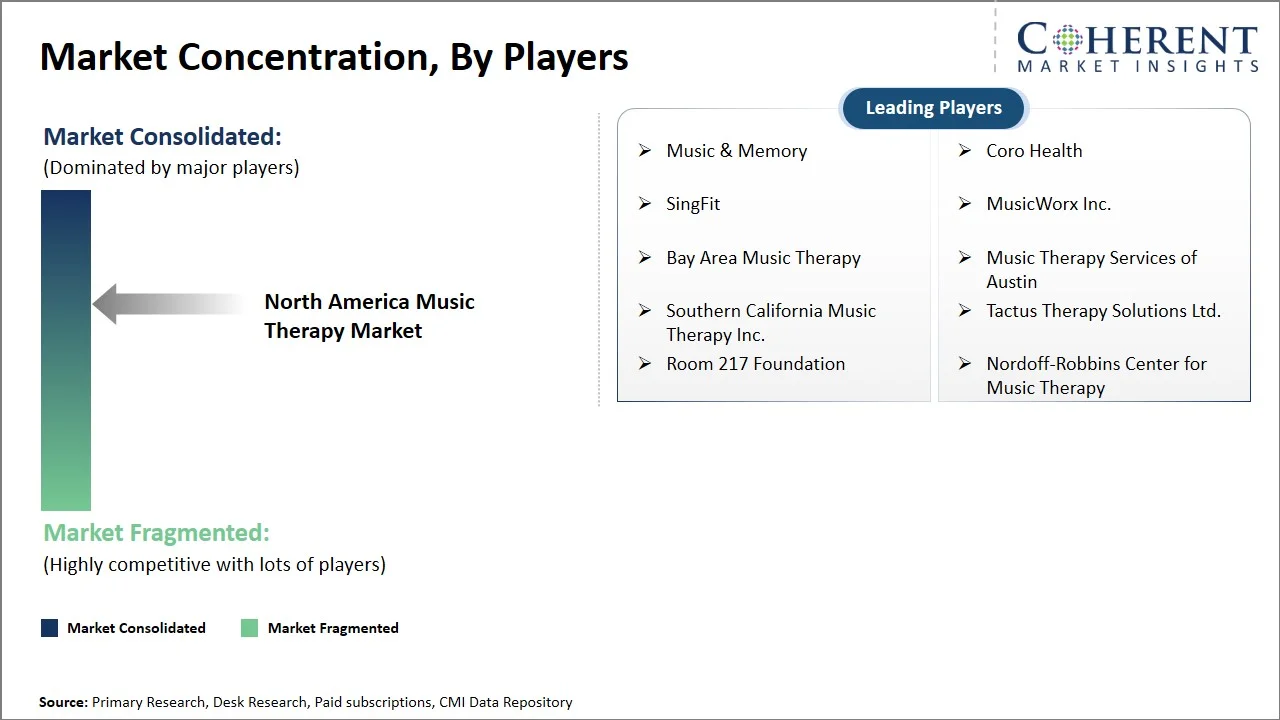
The North America music therapy market is moderately fragmented, with competition centered on clinical specialization, certified therapist availability, evidence-based outcomes, digital delivery capabilities, and expansion across healthcare and community settings. Leading providers and organizations are strengthening their positions by broadening clinical applications, developing technology-enabled services, and building partnerships with hospitals, rehabilitation centers, senior-care facilities, and behavioral-health providers. Key focus areas include:
- Expansion of music therapy services across mental health, neurological rehabilitation, dementia care, developmental disorders, and pain management
- Integration of telehealth and hybrid music therapy models to expand access and continuity of care
- Development of technology-enabled and personalized music therapy interventions using digital platforms and interactive tools
- Strengthening evidence-based clinical protocols and outcome measurement to demonstrate therapeutic effectiveness
- Expansion of services into hospitals, rehabilitation centers, long-term care facilities, schools, and community healthcare settings
Market Report Scope
North America Music Therapy Market Report Coverage
| Report Coverage | Details | ||
|---|---|---|---|
| Base Year: | 2025 | Market Size in 2026: | USD 3,282.2 Mn |
| Historical Data for: | 2020 To 2024 | Forecast Period: | 2026 To 2033 |
| Forecast Period 2026 to 2033 CAGR: | 10.3% | 2033 Value Projection: | USD 6,517.1 Mn |
| Segments covered: |
| ||
| Companies covered: | Music & Memory, Coro Health, SingFit, MusicWorx Inc., Bay Area Music Therapy, Music Therapy Services of Austin, Southern California Music Therapy Inc., Tactus Therapy Solutions Ltd., Room 217 Foundation, Nordoff-Robbins Center for Music Therapy | ||
| Growth Drivers: |
| ||
| Restraints & Challenges: |
| ||
Analyst Opinion (Expert Opinion)
- In the coming years, North America music therapy market will increasingly shift from conventional in-person sessions toward integrated, evidence-based and technology-enabled care models. Hybrid delivery, digital tools, and personalized interventions are likely to become important complements to in-person therapy, while stronger clinical validation should support broader integration into mainstream healthcare.
- The maximum opportunities will probably exist within mental health & behavioral disorders in the U.S., where providers can target anxiety, depression, trauma, and stress-related conditions through structured music-based interventions. A secondary opportunity lies in neurological rehabilitation in the U.S., particularly for stroke, Parkinson's disease, and traumatic brain injury, where music-based rhythmic interventions can be incorporated into rehabilitation pathways.
- In order to obtain a competitive advantage, market participants should prioritize clinical differentiation and measurable outcomes rather than competing primarily on session availability. Developing standardized protocols, building partnerships with hospitals and rehabilitation providers, expanding hybrid/telehealth capabilities, and investing in therapist specialization can help establish stronger referral networks and improve payer and provider acceptance.
Speak to the analyst
Want personalized insights?
Take the findings above to one of our principal consultants, or have the report rebuilt around the segments, geographies and competitors you actually track.
Market Segmentation
- Application Insights (Revenue, USD Mn, 2021 - 2033)
- Mental Health and Behavioral Disorders
- Neurological Rehabilitation
- Dementia and Alzheimer's Care
- Autism Spectrum and Development Disorders
- Chronic Pain/Palliative Care
- Other Applications
- Key Players Insights
- Music & Memory
- Coro Health
- SingFit
- MusicWorx Inc.
- Bay Area Music Therapy
- Music Therapy Services of Austin
- Southern California Music Therapy Inc.
- Tactus Therapy Solutions Ltd.
- Room 217 Foundation
- Nordoff-Robbins Center for Music Therapy
Sources
Primary Research Interviews
- Board-certified music therapists (MT-BCs) and clinical music therapy practitioners
- Directors of music therapy programs at hospitals and rehabilitation centers
- Neurologic music therapy specialists and rehabilitation professionals
- Mental-health and behavioral-health clinicians using music therapy
- Dementia and geriatric-care specialists
- Pediatric and developmental-disorder music therapists
- Music therapy researchers and clinical-trial investigators
Stakeholders
- Music therapy service providers and private practices
- Hospitals and rehabilitation centers
- Long-term care and senior-care facilities
- Mental-health and behavioral-health centers
- Schools and special-education institutions
- Digital health and telehealth music therapy providers
- Music therapy research institutions and universities
- Insurance companies and healthcare payers
- End-use Sectors
- Mental Health and Behavioral Disorders
- Neurological Rehabilitation
- Dementia and Alzheimer's Care
- Autism Spectrum and Developmental Disorders
- Chronic Pain and Palliative Care
- Pediatric and Adolescent Care
- Hospitals and Rehabilitation Centers
- Long-Term Care and Senior-Care Facilities
- Schools and Special-Education Settings
- Regulatory & Health Bodies
- U.S. Department of Veterans Affairs (VA)
- U.S. Department of Health and Human Services (HHS)
- Centers for Medicare & Medicaid Services (CMS)
- State Departments of Health and professional licensing boards
- Canadian Ministry/Departments of Health
- Health Canada
- U.S. National Institutes of Health (NIH)
Databases
- ClinicalTrials.gov – music therapy and music-based clinical studies
- NIH RePORTER – federally funded music therapy and arts-health research
- National Library of Medicine – music therapy research literature
- VA Research Database – music-based interventions and veteran healthcare research
- Statistics Canada – healthcare, mental-health, and aging statistics
- U.S. Census Bureau – population and demographic statistics
- CDC – mental-health, neurological, and chronic-disease statistics
Associations
- American Music Therapy Association (AMTA)
- Certification Board for Music Therapists (CBMT)
- Canadian Association of Music Therapists (CAMT)
- American Psychological Association (APA)
- American Academy of Neurology (AAN)
- American Geriatrics Society (AGS)
- National Association of Music Merchants (NAMM)
- Society for Music Perception and Cognition (SMPC)
Public Domain Sources
- U.S. Department of Veterans Affairs – Music Therapy National Standards of Practice
- National Institutes of Health – Music and health research
- Centers for Disease Control and Prevention – Mental-health and chronic-disease data
- Centers for Medicare & Medicaid Services – Healthcare utilization and reimbursement data
- U.S. National Endowment for the Arts – Arts and health research and programs
- Health Canada – Mental-health and healthcare statistics
- Statistics Canada – Population health and demographic data
- American Music Therapy Association – Professional standards and workforce information
- Certification Board for Music Therapists – Certification and professional practice data
Proprietary Elements
- CMI Data Analytics Tool, Proprietary CMI Existing Repository of information for last 10 years.
Get access to 250+ pages report
Every segment, forecast, competitor profile and data table behind the analysis above — available for instant download.
- ESOMAR Member
- ISO 9001:2015 Certified
- D-U-N-S Registered
- GDPR & CCPA Compliant
Missing comfort of reading report in your local language? Find your preferred language:
Transform your Strategy with Exclusive Trending Reports
Frequently Asked Questions
Music-based rhythmic and auditory interventions can support motor, speech, cognitive, and coordination-related rehabilitation.
It can support memory, mood, communication, social engagement, and behavioral well-being among people with dementia and Alzheimer's disease.
Music therapy can help reduce perceived pain, anxiety, and emotional distress while supporting comfort and quality of life.
It supports communication, social interaction, emotional expression, sensory regulation, and developmental skills.
Common interventions include receptive listening, active music-making, songwriting, improvisation, movement with music, and guided imagery.
Certified music therapists assess patient needs, develop individualized interventions, deliver therapy, and evaluate therapeutic outcomes.
Digital platforms, interactive tools, sensors, and data-driven systems are enabling more personalized, measurable, and accessible music therapy.