

U.S. Home Healthcare Market Size And Share Analysis - Growth Trends And Forecasts (2026-2033)
U.S. Home Healthcare Market is estimated to be valued at USD 28.32 Bn in 2026 and is expected to reach USD 44.01 Bn in 2033, exhibiting a compound annual growth rate (CAGR) of 6.5% from 2026 to 2033.
Key Takeaways
- Based on Service, the Skilled Home Healthcare Services segment leads the market holding the largest share in 2026, due to the aging population, rising chronic diseases, and the need for post-acute care that reduces hospital readmissions.
- Based on Equipment, the Therapeutic equipment segment leads the market holding an estimated share of 41% in 2026, due to growing demand for cost-effective and value-based care.
Market Overview
The U.S. Home Healthcare market is experiencing strong growth due to the rise in burden of chronic diseases and growing geriatric (aging) population in the U.S. Moreover, increasing demand for better healthcare services and increase in preference for personalized care is expected to boost growth of the market.
Current Events and their Impact on the U.S. Home Healthcare Market
Current Event | Description and its Impact |
Demographic and Social Trends |
|
Geopolitical and Supply Chain Factors |
|
Telehealth Integration in U.S. Home Healthcare Market
The U.S. Home Healthcare market is increasingly shaped by the rapid integration of telehealth technologies, enabling more efficient, accessible, and cost-effective care delivery. Telehealth platforms allow healthcare providers to conduct virtual consultations, monitor patients remotely, and adjust treatment plans without requiring frequent in-person visits. This integration is particularly beneficial for managing chronic conditions such as diabetes, heart disease, and COPD, where continuous monitoring and timely interventions are critical. The use of remote patient monitoring (RPM) devices, wearable sensors, and AI-driven analytics helps detect health anomalies early, reducing hospital readmissions and improving patient outcomes.
For instance, in July 2025, Four U.S. health systems spotlighted at the AHA Leadership Summit have demonstrated the effectiveness of hospital-at-home and behavioral telehealth models in improving outcomes, reducing readmissions and expanding equitable access, the American Hospital Association. Advocate Health rolled out its program in just ten days during the pandemic, now serving over 16,500 patients across 12 facilities, cutting readmissions to 0.93%. Mass General Brigham achieved a 7% 30-day readmission rate well below the 23% seen in traditional hospitals and earned patient satisfaction scores exceeding Apple’s. Ohio State’s program lowered readmissions and achieved 95% patient satisfaction, while Iris Telehealth cut psychiatric ED wait times by 60% and improved depression outcomes by 38%
- Current Industry Events of 2026
- Market Size Estimation
- Regional Breakdown
- Competitive Landscape
- Customer Intelligence
- Segmental Analysis
- Pricing Analysis
- Key Market Drivers, Challenges & Future Trends
- Customized Insights Section
Segmental Insights
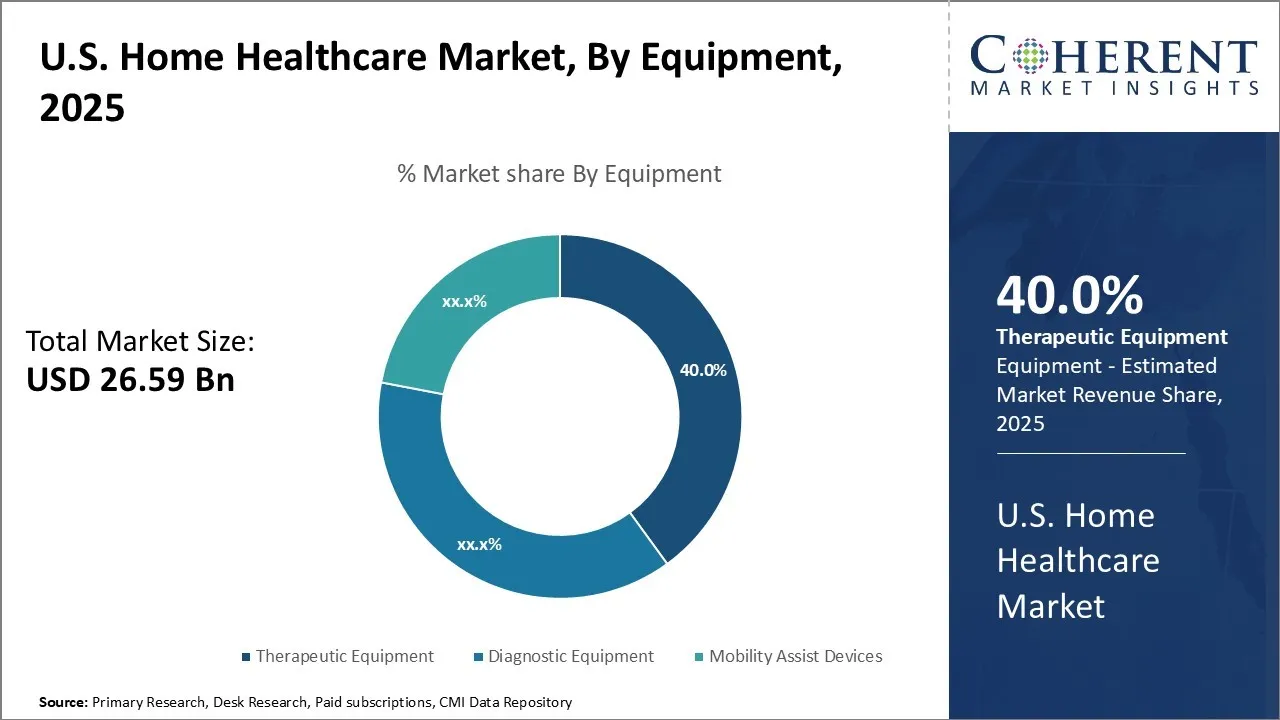
U.S. Home Healthcare Market Insights, By Equipment: Therapeutic Equipment is highest scoring Due to Growing Demand for Cost-Effective and Value Based Care
In terms of equipment, the therapeutic equipment segment is expected to dominate the market with 41.0% share in 2026, due to a growing elderly population, increasing chronic illnesses, and the shift toward cost-effective, value-based care. Devices like oxygen concentrators, CPAP machines, and mobility aids enable effective treatment at home, reducing hospital readmissions. Technological advancements in portable, user-friendly equipment and telehealth integration further boost adoption and improve patient convenience.
For instance, in June 2025, Inogen, Inc. unveiled the Voxi 5, a new stationary oxygen concentrator (SOC) tailored for long-term care patients in the U.S. The device delivers continuous flow oxygen at 1-5 L/min, combining quiet operation, compact design with lockable caster wheels, and medical-grade purity (87–96%). It features an eight-layer internal filtration pathway and comes with a 3-year sieve bed warranty, offering a durable and affordable home oxygen solution.
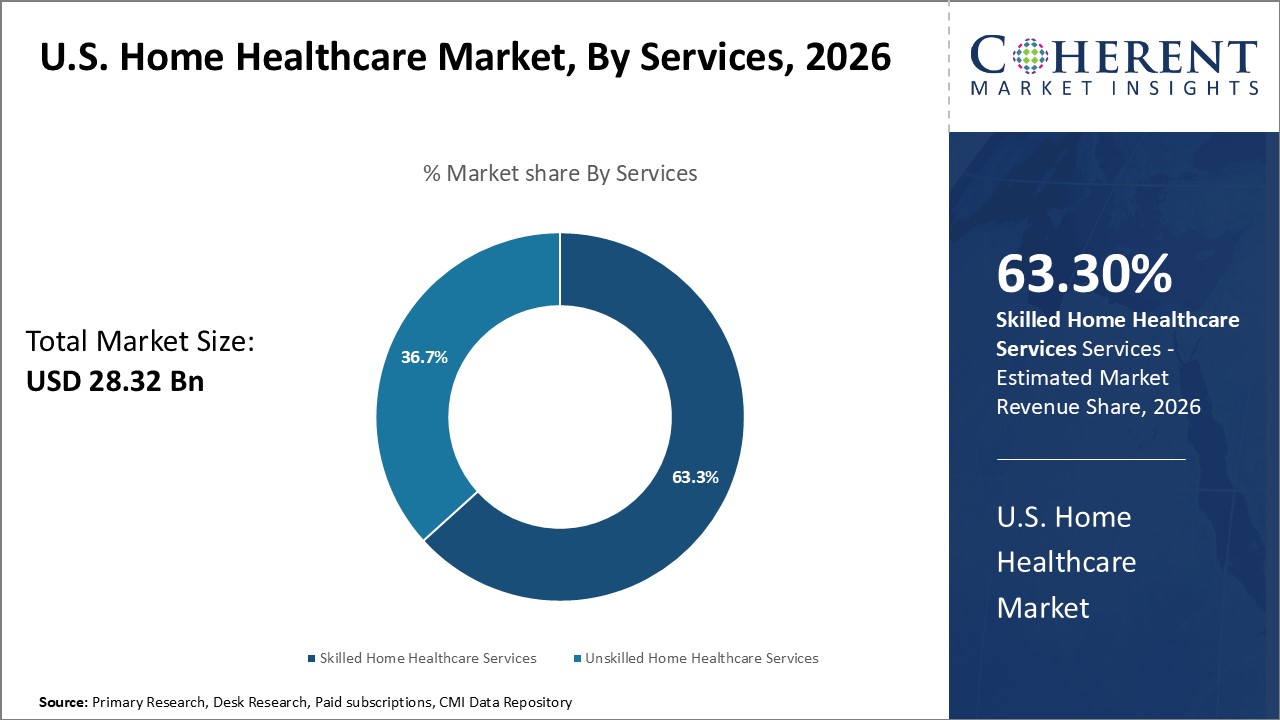
U.S. Home Healthcare Market Insights, By Services: Skilled Home Healthcare Services holds the largest share on account of Aging Population and Rising Chronic disease Surges the Demand
In terms of services, the skilled home healthcare services segment is expected to dominate the U.S. Home Healthcare market in 2026. Hospitals in the U.S. are driving demand for skilled home healthcare services due to the aging population, rising chronic diseases, and the need for post-acute care that reduces hospital readmissions. Skilled services such as nursing, therapy, and wound care enable faster recovery, improve patient outcomes, and free hospital capacity. Value-based care models further encourage shifting complex treatments to home settings, while telehealth and remote monitoring technologies enhance efficiency and reach of skilled providers. This combination of demographic, clinical, and technological factors is making skilled home healthcare an essential part of the U.S. healthcare system.
For instance, in April 2025, Hackensack Meridian Health, New Jersey’s largest health network, teamed up with Equum Medical and AvaSure to roll out a Virtual Nursing Program designed to improve patient care and support bedside staff. The initiative integrates virtual nurses to assist with admissions, mentoring, and discharge support, allowing on-site clinicians to focus on high-acuity care.
Market Report Scope
U.S. Home Healthcare Market Report Coverage
| Report Coverage | Details | ||
|---|---|---|---|
| Base Year: | 2025 | Market Size in 2026: | USD 28.32 Bn |
| Historical Data for: | 2020 To 2024 | Forecast Period: | 2026 To 2033 |
| Forecast Period 2026 to 2033 CAGR: | 6.5% | 2033 Value Projection: | USD 44.01 Bn |
| Segments covered: |
| ||
| Companies covered: | Medline Industries Inc., Medtronic Plc, 3M Healthcare, Baxter International Inc., B. Braun Melsungen AG, Hoffman-La Roche AG, and Nxstage Medical (Fresenius Medical Care) | ||
| Growth Drivers: |
| ||
| Restraints & Challenges: |
| ||
U.S. Home Healthcare Market Drivers
- High prevalence of chronic diseases to propel market growth
One of the key factors expected to augment growth of the U.S. Home Healthcare market during the forecast period is the rise in burden of chronic diseases in the region. Such a high burden of chronic diseases leads to an increase in demand for home healthcare services and is expected to boost the market growth. According to the U.S. Centers for Disease Control and Prevention (CDC), chronic diseases, such as heart disease, cancer, and diabetes, are the leading causes of death and disability in the United States. Moreover, 6 in 10 individuals in the U.S. live with at least one chronic disease, like heart disease and stroke, cancer, or diabetes. An estimated 129 million people in the US have at least 1 major chronic disease, such as heart disease, cancer, diabetes, obesity, hypertension, as defined by the US Department of Health and Human Services.
- Growing geriatric population to underpin market growth
Another factor which is driving growth of the U.S. Home Healthcare market is the growing geriatric (aging) population in the U.S. For instance, the population is aging rapidly due to a decrease in the birth rate and increase in life expectancy, and may result in high prevalence of chronic diseases, which in turn increases demand for home health services/solutions. According to the U.S. Census Bureau, more than 56 million adults ages 65 and older live in the U.S., accounting for about 16.9% of the nation’s population. Moreover, the total number of adults ages 65 and older is projected to rise to an estimated 85.7 million by 2050 (22% of the overall population), further enhancing the U.S. home healthcare market share.
U.S. Home Healthcare Market Opportunities
The U.S. home healthcare market is set to benefit significantly from policy and technology advancements in 2025. The proposed legislation (S.2237/H.R.4313) to extend the Hospital-at-Home model through 2030 represents a major step toward transforming healthcare delivery by enabling patients to receive acute, hospital-level care in their own homes. This initiative can help reduce hospital overcrowding, lower treatment costs, improve patient comfort, and allow hospitals to focus resources on the most critical cases.
At the same time, AI-powered tools and remote patient monitoring (RPM) are revolutionizing home-based care. Wearable sensors, connected devices, and AI-driven analytics enable continuous tracking of vital signs, early detection of health deterioration, personalized treatment planning, and reduced hospital readmissions. These technologies are particularly valuable in managing chronic conditions such as diabetes, heart failure, and COPD, key drivers of home healthcare demand in the U.S.
For instance, in June 2025, Prevounce Health, a leader in remote care management, unveiled its new AI Insights feature. Powered by trained generative AI, the functionality analyzes RPM device readings alongside CCM and APCM clinical notes to deliver intelligent health summaries and care recommendations directly within patient charts.
U.S. Home Healthcare Market Trends
- High demand for home-use therapeutic devices is a recent trend
With the burden of chronic diseases increasing and healthcare infrastructure and resources limited, home healthcare can help meet a portion of the current healthcare need/requirement. For instance, in March 2025, ResMed, the health-technology leader in sleep, breathing, and home care, today introduced a bold brand evolution consolidating its product and service portfolio under a single “ResMed” identity. Building on its 35-year legacy of innovation from CPAP to pioneering cloud-connected digital health, the company’s refreshed visual identity, logo, and brand voice aim to boost accessibility and consumer engagement.
- Rise in adoption of at-home, self-testing solutions is another trend
With the help of at-home, self-administered testing kits or solutions, players in the market are able to support chronic and preventive care virtually and in patients' homes while facilitating patient-centric primary care experiences for a wider range of medical conditions. Thus, there is an increase in demand for such home-use equipment. This trend is also expected to continue over the forecast period, driving the growth of the U.S. Home Healthcare market. For instance, in August 2025, Nonin Medical launched the Nonin Health platform, a cloud-based solution enabling self-testing of overnight pulse oximetry at home. Patients connect the trusted WristOx2 Model 3150 via Bluetooth to an Android or iOS app, conducting overnight SpO₂ tests with minimal hassle.
Analyst Opinion (Expert Opinion)
The U.S. Home Healthcare Market value is demonstrating a pronounced shift toward technologically integrated, outcome-driven care models, which is reshaping patient management and provider operations alike. A significant driver of this transformation is the adoption of remote patient monitoring (RPM) and connected care platforms. For instance, nearly 28% of Medicare Advantage plans have integrated RPM services in 2024, emphasizing proactive intervention and chronic disease management. Providers leveraging AI-enabled analytics are observing measurable reductions in hospital readmissions, with some large-scale programs reporting up to a 22% decline in 30-day readmissions among congestive heart failure and COPD patients.
The rising incorporation of specialized nursing and therapy services within home settings. Agencies investing in targeted clinical expertise, such as post-surgical orthopedic care, are achieving higher patient satisfaction and lower costs per episode, reflecting a growing recognition that quality outcomes are increasingly tied to clinician specialization rather than generic home care services.
Furthermore, payer strategies are beginning to favor value-based reimbursement models, which inherently incentivize measurable patient outcomes over service volume. Health systems experimenting with bundled payments for home care interventions have reported an average cost reduction of 15–18% in post-acute care episodes, indicating that sophisticated home healthcare models can meaningfully reduce systemic healthcare expenditure while maintaining quality standards.
Speak to the analyst
Want personalized insights?
Take the findings above to one of our principal consultants, or have the report rebuilt around the segments, geographies and competitors you actually track.
U.S. Home Healthcare Market: Key Developments
- In July 2025, HealthSure 3X has introduced a virtual in-home medical services platform aimed at enhancing access to quality healthcare. The platform connects individuals with licensed medical professionals through secure video consultations and encrypted messaging, facilitating real-time interactions for various health needs. Services offered include mental health support, chronic disease management, and pediatric care.
- In April 2024, the U.S. Food and Drug Administration’s Center for Devices and Radiological Health (CDRH) today unveiled its “Home as a Health Care Hub” initiative, reimagining the home as a central hub in the health-care system. Accelerated by challenges such as provider shortages, high costs, and inequities across rural and underserved communities, the initiative brings care into patients' homes using integrated medical-device environments.
- In July 2024, the Accreditation Commission for Health Care (ACHC) has unveiled two specialty credentials to elevate home-based care standards. The Distinction in Age-Friendly Care for Home Health and Hospice honors organizations that excel in delivering elder-centered services through the 4Ms framework: What Matters, Medication, Mentation, and Mobility which enhances patient outcomes and satisfaction.
Market Segmentation
- U.S. Home Healthcare Market, By Services (Revenue, USD Bn, 2021 - 2033)
- Skilled Home Healthcare Services
- Physician/Primary Care
- Nursing Care
- Physical/Occupational/Speech Therapy
- Nutritional Support
- Hospice & Palliative Care
- Others
- Unskilled Home Healthcare Services
- Skilled Home Healthcare Services
- U.S. Home Healthcare Market, By Equipment (Revenue, USD Bn, 2021 - 2033)
- Therapeutic Equipment
- Home Respiratory Therapy Equipment
- Insulin Delivery Devices
- Home IV Pumps
- Home Dialysis Equipment
- Other Therapeutic Equipment
- Diagnostic Equipment
- Diabetic Care Unit
- BP Monitors
- Multi Para Diagnostic Monitors
- Home Pregnancy & Fertility Kits
- Apnea & Sleep Monitors
- Holter Monitors
- Heart Rate Monitors
- Other Diagnostic Equipment
- Mobility Assist Devices
- Wheelchair
- Home Medical Furniture
- Walking Assist Devices
- Therapeutic Equipment
- U.S. Home Healthcare Market: Key Companies Insights (Revenue, USD Bn, 2021 - 2033)
- Medline Industries Inc.
- Medtronic Plc
- 3M Healthcare
- Baxter International Inc.
- Braun Melsungen AG
- Hoffman-La Roche AG
- Nxstage Medical (Fresenius Medical Care)
Sources
Primary Research Interviews from the following stakeholders
Stakeholders
Interviews with home healthcare providers, visiting nurse agencies, telehealth service providers, medical device suppliers, hospital discharge planners, insurance payers, and procurement heads across leading U.S. states.
Specific Stakeholders
- Clinical leads and operations managers at home healthcare agencies
- Telehealth program managers at hospital networks and clinics
- Procurement heads for durable medical equipment (DME) and remote monitoring devices
- Insurance and payer representatives overseeing home care coverage
- IT and digital health leads implementing remote patient monitoring solutions
- Product managers at medical device OEMs
Databases
- U.S. Bureau of Economic Analysis (BEA)
- U.S. Census Bureau – Health & Housing Data
- Centers for Medicare & Medicaid Services (CMS) – Home Health Compare Database
- National Center for Health Statistics (NCHS)
- HealthData.gov
- U.S. Food & Drug Administration (FDA) – Medical Device Registrations
Magazines
- Home Health Care News
- Healthcare IT News
- mHealth Intelligence
- Telehealth and Medicine Today
- HomeCare Magazine
- Becker’s Hospital Review – Home Health Section
Journals
- Journal of Home Health Care Management & Practice
- Telemedicine and e-Health
- Home Health Care Services Quarterly
- Journal of Medical Internet Research (JMIR) – Telehealth
- Health Services Research
Newspapers
- The Wall Street Journal – Health & Technology
- The New York Times – Health & Wellness
- The Washington Post – Health Section
- The Boston Globe – Healthcare News
- Los Angeles Times – Health & Medicine
Associations
- National Association for Home Care & Hospice (NAHC)
- American Telemedicine Association (ATA)
- Home Care Association of America (HCAOA)
- National Council for Home Care & Services (NCHCS)
- American Nurses Association (ANA) – Home Health Division
Public Domain Sources
- U.S. Department of Health & Human Services (HHS)
- Centers for Disease Control and Prevention (CDC)
- National Institutes of Health (NIH)
- Medicare.gov – Home Health Compare Data
- Agency for Healthcare Research and Quality (AHRQ)
- U.S. Government Accountability Office (GAO) Reports on Home Health
Proprietary Elements
- CMI Data Analytics Tool, and Proprietary CMI Existing Repository of information for last 8 years
*Definition: Home healthcare refers to a wide range of healthcare services that can be given in at home for illness or injury. These services include various equipment and therapies along with software to help the physicians to plan efficient treatment procedures in the home-care settings.
Get access to 250+ pages report
Every segment, forecast, competitor profile and data table behind the analysis above — available for instant download.
- ESOMAR Member
- ISO 9001:2015 Certified
- D-U-N-S Registered
- GDPR & CCPA Compliant
Missing comfort of reading report in your local language? Find your preferred language:
Transform your Strategy with Exclusive Trending Reports
Frequently Asked Questions
The U.S. Home Healthcare Market is estimated to be valued at USD 28.32 Bn in 2026, and is expected to reach USD 44.01 Bn by 2033.
The CAGR of the U.S. Home Healthcare Market is projected to be 6.5% from 2026 to 2033.
Rise in burden of chronic diseases and growing geriatric (aging) population in the U.S.is fuelling growth of the market.
The Therapeutic Equipment segment is the leading component segment in the market.
Risks associated with home healthcare equipment and lack of skilled/trained workforce are major factors restraining growth of the market.
Major players operating in the market are Medline Industries Inc., Medtronic Plc, 3M Healthcare, Baxter International Inc., B. Braun Melsungen AG, Hoffman-La Roche AG, and Nxstage Medical (Fresenius Medical Care), among others.
Governed by CMS, HIPAA, and state-specific licensing, ensuring patient safety, data privacy, and quality of care standards.