

Global Occupancy Sensor Market Size and Forecast – 2026-2033
The global occupancy sensor market is estimated to be valued at USD 4.36 Bn in 2026 and is expected to reach USD 9.23 Bn by 2033, exhibiting a compound annual growth rate (CAGR) of 11.3% from 2026 to 2033.
Key Takeaways of the Global Occupancy Sensor Market
- The passive infrared segment lead the market holding an estimated share of 44.7% in 2026.
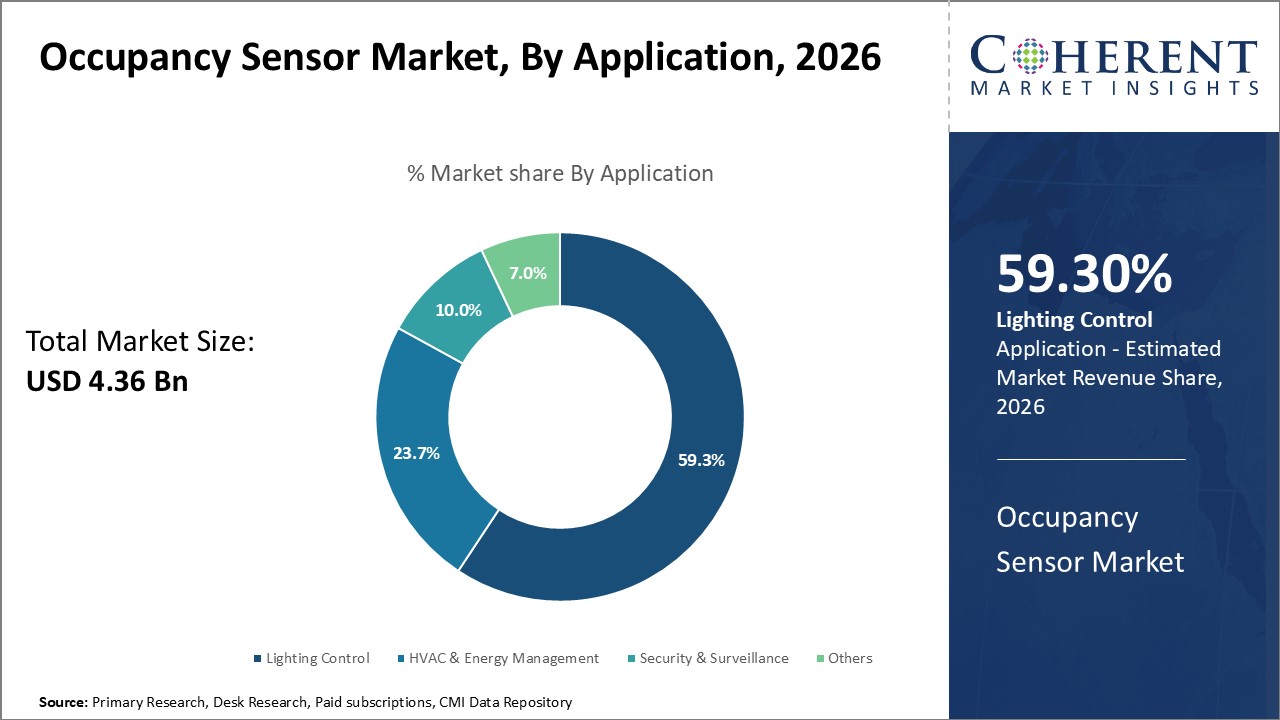
- The lighting control segment is holding an estimated share of 59.3 % in 2026.
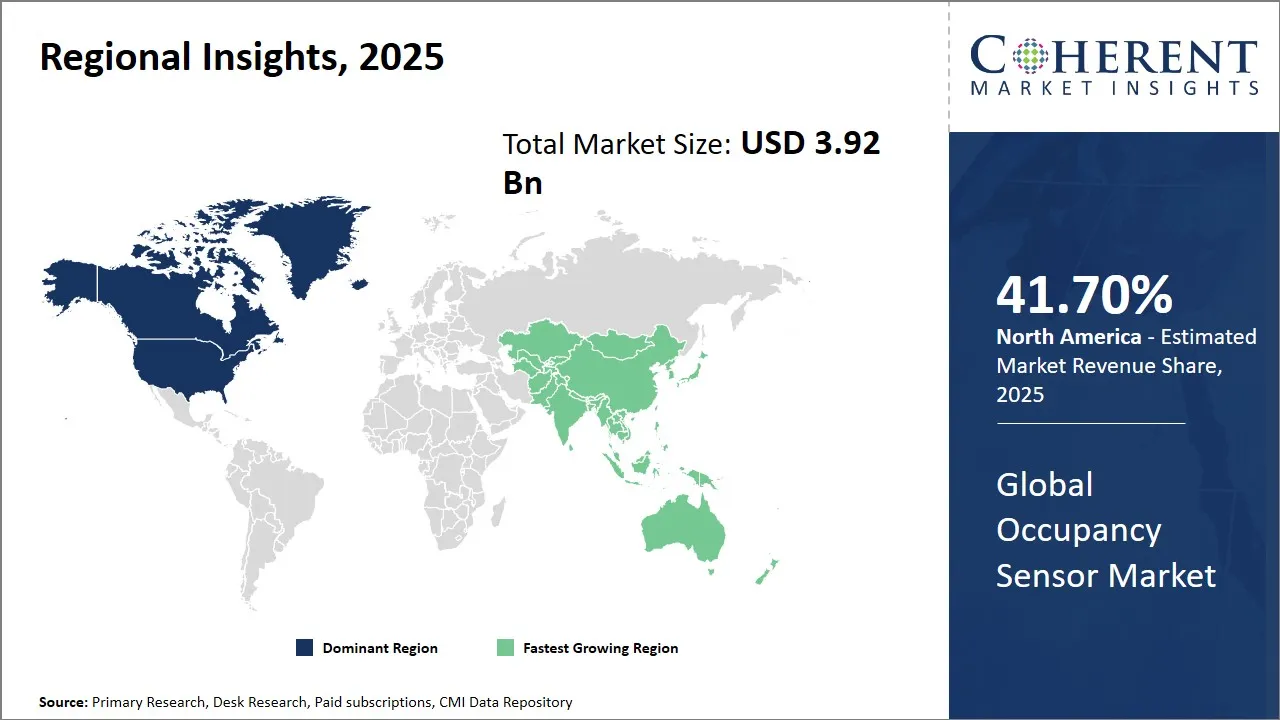
- North America is estimated to lead the market with a share of 41. 7% in 2026.
- Asia Pacific, holding an expected share of 23. 4% in 2026, and it is projected to be the fastest growing region.
Market Overview
The market is seeing the use of advanced technologies such as IoT and AI within occupancy sensors, improving their accuracy and functionality. The shift toward sustainable and energy-efficient infrastructures is adding to the demand because these sensors help in optimizing lighting and Heating, Ventilation, and Air Conditioning (HVAC) systems by detecting occupancy patterns. Additionally, growing government regulations and incentives for energy conservation are motivating industries to implement occupancy sensor solutions, further fueling the market expansion throughout the forecast period.
Current Events and Its Impact
Current Events | Description and its Impact |
Geopolitical and Trade Developments |
|
Economic and Infrastructure Trends |
|
Segmental Insights
- Current Industry Events of 2026
- Market Size Estimation
- Regional Breakdown
- Competitive Landscape
- Customer Intelligence
- Segmental Analysis
- Pricing Analysis
- Key Market Drivers, Challenges & Future Trends
- Customized Insights Section
Global Occupancy Sensor Market Insights, by Sensor Type – Passive Infrared Segment Leads the Market Because of its Cost-Effectiveness and Energy Efficiency
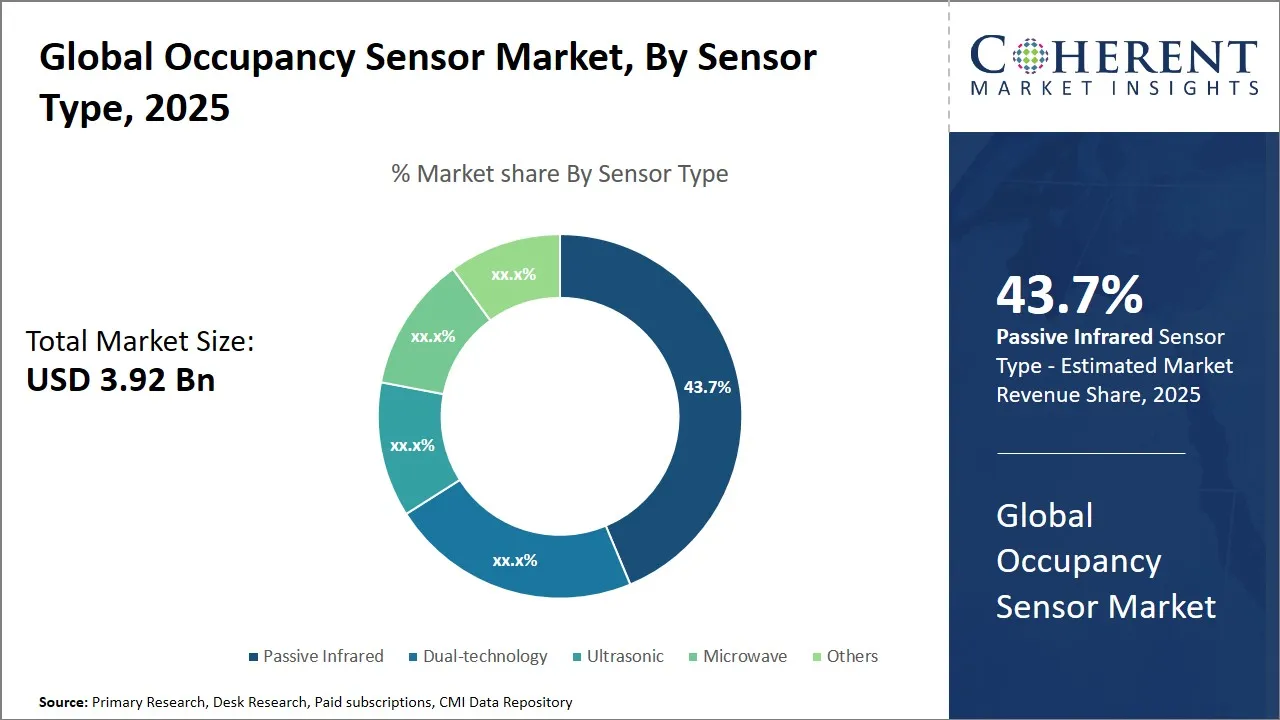
The passive infrared segment is projected to account for 44.7% share in 2026. Passive Infrared sensors (PIR) sensors detect the infrared radiation emitted by warm bodies, such as humans, making possible accurate occupancy identification without the need for physical contact or complex installations. Energy efficiency is seen as a top priority for building management, and PIR sensors make significant energy savings by automatically controlling lighting and HVAC systems based on occupancy. The flexibility and ease of integration with existing lighting and building control systems add to the appeal of PIR sensors.
Also, advancements in sensor technology have improved the sensitivity and detection range of PIR sensors, making possible improved performance in larger spaces and varied environmental conditions. Furthermore, the relatively lower susceptibility of PIR sensors to environmental interferences such as electromagnetic interference or reflective surfaces drives their preference over more complex sensor types like microwave or dual-technology sensors in many use cases.
Global Occupancy Sensor Market Insights, by Application – Lighting Control Segment Leads the Market Because of Growing Emphasis on Energy Saving and Smart Building Initiatives
The lighting control segment is expected to capture 59.3% share in 2026. Occupancy sensors are very important in automating lighting systems, enabling lights to turn on or off based on human presence, thus reducing energy consumption by a lot. Also, the rise of smart buildings and intelligent automation systems has added to the use of occupancy sensors in lighting control frameworks. These sensors provide real-time data that enhances the adaptability and responsiveness of lighting systems, creating environments that are both comfortable and energy-conscious.
Another major driver is the growing awareness in consumers and enterprises about sustainability and carbon footprint reduction. Occupancy-based lighting systems contribute significantly to green building certifications, such as LEED and BREEAM, which encourage the use of innovative energy-saving technologies. The advancements in occupancy sensor technology, including improved detection accuracy and reduced false triggering, have added to their applicability in lighting control. Also, user-friendly installation and compatibility with LED lighting, a fast expanding segment, add to the use of occupancy sensors for lighting control applications.
Impact of AI on the Occupancy Sensor Market
Artificial intelligence is reshaping the global occupancy sensor market by transforming how sensor data is interpreted and applied across smart buildings. Traditional sensors merely detect presence and relay a binary signal to lighting or HVAC systems, but AI-driven platforms now analyze continuous data streams—such as motion patterns, temperature changes, and even radar signatures—to distinguish between people, pets, and background noise. This reduces false positives and makes possible predictive energy management, space-utilization analytics, and smooth integration with building automation systems. As a result, facility managers can optimize heating, cooling, and lighting in real time, lowering operating costs and supporting sustainability goals.
A concrete example comes from Honeywell’s launch of its AI-powered building management platform in June 2025, which incorporates occupancy sensor inputs to provide real-time space-usage insights and automated energy adjustments.
Regional Insights
North America Occupancy Sensor Market Analysis and Trends
North America region is projected to lead the market with a 41.7% share in 2026, because of a mature market ecosystem that integrates advanced technologies across commercial, residential, and industrial sectors. The region benefits from stringent government policies promoting energy efficiency and sustainability, which significantly boost the demand for occupancy sensors in smart building applications. Also, big industry presence with leading technology firms headquartered in the U.S. and Canada adds to innovation and deployment. Trade dynamics support import of cutting-edge components, supporting local manufacturing and integration. Notable companies such as Honeywell International Inc., Legrand North America, and Eaton Corporation have developed sensor solutions that improve energy management and automation, thus adding to North America's lead.
Asia Pacific Occupancy Sensor Market Analysis and Trends
The Asia Pacific region, holding an estimated share of 23.4% in 2026, exhibits the fastest growth in the occupancy sensor market, due to rapid urbanization, industrialization, and increasing awareness about energy conservation. Emerging economies like China and India are seeing a rise in smart infrastructure projects supported by favorable government initiatives aimed at reducing carbon footprints and improving building automation. The extensive manufacturing base and cost-competitive production also attract global and regional players. Trade policies supporting export-led growth add to market expansion. Big companies expanding operations here include Panasonic Corporation, Siemens AG’s regional units, and Shenzhen-based ZHAGA Lighting, adding to adoption through innovative and cost-effective sensor technologies.
Occupancy Sensor Market Outlook for Key Countries
U.S. Occupancy Sensor Market Analysis and Trends
The U.S. is an important market for occupancy sensors because of substantial investments in smart building technologies and strict energy efficiency regulations such as those mandated by the U.S. Department of Energy. The presence of major corporates like Honeywell and Leviton Manufacturing bolsters product innovation and adoption in commercial and residential sectors. Furthermore, advanced research and development facilities in Silicon Valley and other tech hubs facilitate continuous improvements in sensor accuracy and connectivity, enhancing the market's overall maturity.
China Occupancy Sensor Market Analysis and Trends
China occupancy sensor market growth is fueled by aggressive urbanization, government-backed smart city initiatives, and the country’s role as a global manufacturing powerhouse. Companies like Panasonic and local players including Xiaomi and Hikvision are capitalizing on China’s vast construction and infrastructure development to embed smart sensor solutions in buildings. Favorable government policies promoting green buildings and energy savings coupled with a robust supply chain ecosystem elevate China’s strategic importance in the market.
Germany Occupancy Sensor Market Analysis and Trends
Germany continues to lead Europe’s occupancy sensor market with strong government focus on energy-efficient building codes and industry 4.0 practices. The country is home to influential players such as Siemens AG and Hager Group, which develop sophisticated sensor systems integrated with building automation and industrial applications. Germany’s strong trade ties within Europe support widespread deployment, while investments in innovation and smart industries sustain its leadership position and influence market standards continent-wide.
India Occupancy Sensor Market Analysis and Trends
India occupancy sensor market is expanding due to its rising urban population, government schemes promoting energy efficiency in commercial and public infrastructures, and increasing penetration of smart technologies. Local and international players like Philips Lighting (Signify) and Havells India are enhancing product availability and awareness. Fast growth in real estate and public infrastructure projects and supportive regulatory frameworks add to adoption, helping India become a key growth frontier in Asia Pacific.
U.K. Occupancy Sensor Market Analysis and Trends
The U.K. sees strict environmental regulations and growing adoption of green building certifications such as BREEAM. Companies like Schneider Electric and Johnson Controls have made a strong market presence by delivering integrated sensor solutions tailored to the commercial real estate and industrial sectors. The U.K.’s sophisticated trade network and combined government-private sector initiatives add to market penetration and technology innovation, making sustained demand for occupancy sensor systems.
Market Players, Key Development, and Competitive Intelligence
Key Developments
- In June 2025, SensorSwitch announced the launch of the TLS Twist-to-Lock Sensor, an occupancy sensor with daylight dimming designed for industrial spaces such as warehouses and manufacturing facilities. The TLS sensor is available as field-installable or embedded within the Lithonia Lighting REBL Round High Bay and Compact Pro High Bay luminaires.
- In June 2025, Honeywell announced the launch of Honeywell Connected Solutions, an AI-powered platform that integrates critical building software and technologies into a single interface to help enable more efficient operations.
- In April 2025, Enlighted, the Silicon Valley-based provider of IoT-enabled lighting controls and smart building technology, announced plans to wind down its core lighting business.
- In January 2025, Texas Instruments (TI) introduced new integrated automotive chips to enable safer, more immersive driving experiences at any vehicle price point. TI's AWRL6844 60GHz mmWave radar sensor supports occupancy monitoring for seat belt reminder systems, child presence detection and intrusion detection with single chip running edge AI algorithms, enabling a safer driving environment.
Top Strategies Followed by Occupancy Sensor Market Players
- Established market leaders invest heavily in research and development (R&D) to innovate advanced, high-performance occupancy sensors.
- Signify (Philips Lighting) expanded its Interact and Philips Hue MotionAware portfolio in February 2025, embedding advanced ambient-sensing and AI capabilities directly into luminaires.
- Mid-level players in the occupancy sensor market adopt a different approach, primarily focusing on providing cost-effective sensor solutions that strike a balance between quality and affordability.
- Leviton Manufacturing introduced an updated line of Decora Occupancy/Vacancy Sensors aimed at residential and small commercial customers. By focusing on affordability and easy installation while maintaining core performance, Leviton appeals to contractors and homeowners in cost-conscious segments.
- Small-scale players in the global occupancy sensor market typically carve out their competitive advantage by specializing in niche segments or delivering innovative features that differentiate them from larger competitors.
- EnOcean GmbH, a specialist in energy-harvesting wireless sensors, targets buildings where battery-free operation is critical (e.g., historic sites or retrofit projects). Its self-powered occupancy sensors, which draw energy from ambient light or motion, differentiate the company from larger competitors reliant on wired or battery solutions.
Market Report Scope
Occupancy Sensor Market Report Coverage
| Report Coverage | Details | ||
|---|---|---|---|
| Base Year: | 2025 | Market Size in 2026: | USD 4.36 Bn |
| Historical Data for: | 2020 To 2024 | Forecast Period: | 2026 To 2033 |
| Forecast Period 2026 to 2033 CAGR: | 11.3% | 2033 Value Projection: | USD 9.23 Bn |
| Geographies covered: |
| ||
| Segments covered: |
| ||
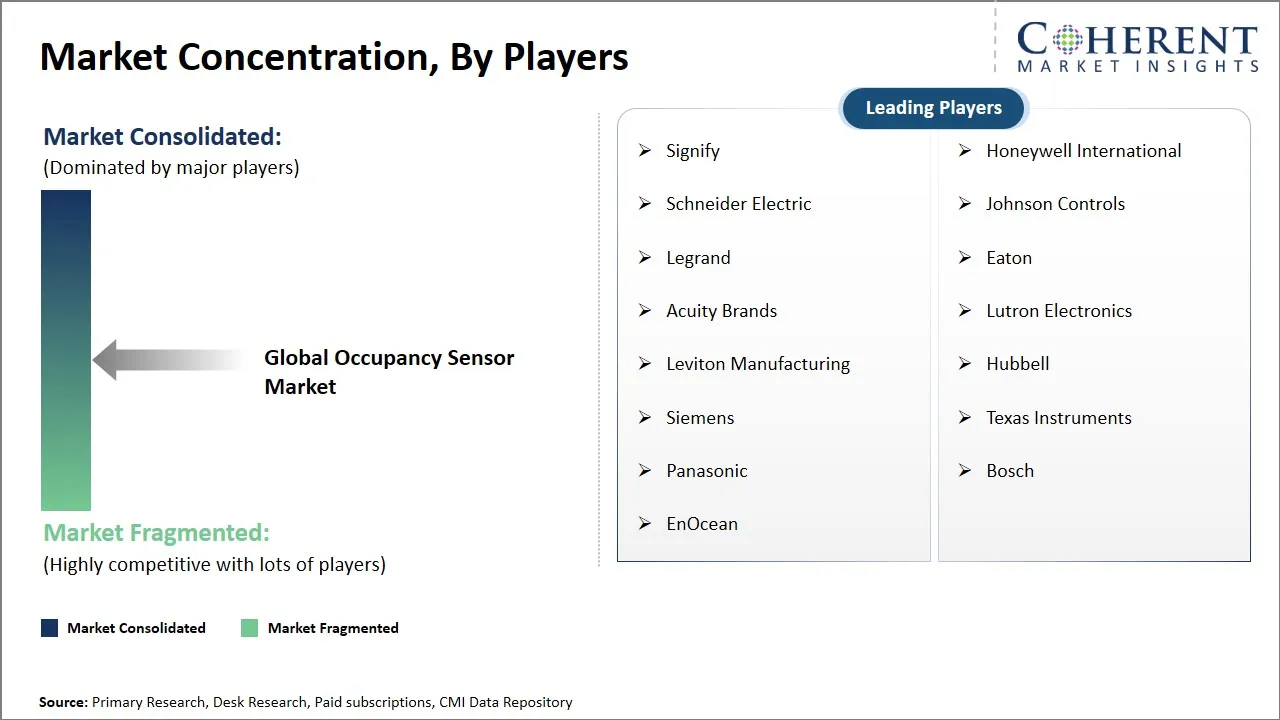
| Companies covered: | Signify, Honeywell International, Schneider Electric, Johnson Controls, Legrand, Eaton, Acuity Brands, Lutron Electronics, Leviton Manufacturing, Hubbell, Siemens, Texas Instruments, Panasonic, Bosch, and EnOcean | ||
| Growth Drivers: |
| ||
| Restraints & Challenges: |
| ||
Market Dynamics
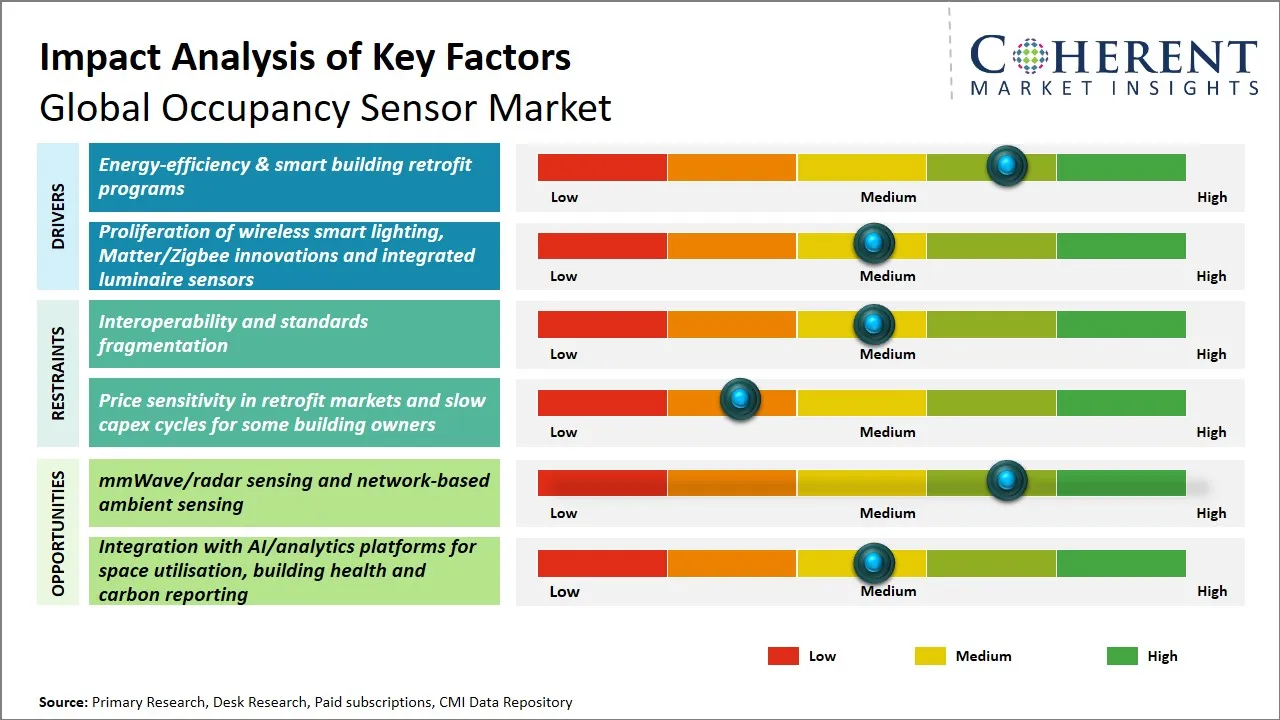
Global Occupancy Sensor Market Driver – Energy-Efficiency & Smart Building Retrofit Programs
With increasing energy costs and stringent regulations aimed at reducing carbon footprints, building owners and facility managers are investing heavily in smart building retrofit programs to optimize energy use. Occupancy sensors play a crucial role in these initiatives by enabling automated lighting, heating, ventilation, and air conditioning (HVAC) systems to operate only when space is occupied, thus minimizing energy wastage. The integration of advanced sensor technologies with building management systems enhances real-time monitoring and control, further promoting energy conservation.
Global Occupancy Sensor Market Opportunity – mmWave/Radar Sensing and Network-Based Ambient Sensing
Millimeter wave (mmWave) and radar sensors offer better accuracy and reliability in detecting human presence and movement, even under challenging environmental conditions like through obstacles, darkness, or adverse weather. This is useful in many applications in different sectors including smart buildings, security, energy management, and IoT-enabled environments. Moreover, the fusion of network-based ambient sensing allows for real-time data collection and analysis, facilitating dynamic space utilization, energy optimization, and personalized occupant experiences. Also, mmWave sensors can preserve privacy better than camera-based systems, making them useful in sensitive environments like offices and healthcare. Industries are focusing on automation and intelligent control systems, using mmWave/radar and ambient network sensing into occupancy detection solutions.
Analyst Opinion (Expert Opinion)
- Millimeter-wave (mmWave) radar is moving from automotive into commercial buildings, offering precise, anonymous detection through glass and partitions. Texas Instruments’ 2025 expansion of its mmWave portfolio illustrates how radar can overcome the line-of-sight limitations of passive infrared (PIR) sensors and enable continuous space-utilization analytics.
- The integration of AI with multi-modal sensing (PIR, ultrasonic, environmental data) is transforming raw detection into actionable insights. Platforms like Honeywell’s AI-powered building management system demonstrate how machine learning can forecast occupancy patterns, enabling predictive HVAC and lighting adjustments for greater energy efficiency.
- Lighting networks are evolving into distributed sensor grids, turning each luminaire into a data node. Signify’s Interact-ready luminaires and Philips Hue MotionAware upgrades highlight how existing lighting infrastructure can double as a pervasive occupancy detection system, lowering installation costs and accelerating smart-building adoption.
Speak to the analyst
Want personalized insights?
Take the findings above to one of our principal consultants, or have the report rebuilt around the segments, geographies and competitors you actually track.
Market Segmentation
- Sensor Type Insights (Revenue, USD Bn, 2021 - 2033)
- Passive Infrared
- Dual-technology
- Ultrasonic
- Microwave
- Others
- Application Insights (Revenue, USD Bn, 2021 - 2033)
- Lighting Control
- HVAC & Energy Management
- Security & Surveillance
- Others
- Regional Insights (Revenue, USD Bn, 2021 - 2033)
- North America
- U.S.
- Canada
- Latin America
- Brazil
- Argentina
- Mexico
- Rest of Latin America
- Europe
- Germany
- U.K.
- Spain
- France
- Italy
- Russia
- Rest of Europe
- Asia Pacific
- China
- India
- Japan
- Australia
- South Korea
- ASEAN
- Rest of Asia Pacific
- Middle East
- GCC Countries
- Israel
- Rest of Middle East
- Africa
- South Africa
- North Africa
- Central Africa
- North America
- Key Players Insights
- Signify
- Honeywell International
- Schneider Electric
- Johnson Controls
- Legrand
- Eaton
- Acuity Brands
- Lutron Electronics
- Leviton Manufacturing
- Hubbell
- Siemens
- Texas Instruments
- Panasonic
- Bosch
- EnOcean
Sources
Primary Research Interviews
Stakeholders
- Smart-building solution providers
- Occupancy Sensor Manufacturers and Component Suppliers
- Lighting & HVAC System Integrators and Contractors
- Commercial Real Estate Developers and Building Automation Companies
- IoT Platform Providers and Building Management Software Vendors
- Sustainability Experts and Green-Building Consultants
Databases
- Global Smart Infrastructure Database (GSID)
- International Building Automation Statistics (IBAS)
- Urban Energy Efficiency Index (UEEI)
- OECD
- Eurostat
- U.S. Census
Magazines
- Smart Buildings Today
- Lighting & Controls Review
- Energy Efficient Buildings Magazine
- IoT in Construction Weekly
Journals
- Journal of Intelligent Building Systems
- Sensors and Smart Infrastructure Journal
- Automation in Construction Journal
- Journal of Building Engineering
Newspapers
- The Guardian (UK)
- The Economic Times (India)
- Smart City Daily
- Building Technology News
Associations
- International Smart Building Alliance (ISBA)
- American Society of Heating, Refrigerating and Air-Conditioning Engineers (ASHRAE)
- Lighting Controls Association (LCA)
- National Association of Home Builders (NAHB)
- European Building Automation Association (EBAA)
Public Domain Sources
- U.S. Census Bureau
- EUROSTAT
- United Nations Economic Commission for Europe (UNECE)
- World Bank
- ResearchGate
Proprietary Elements
- CMI Data Analytics Tool, Proprietary CMI Existing Repository of information for last 8 years
Get access to 250+ pages report
Every segment, forecast, competitor profile and data table behind the analysis above — available for instant download.
- ESOMAR Member
- ISO 9001:2015 Certified
- D-U-N-S Registered
- GDPR & CCPA Compliant
Missing comfort of reading report in your local language? Find your preferred language:
Transform your Strategy with Exclusive Trending Reports
Frequently Asked Questions
The global occupancy sensor market is estimated to be valued at USD 4.36 billion in 2026 and is expected to reach USD 9.23 billion by 2033.
The CAGR of the global occupancy sensor market is projected to be 11.3% from 2026 to 2033.
Energy-efficiency & smart building retrofit programs and proliferation of wireless smart lighting, Matter/Zigbee innovations and integrated luminaire sensors are the major factors driving the growth of the global occupancy sensor market.
Interoperability and standards fragmentation and price sensitivity in retrofit markets and slow capex cycles for some building owners are the major factors hampering the growth of the global occupancy sensor market.
In terms of sensor type, the passive infrared segment is estimated to dominate the market revenue share in 2026.
Occupancy sensor is a device that detects the presence or absence of people in a space to control lighting, HVAC, or security systems automatically.
The market is moderately consolidated, with a handful of global leaders and many regional or niche players.