

Global Onshore Wind Energy Market Size and Forecast – 2026-2033
According to Coherent Market Insights, the global onshore wind energy market is estimated to be valued at USD 64.67 Bn in 2026 and is expected to reach USD 99.18 Bn by 2033, expanding at a compound annual growth rate (CAGR) of 6.3% from 2026 to 2033.
Key Takeaways of the Onshore Wind Energy Market
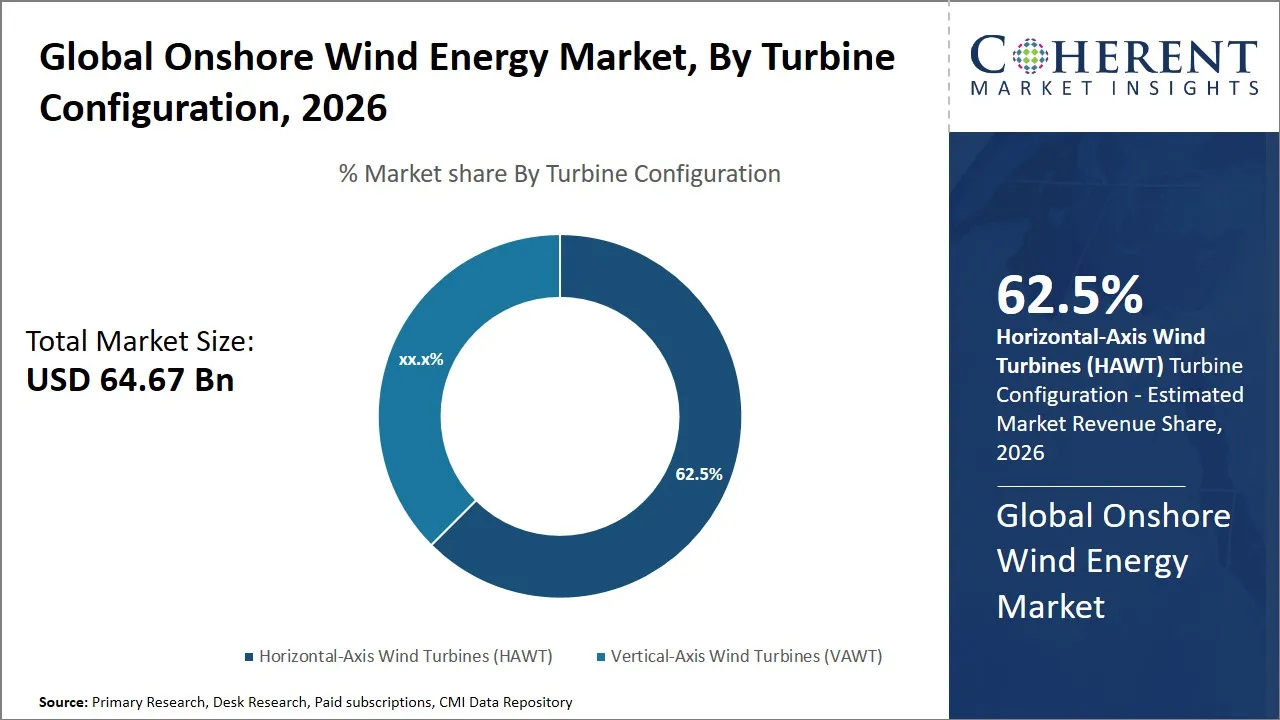
- Horizontal-Axis Wind Turbines (HAWT) segment is expected to account for 62.5 % of the global onshore wind energy market share in 2026.
- The 1 MW to 2.5 MW segment is estimated to hold 42.7 % of the market share in 2026.
- Utilities (vertically integrated) segment is projected to account for 45.8 % of the onshore wind energy market share in 2026.
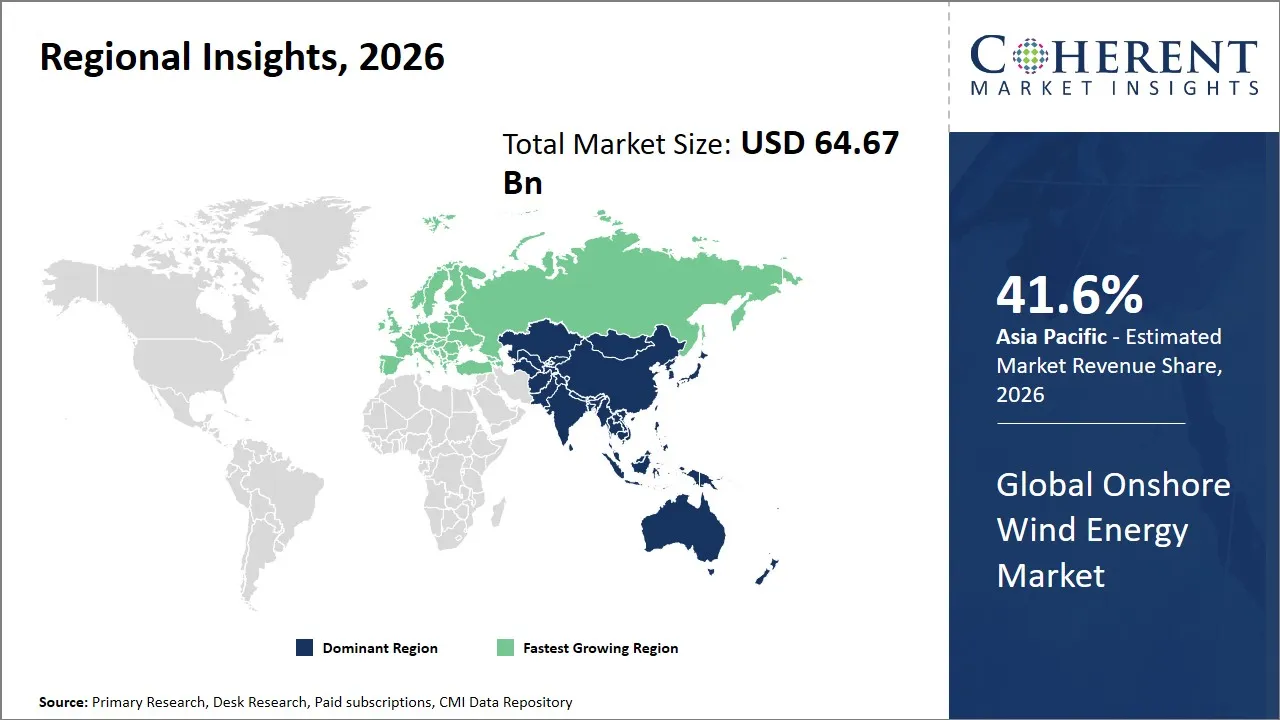
- Asia Pacific is expected to dominate the market in 2026 with a 41.6 % share.
- Europe is projected to be the fastest-growing region in 2026, holding 19.3 % of the market share.
Market Overview
- The market trend is characterized by a significant shift towards digitalization and smart wind turbine solutions, wind turbine blade, enabling real-time monitoring and predictive maintenance to optimize operational efficiency.
- Additionally, the integration of onshore wind energy with hybrid renewable systems is gaining traction, supporting grid stability and energy reliability.
- Growing environmental concerns and ambitious net-zero targets globally are further propelling the adoption of onshore wind projects, making it a crucial component of the evolving energy landscape.
Current Events and Its Impact
Current Events | Description and its Impact |
Germany: Record oversubscription in onshore wind auctions (August 2024 round results released on September 17, 2024) |
|
Germany in 2025 is on track for record-high project approvals, supported by significantly faster installation timelines |
|
Segmental Insights
- Current Industry Events of 2026
- Market Size Estimation
- Regional Breakdown
- Competitive Landscape
- Customer Intelligence
- Segmental Analysis
- Pricing Analysis
- Key Market Drivers, Challenges & Future Trends
- Customized Insights Section
Why Do Horizontal-Axis Wind Turbines (HAWT) Dominate the Onshore Wind Energy Market in 2026?
Horizontal-Axis Wind Turbines (HAWT) Segment is expected to contribute 62.5% of the global onshore wind energy market share in 2026, due to their superior aerodynamic efficiency and established technological advancements. Horizontal-Axis Wind Turbines (HAWT) segment has been at the forefront in terms of their aerodynamic efficiency and proven technological advancement. HAWTs have blades rotating on a horizontal axis enabling them to tap better the power of wind by extracting higher speeds of wind over greater heights. This design feature is the most suitable when it comes to large-scale power production where energy production is paramount.
For example, leading OEMs such as Vestas continue to deploy high-capacity HAWT platforms (3–6 MW class) across Europe, China, and the U.S., reinforcing HAWTs as the backbone of large onshore wind farms due to reliability, bankability, and superior energy yield.
(Source: https://www.vestas.com/en/energy-solutions/onshore-wind-turbines)
Why Does the 1 MW to 2.5 MW Turbine Capacity Segment Dominate the Global Onshore Wind Energy Market?
The 1 MW to 2.5 MW segment is projected to account for 42.7% of the onshore wind energy market share in 2026. The range of capacities offers the perfect compromise between the feasibility of the projects and their cost-efficiency, which makes them extremely appealing to both developers and the users. The range of turbines within this category of the turbine typically provides adequate power to suit large commercial and utility applications without the complexity and high initial cost that are normally related to units that are larger than 2.5 MW.
Another key growth contributor to this segment is the flexibility of 1 MW to 2.5 MW turbines that can be installed in a large variety of terrains and in different wind regimes. Their relatively medium size facilitates easy transportation and installation reducing logistical constraints and project schedules. These turbines are also suitable in new planting as well in repowering older wind farms with outdated technology therefore ensuring higher energy output as well as better reliability.
Utilities (Vertically Integrated) Dominates the Onshore Wind Energy Market
Utilities (Vertically Integrated) segment is expected to command 45.8% of the market share in 2026. These companies, which integrate generation, transmission and distribution businesses, take advantage of their overall control of the value chain of energy to cause massive investments on onshore wind projects. Their supremacy is essentially connected with strategic advantages of the outright cost ownership of generation assets in regards to cost efficiency, grid stability, and regulatory conformity.
Using vertically integrated utilities also has an advantage in predictability of energy demand over the entire network, which allows more accurate long-term planning and allows optimal use of wind resources. This means that the internal control of supply and distribution enables the utilities to control the challenge of intermittency that comes with wind power, more efficiently, by balancing it with other generation sources or energy storage options. Such operational flexibility eliminates the risk of relying on external power contracts and being exposed to market price fluctuations, which places it in a competitive advantage when it comes to overall energy expenses.
Regional Insights
Asia Pacific Onshore Wind Energy Market Analysis and Trends
The Asia Pacific region is projected to lead the market with a 41.6% share in 2026. Due to the growing energy demand, the government pledges to lessen the use of fossil fuels, and the inflow of capital. China and India are some of the countries that pay a lot of attention to onshore wind development to achieve renewable energy objectives through the active policies in the form of auctions and subsidies.
Regional market also enjoys a growing industrial base to produce wind turbines as is the case with Goldwind and Envision Energy in China and Suzlon in India. More so, the adoption in the emerging markets in the Southeast Asian region is faster with better grid infrastructure and rural electrification programs. The growing inclusion of the domestic manufacturers lessens the dependence on imports and creates competitive prices making Asia Pacific the fastest growing region.
Europe Onshore Wind Energy Market Analysis and Trends
The Europe region is expected to exhibit the fastest growth in the market contributing 19.3% share in 2026, due to the mature market ecosystem, full regulation frameworks and strong investments in the renewable infrastructure. The EU has established ambitious carbon neutrality, which has led to long-term government subsidies in the form of feed-in tariffs, tax reliefs, and less elaborate permit regulations.
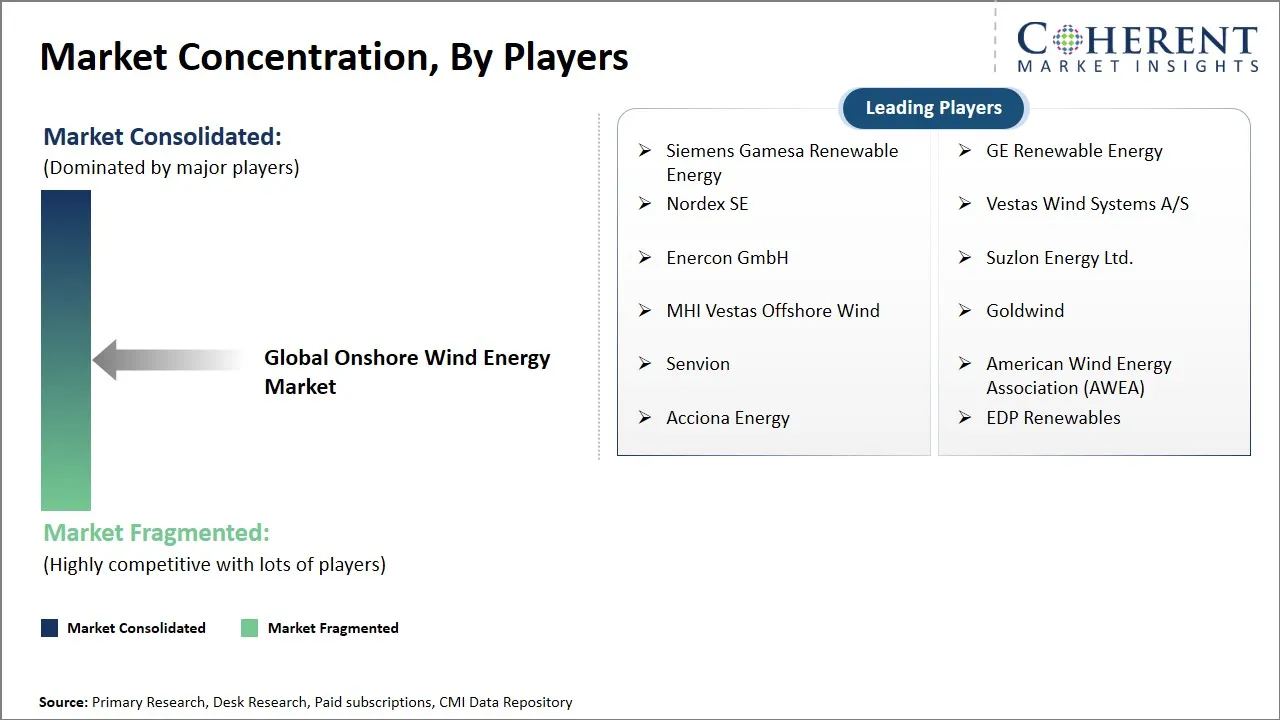
The supply chain of the Europes comprises major manufacturers such as Siemens Gamesa Renewable Energy (Spaniards and Germans), Vestas (Denmark) and Nordex (Germany) whose technological development and mass project construction takes an important influence on the market. Moreover, due to the collaboration of the European countries via organizations such as the European Green Deal, the cross-border trade and the extent of the project are enabled, which strengthens the regions leadership. The offshore complementing that is based on onshore wind energy also contributes to the general impetus on renewable energy.
Onshore Wind Energy Market Outlook for Key Countries:
Germany Onshore Wind Energy Market Trends
Germany leads the onshore wind energy market, driven by its Energiewende strategy focused on long-term energy transition. Strong policy support and a mature grid infrastructure have accelerated project execution, enabling manufacturers such as Siemens Gamesa and Enercon to rapidly scale installed capacity and deployment speed. Germany also focuses on the models of community ownership and environment checks that can equalize the effect of wind development and environmental issues to improve the overall acceptance of the population and the duration of the project.
U.S. Onshore Wind Energy Market Trends
The U.S. is leading North America with much onshore wind capacity being developed due to federal tax incentives and state-based renewable portfolio standards. The U.S. has an established presence of industries, and the key players, including GE Renewable Energy, NextEra Energy Resources, and Vestas, are actively implementing the projects throughout the Midwest and Texas. The policies that promote technological innovation and modernization of infrastructure enable expansion of the market even though regulatory environment may be volatile at the state level.
China Onshore Wind Energy Market Trends
China is a central figure in the development of Asia Pacific, and has massive government-sponsored initiatives to reach carbon peaking and carbon neutrality. Large domestic companies such as Goldwind and Mingyang Smart Energy control the supply chain of the country and allow large-scale implementation in regions with resources. The emphasis on the upgrading grid connectivity and offshore expansions by the governments is a complement to the onshore wind agenda. The trade policies that promote a local content and innovation make Chinas global competitiveness even stronger.
India Onshore Wind Energy Market Trends
The onshore wind energy market in India stem from aggressive renewable targets and focused policies such as the National Wind–Solar Hybrid Policy. The wind power industry players like Suzlon Energy and ReNew Power are the ones who are going for modular and scalable project execution. Government policies to ease land, grid access, and competitive bidding have created more favorable conditions in the market. In the meantime, the issue of gradual power supply has remained but it hasn’t really affected the growth much as India has a large wind resource base and demand for electricity is on a steady rise.
Brazil Onshore Wind Energy Market Trends
The Brazil Onshore Wind Energy Market has shown a rise in the trend of wind energy among the developing countries, which in turn would bring Latin America closer to the map of global onshore wind markets. Project development is being spearheaded by the likes of Siemens Gamesa and WEG Electric Equipment, and the Northeast is the main high-potential region they are focusing on. The maturing of the market is aided by good policies, better auction mechanisms, and the growth of infrastructure being built. Brazil’s focus on renewable energy mix and rural electrification match perfectly with onshore wind’s functions of making energy supply secure and eco-friendly.
Technological Advancements for the Onshore Wind Energy Market
Technology Area | Key Advancement | Description |
Turbine Capacity Scaling | 5–7 MW Onshore Turbines | Larger turbine ratings with optimized drivetrain designs |
Rotor Technology | Ultra-Long Rotor Blades | Blades exceeding 80–90 meters using lightweight composites |
Installation Technology | Modular Transportable Components | Blades and towers designed for difficult terrains |
Macro and Micro Economic Factors Impacting on the Onshore Wind Energy Market
Factor | Description |
Declining LCOE & Technological Advancements | LCOE fell to USD 44/MWh globally; larger turbines (>5MW, 160m rotors) raise capacity factors >45% |
Energy Demand & Climate Mandates | Rising global demand, carbon reduction goals, and ESG requirements drive utility-scale adoption |
Capital Expenditures & Investment | High upfront costs for turbines/infrastructure; varies by site suitability |
Supply Chain & Competition | Localization by Vestas/Siemens Gamesa; fragmentation across standards |
Market Players, Key Development, and Competitive Intelligence
Key Developments
- In April 2025, the wind industry association of the German Bundestag reported a record-breaking first quarter for onshore wind, with over 4 GW of new approvals and 1 GW of installations. This was a 40% year-over-year increase, driven by regulatory reforms to eliminate development barriers.
- In June 2025, Poland's parliament passed legislation that aims to increase the production of renewable energy and reduce the cost of electricity by reducing the minimum setback distances from residences for onshore wind development. The measure is currently awaiting the approval of the Senate and the president.
- Squadron Energy and General Electric Company Vernova reached a strategic framework agreement in January 2024 to jointly develop 1.4 GW of onshore wind projects in New South Wales, Australia.
Top Strategies Followed by Global Onshore Wind Energy Market Players
Player Type | Strategic Focus | Example |
Established Market Leaders | Heavy investment in R&D and innovation | Companies such as Vestas and Siemens Gamesa are still continuing with larger rotor diameters, higher hub heights, and digital twin based optimization of turbines to enhance capacity factors and reduce LCOE. The direct example can be seen in the implementation of EnVentus platform by Vestas, which will help to adjust turbines to different wind regimes and save the fees on the service. |
Mid-Level Players | Cost-effective solutions with balanced quality | Firms such as Nordex and Suzlon which focus on standardized turbines platforms and localized supply chains to manage the costs. A practical example here is the Nordexs Delta4000 series which gives flexible configurations at affordable prices to price sensitive developers. |
Small-Scale Players | Niche specialization & innovative variants | Firms such as Enercon specialize in gearless turbine designs that are used in low-wind locations or in sites with environmental concerns. Others focus on digital retrofitting, modular turbines, or smaller-scale projects at the community level, where customization is more of a major consideration than scale. |
Market Report Scope
Onshore Wind Energy Market Report Coverage
| Report Coverage | Details | ||
|---|---|---|---|
| Base Year: | 2025 | Market Size in 2026: | USD 64.67 Bn |
| Historical Data for: | 2020 To 2024 | Forecast Period: | 2026 To 2033 |
| Forecast Period 2026 to 2033 CAGR: | 6.3% | 2033 Value Projection: | USD 99.18 Bn |
| Geographies covered: |
| ||
| Segments covered: |
| ||
| Companies covered: | Siemens Gamesa Renewable Energy, GE Renewable Energy, Nordex SE, Vestas Wind Systems A/S, Enercon GmbH, Suzlon Energy Ltd., MHI Vestas Offshore Wind, Goldwind, Senvion, American Wind Energy Association (AWEA), Acciona Energy, and EDP Renewables | ||
| Growth Drivers: |
| ||
| Restraints & Challenges: |
| ||
Onshore Wind Energy Market Dynamics
Onshore Wind Energy Market Driver - Increasing Demand for Renewable Energy Sources to Combat Climate Change
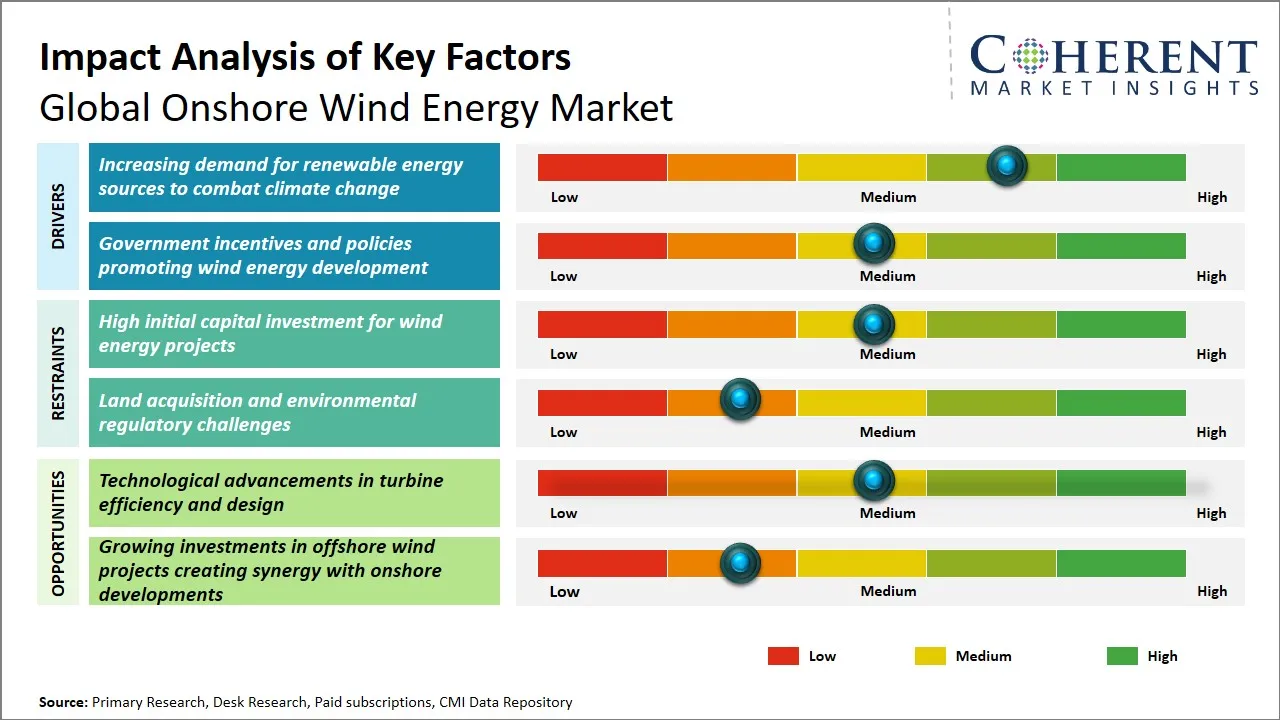
The increased international concern to tackle the issue of climate change has greatly boosted the need for renewable energy sources, thus making onshore wind energy one of the most important aspects of the dynamics in energy. Governments, corporations, and consumers are becoming more concerned with the issue of sustainability, and are also exploring cleaner options to conventional fossil fuels. The latter is prompted not only by global climate regulations and high levels of carbon emissions reduction but also by the increased awareness of the population regarding the environmental effects of energy production that is energy-consuming. Onshore wind turbine energy, which has mature technology, and a descending cost trend, is a scalable and predictable solution to lower greenhouse gas emissions.
State-level renewable purchase obligations (RPOs) and net-zero alignment have been driving large-scale onshore wind additions in Gujarat and Tamil Nadu in India, with the climate targets explicitly converted into capacity auctions.
Onshore Wind Energy Market Opportunity - Technological Advancements in Turbine Efficiency and Design
The onshore wind energy market is set to grow tremendously due to the constant improvement in technology in terms of efficiency and design of the turbines. The use of larger rotor diameters, taller towers and improved blade aerodynamics are all innovations that are helping turbines to tap into lower speed wind and use it more efficiently. The direct result of these advances is an increase in energy production and a decrease in the levelized cost of electricity (LCOE) thus, onshore wind projects are economically feasible and appealing to investors. There has also been the development of superior quality materials through materials science which has resulted in lighter and stronger blades thereby enhancing durability and decreasing costs of maintenance.
A key technological opportunity lies in the deployment of next-generation onshore turbines featuring larger rotor diameters and taller hub heights by OEMs such as Vestas and Siemens Gamesa. These advanced onshore platforms are optimized for low- and medium-wind conditions, enabling cost-effective project development in sites that were previously considered uneconomical.
Analyst Opinion (Expert Opinion)
- The onshore wind energy market has moved beyond experimentation into a consolidation and optimization phase, where execution capability now matters more than sheer capacity additions. This shift is evident as OEMs and developers prioritize scaling proven turbine platforms rather than pursuing radical designs, reflected in Vestas’ strategic focus on repowering and GE Vernova’s decision to streamline its onshore portfolio after margin pressure from earlier design choices.
- Tracking of recent projects in Germany, Spain, and Texas by analysts indicates that repowering yields 20 to 35 per cent greater output without corresponding capex inflation hence is the most intelligent near-term growth lever. Strategic shift is confirmed in dialogue in the industry at WindEurope Annual Events and CLEANPOWER Conference developers care less about bragging megawatts and more about grid fit, lifetime O&M cost savings, and expedited permitting closure. Repowering incentives and grid upgrades will overshoot value and areas that strain capacity to outgrow permitting and interconnection bottlenecks will not perform well even with good wind resources.
Speak to the analyst
Want personalized insights?
Take the findings above to one of our principal consultants, or have the report rebuilt around the segments, geographies and competitors you actually track.
Market Segmentation
- Turbine Configuration Insights (Revenue, USD Bn, 2021 - 2033)
- Horizontal-Axis Wind Turbines (HAWT)
- Vertical-Axis Wind Turbines (VAWT)
- Turbine Capacity Insights (Revenue, USD Bn, 2021 - 2033)
- 1 MW to 2.5 MW
- Less than 1 MW
- Above 2.5 MW
- End-user / off taker Insights (Revenue, USD Bn, 2021 - 2033)
- Utilities (vertically integrated)
- Independent Power Producers (IPPs) / Project developers
- Corporate / Industrial (captive / PPA)
- Community / Municipal / Cooperatives
- Installation Type Insights (Revenue, USD Bn, 2021 - 2033)
- New-build greenfield installations
- Repowering / Retrofit (turbine replacement & repower)
- Expansion / Brownfield additions
- Regional Insights (Revenue, USD Bn, 2021 - 2033)
- North America
- U.S.
- Canada
- Latin America
- Brazil
- Argentina
- Mexico
- Rest of Latin America
- Europe
- Germany
- U.K.
- Spain
- France
- Italy
- Russia
- Rest of Europe
- Asia Pacific
- China
- India
- Japan
- Australia
- South Korea
- ASEAN
- Rest of Asia Pacific
- Middle East
- GCC Countries
- Israel
- Rest of Middle East
- Africa
- South Africa
- North Africa
- Central Africa
- North America
- Key Players Insights
- Siemens Gamesa Renewable Energy
- GE Renewable Energy
- Nordex SE
- Vestas Wind Systems A/S
- Enercon GmbH
- Suzlon Energy Ltd.
- MHI Vestas Offshore Wind
- Goldwind
- Senvion
- American Wind Energy Association (AWEA)
- Acciona Energy
- EDP Renewables
Sources
Primary Research Interviews
- CEO – Leading Onshore Wind Turbine Manufacturer (e.g., Vestas or Siemens Gamesa equivalent)
- Supply Chain Director – Major Wind Energy Components Distributor
- Production Lead – Onshore Wind Farm Developer
- Sustainability Officer – Wind Energy Certification Authority (e.g., equivalent to GWEC sustainability leads)
Stakeholders
- Manufacturers
- End-use Sectors
- Utility-scale Power Producers
- Grid Operators and Utilities
- Renewable Energy EPC Contractors
- Regulatory & Certification Bodies (e.g., IEA Wind TCP, EU Renewable Energy Directive compliance)
- E-commerce Platforms and Retailers (Alibaba Industrial Wind Components, Wind Turbine Parts Suppliers)
- Technology Integration Players: Advanced turbine and blade manufacturers using onshore wind tech
Databases
- UN Comtrade Database (wind turbine trade data)
- India Import Export (EXIM) Database (onshore wind equipment imports)
- USGS Mineral Commodity Summaries (related materials for wind)
- IEA Wind TCP Open Data (wind energy datasets globally)
- The Wind Power Database (turbines, capacity, developers)
- IRENA Renewable Energy Statistics
- Eurostat Trade Statistics for Renewable Energy Equipment
Magazines
- Windpower Monthly – Trends in onshore wind supply and policy
- Wind Systems Magazine – Onshore wind technology innovations
- Wind Energy Weekly (AWEA) – Market dynamics for onshore installations
- Journals
- Wind Energy (Wiley) – Onshore wind resource and engineering research
- Renewable Energy – Large-scale onshore wind potentials
- Resources Policy – Global onshore wind supply chain analysis
- Wind Energy Science – Turbine aerodynamics and onshore applications
Newspapers
- The Wall Street Journal – Global demand for onshore wind energy
- Reuters – Onshore wind project financing and volatility
- Business Standard (India) – Onshore wind growth in Asia markets
Associations
- Global Wind Energy Council (GWEC)
- International Renewable Energy Agency (IRENA)
- American Clean Power Association (ACP, formerly AWEA)
- European Wind Energy Association (WindEurope)
- China Wind Power Association
Public Domain Sources
- IEA – Onshore wind outlook and statistics
- U.S. Department of Energy – Land-Based Wind Market Reports
- NREL – Renewable Energy Materials Properties Database (wind components)
- World Bank EnergyData.info (wind datasets)
- OECD – Renewable energy trade and sustainability reports
Proprietary Elements
- CMI Data Analytics Tool, Proprietary CMI Existing Repository of information for last 8 years.
Get access to 250+ pages report
Every segment, forecast, competitor profile and data table behind the analysis above — available for instant download.
- ESOMAR Member
- ISO 9001:2015 Certified
- D-U-N-S Registered
- GDPR & CCPA Compliant
Missing comfort of reading report in your local language? Find your preferred language:
Transform your Strategy with Exclusive Trending Reports
Frequently Asked Questions
The global onshore wind energy market is estimated to be valued at USD 64.67 Bn in 2026 and is expected to reach USD 99.18 Bn by 2033.
The CAGR of global onshore wind energy market is projected to be 6.3% from 2026 to 2033.
Upgrading old wind farms with high-capacity turbines to boost output and returns.
Through grid upgrades, forecasting tools, flexible dispatch, and energy storage intermittency is managed.
Increasing demand for renewable energy sources to combat climate change and government incentives and policies promoting wind energy development are the major factors driving the growth of the global onshore wind energy market.
High initial capital investment for wind energy projects and land acquisition and environmental regulatory challenges are the major factors hampering the growth of the global onshore wind energy market.
In terms of turbine configuration, Horizontal-Axis Wind Turbines (HAWT) are estimated to dominate the market revenue share in 2026.