

Pearlizing Agent Market Analysis & Forecast: 2026-2033
The Global Pearlizing Agent Market size is estimated to be valued at USD 2.10 Bn in 2026 and is expected to reach USD 3.40 Bn by 2033, exhibiting a compound annual growth rate (CAGR) of 7.0% from 2026 to 2033.
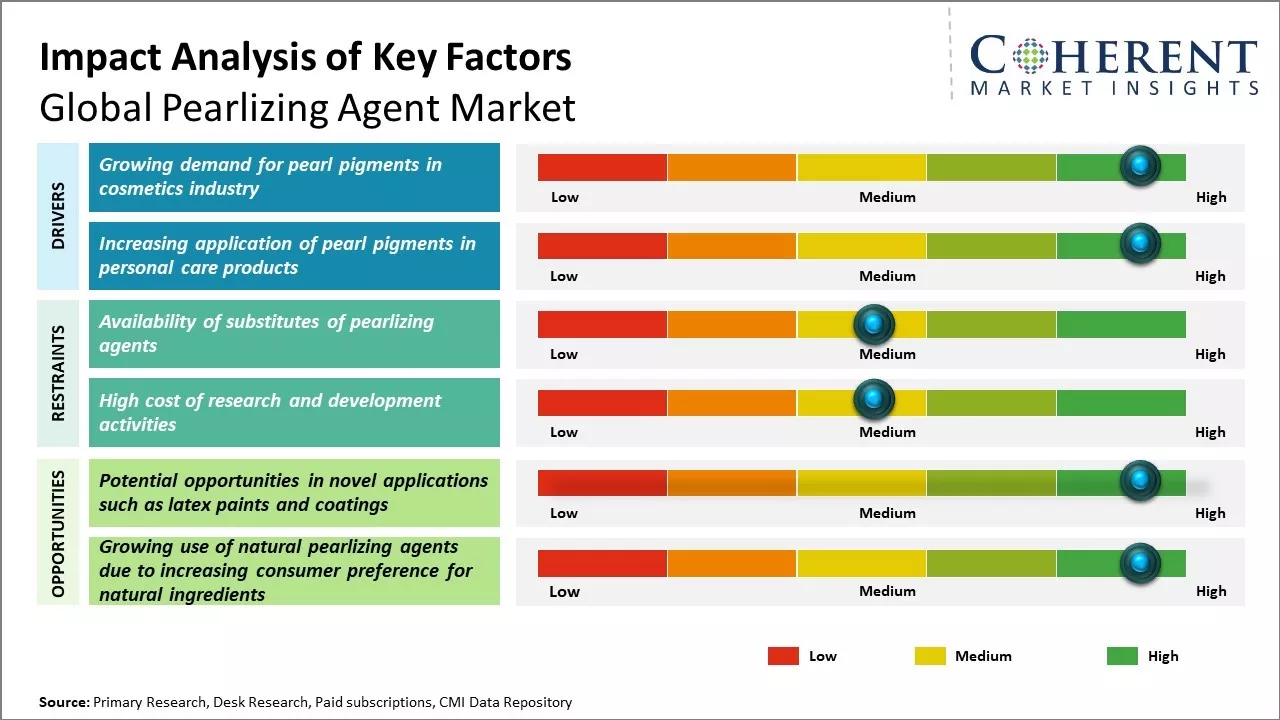
Key Takeaways:
- By Product Type, the Synthetic Pearlizing Agents’ segment is expected to contribute 60.2% share of the global pearlizing agent market in 2026 owing to the increasing demand for enhanced aesthetic appeal in personal care products.
- On the basis the Application Segment, cosmetics is expected to contribute 42.2% of the market share in 2026 owing to the escalating demand for anti-aging creams and facial serums.
- Based on Region, North America has emerged as the dominant region and is expected to hold 38.2% of the pearlizing agent market share in 2026. The growth of this region is driven by presence of advanced manufacturing facilities across Canada and United States.
Market Overview
The pearlizing agent market is expected to witness positive growth over the forecast period owing to rising demand from personal care industry. Growing consciousness among consumers regarding physical appearance is driving the consumption of premium personal care products incorporating pearlizing agents. The increasing use of pearlizing agents in personal care products, such as skin care, hair care, and makeup products, is escalating the market size. Pearlizing agents provide lustrous appearance and enhance the beauty of these products. Additionally, increasing spending on personal grooming worldwide will contribute to the market trend.
Current Events and Its Impact
Current Events | Description and its impact |
Technological Innovations in Pearlizing Agent Formulations |
|
Geopolitical Trade and Supply Chain Disruptions |
|
Pricing Analysis
Pearlizing agent market prices vary widely based on application, formulation, and brand. In cosmetics, foundations range from $15 to $80 per 30ml, highlighters from $20 to $60 per 8g, and eyeshadow palettes from $20 to $125 per 10g, reflecting broad market segments from mass to luxury. Lipsticks and glosses cost between $5 and $55, while nail polishes range from $5 to $30 per 15ml. Body care products with pearlizing effects, like lotions and shower gels, are priced between $3 and $50.
In paints and coatings, automotive basecoats cost $20 to $150 per liter, and clearcoats $25 to $200 per liter, driven by performance needs. Architectural paints range from $15 to $125 per gallon, while industrial powder and liquid coatings vary from $5 to $50 per kg or liter.
Pearlizing agents in plastics packaging, such as bottles, cost $0.05 to $0.50 per unit. Prices are influenced by raw materials like mica and titanium dioxide, with natural, eco-friendly agents commanding premiums. Recent raw material shortages and regulatory changes have caused price fluctuations. Bulk buyers benefit from negotiated discounts. Regional variations exist due to differing raw material availability and regulations.
- Current Industry Events of 2026
- Market Size Estimation
- Regional Breakdown
- Competitive Landscape
- Customer Intelligence
- Segmental Analysis
- Pricing Analysis
- Key Market Drivers, Challenges & Future Trends
- Customized Insights Section
Role of Emerging Technologies
Technological advancements have significantly transformed the pearlizing agent market forecast, driving innovation across cosmetics, automotive, and printing industries. A key trend is the shift toward eco-friendly, sustainable pearlizing agents derived from natural sources like mica, fish scales, and cellulose. These bio-based pigments reduce environmental impact and meet growing consumer demand for clean, green products.
New formulations offer enhanced heat and light stability, improving durability and broadening their usability across different materials. In cosmetics, multi-dimensional and color-shifting pearlizing pigments create dynamic, luminous effects in products such as highlighters, eyeshadows, and nail polishes.
The automotive sector leverages advanced pearlizing agents to produce iridescent coatings with improved aesthetic appeal and resistance to environmental factors. Meanwhile, the printing industry benefits from innovative pearlescent inks that enable eye-catching packaging and promotional designs.
Despite the higher production costs, these technological innovations expand application possibilities and cater to consumers willing to pay premiums for visually striking, sustainable products. Overall, emerging technologies are pivotal in driving market growth and fostering ongoing innovation in the pearlizing agent industry.
Segmental Analysis
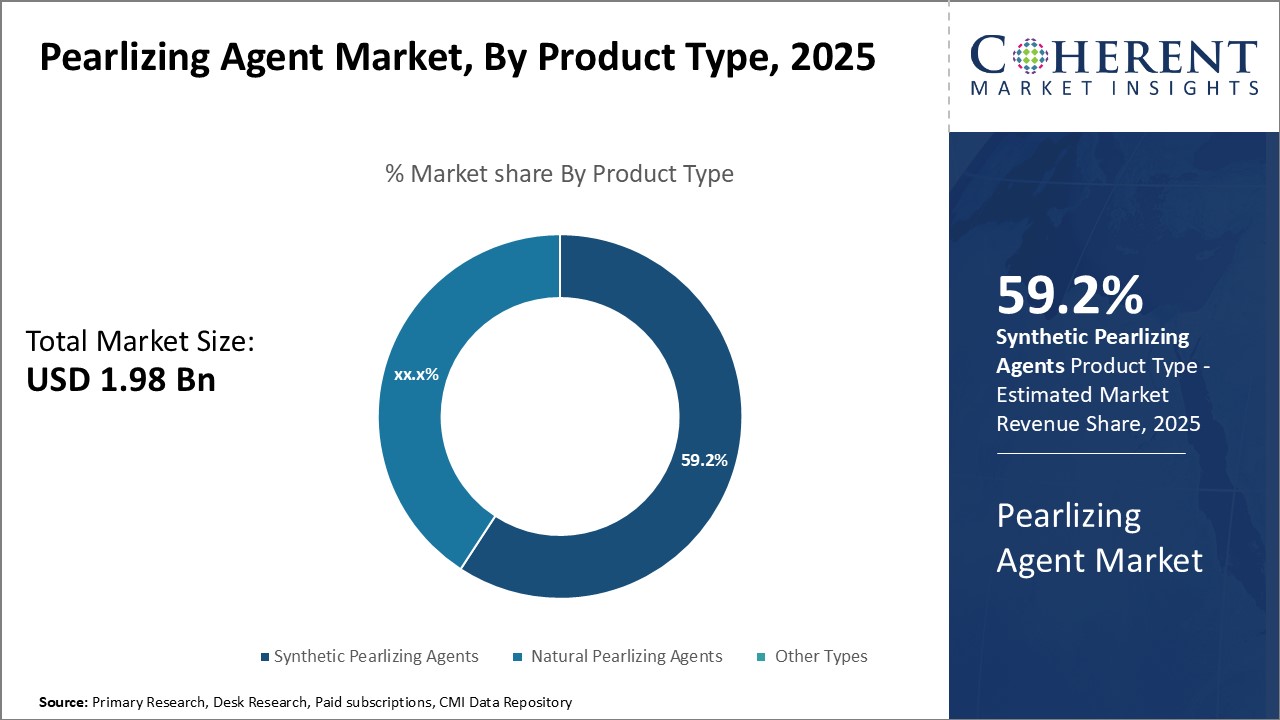
Pearlizing Agent Market Insights, by Product Type
The synthetic pearlizing agents’ segment is expected to contribute 60.2% share of the global pearlizing agent market outlook in 2026, owing to their versatility and cost advantages over natural alternatives. These synthetic products can be extensively customized during production to deliver a wide range of pearlizing effects across different formulations and applications.
Manufacturers have tremendous control over attributes like particle size, shape, density, and refractive index, allowing them to precisely tune the optical properties needed. This high degree of customizability enables synthetic pearlizing agents to replicate the lustrous appearances of pearls, mother of pearl, and other natural materials very effectively across cosmetics, coatings, plastics and more.
Additionally, synthetic pearlizing agents benefit from economies of scale during mass manufacturing processes. Their production does not depend on the unpredictable availability of raw material sources like fish scales as natural options do. This consistent, bulk supply allows synthetic varieties to be highly cost-competitive when compared to natural pearlizing agents. Their affordable price point expands their usage to more mass pearlizing agent market and commodity products where formulating costs are tightly controlled.
The combination of unparalleled customizability and low costs gives synthetic pearlizing agents strong advantages that have made them the dominant choice, accounting for the largest market share globally, growing initiatives by key players is expected to drive the segment growth.
For instance, reflecting this growth is the expansion of Shiseido Europe S.A., a subsidiary of Shiseido Company, Limited which finalized an agreement to acquire Gallinée Ltd. in September 2022. This acquisition aims to enhance Shiseido Europe S.A. product offerings in the skincare segment, particularly in the area of microbiome-friendly products, aligning with the increasing consumer demand for innovative and effective skincare solutions.
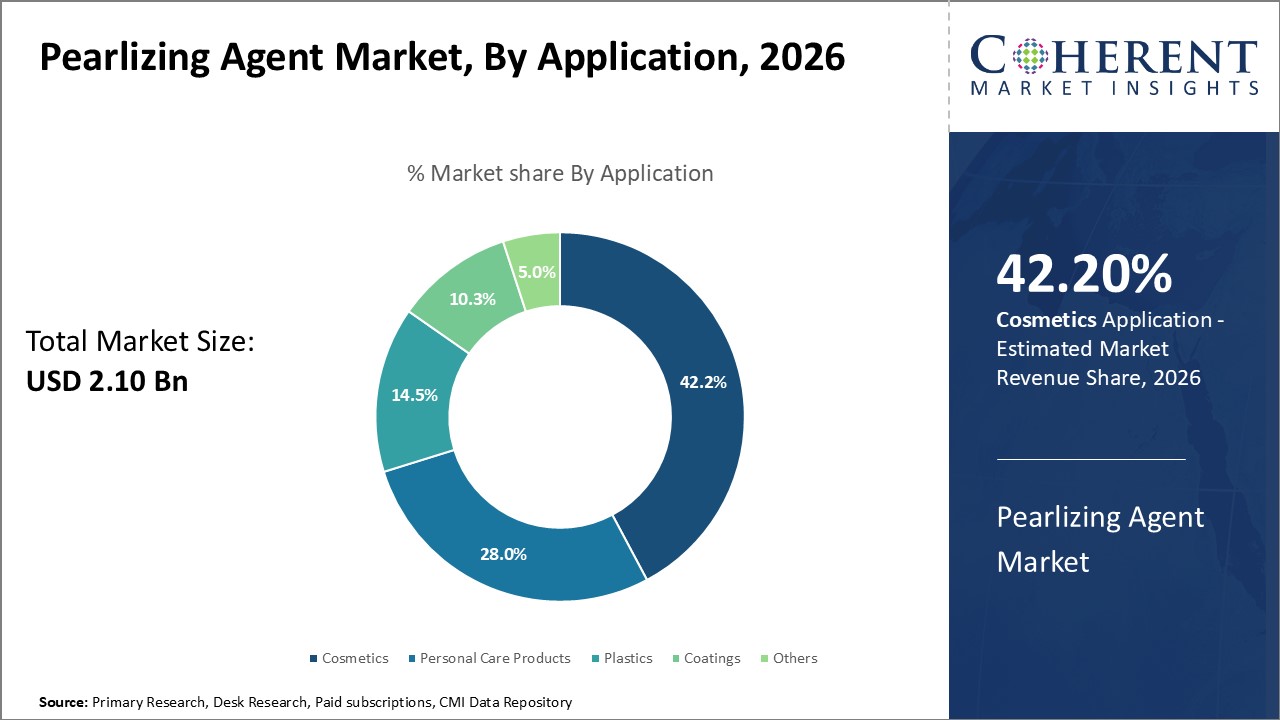
Pearlizing Agent Market Insights, by Application
Within the application segment, cosmetics is expected to contribute 42.2% of the pearlizing agent market demand share in 2026. The cosmetic industry has seen a significant rise in popularity for pearlescent and shimmering makeup products that deliver luminous, glowing skin. Pearlizing agents are heavily relied upon to provide these prismatic optical effects in foundations, concealers, highlighters, and eye shadows.
For instance, in January 2026, House of Makeup, a direct-to-consumer beauty brand, expanded its portfolio with the introduction of its new liquid highlighter, ‘Starry Night’. This unique, pearl-infused formula delivers a radiant, long-lasting glow while being resistant to transfer. Pearlized complexions aligned with the "glow from within" aesthetic championed in these industries.
As makeup users increasingly emulate these trends, demand for products containing different grades of finely-milled pearlizing agents from transparent to boldly opaque has increased exponentially within the cosmetics segment over recent years. With no signs of slowing based on industry projections, cosmetics will remain the leading application field driving relevance and profits for pearlizing agent producers globally.
Export-Import Analysis of Pearlizing Agent Market
United States- According to the Coherent Market Insights, United States imported 192 shipments of Pearl Pigments during Oct 2023 to Sep 2024 (TTM). These imports were supplied by 44 foreign exporters to 49 United States buyers, marking a growth rate of -42% compared to the preceding twelve months. Within this period, in Sep 2024 alone, United States imported 21 Pearl Pigments shipments.
India- There are a total of 195 importers, sourcing from 248 global suppliers. Between October 2023 and September 2024, 57 importers were active in the market. Among them, Kuncai International India Pvt Ltd leads as the top importer, accounting for 27% of India’s total pearl pigments imports with 276 shipments. Close behind is WUERTH INDIA PVT LTD, which holds a 14% market share, representing 140 shipments. PON PURE CHEMICAL INDIA PRIVATE ranks third, contributing 11% of the total with 113 shipments. Together, these top three importers—Kuncai International India Pvt Ltd, WUERTH INDIA PVT LTD, and PON PURE CHEMICAL INDIA PRIVATE—account for 53% of India’s total pearl pigments imports.
Emerging Use-Cases in the Pearlizing Agent Market
Pharmaceuticals:
- Uses : Pearlescent pigments are used in the pharmaceutical industry to create visually appealing capsules or tablets. These agents can provide a premium look while ensuring the product is easy to distinguish.
- Example : In January 2024, Qingdao Yiqing Biotechnology Co., Ltd. introduced Pearl Metallic Capsules, a revolutionary advancement in the production of hard pharmaceutical capsules. These capsules have been generating significant attention in the industry due to their innovative technology and exceptional quality.
Automotive Coatings:
- Uses : Pearlizing agents are applied to automotive paints to provide a distinctive, shimmering finish that changes with the light.
- Example : For instance, in March 2023, Tesla used pearlescent paints in the finish of its Model S and Model X vehicles, offering the vehicles a luxurious, eye-catching appearance. The pearlescent finish is part of their premium range of colors like the Midnight Silver Metallic finish.
Food and Beverage Industry:
- Uses: Edible pearlescent pigments are used in food products, particularly for special occasions or premium products. These pigments are added to confectionery and desserts to give them a sparkling, luxurious look.
- Example : For instance, in February 2025, BakersVille India launched MetaGlo pearls spray for cakes. These pigments are commonly used for decorating cakes, cupcakes, and cookies, especially for weddings or special events.
Regional Insights
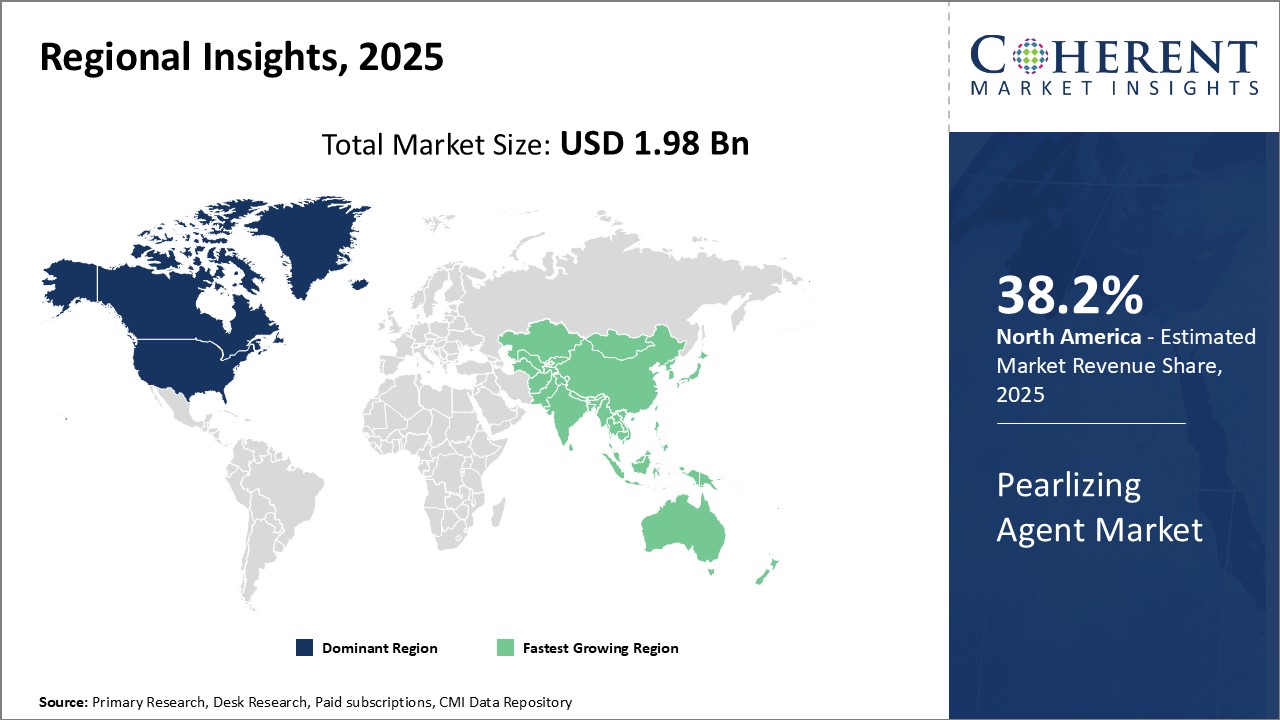
North America Pearlizing Agent Market Analysis and Trends
North America has emerged as the dominant region in the global pearlizing agent market trend. The region is expected to hold 38.2% of the market share in 2026. The market here is driven by strong demand from the personal care industry, which is one of the most established in the world. Leading cosmetics brands such as L'Oréal and other brands have their headquarters in the U.S. and Canada and invest heavily in product development.
In July 2024, Debut, a leading biotech beauty company with fully integrated biotechnology capabilities, formed a strategic alliance with L'Oréal to co-develop essential bio-identical ingredients. These sustainably produced alternatives are set to replace traditionally sourced ingredients across L'Oréal’s portfolio of beauty and personal care products, including skincare, haircare, color cosmetics, and fragrances. This gives North American pearlizing agent manufacturers an edge, as they can cater to the customized needs of their big-spending local clients.
Asia Pacific Pearlizing Agent Market Trends
The pearlizing agent market in Asia Pacific region is witnessing exponential growth and gaining global attention. Countries like India and China are fast emerging as lucrative markets due to their booming middle classes and rising expenditure on personal care and beauty products. For instance, as per IBEF, India’s beauty and personal care industry—valued at INR 2, 43,236 crore in 2026—is projected to grow to INR 2,95,358 crore by 2028. International brands such as loreal and other brands view the region as an important area for expansion to tap the enormous untapped potential.
United States Pearlizing Agent Market Trends
The market in United States is witnessing steady growth, fueled by increasing demand for visually appealing and premium personal care products. Key trends driving this growth include rising consumer interest in high-performance cosmetics with enhanced aesthetics, such as pearlescent shampoos, body washes, and facial cleansers. Regulatory oversight from agencies like the FDA and Cosmetic Ingredient Review (CIR) ensures the safety and quality of pearlizing agents, encouraging wider adoption. The presence of major cosmetics companies and a thriving R&D ecosystem further contribute to product innovation and market expansion.
Germany Pearlizing Agent Market Trends
Germany's pearlizing agent market has seen notable developments owing to the growing demand for sustainable ingredients in personal care industry. For instance, in December 2022, BASF introduced Euperlan NL Pearl. This wax-based, COSMOS-compliant pearlizer enhances personal care products with opalescent and pearlescent effects without relying on pigments. Euperlan NL Pearl is made from naturally sourced ingredients, including hydrogenated vegetable oil, cocamidopropyl betaine, and glycerol oleate.
Pearlizing Agent Market Trends
Growing Demand for Pearl Pigments in Cosmetics Industry
The global cosmetics industry has been witnessing significant growth over the years on the back of rising disposable income, evolving lifestyle, growing consciousness about appearance among individuals as well as changing fashion trends across major countries.
For instance, according to data by India Brand Equity Foundation (IBEF) released in 2021, India's beauty, cosmetics, and grooming market will reach US$ 20 billion by 2025. Women, in particular, are spending increasingly on various cosmetic products to enhance their facial looks and overall appearance. With busy schedules and rising aspirations to look trendy, consumers prefer cosmetic products that impart a radiant glow and youthful effect to their facial skin.
Pearl pigments are special effect pigments that impart pearlescent properties and add shimmer and sparkle when blended into cosmetic formulations. They provide a pearly lustrous and multi-dimensional effect when applied on the skin. Their unique optical properties help cosmetic manufacturers design products catering to growing demand for pearlized and luminous makeup looks among young population. This is further adding to the pearlizing agent market demand.
Rising Product Innovations
The ever-widening choice of high-pigment cosmetic formulations in the market also drives the need for continuous innovation. Cosmetic brands introduce new products regularly with advanced pearl pigment technologies to sustain customer appeal. Due to their excellent hiding prowess, compatibility with other ingredients and long-lasting effect, pearl pigments give improved depth and dimension to novel cosmetic ranges. Their widespread use in high-end as well as affordable makeup and skincare helps brands capture more consumers.
For instance, in February 2025, One/Size introduced the B12 Base Thinner Vitamin Pearl Serum, packaged in a sleek, pill-shaped bottle with a convenient pump dispenser. This versatile product can be applied on its own for a radiant finish or blended with a makeup base, like foundation, to create a dewier, glowing look. The surging worldwide fascination among youth with K-beauty and J-beauty trends centered on radiant complexion further positively influence the pearlizing agent market forecast.
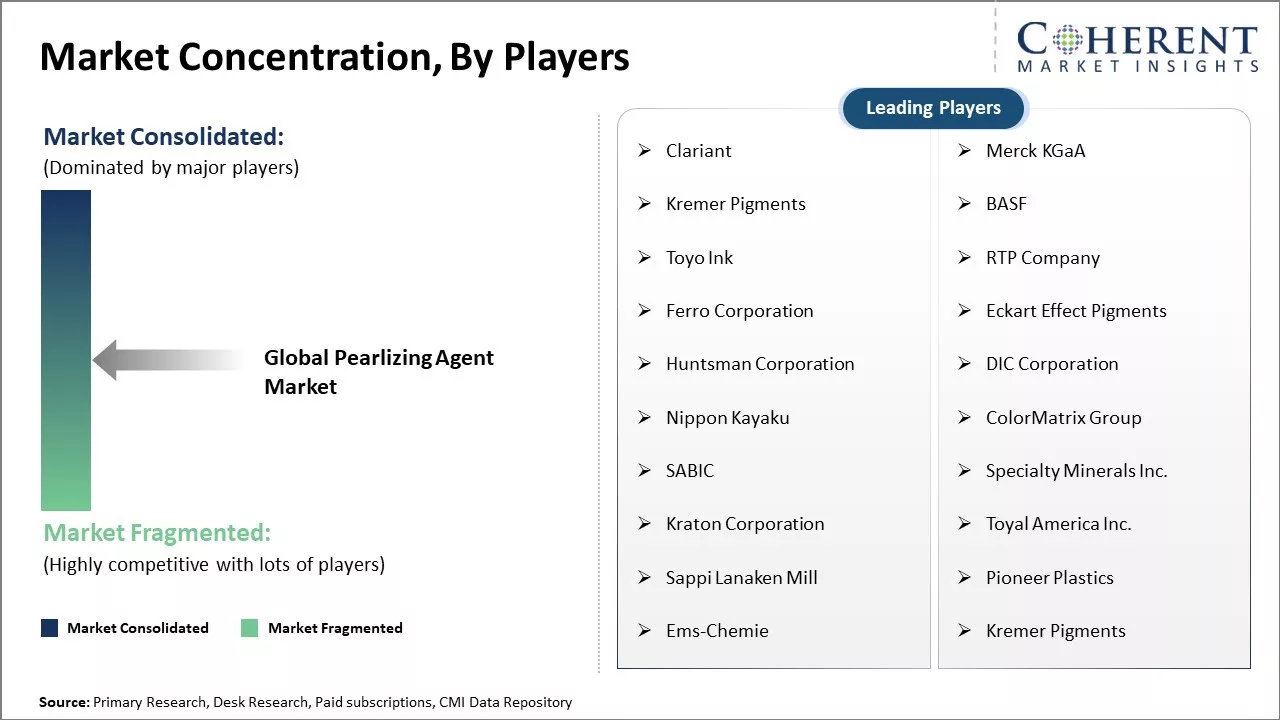
Market Concentration and Competitive Landscape
Key Developments in Pearlizing Agent Market
- In April 2025, KCC introduced "Cala Navi Plus," a color solution for automobile repairs that replicates metallic and pearl finishes with real-world accuracy. Calabi Plus was developed to precisely measure and replicate the metallic and pearl particles in automotive paint for a perfect color match.
- In September 2024, Vibrantz Technologies announced the expansion of its Sittard, Netherlands facility to boost production of its Pearls™ sustainable tinting solution, which uses a dispensing machine to create a variety of paint colors.
- In December 2022, BASF launched Euperlan NL Pearl (INCI: Hydrogenated Vegetable Oil (and) Cocamidopropyl Betaine (and) Glyceryl Oleate), a COSMOS-compliant, wax-based pearlizer for personal care products.
Market Report Scope
Pearlizing Agent Market Report Coverage
| Report Coverage | Details | ||
|---|---|---|---|
| Base Year: | 2025 | Market Size in 2026: | USD 2.10 Bn |
| Historical Data for: | 2020 To 2024 | Forecast Period: | 2026 To 2033 |
| Forecast Period 2026 to 2033 CAGR: | 7.0% | 2033 Value Projection: | USD 3.40 Bn |
| Geographies covered: |
| ||
| Segments covered: |
| ||
| Companies covered: | Clariant, Merck KGaA, Kremer Pigments, BASF, Toyo Ink, RTP Company, Ferro Corporation, Eckart Effect Pigments, Huntsman Corporation, DIC Corporation, Nippon Kayaku, ColorMatrix Group, SABIC, Specialty Minerals Inc., Kraton Corporation, Toyal America Inc., Sappi Lanaken Mill, Pioneer Plastics, Ems-Chemie, and Kremer Pigments | ||
| Growth Drivers: |
| ||
| Restraints & Challenges: |
| ||
Market Dynamics
Pearlizing Agent Market Challenge - Availability of substitutes of pearlizing agents
Pearlizing agents face strong competition from alternative products that can be used as substitutes. The availability of nanoparticles, micas, and polymers that can provide pearlescent effects similar to pearlizing agents poses a major challenge. Products like synthetic fluorphlogopite, synthetic mica, and polyethylene terephthalate flakes have been gaining traction in end-use industries.
Switching to alternative products allows formulation of pearlescent coatings at lower costs, with consistency in performance. The easy availability and price competitiveness of substitutes can impede the demand growth of pearlizing agents. To remain competitive, pearlizing agent manufacturers will need to focus on new high-performance formulations and enhancing the value proposition versus alternatives.
Pearlizing Agent Market Opportunity - Potential opportunities in novel applications such as latex paints and coatings
There are significant opportunities for pearlizing agents to expand into new application areas such as latex paints and coatings. The coating industry is witnessing demand growth for products that impart unique aesthetics and added functionality. Pearlizing agents can enable novel coating formulations with high-covering power, appealing aesthetics and durability. Their matting and opacifying properties align well with the requirements of latex paints used in decorations and home interiors. Switching to pearlizing agents allows paint manufacturers to efficiently mask substrates and offer varied texture and color effects.
For instance, Godavri Paint’s PEARL MAX Acrylic Latex Paint is a premium, water-based, elastomeric exterior paint formulated with advanced acrylic-modified binders and high-performance additives. It delivers a smooth, luxurious finish while providing excellent protection against water penetration. With focused R&D initiatives to develop latex paint and coating-specific grades, pearlizing agent producers stand to penetrate this promising application domain and capture a widening pearlizing agent market share.
Analyst Opinion (Expert Opinion)
- One of the most promising developments in the Pearlizing Agent Market is the rise of India as a major importer of pearlescent pigments. With Kuncai International India Pvt Ltd and other major players accounting for over half of the country’s imports, India’s growing demand for premium pigments is undeniable. The country’s expanding manufacturing base, along with a rapidly increasing middle-class population, presents a significant opportunity for further market expansion.
- In the automotive coatings industry, leading brands like Tesla are using pearlescent finishes to enhance their vehicles’ aesthetic appeal. The use of pearlescent pigments in premium vehicle lines, such as Tesla's Midnight Silver Metallic finish, underscores a broader trend toward luxury, customization, and innovation in the automotive industry. As automotive manufacturers continue to focus on high-end finishes, the demand for pearlescent agents will increase, driving growth in this lucrative market segment.
Speak to the analyst
Want personalized insights?
Take the findings above to one of our principal consultants, or have the report rebuilt around the segments, geographies and competitors you actually track.
Market Segmentation-
- Product Type Insights (Revenue, USD Bn, 2021 - 2033)
- Synthetic Pearlizing Agents
- Natural Pearlizing Agents
- Other Types
- Application Insights (Revenue, USD Bn, 2021 - 2033)
- Cosmetics
- Personal Care Products
- Plastics
- Coatings
- Others
- Regional Insights (Revenue, USD Bn, 2021 - 2033)
- North America
- U.S.
- Canada
- Latin America
- Brazil
- Argentina
- Mexico
- Rest of Latin America
- Europe
- Germany
- U.K.
- Spain
- France
- Italy
- Russia
- Rest of Europe
- Asia Pacific
- China
- India
- Japan
- Australia
- South Korea
- ASEAN
- Rest of Asia Pacific
- Middle East
- GCC Countries
- Israel
- Rest of Middle East
- Africa
- South Africa
- North Africa
- Central Africa
- Key Players Insights (Revenue, USD Bn, 2021 - 2033)
- Clariant
- Merck KGaA
- Kremer Pigments
- BASF
- Toyo Ink
- RTP Company
- Ferro Corporation
- Eckart Effect Pigments
- Huntsman Corporation
- DIC Corporation
- Nippon Kayaku
- ColorMatrix Group
- SABIC
- Specialty Minerals Inc.
- Kraton Corporation
- Toyal America Inc.
- Sappi Lanaken Mill
- Pioneer Plastics
- Ems-Chemie
- Kremer Pigments
Sources
Primary Research Interviews:
- Stakeholder interviews conducted with key industry players in the Pearlizing Agent market, including manufacturers, suppliers, formulators, and end-users in industries such as cosmetics, personal care, and automotive.
Databases:
- Chemical Abstracts Service (CAS)
- Scopus
Magazines:
- Cosmetics & Toiletries
- Beauty Packaging
- Chemical Engineering News
- Specialty Chemicals Magazine
Journals:
- Journal of Surfactants and Detergents
- Journal of Industrial and Engineering Chemistry
- International Journal of Cosmetic Science
- European Journal of Lipid Science and Technology
Newspapers:
- The Wall Street Journal
- Financial Times
- The New York Times
- The Guardian
Associations:
- American Chemical Society (ACS)
- Cosmetic Ingredient Review (CIR)
- Society of Cosmetic Chemists (SCC)
- International Association for Soaps, Detergents and Maintenance Products (AISE)
Public Domain Sources:
- U.S. Environmental Protection Agency (EPA)
- European Chemicals Agency (ECHA)
- World Health Organization (WHO)
- U.S. Food and Drug Administration (FDA)
Proprietary Elements:
- CMI Data Analytics Tool, Proprietary CMI Existing Repository of information for last 8 years
Get access to 250+ pages report
Every segment, forecast, competitor profile and data table behind the analysis above — available for instant download.
- ESOMAR Member
- ISO 9001:2015 Certified
- D-U-N-S Registered
- GDPR & CCPA Compliant
Missing comfort of reading report in your local language? Find your preferred language:
Transform your Strategy with Exclusive Trending Reports
Frequently Asked Questions
The Pearlizing Agent Market size is estimated to be valued at USD 2.10 Bn in 2026, and is expected to reach USD 3.40 Bn by 2033.
The CAGR of the global Market is projected to be 7.0% from 2026 to 2033.
Growing demand for pearl pigments in cosmetics industry and increasing application of pearl pigments in personal care products are the major factors driving the growth of the global market.
Availability of substitutes of pearlizing agents and high cost of research and development activities are the major factors hampering the growth of the global market.
In terms of product type, synthetic pearlizing agents is estimated to dominate the market revenue share in 2026.
Clariant, Merck KGaA, Kremer Pigments, BASF, Toyo Ink, RTP Company, Ferro Corporation, Eckart Effect Pigments, Huntsman Corporation, DIC Corporation, Nippon Kayaku, ColorMatrix Group, SABIC, Specialty Minerals Inc., Kraton Corporation, Toyal America Inc., Sappi Lanaken Mill, Pioneer Plastics, Ems-Chemie, and Kremer Pigments are the major players.
North America is expected to lead the global market.