

Global Pet Robot Market and Forecast – 2026 to 2033
Coherent Market Insights estimates that the global pet robot market is expected to reach USD 720 Bn in 2026 and will expand to USD 1,100 Bn by 2033, registering a CAGR of 6% between 2026 and 2033.
Key Takeaways of the Pet Robot Market
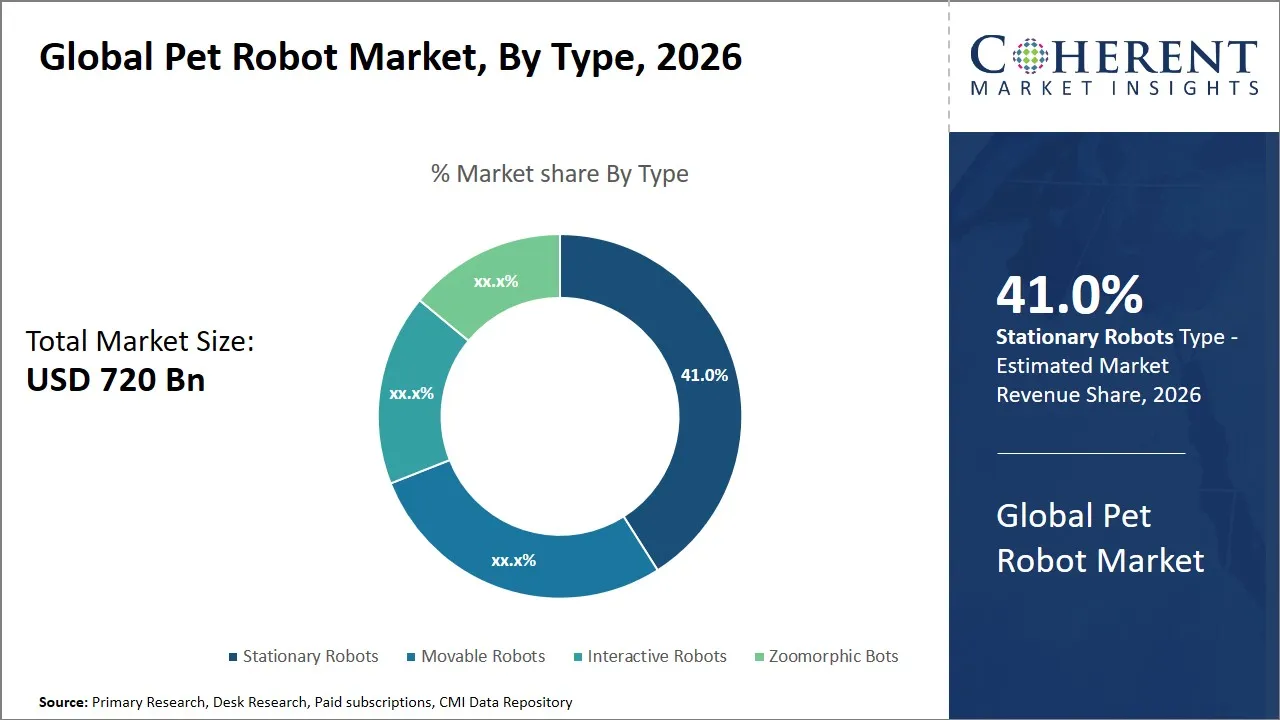
- The stationary robots segment is expected to account for 41% of the pet robot market share in 2026.
- The AI software segment is estimated to capture 47% of the market share in 2026.
- The video recording and monitoring segment is projected to hold 45% share in 2026.
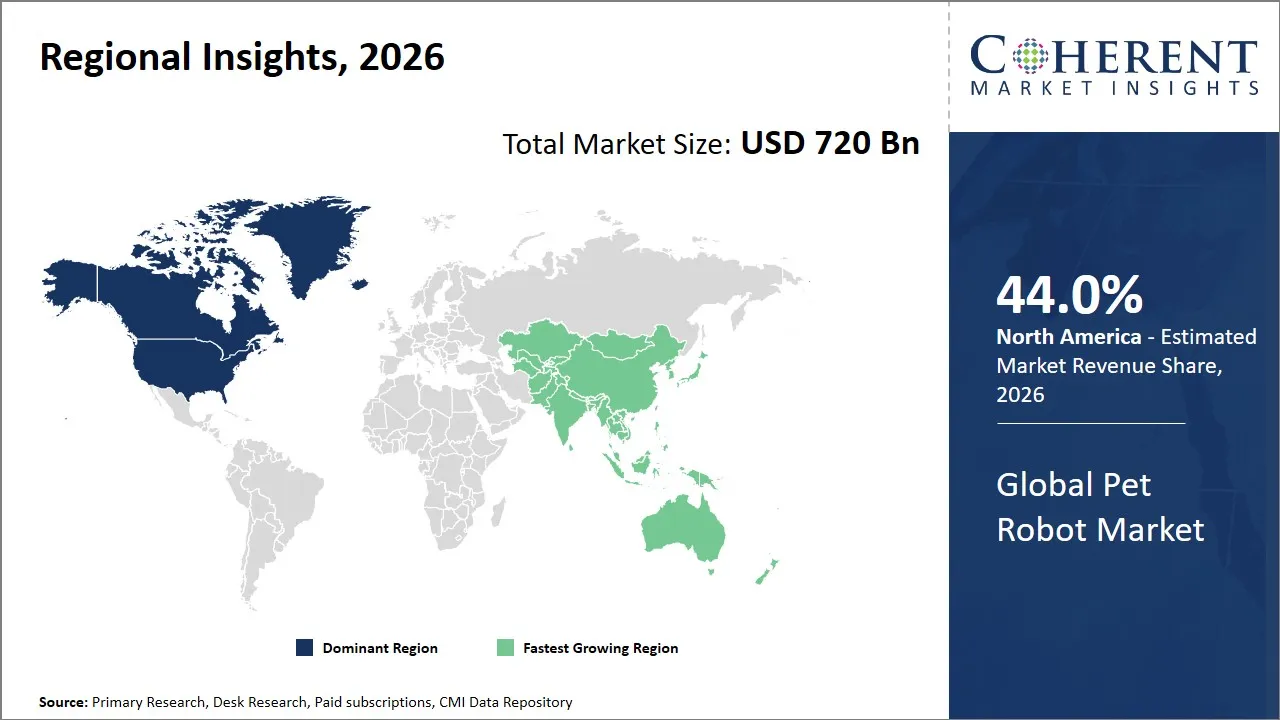
- North America is projected to dominate the pet robot market in 2026 with a 44%
- Asia Pacific is expected to hold 31% share in 2026 and is expected to record the fastest growth over the forecast period.
Currents Events and Its Impacts
Current Events | Description and its Impact |
Tuya Smart Aura Launch |
|
Segmental Insights
- Current Industry Events of 2026
- Market Size Estimation
- Regional Breakdown
- Competitive Landscape
- Customer Intelligence
- Segmental Analysis
- Pricing Analysis
- Key Market Drivers, Challenges & Future Trends
- Customized Insights Section
Why Does Stationary Robots Segment Dominate the Global Pet Robot Market in 2026?
The stationary robots segment is expected to account for 41.0% of the global pet robot market share in 2026. Primarily, steady performance explains the rise - simple setup at home plays a role too, alongside focused features tailored for specific tasks. Fixed in place, these pet robots operate within set boundaries, suited well for watching pets, giving food, or adjusting surroundings, even though they do not move around much. With no need to travel far, their function improves because motion problems vanish; avoiding barriers or calculating routes becomes irrelevant, issues that often complicate mobile animal-like machines.
AI Software Segment Dominates the Global Pet Robot Market
The AI software segment is estimated to account for 47.0% of the pet robot market share in 2026. Despite rising interest in responsive gadgets tuned to animal actions, progress stems largely from advanced artificial intelligence integration. Machines, by analyzing voice pitch, motion habits, and regular behaviors, allow exchanges to seem less rigid. Responses shaped by sensor inputs adapt slowly to each animal’s presence. Over time, precision increases because learning accumulates through consistent interaction. The rhythm of home life feeds into adjustments just as much as the movements of pets do. At first, shifts are barely noticeable - yet they build quietly beneath routine moments.
For instance, on January 29, 2026, Tuya Smart announced an AI toy solution suite aimed at enabling developers & brands to build AI‑powered interactive robots. In addition, Tuya showcased AI robotic dogs with motion mimicry and emotional interaction capabilities, responding to voice commands and performing a variety of realistic actions.
Why is Video Recording and Monitoring the Most Widespread Application in the Pet Robot Market?
The video recording and monitoring segment is expected to account for 45.0% of the global pet robot market share in 2026. Primarily, expansion stems from addressing fundamental worries about safety, well-being tracking, and distant interaction. Due to faster daily routines alongside greater movement across regions, staying linked becomes essential for animal caregivers who rely on digital tools. Instead of being present, owners access ongoing supervision through automated helpers featuring visual documentation functions. These devices deliver real-time viewing, saved clips, also warnings when activity occurs.
Global Pet Robot Market - Affordability & Consumer Barriers
Metric | Details | Impact on Consumers |
Initial Pricing - Basic Models | Entry-level pet robots / toy-grade models can start as low as ~USD 30–USD 200 for simple interaction and movement features. | Affordable for price-sensitive buyers and children, but limited in interactivity and intelligence. |
Initial Pricing - Mid-Range | Mid-range interactive models typically cost ~USD 300–USD 1,000+ | More capable (voice recognition, basic AI), but still a notable household expense. |
Initial Pricing - Premium Models | Advanced AI robots with emotional interaction and realistic behavior often exceed USD 1,200–USD 3,000+, with some high-end units much higher. | Strongest companion experience but major affordability barrier, especially in emerging economies. |
Maintenance Costs - Batteries | Replacement battery packs typically range USD 50–USD 150 every few years. | Adds to long-term ownership cost beyond the upfront purchase. |
Maintenance - Repairs & Parts | Minor repairs (motors, sensors): USD 30–USD 80; major servicing: USD 100–USD 300; warranty/tech support: USD 50–USD 200/year. | High complexity and cost of parts & service can deter purchases without robust after-sales support. |
Regional Insights
North America Pet Robot Market Analysis and Trends
The North America region is projected to lead the market with a 44% share in 2026. Growth finds roots in an advanced tech environment, broad use of connected household gadgets, yet rising interest in new ways to care for pets. Innovation thrives where major tech builders and robot-focused firms operate, driven by complex needs from those who own animals. Progress in machine-driven solutions moves gradually yet consistently, supported by favorable rules and financial benefits in North America. Because of established retail locations along with strong web-based platforms, distribution systems perform well. Responsive artificial intelligence evolves pet robots, guided by individuals once at Anki, now part of larger tech initiatives. Sony Corporation together with Hasbro influences direction, working within these expanding digital efforts. Steady logistics underpin dependable outcomes.
For instance, on February 2, 2026, EdisonFuture Motor Inc., a wholly owned subsidiary of Phoenix Motor Inc, announced the launch of a U.S.-manufactured robotic dog platform designed for commercial deployment and delivered through a scalable Robot Fleet as a Service (RFaaS) model. The initiative represents a strategic expansion of Phoenix Motor's technology portfolio into advanced robotics, autonomy, and recurring-revenue fleet services.
Asia Pacific Pet Robot Market Analysis and Trends
The Asia Pacific region is expected to exhibit the fastest growth in the market contributing 31% share in 2026. Progress unfolds through multiple connected causes. As cities grow quickly alongside higher personal income levels across nations including China, Japan, and South Korea, interest grows in new pet-related items and ways to support animal companionship. Technology networks spread widely - especially within East Asia - making robotic systems and artificial intelligence more accessible at faster rates. At the same time, government initiatives in countries like China and South Korea support manufacturing progress in robotics, establishing hubs dedicated to innovation that enhance production strength as well as international trade potential.
Companies including Sony in Japan, ZoraBots from Singapore, together with China’s Roborobo show clear market visibility via customized robotic companions reflecting local preferences. While this unfolds, expansion of digital shopping platforms alongside increasing concern for animal welfare has contributed to faster uptake throughout the Asia Pacific area.
Global Pet Robot Market Outlook for Key Countries
Why is U.S. Emerging as a Major Hub in the Pet Robot Market?
In the U.S., technology advances align closely with growing interest in intelligent pets designed for home life. Driven by funding into artificial intelligence and machine systems, many new ventures thrive alongside well-known tech developers. Robotic creatures made by Hasbro react when people engage with them. In parallel, progress from Boston Dynamics enhances how machines move and sense environments. These are not mere playthings - instead, they signal change, quietly advancing into forms that adapt through experience. Found without effort today, they appear widely online and on shelves throughout the country.
Is Japan the Next Growth Engine for the Pet Robot Market?
Japan maintains a lead through long-standing strengths in automated systems and creative engineering. As communities grow comfortable with robots as partners, older adults increasingly interact with responsive devices within private residences. Notably, Sony’s Aibo illustrates how feelings may influence the design of artificial beings. As community initiatives introduce intelligent gadgets into homes, regional developers craft animal-style robots that assist while also engaging playfully. Where custom blends with necessity, progress appears without force. Driven by quiet shifts rather than sudden change, adaptation unfolds steadily across living spaces.
China Pet Robot Market Analysis and Trends
Even with more people owning pets, city living increasingly favors robot alternatives. As manufacturing capacity has grown nationwide, local startups and foreign companies find entry possible. Not only do businesses like Roborobo participate, but also emerging designers build affordable robotic animals for younger, tech-savvy users. Through programs called "Made in China 2025," government support advances automation along with smart city development. As advancements continue, global gaps lessen while international opportunities emerge slowly.
Germany Pet Robot Market Analysis and Trends
German precision stands out in Europe's pet robot market owing to meticulous engineering aimed at durability and advanced function. As rules are strict, every item reflects careful attention to safety at all times. From one instance to the next, uniformity appears - rooted in organized methods where supervision leads. Outcomes meet top standards largely through steady observation guiding how machines interact with animals. Entities such as Bosch invest heavily in creating robotic companions despite slower uptake compared to regions focused on consumer trends. Supportive government policies aimed at expanding Industry 4.0 applications, including robotics, provide an encouraging business climate.
South Korea Pet Robot Market Analysis and Trends
South Korea stands out globally due to its strength in consumer electronics. As people widely use digital devices, progress in robotics continues without pause. Supported by state investment in artificial intelligence, domestic needs influence machine behavior during personal exchanges. Firms like Hyundai Robotics work beside niche developers, refining sensor-driven responses in companion devices. Because policies favor automated production and health-focused digital systems, progress in pet-oriented robotics continues without reliance on foreign models.
Market Players, Key Development, and Competitive Intelligence
Key Developments
- On January 6, 2026, Ecovacs unveiled its first dedicated AI‑powered pet companion robot called LilMilo, designed to simulate emotional companionship using multisensory perception and interactive AI.
- On June 12, 2025, Tombot, the robotics company that earned widespread acclaim at CES 2025 for its lifelike robotic puppy, Jennie, announced the successful close of its USD 6.1 million Series A funding round.
Top Strategies Followed by Global Pet Robot Market Players
Player Type | Strategic Focus | Example |
Established Market Leaders | Casio Product Launch | On September 17, 2025, CASIO announced the U.K. launch of Moflin, a palm-sized, emotionally intelligent companion that has been designed to provide comfort, connection, and emotional support through advanced emotional AI. |
Mid-Level Players | Ludens AI Product Reveal | On January 5, 2025 Ludens AI unveiled Cocomo, a companion robot designed to focus on warmth and emotional interaction, at the CES 2026 technology show. Cocomo is positioned as an autonomous robotic pet that can move independently on a wheeled base, follow its owner around the home and interact through voice and touch. |
Small-Scale Players | Hengbot Innovation Ltd. Product Launch | On June 26, 2025, Hengbot Innovation Ltd launched its first product in the Hengbot Universe, Sirius. Sirius is a robotic dog for consumers that made waves at CES 2025 for its powerful AI multimodal interaction capabilities and high dynamic motion performance. |
Market Report Scope
Pet Robot Market Report Coverage
| Report Coverage | Details | ||
|---|---|---|---|
| Base Year: | 2025 | Market Size in 2026: | USD 720 Bn |
| Historical Data for: | 2020 To 2024 | Forecast Period: | 2026 To 2033 |
| Forecast Period 2026 to 2033 CAGR: | 6 % | 2033 Value Projection: | USD 1,100 Bn |
| Geographies covered: |
| ||
| Segments covered: |
| ||
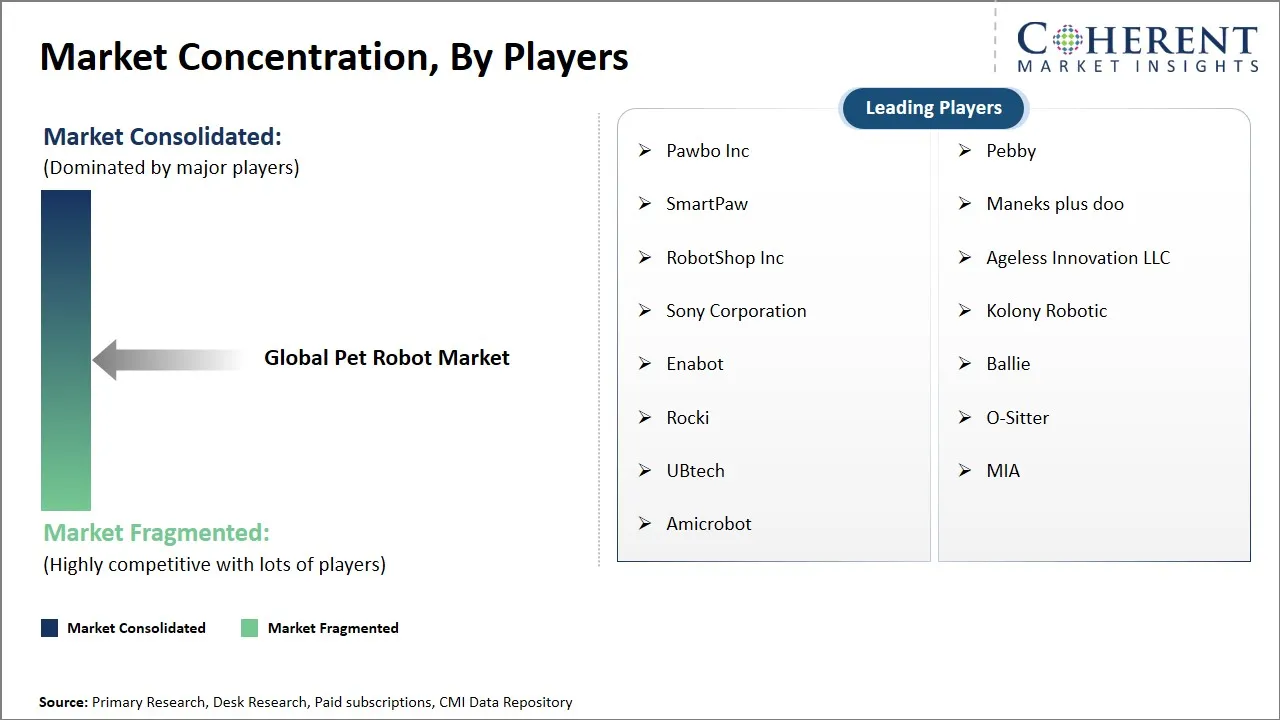
| Companies covered: | Pawbo Inc, Pebby, SmartPaw, Maneks plus doo, RobotShop Inc, Ageless Innovation LLC, Sony Corporation, Kolony Robotic, Enabot, Ballie, Rocki, O‑Sitter, UBtech, MIA, and Amicrobot | ||
| Growth Drivers: |
| ||
| Restraints & Challenges: |
| ||
Global Pet Robot Market Dynamics
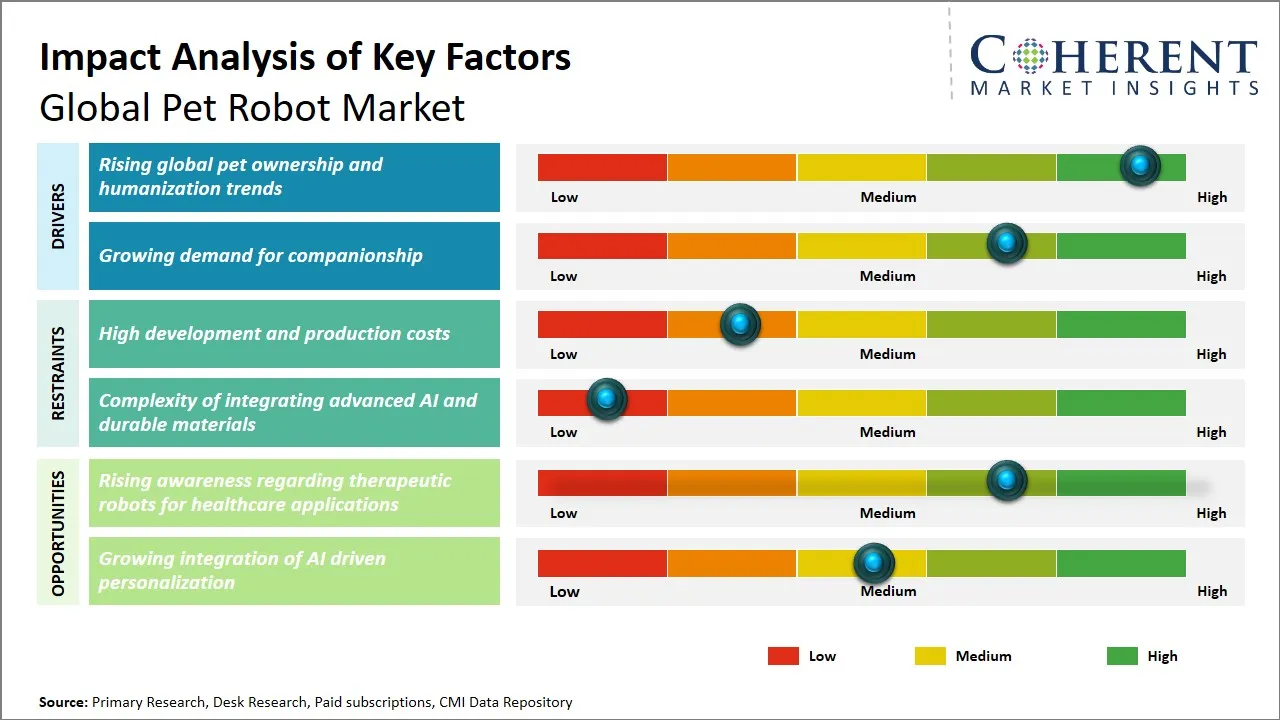
Global Pet Robot Market Driver - Rising Global Pet Ownership and Humanization Trends
Worldwide, more people now keep pets, while attitudes toward them grow closer to seeing them as part of the family. Owing to this change, demand rises for ways to improve pet grooming are cared for and engaged with daily. Instead of treating animals simply as animals, many act as if they share emotional ties equal to those among relatives, prompting interest in tools that offer interaction and comfort. Home by home, these tools arrive less as electronics and more as support when people are absent. When routines overwhelm or movement becomes difficult, reliance grows on automated assistance filling gaps left by human absence. What changes is not wiring or software, yet something quieter, assumptions about whose presence matters, who receives care, how continuity forms.
For instance, on January 8, 2026, Purina announced the five startups selected as winners of its tenth annual Pet Care Innovation Prize, recognizing emerging companies that are shaping the future of pet health, wellness, nutrition and veterinary care. Each prize winner will receive USD 25,000 in non-dilutive funding, along with mentorship and access to industry expertise from Purina, as they continue building solutions for today's evolving pet care landscape.
Global Pet Robot Market Opportunity - Rising Awareness Regarding Therapeutic Robots for Healthcare Applications
With rising focus on mental well-being and elder support across nations, robotic pets are finding stronger footing in medical devices and environments. Emotional separation impacts numerous elderly individuals, so a constant companion can soften stress while lowering loneliness. Found beyond households now, medical approaches include them regularly when routine proves essential, especially useful for people managing cognitive decline such as dementia. Without fur or dander, unlike real animals, there are no allergy concerns; meals and care routines also become irrelevant. Slowly, their purpose grows, guided more by necessity than fashion.
For instance, on January 9, 2024, Intuition Robotics, a pioneer in the field of AI-driven technology for older adults, unveiled the latest upgrades and advancements to its award-winning artificial intelligence companion ElliQ, which has been proven to positively impact seniors' health, social connectedness, and independence.
Analyst Opinion (Expert Opinion)
- When cities grow more crowded, machine-made friends begin to matter in small ways. Rather than mere toys, their actions emerge from complex programming paired with delicate signals. Where actual animals face restrictions, these devices fill gaps left by silence. A steady kind of comfort forms via repetition - gentle, yet never requiring attention. Beyond rooms meant for games, these figures appear near medical centers, inside urban dwellings, seated in still spaces. If tending to animals demands too much, manufactured companions offer relief without removing warmth.
- A shift unfolds not by invention, but through systems sensing feelings, adjusting uniquely, running without waste. Yet distinction between companies grows from steady steps into movement tracking, recognizing routines, linking household networks smoothly. Even when questions rise about equity and price limits restricting reach, such tools extend past entertainment - maintaining everyday stability. Over time, quiet shifts suggest what persists forward.
Speak to the analyst
Want personalized insights?
Take the findings above to one of our principal consultants, or have the report rebuilt around the segments, geographies and competitors you actually track.
Market Segmentation
- Type Insights (Revenue, USD Bn, 2021 - 2033)
- Stationary Robots
- Movable Robots
- Interactive Robots
- Zoomorphic Bots
- Component Insights (Revenue, USD Bn, 2021 - 2033)
- AI Software
- Sensors and Actuators
- Services
- Application Insights (Revenue, USD Bn, 2021 - 2033)
- Video Recording and Monitoring
- Pet Entertainment
- Pet Feeding
- Regional Insights (Revenue, USD Bn, 2021 - 2033)
- North America
- U.S.
- Canada
- Latin America
- Brazil
- Argentina
- Mexico
- Rest of Latin America
- Europe
- Germany
- U.K.
- Spain
- France
- Italy
- Russia
- Rest of Europe
- Asia Pacific
- China
- India
- Japan
- Australia
- South Korea
- ASEAN
- Rest of Asia Pacific
- Middle East
- GCC Countries
- Israel
- Rest of Middle East
- Africa
- South Africa
- North Africa
- Central Africa
- North America
- Key Players Insights
- Pawbo Inc
- Pebby
- SmartPaw
- Maneks plus doo
- RobotShop Inc
- Ageless Innovation LLC
- Sony Corporation
- Kolony Robotic
- Enabot
- Ballie
- Rocki
- O‑Sitter
- UBtech
- MIA
- Amicrobot
Sources
Primary Research Interviews
- Pet robot manufacturers and OEMs
- Technology developers and AI specialists in robotic
- Pet product retailers and distributors
- Pet owners and consumer focus groups
Magazines
- Pet Product News International
- Robotics Business Review
- Consumer Electronics Magazine
- Pet Age Magazine
- Modern Dog Magazine
Journals
- Journal of Consumer Electronics
- International Journal of Advanced Robotic Systems
- Anthrozoos: A Multidisciplinary Journal of Human-Animal Interactions
Newspapers
- The Wall Street Journal (Technology Section)
- Financial Times (Consumer Goods)
- USA Today (Technology & Innovation)
- The Guardian (Technology Section)
- Reuters (Business & Technology)
Associations
- Consumer Technology Association (CTA)
- International Federation of Robotics (IFR)
- Pet Industry Joint Advisory Council (PIJAC)
- American Pet Products Association (APPA)
- Robot Industries Association (RIA)
Public Domain Sources
- U.S. Patent and Trademark Office (USPTO)
- European Patent Office (EPO)
- Securities and Exchange Commission (SEC) filings
- Company annual reports and investor presentations
- Government trade statistics databases
Proprietary Elements
- CMI Data Analytics Tool
- Proprietary CMI Existing Repository of information for last 8 years
Get access to 250+ pages report
Every segment, forecast, competitor profile and data table behind the analysis above — available for instant download.
- ESOMAR Member
- ISO 9001:2015 Certified
- D-U-N-S Registered
- GDPR & CCPA Compliant
Missing comfort of reading report in your local language? Find your preferred language:
Transform your Strategy with Exclusive Trending Reports
Frequently Asked Questions
The global pet robot market stood at USD 720 Bn in 2026 and is expected to reach USD 1,100 Bn by 2033.
The CAGR of global pet robot market is projected to be 6% from 2026 to 2033.
Rising global pet ownership and humanization trends and growing demand for companionship are the major factors driving the growth of the global pet robot market.
High development and production costs and complexity of integrating advanced AI and durable materials are the major factors hampering the growth of the global pet robot market.
In terms of type, stationary robots are estimated to dominate the market revenue share in 2026.
Pet robots are positioned as alternatives or supplements, especially where real pet ownership is impractical.
North America is expected to lead the global pet robot market in 2026.