

Philippines Ube Market Size and Forecast – 2026 To 2033
The Philippines ube market is estimated to be valued at USD 48.7 Mn in 2026 and is expected to reach USD 75.2 Mn by 2033, exhibiting a compound annual growth rate (CAGR) of 6.4% from 2026 to 2033. Market growth is supported by the shift of ube from a traditional Filipino household ingredient to a commercial food ingredient used in bakery products, frozen desserts, beverages, ready-to-eat desserts, and packaged snacks. Processed formats such as ube powder, puree, frozen ube, ube jam, and ube extract—are becoming increasingly relevant, because they offer extended shelf life, are more convenient to store, help to maintain color, and provide an opportunity to scale up use for food manufacturers and foodservice operators.
The export potential of processed Philippine ube products is reflected in the April 2026 shipment of 1.2 tons of ube powder from Quirino to Japan by the Quirino Young Entrepreneurs Association. This shipment increased the group’s cumulative exports to over 4 tons, with total export sales reaching around PHP 4.4 million, highlighting growing overseas demand for value-added ube formats. (Source: PR News)
Key Takeaways of the Philippines Ube market
- Ube powder is expected to hold 30.4 % share in 2026, supported by better shelf stability, bulk handling, and suitability for bakery, dessert, beverage, and premix applications. Hamburg Trading Corporation offers Philippines-made ube powders using locally-sourced purple yams, including premium roll-dried powder for local distribution. (Source: Hamburg Trading Corporation)
- Bakery products are expected to account for 32.1 % of the market share in 2026, as ube is widely used in pies, cakes, breads, pastries, and fillings. Jollibee Philippines’ Ube Cheese Pie reflects strong commercial menu integration, combining sweet ube and cheese in a crispy crust for mass foodservice consumption. (Source: Jollibee Philippines)
- Food manufacturers are expected to hold 38.7 % of the market share in 2026, as standardized ube formats help scale production across desserts, baked goods, snacks, and prepared foods. Encore Fruit offers sweetened and unsweetened ube puree for food manufacturers, positioning ube as a versatile ingredient for bakery and dessert applications. (Source: Encore Fruit)
- Frozen Dessert Premiumization: Frozen desserts remain a major demand pocket, supported by the shift toward indulgent local flavors in retail ice cream and chilled desserts. Selecta Philippines markets Super Thick Ube Royale Ice Cream made with authentic Kinampay ube flavor, showing how branded frozen dessert players are commercializing ube as a premium Filipino flavor. (Source: Selecta Philippines)
- Beverage Innovation Accelerates Visibility: Beverage applications are gaining strategic relevance as cafés and global chains use ube for color, flavor, and menu differentiation. In March 2026, Starbucks Reserve introduced an Iced Ube Coconut Latte and allowed customers to add ube coconut cold foam to beverages, strengthening global awareness of ube-based drink formats. (Source: Starbucks)
Segmental Insights
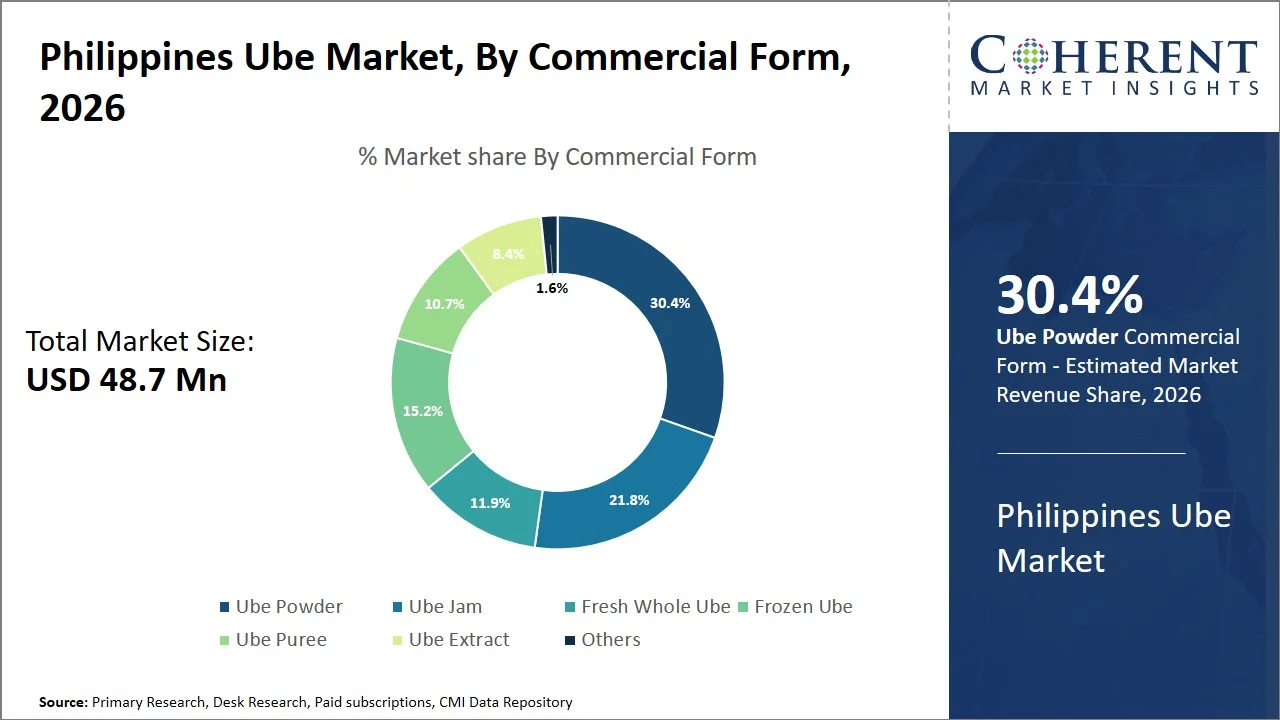
Why Does Ube Powder Represent the Largest Commercial Form Segment in the Philippines Ube market?
The Philippines Ube Market is expected to be led by ube powder, which is projected to capture 30.4% share in 2026. This segment’s dominance stems from its longer shelf life, reduced dependency on fresh storage, and suitability for bulk transportation, making it ideal for industrial applications. Demand is driven by bakeries, dessert processors, beverage premix producers, and packaged snack manufacturers requiring consistent color, flavor, and texture across batches. On the supply side, drying and powder-processing technologies mitigate the limitations of seasonal fresh ube and enable wider distribution through ingredient channels, supporting both domestic and export markets. For instance, Department of Trade and Industry (DTI)'s February 2026 report noted that the value of Philippine ube exports increased to US$ 3.06 Mn in 2025, and processed varieties like ube powder are showing a gradual rise. (Source: Department of Trade and Industry)
- Current Industry Events of 2026
- Market Size Estimation
- Regional Breakdown
- Competitive Landscape
- Customer Intelligence
- Segmental Analysis
- Pricing Analysis
- Key Market Drivers, Challenges & Future Trends
- Customized Insights Section
Why Do Bakery Products Dominate the Philippines Ube Market by Application?
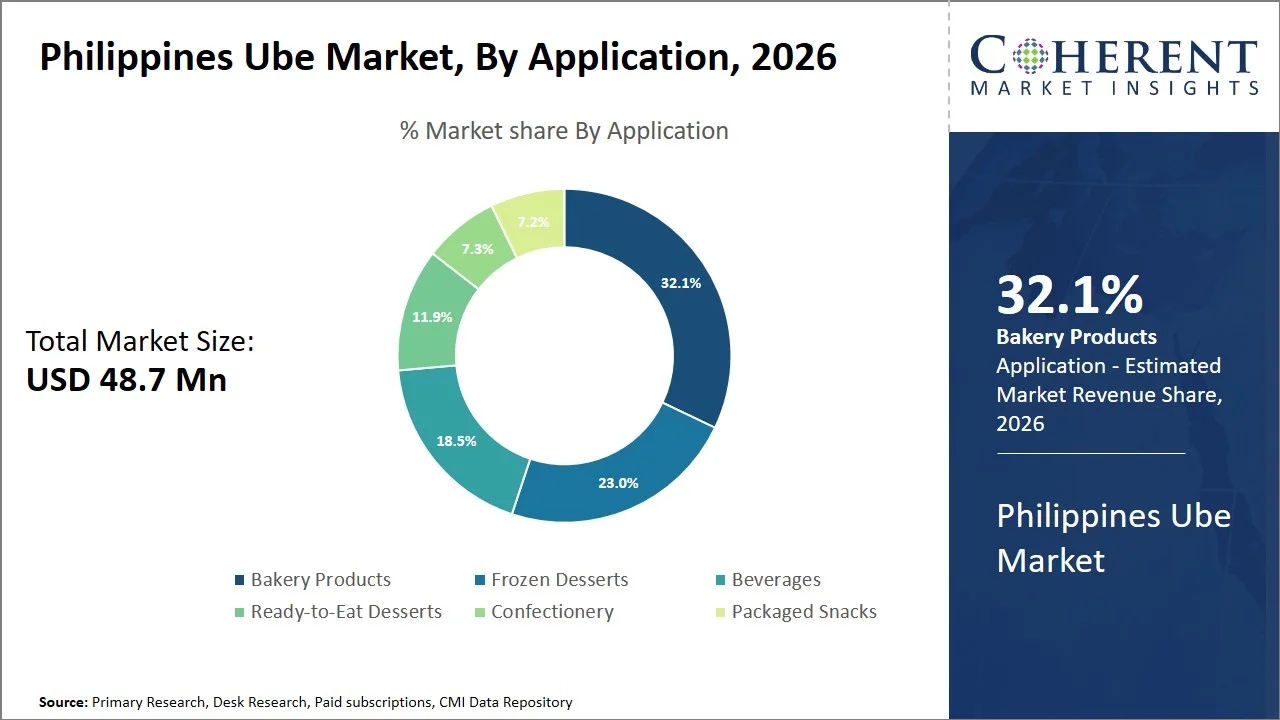
Bakery products are expected to hold 32.1% share in 2026, as ube is deeply embedded in Filipino bakery culture through cakes, breads, pastries, pies, rolls, and filled desserts. The segment dominates because ube works well as both a flavor and visual differentiator, giving bakeries a premium local identity while supporting repeat purchases for snacks and celebrations. Demand is reinforced by urban bakery chains, quick-service restaurants, home bakers, and cafés that use ube in accessible daily-consumption products. From an application standpoint, ube jam, powder, and puree provide flexibility for fillings, doughs, toppings, and creams. A relevant instance is Jollibee Philippines’ Ube Cheese Pie, which combines sweet ube and cheese in its signature crispy crust, showing mainstream foodservice adoption of ube-based bakery products.
Why Do Food Manufacturers Represent the Largest Buyer Type Segment in the Philippines Ube Market?
Food manufacturers are expected to account for 38.7% share in 2026, making them the largest buyer type in the Philippines ube market. Their dominance comes from high-volume procurement needs across frozen desserts, baked goods, packaged snacks, beverage bases, and ready-to-eat desserts. Unlike retail consumers, manufacturers require repeatable ingredient performance, predictable supply, and formats suitable for processing lines, which supports demand for powder, puree, extract, frozen ube, and jam. Supply-side relevance is also strong because processed ube enables batch consistency, longer inventory cycles, and product launches beyond seasonal fresh yam availability. For instance, King’s Hawaiian launched Ube Coconut Sweet Rolls nationwide in April 2026, made with real ube and coconut milk, showing how branded food manufacturers are scaling ube into mainstream packaged bakery innovation.
Currents Events and their Impact
Current Events | Description and its Impact |
Philippines FDA advances electronic registration for processed food products February 2026 |
|
DTI strengthens export support for Philippine ube products February 2026 |
|
DOST-PCAARRD supports year-round Ube production research, April 2025 |
|
(Source: Department of Trade and Industry, Philippine Government, & Food and Drug Administration (FDA))
Philippines Ube Market Dynamics
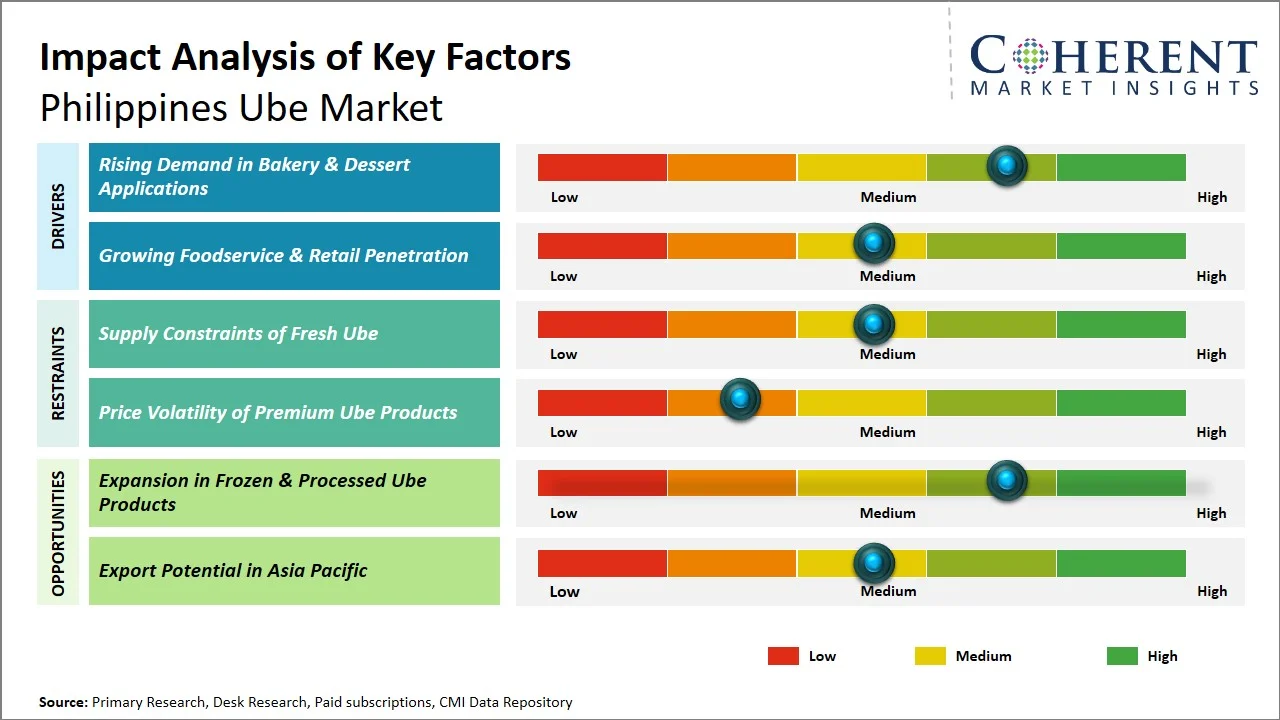
Market Drivers
- Rising demand in bakery and dessert applications: Ube is gaining stronger commercial relevance in bakery and dessert formats because it delivers flavor, color, and Filipino identity in cakes, pastries, frozen milk desserts, and celebration products. This strengthens the demand for ube powder, jam, puree, and halaya among bakeries and dessert operators that need consistent taste, texture, and visual appeal. A fresh instance is Conti’s Bakeshop & Restaurant offering Ube Custard, made with ube sponge cake, real purple yam, and creamy custard layers, along with Ube Custard Snow made with real ube halaya and frozen milk snow. This shows premium bakery and dessert adoption within the domestic market. (Source: Conti’s Bakeshop & Restaurant)
- Growing foodservice and retail penetration: Ube is moving deeper into convenience retail and ready-to-eat foodservice channels, helping convert traditional consumption into impulse-led and on-the-go purchases. For the Philippines bbe market, this improves commercial offtake for processed formats used in fillings, beverages, chilled desserts, and bakery-style snacks. A fresh instance is 7-Eleven Philippines listing multiple ube-based offerings under its current new product range, including Ube and Chocolate Egg Tart, Ube Halaya Fundae, and Milk Tea and Ube Cheese Milky Sago. This indicates wider retail experimentation with ube across desserts and beverages. (Source: 7-Eleven Philippines)
Emerging Trends
- Beverage led ube innovation: Ube is increasingly being positioned as a beverage innovation ingredient due to its natural violet color, mildly sweet nutty profile, and strong visual appeal. This trend is important for the Philippines ube market because beverages allow brands to use ube beyond traditional desserts and bakery products. Cafés, milk tea chains, quick-service restaurants, and specialty beverage players can use ube in lattes, milkshakes, cold foams, smoothies, flavored milk, and dessert beverages. This creates stronger demand for ube extracts, ube powder, syrups, and puree formats that offer consistency, easy blending, and scalable preparation. As beverage manufacturers seek differentiated local flavors, ube is becoming a commercially attractive ingredient for premiumization, seasonal menus, and youth-focused product innovation.
- Supply stabilization through improved cultivation: Supply stabilization is emerging as a key trend as the Philippines ube market moves from fragmented seasonal production toward more organized cultivation, better planting material access, and stronger farm-to-processor linkages. This is commercially important because inconsistent raw ube availability can affect pricing, production planning, and quality consistency for powder, jam, puree, frozen ube, and extract manufacturers. Improved cultivation practices can help processors secure more reliable volumes, reduce wastage, and support year-round availability for food manufacturers and foodservice operators. As demand grows from bakery, frozen dessert, beverage, and packaged snack applications, better supply management will become essential for scaling production, improving export readiness, and maintaining stable margins across the value chain.
Regulatory Quality and Export Compliance Scenario in the Philippines Ube Market
Regulatory area | Applicability to Philippines Ube market | Market impact |
Food Establishment Licensing | Applies to manufacturers, processors, repackers, exporters, wholesalers, and distributors of ube powder, jam, puree, extract, frozen ube, desserts, snacks, and beverages | Improves formal market participation and buyer confidence, while increasing compliance requirements for small and informal ube processors |
Processed Food Product Registration | Packaged and processed ube products require FDA product registration before retail sale, distribution, promotion, or export | Supports access to supermarkets, foodservice buyers, distributors, and export customers |
Food Safety and Hygiene Compliance | Relevant for ube jam, puree, frozen ube, extract, bakery fillings, beverages, and ready-to-eat desserts | Improves product safety, shelf-life reliability, and batch consistency across processed ube formats |
Labeling and Packaging Compliance | Applies to pre-packaged ube products including retail packs, ingredient packs, frozen desserts, packaged snacks, and beverages | Enhances consumer transparency and reduces rejection risk in organized retail and export markets |
Microbiological and Quality Testing | Important for high-moisture and handled products such as ube jam, puree, frozen ube, beverages, and desserts | Encourages batch testing, shelf-life validation, and stronger quality control among processors |
Plant Quarantine and Phytosanitary Compliance | Relevant for fresh whole ube, plant-based shipments, and agricultural export consignments | Supports export market access but adds inspection, documentation, and destination-country compliance requirements |
Certificate of Origin Compliance | Applies to exporters seeking origin verification or preferential tariff access for Philippine ube products | Strengthens export credibility and improves competitiveness in ASEAN and other trade-linked markets |
Destination-Market Conformity Requirements | Applies to processed ube exports entering countries with additional food safety, inspection, or conformity requirements | Pushes processors toward stronger documentation, standardized production, and export-ready quality systems |
How are Processing and Shelf-Life Technologies Creating New Growth Opportunities in the Philippines Ube market?
Advanced processing technologies are creating growth opportunities in the Philippines ube market by converting seasonal fresh ube into more stable, scalable, and commercially usable formats such as ube puree, ube jam, ube powder, frozen ube, and extracts. This is important because food manufacturers, bakeries, frozen dessert brands, and beverage companies require consistent texture, color, flavor, and shelf-life performance for large-scale production. A relevant instance is the DOST-ITDI 2025 project on quality improvement through agitated retort processing of thermally processed local products, including ube puree and ube jam, implemented from 2025 to 2026. This supports safer, longer-lasting, and standardized ube products for manufacturers and commercial buyers. (Source: DOST-ITDI)
Market Players, Key Development, and Competitive Intelligence
Key Developments
- In 2025, according to the Xinhua News Agency, ube exports in the Philippines reached US$ 3.06 million. This development highlights the growing global demand for Philippine ube and strengthens export visibility for processed forms such as ube powder, puree, halaya, and extracts. The demand is particularly supported by bakery, frozen dessert, beverage, and ready-to-eat dessert applications.
- In April 2026, King’s Hawaiian launched ube coconut sweet rolls. This launch demonstrates mainstream retail adoption of ube outside the Philippines and signals rising demand for ube-based bakery products. It also highlights export potential for Philippine ingredient suppliers across ube powder, puree, and extract formats.
Competitive Landscape
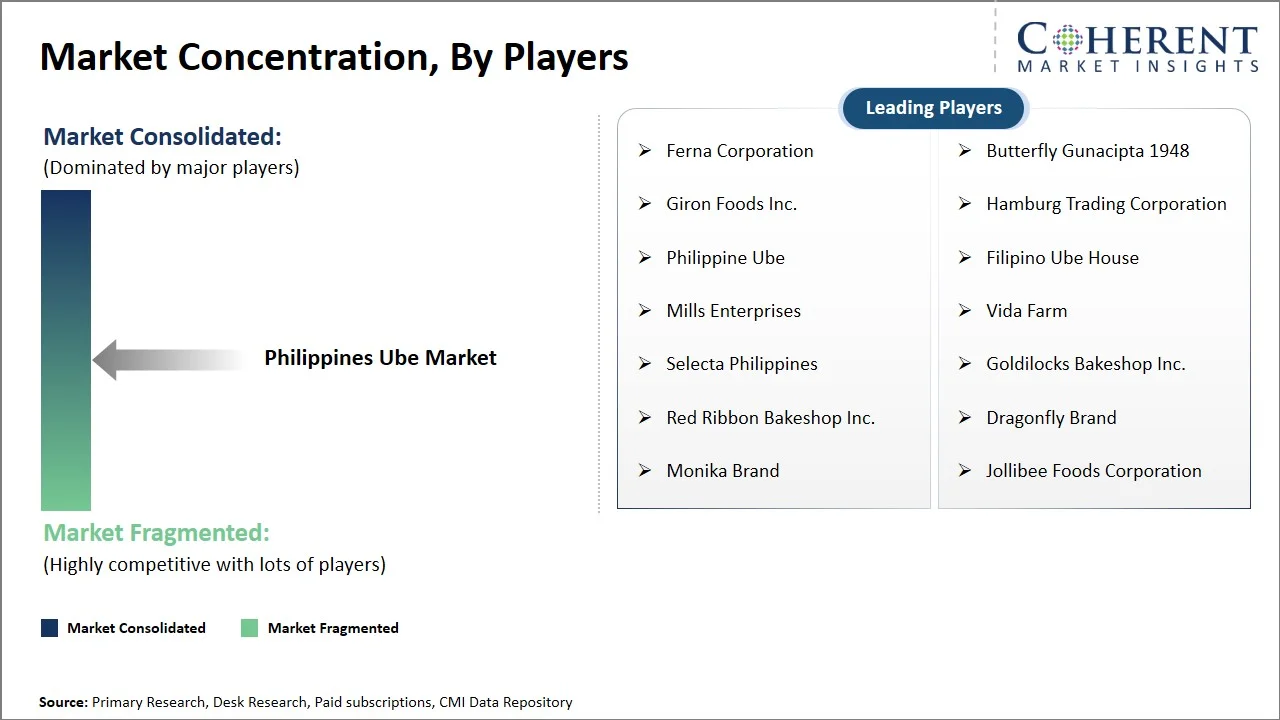
The Philippines ube market is fragmented, with competition spread across local farmers, regional aggregators, ingredient processors, dessert and bakery brands, food manufacturers, and exporters. Companies compete mainly on product authenticity, color consistency, shelf life, processing capability, food safety compliance, and access to reliable ube sourcing. Processed ingredient suppliers are gaining stronger positioning as commercial buyers shift toward powder, puree, frozen ube, jam, and extract formats for scalable bakery, dessert, beverage, and snack production. Players such as Hamburg Trading Corporation offer locally-sourced ube powder, while Cenmaco markets Gina ube puree and KLT Fruits lists ube puree, powder, and chips in its Philippine fruit portfolio.
Key focus areas include
- Expansion of processed ube formats such as powder, puree, jam, frozen ube, and extracts for industrial food applications
- Strengthening of farmer sourcing, planting material access, and year-round supply programs to reduce raw material seasonality
- Investment in food safety, FDA, Halal, GMP, and export-ready quality systems to serve retail and overseas buyers
- Product innovation across bakery, frozen desserts, beverages, packaged snacks, and ready-to-eat desserts
- Development of authentic Philippine-origin positioning to differentiate from generic purple yam and artificial flavor alternatives
- Expansion through distributors, foodservice chains, supermarkets, convenience stores, specialty retailers, and export channels
Market Report Scope
Philippines Ube Market Report Coverage
| Report Coverage | Details | ||
|---|---|---|---|
| Base Year: | 2025 | Market Size in 2026: | USD 48.7 Mn |
| Historical Data for: | 2020 To 2024 | Forecast Period: | 2026 To 2033 |
| Forecast Period 2026 to 2033 CAGR: | 6.4% | 2033 Value Projection: | USD 75.2 Mn |
| Segments covered: |
| ||
| Companies covered: | Ferna Corporation, Butterfly Gunacipta 1948, Giron Foods Inc., Hamburg Trading Corporation, Philippine Ube, Filipino Ube House, Mills Enterprises, Vida Farm, Selecta Philippines, Goldilocks Bakeshop Inc., Red Ribbon Bakeshop Inc., Dragonfly Brand, Monika Brand, and Jollibee Foods Corporation | ||
| Growth Drivers: |
| ||
| Restraints & Challenges: |
| ||
Analyst Opinion (Expert Opinion)
- The Philippines ube market is expected to grow steadily over the long term due to the strong cultural relevance of ube in Filipino food, rising use in bakery and dessert applications, and increasing commercialization of processed formats such as ube powder, jam, puree, frozen ube, and extracts. As food manufacturers and foodservice operators seek locally rooted ingredients with strong visual appeal, ube is likely to remain a high-value flavor and color ingredient across desserts, beverages, snacks, and ready-to-eat products.
- The highest opportunity is expected in processed and value-added ube formats, especially ube powder, ube puree, and frozen ube, as these products address the limitations of fresh whole ube such as seasonality, short shelf life, and inconsistent supply. Bakery products, frozen desserts, and beverages are expected to remain the most attractive application areas, supported by demand from cafés, QSR chains, packaged food manufacturers, dessert shops, and export-oriented ingredient buyers.
- To gain competitive advantage, market participants should invest in supply stabilization, processing technology, food safety compliance, and export-ready quality systems. Companies with strong farmer linkages, consistent raw material sourcing, standardized color and flavor profiles, FDA-compliant processing, and scalable distribution networks will be better positioned. Strategic focus on premium Philippine-origin branding, clean-label formulations, and innovation in bakery, beverage, and frozen dessert formats will strengthen long-term competitiveness.
Speak to the analyst
Want personalized insights?
Take the findings above to one of our principal consultants, or have the report rebuilt around the segments, geographies and competitors you actually track.
Market Segmentation
- Commercial Form Insights (Revenue, USD Mn, 2021 - 2033)
- Ube Powder
- Ube Jam
- Fresh Whole Ube
- Frozen Ube
- Ube Puree
- Ube Extract
- Others
- Application Insights (Revenue, USD Mn, 2021 - 2033)
- Bakery Products
- Frozen Desserts
- Beverages
- Ready-to-Eat Desserts
- Confectionery
- Packaged Snacks
- Buyer Type Insights (Revenue, USD Mn, 2021 - 2033)
- Food Manufacturers
- Foodservice Operators
- Retail Consumers
- Beverage Manufacturers
- Ingredient Distributors
- Distribution Channel Insights (Revenue, USD Mn, 2021 - 2033)
- Direct Sales
- Indirect Sales (via distributors)
- Key Players Insights
- Ferna Corporation
- Butterfly Gunacipta 1948
- Giron Foods Inc.
- Hamburg Trading Corporation
- Philippine Ube
- Filipino Ube House
- Mills Enterprises
- Vida Farm
- Selecta Philippines
- Goldilocks Bakeshop Inc.
- Red Ribbon Bakeshop Inc.
- Dragonfly Brand
- Monika Brand
- Jollibee Foods Corporation
Sources
Primary Research Interviews
- Ube growers and farmer cooperatives involved in purple yam cultivation
- Ube processors producing powder, jam, puree, frozen ube, extracts, and halaya
- Food manufacturers using ube in bakery, frozen desserts, beverages, snacks, and ready-to-eat desserts
- Bakery chains, dessert shops, cafés, and foodservice operators using ube-based ingredients
- Ingredient distributors, wholesalers, exporters, and retail channel partners handling ube products
- Food safety, quality assurance, and product development professionals from processed food companies
Stakeholders
- Ube farmers, growers, and agricultural cooperatives
- Ube powder, jam, puree, extract, and frozen ube manufacturers
- Bakery and dessert product manufacturers
- Beverage manufacturers and café chains
- Packaged snack and confectionery companies
- Food ingredient suppliers and distributors
- Exporters of ube and ube-based processed products
- End-use Sectors
- Bakery products manufacturers
- Frozen dessert and ice cream manufacturers
- Beverage companies and café chains
- Ready-to-eat dessert producers
- Confectionery and packaged snack manufacturers
- Hotels, restaurants, cafés, and quick-service restaurants
- Supermarkets, convenience stores, specialty food retailers, and online food platforms
Regulatory & Government Bodies
- Philippine Food and Drug Administration (FDA)
- Department of Agriculture (DA), Philippines
- Bureau of Plant Industry (BPI), Philippines
- Department of Trade and Industry (DTI), Philippines
- DTI Export Marketing Bureau (EMB)
- Bureau of Customs, Philippines
- DOST Philippine Council for Agriculture, Aquatic and Natural Resources Research and Development (DOST-PCAARRD)
- DOST Industrial Technology Development Institute (DOST-ITDI)
- DOST Food and Nutrition Research Institute (DOST-FNRI)
Databases
- Philippine Statistics Authority (PSA) OpenSTAT
- PSA Agricultural Indicators System
- FAOSTAT
- UN Comtrade Database
- International Trade Centre (ITC) Trade Map
- DTI TradeLine Philippines
- ASEANstats Database
- World Bank Data
- WTO SPS and TBT Information Management Systems
- Philippine National Plant Quarantine Services Division export database
Magazines
- Agriculture Monthly
- Food Philippines
- DOST-PCAARRD Monitor
- BAR Chronicle
- FoodNavigator-Asia
- Food Business News
- Asia Food Journal
Journals
- Philippine Journal of Crop Science
- The Philippine Agricultural Scientist
- Journal of Root Crops
- Food Research
- Food Chemistry
- International Journal of Food Science and Technology
- Asian Journal of Agriculture and Food Sciences
News and Business Media Sources
- BusinessWorld
- BusinessMirror
- Philippine Daily Inquirer
- Manila Bulletin
- The Philippine Star
- Rappler
- ABS-CBN News
- GMA News Online
Associations
- Philippine Food Processors and Exporters Organization Inc. (PHILFOODEX)
- Philippine Exporters Confederation Inc. (PHILEXPORT)
- Philippine Chamber of Food Manufacturers Inc.
- Philippine Association of Food Technologists Inc.
- Philippine Franchise Association
- Philippine Coffee Board and café industry networks
- Local farmer associations and ube grower cooperatives
Public Domain Sources
- Department of Trade and Industry – Ube export and trade promotion data
- Department of Agriculture – Crop production and farmer support programs
- Bureau of Plant Industry – Plant quarantine and phytosanitary export requirements
- Philippine FDA – Food product registration and labeling guidelines
- DOST-PCAARRD – Ubi Kinampay and purple yam cultivation research
- DOST-ITDI – Food processing and shelf-life technology projects
- PSA – Agriculture, retail, and food manufacturing statistics
- FAO – Root and tuber crop production data
Proprietary Elements
- CMI Data Analytics Tool, Proprietary CMI Existing Repository of information for last 10 years.
Get access to 250+ pages report
Every segment, forecast, competitor profile and data table behind the analysis above — available for instant download.
- ESOMAR Member
- ISO 9001:2015 Certified
- D-U-N-S Registered
- GDPR & CCPA Compliant
Missing comfort of reading report in your local language? Find your preferred language:
Transform your Strategy with Exclusive Trending Reports
Frequently Asked Questions
The CAGR of the Philippines ube market is projected to be 6.4% from 2026 to 2033.
The Philippines ube market is estimated to be valued at USD 48.7 million in 2026 and is expected to reach USD 75.2 million.
In terms of application, bakery products are expected to dominate the Philippines ube market with 32.1% market share in 2026, supported by strong use of ube in cakes, breads, pastries, pies, rolls, and bakery fillings.
Expansion in processed and value-added ube products, including ube powder, puree, frozen ube, jam, and extracts, represents a key opportunity as these formats offer longer shelf life, easier handling, and stronger suitability for bakery, frozen dessert, beverage, and export applications.
Rising demand in bakery and dessert applications and growing foodservice and retail penetration are the major factors driving the growth of the Philippines ube market.
Supply constraints of fresh ube and price volatility of premium ube products are the major factors hampering the growth of the Philippines ube market.
In terms of commercial form, ube powder is estimated to dominate the market revenue share in 2026.