

Global Frozen Dessert Market Size and Forecast – 2026-2033
The Global Frozen Dessert Market is estimated to be valued at USD 134.35 Bn in 2026 and is expected to reach USD 182.83 Bn by 2033, exhibiting a compound annual growth rate (CAGR) of 4.5% from 2026 to 2033.
Key Takeaways of the Frozen Dessert Market
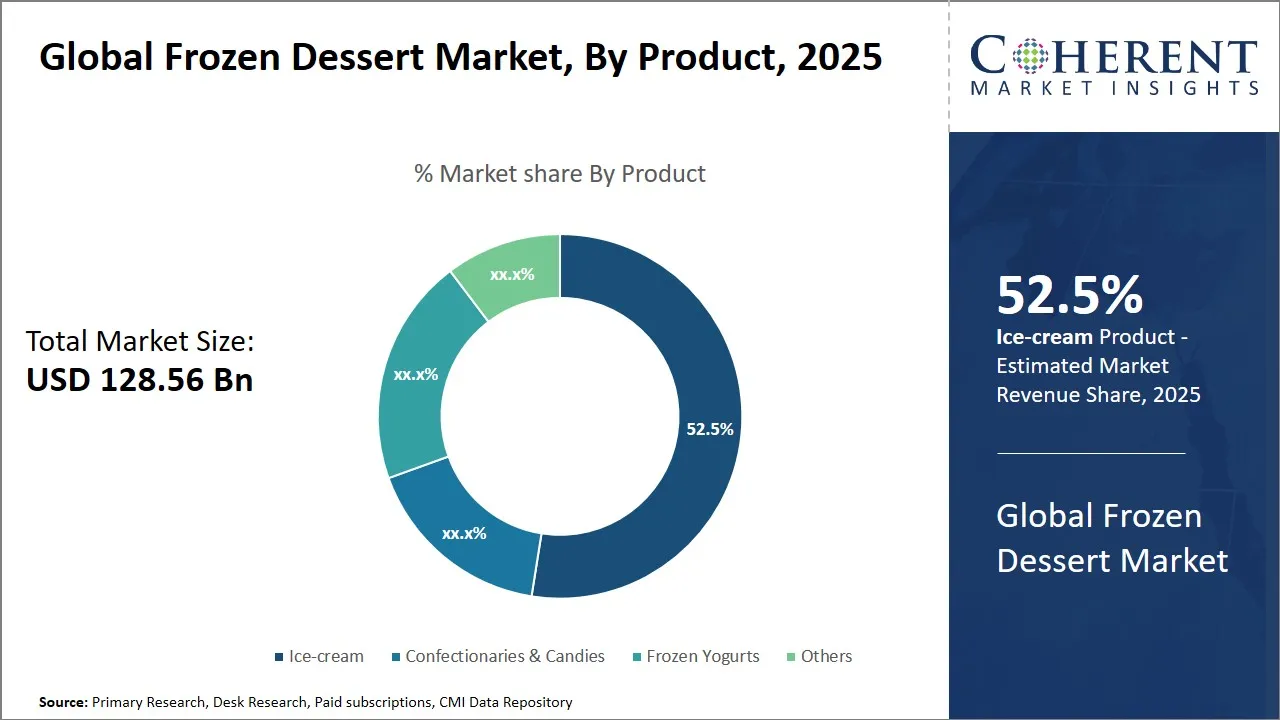
- The ice-cream segment is projected to capture 53.5 % of the frozen dessert market in 2026, driven by several key factors.
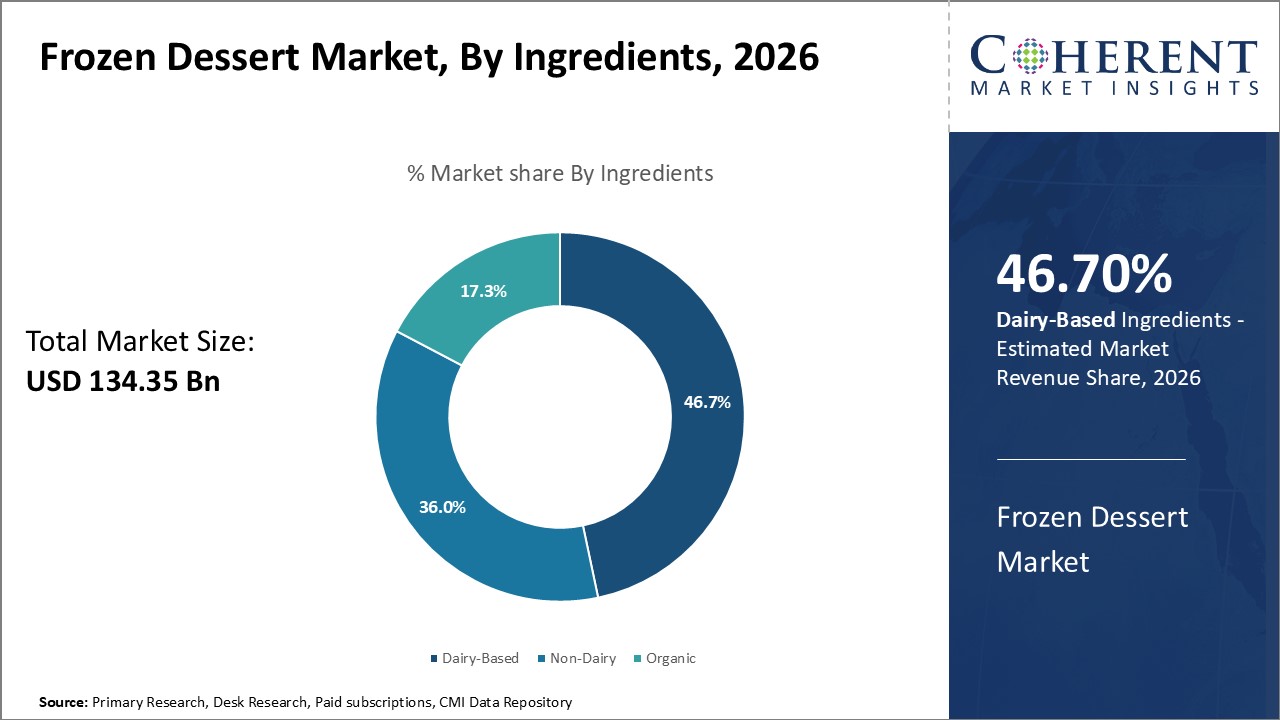
- The dairy-based segment is expected to account for 46.7 % of the frozen dessert market in 2026, offering creamy texture, rich flavor, and mouthfeel that consumers desire.
- The supermarkets/hypermarkets segment is projected to hold a 35.7 % share of the frozen dessert market in 2026, primarily due to their convenience, variety, and competitive pricing in one location.
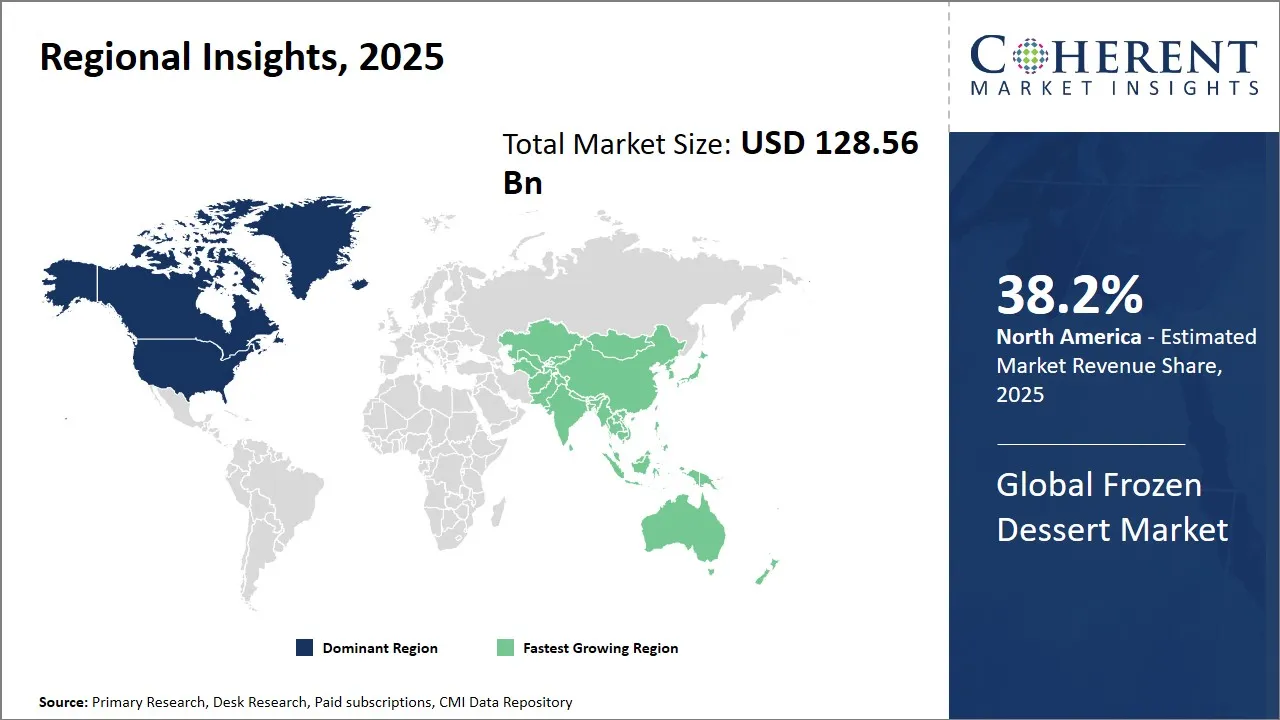
- North America will lead the global frozen dessert market in 2026 with a 38.2 % share, driven by strong demand and product innovation. Asia Pacific, with a 21.5% share in 2026, will be the fastest-growing region, fueled by rising incomes and urbanization.
Market Overview
Recent market trends are characterized by the movement towards the better and practical frozen dessert materials, and consumers are more inclined towards the low-calorie food, dairy-free, and organic variants. The vegan substitutes and sophisticated tastes are on the rise, engaged in serving to the changing eating habits and lifestyle. Moreover, there is the advent of technological development of freezing and packaging, which enhance the quality of products and their shelf life to become a brand that attracts a broader audience. The use of sustainability programs and green packaging is also emerging as a major point of difference in this competitive market.
Current Events and Its Impact
Current Events | Description and its impact |
Acceleration of online grocery & e‑commerce footprint for frozen desserts |
|
Acceleration of online grocery & e‑commerce footprint for frozen desserts |
|
Segmental Insights
- Current Industry Events of 2026
- Market Size Estimation
- Regional Breakdown
- Competitive Landscape
- Customer Intelligence
- Segmental Analysis
- Pricing Analysis
- Key Market Drivers, Challenges & Future Trends
- Customized Insights Section
Frozen Dessert Market Insights, By Product - Ice-cream Segment Dominates the Market due to Its Widespread Consumer Appeal and Versatility
Ice-cream segment is expected to hold 53.5% share of the frozen dessert market in 2026, due to several key factors. Primarily, historical status and cultural importance in all its forms in many parts of the world have solidified its popularity as a luxury treat among people of all ages. The products have rich texture with the variety of flavor profiles to suit the needs of the broad consumer tastes, including the traditional vanilla and chocolate. These natural versatilities allow producers to keep on updating their product line and lure repeat buyers.
In addition, the rising emphasis on the premiumization in the ice cream segment has helped in increasing its strong market share. Customers are now ready to explore premiums, crafted and specialty ice-creams that provide a different experience and healthier options such as less sugar or high protein content. This is in line with increasing disposable income and shifting palate where quality is more important than quantity which drives the growth of the segments in the frozen dessert sector.
Frozen Dessert Market Insights, By Ingredients - Dairy-Based Segment Dominates the Market due to their Traditional Appeal and Superior Sensory Attributes
Dairy-based segment is projected to hold 46.7% share of the frozen dessert market in 2026, providing a creamy texture, rich flavor, and mouthfeel that consumers expect. The inherent fat and protein structure of the dairy makes the products have a typical lusciousness that cannot be convincingly imitated with the non-dairy products. It is this inherent aspect that has caused dairy-based frozen desserts to be of high preference by consumers who are in need of original taste experiences.
The dominance of dairy-based frozen desserts is further enhanced by the perception of the consumers about the health and nutrition. Most consumers relate dairy ingredients with other nutritional values like calcium, vitamins and essential fatty acids. Trust and familiarity associated with the consumption of dairy products are transferred to increased demand particularly in areas where consumption and farming of dairy products have been common as a staple diet.
Frozen Dessert Market Insights, By Distribution Channel - Supermarket/Hypermarket Segment Dominates the Market due to Extensive Reach and Enhanced Consumer Shopping Experience
Supermarkets/hypermarkets segment is expected to hold 35.7% share of the frozen dessert market in 2026, largely because they provide consumers with convenience, variety, and competitive pricing under one roof. These retail formats typically offer expansive frozen dessert sections, showcasing an extensive assortment of products that cater to diverse preferences, from budget-friendly options to premium and health-conscious variants. This diversity facilitates impulse buying and enables co-existence of culturally diversified products, which satisfy the needs of a diverse consumer base.
Moreover, such stores usually invest in the latest technology of refrigeration to maintain the quality of the products, which will preserve the quality of frozen desserts and will guarantee a high level of customer satisfaction.
Seasonal Demand & Flavor Innovation (Seasonal sales spikes across regions, top-selling flavors by geography)
Seasonal Demand
- Frozen desserts experience significant seasonal sales spikes, particularly in hotter weather, with consumption rising up to 50% during warm spells.
- Demand drops by over 20% during colder weeks, requiring producers to have flexible production capacity and region-specific inventory buffers to manage supply efficiently.
- Seasonal preferences vary by region, influenced by climate and consumer behavior.
Regional Flavor Preferences
- North America: Preference for flavors like peanut butter, dark chocolate, milk chocolate, with a demand for no added sugar, plant-based, and GMO-free claims.
- Europe: Popularity of strawberry, dark chocolate, vanilla, caramel, with trends toward indulgent, premium, low/no/reduced fat, and no added sugar claims.
- Asia Pacific: Interest in fruit flavors (mango, coconut, white peach), limited edition and seasonal flavors, influenced by rapid urbanization and rising disposable income.
- Middle East and Africa: Growth in fruit flavors and seasonal claims, reflecting local tastes and customs.
Regional Insights
North America Frozen Dessert Market Analysis and Trends
The North America region is projected to lead the market with a 38.2% share in 2026, driven by a well-established market ecosystem, high consumer demand for innovative and premium frozen dessert products, and widespread retail infrastructure. Players (Unilever with its Breyers and Magnum brands, Nestle, and General Mills) in the major industries make the market stronger. Food safety and quality regulations are highly supported and the health-conscious consumer market is compelling manufacturers to come up with low fats, organic and dairy free frozen desserts.
Moreover, supply chains and distribution channels are very efficient and make sure that they are widely available in supermarkets, convenience stores and specialty stores. Policies of the government to promote clean-label ingredients and nutritional transparency also supplement the products. The trade dynamics would prefer importation of artisanal and ethnic frozen desserts which increase the diversity of the products.
Asia Pacific Frozen Dessert Market Analysis and Trends
The Asia Pacific region is expected to exhibit the fastest growth in the market contributing 21.5% share in 2026, due to the strong impetus of the high rate of urbanization, rising disposable incomes, and growing populations of the middle classes. Consumer preference towards western-style desserts and localized ones is also on the rise in countries such as China, India, and Southeast Asian countries. The booming retail and foodservice markets as well as online platforms such as e-commerce facilitate accessibility and product innovation.
Modernization and safety standards of the government programs in the food industry provide favorable operations environment. There are local players like Amul in India and Joyvio in China who are developing traditional and fusion frozen desserts whilst there are multinationals who are fiercely increasing their presence. The liberalization of trade and regional trade agreements allow the procurement of raw materials and international brand extension thus further spurring market growth.
Global Frozen Dessert Market Outlook for Key Countries
U.S. Frozen Dessert Market Trends
The frozen dessert market in the U.S. is aggressive and innovative, with the major players, such as Unilever, Nestle, and General Mills. The money in the research and development of products to meet the emerging health trends like plant-based and low-calorie products. The need to purchase handcrafted goods is on the rise and this is contributing to the development of high-end brands and boutique frozen dessert firms. Large retail players and foodservice chains offer a large distribution system, which improves market penetration. Labeling and food quality focus and related regulations are used to maintain the same standards of products, which will make the consumers trust and be loyal.
China Frozen Dessert Market Trends
The market of frozen desserts in Chinas has shown the increasing consumer interest in international as well as domestic brands. Large domestic players such as Joyvio and Yili utilize both the traditional flavors with innovation to attract different types of consumers. MNCs are increasing production plants and forming joint ventures to meet the taste of local countries. Consumption increases due to changes in urban lifestyle, growth of e-commerce and high marketing campaigns. The quality certification and control of food safety by the government enhances market credibility.
India Frozen Dessert Market Trends
The frozen dessert market in India is defined by the combination of the traditional sweets and frozen dessert innovations. The market is filled with competitors such as Amul and Mother Dairy, which have extensive dairy supply chains to provide low-cost, but differentiated frozen dessert items. The growth of consumption is caused by rising urbanization and warming climates. Market improvement is brought up by policy activities that seek to improve the dairy industry and develop cold chain infrastructure. The new generation of middle-income consumers and young people prefer new tastes and healthy alternatives, promoting product differentiation.
Germany Frozen Dessert Market Trends
Germany stands as a key European market with sophisticated consumer preferences focused on quality, organic ingredients, and nutritional value. Leading companies, such as Deutsche Markengetränke and Langnese (Unilever), emphasize sustainable sourcing and environmental responsibility. The country benefits from strong retail frameworks and well-enforced food regulations that promote transparency and safety. Market trends include vegan frozen desserts and innovative ingredients like oat and almond milk. Trade within the European Union facilitates seamless import-export operations, enriching product variety.
Brazil Frozen Dessert Market Trends
Brazil’s frozen dessert market is growing, driven by a young population and increasing demand for indulgent and convenient treats. Local companies, such as Nestlé Brasil and Diletto (owned by Nestlé), have a strong presence, introducing products tailored to regional tastes. The expanding retail and informal trade channels, combined with rising tourism, contribute to market dynamism. Government initiatives aimed at agricultural support and improved refrigeration infrastructure aid product availability in varied regions. Flavor innovation often blends tropical fruits and traditional sweets, appealing to evolving consumer palates.
Role of Cold-Chain Logistics in E-Commerce Adoption
- Cold-chain logistics is critical for maintaining the quality, taste, texture, and safety of frozen desserts during storage, transportation, and last-mile delivery in e-commerce channels.
- Reliable temperature-controlled logistics prevent product spoilage and wastage, enabling brands to expand their reach across cities and regions without compromising product integrity.
- Advanced technology such as IoT-enabled freezer monitoring, AI-driven route optimization, and real-time temperature tracking are increasingly used to ensure products remain perfectly frozen during shipment and delivery.
- The last-mile delivery is a crucial and challenging phase where specialized refrigerated vehicles, temperature-controlled packaging, and optimized delivery routes help minimize exposure to ambient temperatures and speed up delivery times.
Market Players, Key Development, and Competitive Intelligence
Key Developments
- In May 2024, Blue Bell, a renowned ice cream company, launched a new flavor called A&W Root Beer Float Ice Cream. This product features a blend of rich vanilla ice cream and A&W Root Beer-flavored sherbet. Consumers can purchase the ice cream in half-gallon and pint sizes, which are currently sold in 23 states. Blue Bell offers nationwide shipping for those who wish to enjoy this flavor outside of the 23-state region.
- In March 2024, Unilever announced its intention to expedite its Growth Action Plan (GAP) by divesting its ice cream business. The board’s rationale was that the ice cream sector provided the most effective platform for applying its innovation, marketing, and go-to-market capabilities.
Top Strategies Followed by Global Frozen Dessert Market Players
- The market leaders have high investment in research and development (R&D) to ensure they constantly innovate and introduce high-performance and differentiated products in the market. These firms strive to launch new tastes, healthier ingredients, and superior texture characteristics that are attractive to changing consumer tastes and preferences. In addition, the established competitors focus on expanding their operations to the global market through expansion of their distribution network, and penetration in the new markets.
- One notable case is Haagen-Dazs, which has continuously diversified its product line to comprise luxurious, but healthier foods, such as their Non-Dairy Frozen Dessert line, where almond milk is used to serve the lactose intolerant consumers.
- The middle-level players in the industry of frozen desserts have rather a different strategy, as they are more oriented towards providing their customers with more affordable and affordable solutions that do not compromise on quality. This segment appeals to the price sensitive consumers who do not want to spend much on the quality of products. Mid-level firms are forced to focus on operational effectiveness and cost management so that they can afford to offer attractive prices to their products.
- For example, Blue Bunny has a diversification of low-priced frozen desserts, e.g., ice cream tubs and ice cream bars, which target low-income families. As another way of competing, the company has very high level of operational efficiency, such that low cost of production and yet providing good quality products.
- To perform market segmentation, small-scale players in the frozen dessert market focus on the specific features of their products or present new ones to contrast themselves with the large players. They tend to bring new special flavors, organic or craft product lines, and healthy variations, serving certain consumers. These players use the latest technologies to stay competitive, like high-quality refrigeration systems, automation in small-volume production, or new packaging that helps increase the shelf life of products and attract their customers.
- As an illustration, an example is Halo Top that rapidly gained prominence as it was able to provide a low-calorie and high-protein frozen dessert option, which attracted the rising group of consumers who are health-conscious and fitness oriented.
Market Report Scope
Frozen Dessert Market Report Coverage
| Report Coverage | Details | ||
|---|---|---|---|
| Base Year: | 2025 | Market Size in 2026: | USD 134.35 Bn |
| Historical Data for: | 2020 To 2024 | Forecast Period: | 2026 To 2033 |
| Forecast Period 2026 to 2033 CAGR: | 4.5% | 2033 Value Projection: | USD 182.83 Bn |
| Geographies covered: |
| ||
| Segments covered: |
| ||
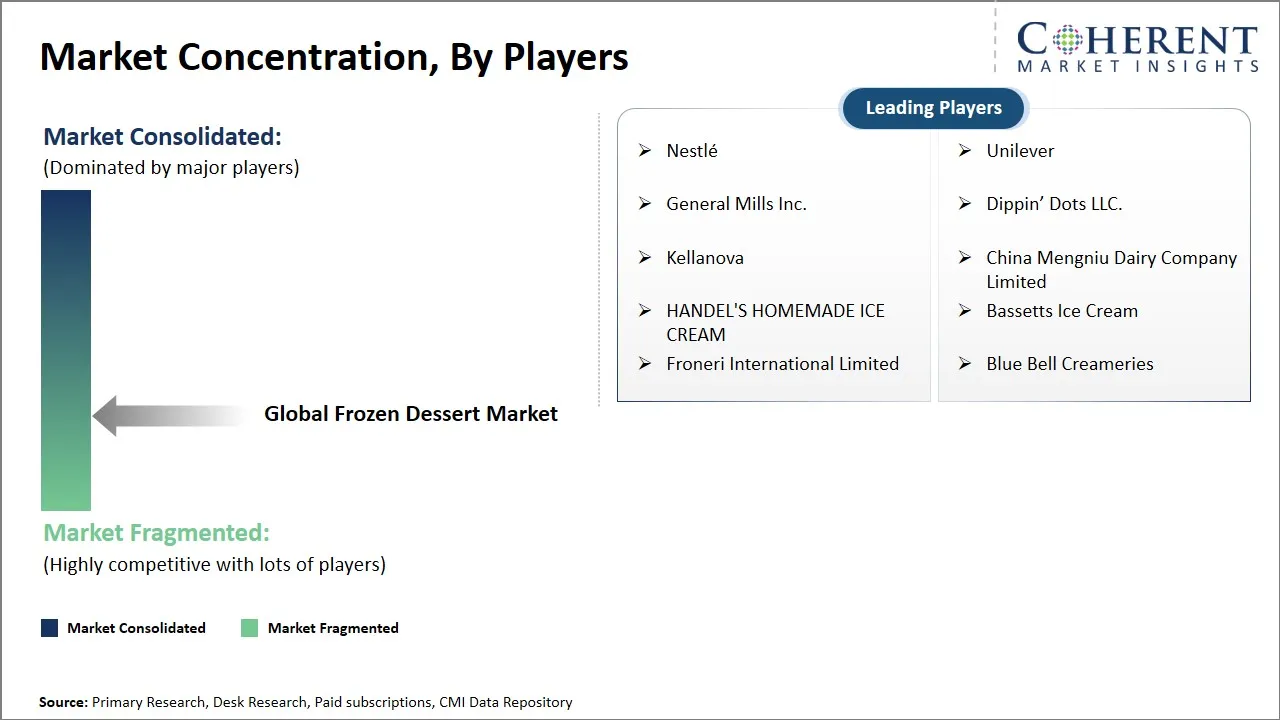
| Companies covered: | Nestlé, Unilever, General Mills Inc., Dippin’ Dots LLC., Kellanova, China Mengniu Dairy Company Limited, HANDEL'S HOMEMADE ICE CREAM, Bassetts Ice Cream, Froneri International Limited, and Blue Bell Creameries | ||
| Growth Drivers: |
| ||
| Restraints & Challenges: |
| ||
Frozen Dessert Market Dynamics
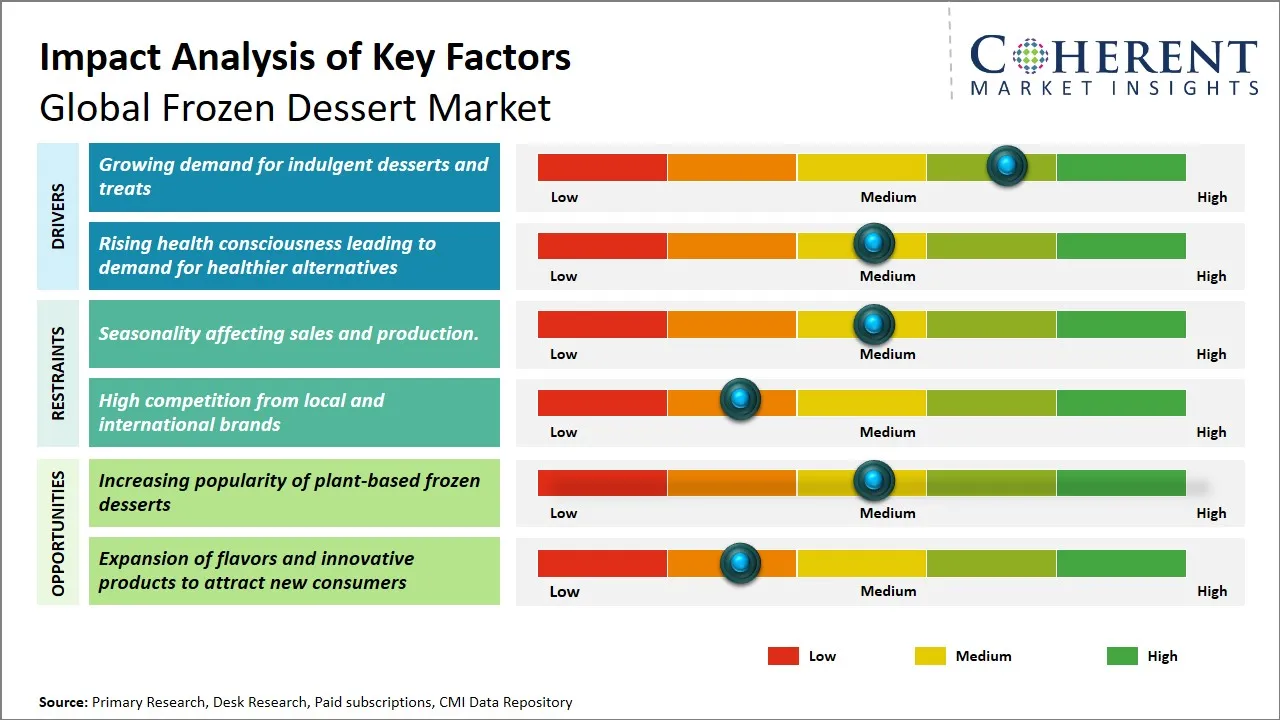
Frozen Dessert Market Driver - Growing Demand for Indulgent Desserts and Treats
The increasing consumer preference on luxurious desserts is largely contributing to the expansion of the frozen dessert market across the world. In the contemporary world of hectic living, there is a growing trend of consumers looking to get comfort foods that bring them a temporary reprieve and frozen desserts are one of their preferred comfort foods based on their delicious flavors and texture.
This is increased by the rising urban population and increased disposable incomes which has increased the demand to spend more on high quality and fancy dessert offerings. Also the foodservice sector such as cafes and specialty dessert, frozen pastries shops is also developing exclusive flavors and formulations to meet the changing palates and need by consumers to experience new taste in their mouth.
For example, the growing popularity of premium frozen desserts brands such as Haagen-Dazs and Ben and Jerrys. These firms have also updated their product lines to include indulgent and rich flavor products like Caramel Cone and Peanut Butter Cup that are satisfying the urge of consumers to have gourmet experiences.
Frozen Dessert Market Opportunity - Increasing Popularity of Plant-Based Frozen Desserts
The worldwide frozen dessert sector is experiencing a huge opportunity due to the increased consumer demand of plant-based frozen desserts. This trend is mainly driven by increased awareness of health, environmentalism, and the development of vegan and flexitarians around the world.
The growing demand by the consumers to find substitutes to old dairy-based frozen desserts is because of the perceived lactose intolerance, cholesterol testing services, and animal welfare. The plant-based alternatives like almond, coconut, soy, oat, and cashew milk have attractive nutritional values, including reduced saturated fats and lower calorie content, and respond to the ethical and sustainability factors.
To illustrate, a prime example of this opportunity is the success of such brands as So Delicious Dairy Free, which is a set of plant-based frozen desserts prepared with the help of coconut, almond, and soy milk. The development of plant-based substitutes through the influence of health-conscious consumers and environmentalists has been captured in the growth of market share of vegetarian products.
Analyst Opinion (Expert Opinion)
- The frozen dessert market is undergoing a dynamic growth due to the changing consumer tastes to have an indulgent but healthier product, especially in the post-health trend era. The perceptions of the International Dairy Show (2023) and the Frozen Food Industry Conference (2022) have revealed the key innovations, and brands such as Haagen-Dazs and Breyers are the pioneers of the artisanal and plant-based frozen desserts.
- The recent move by Haagen-Dazs to introduce a non-dairy line that maintains the creaminess of standard ice cream represents just one of the ways that the brand is changing to suit the needs of lactose-intolerant consumers, along with the needs of vegan diets. Debates during these conferences have underlined that clean labels and natural ingredients are increasingly becoming important, and this represents a drastic change in the consumer demands towards transparency and healthy products.
- Nevertheless, emerging difficulties like the increased cost of ingredients and strong competition with the new local brands were also often observed as the barriers to market growth. The companies which are concentrated on the innovation and branding and use sustainable practices, it is probable that they will be successful. The final outcome will be the success of the frozen dessert market in terms of balancing its indulgence with health trends and environmental stewardship to survive in the competitive market.
Speak to the analyst
Want personalized insights?
Take the findings above to one of our principal consultants, or have the report rebuilt around the segments, geographies and competitors you actually track.
Market Segmentation
- Product Insights (Revenue, USD Bn, 2021 - 2033)
- Ice-cream
- Confectionaries & Candies
- Frozen Yogurts
- Others
- Ingredients Insights (Revenue, USD Bn, 2021 - 2033)
- Dairy-Based
- Non-Dairy
- Organic
- Distribution Channel Insights (Revenue, USD Bn, 2021 - 2033)
- Supermarket/hypermarket
- Convenience Store
- Café & Bakery Shops
- Online
- Others
- Regional Insights (Revenue, USD Bn, 2021 - 2033)
- North America
- U.S.
- Canada
- Latin America
- Brazil
- Argentina
- Mexico
- Rest of Latin America
- Europe
- Germany
- U.K.
- Spain
- France
- Italy
- Russia
- Rest of Europe
- Asia Pacific
- China
- India
- Japan
- Australia
- South Korea
- ASEAN
- Rest of Asia Pacific
- Middle East
- GCC Countries
- Israel
- Rest of Middle East
- Africa
- South Africa
- North Africa
- Central Africa
- North America
- Key Players Insights
- Nestle
- Unilever
- General Mills Inc.
- Dippin’ Dots LLC.
- Kellanova
- China Mengniu Dairy Company Limited
- HANDEL'S HOMEMADE ICE CREAM
- Bassetts Ice Cream
- Froneri International Limited
- Blue Bell Creameries
Sources
Primary Research Interviews
- Product Development Manager – Leading Frozen Dessert Manufacturer
- Retail Buyer – Major Frozen Dessert Retail Chain
- Category Manager – Large Food Retailer
- Innovation Head – Frozen Dessert Brand
Stakeholders
- Manufacturers (e.g., Unilever, Nestlé, General Mills)
- Retailers and E-commerce Platforms
- End-use Segments
- Ice Cream
- Frozen Yogurt
- Sorbet and Gelato
- Plant-based and Dairy-Free Frozen Desserts
- Food Technology Providers (Innovative freezing, packaging)
- Regulatory and Certification Bodies
Databases
- UN Comtrade Database
- Global Trade Database (e.g., India EXIM Database)
Magazines
- Nutrition & Wellness Magazine – Trends impacting frozen dessert health attributes
- Food Business News – Innovations and new product launches in frozen desserts
- Global Food Insights – Consumer trends in frozen foods
- Frozen Food Digest – Market updates and frozen dessert category growth
Journals
- Journal of Food Science & Technology – Formulation and processing of frozen desserts
- International Journal of Gastronomy and Food Science – Innovations in frozen dessert textures and flavors
- Food Research International – Nutritional and quality assessments of frozen treats
- Journal of Dairy Science – Functional benefits and ingredient research in frozen mixes
Newspapers
- The Financial Times – Market growth and investment in frozen desserts
- The Guardian – Consumer preference shifts towards healthier frozen treats
- Asia Health Journal – Growth of frozen dessert consumption in Asia-Pacific
- European Nutrition News – Regulatory updates impacting frozen desserts in Europe
- The New York Times – Trends in convenience and indulgence in frozen foods
Associations
- International Dairy Federation (IDF)
- National Frozen & Refrigerated Foods Association (NFRA)
- American Frozen Food Institute (AFFI)
- European Frozen Food Federation (EuroFreeze)
Public Domain Sources
- FDA – Regulations on frozen desserts and food safety
- European Commission – Food Supplements and Frozen Dessert Regulations
- World Health Organization – Dietary guidelines related to frozen treats and health
- OECD – Market and safety assessments for food products including frozen desserts
Proprietary Elements
- CMI Data Analytics Tool, Proprietary CMI Existing Repository of information for last 8 years.
Get access to 250+ pages report
Every segment, forecast, competitor profile and data table behind the analysis above — available for instant download.
- ESOMAR Member
- ISO 9001:2015 Certified
- D-U-N-S Registered
- GDPR & CCPA Compliant
Missing comfort of reading report in your local language? Find your preferred language:
Transform your Strategy with Exclusive Trending Reports
Frequently Asked Questions
The global frozen dessert market is estimated to be valued at USD 134.35 Bn in 2026 and is expected to reach USD 182.83 Bn by 2033.
The CAGR of global frozen dessert market is projected to be 4.5% from 2026 to 2033.
Growing demand for indulgent desserts and treats and rising health consciousness leading to demand for healthier alternatives are the major factors driving the growth of the global frozen dessert market.
Seasonality affecting sales and production and high competition from local and international brands are the major factors hampering the growth of the global frozen dessert market.
In terms of product, ice-cream is estimated to dominate the market revenue share in 2026.
Nestlé, Unilever, General Mills Inc., Dippin’ Dots LLC., Kellanova, China Mengniu Dairy Company Limited, HANDEL'S HOMEMADE ICE CREAM, Bassetts Ice Cream, Froneri International Limited, and Blue Bell Creameries are the major players.
North America is expected to lead the global frozen dessert market in 2026.