

Global Piezoelectric Sensor Market Size and Forecast – 2026 To 2033
The global piezoelectric sensor market is expected to grow from USD 2.35 Bn in 2026 to USD 4 Bn by 2033, registering a compound annual growth rate (CAGR) of 3.2% from 2026 to 2033. The global piezoelectric sensor market is driven by the increasing use of piezoelectric sensors in medical diagnostic equipment. In February 2025, Kistler introduced the optimized maXYmos TL ML process monitoring solutions for medical device manufacturing, using piezoelectric force sensing to improve assembly quality of diagnostic and medical products.
Key Takeaways of the Global Piezoelectric Sensor Market
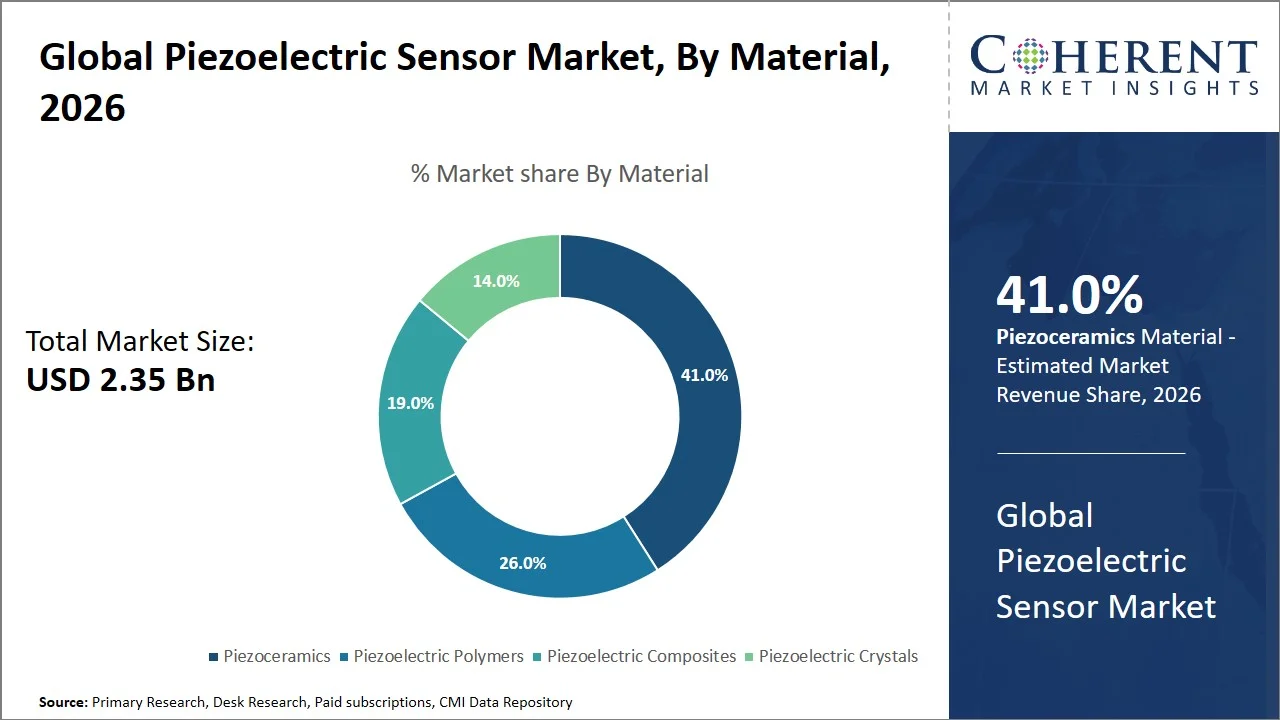
- The piezoceramics segment is expected to account for 41.0% of the global piezoelectric sensor market share in 2026. Rising investment in smart manufacturing and Industry 4.0 is driving the growth of the segment. On February 20, 2025, Murata Manufacturing announced a new three-year management plan for strategic investments, including mergers and acquisitions, while committing to expand manufacturing capacity in Japan and Thailand.
- The accelerometers segment is estimated to capture 36.0% of the market share in 2026. Expansion of aerospace structural health monitoring applications is majorly driving the growth of the segment. In March 2026, Kistler Group launched its first digital Structural Health Monitoring (SHM) solution for bridges and infrastructure based on piezoelectric sensing technologies, with applications extending to aerospace structural monitoring methodologies.
- The automotive segment is estimated to capture 29.0% of the market share in 2026. Growing demand for automotive safety and engine monitoring sensors is driving the growth of the segment. On December 12, 2025, Kistler Group updated its KiBox2 platform with the KiBox2 E-Powertrain Analysis function. It builds on the core hardware to support electric, hybrid, and fuel-cell vehicle testing alongside traditional combustion engine measurements.
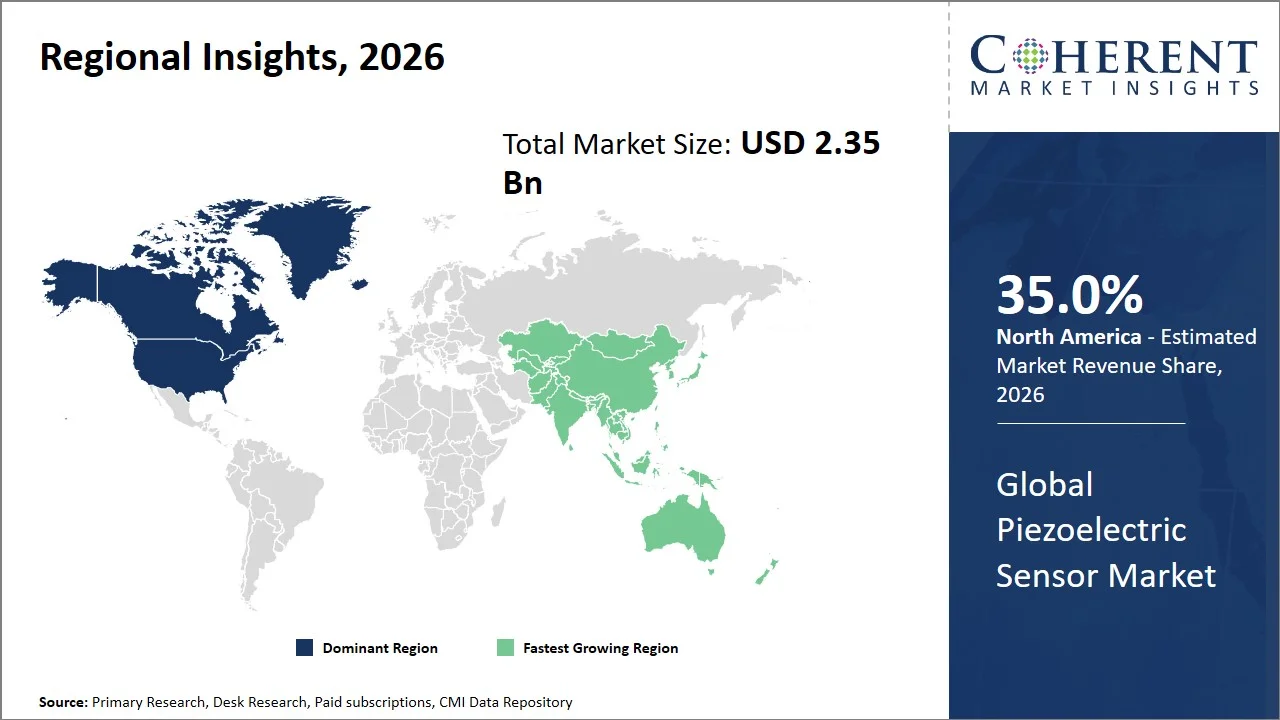
- North America is expected to dominate the piezoelectric sensor market in 2026 with a market share of 35.0%. Rising implementation in robotics and autonomous systems in North America is driving the growth of the regional market. On June 17, 2025, Hexagon launched a humanoid robot, AEON, at its flagship Hexagon LIVE Global event. AEON has been specifically designed to meet real-world customer needs and address labor shortages.
- Asia Pacific is expected to account for 32.0% of the market share in 2026 and is projected to record the fastest growth over the forecast period. Increasing integration with Industrial Internet of Things platforms across Asia Pacific is driving the growth of the regional market. On April 16, 2026, Advantech announced a collaboration with Microsoft to accelerate Industrial IoT and AI-enabled manufacturing across Asia Pacific by integrating its edge computing platforms with Microsoft Azure and industrial AI services.
Segmental Insights
Why Does Piezoceramics Dominate the Global Piezoelectric Sensor Market?
The piezoceramics segment is expected to account for 41.0% of the global piezoelectric sensor market share in 2026. Piezoceramics are generally selected due to their extremely high piezoelectric sensitivity and electromechanical coupling which allows accurate sensing of pressure, vibration, force and acceleration in challenging industrial situations. They are excellent at generating high electrical signals under low mechanical stress and durable over wide temperature and high frequency ranges, making them the preferred choice of material for automotive, aerospace, industrial automation and medical sensing applications where measurement accuracy and long-term reliability are important. On March 5, 2026, Murata Manufacturing announced that it will merge Toyama Murata Manufacturing and Himi Murata Manufacturing to improve the production of products using piezoelectric ceramics, such as piezoelectric sensors and ceramic electronic components, and to improve manufacturing flexibility and production efficiency.
- Current Industry Events of 2026
- Market Size Estimation
- Regional Breakdown
- Competitive Landscape
- Customer Intelligence
- Segmental Analysis
- Pricing Analysis
- Key Market Drivers, Challenges & Future Trends
- Customized Insights Section
Why are Accelerometers the Most Preferred Sensor Type?
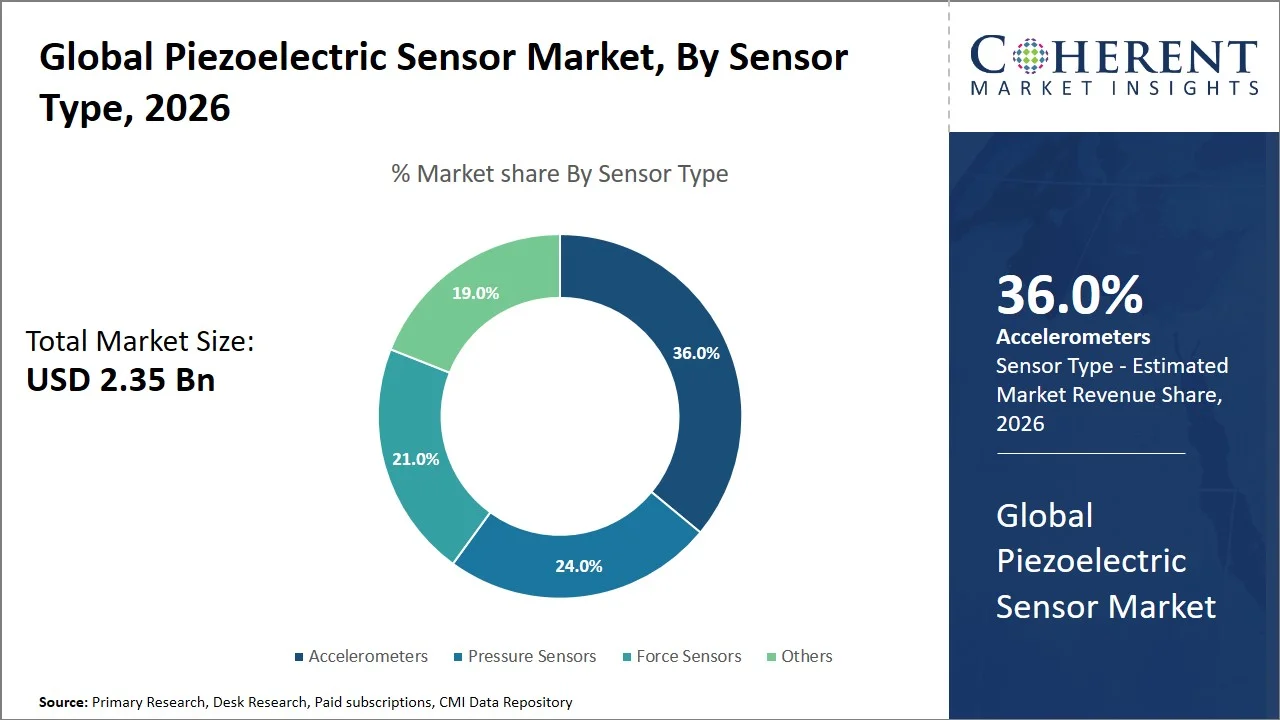
The accelerometers segment is expected to account for 36.0% of the global piezoelectric sensor market share in 2026. Among the different types of piezoelectric sensors, accelerometers are the most widely used type of sensor due to their very high accuracy in real-time vibration monitoring which is essential for predictive maintenance and health assessment of industrial machinery, automotive systems, aerospace platforms and energy infrastructure. They also are sensitive to very small changes in vibration at high frequencies, providing early detection of mechanical breakdowns. This in turn results in less unplanned downtime, cheaper maintenance costs and increased operational reliability for mission-critical applications. In June 2026, Kistler introduced an updated version of its Type 8763B triaxial accelerometer, with increased sensitivity for micro-vibration readings but with the same compact form factor. The new accelerometer is intended at semiconductor production equipment, precision machinery, aerospace testing and structural dynamics applications.
Automotive Dominates the Global Piezoelectric Sensor Market
The automotive segment is expected to account for 29.0% of the global piezoelectric sensor market share in 2026. The automotive sector has the greatest need, due to the significant use of piezoelectric sensors for monitoring engine combustion in real time and detecting knocks. This allows accurate regulation of ignition timing and fuel injection. They contribute to the improvement of engine economy, reduction of pollutants and improvement of vehicle performance due to their fast response time and high sensitivity and hence are indispensable in traditional internal combustion cars and advanced hybrid powertrain systems. In March 2025, Bosch unveiled its newest generation of piezoelectric knock sensors for hybrid and high-performance internal combustion engines. The sensors have higher sensitivity, inbuilt diagnostics and increased durability for precise combustion control and future emission regulations.
Current Events and their Impact
Current Events | Description and its Impact |
European Union - RoHS Directive (Restriction of Hazardous Substances) |
|
India - Machinery and Electrical Equipment Safety (Omnibus Technical Regulation) Amendment Order, 2025 |
|
Global Piezoelectric Sensor Market Dynamics
Market Drivers
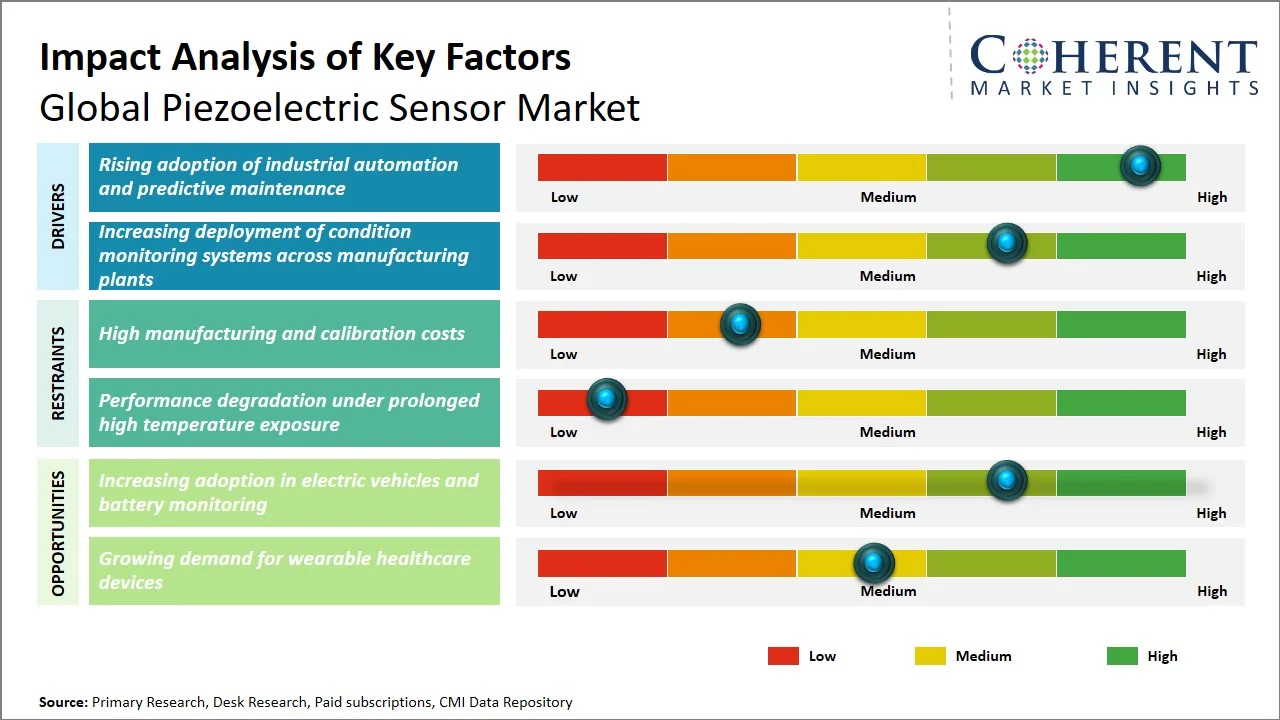
Rising adoption of industrial automation and predictive maintenance
The swift adoption of industrial automation and predictive maintenance is greatly augmenting the demand for piezoelectric sensors, notably for vibration, force, and sound monitoring on automated production setups. Manufacturers are integrating these sensors into robotic systems, CNC machines, conveyors, compressors, turbines and rotating equipment to provide continuous health monitoring of the machinery, to detect abnormal operating conditions and to predict failures before breakdowns. Their high sensitivity, fast response time and ability to operate reliably in harsh industrial environments make them well suited for real time diagnostics helping industries reduce unplanned downtime, optimize maintenance schedules, improve equipment utilization and lower overall operating costs. On February 17, 2025, Murata Electronics (India) Private Limited, a subsidiary of Murata Manufacturing Co., Ltd., signed a deal to lease a factory in an industrial park in India. This alliance will also give Murata insight into factory operations in India and establish a base for future manufacturing endeavors in the nation.
Increasing deployment of condition monitoring systems across manufacturing plants
The growing adoption of condition monitoring systems in manufacturing plants drives the wider utilization of piezoelectric sensors as industries focus on the continuous monitoring of equipment health and operational reliability. These sensors play a critical role in monitoring vibration, impact, dynamic pressure and structural integrity in motors, pumps, gearboxes, bearings and industrial equipment. They allow maintenance teams to discover wear, imbalance, misalignment and mechanical defects early on. As manufacturers implement smart factory programs and industrial IoT connectivity, piezoelectric sensors are becoming increasingly vital for integrated monitoring systems that improve asset performance, extend equipment life, and enable data-driven maintenance decisions. On February 5, 2026, I-care, a global leader in predictive maintenance and reliability solutions, announced that it has joined the AVEVA Partner Ecosystem as a Managed Solution Provider (MSP), integrating the I-see analytics platform with the AVEVA PI System.
Emerging Trends
Growing adoption of lead-free piezoelectric materials
Manufacturers are increasingly developing lead-free piezoelectric ceramics like potassium sodium niobate and bismuth sodium titanate to comply with strict environmental regulations while delivering high sensing performance in industrial, automotive and medical applications.
Integration with industrial IoT and edge analytics
Piezoelectric sensors are increasingly being integrated with industrial IoT platforms and edge computing systems for real-time vibration analysis, predictive maintenance, and remote asset monitoring in smart manufacturing
Expansion of MEMS-based piezoelectric sensor technologies
Advances in microelectromechanical systems are making it possible to develop tiny, lightweight, low-power piezoelectric sensors for applications in wearable medical devices, consumer electronics, automotive safety systems and portable industrial equipment.
Increasing use in electric vehicles and battery health monitoring
To improve vehicle reliability, safety and overall energy efficiency, automotive manufacturers are deploying more piezoelectric sensors in electric vehicles to monitor battery packs, analyze structural vibrations, diagnose motors and enable predictive maintenance.
Regional Insights
Why is North America a Strong Market for Piezoelectric Sensors?
North America is expected to account for a market share of 35.0% in 2026. North America continues to be a prominent location for the adoption of piezoelectric sensors, owing to its well-established aerospace, industrial automation, semiconductor and healthcare industries. Major sensor manufacturers such as PCB Piezotronics, Dytran Instruments, Honeywell and TE Connectivity are based in the U.S. Aerospace businesses like Boeing use piezoelectric accelerometers and vibration sensors for aircraft structural health monitoring and engine diagnostics. Industrial users are implementing these sensors on predictive maintenance platforms at oil and gas facilities, power generation plants and automotive manufacturing lines. Medical equipment manufacturers are incorporating piezoelectric sensors into ultrasound imaging systems, infusion pumps and minimally invasive surgical instruments, and research organizations including NASA and national labs are developing piezoelectric-based structural monitoring technologies for spacecraft and advanced defense systems.
Why Does the Asia Pacific Piezoelectric Sensor Market Exhibit High Growth?
Asia Pacific is projected to account for 32.0% of the global piezoelectric sensor market in 2026 and is expected to register the fastest growth. The Asia Pacific region is the fastest growing manufacturing hub for piezoelectric sensors, driven by the booming output of electronics, automobile manufacture and semiconductor fabrication in China, Japan, South Korea and Taiwan. The region is home to globally recognized businesses like as Murata Manufacturing, Kyocera, TDK and Panasonic Industry, which provide piezoelectric components for use in smartphones, industrial automation equipment, robots and medical devices. Demand for vibration and force sensors throughout electronics manufacturing facilities is being pushed by the rapid adoption of industrial automation, collaborative robots and AI-driven predictive maintenance. The growth in electric car manufacture, high-speed rail systems, renewable energy infrastructure, and precision manufacturing is further driving the adoption of piezoelectric sensing technologies in industrial and transportation applications.
Global Piezoelectric Sensor Market Outlook for Key Countries
Why is the U.S. Emerging as a Major Hub in the Piezoelectric Sensor Market?
The U.S. is one of the most technologically sophisticated markets due to the pervasive application of the technology in aerospace, defense, industrial automation, healthcare, and semiconductor manufacturing. PCB Piezotronics, Dytran Instruments, Honeywell and TE Connectivity offer high-performance piezoelectric accelerometers and vibration sensors for aviation engines, military vehicles, rotating machinery and industrial equipment. All Boeing commercial airplane maintenance programs include vibration monitoring technologies while GE Vernova uses piezo-electric vibration monitoring on gas turbines and power production equipment. Precision piezoelectric sensors are being used in semiconductor manufacturing, wafer inspection, lithography equipment and ultra-precision positioning systems. The world’s leading automotive manufacturers are also continuing to integrate knock sensors and vibration monitoring systems into conventional and hybrid powertrains.
Is China the Next Growth Engine for the Piezoelectric Sensor Market?
Owing to its large-scale electronics, automotive, renewable energy and industrial automation industries, China has become one of the world’s top manufacturers and consumers of piezoelectric sensors. Locally, piezoelectric ceramics and MEMS-based sensing devices are being ramped up by local producers under the Made in China industrial modernization strategy to support smart factories and high-end manufacturing projects. Electric vehicle manufacturers including BYD, SAIC Motor, Geely and Chery are integrating piezoelectric knock sensors, vibration sensors and structural monitoring systems into their vehicle platforms, while robotics manufacturers are employing force and vibration sensors in their automated production lines. The fast-growing wind turbine manufacturing industry and semiconductor fabrication plants in the country are also fueling the demand for high-precision condition monitoring and process control sensors.
Germany Piezoelectric Sensor Market Analysis and Trends
Germany continues to be a premier European market with world-class automotive engineering, industrial machinery and Industry 4.0 leadership. Companies including Siemens, Bosch Rexroth, Schaeffler, BMW, Mercedes-Benz, Volkswagen and Audi are using piezoelectric sensors in predictive maintenance, engine testing, robotic manufacturing and precision machining applications. German factories are increasingly employing vibration monitoring systems in CNC machines, turbines, compressors and automated assembly lines to cut equipment downtime and enhance production efficiency. Research institutions, such as the Fraunhofer Institutes, are driving forward smart sensor technologies for digital factories, structural health monitoring and intelligent production systems.
Japan Piezoelectric Sensor Market Analysis and Trends
Japan is the world leader in the manufacture of piezoelectric materials and sensors, with industry giants such as Murata Manufacturing, Kyocera, TDK, Panasonic Industry and Alps Alpine. These firms produce high-performance piezoelectric components for smartphones, automobile electronics, factory automation equipment, medical ultrasonography systems and industrial robotics. Japanese car makers such as Toyota, Honda, Nissan and Subaru are widely using piezoelectric knock sensors and vibration monitoring systems to increase engine efficiency and vehicle durability. Piezo force and touch sensors also play a vital role in Japan’s sophisticated robotics sector for precise motion control, semiconductor handling machinery and collaborative robotic systems for electronics assembly.
South Korea Piezoelectric Sensor Market Analysis and Trends
South Korea’s economy is a major one, fueled by semiconductor manufacture, consumer electronics, car manufacturing, and advanced robotics. Samsung Electronics and SK hynix use precision piezoelectric sensors in semiconductor fabrication facilities for vibration isolation, wafer inspection and precision positioning systems in advanced chip manufacturing. Hyundai Motor and Kia’s use of piezoelectric knock sensors, engine monitoring systems and vibration sensing technology in passenger cars, hybrids and electric vehicles. Industrial automation companies continue to increase the adoption of piezoelectric sensors in battery manufacturing lines, electronics assembly plants, and smart factories. Meanwhile, increasing investments in robotics and AI-enabled manufacturing are driving further demand for high-accuracy force and vibration sensing solutions.
Global Piezoelectric Sensor Market - Piezoelectric Accelerometer Demand By Application (2025)
Application | Estimated Demand Share |
Industrial machinery & predictive maintenance | 27.5% |
Automotive testing & powertrain | 21.0% |
Aerospace & defense | 16.5% |
Energy & power | 12.5% |
Semiconductor & electronics manufacturing | 9.5% |
Research laboratories & universities | 6.0% |
Medical equipment | 4.0% |
Others | 3.0% |
Global Piezoelectric Sensor Market - Pressure Sensor Adoption In Aerospace Engine Testing (2025)
Aerospace Engine Testing Application | Estimated Adoption Share |
Combustion chamber pressure testing | 30.0% |
Gas turbine engine development | 22.0% |
Jet engine endurance & durability testing | 16.0% |
Rocket engine hot-fire testing | 12.0% |
Compressor & airflow testing | 8.0% |
Fuel injection & combustion optimization | 6.0% |
Engine component validation & certification | 4.0% |
Other aerospace propulsion testing | 2.0% |
How is Increasing Adoption of Piezoelectric Sensors in Electric Vehicles and Battery Monitoring Creating New Growth Opportunities in the Global Piezoelectric Sensor Market?
Growing production of electric vehicles is opening up new growth potential for makers of piezoelectric sensors. Demand is increasing for high-frequency vibration and acoustic monitoring solutions for battery systems and electric drivetrains. Car manufactures use piezoelectric sensors to detect anomalous vibrations in e-axles, electric motors, reduction gears and high-speed bearings, so they may identify faults early, before mechanical breakdowns occur. Battery makers are also investigating piezoelectric sensing technologies to detect cell swelling, mechanical stress, internal cracking and impact events in lithium-ion battery packs, notably during fast charging and thermal abuse testing.
Companies developing battery management and diagnostic platforms are integrating piezoelectric sensors with AI-enabled condition monitoring software to enhance battery safety, service life and predictive maintenance of commercial electric buses, heavy-duty electric trucks and high-performance passenger electric vehicles, thereby creating new fields of use beyond their traditional applications in internal combustion engine knock detection and industrial vibration monitoring. On March 19, 2025, PULSETRAIN GmbH raised USD 7.0 million in a seed round to improve battery performance and longevity through sophisticated monitoring.
Market Players, Key Development, and Competitive Intelligence
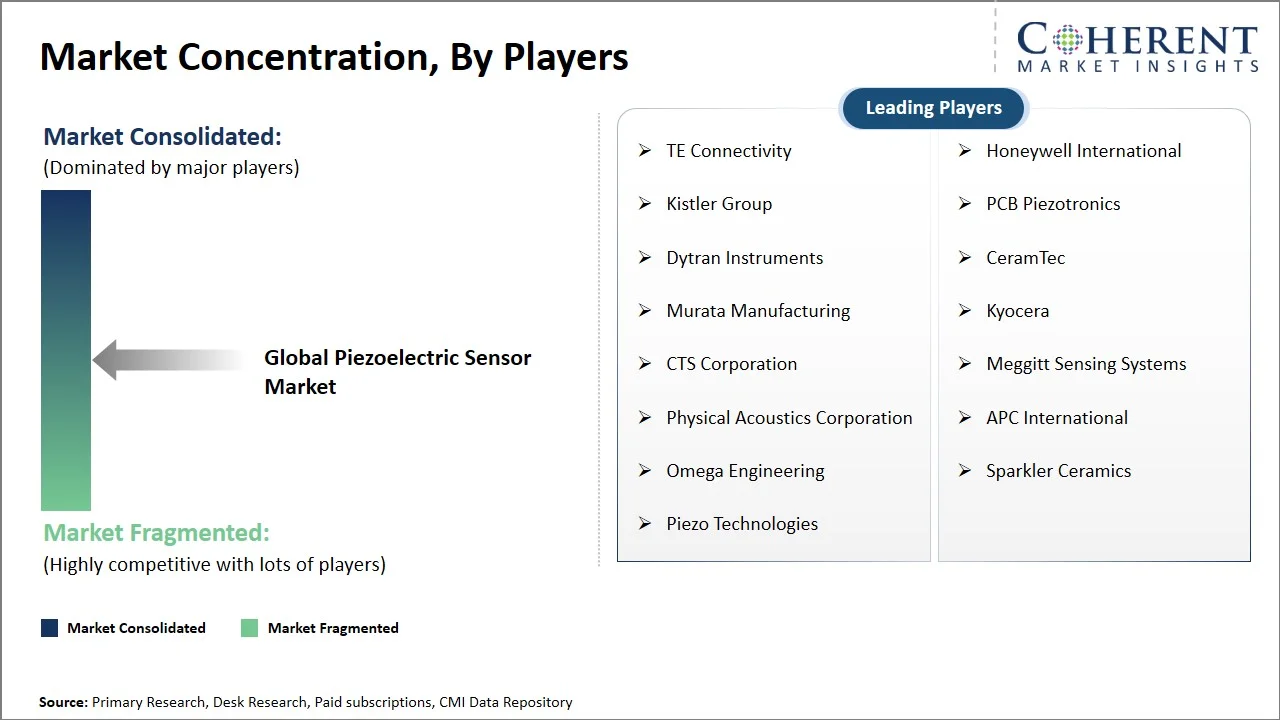
Key Developments
- In December 2024, Kistler introduced the first portable digital 3D force plate with piezoelectric sensors for precise balance and gait analyses. Owing to digital technology, which has already proven itself in the fixed force plate, the portable force plate allows simpler measurement setups.
- On May 2, 2024, PCB Piezotronics introduced its new Model 112A06 wide temperature range charge output piezoelectric pressure sensor. The 112A06 was designed to complement the cryogenic and high temperature pressure sensor line. It has an extremely wide operating temperature range from -400 to 662°F (-240 to 350°C).
Competitive Landscape
The global piezoelectric sensor market is characterized by competition among established sensor specialists and diversified electronics manufacturers focused on high-performance industrial, automotive, aerospace, and medical applications. Kistler Group further strengthens its leadership position with sophisticated piezoelectric force, pressure and acceleration sensors for automotive engine development, industrial process monitoring and manufacturing quality assurance. PCB Piezotronics is well-positioned in vibration monitoring and predictive maintenance solutions for defense, aerospace and heavy industrial machinery. TE Connectivity is focused on robust sensors for automotive safety, electrification and industrial automation. Murata Manufacturing and Kyocera Corporation combine their experience in piezoelectric ceramics and miniaturized electronic components to deliver small sensors for consumer electronics, medical devices and automotive systems. Honeywell International is concentrating on integrated condition monitoring platforms for aerospace engines, energy infrastructure and industrial assets. CeramTec and CTS Corporation are continuing to invest in advanced piezoelectric ceramic materials and customized sensing solutions for medical, semiconductor and precision manufacturing applications.
Market Report Scope
Piezoelectric Sensor Market Report Coverage
| Report Coverage | Details | ||
|---|---|---|---|
| Base Year: | 2025 | Market Size in 2026: | USD 2.35 Bn |
| Historical Data for: | 2020 To 2024 | Forecast Period: | 2026 To 2033 |
| Forecast Period 2026 to 2033 CAGR: | 3.20% | 2033 Value Projection: | USD 4 Bn |
| Geographies covered: |
| ||
| Segments covered: |
| ||
| Companies covered: | TE Connectivity, Honeywell International, Kistler Group, PCB Piezotronics, Dytran Instruments, CeramTec, Murata Manufacturing, Kyocera, CTS Corporation, Meggitt Sensing Systems, Physical Acoustics Corporation, APC International, Omega Engineering, Sparkler Ceramics, and Piezo Technologies | ||
| Growth Drivers: |
| ||
| Restraints & Challenges: |
| ||
Analyst Opinion (Expert Opinion)
- The strongest long-term growth is expected to come from piezoelectric sensors used in electric vehicle diagnostics, battery mechanical health monitoring, and AI-enabled predictive maintenance rather than traditional combustion engine applications. As electric drivetrains operate at higher rotational speeds and battery systems require continuous mechanical integrity monitoring, demand for high-frequency vibration and acoustic sensing solutions is expected to increase significantly across next-generation mobility platforms.
- The highest-value opportunity is expected to emerge in piezoelectric accelerometers and vibration sensors for electric vehicle battery systems and industrial automation in China, where rapid expansion of EV production, lithium-ion battery gigafactories, and smart manufacturing facilities is creating sustained demand for precision condition monitoring technologies. Japan and South Korea are likely to provide more growth prospects in the semiconductor manufacturing equipment market. Ultra-precise vibration measurement is needed for advanced wafer production and inspection procedures.
- Manufacturers need to concentrate on the development of lead-free piezoelectric materials, MEMS-based miniaturized sensors and intelligent sensing platforms with edge analytics and wireless connection to obtain competitive advantage. Strategic collaboration with battery manufacturers, industrial automation companies, robotics suppliers, and semiconductor equipment manufacturers will enable suppliers to secure design wins in rapidly expanding application areas before they become highly competitive.
Speak to the analyst
Want personalized insights?
Take the findings above to one of our principal consultants, or have the report rebuilt around the segments, geographies and competitors you actually track.
Market Segmentation
- Material Insights (Revenue, USD Billion, 2021 - 2033)
- Piezoceramics
- Piezoelectric Polymers
- Piezoelectric Composites
- Piezoelectric Crystals
- Sensor Type Insights (Revenue, USD Billion, 2021 - 2033)
- Accelerometers
- Pressure Sensors
- Force Sensors
- Others
- End User Insights (Revenue, USD Billion, 2021 - 2033)
- Automotive
- Aerospace and Defense
- Industrial Manufacturing
- Healthcare
- Consumer Electronics
- Energy and Utilities
- Oil and Gas
- Others
- Regional Insights (Revenue, USD Billion, 2021 - 2033)
- North America
- U.S.
- Canada
- Latin America
- Brazil
- Argentina
- Mexico
- Rest of Latin America
- Europe
- Germany
- U.K.
- Spain
- France
- Italy
- Russia
- Rest of Europe
- Asia Pacific
- China
- India
- Japan
- Australia
- South Korea
- ASEAN
- Rest of Asia Pacific
- Middle East
- GCC Countries
- Israel
- Rest of Middle East
- Africa
- South Africa
- North Africa
- Central Africa
- North America
Sources
Primary Research Interviews
- Product Managers - Piezoelectric Sensors and Accelerometers
- Automotive Powertrain and NVH Engineers
- Aerospace Structural Health Monitoring Specialists
- Semiconductor Equipment Design Engineers
Magazines
- Sensors Magazine
- Machine Design
- Electronic Design
- Microwaves & RF
- Design World
Journals
- IEEE Sensors Journal
- IEEE Transactions on Instrumentation and Measurement
- IEEE Transactions on Ultrasonics, Ferroelectrics, and Frequency Control
- Smart Materials and Structures
Associations
- IEEE Instrumentation and Measurement Society
- IEEE Sensors Council
- International Society of Automation
- The Minerals, Metals & Materials Society
Public Domain Sources
- U.S. Patent and Trademark Office (USPTO)
- European Patent Office (EPO)
- World Intellectual Property Organization (WIPO)
- National Institute of Standards and Technology (NIST)
Proprietary Elements
- CMI Data Analytics Tool
- Proprietary CMI Existing Repository of Information for the Last 10 Years
Get access to 250+ pages report
Every segment, forecast, competitor profile and data table behind the analysis above — available for instant download.
- ESOMAR Member
- ISO 9001:2015 Certified
- D-U-N-S Registered
- GDPR & CCPA Compliant
Missing comfort of reading report in your local language? Find your preferred language:
Transform your Strategy with Exclusive Trending Reports
Frequently Asked Questions
The global piezoelectric sensor market is expected to stand at USD 2.35 Bn in 2026 and is expected to reach USD 4 Bn by 2033.
The CAGR of the global piezoelectric sensor market is projected to be 3.2% from 2026 to 2033.
Rising adoption of industrial automation and predictive maintenance and increasing deployment of condition monitoring systems across manufacturing plants are the major factors driving the growth of the global piezoelectric sensor market.
High manufacturing and calibration costs and performance degradation under prolonged high temperature exposure are the major factors hampering the growth of the global piezoelectric sensor market.
In terms of material, the piezoceramics segment is estimated to dominate the market revenue share in 2026.
They are generally better suited for dynamic pressure and vibration measurements than static measurements.
They are used for engine diagnostics, structural health monitoring, and aircraft vibration analysis.