

InGaAs Photo Diode Sensor Market Size and Share Analysis - 2026 To 2033
The InGaAs Photo Diode Sensor Market size is anticipated to grow at a CAGR of 7.8% with USD 210 Mn in 2026 and is expected to reach USD 360 Mn in 2033. The primary drivers are defined by rising adoption of high-speed fiber-optic communication networks, expanding deployment of LiDAR-enabled autonomous vehicles and industrial sensing systems, and growing demand for infrared imaging across defense, aerospace, and environmental monitoring applications using InGaAs photodiode technology. According to the International Telecommunication Union (ITU), in 2024 more than 6 billion people globally were using the internet, reflecting continuous expansion of fiber-based optical communication infrastructure operating in the 1310–1550 nm wavelength range where InGaAs detectors are essential.
Key Takeaways
- The single-element InGaAs PIN segment is likely to dominate the market with 60.8% in 2026. The segment’s growth is owing to the mature design, lower system complexity, high responsivity, and broad use in optical power meters and fiber-optic test communication. Excelitas lists its C30641GH InGaAs PIN photodiode with responsivity of 0.90 A/W at 1300 nm and 0.95 A/W at 1550 nm. This supports wider adoption in compact detection modules.
- The medium range detection segment is set to lead with 47.6% in 2026. The segment’s growth is owing to the strong use in 1.0–1.7 µm optical communication, industrial sensing, and spectroscopy systems. Hamamatsu states that InGaAs photodiodes support spectral responses from 0.5 µm to 2.6 µm, making them suitable for near-infrared and SWIR detection. This strengthens demand across telecom test instruments, laser measurement, and environmental sensing.
- The optical communication segment is set to lead with 43.2% in 2026. The segment’s growth is owing to the demand for photodetectors operating at 1310 nm and 1550 nm telecom wavelengths. OECD reported that the share of fiber in total fixed broadband subscriptions reached 47% by end-2024. This directly supports demand for high-speed InGaAs receivers, photodiodes, and optical test devices.
- North America is expected to acquire the prominent share of 36.8% in 2026. The region’s growth is owing to the strong investments in photonics R&D, defense surveillance systems, and advanced semiconductor manufacturing ecosystems supported by U.S. CHIPS Act initiatives.
Segmental Insights
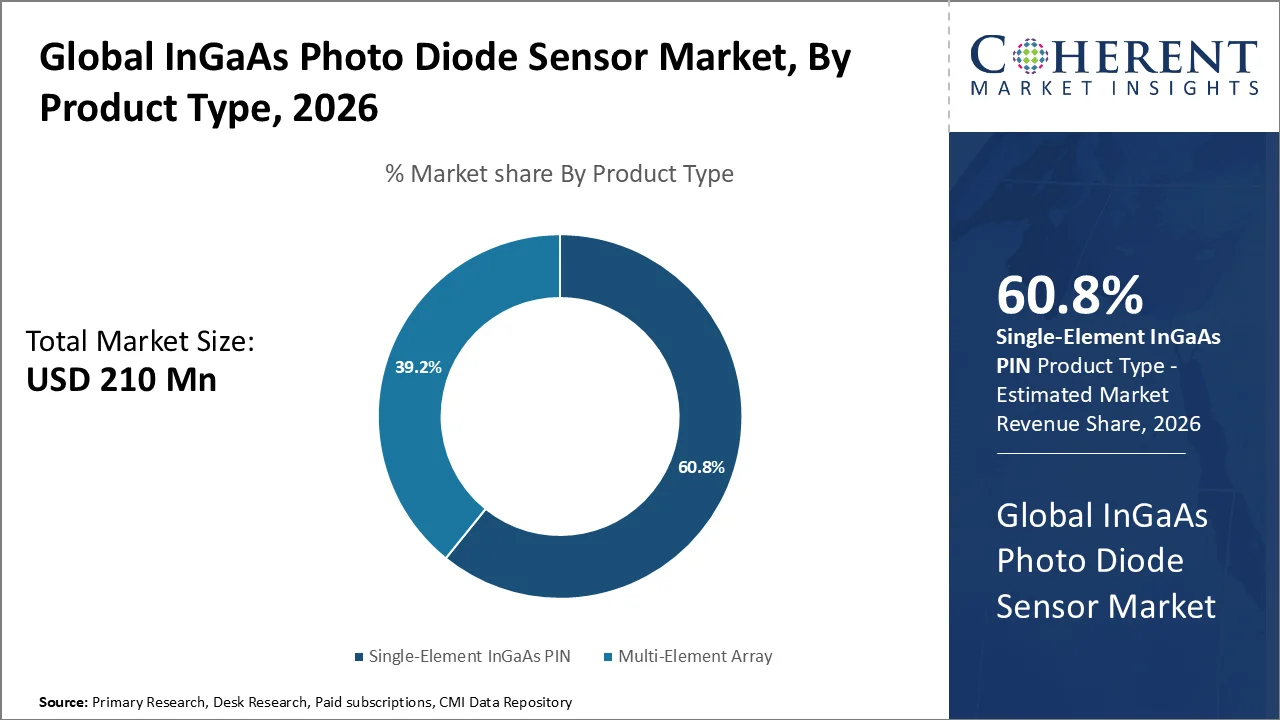
Why is Single-Element InGaAs PIN Segment Acquiring the Largest Share?
On the basis of product type, the single-element InGaAs PIN segment is projected to account for the largest InGaAs Photo Diode Sensor Market share of 60.8% in 2026. The segment’s growth is owing to the widespread adoption of these sensors in optical communications, NIR spectroscopy, and LiDAR applications.
According to the National Institute of Standards and Technology (NIST), standard InGaAs photodiodes achieve a high quantum efficiency exceeding 80% in the 900 nm to 1700 nm spectral range. In addition, the NASA's public technical reports highlight that single-element configurations minimize dark current noise to less than 10 pA, thereby substantially improving the signal-to-noise ratio for spaceborne remote sensing instruments.
- Current Industry Events of 2026
- Market Size Estimation
- Regional Breakdown
- Competitive Landscape
- Customer Intelligence
- Segmental Analysis
- Pricing Analysis
- Key Market Drivers, Challenges & Future Trends
- Customized Insights Section
Optical Communication hold the Largest Market Share
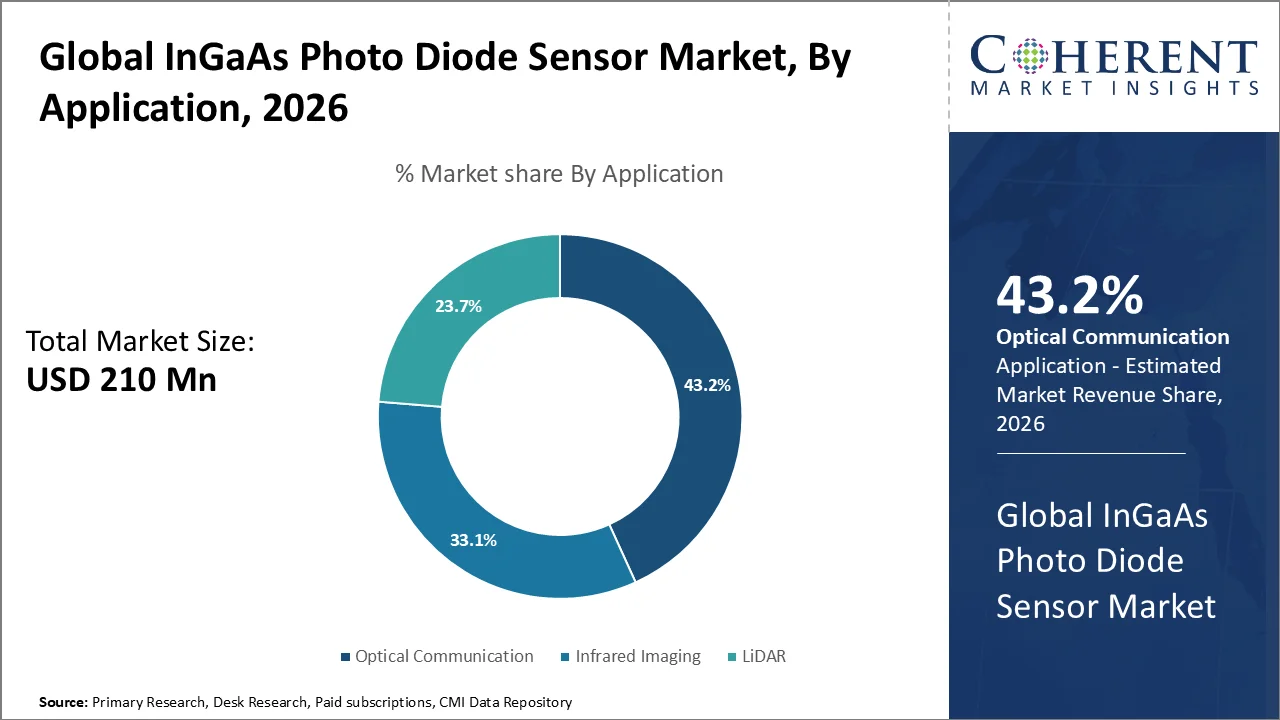
On the basis of application, the optical communication segment lead with a major 43.2% share in 2026. The growth is owing to the rapid expansion of fiber-optic networks, rising demand for high-speed infrared signal detection across the 1.3–1.7 µm wavelength band, and continued upgrades of global high-speed data infrastructure.
InGaAs photodiodes are well suited for optical communication because they provide strong sensitivity in near-infrared and short-wave infrared wavelengths used in telecom and data transmission systems. Public scientific records from the NIH highlight that engineered multi-wavelength InGaAs/InP photodiodes have achieved high-speed bandwidths of 20 GHz at 850 nm and 15.5 GHz at 1550 nm.
In addition, NIST advanced SWIR calibration by developing a dual-InGaAs photodiode optical trap detector, achieving more than 98% system detection efficiency between 1 µm and 1.3 µm, further supporting adoption.
Market Drivers
Rising Innovations in SWIR Imaging are Transforming the InGaAs Photo Diode Sensor Market in Japan
Japan continues to remain an important innovation center for InGaAs photodiodes, SWIR imaging sensors, and precision photonics. The country’s strength is supported by vertically integrated photonics manufacturers, advanced semiconductor packaging capabilities, and strong demand from analytical instruments, factory automation, medical imaging, and scientific measurement.
InGaAs sensors are used where silicon photodiodes lose sensitivity, especially in near-infrared and SWIR wavelengths used for material inspection, moisture detection, food sorting, gas sensing, and optical fiber communication. This makes Japan a strategic supply base for high-performance InGaAs photodiodes and image sensors used by OEMs across industrial as well as scientific applications.
In February 2026, Hamamatsu Photonics launched G17242/G17243-0808T InGaAs area image sensors for near-infrared hyperspectral imaging. The firm stated that the sensors deliver a high frame rate of 503 frames per second, a dynamic range of 3500, low dark current, and three-stage TE-cooled design for reliable imaging. This development is expected to strengthen the adoption of InGaAs-based SWIR detection across industrial inspection, R&D, and process-control applications.
Extended-Wavelength InGaAs Photodetectors: A Key Innovation in the InGaAs Photo Diode Sensor Market
The extended-wavelength InGaAs photodiodes are expanding the addressable range of infrared sensing beyond standard InGaAs devices, which typically operate up to about 1.7 µm, toward extended detection ranges of up to 2.6 µm. This makes them useful in spectroscopy, gas sensing, environmental monitoring, FTIR systems, hydrocarbon detection, as well as industrial process control.
The commercial suppliers like GPD, Hamamatsu, and Laser Components provide extended InGaAs photodiodes with wavelength options reaching 2.6 µm, thereby supporting the demand for higher-performance SWIR detection platforms.
In February 2025, Hamamatsu Photonics Europe launched a compact InGaAs photodiode series with sensitivity options from 1.7 µm to 2.6 µm, ceramic surface-mount packaging, and low dark current comparable to conventional metal packages. This development supports the adoption in portable gas sensing, remote temperature measurement, as well as laser-based measurement systems.
Current Events and Their Impact on the InGaAs Photo Diode Sensor Market
Current Event | Description and its Impact |
Export Controls and Semiconductor Trade Restrictions (U.S.–China Technology Regulations, 2025–2026)
|
|
Government Investments in Photonics, Quantum Sensing & Defense Imaging Programs (EU Horizon Europe & U.S. CHIPS Act Expansion, 2026) |
|
InGaAs Photo Diode Sensor Market Trends
- Rising demand for high-speed fiber-optic communication and DWDM systems drives adoption of InGaAs photodiodes for efficient detection in 900–1700 nm wavelength range, supporting expanding global internet traffic and 5G/6G backhaul networks.
- Autonomous driving and advanced driver-assistance systems (ADAS) accelerate LiDAR deployment, increasing use of InGaAs sensors for long-range, low-light, and high-precision infrared detection in next-generation mobility platforms.
- Defense modernization programs and night-vision enhancement initiatives boost demand for SWIR (short-wave infrared) imaging systems, where InGaAs detectors are widely used for surveillance, targeting, and border monitoring applications worldwide.
- Growing satellite launches and Earth observation missions by agencies such as NASA and European Space Agency expand utilization of InGaAs sensors in space-based optical communication and hyperspectral imaging systems. In 2026, global space programs collectively operate hundreds of Earth-observation satellites across optical and infrared bands, significantly increasing demand for SWIR-enabled photonic components.
- Government-backed semiconductor and photonics initiatives, including U.S. CHIPS Act programs and European photonics funding frameworks, are strengthening domestic InGaAs manufacturing capacity, improving supply chain resilience and accelerating innovation in infrared sensing technologies for industrial and scientific applications.
Regional Insights
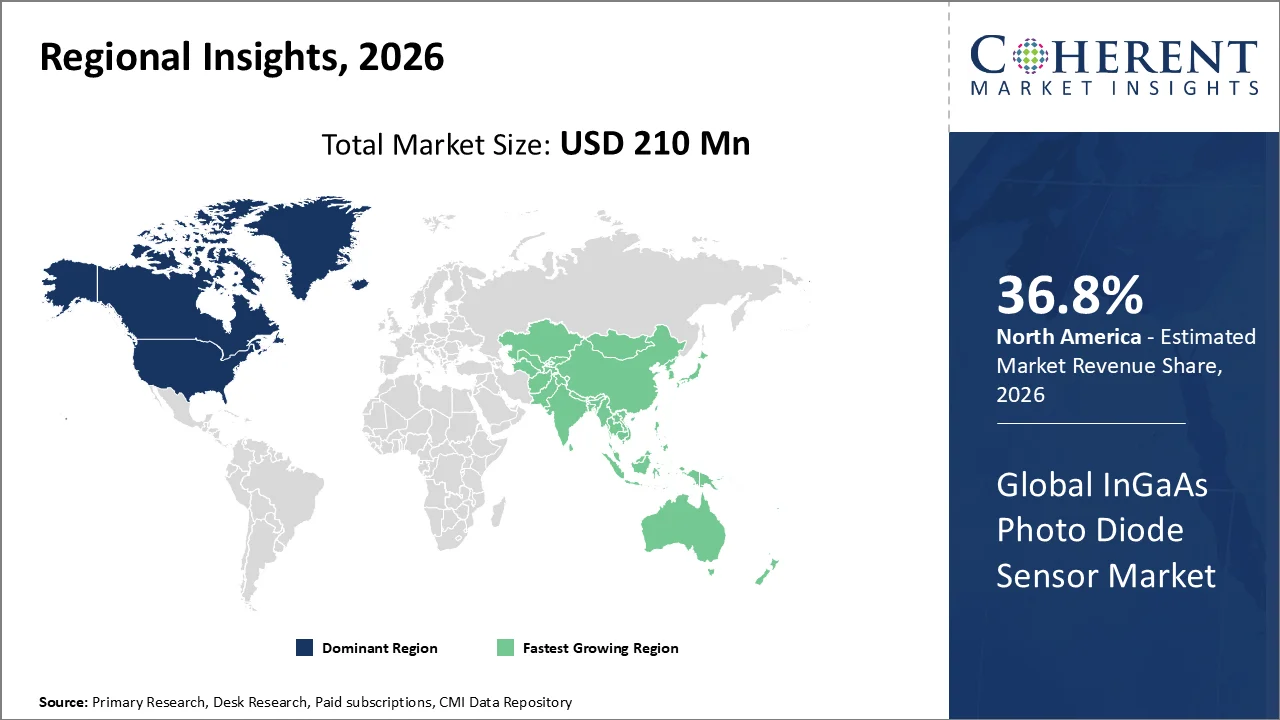
North America Dominates Owing to the Strong Optical Communication and Photonics Infrastructure
The North America region accounts for 38.6% of the market share in 2026. The region’s growth is owing to the strong broadband investment, advanced defense and aerospace demand, established photonics research, and high adoption of optical test equipment across telecom and data-center infrastructure. The U.S. also has a strong base of photonics companies, research laboratories, and end users in LiDAR, fiber sensing, quantum communication, and environmental monitoring.
A major demand driver is broadband infrastructure modernization. NTIA’s BEAD program is funded with USD 42.45 billion to connect every American to high-speed internet. This supports fiber rollout, network testing, and optical performance monitoring, all of which require InGaAs-based photodiodes.
In December 2025, Pittsburgh-based Excelitas launched the C30733EQC-3 InGaAs APD for distributed fiber sensing applications. The device supports telecom O, E, S, C, and L bands with 1000–1700 nm spectral response and 2 GHz bandwidth.
Asia Pacific InGaAs Photo Diode Sensor Market Trends
Asia Pacificis expected to witness strong growth in market over the forecast period. The region’s growth is owing to the rapid fiber deployment, large-scale 5G infrastructure, electronics manufacturing, industrial automation, and strong demand from China, Japan, South Korea, and India.
China is expanding telecom and 5G infrastructure at scale, Japan remains a leading source of precision photonics and InGaAs sensor innovation, and South Korea continues to maintain one of the world’s highest fiber broadband penetration levels. OECD reported that Korea’s fiber share exceeded 90.5% of total fixed broadband subscriptions by the end of 2024.
In August 2025, Hamamatsu Photonics announced the G1682x series, a compact non-cooled InGaAs image sensor designed for near-infrared applications. It offers high sensitivity, low dark current, multichannel spectrophotometry, and efficient real-time analysis for industrial and R&D use.
Broadband Investment and LiDAR Development are Accelerating the InGaAs Photo Diode Sensor Market in United States
In the United States, the InGaAs Photo Diode Sensor Market is influenced by the broadband investment, defense photonics, aerospace imaging, LiDAR development, environmental monitoring, and optical test equipment manufacturing.
The U.S. also remains strong in research and calibration. The PubMed-indexed 2025 research reported an InGaAs trap detector with >98% detection efficiency from 1 µm to 1.3 µm, thereby showing the role of InGaAs devices in the SWIR measurement standards.
In April 2026, Excelitas introduced the C30683-1550 Series InGaAs APD modules with integrated transimpedance amplifiers for high-speed, low-light detection applications. The modules offer up to 450 MHz bandwidth, 250 fW/√Hz NEP, and 120 kV/W responsivity at 1550 nm for LiDAR, sensing, and analytical instrumentation.
China InGaAs Photo Diode Sensor Market Trends
China is emerging as a major growth market for InGaAs Photo Diode Sensor. The growth is owing to the 5G, fiber backhaul, industrial automation, smart city infrastructure, and domestic electronics manufacturing.
The country reached 4.838 million 5G base stations by end-2025, supporting demand for optical communication components and network testing equipment. Since InGaAs photodiodes are used in 1310 nm and 1550 nm optical communication wavelengths, China’s telecom scale creates significant demand for receivers, optical test modules, and fiber monitoring systems.
In March–April 2026, Guohui OPTO-electronic (GHOPTO) announced participation in the WORLD OF LASERS AND OPTICS exhibition in Moscow, showcasing advanced InGaAs and CQD technologies. The company demonstrated SWIR cameras and sensors for industrial inspection, defense, and scientific imaging applications.
Who are the Major Companies in InGaAs Photo Diode Sensor Industry
Some of the major key players in InGaAs Photo Diode Sensor Market are First Sensor, Hamamatsu Photonics K.K., Laser Components GmbH, OSI LaserDiode, Kyoto Semiconductor Co., Ltd., Teledyne Judson Technologies (TJT), SphereOptics GmbH, and Voxtel, Inc.
Key News
- In June 2026, Phlux Technology announced beta sample availability of its Apex 200 µm InGaAs APD receiver module for ultra-low-light detection applications. The device delivers 35 fW/√Hz noise performance and 100 MHz bandwidth, thus targeting LiDAR, defence, as well as sensing systems.
- In February 2025, Hamamatsu Photonics launched the C16795 series InGaAs area image sensor module for hyperspectral imaging applications. The module offers a high dynamic range of ~3500 and up to 503 fps performance, enabling high-quality low-light infrared imaging with easy USB-based PC control and C-mount compatibility.
Market Report Scope
InGaAs Photo Diode Sensor Market Report Coverage
| Report Coverage | Details | ||
|---|---|---|---|
| Base Year: | 2025 | Market Size in 2026: | USD 210 Mn |
| Historical Data for: | 2020 To 2024 | Forecast Period: | 2026 To 2033 |
| Forecast Period 2026 to 2033 CAGR: | 7.8% | 2033 Value Projection: | USD 360 Mn |
| Geographies covered: |
| ||
| Segments covered: |
| ||
| Companies covered: | First Sensor, Hamamatsu Photonics K.K., Laser Components GmbH, OSI LaserDiode, Kyoto Semiconductor Co., Ltd., Teledyne Judson Technologies (TJT), SphereOptics GmbH, and Voxtel, Inc. | ||
| Growth Drivers: |
| ||
| Restraints & Challenges: |
| ||
Analyst Opinion
- The InGaAs photo diode sensor market growth is strongly driven by exponential growth in global data traffic and optical network expansion. According to the International Telecommunication Union (ITU), global internet traffic has increased more than 25× over the last decade, with over 5.4 billion internet users in 2025. This surge speeds up the demand for high-speed InGaAs-based photodetectors used in fiber-optic transceivers as well as long-haul communication infrastructure.
- Defense and security modernization is a major driver for the product demand and is supported by government spending trends. The Stockholm International Peace Research Institute (SIPRI) reports the global military expenditure reached over USD 2.4 trillion in 2024 which is the highest ever recorded. This is speeding up the adoption of SWIR imaging and InGaAs sensors in night vision, surveillance, border monitoring, as well as aerospace systems where silicon sensors are ineffective under low-light or obscured conditions.
- Automotive and LiDAR applications are expanding at a rapid pace supported by the regulatory push for road safety and autonomy. The U.S. National Highway Traffic Safety Administration (NHTSA) and similar EU safety frameworks are driving ADAS integration in vehicles, while China’s MIIT continues to support intelligent connected vehicle deployment. The industry estimates suggest millions of LiDAR-equipped vehicles will be on roads by the late 2020s, thereby substantially increasing the demand for InGaAs-based infrared sensing technologies.
Speak to the analyst
Want personalized insights?
Take the findings above to one of our principal consultants, or have the report rebuilt around the segments, geographies and competitors you actually track.
Market Segmentation
- By Product Type (Revenue, USD Mn, 2021-2033)
- Multi-Element-Array
- PN
- PIN
- Avalanche
- Single-Element InGaAs PIN
- Multi-Element-Array
- By Range (Revenue, USD Mn, 2021-2033)
- Short Range Detection
- Medium Range Detection
- Long Range Detection
- By Application (Revenue, USD Mn, 2021-2033)
- LiDAR
- Automotive ADAS
- Automated Guided Vehicle (AGV)
- Range Finding
- Others (Surveillance Camera, etc.)
- Optical Communication
- Power Monitoring
- DWDM Monitoring
- Single/Multi-Mode Fiber Optic Receiver
- Others
- Infrared Imaging (Especially for Medical Imaging)
- LiDAR
- By Region (Revenue, USD Mn, 2021-2033)
- North America
- U.S.
- Canada
- Latin America
- Brazil
- Mexico
- Argentina
- Rest of Latin America
- Europe
- Germany
- U.K.
- France
- Italy
- Spain
- Russia
- Rest of Europe
- Asia Pacific
- China
- India
- Japan
- Australia
- South Korea
- ASEAN
- Rest of Asia Pacific
- Middle East
- GCC
- Israel
- Rest of Middle East
- Africa
- South Africa
- Central Africa
- North Africa
- North America
Sources
Primary Research Interviews
- Photonics & optoelectronics engineers
- LiDAR system designers (automotive & industrial)
- Semiconductor sensor R&D heads
- Infrared imaging system manufacturers
- Telecom optical communication engineers
- Defense & aerospace sensing specialists
- Key Opinion Leaders (KOLs) in photonics and IR sensing
Databases
- International Telecommunication Union (ITU)
- IEEE Xplore Digital Library
- U.S. National Institute of Standards and Technology (NIST)
- Organisation for Economic Co-operation and Development (OECD)
- World Bank Digital Development Data
- European Photonics Industry Consortium (EPIC) reports
- U.S. Department of Defense (DoD) technology databases (public sections)
Magazines
- Photonics Spectra
- Laser Focus World
- Optics & Photonics News (OSA/Optica)
- Electro Optics
- Compound Semiconductor Magazine
Journals
- IEEE Journal of Quantum Electronics
- IEEE Photonics Technology Letters
- Optics Express
- Journal of Lightwave Technology
- Applied Physics Letters
- Infrared Physics & Technology
Newspapers
- The Wall Street Journal
- Financial Times
- The New York Times
- The Guardian
- Nikkei Asia
Associations
- SPIE – International Society for Optics and Photonics
- Optica (formerly Optical Society of America – OSA)
- IEEE Photonics Society
- SEMI (Semiconductor Equipment and Materials International)
- European Photonics Industry Consortium (EPIC)
- International Society for Optics and Photonics Industry Groups
Public Domain Sources
- U.S. Department of Energy (DOE) reports on photonics and sensing
- European Commission – Photonics21 initiative publications
- National Science Foundation (NSF) reports
- Government defense procurement & technology briefs (U.S., EU, Japan)
- Clinical/industrial sensor validation datasets in open repositories
- Company annual reports and investor presentations (e.g., sensor OEMs)
- Patent databases (USPTO, EPO, WIPO)
- Trade statistics from UN Comtrade (optical/IR components categories)
Proprietary Elements
- CMI Data Analytics Tool
- Proprietary CMI Existing Repository of Information for Last 10 Years
Get access to 250+ pages report
Every segment, forecast, competitor profile and data table behind the analysis above — available for instant download.
- ESOMAR Member
- ISO 9001:2015 Certified
- D-U-N-S Registered
- GDPR & CCPA Compliant
Missing comfort of reading report in your local language? Find your preferred language:
Transform your Strategy with Exclusive Trending Reports
Frequently Asked Questions
The InGaAs Photo Diode Sensor Market is expected to reach USD 360 Mn in 2033.
Major players operating in the global InGaAs Photo Diode Sensor Market include First Sensor, Hamamatsu Photonics K.K., Laser Components GmbH, OSI LaserDiode, Kyoto Semiconductor Co., Ltd., Teledyne Judson Technologies (TJT), SphereOptics GmbH, and Voxtel, Inc.
The exorbitant manufacturing costs, complex fabrication techniques, and intense competition from cheaper alternatives like Silicon and phototransistors are the key factors hampering growth of the market.
The global surge in 5G infrastructure, the booming demand for Automotive LiDAR, and advancements in industrial machine vision is boosting the demand for InGaAs Photo Diode Sensor.
The InGaAs Photo Diode Sensor Market is anticipated to grow at a CAGR of 7.8% between 2026 and 2033.
Among regions, North America is expected to account for a largest market share in the global InGaAs Photo Diode Sensor Market over the forecast period.
The market outlook remains positive due to expanding 5G telecommunication infrastructure, increasing demand for short-wave infrared (SWIR) imaging, and automotive LiDAR applications.