

Global Pneumatic Components Market Size & Forecast – 2026 To 2033
The Global Pneumatic Components Market is estimated to be valued at USD 20.82 Bn in 2026 and is expected to reach USD 33.62 Bn by 2033, exhibiting a compound annual growth rate (CAGR) of 7.1% from 2026 to 2033. Market expansion is supported by increasing automation across manufacturing, automotive, packaging, material handling, electronics, and food-processing industries, where pneumatic cylinders, valves, air-preparation units, and sensors enable rapid and reliable machine operations.
Growing adoption of connected valve terminals, condition-monitoring sensors, and energy-efficient compressed-air systems is further increasing the value of intelligent pneumatic solutions. In March 2026, an ABB Robotics survey found that 31% of automotive manufacturing respondents identified increased investment in automation and robotics as a key strategy for the year ahead, indicating continued demand for motion-control and factory-automation components.
Key Takeaways of the Global Pneumatic Components Market
- Pneumatic cylinders are expected to lead the component type segment with 28.6 % of the market share in 2026, owing to their high force-to-size ratio, rapid cycling, straightforward maintenance, and suitability for repetitive industrial motion. In July 2025, SMC introduced its IN-777 air servo cylinder with FOUNDATION Fieldbus communication support, strengthening digitally connected pneumatic motion control.
- Industrial automation is projected to hold 34.8 % of the market share in 2026, as pneumatic components remain central to clamping, positioning, gripping, sorting, and machine-safety functions. In February 2025, Festo introduced AX Motion Insights Pneumatic, which uses machine learning to monitor pneumatic actuators and detect operational anomalies, supporting predictive maintenance and higher equipment availability.
- Automotive is expected to hold 25.6 % of the market share in 2026, supported by extensive pneumatic deployment in body assembly, welding fixtures, component handling, painting, testing, and final assembly. In November 2025, Stellantis showcased more than 100 technology-driven manufacturing innovations at its Factory Booster Day, highlighting continued investment in automated, flexible, and productivity-focused vehicle production.
- Asia Pacific is expected to dominate the global pneumatic components market with a 32.7 % share in 2026, reflecting its large electronics, automotive, packaging, and general manufacturing base. In September 2025, the International Federation of Robotics reported that Asia accounted for 74% of new industrial robot deployments in 2024, indicating substantial automation intensity and component demand.
- Europe is expected to be the fastest-growing region, representing 29.6 % of the market share in 2026, as manufacturers modernize production with connected machinery, robotics, and energy-efficient motion systems. In July 2025, the European Union announced plans to invest USD 205.57 million in advanced digital technologies, including artificial intelligence and robotics, supporting wider adoption of intelligent industrial automation infrastructure.
- Intelligent Pneumatics and Predictive Maintenance: Pneumatic systems are evolving from standalone mechanical devices into connected assets equipped with pressure, flow, position, and condition-monitoring capabilities. This shift allows manufacturers to detect leakage, wear, and cycle irregularities before failure. Suppliers integrating sensors, edge analytics, and industrial communication protocols can improve equipment uptime while creating recurring revenue through software, diagnostics, and maintenance services.
- Energy-Efficient Compressed-Air Architectures: Rising energy and operating-cost pressures are encouraging manufacturers to redesign pneumatic circuits around lower working pressures, localized air preparation, compact valves, leak detection, and intelligent air-management systems. Demand will increasingly favor components that minimize compressed-air consumption without reducing speed or force. Hybrid pneumatic-electric architectures will also gain relevance where precise positioning and energy optimization must be balanced with rugged, high-cycle operation.
Segmental Insights
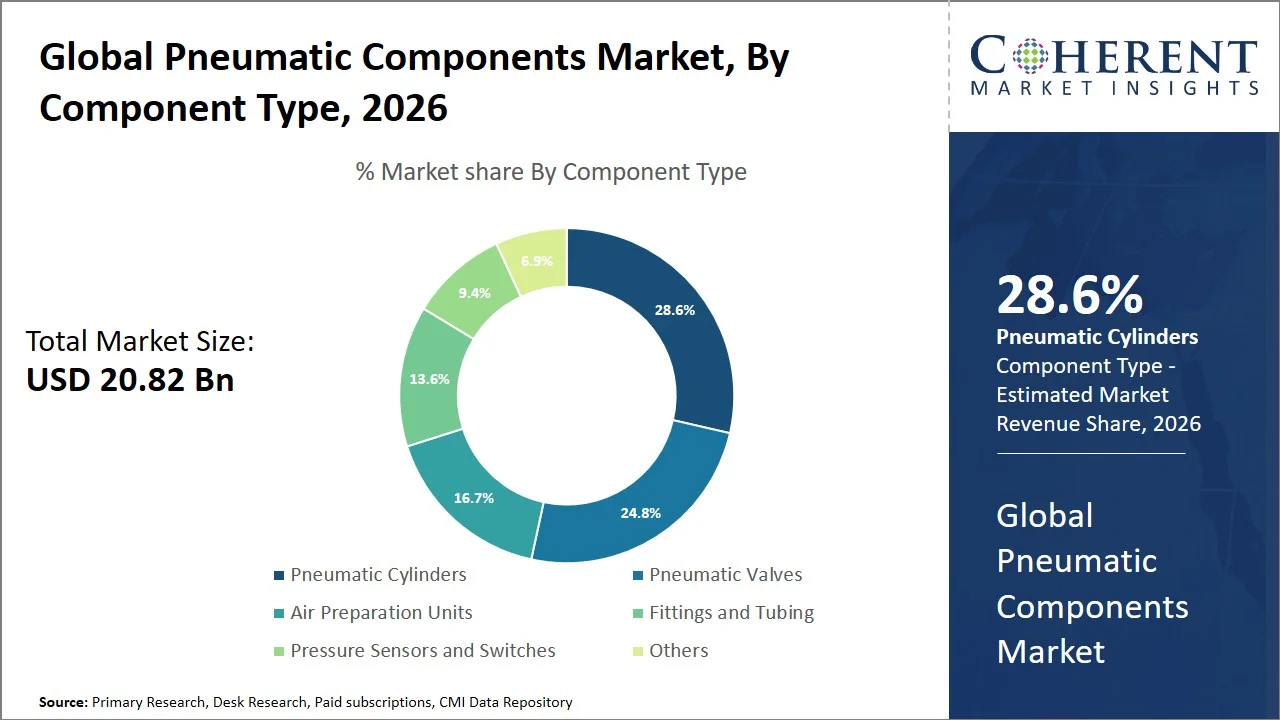
Why Do Pneumatic Cylinders Dominate the Global Pneumatic Components Market?
Pneumatic cylinders are expected to account for 28.6% of the global pneumatic components market in 2026. Their leadership reflects the need for dependable linear motion in machinery performing pushing, lifting, indexing, stopping, clamping, and ejecting at high cycle rates. Cylinders offer straightforward sizing, broad bore and stroke options, standardized mounting, and rapid replacement, reducing machine-builder engineering time and lifecycle service costs.
Demand is particularly strong in packaging lines, material-handling systems, food-processing equipment, and warehouse automation, where repeatability and ruggedness are prioritized over multi-axis precision. Manufacturers are improving competitiveness through integrated valves, cushioning, position sensing, and air-saving circuit designs. In April 2025, IMI Norgren reported that an international motor manufacturer reduced compressed-air usage by 10% at its Amsterdam distribution center using Integrated Valve And Actuator Control (IVAC) cylinders, demonstrating the operating-cost benefits of integrated pneumatic actuation.
- Current Industry Events of 2026
- Market Size Estimation
- Regional Breakdown
- Competitive Landscape
- Customer Intelligence
- Segmental Analysis
- Pricing Analysis
- Key Market Drivers, Challenges & Future Trends
- Customized Insights Section
Why Does Industrial Automation Represent the Largest Application Segment in the Global Pneumatic Components Market?
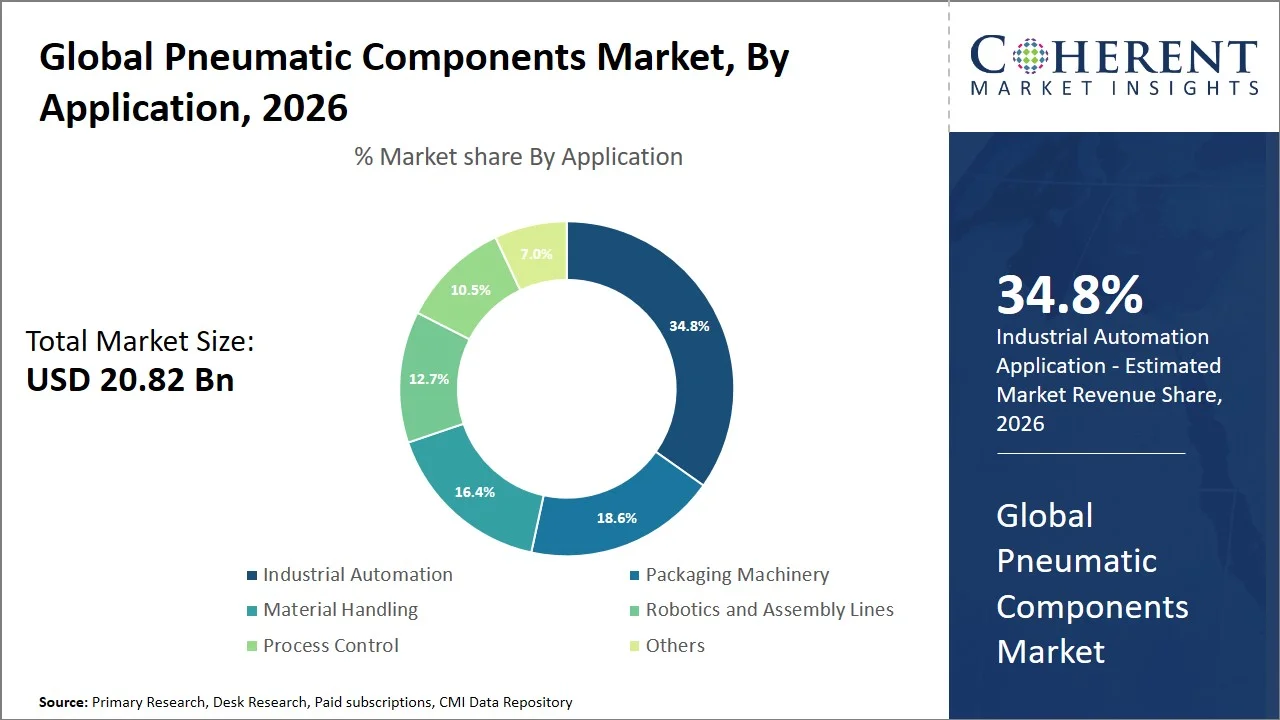
Industrial automation is projected to represent 34.8% of the global pneumatic components market in 2026. Pneumatics remain deeply embedded in automated machinery because valves, actuators, grippers, air-preparation units, and sensors can be configured into compact control architectures for rapid, repetitive operations. Demand comes from manufacturers seeking higher throughput, shorter changeovers, safer machine states, and lower unplanned downtime across assembly, sorting, pick-and-place, filling, and inspection processes. Supply-side development is shifting toward network-connected valve terminals, decentralized pressure control, and continuous compressed-air monitoring, allowing pneumatic assets to participate in plant-level maintenance and energy-management systems. In January 2025, Emerson launched the AVENTICS DS1 sensor, which monitors dew point, temperature, humidity, and compressed-air quality in real time and connects through Modbus TCP. The technology supports reliable automated production by identifying moisture conditions that can corrode components, disrupt switching, and compromise process consistency.
Why Does the Automotive Industry Dominate the Global Pneumatic Components Market?
Automotive is expected to hold 25.6% of the global pneumatic components market in 2026. Vehicle production requires thousands of repeatable motions across body-in-white assembly, welding fixtures, stamping support, parts transfer, fastening, painting, leak testing, and final inspection. Pneumatic equipment remains well suited to these environments because it tolerates contamination, delivers rapid actuation, and can be maintained by established plant engineering teams. Model proliferation and electric-vehicle manufacturing are also increasing demand for flexible tooling, compact grippers, vacuum handling, and digitally monitored air circuits that can be reconfigured between vehicle platforms. In February 2025, Hyundai Motor and Samsung announced the completion of a private 5G RedCap pilot for smart manufacturing, with Hyundai already applying private 5G in mass production and automated guided vehicle operations at its Ulsan plant. This connectivity foundation supports the integration of sensor-equipped pneumatic systems within coordinated, data-driven automotive production lines.
Current Events and their Impact
Current Events | Description and its Impact |
February 2026 – U.K. Government Announces Machinery Safety Framework Direction |
|
November 2025 – OSHA Clarifies Lockout and Hazardous-Energy Controls |
|
January 2026 – Harmonized Pressure-Equipment Standards Updated in Europe |
|
Global Pneumatic Components Market Dynamics
Key Market Drivers
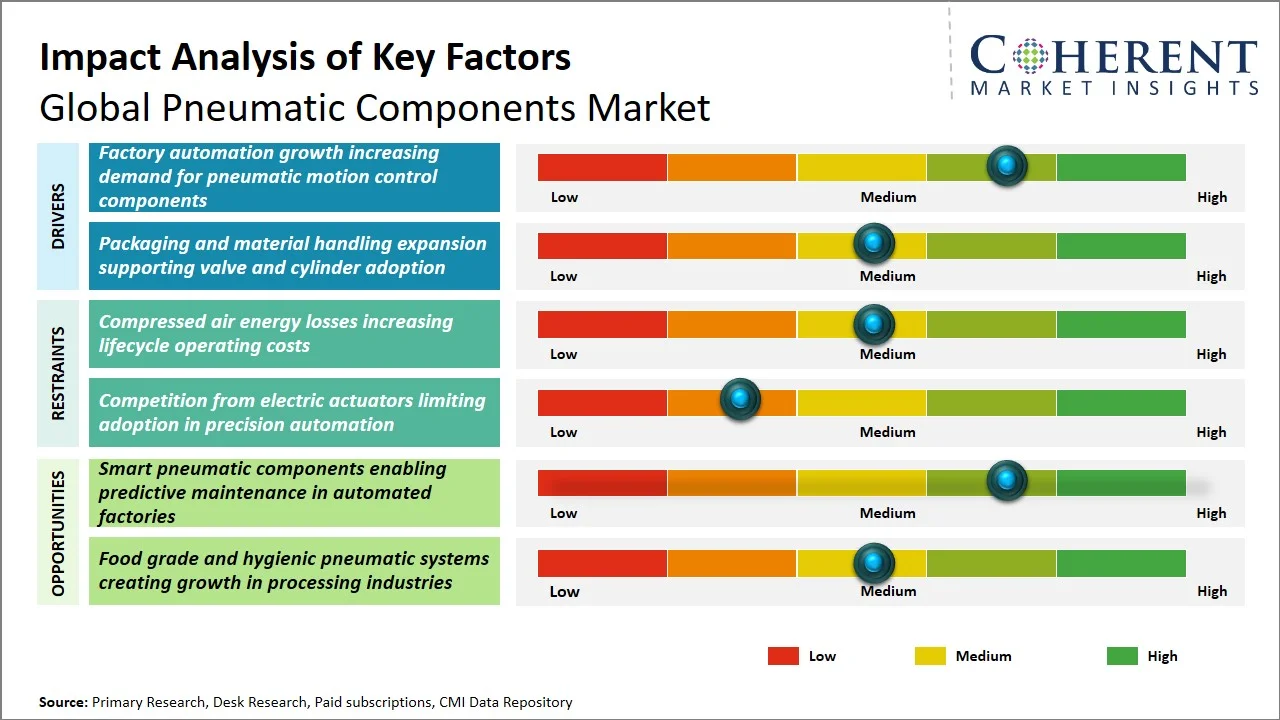
- Factory Automation Growth Is Increasing Demand for Pneumatic Motion-Control Components: Factory automation is expanding the addressable base for pneumatic cylinders, valves, air-preparation units, sensors, and fittings because these components remain effective for rapid, repetitive motion where ruggedness and simple maintenance matter more than multi-axis precision. Manufacturers are increasing automation to improve throughput, manage labor constraints, standardize quality, and reconfigure lines for shorter product cycles. This favors compact valve terminals, sensor-ready actuators, decentralized pressure control, and components that connect with plant-monitoring systems. Suppliers can capture additional value through diagnostics, commissioning, and lifecycle services rather than competing only on hardware price. In March 2026, Siemens announced an investment of more than USD 228.41 million to build an AI-based, digitalized, and automated factory in Amberg, Germany. The planned facility will use digital twins, advanced automation, and automated logistics, illustrating the creation of machinery platforms requiring reliable motion and control components.
- Packaging and Material-Handling Expansion Is Supporting Valve and Cylinder Adoption: Expansion in packaging and material handling is supporting pneumatic component demand because filling, sealing, labeling, case packing, palletizing, sorting, and transfer systems depend on fast, synchronized linear movement. Cylinders and valves are widely selected for product stops, pushers, gates, clamps, grippers, and format-change mechanisms, while vacuum and air-preparation products support handling reliability. Growth in high-mix packaging also increases demand for modular components that can be changed quickly and serviced without lengthy shutdowns. Equipment suppliers therefore prioritize compact footprints, hygienic designs, low leakage, and consistent cycle performance. In May 2025, MULTIVAC disclosed that its approximately USD 114.21 million second plant in Wolfertschwenden included a manufacturing facility and logistics center, with manufacturing move-in underway from April 2025. The smart-factory investment indicates continued scaling of automated packaging and logistics infrastructure using pneumatic motion throughout production and handling operations.
Emerging Market Trends
- Connected Pneumatic Assets Are Enabling Predictive Maintenance: Pneumatic systems are moving from standalone mechanical assemblies toward digitally observable assets. Pressure, flow, temperature, humidity, position, and cycle data are increasingly collected through IO-Link, Ethernet, fieldbus, and edge devices. This enables maintenance teams to identify leakage, slow actuation, pressure instability, contamination, and seal wear before these issues interrupt production. The trend changes supplier economics by creating demand for intelligent sensors, connected valve manifolds, diagnostic software, and remote service support in addition to conventional components. Adoption will be strongest in automotive, electronics, pharmaceuticals, and continuous packaging operations where downtime is costly and traceability is important. However, suppliers must provide interoperable data structures and simple commissioning, as customers are unlikely to accept proprietary systems that complicate integration. Companies combining dependable pneumatic hardware with actionable condition data can improve customer retention and establish recurring software and service revenue.
- Energy-Optimized and Hybrid Motion Architectures Are Gaining Importance: Compressed-air efficiency is becoming a design requirement rather than a secondary maintenance concern. Manufacturers are reassessing oversized cylinders, excessive operating pressure, long tubing runs, continuous blowing, and centralized vacuum generation because these practices raise energy cost and increase leakage exposure. This is encouraging wider use of pressure zoning, pulsed air, local vacuum ejectors, regenerative circuits, leak analytics, and automatic air shutoff during idle periods. Hybrid pneumatic-electric systems will also expand, with pneumatics retained for high-speed clamping and simple transfer while electric motion handles variable positioning and controlled profiles. The trend will favor suppliers that quantify total air consumption and application-level savings instead of marketing components solely by purchase price. Product portfolios with compact valves, low-friction seals, high-flow air preparation, and embedded energy monitoring will be better aligned with factory sustainability programs and lifecycle-cost procurement.
Regional Insights
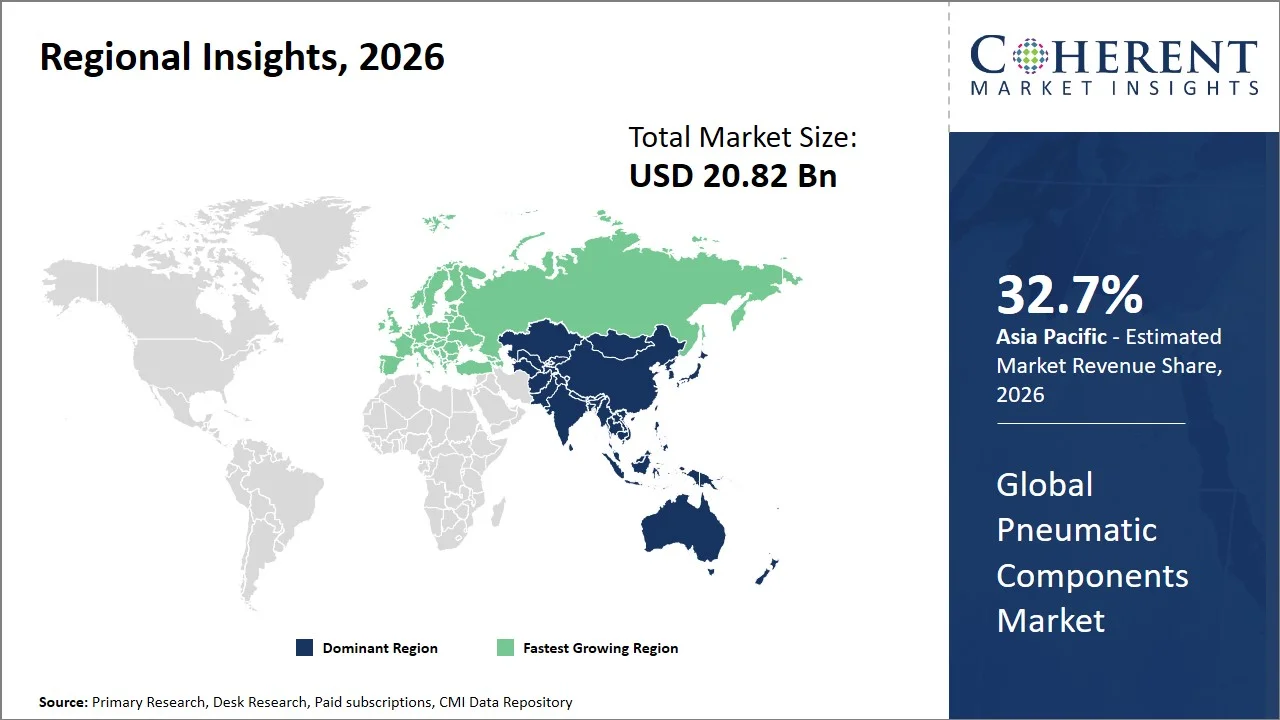
Why Does Asia Pacific Dominate the Global Pneumatic Components Market?
Asia Pacific is expected to dominate the global pneumatic components market with a 32.7% share in 2026. Its leadership reflects the concentration of electronics, automotive, packaging, semiconductor, and general machinery production, where cylinders, valves, air-preparation units, sensors, and fittings support high-cycle automation. Regional machine builders also benefit from dense component supply networks, local engineering support, and cost-efficient manufacturing, enabling faster customization and replacement. Demand is increasingly moving toward compact valve terminals, intelligent pressure control, and condition-monitoring systems that reduce compressed-air losses. In October 2025, Azbil presented data-driven industrial automation solutions at Industrial Transformation ASIA-PACIFIC, including valve diagnostics, AI-based condition monitoring, compact-actuator control valves, and factory fault-detection equipment. The development illustrates how regional automation investment is shifting toward connected pneumatic and process-control architectures that improve uptime, energy efficiency, and maintenance planning.
Why is Europe Emerging as the Fastest-Growing Region in the Pneumatic Components Market?
Europe is expected to be the fastest-growing region in the pneumatic components market, accounting for a 29.6% share in 2026. Growth is supported by extensive factory retrofitting, energy-efficiency targets, advanced machinery production, and the transition toward flexible manufacturing in automotive, batteries, logistics, food processing, and renewable-energy equipment. European users increasingly require pneumatic components with lower leakage, decentralized control, machine-safety functions, and industrial communication compatibility. This favors suppliers that can combine actuators and valves with diagnostics, software, and lifecycle services. In December 2025, the European Investment Bank signed a USD 57.12 million financing agreement with Comau for research and development in robotics, advanced automation, machine tools, and digital technologies across several industrial sectors. The investment supports broader automation deployment and creates additional demand for pneumatic motion, gripping, clamping, air-quality management, and sensor-based control within upgraded European production systems.
Global Pneumatic Components Market Outlook for Key Countries
Why is the U.S. a Key Market for Pneumatic Components?
The U.S. is a key pneumatic components market because it combines a diversified manufacturing base with strong expenditure on automation, reshoring, logistics infrastructure, and semiconductor capacity. Pneumatic equipment remains widely used in automotive assembly, food and beverage processing, medical-device production, warehouse systems, packaging lines, and machine tools. Customers increasingly prioritize readily serviceable components, domestic inventory, safety compliance, and integration with predictive-maintenance platforms. Local production and training capabilities are therefore becoming important differentiators for global suppliers. In June 2025, Yaskawa announced a USD 180 million campus in Franklin, Wisconsin, incorporating headquarters, training, and manufacturing facilities for industrial robots and semiconductor-manufacturing equipment. The company linked the investment to rising U.S. demand for automation and labor-saving equipment. Such projects support demand for cylinders, valve manifolds, grippers, pressure controls, tubing, and air-treatment components used throughout automated production cells.
Why Does China Support Growth in the Pneumatic Components Market?
China is central to the pneumatic components market because of its large machinery, automotive, electronics, battery, packaging, and consumer-goods manufacturing clusters. High-volume factories require cost-efficient motion and control components for material transfer, clamping, sorting, assembly, testing, and process regulation. Domestic component manufacturing supports competitive pricing, while extensive machine-building capacity enables pneumatic systems to be embedded in equipment supplied locally and exported internationally. Demand is also shifting toward networked valve islands, digital pressure sensors, and energy-monitoring devices as factories advance beyond basic automation. In August 2025, China issued a government plan to accelerate digital transformation across the machinery industry, targeting broad smart-technology integration by 2027 and 500 new excellence-level smart factories by 2030. The policy strengthens the adoption environment for intelligent pneumatic components that can connect with industrial software, automated maintenance, and digitally coordinated production lines.
Why is India Important in the Global Pneumatic Components Market?
India is becoming an important pneumatic components market as industrial investment expands across automobiles, electronics, pharmaceuticals, food processing, packaging, and general engineering. Manufacturers increasingly use pneumatic cylinders, valves, vacuum systems, and air-preparation equipment to increase throughput without adopting higher-cost electric motion for every repetitive task. The market also benefits from demand for rugged, easily maintained products suited to varied plant conditions and cost-sensitive machinery. Local assembly, distributor coverage, and application engineering are becoming critical as small and medium manufacturers automate incrementally. In August 2025, India’s Press Information Bureau reported that realized investment under the Production Linked Incentive schemes had reached approximately USD 0.018 Mn, with 806 approved applications covering sectors including electronics, automobiles, and pharmaceuticals. As these projects move into production, they expand the installed base of automated machinery requiring pneumatic actuation, pressure regulation, fittings, and maintenance support.
Why is Germany a Strategic Country in the Pneumatic Components Market?
Germany is a strategic pneumatic components market because its automotive, packaging machinery, chemicals, pharmaceuticals, food-processing equipment, and precision-engineering industries demand high reliability and documented performance. German machine builders frequently integrate pneumatic systems into export-oriented equipment, making compliance with international safety, communication, and energy-efficiency standards commercially important. Customers favor compact components, low-leakage designs, modular valve terminals, and sensor-enabled actuators that support predictive maintenance and rapid line changeovers. Engineering depth also encourages hybrid architectures that combine pneumatic speed and robustness with electric precision. In June 2025, Bosch announced plans to invest more than USD 2.86 billion in artificial intelligence by the end of 2027 and highlighted agentic AI applications in industrial technology and production. This direction reinforces demand for pneumatic hardware that can generate reliable operating data and interact with AI-enabled quality, maintenance, and process-optimization systems in advanced German factories.
Why is Japan an Important Growth Market for the Pneumatic Components Market?
Japan is an important pneumatic components market due to its strong factory-automation industry, precision machinery base, and extensive adoption of compact, high-cycle production equipment. Pneumatic cylinders, grippers, valves, and pressure-control devices are deeply integrated into electronics assembly, automotive production, machine tools, food factories, and packaging systems. Workforce aging and regional labor shortages are increasing interest in automation that can be installed without extensive plant redesign. Japanese customers also emphasize miniaturization, long service life, cleanliness, and energy-efficient air management, supporting premium component demand. In June 2025, Japan’s Ministry of Economy, Trade and Industry established the Robotics and Regional Initiative Networking Group to accelerate robot adoption and address labor shortages nationwide, particularly among smaller manufacturers. Wider robot deployment should increase demand for pneumatic end effectors, clamping units, compact actuators, and air-management systems used alongside robotic and automated workcells.
Technology Adoption Landscape in the Global Pneumatic Components Market
Technology | Adoption Level | Key Application Area | Business Impact |
IO-Link-enabled pneumatic sensors and valves | High | Automated machinery and production cells | Simplifies commissioning, enables parameter transfer, and provides real-time pressure, position, and diagnostic data. |
Smart valve terminals with industrial Ethernet | High | Packaging, assembly, automotive, and process equipment | Reduces wiring, enables decentralized control, and supports faster machine configuration and fault identification. |
Compressed-air flow and leakage monitoring | High | Plant utilities and machine-level air circuits | Identifies energy losses, supports preventive maintenance, and improves compressed-air cost allocation. |
Predictive actuator condition monitoring | Medium | High-cycle cylinders, grippers, and assembly systems | Detects seal wear, slow strokes, abnormal cycles, and pressure deviations before component failure. |
Proportional pressure and flow control | Medium | Robotics, testing, dispensing, and precision handling | Improves force regulation, process repeatability, product quality, and flexibility across multiple operating recipes. |
Digital twins and pneumatic simulation software | Medium | Machine design, sizing, and virtual commissioning | Reduces engineering time, prevents component oversizing, and optimizes cycle time and air consumption before installation. |
How are Smart Retrofits and Compressed-Air Optimization Creating New Growth Opportunities in the Global Pneumatic Components Market?
The strongest growth opportunity lies in converting the large installed base of conventional pneumatic machinery into connected, energy-managed systems without requiring complete equipment replacement. Manufacturers can add digital pressure and flow sensors, smart valve terminals, position feedback, automatic isolation, and edge analytics to existing cylinders and air circuits. This retrofit pathway is commercially important because many factories cannot justify replacing dependable machines solely to gain predictive maintenance or energy visibility. Suppliers can develop modular upgrade kits for packaging, automotive, food processing, pharmaceuticals, electronics, and warehouse equipment, supported by leak audits and application engineering. Standardized IO-Link and Ethernet connectivity can simplify integration with existing control and maintenance platforms. Regional distributors can participate through installation, calibration, and service contracts, creating recurring revenue beyond component resale. The most attractive solutions will combine measurable compressed-air savings, shorter downtime, and rapid payback while preserving current machinery layouts. Vendors providing assessment, retrofit hardware, analytics, and post-installation verification as one package can differentiate themselves from low-cost component suppliers.
Market Players, Key Development, and Competitive Intelligence
Key Developments
- In May 2026, Camozzi Automation introduced the FSX flow sensor, designed to monitor flow, pressure, temperature, humidity, and energy consumption through Ethernet connectivity and data-management software. This is important for the pneumatic components market because it enables machine-level compressed-air monitoring, energy optimization, and predictive maintenance through a single connected device.
- In September 2025, Parker Hannifin launched the SCPSDI pressure switch, featuring a rotatable pressure port, flexible installation, switching outputs, diagnostic functionality, and IO-Link connectivity. This is important for the pneumatic components market because it supports compact machine layouts and improves digital pressure monitoring across pneumatic equipment, compressors, and automated machinery.
- In December 2024, CKD Corporation released the BNP Series pulsed blow valve for cleaning, cooling, drying, and transport-assistance applications. The valve was developed to reduce compressed-air consumption while maintaining instantaneous flow and required no electrical wiring. This is important for the pneumatic components market because it directly addresses energy losses associated with continuous industrial air blowing.
Competitive Landscape
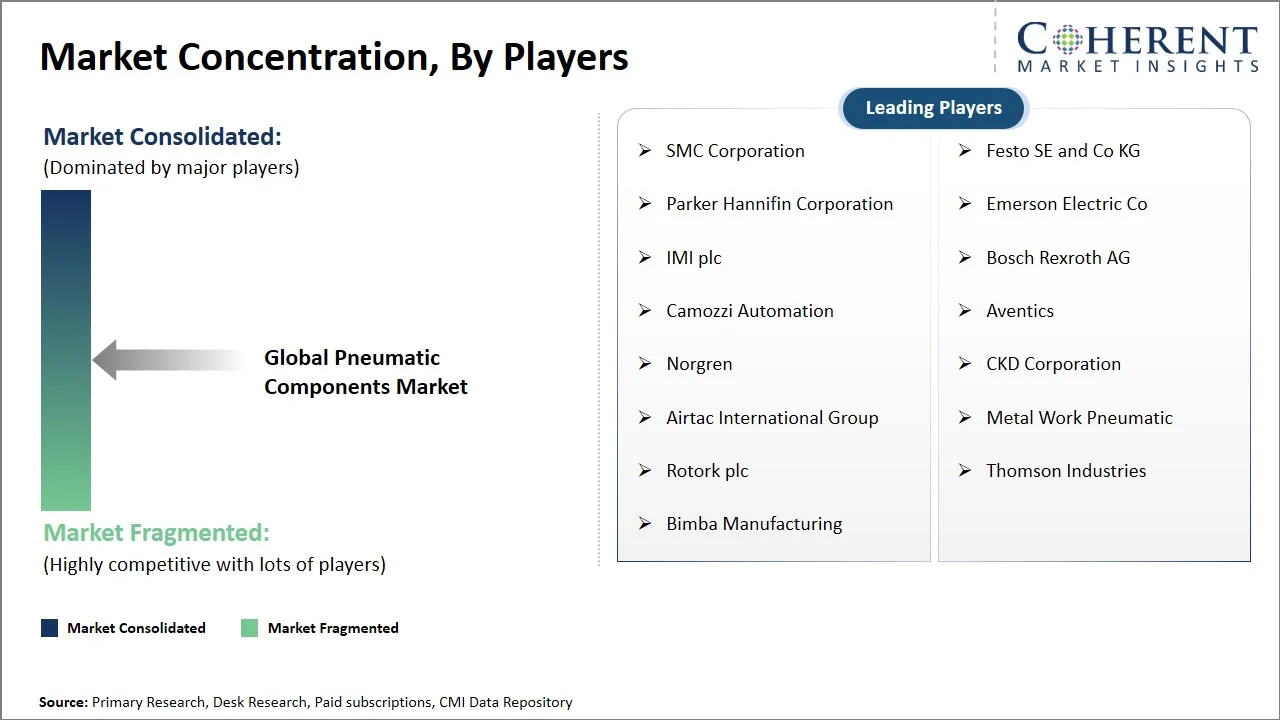
The global pneumatic components market is moderately consolidated at the technology and multinational level but remains fragmented across regional manufacturers, specialist suppliers, distributors, and aftermarket providers. Large companies compete through broad portfolios and global servicing capabilities, while smaller firms focus on application-specific products, competitive pricing, customization, and rapid delivery.
Key focus areas include
- Product performance and reliability: Cycle life, leakage resistance, switching speed, force output, and tolerance to harsh operating environments remain important differentiators.
- Smart-component integration: Suppliers increasingly compete through IO-Link connectivity, embedded sensors, remote diagnostics, and communication-ready valve terminals.
- Energy efficiency: Low-friction actuators, reduced-pressure operation, efficient vacuum generation, pulsed air, and leak-management capabilities influence purchasing decisions.
- Pricing and lifecycle cost: Customers compare initial component price with compressed-air consumption, maintenance frequency, downtime risk, and replacement availability.
- Supply reliability: Local inventory, regional manufacturing, standardized parts, and short delivery lead times are critical for machine builders and maintenance teams.
- Compliance and safety: CE, UKCA, ATEX, functional-safety documentation, hygienic design, and pressure-equipment compliance support access to regulated industries.
- Application-specific design: Cleanroom, food-grade, pharmaceutical, semiconductor, corrosion-resistant, and compact product variants enable premium positioning.
- Distribution and technical support: Distributor training, digital product selection, CAD files, configuration tools, and on-site engineering expand customer reach and retention.
Market Report Scope
Pneumatic Components Market Report Coverage
| Report Coverage | Details | ||
|---|---|---|---|
| Base Year: | 2025 | Market Size in 2026: | USD 20.82 Bn |
| Historical Data for: | 2020 To 2024 | Forecast Period: | 2026 To 2033 |
| Forecast Period 2026 to 2033 CAGR: | 7.1% | 2033 Value Projection: | USD 33.62 Bn |
| Geographies covered: |
| ||
| Segments covered: |
| ||
| Companies covered: | SMC Corporation, Festo SE and Co KG, Parker Hannifin Corporation, Emerson Electric Co, IMI plc, Bosch Rexroth AG, Camozzi Automation, Aventics, Norgren, CKD Corporation, Airtac International Group, Metal Work Pneumatic, Rotork plc, Thomson Industries, and Bimba Manufacturing | ||
| Growth Drivers: |
| ||
| Restraints & Challenges: |
| ||
Analyst Opinion (Expert Opinion)
- Pneumatic components will remain essential even as electric actuation expands. The market is unlikely to experience a simple replacement of pneumatic motion by electric systems. Instead, factories will deploy hybrid architectures that assign each technology according to force, speed, precision, safety, cleanliness, and lifecycle cost. Pneumatics will retain an advantage in repetitive clamping, gripping, sorting, and transfer functions.
- The most transformative shift will be the conversion of compressed air into a measurable and actively managed production resource. Connected valves, flow sensing, leakage analytics, and actuator-health monitoring will move purchasing decisions away from component price toward verified operating savings and uptime improvement. Suppliers that cannot quantify system-level value risk being pushed into commodity competition.
- Growth will be strongest in connected cylinders, intelligent valve terminals, energy-management products, and application-specific components for packaging, semiconductors, pharmaceuticals, and electronics. Key barriers include air leakage, inefficient system design, cybersecurity requirements, integration complexity, and low-cost competition. Market players should strengthen retrofit offerings, open communication compatibility, regional service networks, and outcome-based energy audits to build defensible customer relationships.
Speak to the analyst
Want personalized insights?
Take the findings above to one of our principal consultants, or have the report rebuilt around the segments, geographies and competitors you actually track.
Market Segmentation
- Component Type Insights (Revenue, USD Bn, 2021 - 2033)
- Pneumatic Cylinders
- Pneumatic Valves
- Air Preparation Units
- Fittings and Tubing
- Pressure Sensors and Switches
- Others
- Application Insights (Revenue, USD Bn, 2021 - 2033)
- Industrial Automation
- Packaging Machinery
- Material Handling
- Robotics and Assembly Lines
- Process Control
- Others
- End-use Industry Insights (Revenue, USD Bn, 2021 - 2033)
- Automotive
- Food and Beverages
- Packaging
- Electronics and Semiconductors
- Healthcare and Pharmaceuticals
- Chemicals and Oil and Gas
- Others
- Sales Channel Insights (Revenue, USD Bn, 2021 - 2033)
- Direct Sales
- Distributors and Dealers
- Online Industrial Platforms
- Others
- Regional Insights (Revenue, USD Bn, 2021 - 2033)
- North America
- U.S.
- Canada
- Latin America
- Brazil
- Argentina
- Mexico
- Rest of Latin America
- Europe
- Germany
- U.K.
- Spain
- France
- Italy
- Russia
- Rest of Europe
- Asia Pacific
- China
- India
- Japan
- Australia
- South Korea
- ASEAN
- Rest of Asia Pacific
- Middle East
- GCC Countries
- Israel
- Rest of Middle East
- Africa
- South Africa
- North Africa
- Central Africa
- North America
- Key Players Insights
- SMC Corporation
- Festo SE and Co KG
- Parker Hannifin Corporation
- Emerson Electric Co
- IMI plc
- Bosch Rexroth AG
- Camozzi Automation
- Aventics
- Norgren
- CKD Corporation
- Airtac International Group
- Metal Work Pneumatic
- Rotork plc
- Thomson Industries
- Bimba Manufacturing
Source
Primary Research Interviews
- Manufacturers of pneumatic cylinders, valves, actuators, air preparation units, fittings, tubing, sensors, switches, and vacuum components
- Industrial automation, motion-control, compressed-air treatment, and system integration companies
- Machinery manufacturers serving automotive, packaging, material handling, robotics, electronics, food, pharmaceutical, and process industries
- OEMs, factory operators, maintenance providers, distributors, dealers, and industrial online sellers
- Suppliers of aluminum, steel, plastics, elastomers, seals, solenoids, lubricants, and electronic components
- Industry 4.0, energy-efficiency, machine safety, and predictive-maintenance consultants
Stakeholders
- Pneumatic manufacturers: SMC Corporation, Festo, Parker Hannifin, Emerson, IMI, Bosch Rexroth, CKD Corporation, Camozzi Automation, Airtac International, Pneumax
- Automation and sensing companies: Siemens, ABB, Rockwell Automation, Schneider Electric, Omron, Honeywell, Keyence, Balluff, ifm electronic
- Compressed-air suppliers: Atlas Copco, Ingersoll Rand, Kaeser Kompressoren, Donaldson, Sullair
- End users: automotive, packaging, electronics, food and beverages, pharmaceuticals, chemicals, oil and gas, and general manufacturing companies
Databases
- International Federation of Robotics, VDMA, A3 Association for Advancing Automation
- U.S. Federal Reserve G.17, U.S. Census Bureau, Eurostat, EU PRODCOM, Japan METI
- UN Comtrade, ITC Trade Map, and USITC DataWeb
- World Bank, OECD, IMF, UNIDO, BLS, and FRED
- Company annual reports, investor presentations, product catalogues, technical documents, and press releases
Industry Publications and Journals
- Hydraulics & Pneumatics, Fluid Power Journal, Design World, Machine Design, Control Engineering, Automation World
- Plant Engineering, Modern Machine Shop, Packaging World, Assembly Magazine, The Robot Report
- International Journal of Fluid Power, Mechatronics, Journal of Manufacturing Systems, Sensors, and Machines
Associations
- National Fluid Power Association, British Fluid Power Association, VDMA Fluid Power, Japan Fluid Power Association
- European Fluid Power Committee, International Federation of Robotics, Association for Advancing Automation
- ISA, SAE International, ASTM International, ISO, and PMMI
Public Domain Sources
- U.S. Department of Energy, U.S. Census Bureau, BLS, NIST, and USITC
- European Commission, Eurostat, Japan METI, China National Bureau of Statistics
- India Ministry of Heavy Industries, MoSPI, Germany Federal Statistical Office, Statistics Canada
- ISO standards for pneumatic fluid-power systems, valves, cylinders, connectors, and machine safety
Proprietary Elements
- CMI Data Analytics Tool, Proprietary CMI Existing Repository of information for last 10 years.
Get access to 250+ pages report
Every segment, forecast, competitor profile and data table behind the analysis above — available for instant download.
- ESOMAR Member
- ISO 9001:2015 Certified
- D-U-N-S Registered
- GDPR & CCPA Compliant
Missing comfort of reading report in your local language? Find your preferred language:
Transform your Strategy with Exclusive Trending Reports
Frequently Asked Questions
The CAGR of global pneumatic components market is projected to be 7.1% from 2026 to 2033.
The global pneumatic components market is estimated to be valued at USD 20.82 billion in 2026 and is expected to reach USD 33.62 billion by 2033.
Pneumatic components are used for clamping, lifting, gripping, positioning, sorting, pushing, packaging, assembly, and process-control operations.
Smart pneumatic systems improve predictive maintenance, leakage detection, energy monitoring, equipment availability, and integration with connected factory platforms.
Pneumatic components are widely used in automotive, food and beverages, packaging, electronics, pharmaceuticals, chemicals, oil and gas, and general manufacturing.
In terms of component type, pneumatic cylinders are estimated to dominate the market revenue share in 2026.
Compressed air energy losses increasing lifecycle operating costs and competition from electric actuators limiting adoption in precision automation are the major factors hampering the growth of the global pneumatic components market.