

Global Pocket Lighter Market Size & Forecast – 2026 To 2033
The Global Pocket Lighter Market is estimated to be valued at USD 6,942.6 Mn in 2026 and is expected to reach USD 9,639.4 Mn by 2033, exhibiting a compound annual growth rate (CAGR) of 4.80% from 2026 to 2033. Market expansion is supported by the recurring demand for portable ignition products across tobacco use, candles, outdoor recreation, household activities, culinary applications, and emergency kits. Convenience-store availability continues to sustain disposable lighter volumes, while refillable butane, wind-resistant torch, electric arc, and premium metal lighters are creating higher-value opportunities.
Manufacturers are also investing in child-resistant ignition, fuel-flow control, leak prevention, durable housings, and distinctive finishes to meet regulatory and customer requirements. In August 2024, Prometheus began releasing serial-numbered limited-edition wind-resistant lighters featuring triple-torch and flint-ignition configurations through selected authorized retailers, illustrating the commercial potential of premium, collectible, and application-specific pocket lighters.
Key Takeaways of the Global Pocket Lighter Market
- Disposable butane lighters are expected to hold 52.8 % of the global pocket lighter market in 2026 because the low prices, immediate usability, convenience-store access, and standardized manufacturing of these lighters support frequent replacement purchases. In May 2024, BIC introduced EZ LOAD starter kits containing a BIC Maxi Pocket lighter and expanded availability through Walmart, Amazon, and Family Dollar, demonstrating established pocket-lighter retail compatibility.
- Flint wheel ignition is expected to account for 44.6 % of the global pocket lighter market in 2026 because it requires no battery, uses simple components, and remains familiar across disposable and refillable formats. In April 2024, Zippo released web-exclusive windproof designs across classic, slim, replica, and Armor lighters, showing continued commercial appeal for mechanically ignited products in everyday and collectible purchasing.
- Plastic is expected to hold 48.7 % of the global pocket lighter market in 2026 because injection molding supports lightweight bodies, rapid production, transparent fuel windows, varied colors, and lower freight costs. In February 2025, the Shanghai government announced that Ningbo Xinhai would unveil an ultra-thin lighter using anti-explosion materials and patented constant-flow valve technology, highlighting material and safety engineering in mass-produced lighter design.
- Asia Pacific is expected to command 38.4 % of the global pocket lighter market share in 2026, supported by concentrated manufacturing, component supply, contract production, broad retail networks, and price-sensitive consumption. In February 2026, Tsubota Pearl introduced new two-tone colorways for Queue stick lighters, illustrating how regional producers combine manufacturing expertise with design refreshes for domestic and international specialty distribution.
- Europe is expected to hold 25.8 % of the global pocket lighter market in 2026 and expand the fastest as premium design, refillable formats, specialty e-commerce, product authentication, and ownership services strengthen value per purchase. In April 2025, S.T. Dupont made eligible French-made products available for digital passports with authenticity records and extended warranties, reinforcing trust, after-sales engagement, and resale potential.
- Safety Engineering Becomes a Brand Differentiator: Lighter suppliers are placing greater emphasis on child resistance, controlled fuel flow, pressure stability, flame consistency, and material compliance. This raises qualification costs but allows established manufacturers to defend retailer relationships and reduce recall exposure. Component specialists offering tested valves, ignition assemblies, and heat-resistant polymers can gain influence as buyers demand documented performance rather than relying only on low procurement prices.
- Multi-Occasion Use Broadens Product Strategy: Pocket lighter brands are expanding beyond traditional smoking applications by developing products for candle lighting, outdoor activities, culinary tasks, emergency preparedness, and gifting. This encourages differentiated flame types, weather resistance, ergonomic controls, and decorative finishes. Manufacturers that tailor products and packaging to specific use occasions can access hardware, outdoor, gift, and online channels while reducing dependence on tobacco-store distribution.
Segmental Insights
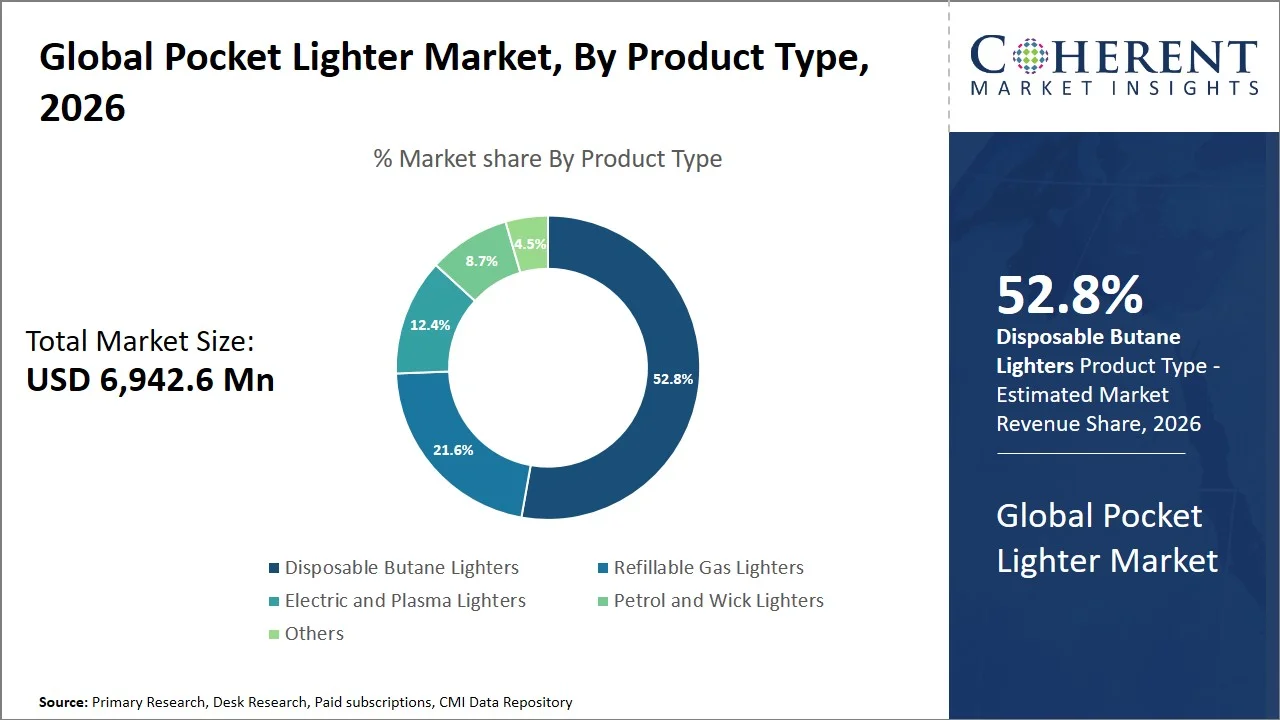
Why Do Disposable Butane Lighters Dominate the Global Pocket Lighter Market?
Disposable butane lighters are expected to hold 52.8% of the global pocket lighter market in 2026 because their prefilled construction removes refilling, charging, and maintenance requirements for users. Low unit prices support impulse and repeat purchases through convenience stores, tobacco outlets, supermarkets, and multipack formats. Standardized tanks, valves, and flame assemblies also allow automated manufacturers to serve large-volume retail programs while controlling packaging and freight costs. Demand extends across smoking, candles, household ignition, and outdoor use. Commercially, suppliers gain from scale but must maintain strict child-resistance testing and traceability to protect retailer access. In February 2024, the U.S. Consumer Product Safety Commission recalled about 62,200 VPR Brands disposable lighters that lacked required child-resistant mechanisms and testing, demonstrating how regulatory qualification directly affects participation in this high-volume segment.
- Current Industry Events of 2026
- Market Size Estimation
- Regional Breakdown
- Competitive Landscape
- Customer Intelligence
- Segmental Analysis
- Pricing Analysis
- Key Market Drivers, Challenges & Future Trends
- Customized Insights Section
Why Does Flint Wheel Ignition Represent the Largest Ignition Mechanism in the Global Pocket Lighter Market?
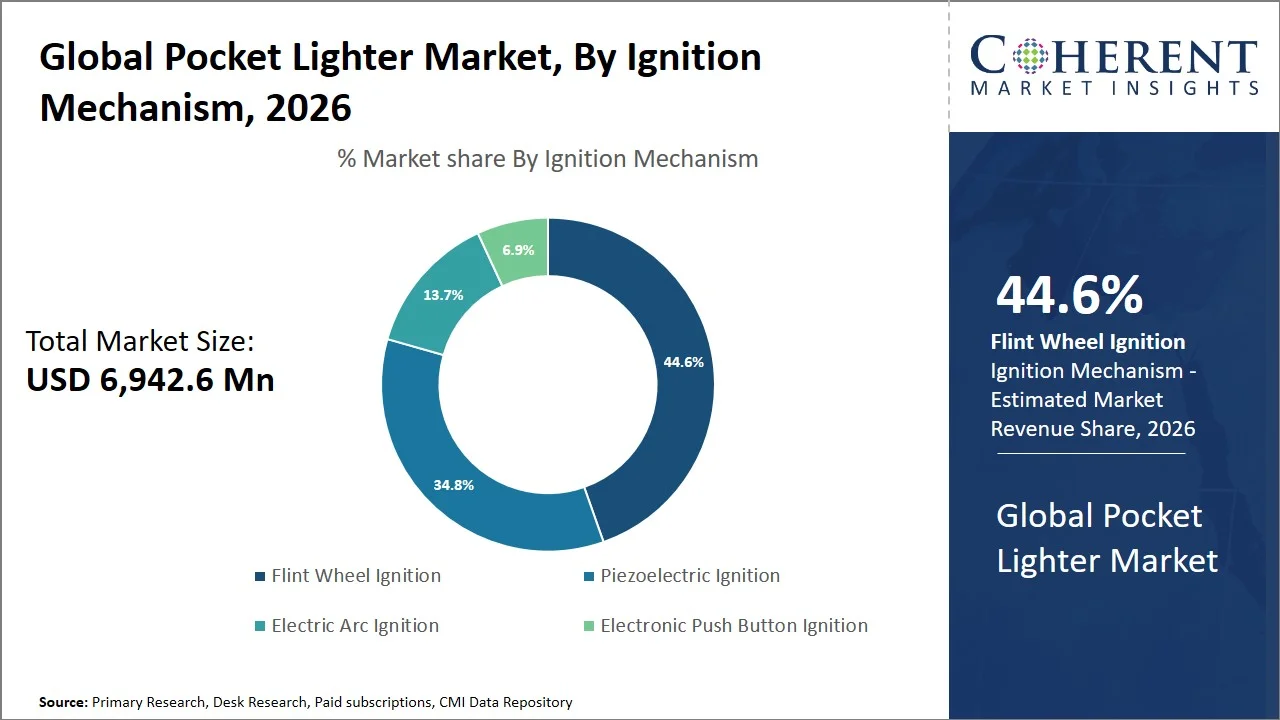
Flint wheel ignition is expected to account for 44.6% of the global pocket lighter market in 2026 because it provides a dependable spark through a compact mechanical assembly without batteries, charging ports, or electronic circuitry. Consumers recognize the wheel-and-lever action, while manufacturers benefit from mature supply chains for ferrocerium flints, spark wheels, springs, valves, and child-resistant guards. The mechanism is compatible with low-cost disposable products, refillable gas models, and metal collectible formats, supporting broad price and retail coverage. Its long storage life is also valuable to wholesalers and convenience retailers managing high-turnover inventories. In November 2024, World Tobacco Middle East listed Weicheng Lighter Manufacture as an exhibitor offering flint spark-wheel lighters within a portfolio supported by annual production capacity of nearly 400 million units, illustrating the industrial scale behind this established ignition technology.
Why Does Plastic Dominate the Material Segment of the Global Pocket Lighter Market?
Plastic is expected to represent 48.7% of the global pocket lighter market in 2026 because molded bodies combine low weight, impact resistance, fuel visibility, color flexibility, and economical large-scale production. Multi-cavity injection molding enables consistent tank geometry while integrating grips, branding surfaces, and structural features with fewer assembly steps. Plastic is especially suited to disposable and mass-market lighters sold through convenience, grocery, promotional, and online channels, where unit cost, packaging density, and transport efficiency shape margins. Resin suppliers and lighter manufacturers can differentiate through heat resistance, thinner-wall engineering, recycled content, and documented material safety. In April 2025, Swedish Match Cricket detailed the production of its Eco lighter body from recycled industrial nylon using extrusion, pelletization, dedicated handling equipment, and injection molding, with capacity exceeding 130 million eco-friendly lighters annually.
Global Pocket Lighter Market Dynamics
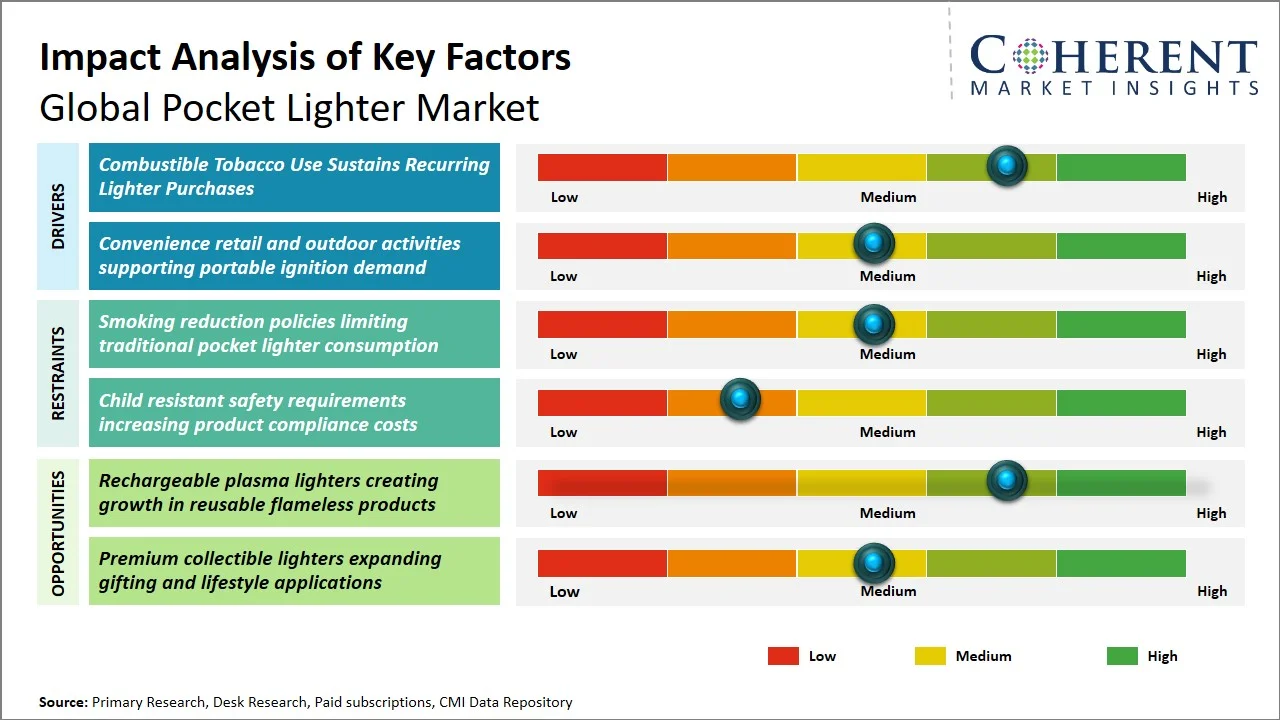
Key Market Drivers
- Combustible Tobacco Use Sustains Recurring Lighter Purchases: Combustible tobacco consumption sustains recurring demand for pocket lighters because users require an inexpensive, portable ignition source that is replaced, refilled, or repurchased frequently. Disposable-lighter producers benefit from high transaction volumes, while refillable brands gain recurring sales of butane, flints, and maintenance accessories. Tobacco shops, convenience chains, wholesalers, and impulse-merchandising distributors also benefit because lighters occupy limited shelf space and complement tobacco purchases at checkout. Commercially, the driver supports broad price architecture across mature consumer markets, but manufacturers must balance volume economics with child-resistance, flame-height, and leak-control requirements. In March 2025, the S. Centers for Disease Control and Prevention reported that 19.8 million adults exclusively smoked cigarettes in 2023, confirming that combustible-product use continues to maintain a sizeable accessory-consumption base.
- Convenience Retail and Outdoor Recreation Broaden Portable Ignition Demand: Convenience retail and outdoor recreation support portable ignition demand by placing pocket lighters close to immediate-use occasions. Convenience stores enable quick replacement purchases, while camping, picnicking, grilling, emergency preparation, and trail use broaden demand beyond tobacco consumption. Retailers benefit from compact displays, multipacks, seasonal assortments, and cross-merchandising with charcoal, candles, camping supplies, and fire-starting products. Manufacturers can capture higher value through wind-resistant flames, protective caps, fuel-level visibility, ergonomic controls, and weather-tolerant housings rather than competing only on unit price. Outdoor-specialty distributors and private-label suppliers gain additional routes to market, although product reliability becomes more important where ignition failure creates safety or usability concerns. In June 2024, the Outdoor Industry Association reported record U.S. outdoor participation and identified camping among activities attracting new casual participants, expanding the addressable base for portable ignition products.
Emerging Market Trends
- Refillable Lighters Gain Share over Single-Use Products: Demand is gradually shifting toward refillable gas and rechargeable electric lighters as consumers seek durable, lower-waste alternatives. This trend supports recurring sales of fuel, flints, charging accessories, and replacement parts, benefiting premium brands and specialist retailers. Additionally, growing environmental awareness and regulatory pressure are encouraging consumers to move away from disposable options. As a result, manufacturers are investing in innovation and design to enhance product longevity and user convenience.
- Pocket Lighters Emerge as Collectible Accessories: Manufacturers are increasing the use of engraving, premium finishes, limited editions, and gift packaging. Customization is strengthening demand across gifting, specialty retail, enthusiast communities, and online channels, while allowing brands to command higher margins than standard utility lighters. Social media and influencer marketing are further amplifying the appeal of collectible designs among younger consumers. This trend is also driving collaborations between lighter brands and lifestyle or fashion labels to create exclusive product lines.
Current Events and their Impact
Current Events | Description and its Impact |
EU General Product Safety Regulation Becomes Applicable – December 2024 |
|
Health Canada Recalls Non-Compliant Reusable Lighters – March 2025 |
|
Regional Insights
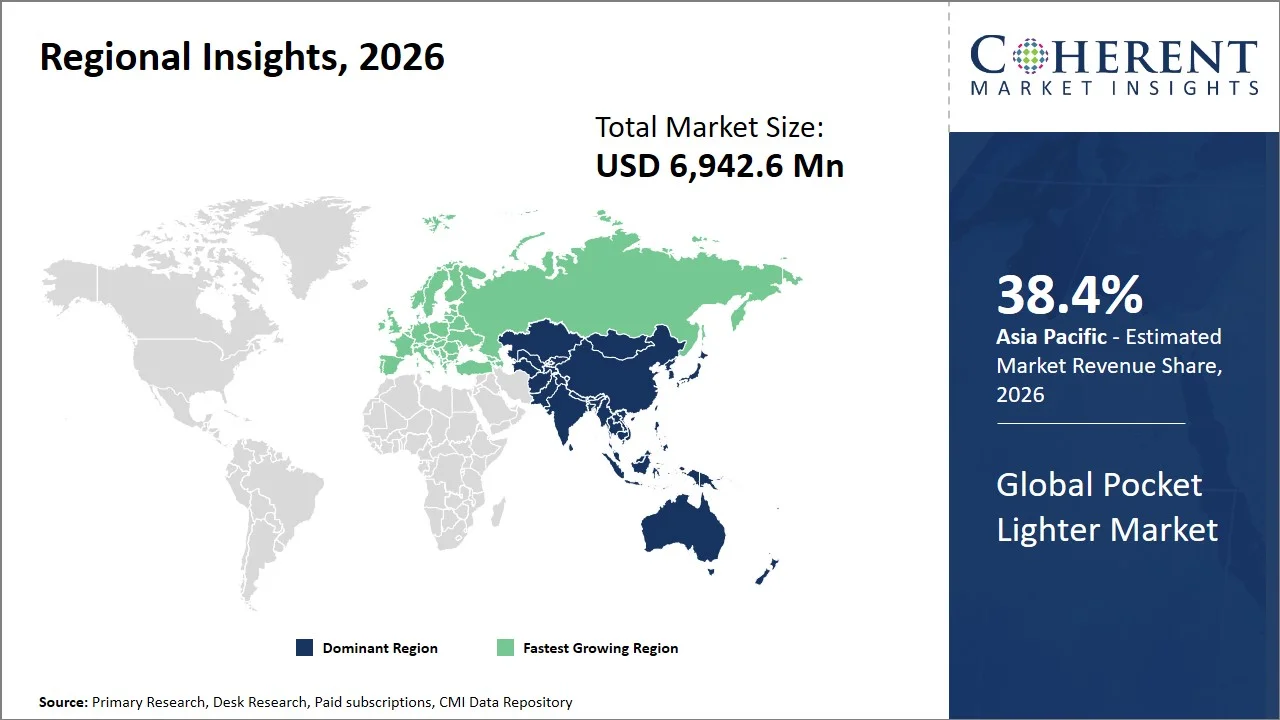
Why Does Asia Pacific Dominate the Global Pocket Lighter Market?
Asia Pacific is expected to account for 38.4% of the global pocket lighter market in 2026 because it combines the largest concentration of disposable-lighter manufacturing with broad price-sensitive consumption. China supplies high-volume plastic bodies, valves, flints, fuel systems, and finished products, while Japan and other regional markets support premium, refillable, and design-oriented formats. Dense convenience retail, tobacco outlets, informal distribution, and expanding online commerce keep products accessible across urban and secondary markets. Regional suppliers also benefit from established hazardous-goods logistics and contract-manufacturing networks that serve international brands. In August 2024, Qiushi Journal Xinhua reported that Shaodong in Hunan produced nearly 70% of the world’s disposable lighters and exported products to more than 120 countries, demonstrating the production scale, local component ecosystem, and export reach underpinning Asia Pacific’s leadership.
Why is Europe Emerging as the Fastest-Growing Region in the Global Pocket Lighter Market?
Europe is expected to hold 25.8% of the global pocket lighter market in 2026 and emerge as the fastest-growing region as buyers shift toward refillable, metal, collectible, and rechargeable products with stronger safety documentation. Specialty tobacconists, gift retailers, premium accessory stores, and cross-border e-commerce platforms support higher-value purchases, while stringent child-resistance and product-traceability requirements reduce access for poorly documented imports. European brands can therefore compete through design heritage, repairability, fuel-system quality, warranties, and limited editions rather than price alone. The continuing use of combustible tobacco also maintains a recurring ignition requirement despite public-health efforts to reduce smoking. In June 2024, the European Commission published Special Eurobarometer 539 on the prevalence and consumption of tobacco and related products, providing updated evidence of the region’s established user base and changing purchasing environment.
Global Pocket Lighter Market Outlook for Key Countries
Why is the U.S. a Key Market for the Global Pocket Lighter Market?
The U.S. is a key country in the global pocket lighter market because it combines a large combustible-tobacco consumer base with substantial demand from camping, grilling, candles, emergency kits, cigar use, and legal adult-use cannabis markets in several states. Convenience stores and tobacco retailers sustain high-volume disposable sales, while specialty cigar shops, outdoor retailers, and direct-to-consumer channels support refillable torch, windproof, electric, and collectible models. Suppliers must satisfy federal child-resistance rules, product-liability expectations, fuel-transport requirements, and retailer testing standards, creating advantages for established brands and compliance-ready importers. The scale of national tobacco-use monitoring illustrates the continued commercial relevance of ignition accessories. In July 2025, the Substance Abuse and Mental Health Services Administration published its 2024 National Survey on Drug Use and Health report, including updated U.S. indicators for tobacco use and smoking behavior.
Why Does China Support Growth in the Global Pocket Lighter Market?
China supports growth in the global pocket lighter market through an integrated manufacturing system covering plastic molding, metal stamping, valve production, flint assemblies, gas filling, printing, packaging, testing, and export logistics. Clusters such as Shaodong allow manufacturers to source most components locally, shorten development cycles, and handle orders ranging from basic disposable products to windproof and multifunctional designs. Automation is becoming commercially important as producers seek to preserve low unit costs while improving flame consistency, leak detection, and international compliance. Domestic e-commerce and wholesale networks also provide a large testing ground for new colors, formats, and price points before export expansion. In April 2025, the Hunan provincial government reported that more than 60% of Shaodong lighter manufacturers had completed or were undertaking automation upgrades, supporting higher productivity and more stable product quality.
Why is Germany a Strategic Country in the Global Pocket Lighter Market?
Germany is a strategic country in the global pocket lighter market because its consumers and retailers place strong emphasis on product reliability, durable construction, controlled flame performance, and regulatory conformity. The market supports disposable products through convenience and tobacco outlets, but it is particularly relevant for refillable metal, premium, cigar, and collectible lighters sold through specialty stores and online channels. German trade fairs and distributors also provide access to wider European buyers, making the country an important launch and validation market for international suppliers. Strict expectations regarding child resistance, labeling, traceability, and hazardous-goods handling favor manufacturers with established testing and documentation systems. In October 2025, Germany’s Federal Statistical Office reported that 24% of the German population aged 15 years and over smoked in 2023, confirming a sizeable underlying user base for conventional ignition accessories.
Why is Mexico an Important Market for the Global Pocket Lighter Market?
Mexico is an important market for pocket lighters because combustible-tobacco use remains concentrated in large urban and metropolitan populations served by extensive convenience-store, supermarket, street-retail, and tobacco-shop networks. Affordable disposable and refillable gas lighters fit the country’s price-sensitive purchasing patterns, while tourism, outdoor cooking, candles, and household use broaden demand beyond smoking. Proximity to the U.S. supports cross-border brand awareness and distribution, although importers must manage customs classification, safety verification, Spanish labeling, and retailer requirements. Suppliers that combine accessible pricing with dependable valves and child-resistant ignition can build stronger relationships with national chains and wholesalers. In May 2024, Nuevo León’s health authority cited Mexico’s GATS 2023 results showing that 14.3 million adults smoked tobacco, providing a direct indication of the continuing addressable base for portable ignition products.
Why is Brazil an Important Growth Market for the Global Pocket Lighter Market?
Brazil is an important growth market for the global pocket lighter market because its large urban population, convenience retail base, tobacco shops, supermarkets, and informal sales channels create wide distribution for low-cost ignition products. Disposable plastic lighters remain relevant for everyday purchases, while refillable and decorative formats gain opportunities through cigar stores, gift retailers, e-commerce, barbecue use, candles, and outdoor leisure. Domestic tobacco production and an established smoking population support recurring demand, although high import duties, customs procedures, safety requirements, and income sensitivity influence pricing and sourcing decisions. Local distributors with regional warehousing can therefore outperform import-only sellers with long replenishment cycles. Brazil represents a high-potential growth market for pocket lighters due to its large consumer base, extensive convenience-retail network, established tobacco consumption, and rising demand for refillable, decorative, barbecue, candle-lighting, and outdoor-use products. In April 2026, Brazil’s National Cancer Institute updated its tobacco data page, reporting that Vigitel 2023 measured adult smoking prevalence of 9.3% across state capitals and the Federal District.
Technology Adoption Landscape in the Global Pocket Lighter Market
Technology | Adoption Level | Key Application Area | Business Impact |
Child-resistant ignition interlocks and shielded spark wheels | High | Disposable and refillable flame-producing lighters | Restrict operation by young children and support conformity with major consumer-safety standards. |
Automated butane filling and inline leak testing | High | High-volume gas-lighter production | Improves filling consistency, detects defective tanks or valves, and reduces fire, recall, and fuel-loss exposure. |
Piezoelectric spark-generation modules | High | Push-button refillable and torch lighters | Provides repeatable ignition without replaceable flints and supports ergonomic one-action operation. |
Constant-flow valves and pressure-stable fuel regulation | Medium | Premium gas, torch, and outdoor lighters | Maintains more consistent flame height across changing fuel levels and operating conditions. |
Rechargeable dual-arc and plasma ignition systems | Medium | Wind-resistant electric pocket lighters | Removes combustible fuel requirements and enables reusable products for household and outdoor applications. |
Machine-vision flame and assembly inspection | Medium | Flame-height testing, valve positioning, body sealing, and component verification | Identifies production variation earlier, improves batch consistency, and strengthens documented quality assurance. |
How are Compliance-Ready Private-Label Programs Creating New Opportunities in the Global Pocket Lighter Market?
Compliance-ready private-label programs represent an underdeveloped growth opportunity in the global pocket lighter market. Convenience chains, supermarkets, outdoor retailers, hospitality suppliers, promotional-product distributors, and regional wholesalers can use exclusive lighter ranges to improve margins and differentiate shelf assortments, but many lack the technical capability to manage ignition safety, child resistance, fuel containment, labeling, and country-specific documentation. Manufacturers can capture this opportunity by offering certified product platforms with configurable colors, packaging, flame types, order quantities, and traceable production records. Commercial success will require in-house testing, audited component suppliers, multilingual regulatory files, rapid artwork approval, and dependable hazardous-goods logistics. Digital portals for compliance certificates, batch tracking, and reorder management could further reduce buyer risk. The opportunity is likely to favor vertically integrated OEM and ODM suppliers that combine molding, valve assembly, filling, inspection, and packaging, while specialist compliance firms can support smaller entrants. Suppliers should avoid excessive customization that compromises standardized safety validation or creates uneconomic SKU complexity.
Market Players, Key Development, and Competitive Landscape
Key Developments
- In August 2025, Quality Importers Trading Company expanded the XIKAR Hedron lighter into nationwide wholesale and retail distribution following an earlier online introduction. The product combines a central jet flame with surrounding soft flames. This is important for the global pocket lighter market because hybrid ignition formats allow premium suppliers to differentiate flame performance while using broader physical and digital distribution to scale specialist products.
- In June 2025, Les Fines Lames expanded its premium lighter portfolio with the Le Feu RS, a refillable flat-flame model offered through its website and cigar stores in multiple finishes. This move aids the global pocket lighter market because purpose-designed flame geometry, compact metal construction, and specialty-channel availability support premiumization beyond conventional single-jet and soft-flame products.
- In April 2024, Lotus Group began shipping four new lighter models to retail stores, including triple-torch, single-torch, portable, and desktop products across its Lotus and Vertigo brands. This is important for the global pocket lighter market because a multi-tier product rollout enables suppliers to address different budgets, carrying preferences, and flame requirements while improving retailer assortment breadth through one vendor relationship.
Competitive Landscape
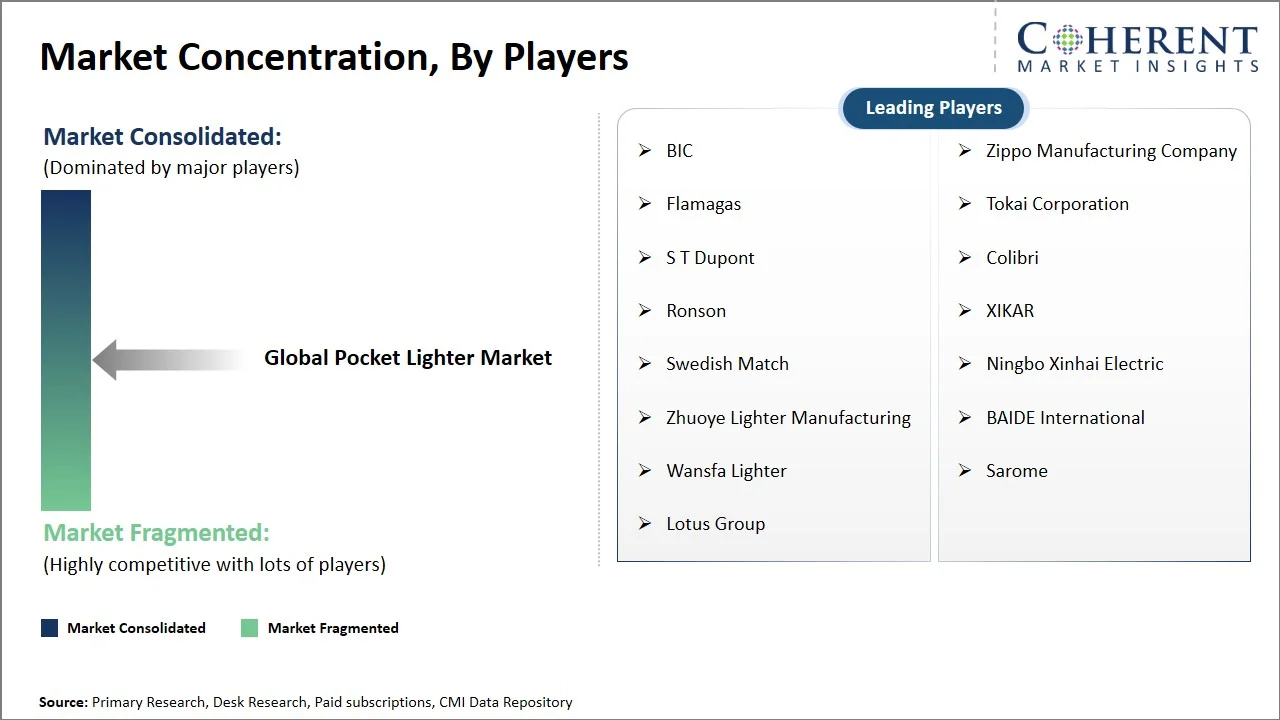
The global pocket lighter market is fragmented at the regional manufacturing and private-label levels but contains established international brands across disposable, refillable, electric, and luxury formats. Competitors include high-volume plastic-lighter manufacturers, specialist gas-lighter producers, premium metal-accessory houses, electric-lighter brands, OEMs, and regional importers. Competition centers on safety conformity, ignition dependability, production economics, retail availability, product appearance, and the ability to manage regulated fuel-product logistics.
Key focus areas include
- Ignition and fuel-system reliability: Stable flames, effective shutoff, valve integrity, and leak resistance directly influence retailer confidence.
- Safety and regulatory documentation: Child-resistance testing, labeling, technical files, and traceability determine access to regulated markets.
- Manufacturing economics: Automated molding, filling, assembly, and testing support competitive pricing and dependable large-volume supply.
- Retail and distributor relationships: Shelf placement, replenishment speed, display formats, and regional wholesaler coverage affect market reach.
- Private-label capabilities: Flexible packaging, finishes, minimum order quantities, and compliance-ready platforms attract large retail accounts.
- Premium product differentiation: Metal construction, flame architecture, engraving, finish quality, and warranties support higher price realization.
- Hazardous-goods logistics: Fuel-filled lighter transportation, warehousing, and customs management can create barriers for smaller suppliers.
- Component supply resilience: Reliable access to valves, flints, ignition modules, resins, seals, and electronic cells protects production continuity.
Market Report Scope
Pocket Lighter Market Report Coverage
| Report Coverage | Details | ||
|---|---|---|---|
| Base Year: | 2025 | Market Size in 2026: | USD 6,942.6 Mn |
| Historical Data for: | 2020 To 2024 | Forecast Period: | 2026 To 2033 |
| Forecast Period 2026 to 2033 CAGR: | 4.80% | 2033 Value Projection: | USD 9,639.4 Mn |
| Geographies covered: |
| ||
| Segments covered: |
| ||
| Companies covered: | BIC, Zippo Manufacturing Company, Flamagas, Tokai Corporation, S T Dupont, Colibri, Ronson, XIKAR, Swedish Match, Ningbo Xinhai Electric, Zhuoye Lighter Manufacturing, BAIDE International, Wansfa Lighter, Sarome, and Lotus Group | ||
| Growth Drivers: |
| ||
| Restraints & Challenges: |
| ||
Analyst Expert (Analyst Opinion)
- Upstream manufacturing is likely to consolidate even while consumer-facing brands remain fragmented. Fuel-system precision, hazardous-goods handling, testing infrastructure, and multinational certification create scale advantages that smaller factories may struggle to replicate. Large OEMs could become shared production platforms for multiple brands, leaving design, merchandising, and channel positioning as the primary areas of customer-facing differentiation.
- Automated compliance screening by marketplaces and large retailers could materially reduce the visibility of undocumented, low-priced lighter listings. Machine-readable test records, responsible-operator details, batch identification, and standardized warning information may become prerequisites for digital distribution. Suppliers without structured product data could lose access rapidly, while compliance-led manufacturers and authorized distributors gain greater control over online assortment quality.
- Manufacturers should prioritize valve precision, fuel containment, dependable ignition modules, dual sourcing of critical components, and region-specific technical documentation. Pricing strategies must account for retailer promotions and hazardous-goods freight without weakening quality controls. Companies should avoid excessive investment in toy-like designs, fragile decorative components, or unserviceable electronic formats that create regulatory, warranty, or inventory exposure without delivering clear user value.
Speak to the analyst
Want personalized insights?
Take the findings above to one of our principal consultants, or have the report rebuilt around the segments, geographies and competitors you actually track.
Market Segmentation
- Product Type Insights (Revenue, USD Mn, 2021 - 2033)
- Disposable Butane Lighters
- Refillable Gas Lighters
- Electric and Plasma Lighters
- Petrol and Wick Lighters
- Others
- Ignition Mechanism Insights (Revenue, USD Mn, 2021 - 2033)
- Flint Wheel Ignition
- Piezoelectric Ignition
- Electric Arc Ignition
- Electronic Push Button Ignition
- Material Insights (Revenue, USD Mn, 2021 - 2033)
- Plastic
- Metal
- Composite Materials
- Others
- Distribution Channel Insights (Revenue, USD Mn, 2021 - 2033)
- Convenience and Tobacco Stores
- Supermarkets and Hypermarkets
- Online Retail
- Specialty and Gift Stores
- Others
- Regional Insights (Revenue, USD Mn, 2021 - 2033)
- North America
- U.S.
- Canada
- Latin America
- Brazil
- Argentina
- Mexico
- Rest of Latin America
- Europe
- Germany
- U.K.
- Spain
- France
- Italy
- Russia
- Rest of Europe
- Asia Pacific
- China
- India
- Japan
- Australia
- South Korea
- ASEAN
- Rest of Asia Pacific
- Middle East
- GCC Countries
- Israel
- Rest of Middle East
- Africa
- South Africa
- North Africa
- Central Africa
- North America
- Key Players Insights
- BIC
- Zippo Manufacturing Company
- Flamagas
- Tokai Corporation
- S T Dupont
- Colibri
- Ronson
- XIKAR
- Swedish Match
- Ningbo Xinhai Electric
- Zhuoye Lighter Manufacturing
- BAIDE International
- Wansfa Lighter
- Sarome
- Lotus Group
Source
Primary Research Interviews
- Pocket lighter and ignition-device manufacturers
- Suppliers of butane, valves, flints, piezoelectric modules, plastics, metals, batteries, and packaging
- Product development, manufacturing, quality, procurement, compliance, sales, and distribution executives
- OEMs, ODMs, private-label producers, wholesalers, retailers, tobacco stores, and e-commerce platforms
- Safety-testing laboratories, customs specialists, and consumer-product compliance professionals
Stakeholders
- Disposable, refillable, electric, plasma, petrol, and collectible lighter brands
- Fuel, ignition-component, body-material, and packaging suppliers
- Contract manufacturers and private-label producers
- Convenience stores, tobacco retailers, supermarkets, specialty shops, wholesalers, and online marketplaces
- Smokers, outdoor users, households, gift buyers, collectors, and hospitality operators
End-use Sectors
- Tobacco and smoking accessories
- Household candles, stoves, fireplaces, and emergency use
- Camping, hiking, barbecuing, and outdoor recreation
- Hospitality, culinary, ceremonial, gifting, and collectible applications
- Promotional merchandise and institutional procurement
Regulatory & Government Bodies
- U.S. Consumer Product Safety Commission
- U.S. Customs and Border Protection
- European Commission
- Health Canada
- Bureau of Indian Standards
- China State Administration for Market Regulation
- Japan Consumer Affairs Agency
- Brazil National Institute of Metrology, Quality and Technology
- National consumer-safety, customs, hazardous-goods, labeling, and fire-safety authorities
Databases
- UN Comtrade
- ITC Trade Map
- WTO Statistics
- USITC DataWeb
- Eurostat and EU PRODCOM
- World Bank and OECD databases
- National trade, manufacturing, retail, tobacco-use, and consumer-expenditure databases
- SEC EDGAR and company stock-exchange filings
Magazines and Journals
- Tobacco Reporter
- Cigar Aficionado
- Convenience Store News
- CSP Daily News
- Packaging World
- Plastics Technology
- Journal of Consumer Product Safety
- Fire Technology
- Journal of Retailing and Consumer Services
Associations
- National Association of Convenience Stores
- Consumer Brands Association
- International Organization for Standardization
- European Committee for Standardization
- Outdoor Industry Association
- National tobacco-retailer, consumer-product, plastics, packaging, and retail associations
Public Domain Sources
- U.S. Consumer Product Safety Commission
- European Commission
- Health Canada
- Bureau of Indian Standards
- National customs, consumer-protection, fire-safety, and product-certification agencies
- Company annual reports, product catalogues, safety data sheets, technical documents, and official press releases
Key Standards and Regulations
- ISO 9994 safety requirements for lighters
- ISO 22702 safety requirements for utility lighters
- Child-resistant lighter regulations
- Flame-height, fuel-containment, leak-resistance, and ignition-cycle testing requirements
- EU General Product Safety Regulation
- U.S. consumer-product safety and hazardous-material transportation requirements
- Country-specific quality-control orders, labeling, customs, packaging, and import-certification rules
Proprietary Elements
- CMI Data Analytics Tool, Proprietary CMI Existing Repository of information for last 10 years.
Get access to 250+ pages report
Every segment, forecast, competitor profile and data table behind the analysis above — available for instant download.
- ESOMAR Member
- ISO 9001:2015 Certified
- D-U-N-S Registered
- GDPR & CCPA Compliant
Missing comfort of reading report in your local language? Find your preferred language:
Transform your Strategy with Exclusive Trending Reports
Frequently Asked Questions
The CAGR of the global pocket lighter market is projected to be 4.80% from 2026 to 2033.
The global pocket lighter market is estimated to be valued at USD 6,942.6 million in 2026 and is expected to reach USD 9,639.4 million by 2033.
Flint wheel ignition leads the market because of its simple design, low manufacturing cost, dependable operation, and compatibility with disposable and refillable lighters.
Plastic is the leading material due to its lightweight construction, molding flexibility, low production cost, and suitability for high-volume disposable lighter manufacturing.
Refillable formats, electric arc ignition, premium collectible designs, child-resistant mechanisms, improved fuel-flow control, and greater use of recycled materials are shaping product development.
Smoking accessory consumption sustaining disposable and refillable lighter sales and convenience retail and outdoor activities supporting portable ignition demand are the major factors driving the growth of the global pocket lighter market.
Smoking reduction policies limiting traditional pocket lighter consumption and child resistant safety requirements increasing product compliance costs are the major factors hampering the growth of the global pocket lighter market.