Schedule a meeting with report Author
POLYLACTIC ACID MARKET SIZE AND SHARE ANALYSIS - GROWTH TRENDS AND FORECASTS (2025-2032)
Polylactic Acid Market, By Raw Material (Corn starch, Sugarcane, Cassava, and Others), By Application (Rigid thermoform, Film & sheets, Bottles, and Others), By End-use (Packaging, Agriculture, Automotive & transportation, Electronics, Textile, Consumer goods, and Others), By Geography (North America, Latin America, Asia Pacific, Europe, Middle East, and Africa)
- Published In : 16 Dec, 2025
- Code : CMI7098
- Page number : 132
- Formats :
Excel and PDF
- Industry : Polymers and Resins
- Historical Range : 2020 - 2024
- Base Year : 2025
- Estimated Year : 2026
- Forecast Period : 2025-2032
Polylactic Acid Market Size and Trends: 2025 to 2032
The polylactic acid market is estimated to be valued at USD 998.2 Mn in 2025 and is expected to reach USD 3,257.9 Mn by 2032, exhibiting a compound annual growth rate (CAGR) of 18.4% from 2025 to 2032.
Key Takeaways
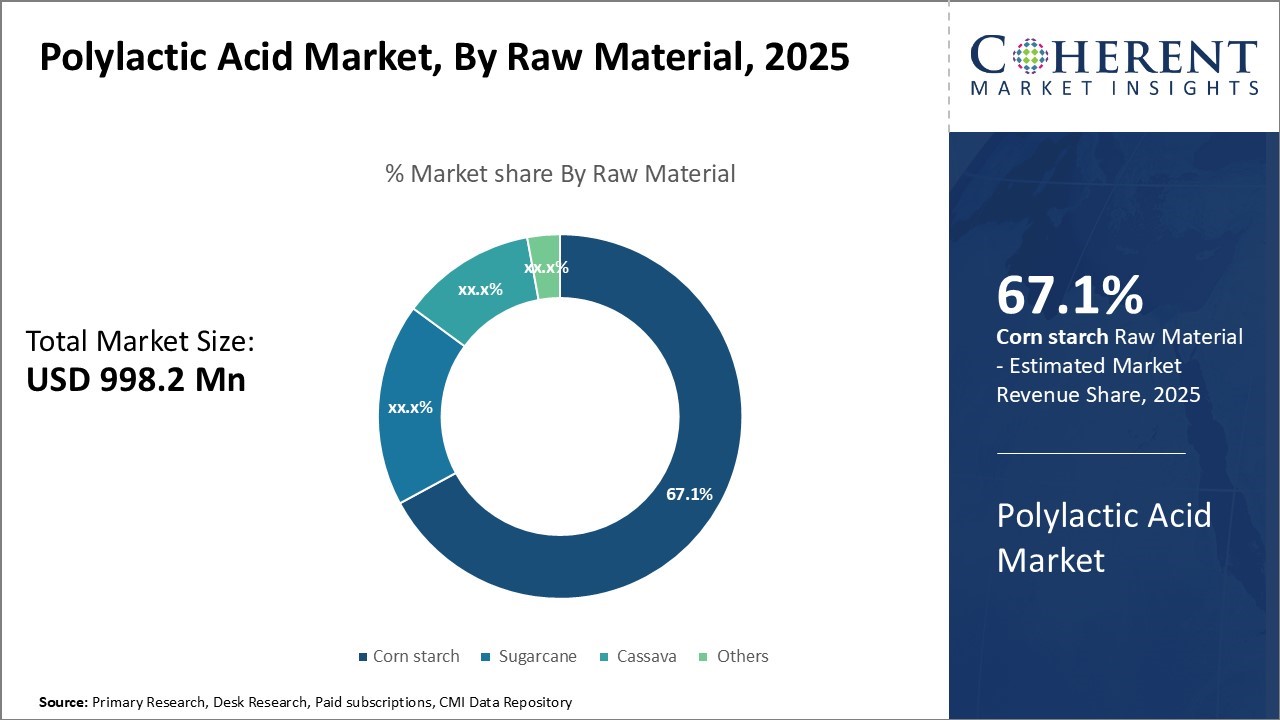
- Based on Raw Material, the Corn Starch segment is expected to lead the market with 67.1% share in 2025, driven by abundance, low cost, and regulatory support.
- Based on Application, the Rigid Thermoforms segment is expected or hold 32.8% share in 2025, driven by versatile, food‑safe, sustainable packaging.
- Based on End-use, the Packaging segment is projected to accounted 40.4% share of the market in 2025, driven by sustainability, regulations, and brand adoption.
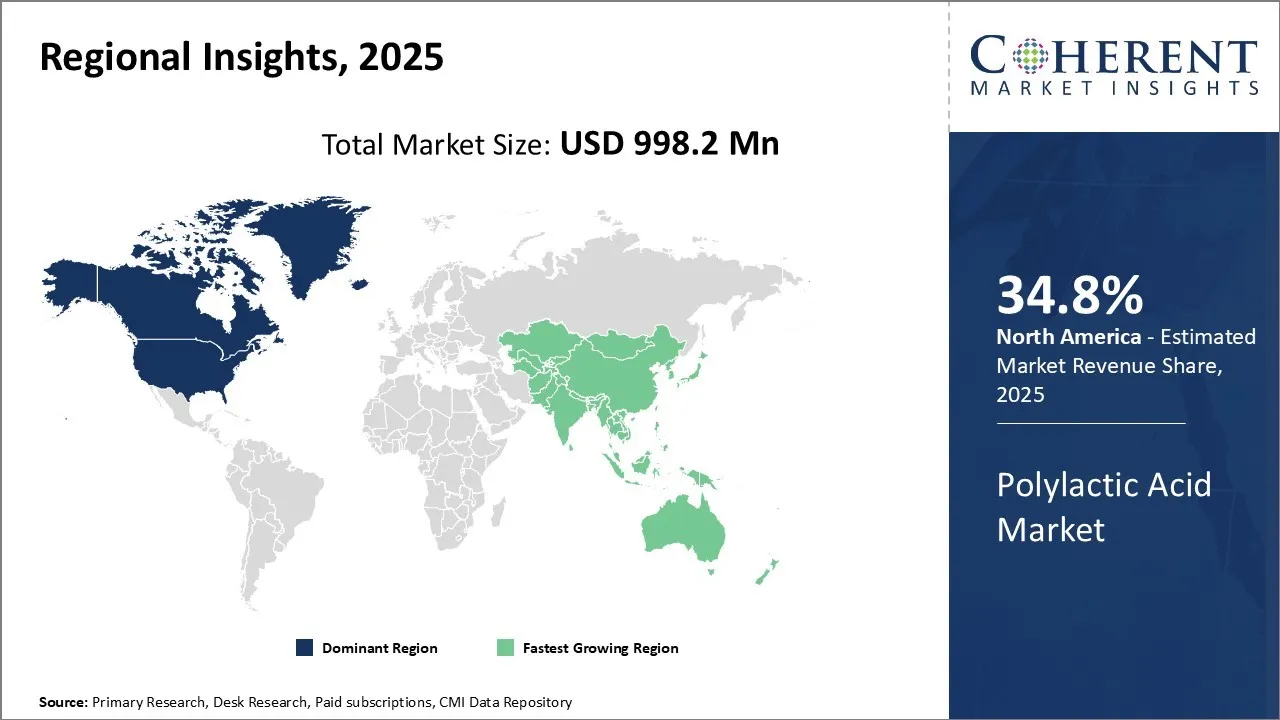
- Based on Region, the North America is set to lead the polylactic acid market with 34.8% share in 2025. While, Asia Pacific is anticipated to be the fastest growing region.
Market Overview
The growth of the polylactic acid market is driven by the increasing demand for biodegradable and sustainable polymers from various end-use industries like packaging, textiles, and agriculture. Polylactic acid (PLA) is widely being adopted as it is made from renewable raw materials such as corn, sugarcane, or social plants making it a viable alternative to conventional plastics which are typically derived from petroleum. Moreover, the biodegradable nature and compostable characteristic of PLA have resulted in growing demand from the packaging industry for food packaging, disposable utensils, and coated paper products. Strict government regulations regarding the use of plastics along with rising environmental awareness among consumers are further expected to propel the Polylactic acid (PLA) market growth during the forecast period.
Current Events and Its Impacts on the Polylactic Acid Market
|
Current Event |
Description and its Impact |
|
EU Single-Use Plastics Directive and Global Plastic Bans |
|
|
Agricultural Raw Material Supply Chain Disruptions |
|
Uncover macros and micros vetted on 75+ parameters: Get instant access to report
Technology and Innovation in Polylactic Acid Market
- Food Waste to PLA: Companies like Sulzer & TripleW are scaling PLA production from food waste‑derived lactic acid.
- PLA Foams: TotalEnergies Corbion & USEON launched PLA foam technology as a replacement for EPS.
- PLA Fabrics: Acme Mills introduced Natura PLA fabrics, reducing GHG emissions by up to 75% vs PET.
- PLA Recycling: Chemical recycling methods are emerging to depolymerize PLA back into lactic acid for reuse.
Polylactic Acid Market, Insights By Raw Material - Expanding bioplastics industry drives demand
In terms of raw material, corn starch is expected to contributes 67.1% share of the market in 2025, owing to its abundant availability and cost-effectiveness. Being one of the most widely produced agricultural commodities globally, corn provides a sustainable and affordable feedstock for PLA production. The growth of bioplastics as an environment-friendly alternative to petroleum-based plastics has significantly boosted the demand for corn starch-based PLA. Regulatory support for degradable plastics in packaging and other applications has also propelled the corn starch segment. Advancements in fermentation and separation technologies have further enhanced the efficiency of extracting PLA monomer from corn, reducing production costs. Looking ahead, the rapid expansion of bioplastics across industries will continue augmenting the consumption of corn starch for PLA manufacturing.
For instance, in January 2025, Researchers have made a new type of fully biodegradable material from corn starch that can be used in packaging and other places instead of traditional plastics like PLA. The new idea uses renewable corn resources to create eco-friendly, long-lasting options that meet the growing demand for biodegradable polymers in the Polylactic Acid market.
Polylactic Acid Market, Insights By Application - Rigid thermoform packaging drives growth
In terms of application, rigid thermoform is expected to contributes 32.8% share of the market in 2025, due to its versatility and compatibility with thermoforming process. PLA is widely used for producing rigid clamshell containers, cups, trays, and other thermoformed food packaging. Its mechanical properties comparable to PET make it a cost-effective replacement for petro-based plastics. Compliance with food contact regulations further expands the utility of PLA in rigid packaging. Increased preference for environment-friendly alternatives and demand for sustainable food packaging present lucrative prospects.
For instance, in December 2025, Emirates Biotech launched its Embio PLA biopolymer range in Dubai, targeting rigid and flexible packaging, appliances, electronics, 3D printing, fibres, and non‑wovens. The company aims to expand renewable, compostable plastics in the Middle East, offering smaller volumes and faster lead times to support sustainable rigid thermoform packaging solutions.
Polylactic Acid Market, Insights By End use - Sustainable packaging attracts brands
In terms of end-use, packaging is expected to contribute 40.4% share in 2025, owing to the remarkable uptake of PLA among brand owners. Growing consumer demand for sustainable and degradable substitutes to petroleum-based plastics has prompted top brands to switch to PLA packaging. Furthermore, regulatory push for eco-friendly options in different packaging applications and bans on single-use plastics augur well for PLA adoption. Advanced barrier properties allow PLA films to replace conventional materials for flexible packaging as well. Commitment of leading food and consumer goods companies toward sustainability also drives the incorporation of PLA in their portfolios. PLA film's compatibility with existing printing and coating lines facilitates seamless integration.
For instance, in July 2025, Balrampur Chini Mills unveiled BioYug, India’s first fully integrated PLA plant using sugarcane feedstock. The facility will produce biodegradable biopolymers for packaging, textiles, and consumer goods, supporting India’s sustainability drive. BioYug marks a major step toward reducing single‑use plastics and advancing compostable packaging solutions in the country.
Regional Insights
To learn more about this report, Download Free Sample
North America Polylactic Acid Market Analysis & Trends
North America has established itself as the dominant regional market for polylactic acid globally. The region is expected to account for 34.8% of the market share in 2025. With countries like the U.S. and Canada having developed chemical industries, there is strong demand as well as supply of polylactic acid in the region. The industry has witnessed significant investments from major players looking to establish or expand their production capacities. This ensures stability and security in supply. Being an early adopter of sustainable practices and bioplastics, there is widespread acceptance and use of polylactic acid among brand owners, retailers as well as consumers. Stringent environmental regulations complement the use of biodegradable and compostable materials like polylactic acid.
Several application sectors like packaging, textiles, and consumer goods are well established and contribute to the regional consumption. Another key factor for the regional leadership is the presence of specialized polylactic acid resin producers and technology players. This allows for the continuous product development and customization of grades for various application needs. It also offers opportunities for technical collaboration and further commercialization of polylactic acid materials.
For instance, in December 2024, Acme Mills, based in Michigan, USA, launched Natura, a biobased PLA fabric line made from renewable corn starch and sugarcane. The biodegradable fabrics target packaging, automotive, healthcare, and filtration industries, meeting FDA food safety standards. Natura reduces greenhouse gas emissions by up to 75% compared to petroleum‑based plastics.
Asia Pacific Polylactic Acid Market Analysis & Trends
The Asia Pacific region has emerged as the fastest growing market for polylactic acid globally. Countries like China, India, Indonesia, and Taiwan are expected to be the major contributors to the regional demand. Expanding middle class, growing consumption patterns as well as massive industrialization drives the market growth. Rapid urbanization and development of packaging, food services and agriculture industries augment the consumption. Proximity to raw material sources and access to skilled but relatively inexpensive workforce provide competitive advantages for establishments. Investments continue to pour in for setting up integrated bioplastics production facilities, thereby securing supplies.
Additionally, regional trade agreements and economic corridors are encouraging collaborations as well as exchanges between key industry stakeholders across the value chain. This helps in overcoming infrastructural and logistic barriers while ensuring availability. With continued efforts on technological advancements and innovations, Asia Pacific is increasingly recognized as an important hub for global bioplastics trade including polylactic acid.
For instance, in July 2025, Futerro has inaugurated China’s first fully integrated PLA plant in Zhuhai, Guangdong. The facility spans the entire value chain from lactic acid to PLA polymerization and recycling, producing biodegradable bioplastics for packaging, textiles, and consumer goods. The project advances circular economy goals with closed‑loop chemical recycling of PLA.
Polylactic Acid Market Outlook Country-Wise
The U.S. Polylactic Acid Market Trends
The U.S. PLA market in 2025 is growing due to strong demand for eco‑friendly packaging, textiles, automotive, and medical products. Rising consumer awareness, stricter regulations on single‑use plastics, and innovations in bioplastics drive adoption. PLA’s biodegradability and renewable feedstock base make it a preferred sustainable alternative across industries.
For instance, in April 2025, TotalEnergies Corbion and USEON have partnered to launch eco‑friendly PLA foam technology, combining Dutch biopolymer expertise with Chinese extrusion machinery. The innovation enables lightweight, compostable foams for packaging, food service, and consumer goods. This collaboration advances circular economy goals, offering a sustainable alternative to petroleum‑based foams like EPS.
China Polylactic Acid Market Trends
The PLA market in China in 2025 is driven by strong demand for sustainable packaging, 3D printing, and healthcare applications. Rising consumer awareness, government restrictions on single‑use plastics, and innovation in bioplastics boost adoption. Domestic supply expansion and renewable feedstocks make PLA a preferred eco‑friendly alternative across industries.
For instance, in December 2025, The 11th International Conference on Bio‑based and Biodegradable Materials in Beijing spotlighted PLA innovations. Global experts, including TotalEnergies Corbion, presented advances in scalable production, processing, and recycling. The event underscored China’s growing role in bioplastics, positioning PLA as central to sustainable packaging, textiles, and circular economy strategies worldwide.
Market Report Scope
Polylactic Acid Market Report Coverage
| Report Coverage | Details | ||
|---|---|---|---|
| Base Year: | 2024 | Market Size in 2025: | USD 998.2 Mn |
| Historical Data for: | 2020 To 2024 | Forecast Period: | 2025 To 2032 |
| Forecast Period 2025 to 2032 CAGR: | 18.4% | 2032 Value Projection: | USD 3,257.9 Mn |
| Geographies covered: |
|
||
| Segments covered: |
|
||
| Companies covered: |
TotalEnergies Corbion bv, NatureWorks LLC, JIANGSU SUPLA BIOPLASTICS CO., LTD., Futerro, COFCO, Jiangxi Keyuan Biopharm Co.,Ltd., Shanghai Tong-jie-liang Biomaterials Co.,LTD., Zhejiang Hisun Biomaterials Co., Ltd., BASF SE, Danimer Scientific, Mitsubishi Chemical America, Inc., UNITIKA LTD., Sulzer Ltd., Weforyou, Polysciences Inc., Musashino Chemical Laboratory Ltd., BEWiSynbra Group, Esun, and Danimer Scientific |
||
| Growth Drivers: |
|
||
| Restraints & Challenges: |
|
||
Uncover macros and micros vetted on 75+ parameters: Get instant access to report
Environmental concerns driving the use of PLA
The growing environmental consciousness across the globe is positively impacting the use of eco-friendly materials. With sustainability becoming a priority, there is an increasing preference for biodegradable and compostable alternatives to reduce dependency on oil-based plastic materials. Polylactic acid is biodegradable in nature and provides a renewable solution made from annually renewable resources like corn. As people become more aware of the environmental damage caused by single-use plastic items that chokes landfills and oceans, the demand for bioplastics is likely to rise. The biodegradability of PLA makes it an attractive option for various packaging applications like food packaging, bottles, containers, etc. Manufacturers in the food and beverage industry are understandably under pressure to switch to sustainable packaging choices. This represents a massive opportunity for PLA to penetrate the packaging market and become the material of choice.
Moreover, legislation banning certain single-use plastic products is anticipated in many countries which will further propel the need for alternatives. PLA being a drop-in replacement for petroleum-based plastics facilitates smooth transition. Stricter environmental policies focusing on waste reduction and promotion of renewables will create a conducive environment for natural biopolymers. Growing eco-consciousness and sustainability driven strategies adopted by corporates are expected to drive preferred usage of PLA over conventional plastics in the coming years
Rise of 3D printing industry spurring PLA demand
The exponential growth of 3D printing industry has opened up new application areas for PLA. 3D printing filaments predominantly use Acrylonitrile Butadiene Styrene (ABS) and PLA raw materials. However, PLA is gaining higher traction owing to properties better suited for desktop 3D printers. Its biodegradable nature makes it safe to use and more environment-friendly than ABS.
PLA provides high dimensional stability and strength required for most basic 3D print applications. It offers users advantages like low warp, easy printability and lower chamber temperature requirements compared to ABS. This has made it the most used thermoplastic for desktop 3D printing currently. With personal 3D printers becoming a common home appliance, more users are opting for PLA.
Market Opportunities: Research & Development of New Application Areas
Research and development of new application areas for polylactic acid offers significant potential for growth in the global market. As sustainability concerns rise around the world, consumers and industries are increasingly seeking out biodegradable and eco-friendly alternatives to traditional plastic products. Polylactic acid, being a bioplastic derived from renewable plant sources such as corn starch or sugarcane, provides a versatile option. However, to achieve wider adoption, further innovations are needed to expand its use into new sectors.
Analyst Opinion (Expert Opinion)
- Increasingly, polylactic acid (PLA) is being used in packaging, compostable disposables, 3D printing, textiles, and medical uses. Most of the production happens in Asia-Pacific, where there is about 490,000 tonnes of installed capacity. Large integrated facilities like the Rayong, Thailand plant make about 75,000 tonnes. This concentration in one area makes sure that supplies are safe and helps exports to Europe and North America.
- Packaging is still the most common end use by volume. This is owing to government rules and commitments to sustainability that favor compostable options. The medical part is growing because PLA is biocompatible and can be used in resorbable sutures, implants, and drug-delivery systems. 3D printing also keeps driving demand for high-value, low-volume products, with PLA making up the majority of global filament shipments.
- Lactic acid and lactide production, the availability of feedstocks, and vertical integration all have an effect on market dynamics. Producers that combine lactide and polymer operations have better quality control and lower costs. Some of the main problems are that they are less impact-resistant and thermally stable than commodity plastics, and that there is insufficient infrastructure for industrial composting in some areas. Volatility in feedstock adds more risk to the supply side.
- There are chances to make money in high-performance copolymers, textile uses, and circularity projects like chemical recycling. To take advantage of growth in the packaging, medical, and specialty markets, companies need to make strategic investments in integration, specialty grades, and end-of-life infrastructure.
Polylactic Acid Industry News
- In October 2025, , Sulzer and TripleW scaled production of PLA bioplastic from food waste in Antwerp, Belgium, supported by the EU’s CIRCLE consortium. TripleW converts waste into lactic acid, while Sulzer provides polymerization technology. The project advances circular economy goals, creating biodegradable PLA for packaging, textiles, and consumer goods sustainably.
- In October 2023, NatureWorks LLC, a PLA manufacturer, announced its commencement of a PLA facility in Thailand
- In April 2023, NatureWorks LLC introduced its new PLA biopolymer, Ingeo 6500D for non-wovens. The tensile strength of the newly introduced application provides enhanced processing for converters, boosting low basis weight fabric applicationion on the latest generation of spunbound equipment.
- In 2023, Sulzer signed an agreement with China's Jindan New Biomaterials to produce polylactic acid (PLA), a biobased plastic
Market Segmentation
- Raw Material Insights (Revenue, USD Mn, 2025 - 2032)
- Corn starch
- Sugarcane
- Cassava
- Others
- Application Insights (Revenue, USD Mn, 2025 - 2032)
- Rigid thermoforms
- Film & sheets
- Bottles
- Others
- End-use Insights (Revenue, USD Mn, 2025 - 2032)
- Packaging
- Agriculture
- Automotive & transportation
- Electronics
- Textile
- Consumer goods
- Others
- Regional Insights (Revenue, USD Mn, 2025 - 2032)
- North America
- U.S.
- Canada
- Latin America
- Brazil
- Argentina
- Mexico
- Rest of Latin America
- Europe
- Germany
- U.K.
- Spain
- France
- Italy
- Russia
- Rest of Europe
- Asia Pacific
- China
- India
- Japan
- Australia
- South Korea
- ASEAN
- Rest of Asia Pacific
- Middle East & Africa
- GCC Countries
- Israel
- Rest of Middle East & Africa
- Key Players Insights
- TotalEnergies Corbion bv
- NatureWorks LLC
- JIANGSU SUPLA BIOPLASTICS CO., LTD.
- Futerro
- COFCO
- Jiangxi Keyuan Biopharm Co.,Ltd.
- Shanghai Tong-jie-liang Biomaterials Co.,LTD.
- Zhejiang Hisun Biomaterials Co., Ltd.
- BASF SE
- Danimer Scientific
- Mitsubishi Chemical America, Inc.
- UNITIKA LTD.
- Sulzer Ltd.
- Weforyou
- Polysciences Inc.
- Musashino Chemical Laboratory Ltd.
- BEWiSynbra Group
- Esun
- Danimer Scientific
Sources
Primary Research Interviews
- Polylactic Acid (PLA) Resin Manufacturers
- Bioplastic Compounding & Additives Suppliers
- Packaging OEMs & Rigid/Flexible Converter Companies
- Consumer Goods / Brand Procurement Managers (Packaging)
- Polymer Scientists & R&D Heads (Biopolymers)
- Biodegradable Product Certification Bodies & Test Labs
- Sustainability & Circular Economy Consultants
- End-use Industry Experts (Packaging, Textile, Automotive, 3D Printing, Agriculture)
- Others
Databases
- Bloomberg Terminal
- Thomson Reuters Eikon
- Euromonitor International
- Plastics Insight / PlasticsToday databases (industry price & production datasets)
- Others
Magazines
- Plastics News
- Packaging World
- Chemical Engineering Magazine
- Bio-based World News / Bioplastics Magazine
- Packaging Europe
- Others
Journals
- Journal of Polymers and the Environment
- Polymer Degradation and Stability
- Biomacromolecules
- Green Chemistry
- Journal of Applied Polymer Science
- Others
Newspapers
- Financial Times
- The Wall Street Journal
- Reuters
- Bloomberg News
- The Economic Times (regional/global business coverage)
- Others
Associations
- European Bioplastics
- Biodegradable Products Institute (BPI)
- PlasticsEurope
- International Solid Waste Association (ISWA) — plastics & circularity working groups
- International Union of Pure and Applied Chemistry (IUPAC) — relevant polymer standards committees
- Others
Public Domain Sources
- U.S. Environmental Protection Agency (EPA) — bioplastics & waste management guidance
- European Commission — Directorate-General for Environment / Circular Economy publications
- Organisation for Economic Co-operation and Development (OECD) — plastics & bioeconomy reports
- United Nations Environment Programme (UNEP) — plastics & sustainability reports
- Food and Agriculture Organization (FAO) — feedstock (corn/sugarcane) statistics where relevant
- Others
Proprietary Elements
- CMI Data Analytics Tool
- Proprietary CMI Existing Repository of Information for the Last 8 Years
*Definition: The Polylactic Acid (PLA) market provides biodegradable and compostable alternatives to petroleum-based plastics. PLA is made from renewable plant sources like corn starch, tapioca roots, chips, or stalks through fermentation and hydrolysis processes. It can be fabricated into clear films suitable for food packaging and also used to make durable plastic objects through injection molding or 3D printing.
Share
Share
About Author
Vidyesh Swar is a seasoned Consultant with a diverse background in market research and business consulting. With over 6 years of experience, Vidyesh has established a strong reputation for his proficiency in market estimations, supplier landscape analysis, and market share assessments for tailored research solution. Using his deep industry knowledge and analytical skills, he provides valuable insights and strategic recommendations, enabling clients to make informed decisions and navigate complex business landscapes.
Missing comfort of reading report in your local language? Find your preferred language :
Transform your Strategy with Exclusive Trending Reports :
Frequently Asked Questions
EXISTING CLIENTELE
Joining thousands of companies around the world committed to making the Excellent Business Solutions.
View All Our Clients