

Global Prepaid Cards Market Size and Forecast – 2026 To 2033
The Global Prepaid Cards Market is estimated to be valued at USD 4.68 Bn in 2026 and is expected to reach USD 10.61 Bn by 2033, exhibiting a compound annual growth rate (CAGR) of 12.4% from 2026 to 2033. Market growth is supported by increasing use of prepaid cards for cross-border spending, online shopping, travel payments, and financially inclusive digital payment solutions.
For instance, in February 2026, UWallet and Mastercard strengthened their collaboration in Jordan, under which UWallet planned to roll out Mastercard multi-currency prepaid cards for travelers and online shoppers, offering real-time currency conversion, contactless payments, and global e-commerce usability. (Source: Mastercard Newsroom)
Key Takeaways of the Global Prepaid Cards Market
- Open loop prepaid cards are expected to dominate with 52.4 % share in 2026, supported by wider merchant acceptance, flexible usage, and suitability for online, in-store, and wallet-based payments. Visa’s reloadable prepaid cards highlight this utility by enabling payments online, in person, and through digital wallets without requiring a credit check. (Source: Visa)
- Digital prepaid cards are expected to hold 53.5 % share in 2026, reflecting faster issuance, instant delivery, and better fit with mobile-first payment behavior. In November 2024, Blackhawk Network launched new Visa and Mastercard eGift products to improve digital gifting security and convenience across consumer reward use cases. (Source: Blackhawk Network (BHN))
- Retail and e-commerce payments are expected to account for 39.8 % share in 2026, as prepaid cards support controlled spending, online checkout, gifting, and everyday purchases. Mastercard’s prepaid gift card platform allows users to buy cards online, send plastic cards or eGifts, and use them across accepted U.S. merchants. (Source: Mastercard)
- North America is expected to lead with 34.8 % share in 2026, supported by mature prepaid infrastructure, consumer protection frameworks, and large-scale public disbursement programs. The U.S. Treasury’s Direct Express Debit Mastercard remains a key example, enabling federal benefit recipients to access payments without a bank account. (Source: Bureau of the Fiscal Service)
- Asia Pacific is expected to be the fastest-growing region, accounting for 30.2 % of the prepaid cards market in 2026. Growth is driven by rising digital payments, expanding e-commerce, and increasing use of prepaid cards for gifting, rewards, travel, and everyday purchases. Growth is also supported by fintech companies offering prepaid and wallet-linked cards, along with government initiatives promoting cashless payments and financial inclusion. In India, the Reserve Bank of India (RBI) recognizes prepaid payment instruments (PPIs) as stored-value payment tools for purchases and fund transfers. (Source: Reserve Bank of India)
- Fraud Protection Becomes a Key Market Priority: Security and fraud prevention are becoming critical differentiators as prepaid and gift cards move further into digital commerce. The Federal Trade Commission Consumer (FTC) continues to warn consumers that scammers frequently misuse gift cards and advises users to retain receipts and report suspicious activity, pushing issuers toward stronger authentication, monitoring, and customer education. (Source: Federal Trade Commission Consumer advice)
- Corporate Payouts Expand Prepaid Use Cases: Corporate prepaid cards are increasingly being used by businesses for employee incentives, reimbursements, travel allowances, vendor payments, and controlled expense disbursements. These cards help companies reduce cash handling, set spending limits, improve transaction visibility, and simplify expense tracking. Mastercard’s business prepaid card offering reflects this trend by enabling safer-than-cash corporate payouts with better control, flexibility, and reporting support.
Segmental Insights
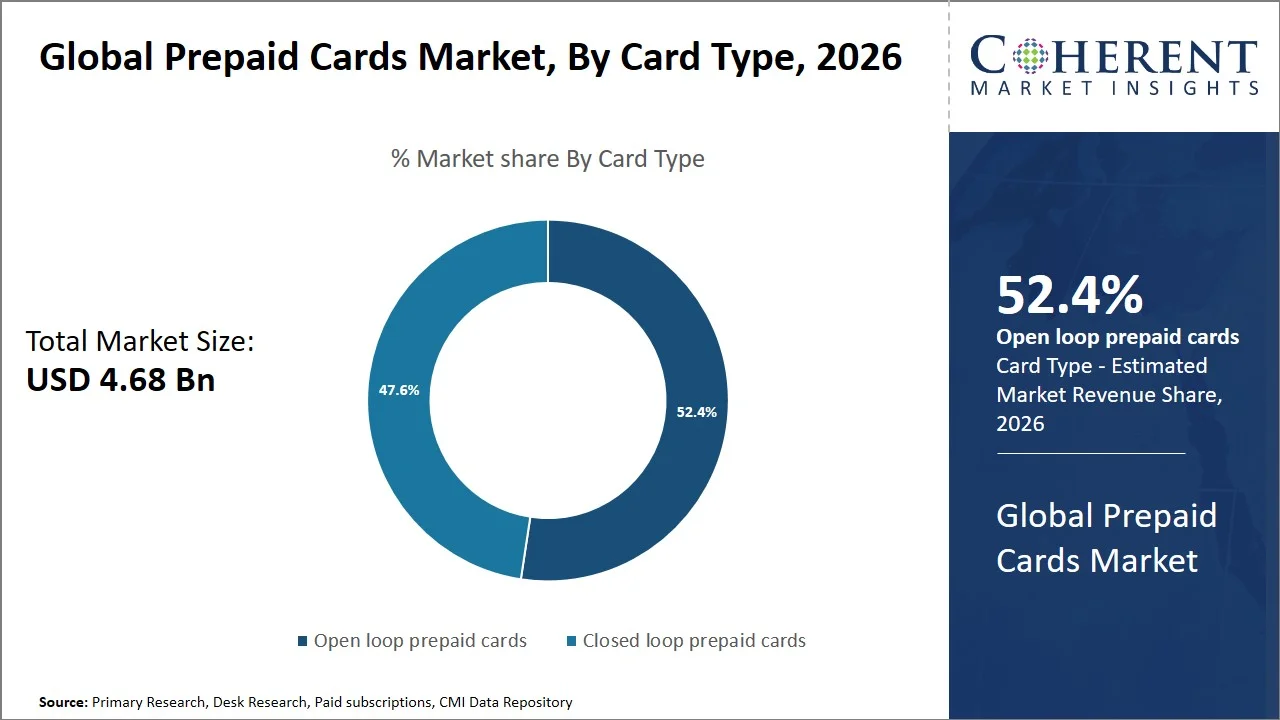
Why Do Open Loop Prepaid Cards Dominate the Global Prepaid Cards Market?
Open loop prepaid cards are expected to dominate the global prepaid cards market with 52.4% share in 2026, as they offer broader payment acceptance than closed loop cards and are better suited for multi-merchant spending, business travel, payroll, fleet payments, and consumer budgeting. Demand is supported by users seeking controlled spending without relying on credit lines or traditional bank accounts. On the supply side, card networks and issuers are strengthening open loop products with contactless functionality, tokenization, wallet integration, and spend-management controls. Their relevance is strong across retail, fuel, travel, corporate disbursement, and incentive programs. For instance, in February 2025, Eurowag partnered with Visa and Nets, part of Nexi Group, to launch an open-loop, secure, contactless prepaid card for fleet management across Europe. (Source: W.A.G. payment solutions)
- Current Industry Events of 2026
- Market Size Estimation
- Regional Breakdown
- Competitive Landscape
- Customer Intelligence
- Segmental Analysis
- Pricing Analysis
- Key Market Drivers, Challenges & Future Trends
- Customized Insights Section
Why Do Digital prepaid Cards Remain a Major Format Segment in the Global Prepaid Cards Market?
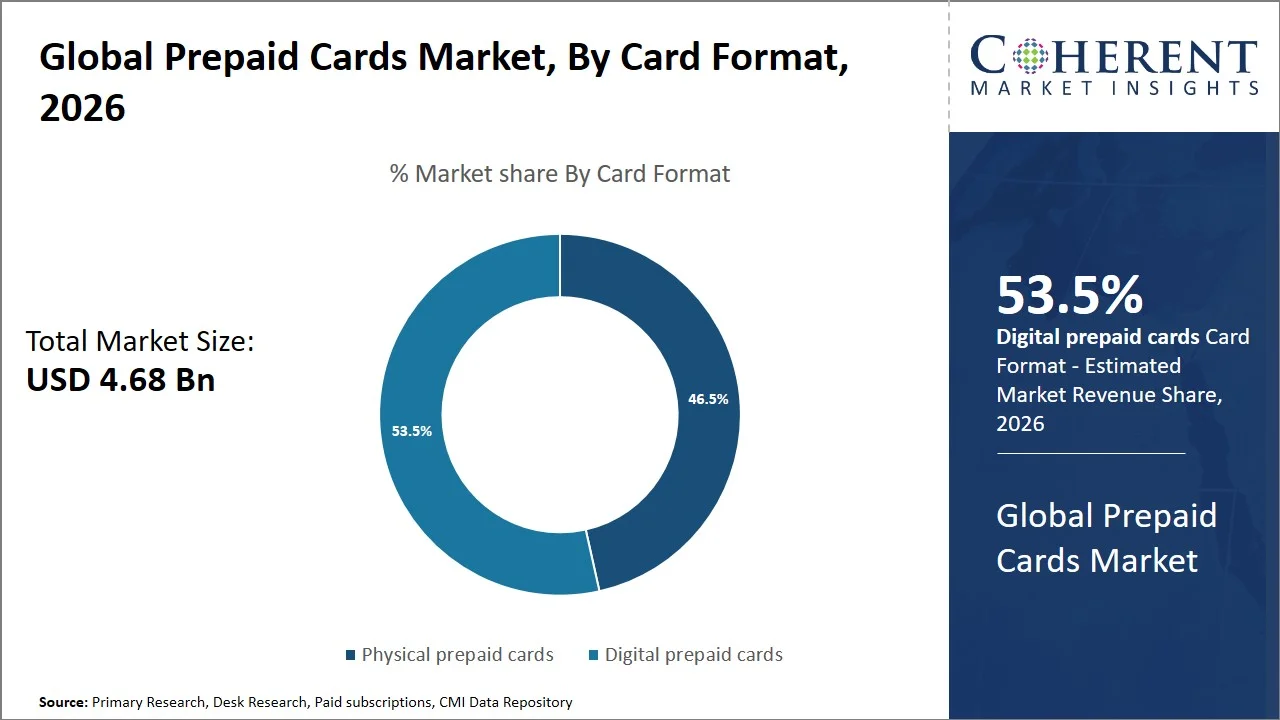
Digital prepaid cards are expected to account for 53.5% share in 2026, supported by rising adoption of instant, app-based, and wallet-enabled payment solutions across e-commerce, corporate rewards, travel, gaming, and digital gifting applications. Unlike physical prepaid cards, digital prepaid cards can be issued instantly, delivered through email or mobile apps, and used for online transactions without printing, packaging, or branch-level distribution. This makes them highly suitable for enterprises, fintech platforms, gig-economy payouts, promotional campaigns, and employee incentive programs where speed, lower fulfilment cost, and easy tracking are important.
The segment remains strategically important because issuers and payment networks can combine tokenization, mobile wallet compatibility, real-time activation, e-commerce acceptance, and reward-program integration within one digital prepaid card offering. Regulatory recognition of prepaid products also supports market maturity, as Canada’s Financial Consumer Agency states that federally regulated issuers must provide key information for prepaid products, including prepaid cards used for purchases through payment networks. (Source: Government of Canada)
Why Do Retail and E-commerce Payments Represent the Largest Application Segment in the Prepaid Cards Market?
Retail and e-commerce payments are expected to lead the application segment with 39.8% share in 2026, as prepaid cards are widely used for controlled online purchases, gift spending, subscription payments, marketplace checkout, and omnichannel retail programs. Demand is the strongest among consumers who prefer pre-funded payment methods to limit overspending and among businesses using prepaid cards for promotions, loyalty, and customer acquisition. Supply-side growth is supported by integrations between prepaid card platforms, POS systems, e-commerce storefronts, and digital wallets, enabling merchants to issue and redeem cards across online and offline channels. For instance, Factor4 announced a Shopify integration in May 2024, enabling merchants to sell and accept both physical and digital gift cards in-store and online. (Source: Factor4 Gift)
Currents Events and their Impact
Current Events | Description and its Impact |
India Releases Draft Master Direction on Prepaid Payment Instruments (April 2026) |
|
European Union Tightens AML Rules for Anonymous Prepaid Cards (2024 onward) |
|
U.S. CFPB Expands Oversight of Digital Payment Applications (Effective January 2025) |
|
Singapore Strengthens E-Payment User Protection Rules (December 2024 onward) |
|
(Sources: European Commission, Consumer Financial Protection Bureau (CFPB), Monetary Authority of Singapore (MAS))
Global Prepaid Cards Market Dynamics
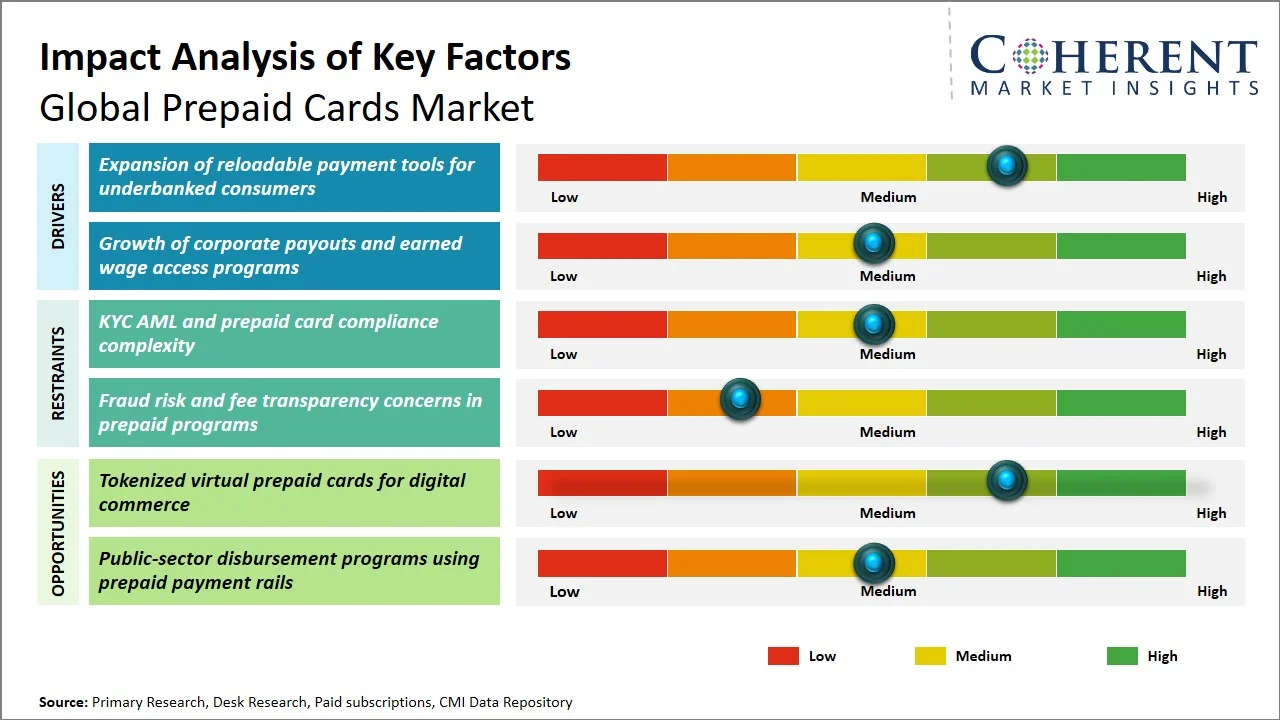
Key Market Drivers
- Reloadable Cards Expand Financial Access for Underbanked Users: Reloadable prepaid cards are becoming a practical payment bridge for underbanked consumers who need card-based access without depending on conventional credit products or full-service bank accounts. These cards support salary receipt, cash loading, bill payment, ATM withdrawals, and online purchases, making them useful for daily financial activity in cash-heavy and emerging economies. For issuers, reloadability improves customer lifetime value because the card remains active beyond one-time gifting or closed-loop use. The model also supports financial inclusion programs by giving consumers a controlled, low-barrier payment tool. In January 2025, PayMint received final approval from the Central Bank of Egypt to launch its first Meeza prepaid card with ADIB-Egypt, supporting digital payments, purchases, withdrawals, and app-based card management. (Source: PayMint)
- Corporate Payouts and Earned Wage Access Strengthen B2B Adoption: Corporate payouts and earned wage access programs are increasing prepaid card relevance beyond consumer spending. Employers are using prepaid and card-linked payout tools to distribute wages, tips, incentives, contractor payments, emergency payments, and off-cycle compensation more efficiently than paper checks or delayed payroll cycles. This improves employee cash-flow flexibility while helping companies reduce payout administration costs and strengthen retention in hourly and gig-based workforces. Prepaid cards also give issuers access to recurring transaction flows, making payroll-linked products commercially attractive. In March 2026, EarnIn reported that its Live Pay product enables real-time access to earnings through the EarnIn Card backed by Visa, with access up to USD 1,500 per pay period and acceptance wherever Visa is accepted. (Source: Business Wire, Inc)
Emerging Market Trends
- Tokenized Digital Prepaid Cards Move into Mobile-First Commerce: Digital prepaid cards are increasingly being designed for wallet provisioning, e-commerce checkout, subscription use, and app-based spending controls rather than only physical card replacement. Tokenization is becoming central to this shift because it replaces sensitive card numbers with restricted payment tokens that can be limited by device, merchant, or transaction environment. For prepaid card issuers, this improves security while enabling instant issuance, card-on-file usage, and safer remote payments. The trend is commercially important because it lowers distribution cost, supports faster activation, and makes prepaid cards more relevant for digital-native consumers and online merchants. EMVCo notes that payment tokenization enhances in-store, e-commerce, and remote payment security by replacing the primary account number with a unique EMV Payment Token.
- Compliance-Led Product Design Becomes a Competitive Requirement: Prepaid card programs are moving toward stronger compliance-by-design models as regulators place more emphasis on fee transparency, error resolution, fraud protection, AML controls, and customer fund safeguards. This trend is reshaping issuer strategy because prepaid products can no longer rely only on convenience or affordability; they must also demonstrate responsible disclosure, transaction monitoring, and consumer protection. For program managers and fintech partners, compliance capability is becoming a market-entry filter, especially for cross-border, payroll, benefit disbursement, and wallet-linked prepaid use cases. Stronger governance may increase short-term operating costs, but it can improve institutional trust and support partnerships with banks, employers, and public agencies. The Consumer Financial Protection Bureau’s (CFPB) prepaid account rule highlights clear fee disclosure and legal protections for prepaid account users.
Regional Insights
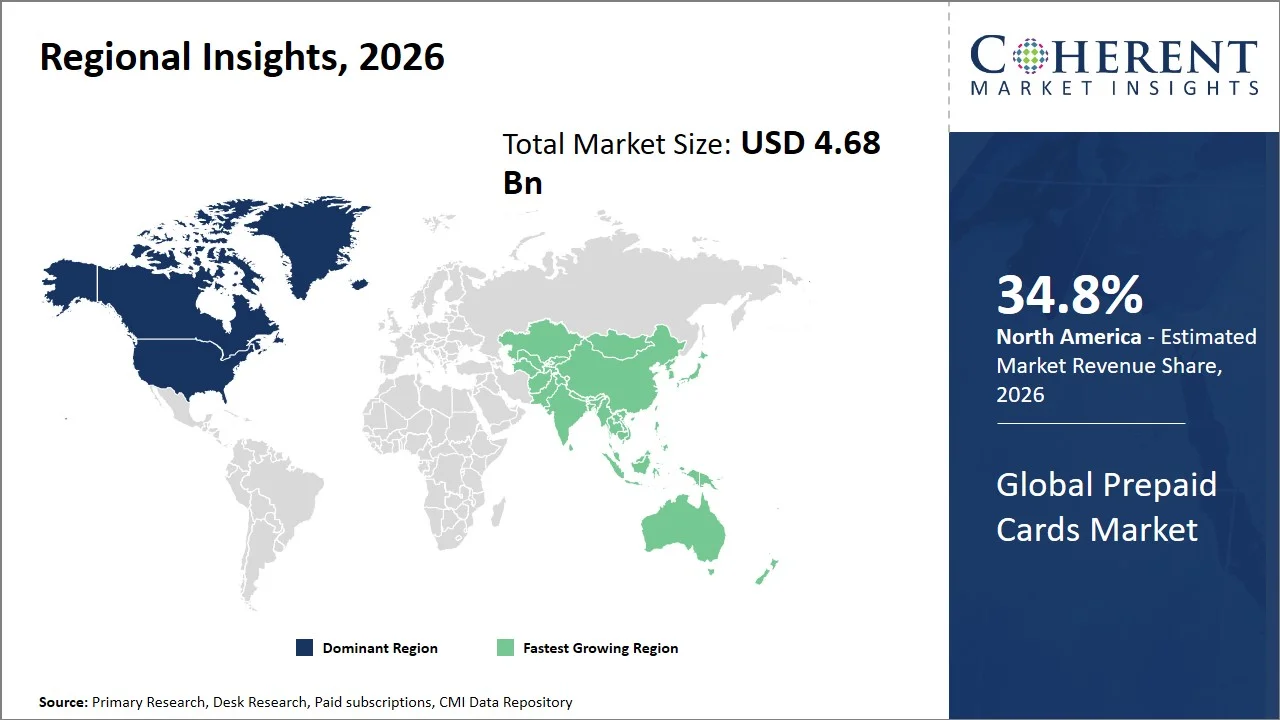
Why is North America a Strong Market for Prepaid Cards?
North America is expected to dominate the global prepaid cards market with 34.8% share in 2026, supported by a mature card payment ecosystem, strong digital payment infrastructure, high consumer familiarity with prepaid products, and broad use across retail, payroll, gifting, government benefits, and corporate expense management. The region also benefits from well-established consumer protection frameworks, which improve trust in prepaid accounts and support issuer participation. Strong participation from banks, fintechs, card networks, retailers, and government agencies enables wide distribution across both physical and digital channels. A recent regulatory instance includes the U.S. Consumer Financial Protection Bureau’s final rule on larger providers of general-use digital consumer payment applications, aimed at strengthening oversight, privacy protection, fraud monitoring, and accountability in digital payment ecosystems. (Source: McDermott Will & Schulte)
Why Does the Asia Pacific Prepaid Cards Market Exhibit High Growth?
Asia Pacific is expected to emerge as the fastest-growing region in the global prepaid cards market, accounting for 30.2% share in 2026, supported by rapid digital payment adoption, large underbanked populations, expanding mobile wallet ecosystems, and increasing use of prepaid instruments for transit, retail, payroll, gifting, and financial inclusion. Countries such as India, China, Indonesia, and Southeast Asian markets are moving quickly toward card-linked and app-based prepaid solutions as consumers and businesses shift away from cash. Regulatory modernization and domestic payment infrastructure expansion are also supporting faster issuer participation. A recent instance includes PhonePe’s March 2026 launch of its RuPay On-The-Go NCMC card in India, designed for offline transit and mobility payments, showing how prepaid instruments are being integrated into everyday public payment use cases. (Source: The Economy Times)
Global Prepaid Cards Market Outlook for Key Countries
Why is China Emerging as a Key Growth Hub for the Prepaid Cards Market?
China remains one of the most important countries in the prepaid cards market due to its large digital payments base, strong non-bank payment ecosystem, and growing regulatory focus on stored-value payment activities. The country’s prepaid card opportunity is closely linked to retail payments, closed-loop commercial cards, digital wallets, transit payments, and corporate stored-value programs. Regulatory tightening is also shaping issuer behavior by improving fund safety, governance, capital requirements, and customer protection. In July 2024, China reported that detailed implementation rules for non-bank payment institutions had been introduced after State Council measures took effect with higher capital and risk-management expectations for payment institutions. This strengthens the operating framework for prepaid and stored-value payment services. (Source: State Council of China)
Why is the U.S. Leading Innovation and Adoption in the Prepaid Cards Market?
The U.S. is a core market for prepaid cards due to its established card network infrastructure, high merchant acceptance, mature consumer protection rules, and wide use in government benefit disbursement, payroll, gift cards, and general-purpose reloadable cards. Prepaid cards are especially relevant for consumers without traditional banking access, as they provide a practical route to receive funds, withdraw cash, make purchases, and manage spending without credit exposure. The country also supports large-scale public-sector prepaid card usage. A recent official example is the U.S. Treasury’s Direct Express Debit Mastercard program, updated in March 2026, which enables federal benefit recipients to receive payments even without a bank account. (Source: Bureau of the Fiscal Service)
Why is India Becoming a Fast-Growing Market for Prepaid Cards?
India is a high-growth country in the prepaid cards market because of its large digital payments’ population, strong UPI ecosystem, expanding transit payment infrastructure, and rising use of prepaid payment instruments for retail, travel, gifting, payroll, and merchant payments. The market is also supported by consumer preference for low-value, controlled digital payment tools and increasing fintech participation. Regulatory clarity is becoming a key growth enabler, as issuers need well-defined rules around KYC, loading, interoperability, refunds, dormancy, and customer protection. In April 2026, the Reserve Bank of India released the Draft Master Direction on Prepaid Payment Instruments, 2026, following a comprehensive review to support long-term growth of PPIs with enhanced transaction security. (Source: Reserve Bank of India)
Why is Brazil Gaining Importance in the Prepaid Cards Market?
Brazil is important in the prepaid cards market due to its rapidly evolving digital payments landscape, strong fintech ecosystem, and growing use of prepaid instruments for consumer payments, corporate payouts, cross-border transactions, and financial inclusion. The country’s payment infrastructure has been transformed by account-based digital payments, but prepaid cards remain relevant where card acceptance, controlled spending, travel payments, and business disbursements are required. Local regulatory authorization is becoming increasingly important for prepaid card issuers seeking to operate domestically. A recent example is Nium securing a payment institution license from the Central Bank of Brazil, enabling it to offer locally regulated payment accounts and services, including prepaid card issuance once operational. (Source: Nium Pte. Ltd)
Why is the U.K. a Mature and Regulated Market for Prepaid Cards ?
The U.K. is a significant prepaid cards market due to its advanced e-money framework, high card usage, strong fintech base, and widespread adoption of prepaid products for travel, payroll, gifting, expense management, and digital wallets. Prepaid cards in the country are closely tied to e-money regulation, making safeguarding, reconciliation, and customer fund protection critical for market stability. As payment firms face tighter governance expectations, well-capitalized and compliant issuers are likely to gain stronger institutional and consumer trust. In August 2025, the Financial Conduct Authority finalized changes to the safeguarding regime for payment and e-money firms, aiming to better protect customer funds and improve intervention where firms fail to meet safeguarding expectations. (Source: UK Financial Conduct Authority)
Technology Landscape of the Global Prepaid Cards Market
Technology | Key Features | Clinical Advantage | Market Relevance |
EMV Chip and Contactless Card Technology | Secure chip-based authentication, tap-and-pay functionality, reduced card cloning risk, and compatibility with POS terminals | Improves transaction security, reduces fraud exposure, and enhances consumer confidence in physical prepaid card usage | Highly relevant for physical prepaid cards, retail payments, travel cards, payroll cards, and government disbursement cards |
Digital and Virtual Prepaid Cards | Instant card issuance, app-based activation, online usability, card-on-file support, and remote delivery | Reduces issuance cost, improves speed-to-market, and supports immediate user access without physical distribution | Strongly supports digital prepaid card adoption across e-commerce, corporate rewards, gig payouts, and online gifting |
Payment Tokenization | Replaces actual card numbers with secure digital tokens for mobile wallets, e-commerce, and in-app payments | Strengthens data protection, lowers payment fraud risk, and enables safer use of prepaid cards in digital channels | Important for mobile wallet-linked prepaid cards, digital prepaid cards, and online retail transactions |
Mobile Wallet Integration | Enables prepaid cards to be added to Apple Pay, Google Pay, Samsung Pay, and issuer wallets | Improves convenience, supports contactless payments, and increases transaction frequency among mobile-first users | Critical for expanding prepaid card usage among younger consumers, urban users, and digital payment adopters |
API-based Issuing Platforms | Allows fintechs, banks, retailers, and corporates to launch prepaid card programs through modular APIs | Shortens product launch timelines, supports customization, and improves scalability for issuers and program managers | Highly relevant for corporate payout cards, employee benefit cards, branded prepaid cards, and fintech-led programs |
Real-time Reload and Fund Transfer Technology | Enables instant loading, balance updates, card-to-wallet transfers, and faster settlement | Improves user liquidity, supports repeat usage, and increases customer retention for reloadable prepaid products | Key for underbanked consumers, payroll cards, earned wage access, remittance-linked prepaid cards, and everyday spending |
AI-based Fraud Detection and Risk Analytics | Uses transaction monitoring, behavioral analytics, anomaly detection, and risk scoring | Reduces unauthorized transactions, improves AML monitoring, and supports safer prepaid card operations | Increasingly important as prepaid cards expand into digital commerce, cross-border payments, and high-volume corporate programs |
KYC, AML, and Digital Identity Verification Tools | Supports e-KYC, document verification, biometric checks, sanctions screening, and transaction compliance | Improves regulatory compliance, reduces misuse, and enables safer onboarding of prepaid card users | Essential for open loop prepaid cards, reloadable cards, payroll cards, government benefit cards, and cross-border prepaid programs |
QR Code and NFC-based Transit Payment Technology | Enables prepaid cards to support metro, bus, toll, parking, and mobility payments through contactless or QR-based systems | Improves payment speed, reduces cash handling, and supports seamless mobility transactions | Highly relevant for travel, transit, and mobility prepaid card applications, especially in Asia Pacific and urban markets |
How are technological advancements in digital prepaid card platforms creating new growth opportunities in the prepaid cards market?
Technological advancement in prepaid card platforms, including virtual issuance, tokenization, mobile wallet integration, real-time reloads, and API-based card program management, is creating strong growth opportunities in the prepaid cards market. These technologies are shifting prepaid cards from basic stored-value instruments to flexible, secure, and instantly usable payment tools for retail purchases, e-commerce, payroll, incentives, travel, and financial inclusion. The ability to issue digital prepaid cards quickly reduces distribution cost for banks, fintechs, corporates, and retailers, while tokenized credentials improve security for online and mobile transactions. This is expected to widen prepaid card adoption among underbanked consumers, SMEs, gig workers, and digital-first users.
Market Players, Key Development, and Competitive Intelligence
Key Developments
- In June 2026, Paymentology, PayMongo, and Mastercard launched a Virtual Prepaid Business Payment Card for Philippine SMEs to support digital supplier payments, expense control, and faster business card issuance.
- In January 2026, Blackhawk Network expanded its partnership with Mastercard to launch the Drive Prepaid Card and Grocery Prepaid Card, targeting fuel, EV charging, and grocery reward programs.
- In October 2025, RBL Bank and NPCI launched the Humsafar RuPay Prepaid Card with RuPay On-The-Go NCMC Tap & Pay functionality for travel, food, fuel, shopping, and entertainment payments.
Competitive Landscape
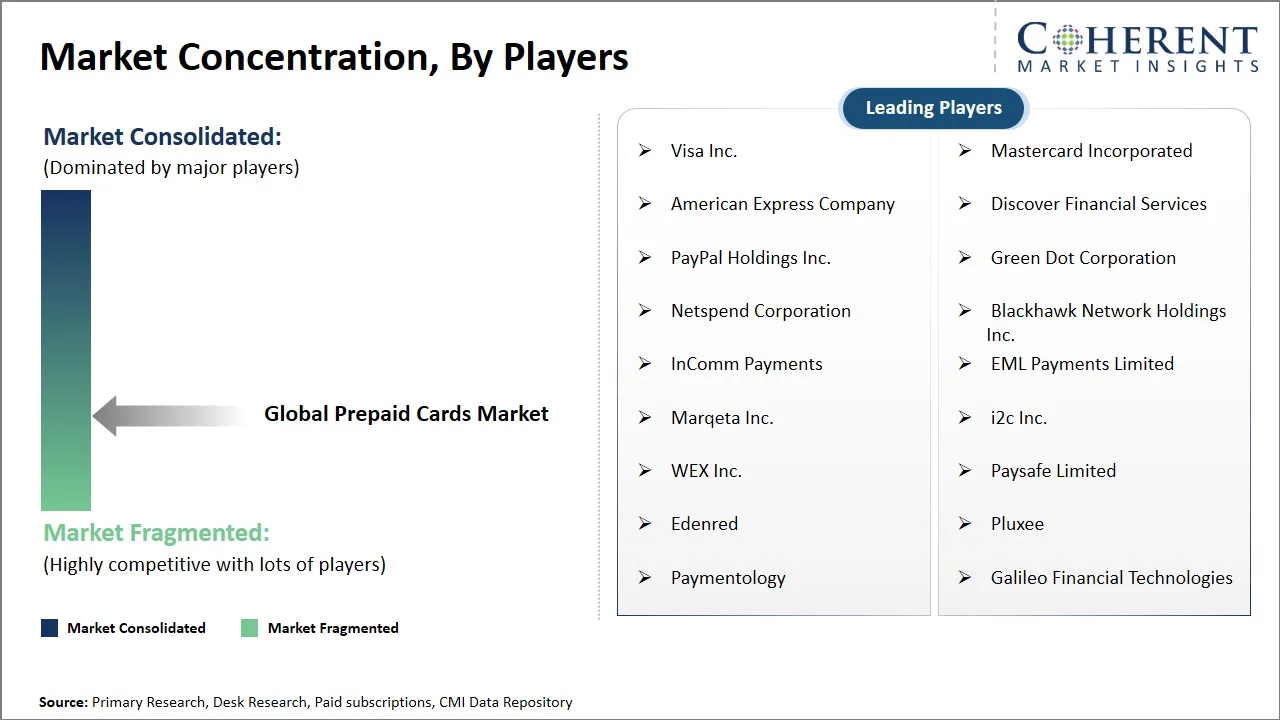
The global prepaid cards market is moderately fragmented, with banks, card networks, fintech companies, retailers, payment processors, and program managers competing on product flexibility, security, distribution reach, digital issuance, and user experience. Companies are focusing on reloadable cards, virtual prepaid cards, corporate payout solutions, gift and incentive cards, and transit-linked prepaid products to expand adoption across consumer and business use cases. Competition is increasingly shaped by regulatory compliance, fraud prevention, API-based issuing platforms, and partnerships with merchants, employers, and government agencies.
Key focus areas include
- Development of virtual and reloadable prepaid cards with instant issuance and mobile wallet compatibility
- Expansion of prepaid card use in payroll, employee benefits, corporate rewards, travel, and SME expense management
- Integration of tokenization, fraud analytics, KYC, and AML tools to improve transaction security and compliance
- Partnerships between card networks, fintechs, banks, and retailers to strengthen distribution and acceptance
- Growth of closed-loop and category-specific prepaid cards for fuel, grocery, gifting, mobility, and loyalty programs
- Expansion in emerging markets through financial inclusion, transit payments, and digital payment adoption initiatives
Market Report Scope
Prepaid Cards Market Report Coverage
| Report Coverage | Details | ||
|---|---|---|---|
| Base Year: | 2025 | Market Size in 2026: | USD 4.68 Bn |
| Historical Data for: | 2020 To 2024 | Forecast Period: | 2026 To 2033 |
| Forecast Period 2026 to 2033 CAGR: | 12.4% | 2033 Value Projection: | USD 10.61 Bn |
| Geographies covered: |
| ||
| Segments covered: |
| ||
| Companies covered: | Visa Inc., Mastercard Incorporated, American Express Company, Discover Financial Services, PayPal Holdings Inc., Green Dot Corporation, Netspend Corporation, Blackhawk Network Holdings Inc., InComm Payments, EML Payments Limited, Marqeta Inc., i2c Inc., WEX Inc., Paysafe Limited, Edenred, Pluxee, Paymentology, and Galileo Financial Technologies | ||
| Growth Drivers: |
| ||
| Restraints & Challenges: |
| ||
Analyst Opinion (Expert Opinion)
- The global prepaid cards market is expected to witness steady long-term growth due to rising adoption of reloadable payment tools, digital prepaid cards, corporate payout solutions, and gift/reward cards. Increasing preference for controlled spending, faster fund access, and cashless transactions is strengthening prepaid card usage across retail, e-commerce, payroll, travel, government benefits, and SME payments.
- The strongest opportunities are likely to emerge in open loop and digital prepaid card formats, where broader merchant acceptance, mobile wallet integration, instant issuance, and real-time reload features improve convenience for both consumers and businesses. North America will continue to remain a mature revenue-generating market, while Asia Pacific is expected to offer high growth potential due to financial inclusion, transit digitization, fintech expansion, and rising digital payment adoption in India, China, and Southeast Asia.
- To gain a competitive advantage, market participants should focus on secure virtual prepaid cards, API-based issuing platforms, fraud analytics, tokenization, and compliance-ready program management. Strategic partnerships with banks, fintechs, retailers, employers, and government agencies will be critical for expanding use cases. Companies that combine strong distribution reach with customer-friendly pricing, regulatory compliance, and flexible card controls are expected to strengthen their competitive position.
Speak to the analyst
Want personalized insights?
Take the findings above to one of our principal consultants, or have the report rebuilt around the segments, geographies and competitors you actually track.
Market Segmentation
- Card Type Insights (Revenue, USD Bn, 2021 - 2033)
- Open loop prepaid cards
- Closed loop prepaid cards
- Card Format Insights (Revenue, USD Bn, 2021 - 2033)
- Physical prepaid cards
- Digital prepaid cards
- Application Insights (Revenue, USD Bn, 2021 - 2033)
- Retail and e commerce payments
- Gift rewards and incentives
- Payroll and employee payouts
- Travel transit and mobility payments
- Government and social benefit disbursements
- End User Insights (Revenue, USD Bn, 2021 - 2033)
- Individual consumers
- Corporate or business sectors
- Government and public sector agencies
- Others
- Distribution Channel Insights (Revenue, USD Bn, 2021 - 2033)
- Direct sales
- Indirect sales
- Regional Insights (Revenue, USD Bn, 2021 - 2033)
- North America
- U.S.
- Canada
- Latin America
- Brazil
- Argentina
- Mexico
- Rest of Latin America
- Europe
- Germany
- U.K.
- Spain
- France
- Italy
- Russia
- Rest of Europe
- Asia Pacific
- China
- India
- Japan
- Australia
- South Korea
- ASEAN
- Rest of Asia Pacific
- Middle East
- GCC Countries
- Israel
- Rest of Middle East
- Africa
- South Africa
- North Africa
- Central Africa
- North America
- Key Players Insights
- Visa Inc.
- Mastercard Incorporated
- American Express Company
- Discover Financial Services
- PayPal Holdings Inc.
- Green Dot Corporation
- Netspend Corporation
- Blackhawk Network Holdings Inc.
- InComm Payments
- EML Payments Limited
- Marqeta Inc.
- i2c Inc.
- WEX Inc.
- Paysafe Limited
- Edenred
- Pluxee
- Paymentology
- Galileo Financial Technologies
Sources
Primary Research Interviews
- Prepaid card issuers and program managers
- Executives from banks, fintech companies, and payment institutions
- Product managers handling open loop, closed loop, reloadable, and virtual prepaid cards
- Corporate payroll and employee payout solution providers
- Retailers, e-commerce platforms, and gift card program operators
- Payment processors, card issuing platform providers, and digital wallet companies
- Compliance, KYC/AML, and fraud prevention professionals in prepaid card operations
Stakeholders
- Prepaid card issuers and payment banks
- Card networks and payment scheme operators
- Fintech companies and digital wallet providers
- Payment processors and issuer processing platforms
- Retailers, supermarkets, fuel chains, and e-commerce merchants
- Gift card and rewards program providers
- Corporate payout, payroll, and earned wage access providers
- Transit and mobility payment operators
- Government benefit disbursement agencies
- KYC, AML, fraud analytics, and digital identity solution providers
End-use Sectors
- Individual consumers
- Corporate and business sectors
- Government and public sector agencies
- Retail and e-commerce merchants
- Payroll and employee benefit providers
- Travel, transit, and mobility operators
- Gift, rewards, and incentive program managers
- SMEs and gig economy platforms
- financial inclusion and welfare payment programs
Regulatory & Government Bodies:
- Consumer Financial Protection Bureau (CFPB), U.S.
- Federal Reserve, U.S.
- Financial Crimes Enforcement Network (FinCEN), U.S.
- Reserve Bank of India (RBI)
- National Payments Corporation of India (NPCI)
- Financial Conduct Authority (FCA), U.K.
- European Banking Authority (EBA)
- European Commission – Payment Services and AML Regulations
- Monetary Authority of Singapore (MAS)
- People’s Bank of China (PBOC)
- Banco Central do Brasil
- Financial Action Task Force (FATF)
Databases
- World Bank Global Findex Database
- Bank for International Settlements (BIS) Payment Statistics
- Federal Reserve Payments Study
- CFPB Prepaid Account Rule and Consumer Finance Data
- RBI Payment and Settlement Systems Data
- NPCI Digital Payments Statistics
- European Central Bank Payment Statistics
- UK Finance Payment Markets Data
- MAS Payment Services and E-money Data
- Banco Central do Brasil Payments Statistics
Magazines
- Payments Dive
- Finextra
- The Paypers
- PYMNTS
- PaymentsSource
- American Banker
- Cards International
- Retail Banker International
- Banking Technology
- Digital Transactions
Newspapers
- Economic Times
- Financial Times
Associations
- Electronic Transactions Association (ETA)
- Payments Canada
- UK Finance
- European Payments Council (EPC)
- Emerging Payments Association Asia
- Merchant Risk Council (MRC)
- International Card Manufacturers Association (ICMA)
- Smart Payment Association
- ATM Industry Association (ATMIA)
- Prepaid International Forum
Public Domain Sources
- World Bank – Financial Inclusion and Digital Payments Data
- Bank for International Settlements – Payment and Settlement Statistics
- Federal Reserve – U.S. Payment Systems and Card Usage Data
- CFPB – Prepaid Account Consumer Protection Rules
- RBI – Prepaid Payment Instruments Guidelines
- NPCI – RuPay and NCMC Payment Infrastructure Information
- European Commission – Payment Services and AML Framework
- FCA – E-money and Payment Institution Regulations
- MAS – Payment Services Act and E-payment Protection Guidelines
- FATF – AML/CFT Guidance for Prepaid and Digital Payment Products
Proprietary Elements
- CMI Data Analytics Tool, Proprietary CMI Existing Repository of information for last 10 years.
Get access to 250+ pages report
Every segment, forecast, competitor profile and data table behind the analysis above — available for instant download.
- ESOMAR Member
- ISO 9001:2015 Certified
- D-U-N-S Registered
- GDPR & CCPA Compliant
Missing comfort of reading report in your local language? Find your preferred language:
Transform your Strategy with Exclusive Trending Reports
Frequently Asked Questions
The CAGR of the global prepaid cards market is projected to be 12.4% from 2026 to 2033.
The global prepaid cards market is valued at USD 4.68 Bn in 2026 and is expected to reach USD 10.61 Bn by 2033.
Yes, it is profitable, supported by transaction fees, reload fees, corporate payout programs, gift cards, and growing digital prepaid card adoption.
In terms of card type, open loop prepaid cards are estimated to dominate the market revenue share in 2026.
Expansion of reloadable payment tools for underbanked consumers and growth of corporate payouts and earned wage access programs are the major factors driving the growth of the global prepaid cards market.
KYC AML and prepaid card compliance complexity and fraud risk and fee transparency concerns in prepaid programs are the major factors hampering the growth of the global prepaid cards market.
North America is expected to lead the global prepaid cards market in 2026.