

Global Psychotherapy Service Market Size and Forecast – 2026 to 2033
The global psychotherapy service market is estimated to be valued at USD 47.55 Bn in 2026 and is expected to reach USD 107.10 Bn by 2033, exhibiting a compound annual growth rate (CAGR) of 12.3% from 2026 to 2033. This significant growth reflects increasing awareness around mental health issues and the rising demand for professional therapeutic interventions across diverse demographics and regions worldwide.
Key Takeaways of the Global Psychotherapy Service Market
- In 2026, individual therapy segment is expected to lead the global psychotherapy service market, accounting for 51.2 % share.
- The in-person therapy segment is projected to account for 71.4 % of the market share in 2026.
- The Cognitive Behavioral Therapy (CBT) segment is expected to capture 25.6 % share in 2026.
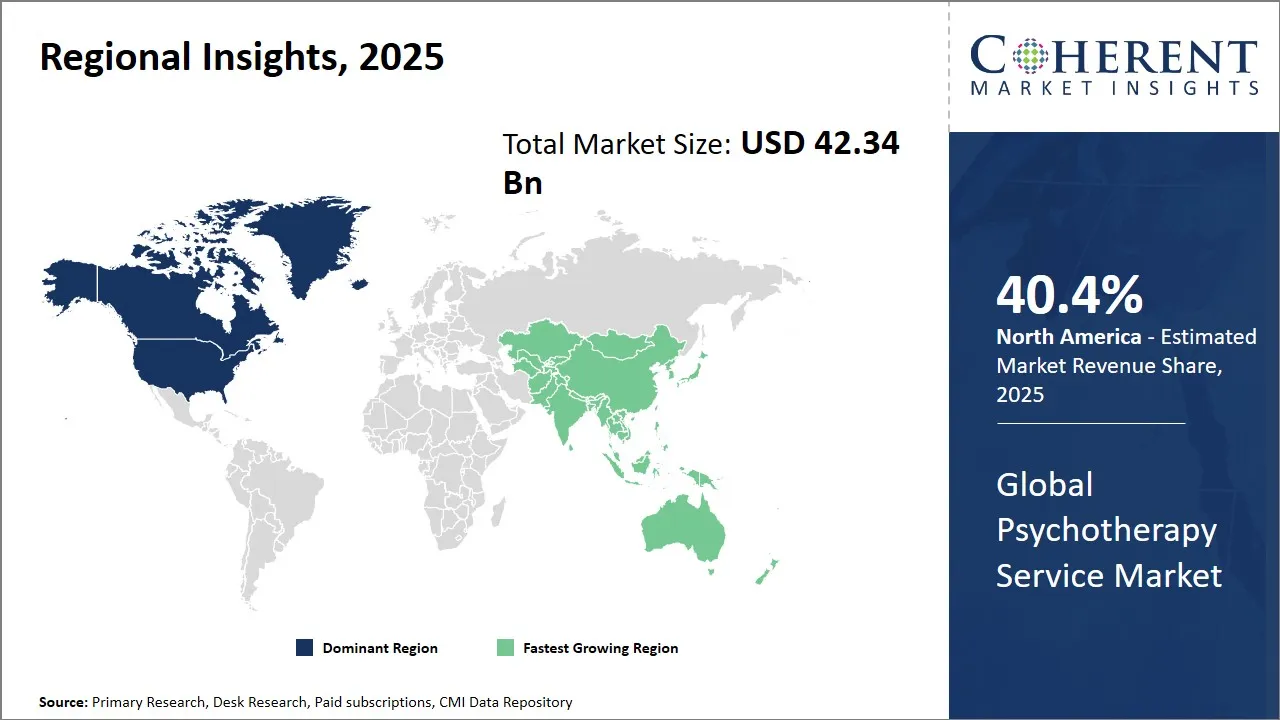
- North America is expected to lead the market, holding a share of 40.4 % in 2026. Asia Pacific is anticipated to be the fastest-growing region, with a market share of 24.5% in 2026.
Market Overview
A key market trend driving this expansion is the growing integration of digital technologies in psychotherapy services, such as teletherapy and AI-driven mental health platforms. Additionally, there is a surge in personalized therapy approaches and increased adoption of mental health programs in workplaces. Moreover, the reduction of stigma associated with mental health and government initiatives promoting psychological well-being are accelerating service uptake, shaping a dynamic and rapidly evolving psychotherapy market landscape.
Current Events and Its Impact
Current Events | Description and its Impact |
Post-Pandemic Expansion of Telehealth Regulation |
|
Rising Awareness of Mental Health |
|
Segmental Insights
- Current Industry Events of 2026
- Market Size Estimation
- Regional Breakdown
- Competitive Landscape
- Customer Intelligence
- Segmental Analysis
- Pricing Analysis
- Key Market Drivers, Challenges & Future Trends
- Customized Insights Section
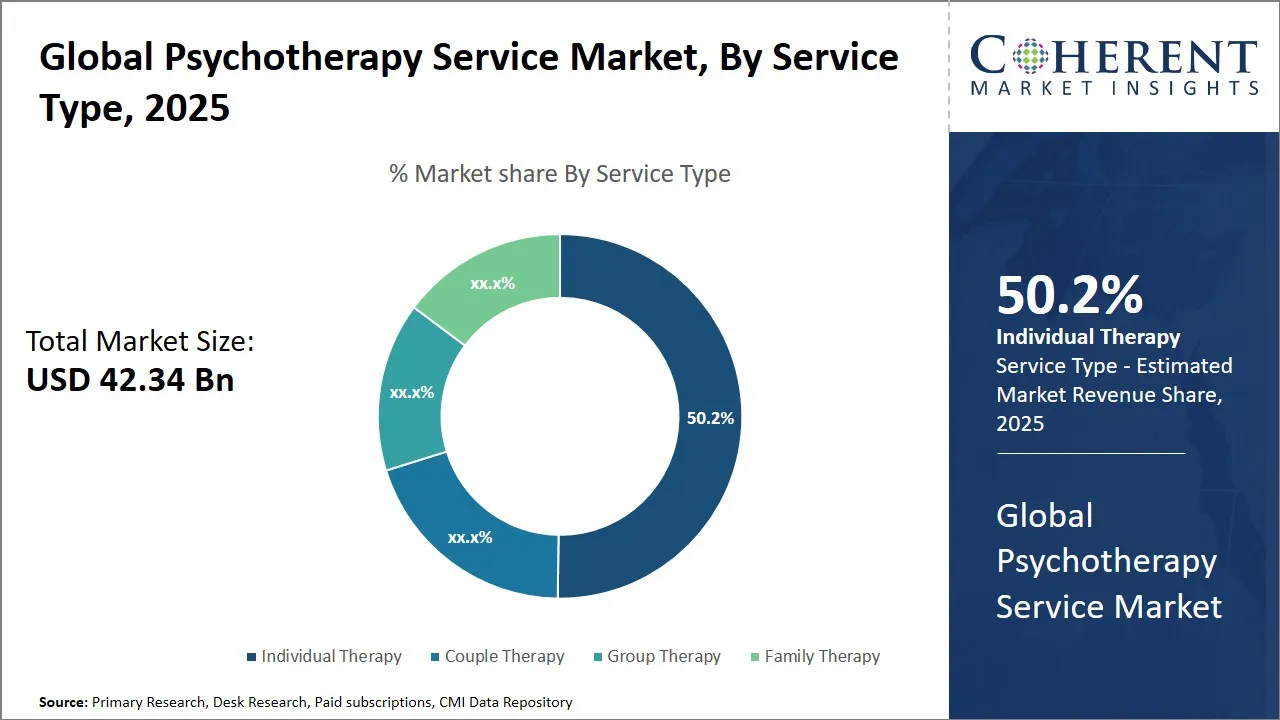
Psychotherapy Service Market Insights, By Service Type - Individual Therapy Contributes the Highest Market Share Owing to Personalized Care and Increasing Mental Health Awareness
The individual therapy is projected to be the largest part of the global psychotherapy service market in 2026 with a 51.2% share, because of its personalized and direct approach through one-on-one sessions, meeting the unique mental health needs of the individuals. The therapy's exclusivity enables the therapist to mix and match, using the client's psychological profile, trauma history, and coping strategies, thereby increasing the effectiveness of the treatment.
As mental health awareness grows worldwide, more individuals are seeking confidential and focused therapeutic environments where they can freely discuss sensitive issues without fear of judgment or privacy breaches. Individual Therapy facilitates this safe space, which is highly valued by patients navigating anxiety, depression, stress, or other psychological challenges.
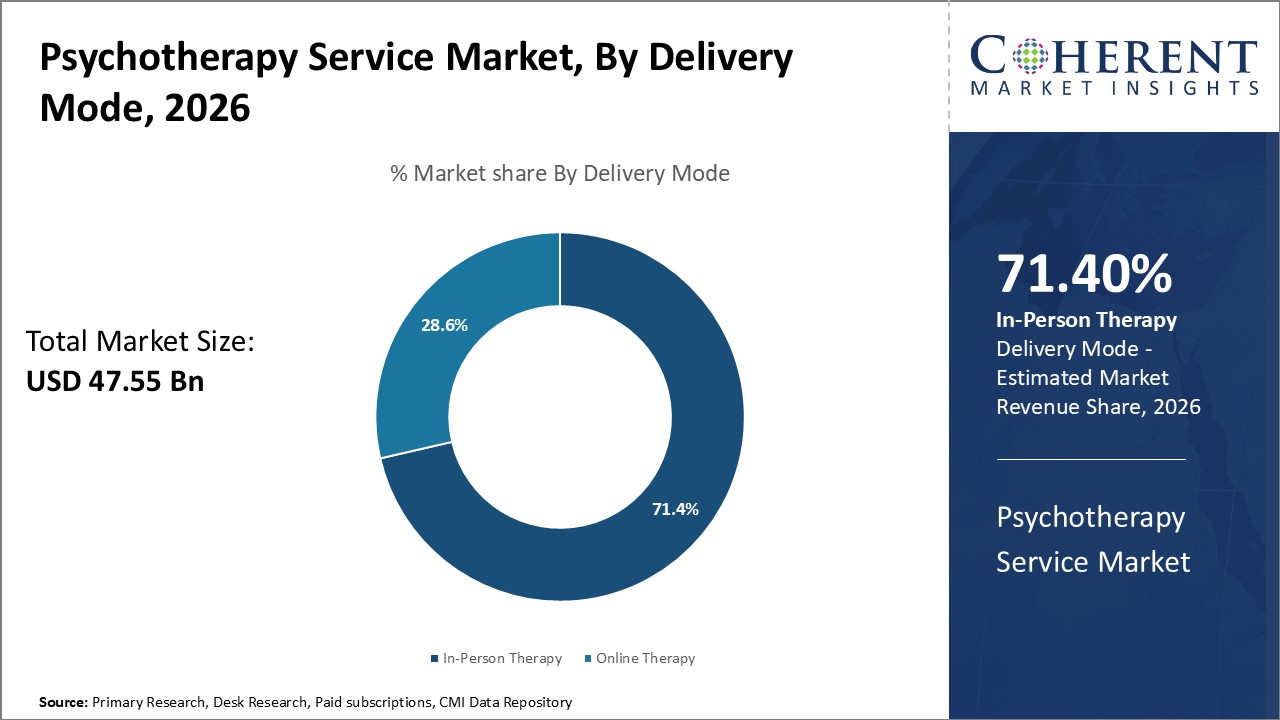
Psychotherapy Service Market Insights, By Delivery Mode - In-Person Therapy Dominates Owing to the Value of Face-to-Face Interaction and Therapeutic Alliance
The in-person therapy is listed as the global psychotherapy service market's most preferred delivery method with an estimated share of 71.4% in 2026, due to the fact that it supports a stronger therapeutic alliance that is crucial for effective psychotherapy. The presence of the therapists allows them to interpret body language, facial expressions, and subtle emotional changes plus the overall mood, all of which are important for efficient and accurate diagnosis and treatment.
The communication through the body helps in the creation of trust and rapport between the therapist and the client which can particularly be critical when dealing with deeply rooted psychological problems or trauma.
Psychotherapy Service Market Insights, By Therapy Modality - Cognitive Behavioral Therapy (CBT) Leads Due to Its Evidence-Based Efficacy and Broad Applicability
Cognitive Behavioral Therapy (CBT) is expected to capture the maximum share of the global psychotherapy service market of 25.6% share in 2026, by therapy modality as it is one of the most thoroughly tested and widely accepted forms of therapy. The systematic method of CBT works on the principle of dysfunctional cognition and behavior modification that is done through specific, goal-directed strategies and with the help of independent clients that lead to quantifiable reductions in mental health symptoms.
In November 2021, MindBeacon, a Canada-based digital mental health company, launched its new Guided Cognitive Behavioral Therapy (CBT) Program to support patients managing chronic conditions. The program, part of MindBeacon’s broader suite of internet-based psychotherapy services, focuses on helping individuals cope with the emotional and psychological challenges that accompany long-term illnesses.
Role of Artificial Intelligence (AI) in the Global Psychotherapy Service Market
- The global psychotherapy service market is going through a revolution; the main contributor being AI as its biggest player. Upgrading efficiency, maximizing cost-effectiveness, and offering personalized services are the main strongholds of AI in the therapy sector. Different AI tools like chatbots, predictive analytics, and automated scheduling are technical; they are engaging the stakeholders into a seamless and transparent process of diagnosis, therapy planning, and administrative work. Woebot Health, Wysa, and Mindstrong are some platforms that are making use of AI by monitoring mood patterns, with the help of CBT therapy, and providing 24/7 support respectively, thus making mental healthcare affordable and scalable. Moreover, through data-driven insights, therapists are able to come up with the best-suited treatments for their patients, in addition to foreseeing possible relapse risks.
- Teletherapy, virtual consultations, and precision mental health services are some of the new business opportunities that AI is creating. Talkspace and BetterHelp are two companies that are already in the AI area for therapist matching and user engagement analysis for better results. Despite this, there are still questions regarding data privacy, emotional authenticity, and overdependence on automation. A hybrid model combining AI’s analytical power with human empathy will be the best path forward, since it will be able to ensure efficiency, accessibility, and trust in psychotherapy services.
Regional Insights
North America Psychotherapy Service Market Analysis and Trends
The North America psychotherapy service market is taking the global lead with an estimated 40.4% market share in 2026, mainly due to the availability of well-established healthcare ecosystem without any delay, advanced technological integration, and strong insurance provisions that allow access to mental health services. This region is also benefiting from the government’s considerable support in terms of mental health awareness and financial assistance for psychological services, especially in the U.S. and Canada.
In September 2024, Nitto Denko Corporation, headquartered in Osaka, Japan, launched its Counseling System in parts of California, U.S. This new service enables real-time analysis and visualization of a client's physiological data, such as blood flow changes, to provide counselors and psychologists with valuable insights during sessions.
Asia Pacific Psychotherapy Service Market Analysis and Trends
The Asia Pacific market is expected to exhibit the fastest growth contributing 24.5% share in 2026, due to a combination of mental health awareness, healthcare infrastructure development, and digital adoption, especially in the big four countries: China, India, Japan, and Australia. The governments of the region have already incorporated mental health into their primary public health policies, thus resulting in great support in terms of policies and funds in the previously neglected markets.
Take the case of China's National Mental Health Plan and India's Mental Healthcare Act as examples, both programs are already showing positive effects for mental health in terms of promotion and service delivery. The increasing popularity of therapy as a norm coupled with the constant push to make mental health issues less of a taboo are the main factors driving demand for the service.
Psychotherapy Service Market Outlook for Key Countries
U.S. Psychotherapy Service Market Analysis and Trends
In North America, the U.S. is still the major market; it even facilitates innovations in the field of psychotherapy services by having good healthcare infrastructure and extensive insurance also as its backbone. The Mental Health Parity and Addiction Equity Act is one of the governmental policies that guarantee better insurance payments for mental health services. A number of hospitals and private clinics work together in major research and they carry out clinical trials which in turn leads to a high-quality delivery of health services and the development of personalized patients' treatment modalities.
In December 2024, Mentavi Health, a leading online provider of mental health diagnosis and treatment in the U.S., expanded its telehealth therapy services to over 40 states. The company, known for its telehealth services through ADHD Online, will now offer psychotherapy sessions provided by doctorate-level psychologists.
Canada Psychotherapy Service Market Analysis and Trends
The Canada psychotherapy service market is very active; besides there being public support, the legislation is also on the side of mental health, public health is very much supportive and the progressive mental health legislation helps to ensure that psychological services are accessible to a large number of people. Provinces have their healthcare systems and these governments provide funding for community-based mental health interventions. Also, digital health projects have experienced increased participation in isolated areas and among Indigenous peoples, thus, allowing them to get the same care as the rest.
In July 2024, the Canada Revenue Agency (CRA) clarified the new GST/HST exemption for psychotherapy and counselling therapy services. As of June 20, 2024, certain psychotherapists and counselling therapists are no longer required to collect GST/HST on their services.
China Psychotherapy Service Market Analysis and Trends
The quickly expanding psychotherapy service market in China is a sign of increasing public awareness that is further supported by the government’s strategies to incorporate psychological services into primary health care. The National Mental Health Work Plan has also been a significant factor in providing the necessary funds to deal with the issue of mental health disorders, which are increasing in number. The convenience of smartphones also led to a rapid adoption of therapy apps like WeDoctor and Yuanfudao among urban millennials as these platforms have already created a stronghold in the population of the cities.
In May 2024, JD Health, one of China’s largest digital healthcare platforms, introduced its AI-driven Psychotherapy Service Product at a conference in Beijing. The company launched “Small Universe for Chatting and Healing,” an AI-based therapeutic chatbot built on JD Health’s own healthcare-specific large language model, designed to provide empathetic and natural psychological support.
India Psychotherapy Service Market Analysis and Trends
The Indian market for psychotherapy services is also going through a very fast change that is being facilitated by the mental health advocacy and policy reforms coming in through the Mental Healthcare Act among others. However, despite the challenges that come with the disparity in healthcare infrastructure, digital solutions have made psychotherapy available even in the farthest corners of the country. YourDOST and InnerHour are the most notable players in this space providing counseling that is sensitive to one’s culture along with individual mental health programs.
In May 2026, the Health Department of Tamil Nadu, India launched a counselling initiative for students following the release of Class 12 board examination results. The initiative, available through the TeleMANAS call center (14416) and the State Health helpline (104), is aimed at providing support to approximately 39,000 students who did not pass the exams.
Market Players, Key Developments, and Competitive Intelligence
Key Developments
- On October 10, 2025, on the World Mental Health Day, Union Health Minister Shri J P Nadda launched enhanced features for the Tele MANAS App under the National Tele Mental Health Programme. The app now includes a multi-lingual user interface supporting 10 regional languages, a chatbot feature named 'Asmi' for user engagement, and an Emergency Module for immediate support during crises.
- On October 14, 2025, Neuro Wellness Spa, a leader in evidence-based mental health care, launched its new Teen Talk Therapy program aimed at adolescents ages 12 to 17 in California. The program offers both virtual and in-person therapy sessions at select locations, including Brea and Manhattan Beach. Designed to address the unique challenges of adolescence, the program provides focused, goal-oriented support for issues such as academic stress, social anxiety, family conflicts, self-esteem, and navigating social media.
- In July 2025, Talkiatry, a leading provider of in-network psychiatry and therapy services, announced the launch of its new Couples Therapy program. This expansion complements Talkiatry's existing psychotherapy services, working alongside its psychiatry team to offer comprehensive care. The program aims to address the growing demand for relationship-specific therapy, as relationship problems are often linked to emotional distress and mental health issues such as mood disorders, anxiety, and substance abuse.
- In July 2025, Slingshot AI, a mental health startup backed by Andreessen Horowitz, officially launched its therapy chatbot, Ash, after a successful beta phase with 50,000 users. The company, which aims to create the world’s first foundation model for psychology, has raised USD 93 million to support its product. Ash uses generative AI to provide therapy services, marking a significant step in integrating AI into mental health care.
Top Strategies Followed by Global Psychotherapy Service Market Players
- The big players in the market have long ago set their sights on investing heavily in research and development (R&D) as the main route for perennial innovation and the provision of high-performance products and services. These R&D companies aspire to create not just the most efficacious therapeutic tools but digital platforms that can handle patients quite efficiently — through comprehensive integrative care solutions.
- In July 2025, Google announced two AI initiatives aimed at advancing mental health treatment and research. The first initiative is a comprehensive field guide developed with Grand Challenges Canada and the McKinsey Health Institute. This guide provides foundational concepts for using AI responsibly in mental health, including enhancing clinician training, personalizing support, and improving data collection.
- Quite contrary to the above-explained strategy, the midsized competitors in the psychotherapy service market are going by a less risky approach which is providing reasonably priced solutions that are of good quality and are affordable at the same time. These players have become aware of the necessity for providing affordable mental healthcare to the price-sensitive consumer segments, especially in the developing regions where economic tightness dictates purchase decisions.
- Mid-level players such as Talkspace, Cerebral, and BetterHelp exemplify companies offering cost-effective psychotherapy services that balance quality and accessibility. These platforms provide affordable online therapy through subscription-based models, making mental health care accessible to a wider audience, especially in regions with limited access to in-person counseling.
- Small-scale operators in the psychotherapy service market usually set themselves apart by concentrating on certain areas and providing tailored or innovative products that meet specific therapeutic needs or the needs of neglected populations. One of the ways of getting ahead of the competition is by using the latest technologies such as artificial intelligence, virtual reality, and mobile health applications to make the treatments more interesting and attractively different
- Smaller firms like Wysa, Youper, and Replika represent emerging innovators in the psychotherapy service market. Wysa utilizes AI-driven conversational therapy tools to assist users in managing anxiety and depression through personalized, on-demand interaction.
Market Report Scope
Psychotherapy Service Market Report Coverage
| Report Coverage | Details | ||
|---|---|---|---|
| Base Year: | 2025 | Market Size in 2026: | USD 47.55 Bn |
| Historical Data for: | 2020 To 2024 | Forecast Period: | 2026 To 2033 |
| Forecast Period 2026 to 2033 CAGR: | 12.3% | 2033 Value Projection: | USD 107.10 Bn |
| Geographies covered: |
| ||
| Segments covered: |
| ||
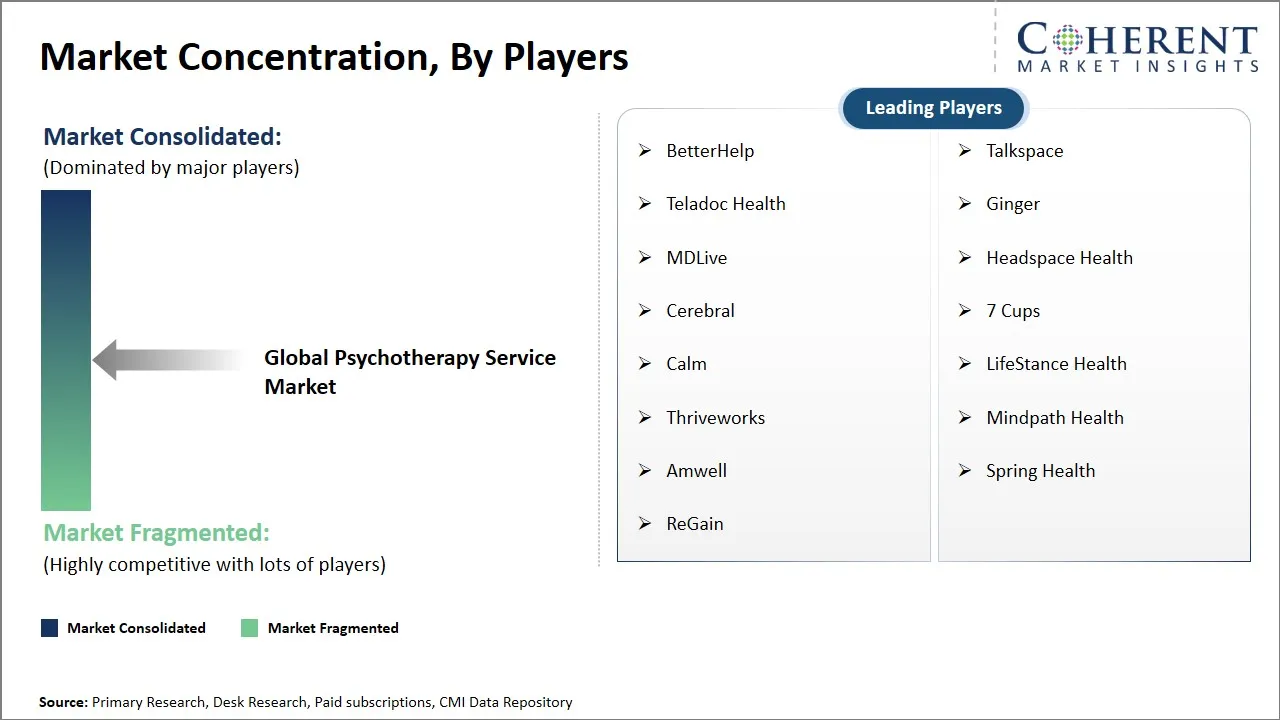
| Companies covered: | BetterHelp, Talkspace, Teladoc Health, Ginger, MDLive, Headspace Health, Cerebral, 7 Cups, Calm, LifeStance Health, Thriveworks, Mindpath Health, Amwell, Spring Health, and ReGain | ||
| Growth Drivers: |
| ||
| Restraints & Challenges: |
| ||
Psychotherapy Service Market Dynamics
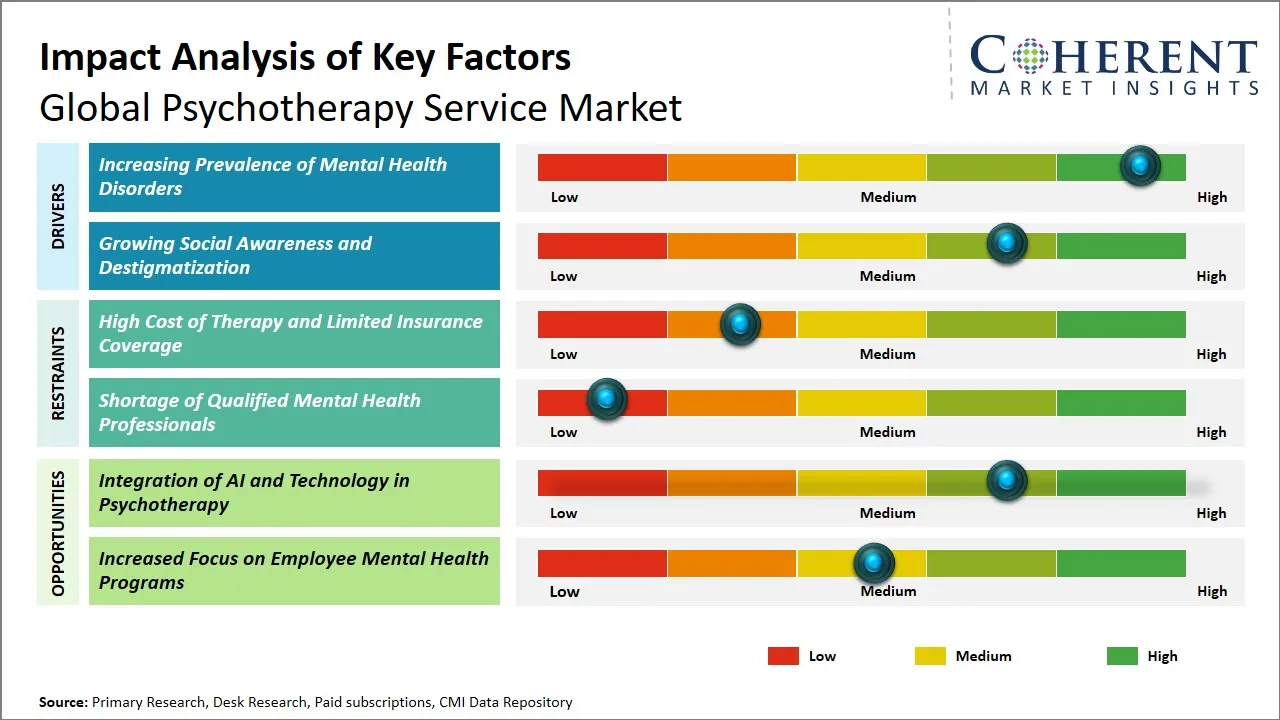
Psychotherapy Service Market Driver - Increasing Prevalence of Mental Health Disorders
The increasing number of mental disorders worldwide is a major driver that is pushing the psychotherapy service market growth. The world has come to understand mental health issues better and the ability to diagnose them has also improved resulting in the identification of more cases of depression, anxiety, bipolar disorder, and post-traumatic stress disorder in different people. Various stressors like urbanization, the changing work environment, and the COVID-19 pandemic have increased the number of people suffering from mental health issues. However, as the stigma attached to mental health treatment decreases more and more patients are coming forward seeking professional help to cope with their psychological well-being thus directly increasing the demand for psychotherapy services.
In September 2025, the WHO reported that over a billion people globally suffer from mental health conditions, with anxiety and depression being the most common. These disorders are the second leading cause of long-term disability, significantly impacting individuals and economies. Suicide remains a major issue, claiming 727,000 lives in 2021, particularly among young people. Despite some progress, efforts to reduce suicide rates and increase access to mental health services, including psychotherapy, remain insufficient, highlighting the urgent need for greater global investment and support.
Psychotherapy Service Market Opportunity - Integration of AI and Technology in Psychotherapy
The combining of artificial intelligence (AI) and advanced technology in psychotherapy is a big plus point for the global psychotherapy service market. Surely, as people get more and more aware of mental health issues worldwide the demand for easy, personalized, and fast-acting therapeutic solutions keeps on growing. AI-driven chatbots, digital therapists, and other online platforms help the service providers to deliver a huge amount of mental health services, thus going beyond the traditional barriers like geographical constraints, stigma, and lack of trained personnel. These technologies facilitate real-time monitoring of patient progress, adaptive treatment plans based on data analytics, and enhanced patient engagement through interactive interfaces.
In February 2025, Grow Therapy, a leading mental health technology company, launched two new AI-assisted tools aimed at enhancing the therapist-client experience. These tools are designed to help therapists stay more present during sessions by providing structured drafts of notes, which can be audited and refined after conversations.
Analyst Opinion (Expert Opinion)
- The psychotherapy service market is growing rapidly, driven by increasing mental health awareness, the rise in demand for accessible services, and advancements in teletherapy technology. The pandemic accelerated the shift toward online therapy, making mental health services more accessible globally. Governments are also enhancing regulatory support and funding for mental health initiatives, though challenges such as a shortage of professionals and high service costs remain barriers to wider accessibility.
- Emerging opportunities include the integration of AI in mental health platforms, improving service delivery and accessibility. Conferences like the World Health Summit 2023 and Global Mental Health Summit 2022 have played a pivotal role in shaping policy and fostering digital health innovations. Initiatives such as the National Mental Health Program and companies like Talkspace and BetterHelp are leading efforts to provide scalable, digital-first mental health solutions, positioning the market for continued growth and expansion.
Speak to the analyst
Want personalized insights?
Take the findings above to one of our principal consultants, or have the report rebuilt around the segments, geographies and competitors you actually track.
Market Segmentation
- Service Type Insights (Revenue, USD Bn, 2021 - 2033)
- Individual Therapy
- Couple Therapy
- Group Therapy
- Family Therapy
- Delivery Mode Insights (Revenue, USD Bn, 2021 - 2033)
- In-Person Therapy
- Online Therapy
- Therapy Modality Insights (Revenue, USD Bn, 2021 - 2033)
- Cognitive Behavioral Therapy (CBT)
- Psychodynamic Therapy
- Person-Centered Therapy
- Dialectical Behavior Therapy (DBT)
- Interpersonal Therapy (IPT)
- Acceptance and Commitment Therapy (ACT)
- Other Specialized Therapies
- Treatment Setting Insights (Revenue, USD Bn, 2021 - 2033)
- Outpatient Services
- Inpatient Services
- Residential Treatment Centers
- Telehealth Platforms
- Patient Demographics Insights (Revenue, USD Bn, 2021 - 2033)
- Adults
- Children and Adolescents
- Geriatric
- Disorder Type Insights (Revenue, USD Bn, 2021 - 2033)
- Anxiety Disorders
- Depressive Disorders
- Post-Traumatic Stress Disorder (PTSD)
- Obsessive-Compulsive Disorder (OCD)
- Eating Disorders
- Substance Use Disorders
- Attention-Deficit/Hyperactivity Disorder (ADHD)
- Bipolar Disorder
- Personality Disorders
- Other Mental Health Conditions
- End User Insights (Revenue, USD Bn, 2021 - 2033)
- Healthcare Providers
- Hospitals
- Clinics
- Private Practices
- Payers
- Public/Government Reimbursed (e.g., NHS, Medicare)
- Private Health Insurance
- Regional Insights (Revenue, USD Bn, 2021 - 2033)
- North America
- U.S.
- Canada
- Latin America
- Brazil
- Argentina
- Mexico
- Rest of Latin America
- Europe
- Germany
- U.K.
- Spain
- France
- Italy
- Russia
- Rest of Europe
- Asia Pacific
- China
- India
- Japan
- Australia
- South Korea
- ASEAN
- Rest of Asia Pacific
- Middle East
- GCC Countries
- Israel
- Rest of Middle East
- Africa
- South Africa
- North Africa
- Central Africa
- North America
- Key Players Insights
- BetterHelp
- Talkspace
- Teladoc Health
- Ginger
- MDLive
- Headspace Health
- Cerebral
- 7 Cups
- Calm
- LifeStance Health
- Thriveworks
- Mindpath Health
- Amwell
- Spring Health
- ReGain
Sources
Primary Research Interviews
- Industry Stakeholders List
- Mental Health Professionals
- Healthcare Providers (Hospitals, Clinics, Private Practices)
- End Users List
- Patients seeking psychotherapy services
- Individuals using teletherapy platforms
Government and International Databases
- World Health Organization (WHO)
- National Institutes of Health (NIH)
- U.S. Centers for Disease Control and Prevention (CDC)
- European Commission (EC)
- Mental Health Commission of Canada
- National Institute for Health and Care Excellence (NICE)
Trade Publications
- Psychotherapy Networker
- Psychiatric Times
- Mental Health Weekly
- Therapy Today
- Journal of Clinical Psychology
- American Journal of Psychiatry
Academic Journals
- Journal of Psychotherapy Integration
- Journal of Mental Health Counseling
- Clinical Psychology Review
- Journal of Clinical Psychology
- Journal of Consulting and Clinical Psychology
- Psychological Bulletin
Reputable Newspapers
- The New York Times
- The Guardian
- The Washington Post
- The Times
- The Globe and Mail
- Financial Times
Industry Associations
- American Psychological Association (APA)
- British Psychological Society (BPS)
- National Association of Social Workers (NASW)
- International Federation of Social Workers (IFSW)
- European Association for Psychotherapy (EAP)
- American Psychiatric Association (APA)
Public Domain Resources
- U.S. Department of Health and Human Services (HHS)
- European Union's Mental Health Policy Resources
- National Health Service (NHS) Resources
- National Mental Health Institute (NMHI) Resources
- Public Health Agency of Canada (PHAC) Resources
- U.S. National Library of Medicine (PubMed)
Proprietary Elements
- CMI Data Analytics Tool: Proprietary analytics tool to analyze real-time market trends, consumer behavior, and technology adoption in market
- Proprietary CMI Existing Repository of Information for Last 8 Years
Get access to 250+ pages report
Every segment, forecast, competitor profile and data table behind the analysis above — available for instant download.
- ESOMAR Member
- ISO 9001:2015 Certified
- D-U-N-S Registered
- GDPR & CCPA Compliant
Missing comfort of reading report in your local language? Find your preferred language:
Transform your Strategy with Exclusive Trending Reports
Frequently Asked Questions
The global psychotherapy service market is estimated to be valued at USD 47.55 Bn in 2026 and is expected to reach USD 107.10 Bn by 2033.
The CAGR of the global psychotherapy service market is projected to be 12.3% from 2026 to 2033.
Increasing prevalence of mental health disorders and growing social awareness and destigmatization are the major factors driving the growth of the global psychotherapy service market.
High cost of therapy and limited insurance coverage and shortage of qualified mental health professionals are the major factors hampering the growth of the global psychotherapy service market.
Artificial Intelligence (AI), Natural Language Processing (NLP), and wearable-based emotion tracking dominate adoption.
AI enhances personalization, automates processes, and improves diagnostic accuracy and treatment efficiency.
In terms of service type, the individual therapy is estimated to dominate the market revenue share in 2026.