

Global Quartz Crystals and Oscillators Market Size and Forecast – 2026-2033
The Global Quartz Crystals and Oscillators Market is estimated to be valued at USD 2.80 Bn in 2026 and is expected to reach USD 4.83 Bn by 2033, exhibiting a compound annual growth rate (CAGR) of 8.1% from 2026 to 2033.
Key Takeaways of the Global Quartz Crystals and Oscillators Market
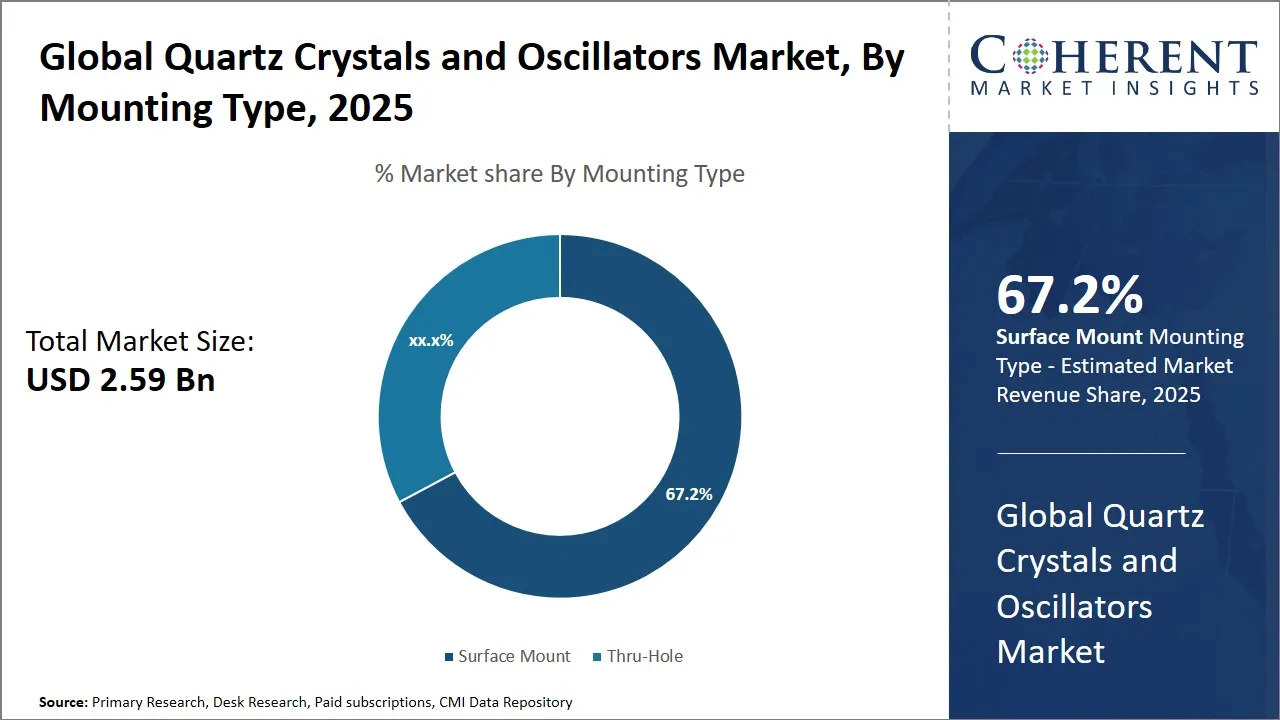
- The surface mount segment leads the market holding an estimated share of 68.2% in 2026.
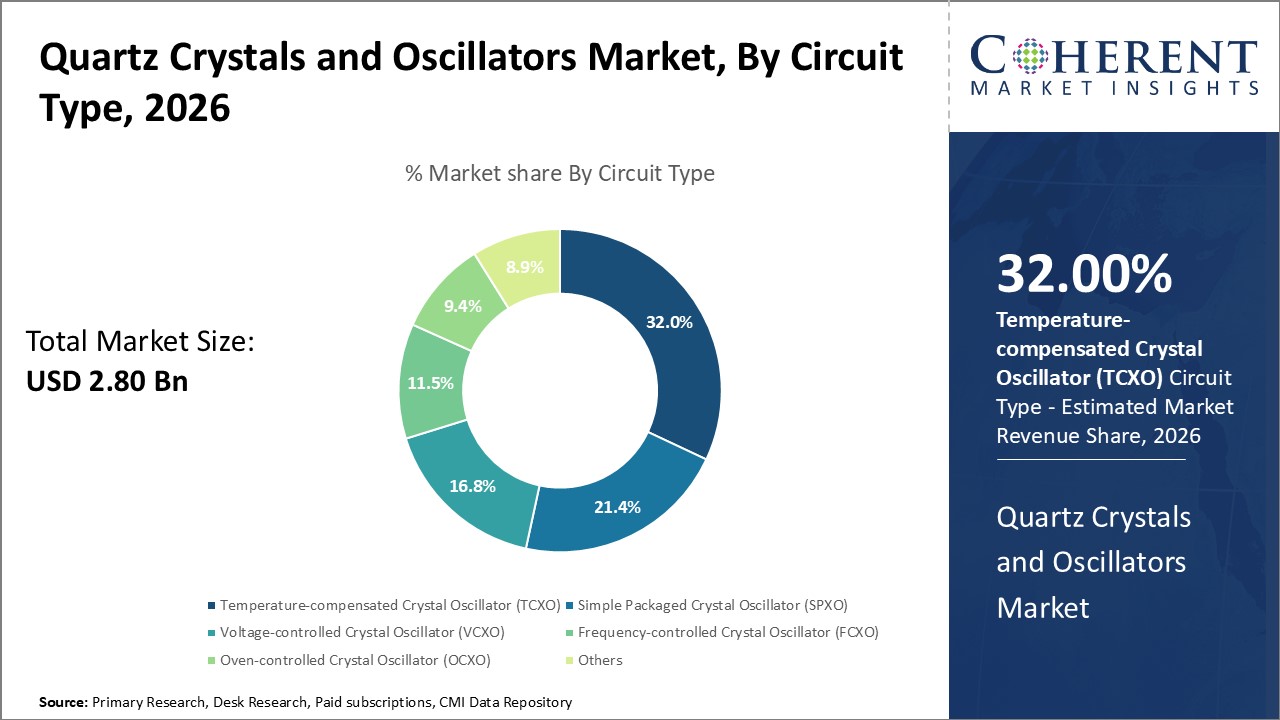
- The Temperature-compensated Crystal Oscillator (TCXO) segment is projected to dominate with a share of 32% in 2026.
- The telecom and networking segment is estimated to lead the market with a share of 33.7% in 2026.
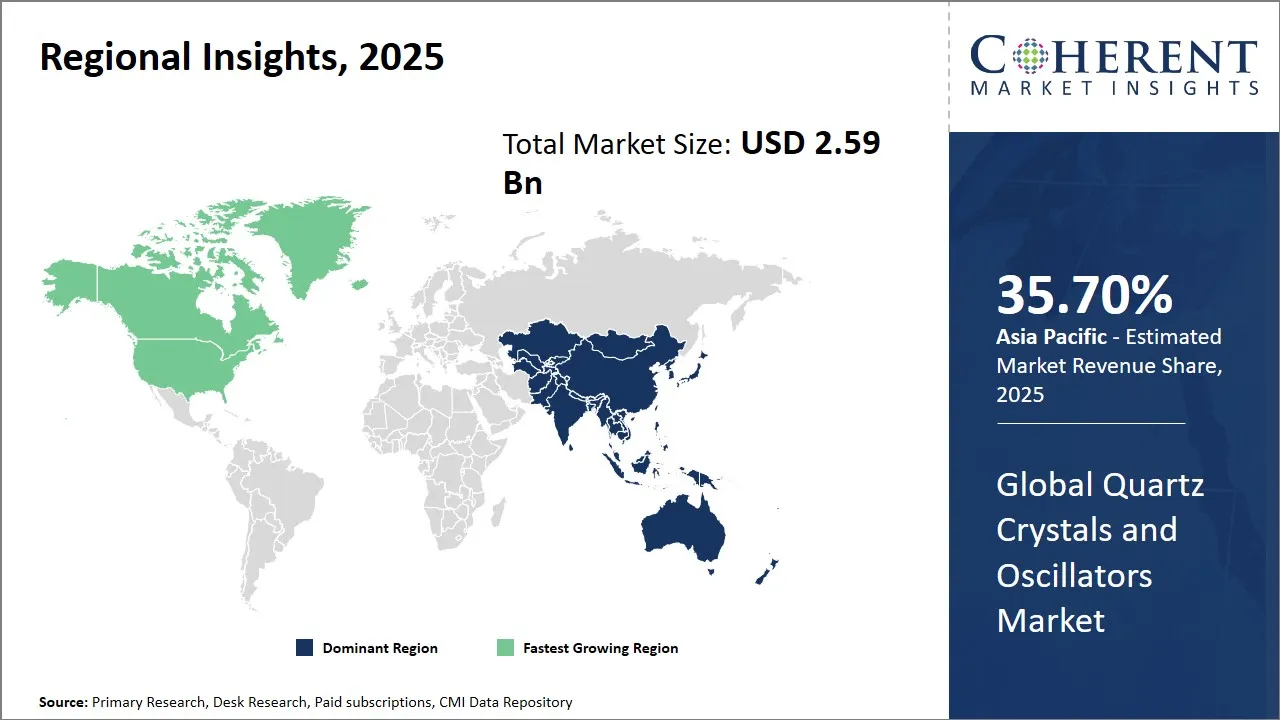
- Asia Pacific is estimated to lead the market with a share of 35.7% in 2026. North America, holding a share of 27.6% in 2026, is projected to be the fastest growing region.
Market Overview
The market is witnessing the use of quartz crystals and oscillators in IoT-enabled devices, which need accurate frequency control for reliable operation. Also, innovations in miniaturization and energy-efficient designs are making possible more applications in wearable electronics and smart devices. The increasing focus on high-performance and stable timing components in telecommunications infrastructure and automotive electronics is also adding to market growth. As industries continue to digitize and automate, the reliance on advanced quartz oscillator technologies will grow.
Current Events and their Impact
Current Events | Description and its impact |
Geopolitical and Trade Developments |
|
Economic and Infrastructure Trends |
|
Segmental Insights
- Current Industry Events of 2026
- Market Size Estimation
- Regional Breakdown
- Competitive Landscape
- Customer Intelligence
- Segmental Analysis
- Pricing Analysis
- Key Market Drivers, Challenges & Future Trends
- Customized Insights Section
Global Quartz Crystals and Oscillators Market Insights, by Mounting Type – Surface Mount Leads Because of Increasing Demand for Miniaturization and Automation in Electronic Device Assembly
Surface mount, holding an estimated share of 68.2% in 2026, leads because of its advantages in modern electronics manufacturing. The rise in demand for smaller, lighter, and highly reliable electronic devices has been a big driver for surface mount components. Unlike thru-hole mounting, which needs lead insertion into PCB holes and subsequent soldering, surface mount components are placed on the surface of the printed circuit board, allowing more compact board designs and improved circuit density.
The trend towards miniaturization in consumer electronics like smartphones, tablets, and wearable devices, adds to the demand for surface mount quartz crystals and oscillators. These devices need high-frequency stability in a compact footprint, which surface mount components provide. Also, surface mount components support high-speed automated assembly lines, helping manufacturers reduce production costs and improve throughput. This compatibility is very important as electronics manufacturers look for higher production efficiency and lower defect rates.
Another factor is the improved electrical performance made possible by reduced parasitic inductance and capacitance. Because the circuit traces and device leads are shorter and more direct on surface mount devices, it improves signal integrity. Also, the ongoing adoption of advanced packaging technologies like System-in-Package (SiP) and multichip modules, integrates numerous functions into compact spaces, making demand for surface mount quartz crystals and oscillators. The ability to package multiple electronic components into smaller footprints without compromising signal quality plays directly into the strengths of surface mount technology.
The environmental and economic factors also favor surface mount components. Reduced material consumption and recycling efficiency align with growing environmental regulations and sustainability goals. The ease of reflow soldering in SMT compared to manual soldering used in thru-hole mounting reduces production waste and energy usage, adding to its appeal.
Global Quartz Crystals and Oscillators Market Insights, by Circuit Type – Temperature-compensated Crystal Oscillator (TCXO) Leads Because of the Rising Demand for Frequency Stability in Temperature-Variable Environments
Temperature-compensated Crystal Oscillator (TCXO) is expected to hold a leading share of 32% in 2026. This stability is needed for applications where precise timing and synchronization affect overall system performance. TCXOs use temperature compensation circuits that adjust the frequency output in response to ambient temperature variations. Because of their improved reliability, TCXOs are highly preferred in telecommunications, navigation, and different wireless communication systems where signal integrity is paramount.
The proliferation of mobile communication technologies like 4G and 5G networks has greatly increased the demand for TCXOs. These networks need oscillators that can maintain consistent performance despite environmental temperature fluctuations caused by outdoor deployment of equipment and variable operational conditions. TCXOs' ability to provide stable frequency references makes possible seamless data transmission, reduces signal loss, and improves overall network quality.
Also, emerging applications in Internet of Things (IoT) devices and GPS modules extensively use TCXOs for efficient power consumption combined with precise frequency control. The temperature compensation circuitry allows these devices to remain energy-efficient, which is important for battery-powered applications. Industrial automation, aerospace, and defense sectors also contribute a lot to the widespread adoption of TCXOs because their systems often operate under harsh temperature environments where uncompensated crystal oscillators would fail to meet strict performance criteria.
Beyond temperature compensation, the continuous evolution of TCXO designs focusing on miniaturization, lower phase noise, and extended operational lifespans adds to their market leadership. The ability to add these oscillators to complex systems without affecting performance or durability adds to their dominant position.
Global Quartz Crystals and Oscillators Market Insights, by End User – Telecom and Networking Leads with 5G Expansion Requiring High-stability Oscillators
Telecom and networking, holding an estimated share of 33.7% in 2026, is one of the strongest demand drivers for quartz crystals and oscillators. These components deliver the precise timing needed to synchronize base stations, routers, and switches, ensuring smooth data transmission in huge networks. With 5G expanding fast, the need for ultra-low latency and reliable synchronization has grown a lot, making high-stability oscillators very important in telecom infrastructure.
At the same time, edge computing is pushing timing requirements closer to end users, powering applications like smart cities, autonomous vehicles, and IoT. Here, oscillators ensure real-time data processing and communication. As networks evolve, the demand is moving toward compact, energy-efficient, and more resilient timing solutions, positioning telecom and networking as a big growth driver for the global quartz crystals and oscillators market.
Pricing Analysis of the Quartz Crystals and Oscillators Market
Product/Category | Typical Frequency (example) | Typical Single-Unit Price (USD) | Typical Price Range (USD) |
Watch crystal (32.768 kHz SMD) | 32.768 kHz | USD 0.84 | USD 0.30 – USD 1.50 |
General SMD quartz crystal (logic/MCU) | 16 MHz | USD 1.18 | USD 0.40 – USD 2.50 |
Commodity thru-hole/canned XO (standard) | 20–25 MHz (TTL/XO) | USD 0.49 | USD 0.19 – USD 1.00 |
SMD XO (standard, LVCMOS) | 10–50 MHz | USD 1.25 | USD 0.70 – USD 3.00 |
TCXO (temperature-compensated oscillator, commercial grade) | 10–40 MHz | USD 4.22 | USD 2.50 – USD 15.00 |
VCXO (voltage-controlled oscillator, general) | 10–40 MHz | USD 3.00 | USD 1.50 – USD 12.00 |
MEMS oscillator (SiTime/programmable) | 1 – 125 MHz | USD 1.21 | USD 0.90 – USD 6.00 |
Crystal resonator (discrete resonator, SMD) | 10–50 MHz | USD 0.69 | USD 0.25 – USD 1.50 |
Precision OCXO (small SMD, entry precision) | 10 MHz | USD 54.00 | USD 45.00 – USD 140.00 |
High-end OCXO (rack/lab grade, ±ppb stability) | 10 MHz | USD 250.00 | USD 130.00 – USD 1,500.00+ |
Crystal blank/raw quartz (industrial) | n/a (raw material) | USD 14.00/lb | USD 5 – USD 40/lb |
Specialty high-stability SC-cut crystal (resonator) | Various (MHz) | USD 25.00 | USD 10.00 – USD 120.00 |
Regional Insights
Asia Pacific Quartz Crystals and Oscillators Market Analysis and Trends
Asia Pacific, holding an estimated share of 35.7% in 2026, dominates the global quartz crystals and oscillators market, because of the region’s strong electronics manufacturing ecosystem, including consumer electronics, automotive, telecommunications, and industrial automation sectors. Countries like China, Japan, South Korea, and Taiwan have a well-established base of semiconductor companies and original equipment manufacturers (OEMs) who rely a lot on quartz crystal and oscillator components for precision timing.
Favorable government initiatives supporting technology innovation and large-scale investments in 5G infrastructure and IoT add to demand. Also, trade dynamics in the region, including efficient supply chains and localized manufacturing, add to Asia Pacific’s leadership position. Big companies like Murata Manufacturing Co. Ltd., Seiko Epson Corporation, and TXC Corporation add a lot through continuous product innovation and extensive production capacities.
North America Quartz Crystals and Oscillators Market Analysis and Trends
The North America region, holding a share of 27.6% in 2026, is projected to exhibit the fastest growth in the quartz crystals and oscillators market. This is because of its strong presence of high-tech industries like aerospace, defense, automotive electronics, and advanced communications equipment manufacturing. The U.S., as a leader in semiconductor design and innovation, benefits from increased investments in next-generation technologies including 5G networks, autonomous vehicles, and military-grade electronic systems that need highly reliable timing solutions. Government policies supporting domestic manufacturing and R&D add to market expansion alongside strategic collaborations between key industry players. Companies like CTS Corporation, Skyworks Solutions, and Jauch Quartz USA play important roles, focusing on developing tailored and high-precision oscillator products addressing different industrial needs.
Quartz Crystals and Oscillators Market Outlook for Key Countries
China Quartz Crystals and Oscillators Market Analysis and Trends
China quartz crystals and oscillators market uses its status as the world’s largest electronics manufacturing hub to maintain high demand for quartz crystals and oscillators. Government initiatives like “Made in China 2026” push indigenous technology development and make the local supply chain stronger. A large consumer base for smartphones, consumer electronics, and IoT devices adds to consistent consumption. Big players including TXC Corporation and local firms focus on expanding their production capabilities and improving product quality to meet domestic and export demands.
Japan Quartz Crystals and Oscillators Market Analysis and Trends
Japan continues to lead in the production of high-performance quartz components through its established precision manufacturing industry. The country’s expertise is centered on advanced technology and innovation, which support applications in automotive electronics, telecommunications, and industrial automation sectors. Leading companies like Murata Manufacturing and Seiko Epson are known for their work in miniaturization and high-reliability oscillators, making Japan a technology innovator and key exporter in the global market.
U.S. Quartz Crystals and Oscillators Market Analysis and Trends
The U.S. sees cutting-edge innovation and strong aerospace and defense demands. Major corporations like CTS Corporation and Skyworks Solutions focus on the development of customized oscillators for high-frequency and high-stability applications, important to military and space exploration technologies. Policy incentives pushing semiconductor fabrication expansion aid in making a resilient local supply chain, making the U.S. a big player in reducing dependency on foreign imports while advancing oscillator technology.
Germany Quartz Crystals and Oscillators Market Analysis and Trends
Germany quartz crystals and oscillators market is greatly affected by its strong automotive and industrial automation industries. The country focuses on quality and precision, supplying components to OEMs in automotive electronics and smart manufacturing sectors. Companies like SiTime join hands with German manufacturers to introduce innovative timing solutions. Also, Germany’s regulatory landscape and investment in Industry 4.0 initiatives make demand for highly reliable and resilient oscillator modules.
South Korea Quartz Crystals and Oscillators Market Analysis and Trends
South Korea sees growth because of its thriving semiconductor fabrication sector and leading electronics manufacturers like Samsung and LG. These companies’ dependence on quartz crystals and oscillators for mobile devices, consumer electronics, and automotive applications add to local production and innovation. The government supports this ecosystem with R&D funding and infrastructure development, adding to the region’s capacity to meet domestic consumption and compete internationally. Local oscillator suppliers also increasingly focus on miniaturized and energy-efficient solutions tailored for emerging IoT and 5G applications.
Market Players, Key Development, and Competitive Intelligence
Key Developments
- On September 17, 2025, SiTime Corporation, the Precision Timing company, launched the Titan Platform, a breakthrough family of MEMS resonators that are at least 4x smaller than the smallest legacy quartz alternatives. Titan enables unprecedented miniaturization and integration in small, battery-powered, connected devices, powering the next wave of innovation in wearables, medical devices, smart home and industrial IoT.
- In February 2025, Japan's Murata Manufacturing announced that it is considering deals of more than USD 665 million (100 billion yen) to drive growth. Murata is looking at areas such as inductors and sensors, and overseas targets are also a possibility as the company seeks to boost market share and expand in new markets.
- In January 2025, Vishay Intertechnology, Inc. announced that the company’s Inductors Division had expanded its frequency control line with new surface-mount crystals and oscillators designed to deliver smaller packages, wider value ranges, and improved performance, all while reducing costs. The new additions to Vishay’s frequency control portfolio include six new series of crystals and three new series of oscillators. Vishay’s new sizes include crystals as compact as 1.6 mm by 1.2 mm and oscillators starting at 2.0 mm by 1.6 mm. These space-saving designs reduce board space requirements and lower overall costs by up to 40 % compared to the larger 5 mm by 7 mm packages currently offered.
- In October 2024, Seiko Epson Corporation developed an oven-controlled crystal oscillator (OCXO) 'OG7050CAN' that consumes 56% less power than the products in Epson's earlier OG1409 series. Measuring 7.0 × 5.0mm and with a height of 3.3mm (Typ.), the new OCXO is 85% smaller than earlier products by cubic volume.
Top Strategies Followed by Quartz Crystals and Oscillators Market Players
- Leading players in this sector invest a lot in research and development (R&D), wanting to innovate high-performance quartz crystals and oscillators that meet increasingly strict industry standards.
- Seiko Epson developed the OG7050CAN ultra-low-power OCXO through R&D, reducing power consumption by over 50%, targeting high-stability applications in telecom and satellite sectors.
- Mid-level players in the quartz crystals and oscillators market use strategies centered around cost-effectiveness and accessibility without compromising quality.
- TXC Corporation provides cost-effective SMD and TCXO modules for consumer electronics and telecom infrastructure in big volumes, competing with larger players on price and supply chain efficiency.
- Small-scale players in the global quartz crystals and oscillators industry focus on niche product segments, often using specialized features or innovative designs to meet unique customer needs.
- Abracon LLC offers low- to mid-cost oscillators and resonators for general electronics, industrial automation, and IoT devices, often with flexible delivery and small MOQ options to attract mid-market OEMs.
Market Report Scope
Quartz Crystals and Oscillators Market Report Coverage
| Report Coverage | Details | ||
|---|---|---|---|
| Base Year: | 2025 | Market Size in 2026: | USD 2.80 Bn |
| Historical Data for: | 2020 To 2024 | Forecast Period: | 2026 To 2033 |
| Forecast Period 2026 to 2033 CAGR: | 8.1% | 2033 Value Projection: | USD 4.83 Bn |
| Geographies covered: |
| ||
| Segments covered: |
| ||
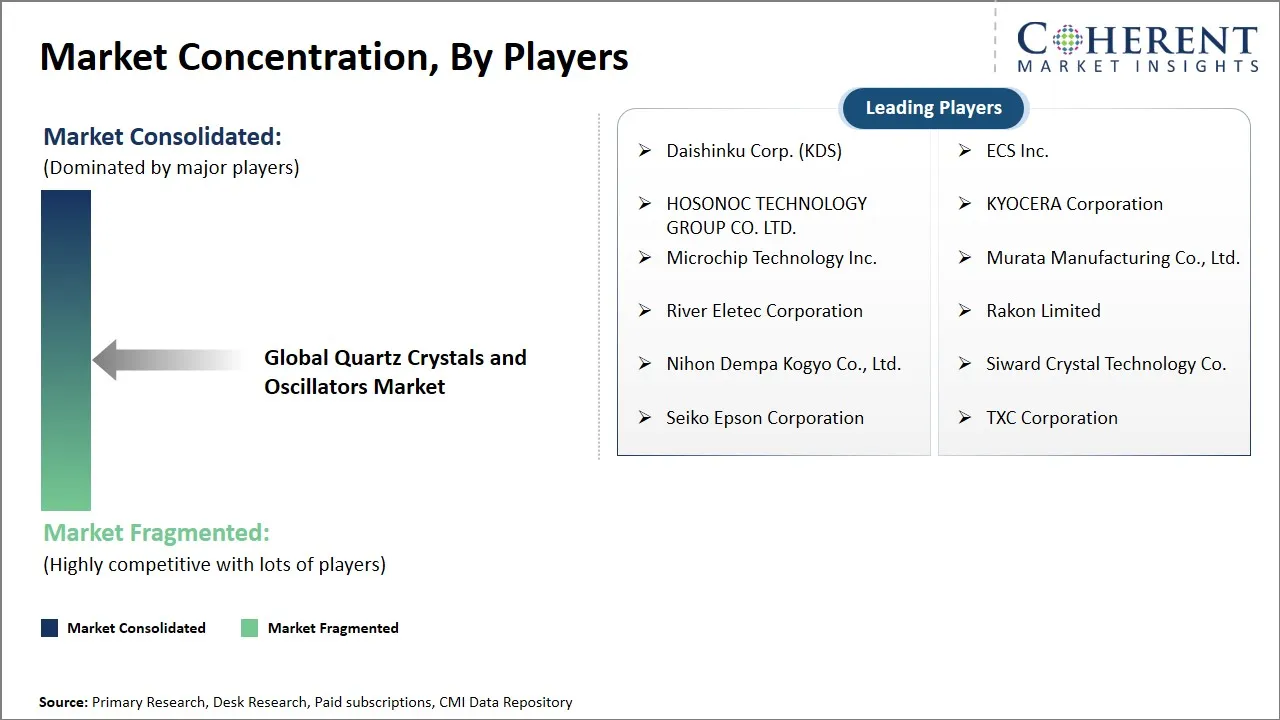
| Companies covered: | Daishinku Corp. (KDS), ECS Inc., HOSONOC TECHNOLOGY GROUP CO. LTD., KYOCERA Corporation, Microchip Technology Inc., Murata Manufacturing Co., Ltd., River Eletec Corporation, Rakon Limited, Nihon Dempa Kogyo Co., Ltd., Siward Crystal Technology Co., Seiko Epson Corporation, and TXC Corporation | ||
| Growth Drivers: |
| ||
| Restraints & Challenges: |
| ||
Market Dynamics
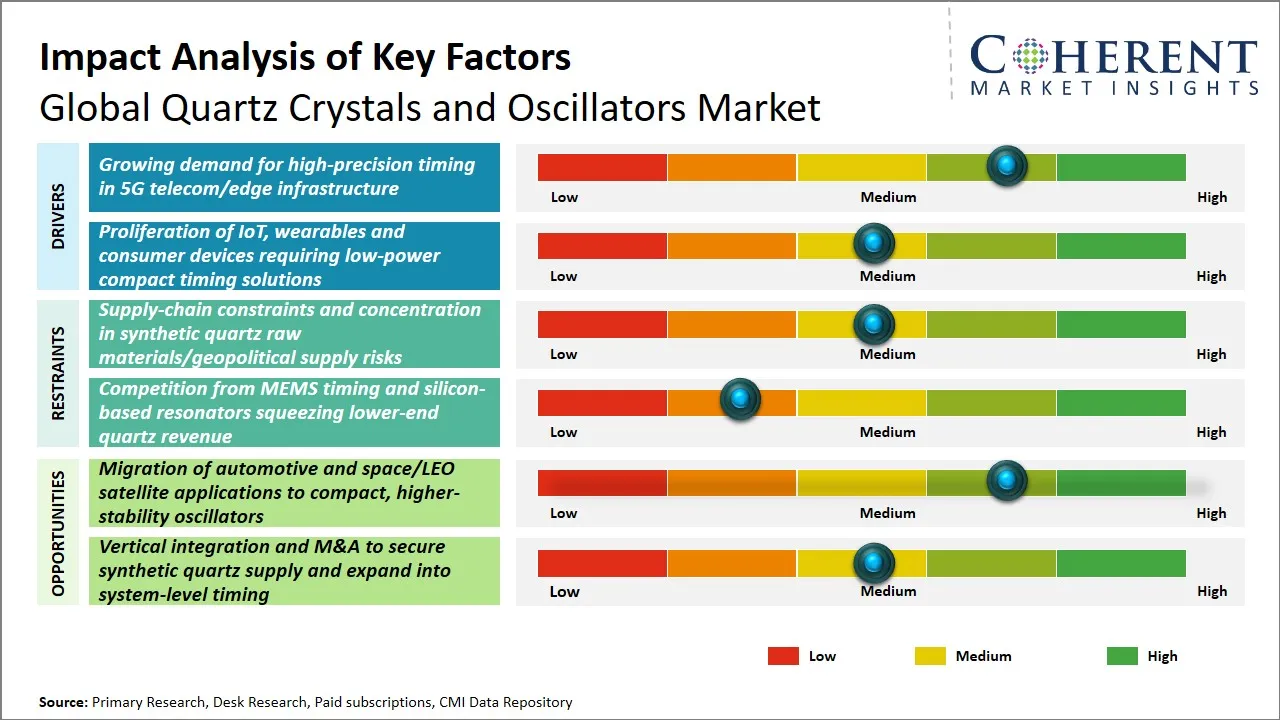
Global Quartz Crystals and Oscillators Market Driver – Growing Demand for High-Precision Timing in 5G Telecom/Edge Infrastructure
As 5G technology aims to deliver ultra-low latency, improved bandwidth, and massive connectivity, maintaining accurate synchronization in network elements is very important. Quartz crystals and oscillators provide the stable frequency references needed for these applications, allowing precise timing and frequency control in base stations, routers, and edge devices. Also, the use of Internet of Things (IoT) devices connected to 5G networks adds to this need for reliable timing solutions to manage data flow and reduce network delays. In 2023, SiTime Corporation announced that its precision timing solutions (MEMS-based oscillators) are being designed into 5G O-RAN base stations by major telecom equipment vendors.
Global Quartz Crystals and Oscillators Market Opportunity – Migration to Compact, Higher-Stability Oscillators in Automotive and Space/LEO Satellite Applications
The growing demand for compact and higher-stability oscillators in automotive and space/Low Earth Orbit (LEO) satellite applications give a big growth opportunity for the global quartz crystals and oscillators market. Modern automotive systems rely a lot on advanced driver-assistance systems (ADAS), infotainment, and telematics, all needing precise timing and frequency control to ensure safety, connectivity, and overall performance. In 2022, Nihon Dempa Kogyo Co., Ltd. (NDK) introduced its temperature-stable crystal units for automotive ADAS and EV applications, engineered to withstand high vibration and thermal fluctuations.
Similarly, the space sector, particularly with the rise in LEO satellite deployments for communication, Earth observation, and navigation, needs oscillators that can reliably maintain frequency accuracy amidst harsh radiation and thermal extremes.
Analyst Opinion (Expert Opinion)
- APAC leads the market because of high consumer electronics production in China, Taiwan, South Korea, and Japan, as well as telecom infrastructure buildout. Experts note that low-cost manufacturing hubs combined with strong domestic demand make APAC the key driver of global volume growth.
- The U.S. and Canada show a lot of demand for high-precision OCXOs, TCXOs, and MEMS-based oscillators, particularly for aerospace, defense, data centers, and advanced semiconductor applications. MEMS oscillator adoption is especially seen in wearable and IoT devices as a differentiator in North America, where cost pressures are secondary to performance and reliability.
- Europe sees steady demand from industrial automation, automotive electronics, and aerospace applications. Experts emphasize that regulatory compliance and high-reliability standards in European industries push manufacturers to adopt high-stability oscillators, making opportunities for niche high-value products rather than volume-driven growth.
Speak to the analyst
Want personalized insights?
Take the findings above to one of our principal consultants, or have the report rebuilt around the segments, geographies and competitors you actually track.
Market Segmentation
- Mounting Type Insights (Revenue, USD Bn, 2021 - 2033)
- Surface Mount
- Thru-Hole
- Circuit Type Insights (Revenue, USD Bn, 2021 - 2033)
- Temperature-compensated Crystal Oscillator (TCXO)
- Simple Packaged Crystal Oscillator (SPXO)
- Voltage-controlled Crystal Oscillator (VCXO)
- Frequency-controlled Crystal Oscillator (FCXO)
- Oven-controlled Crystal Oscillator (OCXO)
- Others
- End User Insights (Revenue, USD Bn, 2021 - 2033)
- Telecom and Networking
- Consumer Electronics
- Aerospace and Defense
- Automotive
- Industrial
- Others
- Regional Insights (Revenue, USD Bn, 2021 - 2033)
- North America
- U.S.
- Canada
- Latin America
- Brazil
- Argentina
- Mexico
- Rest of Latin America
- Europe
- Germany
- U.K.
- Spain
- France
- Italy
- Russia
- Rest of Europe
- Asia Pacific
- China
- India
- Japan
- Australia
- South Korea
- ASEAN
- Rest of Asia Pacific
- Middle East
- GCC Countries
- Israel
- Rest of Middle East
- Africa
- South Africa
- North Africa
- Central Africa
- North America
- Key Players Insights
- Daishinku Corp. (KDS)
- ECS Inc.
- HOSONOC TECHNOLOGY GROUP CO. LTD.
- KYOCERA Corporation
- Microchip Technology Inc.
- Murata Manufacturing Co., Ltd.
- River Eletec Corporation
- Rakon Limited
- Nihon Dempa Kogyo Co., Ltd.
- Siward Crystal Technology Co.
- Seiko Epson Corporation
- TXC Corporation
Sources
Primary Research Interviews
Stakeholders
- Electronics Manufacturers and OEMs (e.g., CTOs, Product Managers of semiconductor and consumer electronics companies)
- Quartz Crystal and Oscillator Manufacturers and Suppliers
- MEMS Timing Device Developers and Engineers
- Telecommunications and Networking Infrastructure Companies (e.g., 5G equipment providers)
- Automotive Electronics and ADAS System Developers
- Aerospace and Defense Electronics Specialists
- Industrial Automation and IoT Solution Providers
Databases
- Global Semiconductor Analytics Database (GSAD)
- International Electronics Market Statistics (IEMS)
- World Telecom Equipment Database (WTED)
- OECD Technology and Innovation Database
- APAC Electronics Supply Chain Tracker (AESCT)
Magazines
- Electronics Today International
- Semiconductor Digest
- Global Telecom Review
- Electronic Components & Technology Magazine
- Embedded Systems Design Magazine
Journals
- Journal of Electronic Materials and Devices
- IEEE Transactions on Ultrasonics, Ferroelectrics, and Frequency Control
- Journal of Microelectromechanical Systems (MEMS)
- Journal of Applied Physics in Electronics
- International Journal of Industrial Electronics and Automation
Newspapers
- The Electronics Times
- Global Technology Review
- Tech Industry Daily
- Semiconductor Weekly
- The Economic Times (India) – Electronics Section
Associations
- International Frequency Control Association (IFCA)
- Global Electronics Components Association (GECA)
- IEEE Ultrasonics, Ferroelectrics & Frequency Control Society
- MEMS Industry Group (MIG)
- American Electronics Manufacturers Association (AEMA)
Public Domain Sources
- U.S. Census Bureau – Electronics Manufacturing Data
- EUROSTAT – Technology & Electronics Production
- United Nations Industrial Development Organization (UNIDO) Reports
- World Bank – Global Electronics Trade Data
- ResearchGate – Open-Access Electronics & MEMS Studies
Proprietary Elements
- CMI Data Analytics Tool, Proprietary CMI Existing Repository of information for last 8 years
Get access to 250+ pages report
Every segment, forecast, competitor profile and data table behind the analysis above — available for instant download.
- ESOMAR Member
- ISO 9001:2015 Certified
- D-U-N-S Registered
- GDPR & CCPA Compliant
Missing comfort of reading report in your local language? Find your preferred language:
Transform your Strategy with Exclusive Trending Reports
Frequently Asked Questions
The global quartz crystals and oscillators market is estimated to be valued at USD 2.80 billion in 2026 and is expected to reach USD 4.83 billion by 2033.
The CAGR of global quartz crystals and oscillators market is projected to be 8.1% from 2026 to 2033.
Growing demand for high-precision timing in 5G telecom/edge infrastructure and proliferation of IoT, wearables and consumer devices requiring low-power compact timing solutions are the major factors driving the growth of the global quartz crystals and oscillators market.
Supply-chain constraints and concentration in synthetic quartz raw materials/geopolitical supply risks and competition from MEMS timing and silicon-based resonators squeezing lower-end quartz revenue are the major factors hampering the growth of the global quartz crystals and oscillators market.
In terms of mounting type, surface mount is estimated to dominate the market revenue share in 2026.
Daishinku Corp. (KDS), ECS Inc., HOSONOC TECHNOLOGY GROUP CO. LTD., KYOCERA Corporation, Microchip Technology Inc., Murata Manufacturing Co., Ltd., River Eletec Corporation, Rakon Limited, Nihon Dempa Kogyo Co., Ltd., Siward Crystal Technology Co., Seiko Epson Corporation, and TXC Corporation are the major players.
Asia Pacific is expected to lead the global quartz crystals and oscillators market in 2026.