

Global Racing Vehicle Market Size and Forecast – 2026 To 2033
The global racing vehicle market is expected to grow from USD 8.75 Bn in 2026 to USD 15.15 Bn by 2033, registering a compound annual growth rate (CAGR) of 7.2% from 2026 to 2033. The global racing vehicle market is driven by increasing technological advancements in aerodynamics and powertrain engineering. On November 5, 2025, Formula E and the Fédération Internationale de l’Automobile (FIA) revealed the all-new GEN4 race car, marking a reinvention of motorsport and the next chapter of electric racing.
Key Takeaways of the Global Racing Vehicle Market
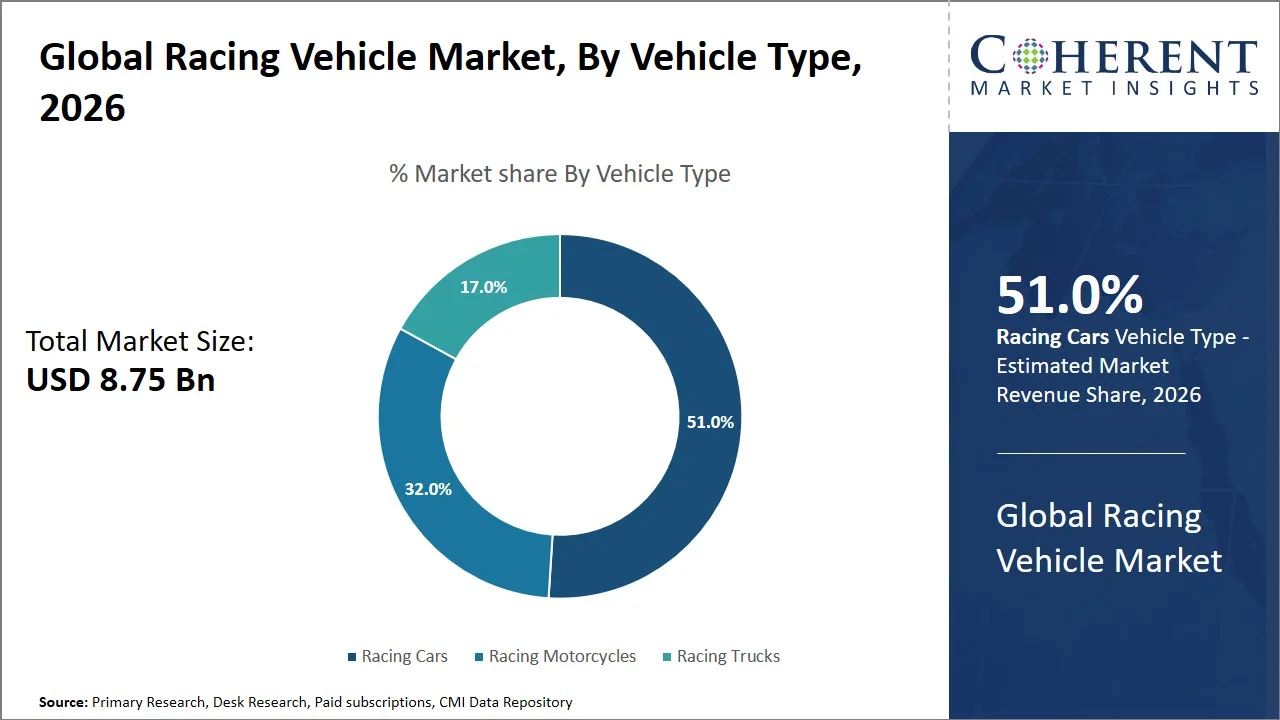
- The racing cars segment is expected to account for 51.0% of the global racing vehicle market share in 2026. Increasing popularity of grassroots and amateur racing events is driving the growth of the racing cars segment. On December 19, 2025, TOYOTA GAZOO Racing announced its 2026 motorsport program, expanding support for customer racing, Super Taikyu, Super Formula, and grassroots driver development initiatives to strengthen the pathway from amateur competition to professional motorsport.
- The internal combustion engine segment is estimated to capture 54.0% of the market share in 2026. Growing demand for high performance testing platforms for production vehicles is majorly driving the growth of the segment. On April 22, 2026, Hyundai Motor announced it will take part in the 2026 ADAC RAVENOL 24H Nürburgring race with pre-production ELANTRA N1 RP race cars. The event will serve as a test bed for a next-generation high-performance engine, which will be put through the paces of extreme endurance racing before being launched in future Hyundai N production vehicles.
- The Formula Racing segment is estimated to capture 34.0% of the market share in 2026. Higher sponsorship spending from automotive and technology brands is driving the growth of the segment. On February 11, 2025, Atlassian became the title partner of Williams Racing, signing the largest commercial partnership in the team's history.
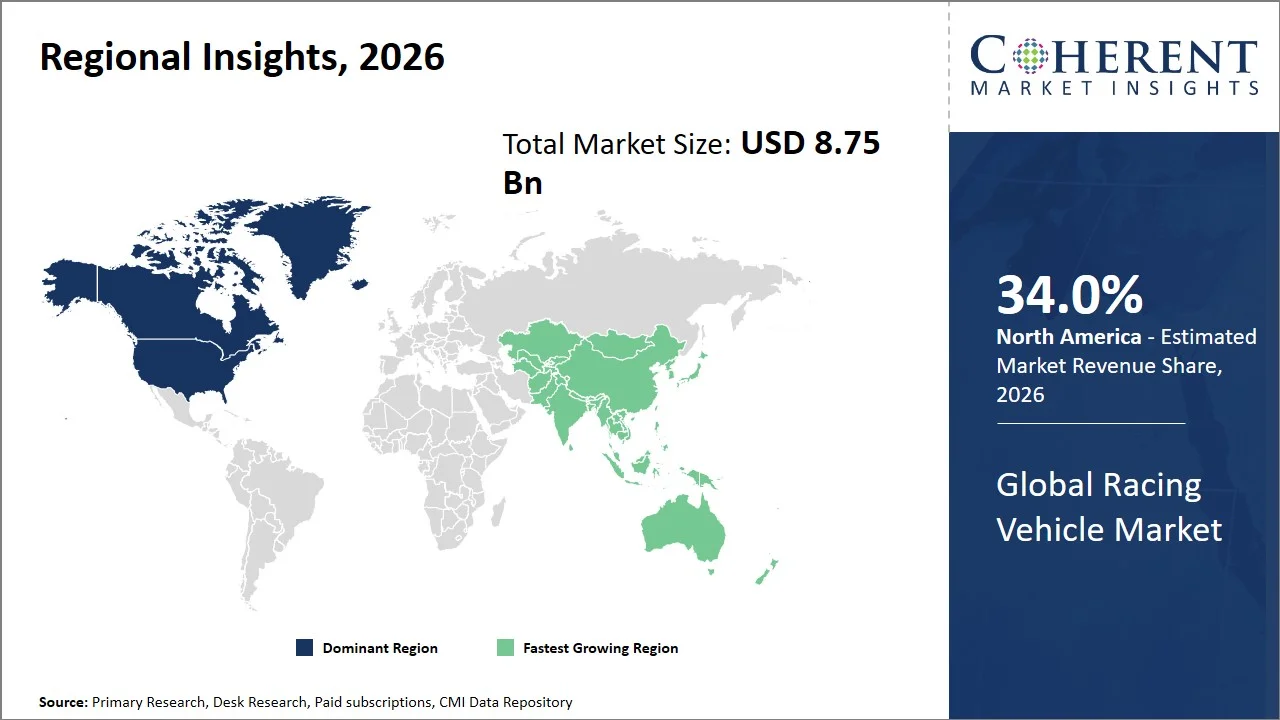
- North America is expected to dominate the racing vehicle market in 2026 with a market share of 34.0%. Increasing integration of AI based telemetry and vehicle analytics in North America is driving the growth of the regional market. On May 22, 2026, NTT, Inc., together with NTT DATA Group Corporation, announced the renewal of its sponsorship of the NTT INDYCAR SERIES. Under the renewed agreement, NTT expanded its role beyond race analytics and fan engagement to provide advanced AI and data capabilities for Penske Entertainment and INDYCAR.
- Asia Pacific is expected to account for 27.0% share in 2026 and is projected to record the fastest growth over the forecast period. Growth in simulation driven vehicle development in Asia Pacific is driving the growth of the regional market. On May 20, 2025, Hyundai Motorsport’s performance division, Genesis Magma Racing announced a partnership with Dynisma to build the GMR-001 Hypercar on the advanced DMG-360XY simulator.
- Accelerated Transition Toward Electric and Hybrid Racing Platforms: Motorsport organizations and vehicle manufacturers are investing more and more in electric and hybrid racing vehicles, to improve energy efficiency, reduce emissions and accelerate the commercialization of next generation propulsion technologies through the use of competitive racing platforms.
- Growing Integration of Artificial Intelligence and Advanced Vehicle Analytics: Racing teams are utilizing AI-powered telemetry, predictive maintenance, digital twins, and real-time performance analytics in order to optimize vehicle setup, refine race strategies, boost driver performance, and reduce component failures during competitions.
Segmental Insights
Why Does Racing Cars Dominate the Global Racing Vehicle Market?
The racing cars segment is expected to account for 51.0% of the global racing vehicle market share in 2026. Internationally renowned racing competitions such as Formula One, endurance racing, touring car racing and stock car racing are common and continue to generate demand for racing automobiles throughout professional motorsport organizations. Such competitions drive manufacturers and racing teams to invest extensively in advanced racing car platforms, via the need for constant vehicle development, regular technical upgrades and adherence to changing performance and safety requirements. The commercial ecology of racing vehicles is robust, with sponsorships, media rights and automotive research activities bolstering the leadership position of racing cars in the worldwide racing vehicle market. For instance, Audi officially entered the FIA Formula One World Championship for the 2026 season, replacing Sauber with a full factory team and developing an all-new works hybrid power unit under the new Formula One regulations.
- Current Industry Events of 2026
- Market Size Estimation
- Regional Breakdown
- Competitive Landscape
- Customer Intelligence
- Segmental Analysis
- Pricing Analysis
- Key Market Drivers, Challenges & Future Trends
- Customized Insights Section
Why is Internal Combustion Engine the Most Preferred Propulsion?
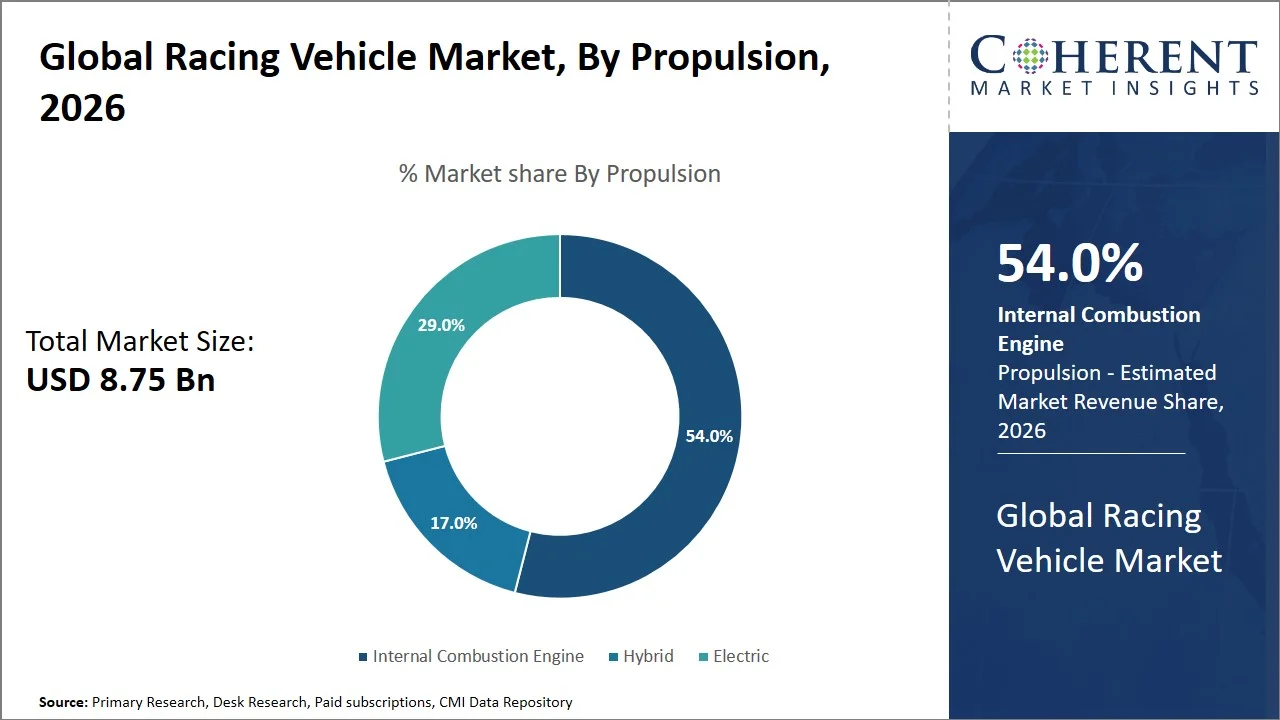
The internal combustion engine segment is expected to account for 54.0% of the global racing vehicle market share in 2026. Racing cars are propelled by internal combustion engines since they are widely employed in the world’s major motorsport categories. These engines are very powerful, quick off the throttle, and able to endure intense racing conditions. They are the result of decades of engineering refinement and come with a solid infrastructure for fuel, maintenance and technical assistance. Teams and manufacturers can produce competitive performance while continuously improving engine efficiency and durability through ongoing research and development, given their compatibility with existing racing regulations and proven reliability across several racing formats. On June 12, 2026, Ford Performance announced it would enter a new naturally aspirated 5.4-liter Coyote V8 engine in the FIA World Endurance Championship Hypercar class, using engineering knowledge gained from their Formula One partnership with Red Bull Powertrains to develop the combustion engine for Le Mans.
Formula Racing Dominates the Global Racing Vehicle Market
The Formula Racing segment is expected to account for 34.0% of the global racing vehicle market share in 2026. Formula racing is the world’s top single-seater motorsport and has a strong presence in the racing vehicle market. Major car manufacturers, technology corporations and global sponsors invest heavily in formula racing, fueling continual innovation in aerodynamics, powertrain systems, lightweight materials and vehicle electronics. Its broad international race calendar, global media attention and position as a platform for modern automotive technology means there is a continuing need for racing cars and associated engineering solutions with top performance. On March 7, 2025, Cadillac Formula 1 Team obtained permission to join the FIA Formula One World Championship in 2026 as the 11th team, with support from General Motors and TWG Motorsports.
Currents Events and their Impact
Current Events | Description and its Impact |
FIA Formula One 2026 Technical Regulations |
|
FIA 2026 Formula One Sporting, Technical and Financial Regulations |
|
Racing Vehicle Market Dynamics
Market Drivers
Rising investments in professional motorsports and racing championships
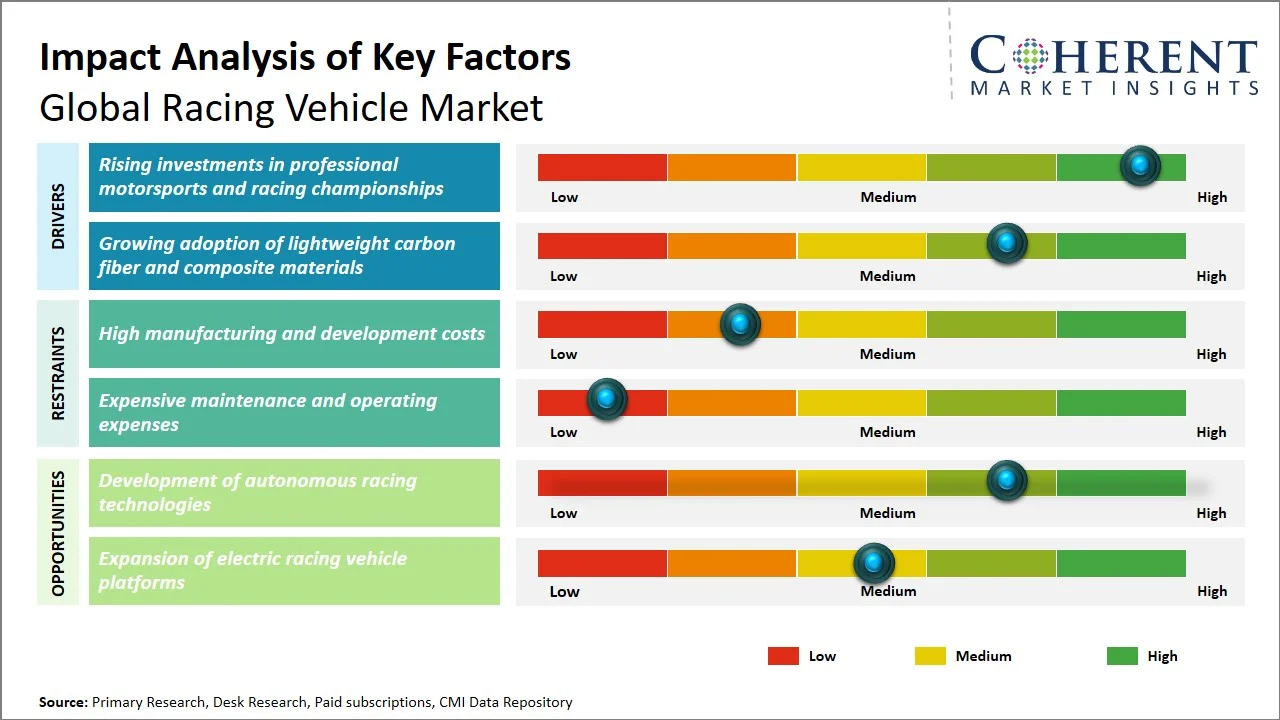
Growing investment in professional motorsports and international racing championships is driving the demand for superior racing vehicles and accompanying technologies. Car manufacturers, technology companies, sponsors and private investors are still pouring large sums into racing teams, vehicle development and motorsport infrastructure to increase brand exposure and speed up innovation. The worldwide racing calendars are increasing, broadcasting income and fan engagement are growing, which are driving the continuing development of high-performance racing vehicles, providing persistent opportunities for manufacturers, component suppliers and engineering service providers. On November 26, 2025, Mahindra Racing announced its commitment as a manufacturer to the GEN4 era of the ABB FIA Formula E World Championship, which commences from the beginning of the 2026/27 season.
Growing adoption of lightweight carbon fiber and composite materials
Growing usage of lightweight carbon fiber and advanced composite materials is greatly boosting the performance and efficiency of racing vehicles. These materials give excellent strength to weight ratios and increased structural stiffness while providing improved crash protection and reducing the overall weight of the vehicle for improved acceleration, handling, braking and fuel efficiency. Ongoing progress in composite manufacturing technology and growing investments in high-performance materials are helping racing teams and vehicle makers improve aerodynamic performance and maintain a competitive edge in numerous motorsport categories.
Emerging Trends
Increasing Adoption of Lightweight Advanced Materials and Additive Manufacturing
Manufacturers are increasing the use of carbon fiber composites, advanced alloys, and 3D-printed components to reduce vehicle weight, increase structural rigidity, accelerate development cycles, and obtain superior aerodynamic and mechanical performance.
Expansion of Sustainable Motorsport Technologies
Motorsport organizations and automotive manufacturers are aligning themselves with global sustainability and carbon reduction goals, resulting in an increase in the implementation of sustainable fuels, recyclable materials, energy recovery systems, and green manufacturing methodologies in the racing vehicle market.
Regional Insights
Why is North America a Strong Market for Racing Vehicle?
North America is expected to account for a market share of 34.0% in 2026. North America is a primary center point for the racing vehicle market, because of its high presence of NASCAR, IndyCar, IMSA SportsCar Championship, and NHRA drag racing. The U.S. boasts world-famous venues like Daytona International Speedway, Indianapolis Motor Speedway and Circuit of the Americas, all of which drive a constant need for high-performance racing vehicles and parts. These racing platforms are used by General Motors, Ford Performance, Chevrolet Performance and Toyota Racing Development to help research powertrain technology, lightweight materials and sophisticated aerodynamics that eventually find their way into production vehicles. The region is also seeing more investment in electric racing, through the ABB FIA Formula E World Championship and sustainable racing fuel programs.
Why Does the Asia Pacific Racing Vehicle Market Exhibit High Growth?
Asia Pacific is projected to account for 27.0% of the global racing vehicle market and is expected to register the fastest growth. The Asia Pacific racing vehicle market is expected to grow at a quick pace, as governments and car manufacturers increase spending in motorsport infrastructure and high-performance vehicle development. Japan continues to be the regional leader with its Super GT and Super Formula championships, while China is boosting its investment into Formula E, GT racing and local motorsport infrastructure. International circuits including Suzuka Circuit, Fuji Speedway, Mobility Resort Motegi, Shanghai International Circuit and Sepang International Circuit are important destinations for testing and competition. Toyota Gazoo Racing, Honda Racing Corporation, Nissan NISMO, Hyundai Motorsport and new Chinese manufacturers are all developing hybrid powertrains, lightweight chassis and advanced racing technology for regional and world championships.
Global Racing Vehicle Market Outlook for Key Countries
Why is the U.S. Emerging as a Major Hub in the Racing Vehicle Market?
The U.S. has one of the largest racing vehicle ecosystems in the world, boasting NASCAR, IndyCar, IMSA, SCORE off-road racing, and NHRA drag racing. To stay competitive in numerous categories manufacturers including Chevrolet, Ford, Toyota and Dodge continue to produce innovative racing platforms and engine technology. Examples of events driving continued investment in vehicle development are the Indianapolis 500, Daytona 500 and Rolex 24 at Daytona. Engineering firms in North Carolina’s Motorsport Valley focus on chassis design, simulation and advanced manufacturing. The country’s leadership position in racing car innovation is further reinforced by the increasing acceptance of hybrid racing technology and sustainable fuels in the country.
Is the U.K. the Next Growth Engine for the Racing Vehicle Market?
The U.K. is the global engineering center for Formula One, with seven of the ten teams based in the country’s Motorsport Valley with important engineering or operational facilities. McLaren Racing, Williams Racing, Aston Martin Aramco Formula One Team, Mercedes-AMG High Performance Powertrains and Red Bull Racing Technologies are among the companies developing cutting-edge aerodynamics, hybrid power units, simulation software and carbon fiber structures. The Silverstone Circuit is still considered one of the world’s most influential motorsport grounds, with a number of specialty vendors supporting quick prototyping, composite manufacturing and precise engineering for international racing championships.
Germany Racing Vehicle Market Analysis and Trends
Germany is a key player with its world-famous automotive engineering skills and high manufacturer involvement in endurance racing, GT championships and customer motorsport programs. Porsche Motorsport, BMW M Motorsport, Mercedes-AMG Motorsport and Audi Sport are still developing sophisticated racing cars with hybrid technology, lightweight design and highly efficient engines. The Nürburgring Nordschleife is the world’s leading proving ground where manufacturers test the endurance and performance of vehicles before putting them on the road. German experience in powertrains, motorsport electronics and precision manufacturing development continues to impact racing vehicle innovation around the globe.
Japan Racing Vehicle Market Analysis and Trends
Japan’s racing vehicle development is among the best in the world, owing to the success of its Super GT, Super Formula and international endurance racing programs. Toyota Gazoo Racing and Honda Racing Corporation are investing extensively in hybrid propulsion systems, sophisticated combustion technologies and lightweight vehicle chassis, while Nissan NISMO remains involved in GT racing and customer motorsport. High-profile car testing and international events like Suzuka Circuit and Fuji Speedway allow manufacturers to fine-tune aerodynamics, chassis dynamics and powertrain efficiency in a challenging racing environment. Japan has created a number of motorsport technology that are often transferred to high performance commercial vehicles.
Italy Racing Vehicle Market Analysis and Trends
Italy is a major player in the racing vehicle market because of the concentration of premium performance manufacturers and world-class motorsport engineering knowledge. Ferrari, Lamborghini Squadra Corse, Dallara Automobili and Ducati Corse constantly design state-of-the-art racing cars for Formula One, endurance racing, GT racing and motorcycle championships. The Autodromo Nazionale Monza and Imola Circuit continue to be some of the most prestigious racing facilities in Europe, with a lot of testing and international motorsport events. Italy is also a world leader in carbon fiber construction, aerodynamic design and custom chassis engineering, which provide important sources of high-performance racing technologies for international motorsport programs.
Global Racing Vehicle Market - Global Motorsport Championship Participation Trends
Motorsport Championship | Active Championship Status (2025–2026) | Registered Teams / Entries | Manufacturer Participation | Annual Race Events |
Formula One (F1) | Global premier single-seater championship with 11 teams from 2026 following Cadillac’s entry | 10 teams in 2025, expanding to 11 teams from 2026 with 22 full-time drivers | Ferrari, Mercedes, Red Bull Ford Powertrains, McLaren, Aston Martin Honda, Alpine, Audi, Cadillac General Motors, Williams, Haas, Racing Bulls | 24 Grands Prix in 2025 calendar |
FIA World Endurance Championship (WEC) | Global endurance racing championship featuring Hypercar and LMGT3 categories | 18 Hypercar entries and over 40 total cars across Hypercar and LMGT3 categories in 2025 | Toyota, Ferrari, Porsche, BMW, Cadillac, Alpine, Peugeot, Aston Martin, Lamborghini, Genesis from 2026 | 8 rounds including 24 Hours of Le Mans |
Formula E | Global electric single-seater championship focused on electric vehicle technology development | 11 teams and 22 drivers in Season 11 (2024–2025) | Porsche, Jaguar, Nissan, Mahindra, Maserati, DS Automobiles, Nissan, Lola Yamaha ABT, Cupra Kiro | 16 races in 2025 season |
NASCAR Cup Series | Leading stock car racing championship in North America | 36 chartered teams and approximately 40 race entries including open teams | Chevrolet, Ford, Toyota | 36 points-paying races plus exhibition events |
Super GT (Japan) | Japan’s leading GT racing championship with international recognition | Around 15–20 GT500 and GT300 cars per season | Toyota, Honda, Nissan in GT500; Lexus, Toyota, Honda, Nissan, BMW, Mercedes-AMG, Ferrari, Porsche in GT300 | 8 rounds annually |
How is the Development of Autonomous Racing Technologies Creating New Growth Opportunities in the Racing Vehicle Market?
The development of autonomous racing technologies is creating new growth prospects in the racing vehicle market by driving innovation in artificial intelligence, machine learning, autonomous navigation, sensor fusion and high-speed decision-making systems. The Abu Dhabi Autonomous Racing League and the Indy Autonomous Challenge, for example, provide automotive manufacturers, technology companies and research institutions with the opportunity to validate autonomous driving software under extreme racing conditions, a major reduction in development cycles for future mobility solutions. These initiatives are also driving demand for advanced computing platforms, lidar, radar, high-resolution cameras, vehicle-to-everything communication systems and simulation software, while spurring collaborations between motorsports organizations and autonomous technology developers to commercialize next-generation intelligent vehicle technologies.
On July 1, 2026, the Abu Dhabi Autonomous Racing League (A2RL) announced it will take its autonomous motorsport platform to new heights, with Season 2 set to take place at Yas Marina Circuit. The improved Dallara-built autonomous race cars will see 11 international teams battle it out using sophisticated AI driving technologies.
Market Players, Key Development, and Competitive Intelligence
Key Developments
- On February 18, 2025, Red Bull introduced the RB21 Formula One car in February 2025, featuring design refinements focused on aerodynamic efficiency and performance optimization while preparing the team for the transition toward the next generation of Formula One regulations.
- On December 12, 2024, Porsche announced its extensive motor racing commitments for the 2025 season. In the FIA World Endurance Championship WEC, the Porsche Penske Motorsport works team is determined to win the 24 Hours of Le Mans and the manufacturers’ title with the 963 hybrid prototype.
Competitive Landscape
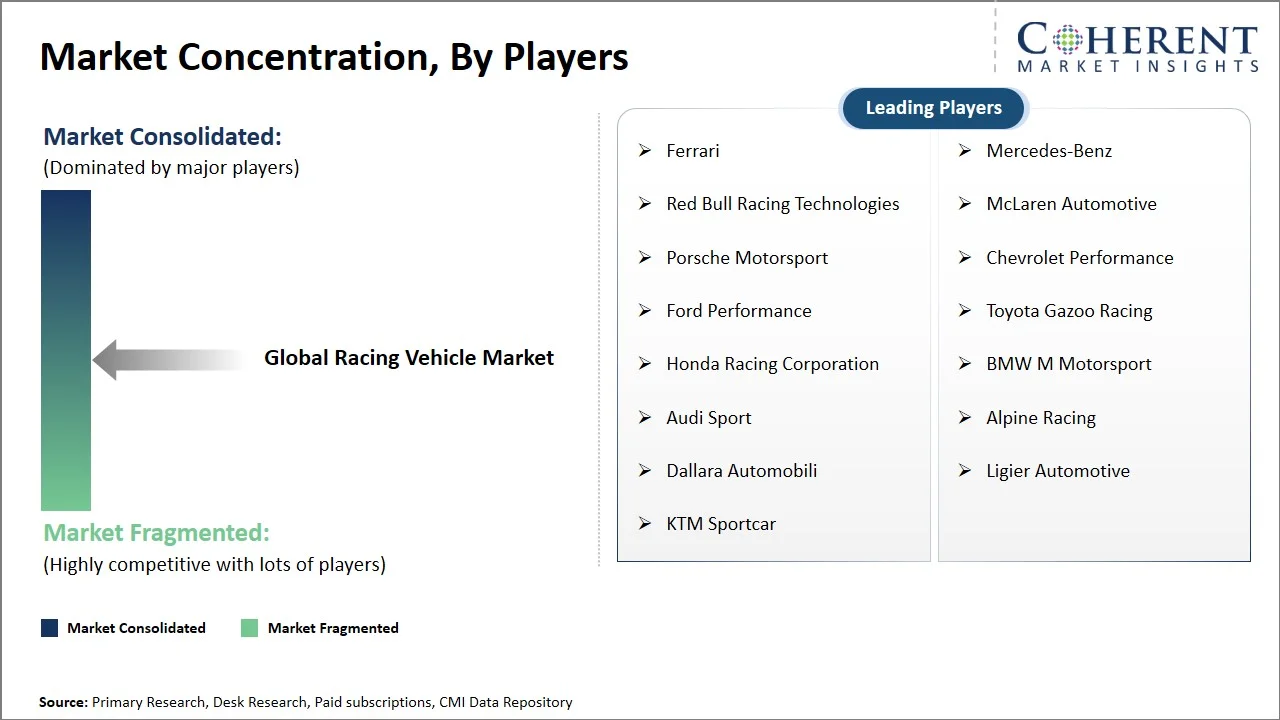
The global market for racing vehicles is highly competitive. Specialized race car manufacturers, automotive OEMs, engineering businesses and technology suppliers compete on the basis of constant innovation and not on volume of production. Ferrari, Dallara Automobili, McLaren Automotive, Ligier Automotive, Porsche Motorsport, Red Bull Racing Technologies and Honda Racing Corporation are investing heavily in proprietary chassis architectures, hybrid propulsion systems, advanced aerodynamics and digital engineering capabilities to gain competitive advantages across the spectrum of Formula racing, endurance racing, GT racing and customer motorsport programs. With racing teams striving for shorter vehicle development cycles and improved on-track performance, even as the technical regulations keep changing, strategic collaborations with simulation software companies, suppliers of composite materials, battery developers, and telemetry specialists are becoming more and more important.
Market Report Scope
Racing Vehicle Market Report Coverage
| Report Coverage | Details | ||
|---|---|---|---|
| Base Year: | 2025 | Market Size in 2026: | USD 8.75 Bn |
| Historical Data for: | 2020 To 2024 | Forecast Period: | 2026 To 2033 |
| Forecast Period 2026 to 2033 CAGR: | 7.20% | 2033 Value Projection: | USD 15.15 Bn |
| Geographies covered: |
| ||
| Segments covered: |
| ||
| Companies covered: | Ferrari, Mercedes-Benz, Red Bull Racing Technologies, McLaren Automotive, Porsche Motorsport, Chevrolet Performance, Ford Performance, Toyota Gazoo Racing, Honda Racing Corporation, BMW M Motorsport, Audi Sport, Alpine Racing, Dallara Automobili, Ligier Automotive, and KTM Sportcar | ||
| Growth Drivers: |
| ||
| Restraints & Challenges: |
| ||
Analyst Opinion (Expert Opinion)
- The racing vehicle market is anticipated to be driven more by technology transfer than by the growth in quantities of racing events. Software-defined vehicle architecture, AI-enabled race engineering, sustainable propulsion systems and digital twin validation are some of the areas with more focus, with investments being made in technologies that can be commercialized in premium passenger vehicles and performance mobility solutions. It also is pushing competitive differentiation through the capacity to integrate modern electronics, lightweight materials and data-driven vehicle optimization within increasingly demanding technical and sustainability frameworks.
- Looking ahead, the future of the racing vehicle market is projected to be shaped by the confluence of electrification, sustainable fuels, autonomous technology, and advanced digital engineering. Expect the vehicle design and development process to be reshaped by wider adoption of high-performance battery systems, hydrogen-compatible racing concepts, cloud-connected telemetry platforms and additive manufacturing. The competitive landscape of the next decade is anticipated to be more technology-intensive and innovation-driven, driven by the expansion of customer racing programs, the growing participation of new automotive manufacturers, and the use of artificial intelligence in vehicle setup, predictive maintenance and race strategy.
Speak to the analyst
Want personalized insights?
Take the findings above to one of our principal consultants, or have the report rebuilt around the segments, geographies and competitors you actually track.
Market Segmentation
- Vehicle Type Insights (Revenue, USD Billion, 2021 - 2033)
- Racing Cars
- Racing Motorcycles
- Racing Trucks
- Propulsion Insights (Revenue, USD Billion, 2021 - 2033)
- Internal Combustion Engine
- Hybrid
- Electric
- Racing Type Insights (Revenue, USD Billion, 2021 - 2033)
- Formula Racing
- NASCAR
- Rally Racing
- Endurance Racing
- Drag Racing
- Regional Insights (Revenue, USD Billion, 2021 - 2033)
- North America
- U.S.
- Canada
- Latin America
- Brazil
- Argentina
- Mexico
- Rest of Latin America
- Europe
- Germany
- U.K.
- Spain
- France
- Italy
- Russia
- Rest of Europe
- Asia Pacific
- China
- India
- Japan
- Australia
- South Korea
- ASEAN
- Rest of Asia Pacific
- Middle East
- GCC Countries
- Israel
- Rest of Middle East
- Africa
- South Africa
- North Africa
- Central Africa
- North America
Sources
Primary Research Interviews
- Racing Vehicle Manufacturers & OEMs
- Racing Team Managers & Engineers
- Motorsport Event Organizers & Promoters
- Automotive Component Suppliers & Distributors
Magazines
- Autosport Magazine
- Motorsport News
- Race Engine Technology
- Car and Driver
Journals
- International Journal of Vehicle Design
- Journal of Automobile Engineering
- Journal of Motorsport Engineering and Technology
Associations
- Federation Internationale de l'Automobile (FIA)
- Sports Car Club of America (SCCA)
- Motorsports Association (MSA)
- National Association for Stock Car Auto Racing (NASCAR)
Public Domain Sources
- U.S. Department of Transportation (DOT) Reports
- European Automobile Manufacturers Association (ACEA) Publications
- United Nations Economic Commission for Europe (UNECE) Vehicle Regulations
- World Motor Sport Council (WMSC) Publications
Proprietary Elements
- CMI Data Analytics Tool
- Proprietary CMI Existing Repository of Information for the Last 10 Years
Get access to 250+ pages report
Every segment, forecast, competitor profile and data table behind the analysis above — available for instant download.
- ESOMAR Member
- ISO 9001:2015 Certified
- D-U-N-S Registered
- GDPR & CCPA Compliant
Missing comfort of reading report in your local language? Find your preferred language:
Transform your Strategy with Exclusive Trending Reports
Frequently Asked Questions
The global racing vehicle market is expected to stand at USD 8.75 Bn in 2026 and is expected to reach USD 15.15 Bn by 2033.
The CAGR of the global racing vehicle market is projected to be 7.2% from 2026 to 2033.
Rising investments in professional motorsports and racing championships and growing adoption of lightweight carbon fiber and composite materials are the major factors driving the growth of the global racing vehicle market.
High manufacturing and development costs and expensive maintenance and operating expenses are the major factors hampering the growth of the global racing vehicle market.
In terms of vehicle type, the racing cars segment is estimated to dominate the market revenue share in 2026.
Carbon fiber composites improve acceleration, handling, fuel efficiency, and structural strength by significantly reducing vehicle weight.
Artificial intelligence enhances race strategy, vehicle diagnostics, predictive maintenance, and real-time performance optimization.