

Global Reaction Wheel Market Size and Forecast: 2026-2033
The Global Reaction Wheel Market is estimated to be valued at USD 712.0 Mn in 2026 and is expected to reach USD 1,352.5 Mn by 2033, exhibiting a compound annual growth rate (CAGR) of 9.6% from 2026 to 2033.
Key Takeaways of the Reaction Wheel Market
- The single wheel segment leads the market holding an estimated share of 67.1% in 2026.
- North America is estimated to lead the market with a share of 38. 7% in 2026.
- Asia Pacific, holding a share of 19. 7% in 2026, is projected to be the fastest growing region.
Market Overview
The market is seeing a strong focus on improving reaction wheel efficiency and reliability because of the rising adoption of small satellites and the expansion of space exploration missions. Also, innovations in materials and manufacturing processes are making possible the development of lighter, more compact reaction wheels, supporting the trend toward miniaturization and cost-effectiveness in spaceborne instruments. Growing investments in defense and commercial satellite sectors further fuel the market’s upward trajectory.
Current Events and their Impact
Current Events | Description and its impact |
Geopolitical and Trade Developments |
|
Economic and Infrastructure Trends |
|
Segmental Insights
- Current Industry Events of 2026
- Market Size Estimation
- Regional Breakdown
- Competitive Landscape
- Customer Intelligence
- Segmental Analysis
- Pricing Analysis
- Key Market Drivers, Challenges & Future Trends
- Customized Insights Section
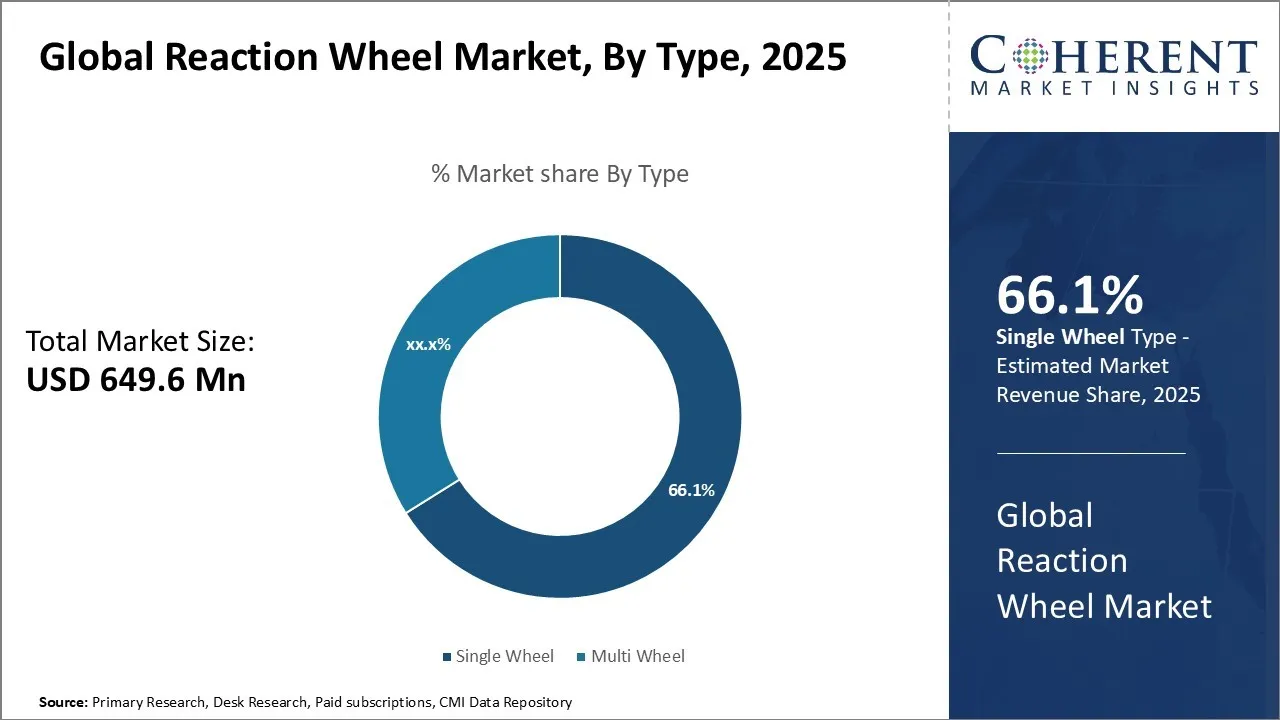
Global Reaction Wheel Market Insights, By Type – Single Wheel Leads Owing to its Simplicity and Cost-Effectiveness
The single wheel segment is expected to command the largest share of 67.1% in 2026. Single wheel reaction devices are used in a lot of spacecraft, especially small satellites and CubeSats because of their relatively simple mechanical structure which translates to reduced manufacturing and maintenance costs. Also, their efficiency in providing precise attitude control for missions with less complex maneuvering needs adds to their demand. Many small to medium-sized satellites use single reaction wheels as they provide sufficient torque for typical orientation adjustments without the need for the additional weight and complexity associated with multi-wheel systems.
To add, the rising demand for cost-sensitive space missions conducted by emerging space agencies and private companies is adding to segment growth. Additionally, advancements in materials and design technology have enhanced the reliability and performance of single wheel systems, alleviating previous concerns related to potential mechanical failures. The scalability of single wheel reaction wheels also makes them useful for different spacecraft sizes and mission types. Being lighter and requiring less structural support, they are well-suited for small platforms where weight and space are at a premium.
Impact of Artificial Intelligence (AI) on the Reaction Wheel Market
The integration of Artificial Intelligence (AI) in the reaction wheel market is significantly enhancing satellite performance and operational reliability. AI-driven algorithms are being used for predictive maintenance, enabling onboard systems to detect early signs of wear, imbalance, or malfunction in reaction wheels before they lead to mission failure. By analyzing telemetry and sensor data in real time, AI models can forecast anomalies in wheel speed, temperature, or torque demand, allowing satellites to switch to redundant systems or adjust operational parameters autonomously.
A real-world example is NASA’s use of AI-based fault diagnostics in the Artemis program’s small satellite payloads, which include reaction wheels from suppliers like Blue Canyon Technologies. These AI systems continuously monitor attitude control data and dynamically adjust control logic to prevent attitude drift or hardware stress.
Regional Insights
North America Reaction Wheel Market Analysis and Trends
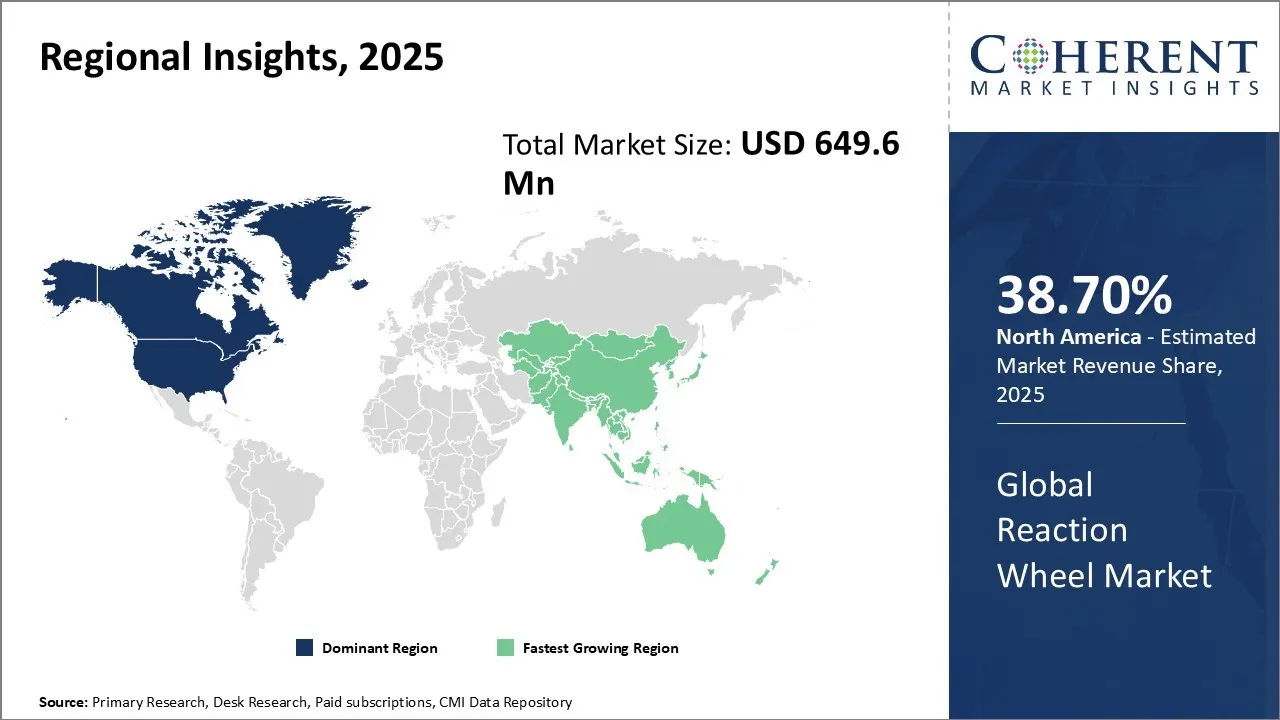
North America, holding a share of 38.70% in 2026, is expected to dominate the global reaction wheel market, driven by a mature aerospace and defense ecosystem, strong government investments in space exploration, and advanced technology infrastructure. The presence of major space agencies such as NASA, coupled with a robust network of research institutions and private space companies, fosters continuous innovation in reaction wheel technology.
Favorable government policies promoting space missions and satellite deployments further bolster market leadership. Key industry players like Honeywell International Inc., Blue Canyon Technologies, and Blue Origin contribute significantly by developing high-performance reaction wheels, catering to both government and commercial satellite needs. In April 2026, Blue Canyon Technologies launched the RW16, a new generation reaction wheel capable of delivering up to 16 N·m·s momentum storage, the highest in their product line.
Asia Pacific Reaction Wheel Market Analysis and Trends
The Asia Pacific region, holding a share of 19.7% in 2026, is expected to exhibit the fastest growth in the global reaction wheel market due to rapidly expanding space programs, increasing defense budgets, and heightened investment in satellite technologies by countries like China, India, and Japan. Government initiatives aimed at advancing indigenous satellite manufacturing capabilities and fostering local innovation have stimulated the demand for reaction wheels. CubeSpace, although headquartered in South Africa, has rapidly expanded its market footprint in the Asia Pacific region—especially in India and Southeast Asia—by offering ultra-compact reaction wheels with high pointing accuracy for CubeSats.
The growing presence of domestic companies such as China’s China Aerospace Science and Technology Corporation (CASC), India’s Antrix Corporation, and Japan’s NEC Corporation highlight the region’s drive toward self-reliance in aerospace components. Additionally, burgeoning commercial space ventures and international collaborations have accelerated technology adoption.
Global Reaction Wheel Market Outlook for Key Countries
U.S. Reaction Wheel Market Analysis and Trends
The U.S. reaction wheel market benefits from its deep-rooted aerospace sector and cutting-edge innovation culture. Leading contractors and manufacturers, including Honeywell International Inc., actively supply advanced reaction wheels for NASA’s manned and unmanned missions as well as the commercial satellite industry. The U.S. government’s substantial funding of space exploration programs and defense modernization supports ongoing research and development in reaction wheel technologies. Additionally, collaborations between private companies like Blue Canyon Technologies and governmental agencies drive rapid advancements, ensuring the U.S. retains a competitive edge globally.
China Reaction Wheel Market Analysis and Trends
China reflects strong state support through its rapidly expanding space program managed by key players such as the China Aerospace Science and Technology Corporation (CASC). The country’s initiatives like the Chang’e lunar missions and BeiDou satellite navigation system require sophisticated reaction wheels to enable precision attitude control. Emphasis on domestic manufacturing capacity and technology indigenization has led to significant investments in reaction wheel development.
India Reaction Wheel Market Analysis and Trends
India reaction wheel market growth is fueled by the Indian Space Research Organisation (ISRO), which continuously expands its satellite deployment and space exploration ambitions. ISRO’s focus on developing reliable, cost-effective reaction wheels suited for small to medium-scale satellites encourages the emergence of local manufacturers and suppliers. Indian aerospace companies, supported by governmental policies emphasizing Make in India, are ramping up production and R&D efforts.
Japan Reaction Wheel Market Analysis and Trends
Japan continues to lead in precision engineering and space technology applications with companies like NEC Corporation and Mitsubishi Electric Corporation playing pivotal roles in advanced reaction wheel development. The country’s well-established space agency, JAXA, promotes innovation by supporting satellite missions that require highly reliable attitude control systems.
France Reaction Wheel Market Analysis and Trends
France benefits from its robust aerospace industry centered around major players like Airbus Defence and Space and Thales Alenia Space. The French government’s commitment to the European Space Agency’s initiatives and satellite programs supports steady demand for high-quality reaction wheels. Strategic European collaborations and a well-integrated aerospace supply network enhance France’s capacity to deliver innovative space components.
Market Players, Key Development, and Competitive Intelligence
Key Developments
- In July 2025, CubeSpace, a provider of high-performance ADCS subsystems, extended its range of flight-proven Reaction Wheels to include several MicroSat options, showcasing robust solutions that address critical industry needs for shorter lead times, increased affordability, and uncompromising reliability.
- In May 2025, CubeSpace announced that it has hit record 40 reaction wheels/week, shipping 300+ ADCS products in February. These deliveries included over 80 wheels, 40 of which were the larger 0.5Nms (CW0500) model, alongside 27 fully customized ADCS systems.
- In April 2025, RTX’s small satellite manufacturer and mission services provider, Blue Canyon Technologies, introduced its largest reaction wheel to date, the RW16 reaction wheel. The new RW16 reaction wheel offers 16 Newton-meter seconds of momentum, providing low-jitter attitude control for spacecraft 400 kg and larger.
- In August 2024, Blue Canyon launched several smallsats via the SpaceX Transporter-11 rideshare mission. Onboard this launch, Blue Canyon Technologies provided two 6U CubeSats, a custom microsatellite for weather monitoring, seven high-performance FleXcore attitude control systems, two XACT attitude control systems, 12 flight sets of reaction wheels, four coarse sun sensors, six torque rods, and a nano star tracker.
Top Strategies Followed by the Global Reaction Wheel Market Players
- Established market leaders primarily focus on heavy investments in research and development (R&D) to innovate and deliver high-performance, reliable reaction wheels that meet the ever-evolving demands of aerospace, satellite, and defense applications.
- Blue Canyon Technologies’ RW16, launched in April 2025, is a high-torque reaction wheel designed for larger spacecraft. The product features enhanced durability, integrated telemetry, and health monitoring systems, demonstrating their commitment to innovation and leadership in next-gen ADCS hardware.
- Mid-level competitors in the reaction wheel market adopt a more balanced approach focused on affordability and practical utility. Recognizing the growing demand from price-sensitive customers, these companies emphasize delivering cost-effective reaction wheel solutions that do not compromise essential performance or reliability.
- NewSpace Systems (South Africa), which serves a wide APAC customer base, offers flight-proven reaction wheels compatible with small satellites and CubeSats.
- Small-scale players in the reaction wheel market, despite limited resources, carve out valuable niches by focusing on specialized features or pioneering innovative designs tailored to specific applications.
- Astro- und Feinwerktechnik Adlershof GmbH focuses on custom-engineered reaction wheel assemblies for high-precision scientific payloads, including ESA’s interplanetary and observation missions.
Market Report Scope
Reaction Wheel Market Report Coverage
| Report Coverage | Details | ||
|---|---|---|---|
| Base Year: | 2025 | Market Size in 2026: | USD 712.0 Mn |
| Historical Data for: | 2020 To 2024 | Forecast Period: | 2026 To 2033 |
| Forecast Period 2026 to 2033 CAGR: | 9.6% | 2033 Value Projection: | USD 1,352.5 Mn |
| Geographies covered: |
| ||
| Segments covered: |
| ||
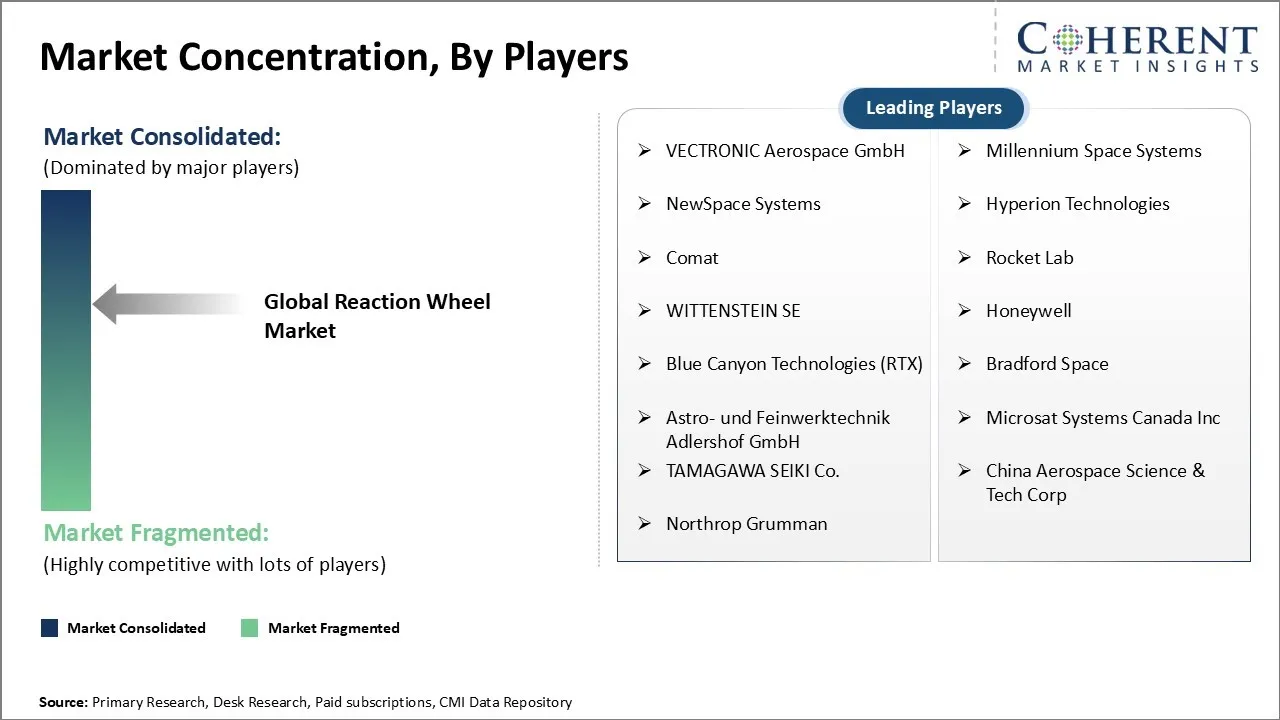
| Companies covered: | VECTRONIC Aerospace GmbH, Millennium Space Systems, NewSpace Systems, Hyperion Technologies, Comat, Rocket Lab, WITTENSTEIN SE, Honeywell, Blue Canyon Technologies (RTX), Bradford Space, Astro- und Feinwerktechnik Adlershof GmbH, Microsat Systems Canada Inc, TAMAGAWA SEIKI Co., China Aerospace Science & Tech Corp, and Northrop Grumman | ||
| Growth Drivers: |
| ||
| Restraints & Challenges: |
| ||
Market Dynamics
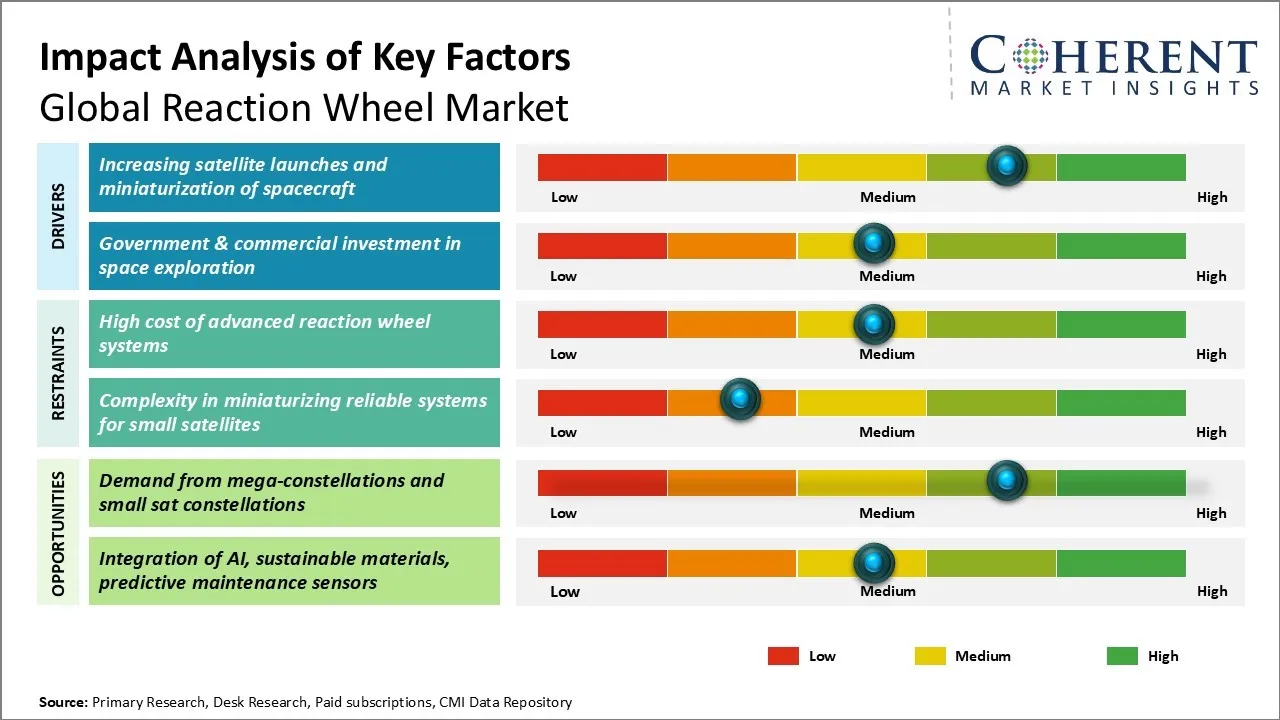
Global Reaction Wheel Market Driver – Increasing Satellite Launches and Miniaturization of Spacecraft
The surge in satellite launches, fueled by advancements in space technology and the growing need for enhanced communication, earth observation, and scientific missions, has significantly propelled the demand for reaction wheels. As satellite operators focus on maximizing efficiency and reducing costs, there is an ongoing shift towards miniaturized spacecraft, including small satellites and CubeSats, which require compact yet highly reliable attitude control systems. Reaction wheels play a crucial role in maintaining precise orientation and stability of these spacecrafts without expending propellant, making them indispensable for extended mission durations and complex maneuvers in orbit.
The trend towards smaller satellites equipped with sophisticated payloads demands lightweight, energy-efficient, and durable reaction wheel assemblies that can seamlessly integrate into limited onboard space. In June 2024, ISRO (India) successfully deployed 36 small satellites in a single PSLV launch, many of which were CubeSats under 10 kg. These miniature satellites rely heavily on compact and lightweight reaction wheels for precise attitude control due to the absence of chemical thrusters.
Global Reaction Wheel Market Opportunity – Growing Demand from Mega-Constellations and Small Satellite Constellations
With rapid advancements in satellite miniaturization and lowered launch costs, numerous private and governmental entities are deploying extensive networks of small satellites aimed at providing global broadband services, Earth observation, and IoT connectivity. These constellations often require precise and reliable attitude control systems to maintain optimal orientation for communication, data collection, and power management.
Reaction wheels, known for their high precision and efficiency in angular momentum control without expending propellant, are increasingly becoming the preferred solution for such applications. The rise of mega-constellations, such as those initiated by companies like SpaceX’s Starlink and OneWeb, involves deploying thousands of satellites in low Earth orbit, which drives substantial demand for compact, lightweight, and energy-efficient reaction wheel systems tailored to small satellite form factors.
Analyst Opinion (Expert Opinion)
- As reaction wheels are classified under dual-use technologies due to their applicability in both civilian and defense space missions, countries like the U.S. are reinforcing export controls (e.g., ITAR regulations). This limits cross-border collaboration and restricts the flow of advanced reaction wheel components to certain regions, posing compliance challenges for manufacturers and buyers alike.
- With the increasing deployment of satellites equipped with reaction wheels, global regulators (e.g., FCC, ESA, ISRO) are introducing stricter policies on end-of-life deorbiting and fault tolerance. Reaction wheel systems are now expected to integrate self-fault diagnostics and safe-mode protocols to prevent attitude instability, which could lead to space debris risks.
- Despite rapid innovation in smallsat reaction wheels, many emerging markets operate without clear regulatory guidelines for certifying the safety and reliability of miniaturized ADCS components. This regulatory gap may slow commercialization or create inconsistencies in system quality, calling for an international standards body to harmonize testing and flight qualification benchmarks.
Speak to the analyst
Want personalized insights?
Take the findings above to one of our principal consultants, or have the report rebuilt around the segments, geographies and competitors you actually track.
Market Segmentation
- Type Insights (Revenue, USD Mn, 2021 - 2033)
- Single Wheel
- Multi Wheel
- Regional Insights (Revenue, USD Mn, 2021 - 2033)
- North America
- U.S.
- Canada
- Latin America
- Brazil
- Argentina
- Mexico
- Rest of Latin America
- Europe
- Germany
- U.K.
- Spain
- France
- Italy
- Russia
- Rest of Europe
- Asia Pacific
- China
- India
- Japan
- Australia
- South Korea
- ASEAN
- Rest of Asia Pacific
- Middle East
- GCC Countries
- Israel
- Rest of Middle East
- Africa
- South Africa
- North Africa
- Central Africa
- North America
- Key Players Insights
- VECTRONIC Aerospace GmbH
- Millennium Space Systems
- NewSpace Systems
- Hyperion Technologies
- Comat
- Rocket Lab
- WITTENSTEIN SE
- Honeywell
- Blue Canyon Technologies (RTX)
- Bradford Space
- Astro- und Feinwerktechnik Adlershof GmbH
- Microsat Systems Canada Inc.
- TAMAGAWA SEIKI Co.
- China Aerospace Science & Tech Corp.
- Northrop Grumman
Sources
Primary Research Interviews
Stakeholders
- Satellite Manufacturers and Integrators (e.g., Project Engineers, Payload Specialists)
- Reaction Wheel and ADCS Component Suppliers
- Space Agencies and Defense Organizations (e.g., ISRO, NASA, ESA engineers)
- Aerospace Systems Integrators
- CubeSat and SmallSat Developers (e.g., University Labs, Startups)
- Space Mission Planning Consultants and Attitude Control System Experts
Databases
- AeroSpaceTech Global Data Repository
- National Space Science Data Center (NSSDC)
- Orbital Systems Market Intelligence Database (OSMID)
- Space Applications Statistics Platform (SASP)
Magazines
- Satellite Systems Today
- Aerospace Engineering Review
- Small Satellite News Digest
- Attitude Control & Propulsion Magazine
Journals
- Journal of Spacecraft and Rockets
- Aerospace Systems Engineering Journal
- Acta Astronautica
- Journal of Guidance, Control, and Dynamics
Newspapers
- The Orbital Times
- SpaceTech Daily
- Aerospace Business News
- The Global Space Observer
Associations
- International Association of Satellite Systems Engineers (IASSE)
- Global Small Satellite Alliance (GSSA)
- Aerospace Components Industry Network (ACIN)
- American Institute of Aeronautics and Astronautics (AIAA)
- International Space Industry Council (ISIC)
Public Domain Sources
- U.S. Census Bureau
- EUROSTAT
- United Nations Economic Commission for Europe (UNECE)
- World Bank
- ResearchGate
Proprietary Elements
- CMI Data Analytics Tool, Proprietary CMI Existing Repository of information for last 8 years
Get access to 250+ pages report
Every segment, forecast, competitor profile and data table behind the analysis above — available for instant download.
- ESOMAR Member
- ISO 9001:2015 Certified
- D-U-N-S Registered
- GDPR & CCPA Compliant
Missing comfort of reading report in your local language? Find your preferred language:
Transform your Strategy with Exclusive Trending Reports
Frequently Asked Questions
The global reaction wheel market is estimated to be valued at USD 712.0 Mn in 2026 and is expected to reach USD 1,352.5 Mn by 2033.
The CAGR of global reaction wheel market is projected to be 9.6% from 2026 to 2033.
Increasing satellite launches and miniaturization of spacecraft and government & commercial investment in space exploration are the major factors driving the growth of the global reaction wheel market.
High cost of advanced reaction wheel systems and complexity in miniaturizing reliable systems for small satellites are the major factors hampering the growth of the global reaction wheel market.
In terms of type, single wheel is estimated to dominate the market revenue share in 2026.
VECTRONIC Aerospace GmbH, Millennium Space Systems, NewSpace Systems, Hyperion Technologies, Comat, Rocket Lab, WITTENSTEIN SE, Honeywell, Blue Canyon Technologies (RTX), Bradford Space, Astro- und Feinwerktechnik Adlershof GmbH, Microsat Systems Canada Inc, TAMAGAWA SEIKI Co., China Aerospace Science & Tech Corp, and Northrop Grumman are the major players.
North America is expected to lead the global reaction wheel market in 2026.