

Global Resistance Sensors Market Size and Forecast – 2026 To 2033
The global resistance sensors market is expected to grow from USD 4 Bn in 2026 to USD 6.50 Bn by 2033, registering a compound annual growth rate (CAGR) of 4.7% from 2026 to 2033. The global resistance sensors market is driven by the increasing demand for resistance sensors from automotive and electric vehicle applications. On June 25, 2025, LEM launched a new current sensing unit for battery management in electric vehicles (EVs).
Key Takeaways of the Global Resistance Sensors Market
- The resistance temperature detector segment is expected to account for 37.0 % of the global resistance sensors market share in 2026. Higher investments in renewable energy and power management is driving the growth of the segment. On June 4, 2025, Enfinity Global Inc., sold c. 49% minority interest in two large-scale battery energy storage system (BESS) projects totaling 380 MW to Daiwa Energy & Infrastructure Ltd. (DEI).
- The two-wire segment is estimated to capture 47.0 % of the market share in 2026. Growth of Industry 4.0 and predictive maintenance solutions are driving the growth of the segment. In 2025, Waites integrated Large Language Model (LLM) capabilities into its predictive maintenance platform after deploying more than 500,000 wireless vibration and temperature sensors across industrial facilities operated by companies including Amazon, Tesla, and DHL.
- The platinum segment is estimated to capture 34.0 % of the market share in 2026. The need for high-accuracy temperature and resistance measurement are driving the growth of the segment. On April 20, 2026, C&B RESI launched its SRES and HRES high-precision shunt current sensing modules, featuring ultra-low temperature drift and high measurement accuracy for battery energy storage systems (BESS), EV battery packs, and industrial power equipment.
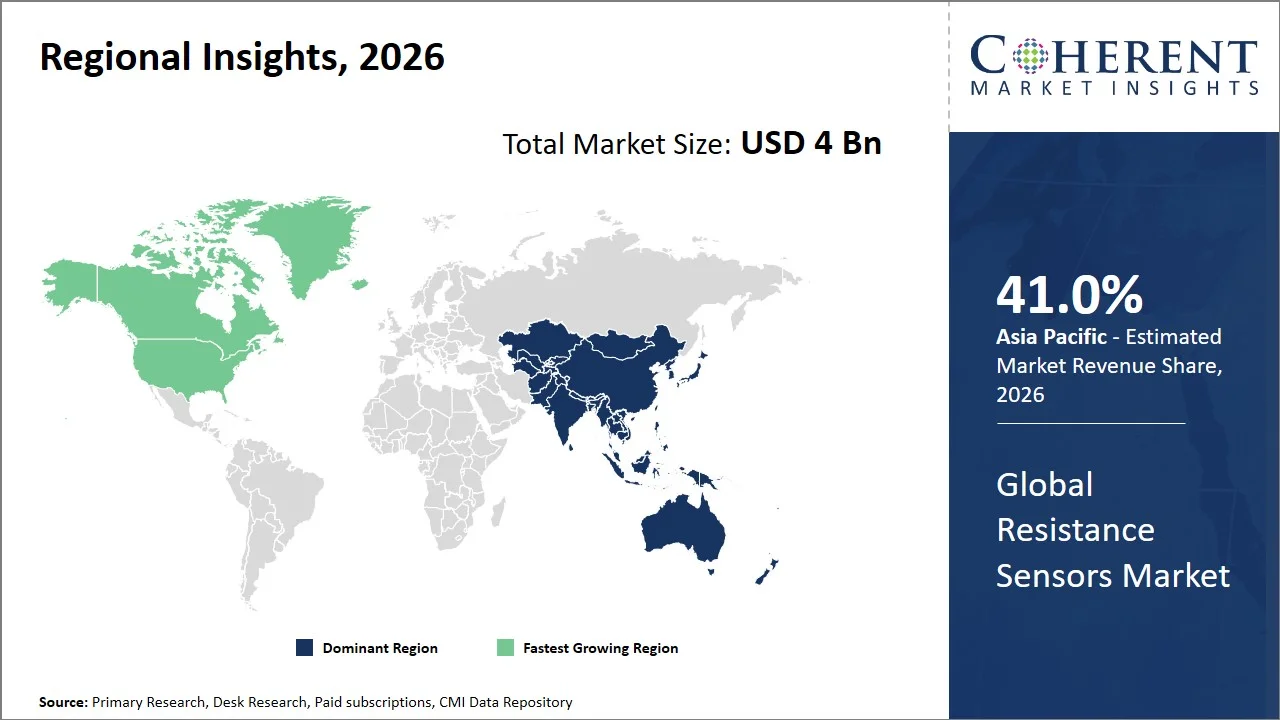
- Asia Pacific is expected to dominate the resistance sensors market in 2026 with a market share of 41.0 %. The development of flexible and printed resistance sensors across Asia Pacific is primarily driving the growth of the regional market. In 2025, Mitsufuji expanded the development of conductive textile-based wearable sensing solutions, integrating printed conductive materials into garments for continuous physiological monitoring in healthcare and industrial safety applications.
- North America is expected to account for 30.0 % of the market share in 2026 and is projected to record the fastest growth over the forecast period. Rising investments in aerospace and defense electronics in North America is driving the growth of the regional market. On October 13, 2025, JPMorganChase announced the Security and Resiliency Initiative, a USD 1.5 trillion, 10-year plan to facilitate, finance and invest in industries critical to national security and resiliency.
- Rising adoption of flexible and printed resistance sensors for wearable and smart healthcare devices: Flexible resistance sensors made with printed electronics, conductive polymers, graphene and nanocomposite materials are getting popular in wearable health monitors, electronic skin and smart textiles. Such sensors offer light weight, excellent mechanical flexibility and continuous physiological monitoring capability with stable resistance characteristics under repeated bending and stretching. They also lend themselves to roll-to-roll manufacturing that is cutting production costs and making large-scale deployment in consumer and medical devices possible.
- Integration of resistance sensors with Industrial IoT and predictive maintenance platforms: Manufacturers are increasingly incorporating resistance-based temperature, strain and position sensors into industrial equipment connected via Industrial Internet of Things (IIoT) networks. Real-time resistance measurements are examined using cloud analytics and edge computing to detect equipment degradation, unexpected operating circumstances and component fatigue before breakdowns occur. This trend is enhancing plant dependability, minimizing unplanned downtime and enabling predictive maintenance techniques, spanning the manufacturing, energy and process industries.
Segmental Insights
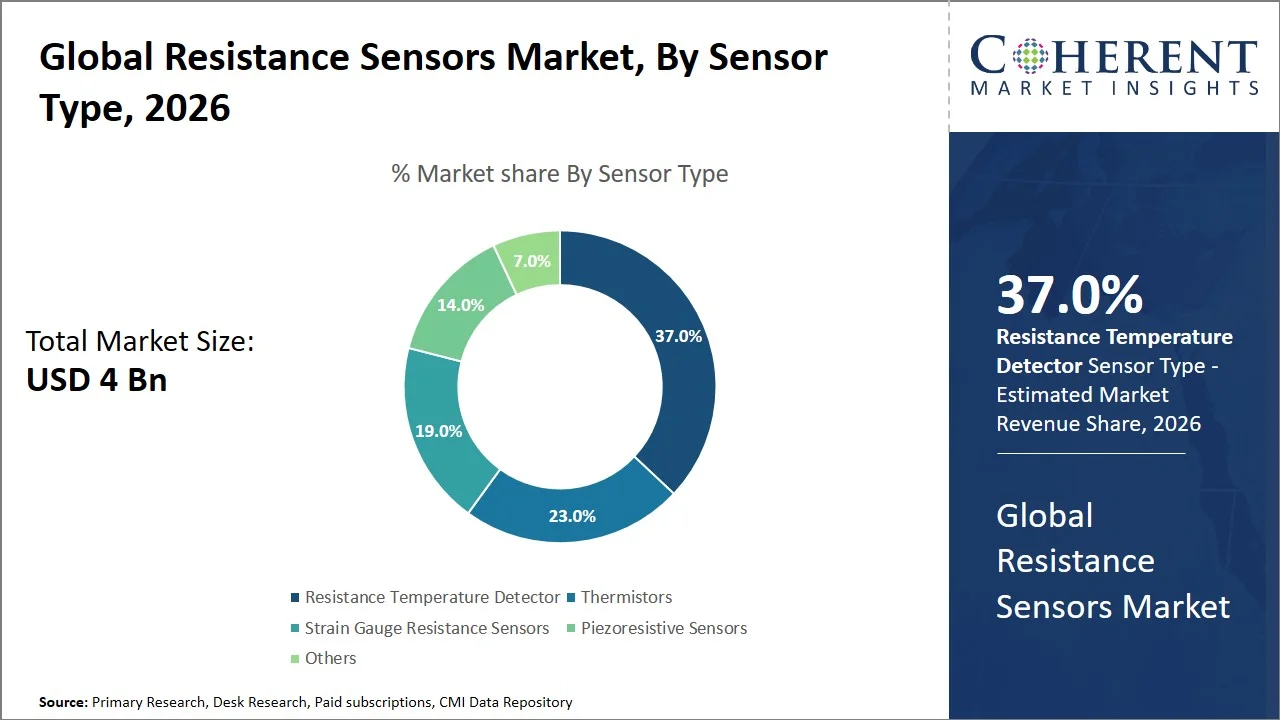
Why Does the Resistance Temperature Detector Segment Dominate the Global Resistance Sensors Market?
The resistance temperature detector segment is expected to account for 37.0% of the global resistance sensors market share in 2026. Resistance temperature detectors are often used because they give precise, consistent, and stable temperature measurements over long periods of operation, and hence can be used when small changes in temperature can compromise product quality or process safety. With excellent linear response, low signal drift and the ability to maintain calibration under demanding operating conditions, they are the sensor of choice in industrial automation, pharmaceutical manufacturing, food processing, power generation and chemical processing facilities where consistent measurement performance and regulatory compliance are essential. On April 22, 2025, Phoenix Contact announced that it is extending the portfolio of Axioline F and Axioline P remote I/O systems with three new resistance temperature measuring modules (RTD modules) that support resistive temperature measuring devices. (Source: Phoenix Contact)
- Current Industry Events of 2026
- Market Size Estimation
- Regional Breakdown
- Competitive Landscape
- Customer Intelligence
- Segmental Analysis
- Pricing Analysis
- Key Market Drivers, Challenges & Future Trends
- Customized Insights Section
Why is Two-wire the Most Preferred Configuration Type?
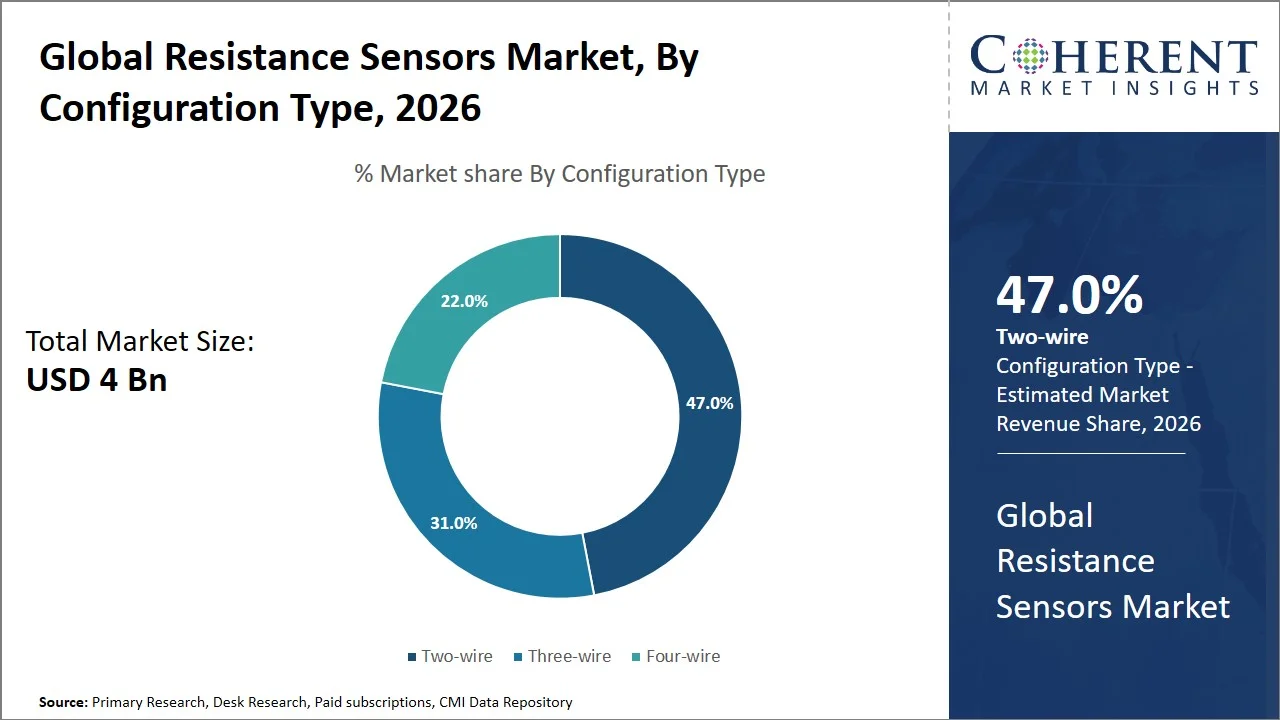
The two-wire segment is expected to account for 47.0% of the global resistance sensors market share in 2026. Two-wire designs are popular because they are the simplest installation architecture with fewer conductors, reduced cabling costs and simpler integration into the existing monitoring and control infrastructure. Their simplicity of design minimizes installation time and maintenance complexity and makes them ideally suited for general purpose temperature measurement in HVAC systems, process industries, building automation and commercial equipment where ultra-high measurement precision is not required. Affordability, ease of deployment, and compatibility with old instrumentation continues to enable their broad acceptance in high volume industrial and commercial applications. RTD Sensors by Radix and TMAG5124 by Texas instruments are prime examples of popular two-wire sensors.
Platinum Dominates the Global Resistance Sensors Market
The platinum segment is expected to account for 34.0% of the global resistance sensors market share in 2026. Platinum is often employed in resistance sensors because of its remarkable chemical inertness, strong oxidation resistance, and very stable electrical characteristics over a wide temperature range. These features make the sensors capable of reliable and reproducible measurements even in severe industrial situations, such as those involving high temperatures, corrosive chemicals and continuous operation. Platinum is the chosen sensing material for process industries, power generation, aerospace, automotive and precision laboratory instrumentation due to its extended service life, minimum calibration drift and conformity with international standards for temperature monitoring.
Currents Events and their Impact
Current Events | Description and its Impact |
European Union - Cyber Resilience Act |
|
U.S. - Department of Energy Conservation Standards |
|
Global Resistance Sensors Market - PLC and SCADA Integration Trends (2025)
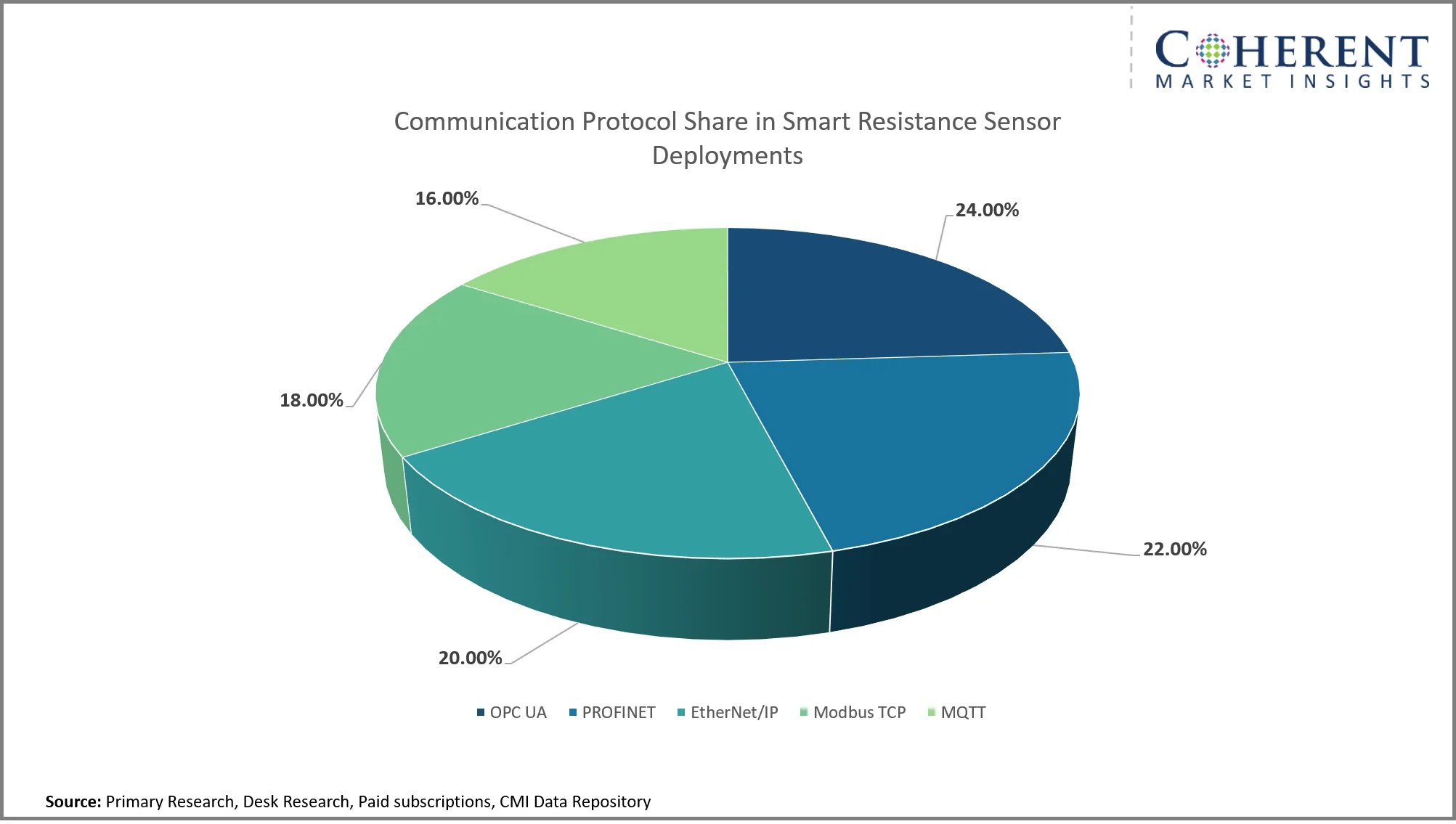
PLC and SCADA architectures are slowly morphing into Industry 4.0-ready, sensor-centric automation, as manufacturers began integrating resistance sensors, such as RTDs, shunt resistors, and resistive process sensors, directly into PLC-controlled production lines and SCADA platforms for real-time monitoring. Using OPC UA, MQTT, edge computing, AI analytics and digital twins, manufacturers, utilities, pharmaceutical and chemical processing companies were able to continuously acquire temperature, current and equipment health data from resistance sensors for predictive maintenance, process optimization and regulatory compliance. Hybrid edge-cloud SCADA deployments became more prevalent, enabling interoperability between legacy PLCs and contemporary Industrial IoT systems. Key points include:
- The preferred industrial communication protocols for the integration of resistance sensors with PLC and SCADA architectures are OPC UA and MQTT.
- Edge computing was increasingly employed with PLCs to handle RTD and resistance sensor data locally before vital information was transmitted to SCADA platforms.
- Hybrid cloud-edge SCADA systems became popular, with real-time control remaining on-site, and historical resistance sensor data being evaluated on cloud platforms.
- A major application became predictive maintenance, where motors, pumps, compressors, transformers and industrial equipment were continuously monitored by resistance temperature sensors.
- Integration of digital twin with PLC systems enhanced by 2025, utilizing high-accuracy resistance sensor data to model equipment performance and enhance maintenance scheduling.
- The expanding connected smart manufacturing facilities immediately connected RTDs, current sensing resistors and other industrial sensors to PLC-based control systems for automated quality control and process optimization.
Resistance Sensors Market Dynamics
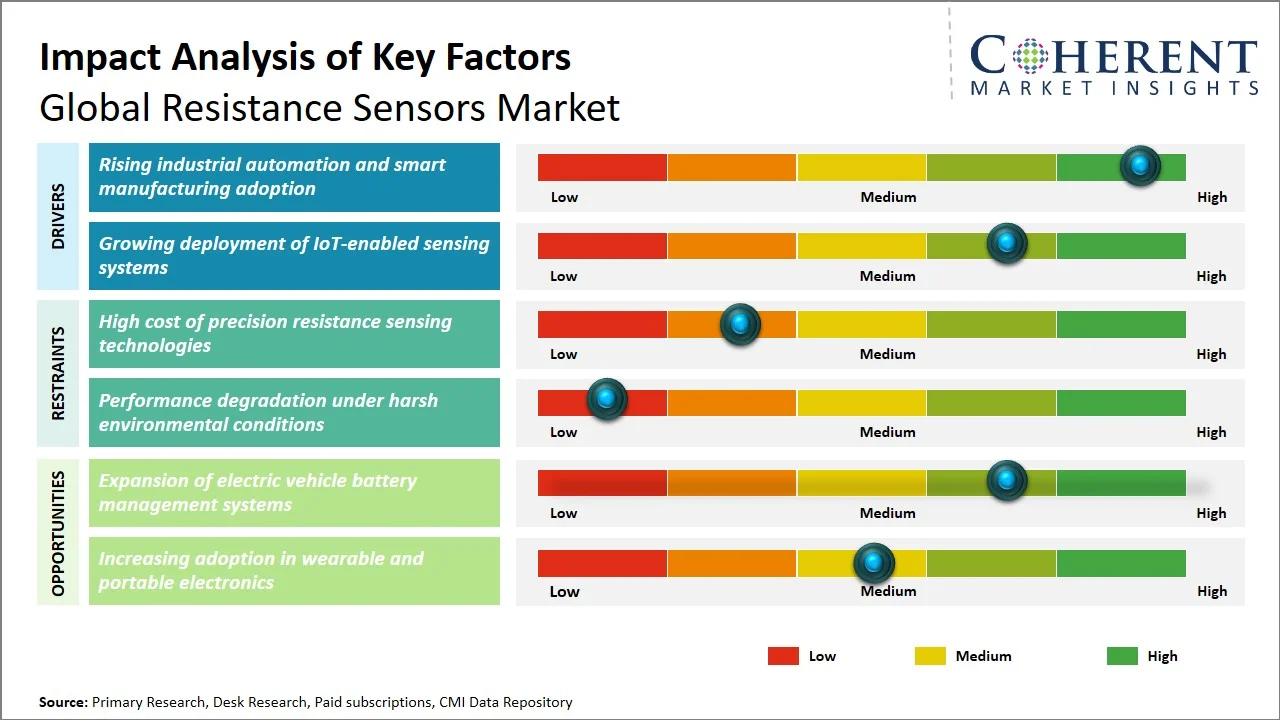
Market Drivers
- Rising industrial automation and smart manufacturing adoption: Industrial automation and smart manufacturing are expanding at a fast pace which is leading to a significant demand for resistance sensors in manufacturing facilities. For automated process control, accurate measurement of temperature, position, strain, and pressure is necessary. They are also pairing resistance sensors with programmable logic controllers, Industrial Internet of Things platforms, robots and predictive maintenance systems to provide continuous equipment monitoring, enhance production efficiency and reduce unexpected downtime. As Industry 4.0 technologies are increasingly integrated into factories, resistance sensors become more and more important to improve operational dependability, guarantee product quality, optimize energy usage and enable real-time, data-driven manufacturing decisions. On June 22, 2026, Rockwell Automation, Inc announced the launch of FactoryTalk Orchestration software, a new solution designed to coordinate material flow and production processes from end-to-end. (Source: Rockwell Automation)
- Growing deployment of IoT-enabled sensing systems: The growing adoption of Internet of Things-enabled sensing systems is fueling the adoption of resistance sensors in industrial, commercial, healthcare, automotive, and smart infrastructure applications. Increasingly, resistance sensors are being interfaced to wireless communication modules, edge computing devices and cloud-based analytics platforms for continuous real-time monitoring of temperature, strain, humidity and equipment health. This connection enables remote diagnostics, predictive maintenance, and automated process optimization, saving maintenance costs and enhancing operational efficiency. “The need for compact and energy efficient and highly reliable resistance sensors is increasing across a broad spectrum of end-use industries as organizations grow connected asset networks and digital monitoring capabilities.
Emerging Trends
- Expansion of electric vehicles and advanced driver assistance systems driving sensor innovation: The fast-growing electrification of transportation is driving the demand for highly accurate resistance sensors for battery thermal management, electric motors, onboard charging systems, braking systems and cabin climate control. To satisfy the tough safety and reliability requirements of electric vehicles, manufacturers are working on small, temperature-resistant sensor elements with better long-term stability. The next generation of automotive sensor development lies in increasing integration of battery management systems and vehicle electronics.
- Growing use of MEMS and advanced material technologies for sensor miniaturization and higher precision: Resistance sensor manufacturers are using microelectromechanical systems (MEMS) manufacturing techniques in conjunction with advanced materials, such as platinum thin films, nickel alloys, graphene, and carbon nanotubes, to create small sensors with greater sensitivity, faster response times, and lower power consumption. Such breakthroughs enable a high level of sensor integration in smartphones, industrial automation equipment, aerospace systems, robotics and precision instruments where space and measurement accuracy are important performance parameters.
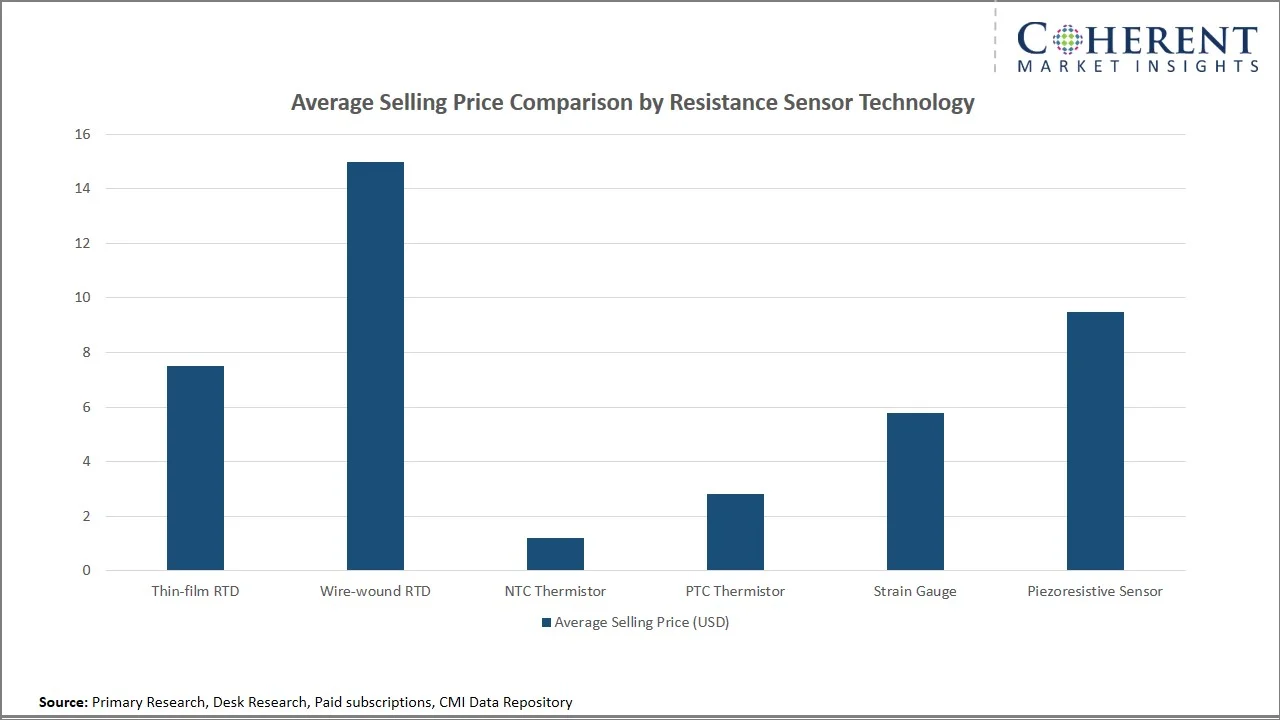
Global Resistance Sensors Market - Average Selling Price Comparison by Resistance Sensor Technology
Global Resistance Sensors Market - Communication Protocol Share in Smart Resistance Sensor Deployments
Regional Insights
Why is Asia Pacific a Strong Market for Resistance Sensors?
Asia Pacific is expected to account for a market share of 41.0% in 2026. China, Japan, South Korea, and India have a large-scale electronics manufacturing cluster in the Asia Pacific region, leading to a robust demand for resistance sensors, which are integrated into smartphones, EV battery systems and industrial automation lines. For example, semiconductor fabs in Taiwan and South Korea use high-precision resistance temperature detectors in cleanroom thermal control systems, while Indian automotive plants use resistance-based strain and temperature sensors in engine testing and EV prototyping lines to improve production accuracy and safety.
Why Does the North America Resistance Sensors Market Exhibit High Growth?
North America is projected to account for 30.0% of the global resistance sensors market and is expected to register the fastest growth. Resistance sensors have diverse applications in mission-critical situations. North America’s advanced industrial automation, aerospace applications and healthcare instruments are driving the market. For example, platinum resistance temperature detectors are used by U.S. aerospace projects to monitor aircraft engines, while smart manufacturing plants in the Midwest use IoT-connected resistance sensors in predictive maintenance systems for robotic assembly lines.
Global Resistance Sensors Market Outlook for Key Countries
Why is China Emerging as a Major Hub in the Resistance Sensors Market?
China’s demand for resistance sensors is closely linked to its large-scale EV production environment, consumer electronics manufacturing, and growth in industrial robotics. Major EV battery manufacturers (Contemporary Amperex Technology Co. Limited and BYD) are using resistance temperature sensors in lithium-ion battery packs to prevent thermal runaway, while automated electronics factories in Shenzhen and Suzhou are using resistance-based sensors in high-speed assembly and quality inspection systems.
Is the U.S. the Next Growth Engine for the Resistance Sensors Market?
The U.S. is focusing on high-precision, high-reliability applications in aerospace, defense, medical devices, and industrial IoT systems. For instance, resistance temperature sensors are used in propulsion and environmental simulation systems at aerospace testing facilities associated with NASA, and resistance-based sensors are used in surgical equipment and patient monitoring systems by U.S. medical device manufacturers for live thermal accuracy.
Germany Resistance Sensors Market Analysis and Trends
The Germany resistance sensors market is dominated by automotive engineering and industrial machinery manufacture where resistance sensors are integrated into high-performance systems that need precision and endurance. German car OEMs embed resistance temperature detectors into EV battery thermal management systems while industrial automation leaders in Bavaria and Baden-Württemberg embed resistance sensors into CNC machines and smart factory production lines.
South Korea Resistance Sensors Market Analysis and Trends
South Korea’s lead in semiconductor fabrication, consumer electronics and EV battery technology relies heavily on resistance sensors for thermal and process management. For example, semiconductor fabs of major South Korean chipmakers utilize resistance temperature sensors to control wafer fabrication chambers, and next-generation EV battery pack manufacturers use them to optimize safety and efficiency.
Japan Resistance Sensors Market Analysis and Trends
Japan’s resistance sensors market features robotics, precision electronics and automotive innovation, with a large utilization of resistance sensors in high reliability systems. Resistance temperature sensors are used by Japanese automotive firms in hybrid car powertrains and braking systems, and by robotics manufacturers in servo motor control systems to provide precise motion control and thermal stability.
Global Resistance Sensors Market - Analog vs. Digital Resistance Sensor Integration
Metric | Analog Resistance Sensors | Digital Resistance Sensors |
Estimated integration share (2025) | 43% | 57% |
Typical output | Continuous voltage/current (mV, V, 4–20 mA) | Digital data (IO-Link, I²C, SPI, Modbus, CAN, IO-Link) |
Average measurement accuracy | ±0.3–0.8% | ±0.1–0.3% |
Signal conditioning | External amplification/ADC often required | Integrated ADC and signal processing |
PLC/SCADA compatibility | Requires analog input modules | Native support through digital communication interfaces |
Preferred applications | Legacy automation systems, HVAC, conventional process control, cost-sensitive equipment | Smart factories, EV battery management systems, robotics, semiconductor equipment, Industry 4.0 manufacturing |
Global Resistance Sensors Market - Printed Electronics Adoption for Resistance Sensors
Application Area | Primary Printed Substrate | Common Conductive Material | Typical Resistance Sensor Type |
Wearable Electronics | PET Film, TPU | Silver nanoparticle ink, Carbon ink | Printed strain and temperature sensors |
Healthcare & Medical Devices | Flexible polymer film | Silver ink, Graphene | Printed RTDs and biosensing resistive elements |
Consumer Electronics | PET Film | Carbon ink, Copper ink | Touch and force-sensitive resistive sensors |
Automotive Interior Electronics | Polyimide (PI) | Silver ink | Printed seat occupancy and heating sensors |
Industrial IoT & Smart Manufacturing | Polyimide (PI) | Carbon ink, Silver ink | Printed temperature and pressure sensors |
How is the Expansion of Electric Vehicle Battery Management Systems Creating New Growth Opportunities in the Resistance Sensors Market?
The rise of electric vehicle battery management systems is driving major growth prospects for the resistance sensors market. Modern EVs require extremely accurate real-time monitoring of battery temperature, voltage stability and cell health to ensure safety and performance. In addition to resistance temperature detectors, other resistance-based sensors are being used in BMS designs to identify thermal runaway threats, improve charging cycles and ensure even temperature distribution throughout battery packs. As EV makers like Tesla, BYD and Hyundai boost production and employ bigger capacity battery platforms, the demand for dependable and miniature resistance sensors integrated into BMS modules is expanding rapidly, thus fueling market growth.
On February 11, 2026, BorgWarner announced that its battery management system was selected for an expanded series-production program with a global original equipment manufacturer (OEM). BorgWarner has supplied the BMS to customers since 2023. The expanded award will support additional B-segment and C-segment passenger cars, as well as light commercial vehicles for battery-electric vehicle (BEV) and plug-in hybrid electric vehicle (PHEV) applications beginning in 2029. (Source: BorgWarner)
Market Players, Key Development, and Competitive Landscape
Key Developments
- On July 2, 2026, Vishay Intertechnology, Inc. introduced a new ready-to-use multi-turn absolute position sensor designed for high accuracy and long term stability in demanding environments. Featuring non-contacting Hall Effect technology, the Vishay Sfernice 34 PHE delivers linearity down to ± 1 % (full stroke), resolution of 1°, and a lifespan greater than 10 million cycles, all in a 7/8 in (22.2 mm) diameter body.
- On March 16, 2026, Infineon Technologies AG expanded its XENSIV sensor portfolio with the TLE4978 family of coreless, isolated magnetic current sensors that combine ultra-low noise with high bandwidth and accuracy.
Competitive Landscape
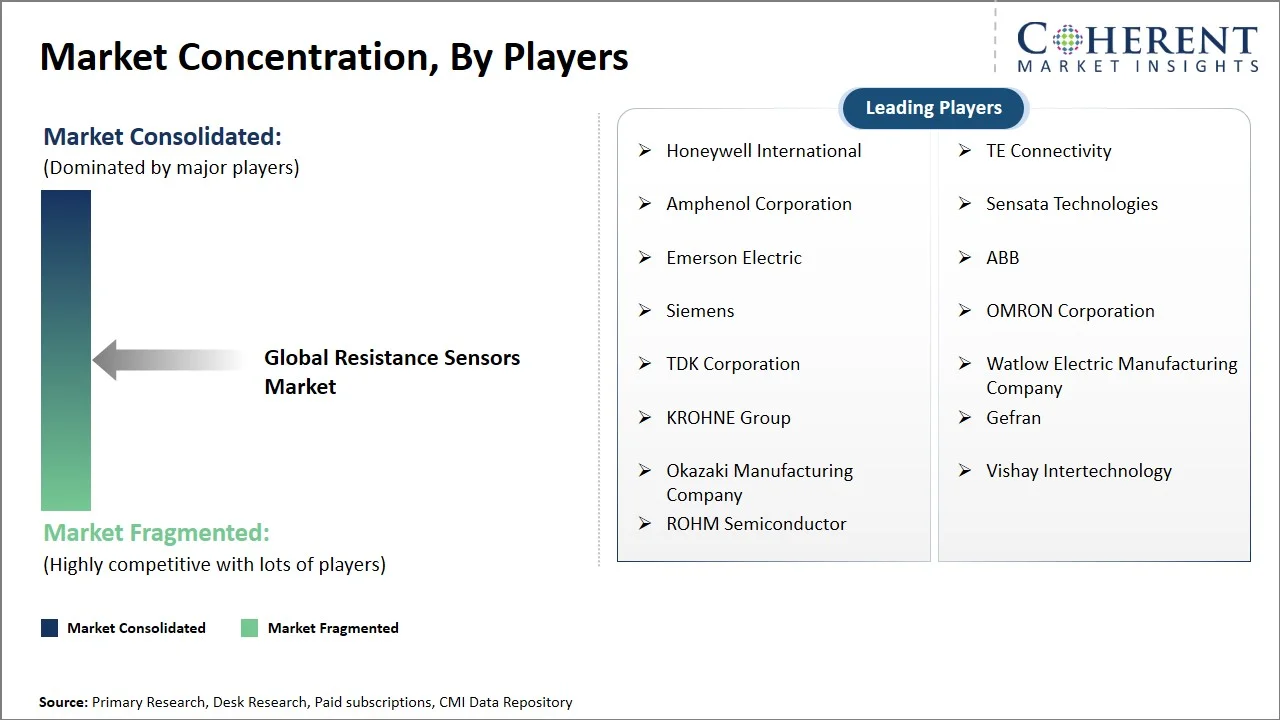
The global resistance sensors market is characterized by a high level of consolidation among few established companies, while specialist producers continue to increase their share through niche applications in automotive, industrial automation, and precision instrumentation. Companies like Honeywell International Inc., TE Connectivity Ltd. and Amphenol Corporation are in good positions, since they are providing broad portfolios of resistance temperature detectors and bespoke sensing modules to the aerospace, EV battery systems and industrial IoT ecosystems. Material innovation (platinum thin films, nickel alloys), downsizing capabilities and integration with smart sensing systems are driving competitive differentiation rather than price competition. The company is pursuing strategic collaborations with automobile OEMs and semiconductor manufacturers to obtain long-term supply agreements for high-reliability sensor components.
Market Report Scope
Resistance Sensors Market Report Coverage
| Report Coverage | Details | ||
|---|---|---|---|
| Base Year: | 2025 | Market Size in 2026: | USD 4 Bn |
| Historical Data for: | 2020 To 2024 | Forecast Period: | 2026 To 2033 |
| Forecast Period 2026 to 2033 CAGR: | 4.7% | 2033 Value Projection: | USD 6.50 Bn |
| Geographies covered: |
| ||
| Segments covered: |
| ||
| Companies covered: | Honeywell International, TE Connectivity, Amphenol Corporation, Sensata Technologies, Emerson Electric, ABB, Siemens, OMRON Corporation, TDK Corporation, Watlow Electric Manufacturing Company, KROHNE Group, Gefran, Okazaki Manufacturing Company, Vishay Intertechnology, and ROHM Semiconductor | ||
| Growth Drivers: |
| ||
| Restraints & Challenges: |
| ||
Analyst Opinion (Expert Opinion)
- Competition in the market is increasingly driven by precision requirements in EV battery systems, semiconductor fabrication and automated industrial processes where resistance sensors are being specified as key components for safety and control rather than peripheral instruments. There is a movement towards application specific sensor modification, especially where standard RTDs are being replaced with designed solutions for high temperature, high vibration and chemically harsh conditions. Reliance on platinum and specialty alloys is viewed as a bottleneck for quick growth, raising supply chain resilience issues. Similarly, the consolidation of sensor portfolios among the leading industrial conglomerates is considered a critical determinant for the pricing stability and the long-term contract structuring.
- Resistance sensors’ adoption in electrified mobility platforms, smart factories, and edge-enabled industrial monitoring systems is expected to reshape demand patterns, with higher adoption expected in battery-centric architectures and autonomous manufacturing environments. The need for continuous sensing is likely to be driven by predictive maintenance systems and resistance sensors will be incorporated in closed-loop feedback systems rather than as isolated measurement locations. The material innovation is expected to be accelerated, with the development of improved composites and nanoengineered sensing elements for better thermal stability and response precision. In the longer term, deeper integration with AI-enabled industrial control systems is predicted to re-define the functional role of resistance sensors from passive measurement devices to active decision-support components in intelligent infrastructure networks.
Speak to the analyst
Want personalized insights?
Take the findings above to one of our principal consultants, or have the report rebuilt around the segments, geographies and competitors you actually track.
Market Segmentation
- Sensor Type Insights (Revenue, USD Billion, 2021 - 2033)
- Resistance Temperature Detector
- Thermistors
- Strain Gauge Resistance Sensors
- Piezoresistive Sensors
- Others
- Configuration Type Insights (Revenue, USD Billion, 2021 - 2033)
- Two-wire
- Three-wire
- Four-wire
- Material Type Insights (Revenue, USD Billion, 2021 - 2033)
- Platinum
- Nickel
- Copper
- Silicon
- Ceramic
- Others
- End User Insights (Revenue, USD Billion, 2021 - 2033)
- Automotive
- Industrial Manufacturing
- Consumer Electronics
- Healthcare and Medical Devices
- Aerospace and Defense
- Energy and Utilities
- Food and Beverage
- Oil and Gas
- Others
- Regional Insights (Revenue, USD Billion, 2021 - 2033)
- North America
- U.S.
- Canada
- Latin America
- Brazil
- Argentina
- Mexico
- Rest of Latin America
- Europe
- Germany
- U.K.
- Spain
- France
- Italy
- Russia
- Rest of Europe
- Asia Pacific
- China
- India
- Japan
- Australia
- South Korea
- ASEAN
- Rest of Asia Pacific
- Middle East
- GCC Countries
- Israel
- Rest of Middle East
- Africa
- South Africa
- North Africa
- Central Africa
- North America
- Key Players Insights
- Honeywell International
- TE Connectivity
- Amphenol Corporation
- Sensata Technologies
- Emerson Electric
- ABB
- Siemens
- OMRON Corporation
- TDK Corporation
- Watlow Electric Manufacturing Company
- KROHNE Group
- Gefran
- Okazaki Manufacturing Company
- Vishay Intertechnology
- ROHM Semiconductor
Sources
Primary Research Interviews
- Manufacturing and Production Managers
- Procurement and Supply Chain Managers
- Industrial Automation System Integrators
- Automotive and EV Battery Management System Engineers
Magazines
- IEEE Sensors Magazine
- IEEE Instrumentation & Measurement Magazine
- Sensors Online
- Control Engineering
Journals
- IEEE Sensors Journal
- IEEE Transactions on Instrumentation and Measurement
- IEEE Sensors Letters
Associations
- IEEE Sensors Council
- IEEE Instrumentation and Measurement Society
- Electronic Components Industry Association (ECIA)
- International Society of Automation (ISA)
Public Domain Sources
- Organisation for Economic Co-operation and Development
- International Energy Agency
- World Bank
- International Organization for Standardization
Proprietary Elements
- CMI Data Analytics Tool
- Proprietary CMI Existing Repository of Information for the Last 10 Years
Get access to 250+ pages report
Every segment, forecast, competitor profile and data table behind the analysis above — available for instant download.
- ESOMAR Member
- ISO 9001:2015 Certified
- D-U-N-S Registered
- GDPR & CCPA Compliant
Missing comfort of reading report in your local language? Find your preferred language:
Transform your Strategy with Exclusive Trending Reports
Frequently Asked Questions
The global resistance sensors market is expected to stand at USD 4 Bn in 2026 and is expected to reach USD 6.50 Bn by 2033.
The CAGR of the global resistance sensors market is projected to be 4.7% from 2026 to 2033.
They enable real-time monitoring and control of machinery conditions to improve efficiency and prevent failures.
They ensure safe battery operation by monitoring temperature and preventing thermal runaway in EV battery systems.
In terms of sensor type, the resistance temperature detector segment is estimated to dominate the market revenue share in 2026.
High cost of precision resistance sensing technologies and performance degradation under harsh environmental conditions are the major factors hampering the growth of the global Resistance Sensors market.
Rising industrial automation and smart manufacturing adoption and growing deployment of IoT-enabled sensing systems are the major factors driving the growth of the global resistance sensors market.