

Led Lighting Horticulture Market Size and Forecast — 2026-2033
Overview
LED lighting horticulture market is directly addressed to the businesses associated with the commercial, indoor and R&D activities associated with plants, which is in contrast of the field farming and animal husbandry. These addressable segments are directly dependent on the presence of sunlight for the crops growth. However, with the increase in global population and lack of adequate sunlight in regions that include North Central Europe and Nordic countries, requirement of additional production of vegetables, fruits, medicines and other agricultural products is expected to drive the demands for these industry products.
Led Lighting Horticulture Market Size and Forecast – 2026 – 2033
The LED Lighting Horticulture Market size is estimated to be valued at USD 2.78 billion in 2026 and is expected to reach USD 6.70 billion by 2033, exhibiting a compound annual growth rate (CAGR) of 13.4% from 2026 to 2033.
Key Takeaways
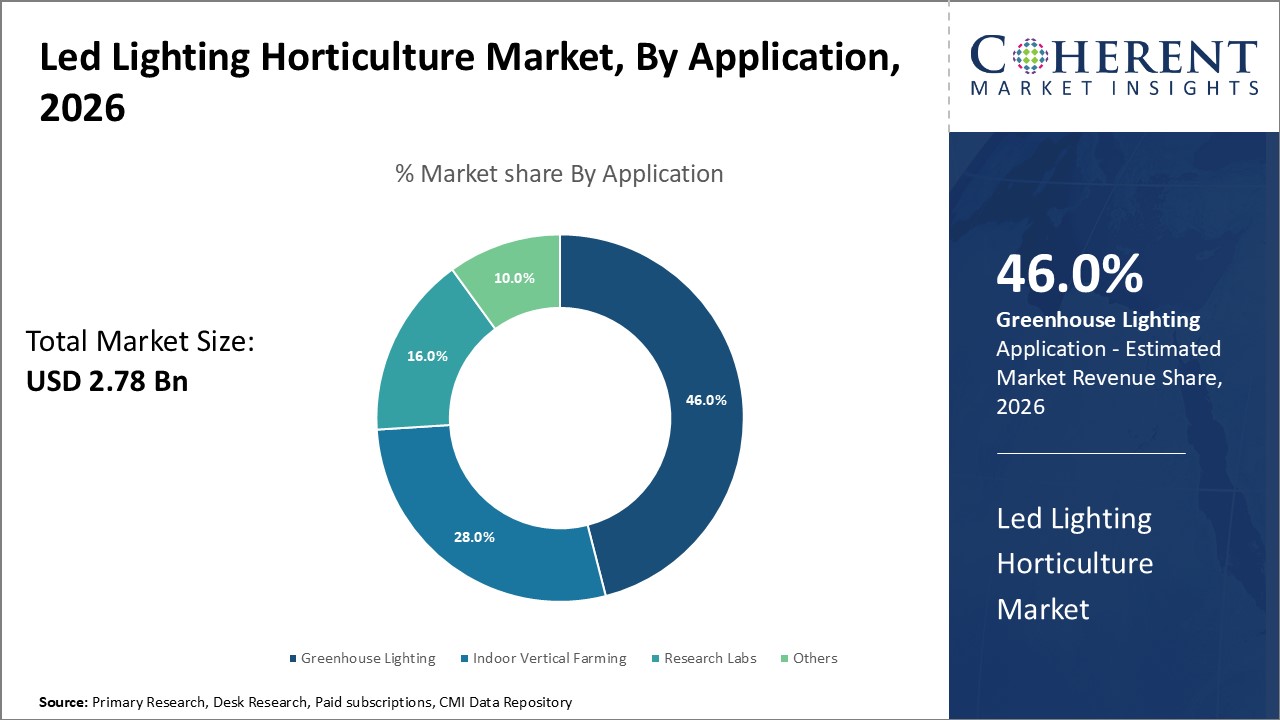
Significant market share is held by the Greenhouse Lighting application segment, which continues to benefit from increasing commercial agricultural investments and technology adoption.
Indoor Vertical Farming is the fastest-growing application segment due to rising urban farm projects needing highly controlled lighting environments. In the Technology segment, LED Lighting dominates market share by a wide margin, driven by superior energy efficiency and spectral customization capabilities.
Fluorescent and High-Pressure Sodium technologies, while declining, remain relevant in niche applications.
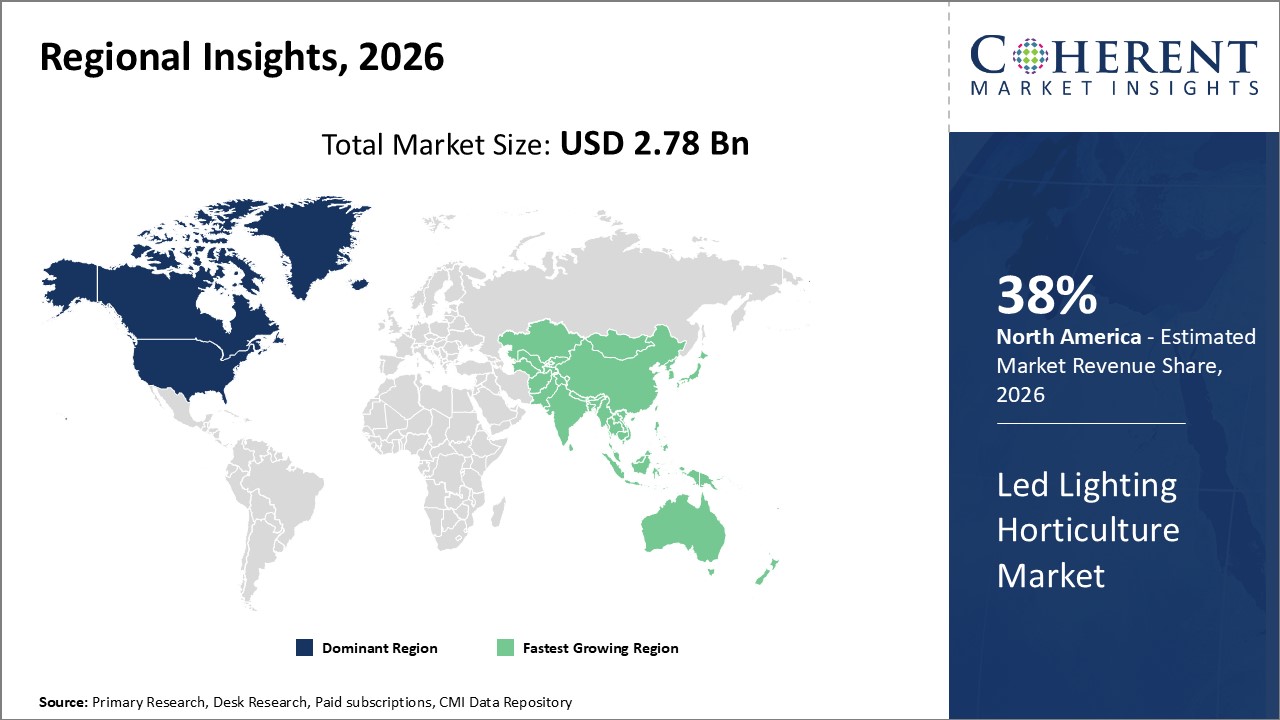
North America commands the largest market share in LED Lighting Horticulture, attributed to advanced controlled environment agriculture infrastructure and favorable government initiatives.
Asia Pacific exhibits the fastest growth, powered by rapid urbanization, increasing CEA adoption, and aggressive infrastructural investments in countries like China and India. Europe maintains steady growth supported by stringent sustainability regulations and a mature agriculture technology ecosystem.
Led Lighting Horticulture Market – Segmentation Analysis
Led Lighting Horticulture Market Insights, By Application
In terms of application, the market is segmented into Greenhouse Lighting, Indoor Vertical Farming, Research Labs, and Others, among this Greenhouse Lighting dominates the market share. Greenhouse Lighting sustains its dominance owing to the established infrastructure supporting controlled environment agriculture at scale. Greenhouses leverage LED technologies to extend growing seasons while reducing energy consumption, crucial for high-value crops such as tomatoes and peppers. Innovations enabling retrofit solutions have broadened adoption in existing facilities.
Led Lighting Horticulture Market Insights, By Technology
In terms of technology, the market is segmented into Fluorescent, High-Pressure Sodium (HPS), LED Lighting, and Others, among this LED Lighting dominates the market share. LED Lighting leads with overwhelming market share due to superior energy efficiency, customizable spectral output, and longer lifecycle which translate into significant operational cost savings. The technology’s flexibility to fine-tune wavelengths for different crop growth stages is a critical driver of market expansion.
Led Lighting Horticulture Market Insights, By End User
In terms of end user, the market is segmented into Commercial Horticulture, Residential Horticulture, Research Institutions, and Others, among this Commercial Horticulture dominates the market share. Commercial Horticulture commands the largest share by virtue of extensive and scalable applications of LED lighting that significantly impact production volumes and profitability of large operators. The need to increase yield efficiency and meet market demand drives continuous upgrades to LED systems in this segment.
Led Lighting Horticulture Market Insights, By Geography
North America Led Lighting Horticulture Market Analysis and Trends
In North America, the dominance in the LED Lighting Horticulture market is attributed to the extensive commercial greenhouse infrastructure, early technology adoption, and favorable policies promoting sustainable agriculture. North America holds approximately 38% market share, with the U.S. leading due to its advanced CEA ecosystem, including numerous large-scale vertical farms and greenhouse projects financed by private and public sectors.
Asia Pacific Led Lighting Horticulture Market Analysis and Trends
The fastest-growing region is Asia Pacific, with a compound annual growth rate (CAGR) of over 15%. This region is fueled by growing urban agricultural efforts, government expenditures in smart farming technology, and increased production of LED systems. In order to maximize agricultural productivity in limited spaces and allay worries about food security, nations such as China and India are quickly implementing horticulture lighting.
Led Lighting Horticulture Market Outlook for Key Countries
United States Led Lighting Horticulture Market Analysis and Trends
The USA's market benefits from a mature controlled environment agriculture sector and strong capital inflow into agricultural innovations. In 2025, over 60% of newly constructed greenhouses integrated advanced LED horticulture lighting, influenced by private companies like Illumitex and Fluence Bioengineering expanding their footprints. Government incentives targeting energy efficiency improvements further bolster the market, enabling rapid product adoption and business growth in key states such as California, Florida, and New York.
China Led Lighting Horticulture Market Analysis and Trends
China’s LED Lighting Horticulture market is rapidly expanding due to governmental focus on urban agriculture and food sustainability. Significant investments in LED technology manufacturing have reduced costs by 12% since 2023, enhancing market accessibility. Prominent domestic players collaborate with international technology providers to customize spectral LED solutions adapted to local crops, supporting the growing horticulture parks in provinces like Guangdong and Jiangsu.
Analyst Opinion
Increasing adoption of spectral customization technologies has been a pivotal demand-side indicator shaping the LED lighting horticulture market. Recent advancements have enabled growers to tailor light wavelengths to specific crop needs, as evidenced by a 26% increase in yield reported by vertical farms utilizing narrow-band LED spectrums in 2025. This customization capability is driving market growth by expanding use cases across leafy greens, fruits, and ornamental plants.
Production capacity expansions in key manufacturing hubs, particularly in East Asia, have enhanced market supply dynamics. In 2025 alone, Asia-based manufacturers increased production output by 18%, enabling better price stability while meeting rising exports to North America and Europe. Competitive pricing driven by volume growth underpins the market’s expanding revenue base.
Import data of LED horticulture fixtures reveals an upward trend in developed economies heavily investing in controlled environment agriculture (CEA). The U.S. and Germany collectively accounted for 41% of global LED horticulture imports in 2026, signaling robust end-user demand, particularly for greenhouse and vertical farm applications.
Micro-indicator trends highlight significant investments in smart lighting integration, with over 56% of new installations in 2025 embedding IoT-enabled lighting controls. This integration facilitates dynamic adjustment of light intensity and duration, improving energy efficiency and crop productivity—a critical market growth strategy supported by data from recent agricultural technology summits.
- Current Industry Events of 2026
- Market Size Estimation
- Regional Breakdown
- Competitive Landscape
- Customer Intelligence
- Segmental Analysis
- Pricing Analysis
- Key Market Drivers, Challenges & Future Trends
- Customized Insights Section
Market Scope
| Report Coverage | Details | ||
|---|---|---|---|
| Base Year: | 2025 | Market Size in 2026: | USD 2.78 billion |
| Historical Data for: | 2020 To 2024 | Forecast Period: | 2026 To 2033 |
| Forecast Period 2026 to 2033 CAGR: | 13.4% | 2033 Value Projection: | USD 6.70 billion |
| Geographies covered: |
| ||
| Segments covered: |
| ||
| Companies covered: | Signify (Philips Lighting), Osram Licht AG, Cree, Inc., GE Lighting, Eaton Corporation, Lumileds, Heliospectra AB, American Green Technology, Valoya Oy, Illumitex, Seoul Semiconductor, Fluence Bioengineering. | ||
| Growth Drivers: |
| ||
Growth factors
Technological advancements in spectral tuning are central market drivers, enabling cultivators to optimize photosynthesis efficiency matched to crop species, which has led to yield improvements exceeding 20% in controlled environments. Rising demand for sustainable agriculture is encouraging widespread adoption of energy-efficient LED systems that reduce electricity consumption by nearly 50% compared to traditional lighting methods. Expanding commercial horticulture operations in developed and emerging markets have stimulated significant capital investments. For instance, greenhouse establishments in the U.S. increased LED lighting retrofit projects by 30% in 2025. Additionally, government regulations promoting eco-friendly agricultural practices and energy conservation are amplifying business growth prospects. Countries like Germany and Japan have implemented subsidies favoring LED horticulture installations, boosting the overall market revenue and industry size.
Led Lighting Horticulture Market Development
In February 2026, Cree LED, a Penguin Solutions brand, introduced the new XLamp XP-L Photo Red S Line LEDs, a groundbreaking advancement in horticulture lighting technology. These LEDs are optimized for high-performance applications in greenhouses, vertical farms, and other large-scale growing operations. They are made to deliver outstanding efficiency, exceptional longevity, and smooth system updates.
Market Trends
Emerging trends in LED lighting horticulture underscore a shift toward integrated, data-driven farming systems that combine LED lighting with environmental sensors and AI analytics to maximize crop output while minimizing resource use. Recent adoption of dynamic light recipes adaptive to plant phenology stages has improved cultivation efficiency, as documented in North American vertical farms reporting up to 18% yield gains in 2025. The market is also witnessing a shift towards modular and scalable LED lighting solutions, facilitating easier upgrades and customization for diverse horticulture setups. In addition, the surge of urban agriculture in Asia Pacific has generated unique market demands for compact, lower-intensity lighting systems suitable for dense metropolitan growing environments. These trends emphasize how market players must adapt product portfolios to meet evolving customer needs and sustainability goals.
Key Players
Signify (Philips Lighting)
Osram Licht AG
Cree, Inc.
Eaton Corporation
Lumileds
Heliospectra AB
American Green Technology
Valoya Oy
Illumitex
Seoul Semiconductor
Fluence Bioengineering
Key competitive strategies focus on technology innovation and market expansion. For instance, Osram Licht AG enhanced its horticulture LED portfolio by launching customizable spectral lighting solutions in 2025, leading to a 15% revenue increase in targeted vertical farming sectors. Similarly, Signify adopted strategic partnerships with agritech start-ups to integrate AI-powered lighting control systems, resulting in expanded market presence in North America and Europe.
Led Lighting Horticulture Market Future Outlook
The LED Lighting Horticulture Market is projected to experience significant growth in the coming years. This strong growth is driven by the rising demand for sustainable and efficient agricultural solutions, especially in urban and controlled environment agriculture such as vertical farming and greenhouses. Advances in LED technology, including energy efficiency, customizable light spectra, and integration with AI and IoT for optimized plant growth, are playing a critical role in expanding market adoption.
Additionally, factors such as increasing urbanization, shrinking arable land, government support for energy-efficient agriculture, and growing consumer preference for fresh, locally grown produce contribute to the expanding market. The future outlook also highlights innovations like smart lighting systems that enable precise control of lighting conditions, enhancing crop yield and quality while reducing energy consumption and operational costs. Despite challenges like high initial costs and skill requirements, opportunities abound in developing economies, specialty crops, and emerging sectors such as pharmaceutical plant cultivation. Overall, the horticulture LED lighting market is poised to be a transformative force in modern agriculture, pumping sustainability, productivity, and technological integration over the coming decade.
Historical Analysis
In August 2019, Fluence Bioengineering, Inc., a provider of energy-efficient LED lighting solutions for commercial crop production, partnered with The Green Organic Dutchman Holdings Ltd., a publicly traded, premium organic cannabis company based in Ontario, Canada, to provide LED lighting solutions to the company.
In June 2018, Illumitex, the horticulture company, introduced HarvestEdge horticulture LED grow lighting modular system, which was designed for greenhouse supplemental and indoor primary grow lighting applications. It was configured for supplemental greenhouse lighting with the high-performance F3 spectrum (26% blue, 6% green, 76% photored). The system delivered nearly 31% more efficiency than competitive products.
In April 2018, Kessil Lighting, a manufacturer of LED horticulture and aquarium lighting, introduced the H160 Tuna Flora, full spectrum LED grow light featuring spectrum and intensity control through Kessil logic, allowing for the best possible yield for plants or algae.
In September 2019, Heliospectra, an intelligent lighting technology provider for greenhouse and controlled plant, introduced the MITRA series, a high-intensity and high-performance LED lighting solution in North America at MJ Biz Con Int’l Event in Toronto, Canada. This system was designed specifically for cannabis and high-light vine crops. The MITRA series offered an electrical efficacy up to 2.9 µmol/J and was the industry’s first modular LED system.
In July 2019, LumiGrow launched BarLight Smart LED Grow Lights for Optimal Vertical Cannabis Production, designed to create the most profitable high-density cultivation.
Sources
Primary Research interviews:
Horticulture lighting manufacturers (e.g., LED producers)
Agronomists & crop consultants
Urban farming associations
Agricultural universities & research institutes
Databases:
ProQuest
ScienceDirect
JSTOR
Magazines:
Urban Ag News
Commercial Greenhouse Grower
Indoor Grower Magazine
Journals:
Journal of Plant Physiology
Photonics Research
Agricultural and Forest Meteorology
Newspapers:
The New York Times (Food & Agriculture)
Financial Times (Agribusiness coverage)
The Economic Times (Agriculture & Technology)
Associations:
International Society for Horticultural Science (ISHS)
Illuminating Engineering Society (IES)
Controlled Environment Agriculture Alliance (CEAA)
Association for Vertical Farming (AVF)
Get access to 250+ pages report
Every segment, forecast, competitor profile and data table behind the analysis above — available for instant download.
- ESOMAR Member
- ISO 9001:2015 Certified
- D-U-N-S Registered
- GDPR & CCPA Compliant
Missing comfort of reading report in your local language? Find your preferred language:
Transform your Strategy with Exclusive Trending Reports
Frequently Asked Questions
The market is led by established companies such as Signify (Philips Lighting), Osram Licht AG, Cree Inc., and GE Lighting, which have demonstrated consistent innovation and expanding portfolios in LED horticulture solutions.
The market size is projected to grow from USD 2.78 billion in 2026 to USD 6.70 billion by 2033, driven by robust CAGR of 13.4% between 2026 and 2033.
Greenhouse lighting holds the largest growth opportunity, supported by rising commercial horticulture investments and regulatory incentives worldwide.
Market trends point to greater integration of AI and IoT features in LED systems and adoption of modular, customizable lighting solutions, which will enhance crop productivity and operational efficiency.
Competition focuses on technological innovation, product diversification, and market expansion through strategic partnerships. Market challenges include pricing pressures due to increasing production capacities and the need for continual R&D investment.
Leading companies adopt strategies such as strategic collaborations with agricultural tech startups, product portfolio expansions into precision lighting, and targeted regional development supported by government policy incentives.