

Global Restaurant Robots Market and Forecast – 2026 to 2033
Coherent Market Insights estimates that the global restaurant robots market is expected to reach USD 2 Bn in 2026 and will expand to USD 6 Bn by 2033, registering a CAGR of 18% between 2026 and 2033.
Key Takeaways of the Restaurant Robots Market
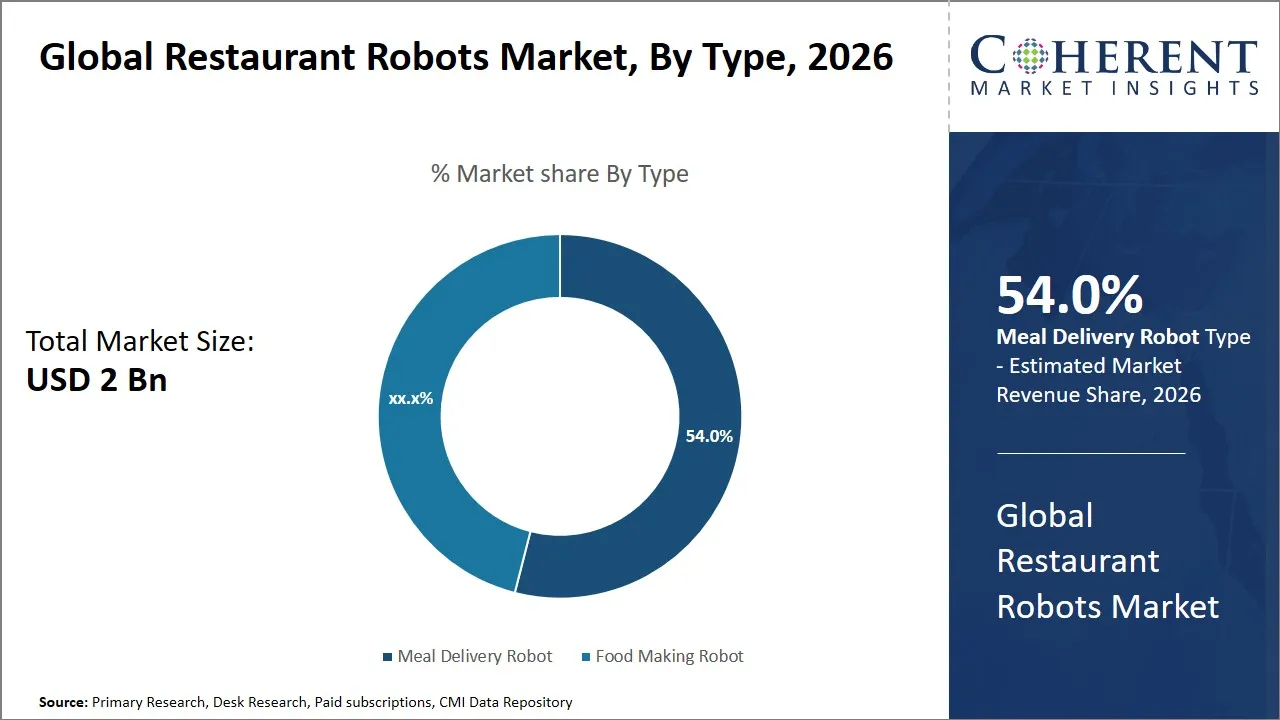
- The meal delivery robot segment is expected to account for 54% of the restaurant robots market share in 2026.
- The restaurant segment is projected to capture 59% of the market share in 2026.
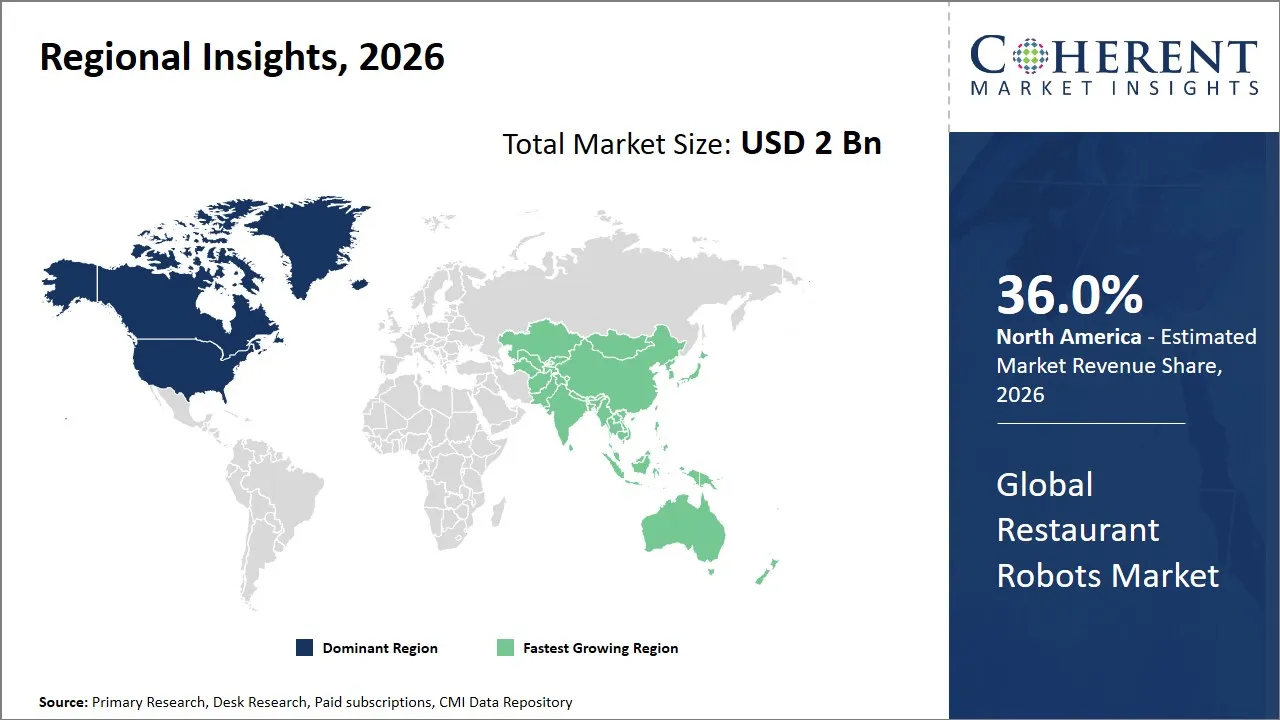
- North America is projected to dominate the restaurant robots market in 2026 with a 36%
- Asia Pacific is expected to hold 28% share in 2026 and is expected to record the fastest growth over the forecast period.
Currents Events and Its Impacts
Current Events | Description and its Impact |
Serve Robotics Deployment Milestone |
|
Segmental Insights
- Current Industry Events of 2026
- Market Size Estimation
- Regional Breakdown
- Competitive Landscape
- Customer Intelligence
- Segmental Analysis
- Pricing Analysis
- Key Market Drivers, Challenges & Future Trends
- Customized Insights Section
Why Does the Meal Delivery Robot Segment Dominate the Global Restaurant Robots Market in 2026?
The meal delivery robot segment is expected to hold 54.0% of the global restaurant robots market share in 2026. Although expansion began earlier, a key reason lies in stronger interest in hands-free service methods along with efforts to streamline operations across dining environments. Instead of traditional serving paths, machines now carry meals inside eateries, lodging sites, and eating halls - improving timing precision while reducing physical interaction between staff and guests. Because health precautions grew more central after 2020, automated transport saw faster uptake, especially when distancing turned essential during outbreaks. What started as an experiment soon shifted into daily practice under new expectations around cleanliness and risk reduction.
For instance, on June 11, 2025, Coco Robotics, the leading autonomous vehicles company for delivery, announced USD 80 million in strategic financing to further advance its AI platform, scale its fleet, and grow enterprise partnerships.
Restaurant Segment Dominates the Global Restaurant Robots Market
The restaurant segment is expected to hold 59.0% of the global restaurant robots market share in 2026. Where fresh money flows into improving meal quality and frontline operations, progress becomes visible. As attention shifts, automation begins to help visitors face-to-face, making visits cleaner, faster, and more interesting. When systems change to keep up with changing customer needs, they work better. This isn't only for fashion, but because there is always a demand for simplicity. This change happens quietly, but it changes the way and speed of work in many places.
Human–Robot Workflow Integration
Integration Aspect | Measurement / Metric | Estimate |
Labor Cost Reduction | Typical reduction in labor cost per location | ~20 – 25 % |
Improvements in Operational Efficiency | Reduction in prep/service time | 15 – 40 % |
Table Turnover Improvement | Increase in throughput | ~15 – 20 % |
Order Accuracy Improvement | Reduction in human errors | ~12 % fewer mistakes |
ROI Payback Period | Payback time for robotic investment | ~18 – 36 months |
Human Staffing Shortages Reported | % of restaurants understaffed | >60 % |
Customer Preference for Contactless Service | % customer preference | ~73 % prefer minimal human contact |
Regional Insights
North America Restaurant Robots Market Analysis and Trends
The North America region is projected to lead the market with a 36% share in 2026. Growth emerges from multiple connected causes. Advanced technology systems define the regional landscape, where robotics firms cluster densely alongside established automation enterprises. Innovation thrives especially across the U.S., backed by consistent public funding and regulations that enable artificial intelligence adoption in eateries. Across the region, major fast-catering chains function at scale, responding to habits formed through regular digital interaction - this nudges them toward kitchen automation.
Driven by needs such as consistent performance, cost oversight, along with smoother operations, they adopt systems that gradually alter how services unfold out of sight. Forward motion is aided by strong manufacturing capacity throughout North America, supported by logistics frameworks already in place. Rather than follow sweeping shifts, firms including Miso Robotics focus on targeted devices - their Flippy unit works inside cooking spaces, sharpening practical uses case by case. At the same time, firms including Bear Robotics introduce automated helpers that navigate spaces independently, pushing function beyond concept. Progress here does not depend solely on invention but also on consistent integration within existing operations.
Asia Pacific Restaurant Robots Market Analysis and Trends
The Asia Pacific region is expected to exhibit the fastest growth in the market contributing 28% share in 2026. Growth stems from shifting economic patterns together with faster city development. In nations including China, Japan, and South Korea, public-sector actions around Industry 4.0 shape how automation spreads within foodservice areas. Rising personal earnings go hand in hand with a stronger preference for fast dining options - this situation leads businesses toward robotic solutions while managing workforce gaps.
At the same time, industrial centers grow larger due to policy support like reduced taxes and funding for new ideas, helping lower costs when building and installing automated systems in eateries. Among key contributors are Japanese firms Panasonic and SoftBank Robotics, delivering advanced machines for guest services, along with Chinese developer Keenon Robotics, focused on transport and meal-serving units.
Global Restaurant Robots Market Outlook for Key Countries
Why is the U.S. Emerging as a Major Hub in the Restaurant Robots Market?
Innovation in dining automation finds its fastest pace within the U.S., driven forward not only by agile tech ventures but also joint efforts alongside major quick-service brands including White Castle and CaliBurger. Favorable rules around deployment, combined with sustained funding into artificial intelligence and machine engineering, support machines capable of both kitchen tasks and guest-facing roles. Miso Robotics introduced Flippy, a system reshaping how food preparation unfolds, whereas Bear Robotics builds units that navigate spaces autonomously to deliver meals with minimal human involvement. Growth in adoption spans diverse service models, influenced heavily by reliability, ease of integration, and gradual familiarity among staff and patrons alike.
Is China the Next Growth Engine for the Restaurant Robots Market?
Urban expansion drives demand as dining venues in major Chinese cities turn to machines instead of people. Labor expenses climb, prompting eateries to explore automated helpers for serving and meal preparation. Backed by government initiatives within a broader upgrade strategy, industry changes gain strength nationwide. Where city centers thrive, machines take on duties previously done by people, responding to fewer available workers.
Firms like Keenon build flexible models suited for routine operations in food prep and customer support areas. With steady function and minimal cost, they align well with limited financial allowances. When engineers work alongside major food service providers, robotic systems begin fitting into everyday workflows. Where design meets actual kitchen demands, changes happen faster. Small moments of interaction - between people and automated devices - carry the most change. Results grow through steady function rather than dramatic breakthroughs.
Japan Restaurant Robots Market Analysis and Trends
Despite shifts elsewhere, Japan holds position in restaurant tech through years of precision design combined with policies for aging populations. Facing workforce shortages, food outlets introduce lifelike helpers influencing customer interaction patterns. These units do not remove people from roles yet stand next to workers, directed by companies such as SoftBank Robotics deploying Pepper widely. Long expertise in mechanics merges with societal planning, keeping automation part of daily meals. Meanwhile, behind counters, automated systems from Panasonic simplify cooking routines with minimal oversight. Precision rooted in tradition helps refine each update, allowing steady trust in machine involvement during meal operations.
South Korea Restaurant Robots Market Analysis and Trends
Driven by rapid tech advancement, South Korea sees rising use of robots in restaurants through state-backed initiatives focused on intelligent industry development. As digital upgrades matter more now, eateries increasingly place machines into tasks like serving meals, preparing dishes, and interacting with guests. Driven by companies like Samsung SDS, automation paired with artificial intelligence advances operations through local startups gaining ground. Enabled by a robust electronics manufacturing base, progress accelerates across tech-integrated environments.
Germany Restaurant Robots Market Analysis and Trends
Rooted in a legacy of industrial robotics, Germany's market for restaurant robots grows through policy support tied to automation advances within the "Industrie 4.0" initiative. Driven by pressure to improve efficiency, Germany’s hospitality industry increasingly incorporates automated systems into daily operations. Firms like KUKA Robotics design machines suited specifically for tasks found in commercial kitchens. As Germany sits at the heart of Europe’s trade networks, new robotic tools developed there reach neighboring markets quickly. As these technologies spread, broader acceptance follows across regional service economies.
Market Players, Key Development, and Competitive Intelligence
Key Developments
- On December 5, 2025, Serve Robotics Inc announced the expansion of its service into Fort Lauderdale, marking a significant extension of its growing footprint in South Florida.
- On November 20, 2025, Starship Technologies, a leading autonomous delivery technology platform, and Uber Technologies, the largest mobility and delivery platform in the world, announced a global collaboration to roll out autonomous sidewalk robot delivery across multiple markets. The partnership will start with the U.K. in December 2025, followed by multiple European countries in 2026, and U.S. expansion planned for 2027.
Top Strategies Followed by Global Restaurant Robots Market Players
- Across the global marketplace for restaurant robotics, multiple companies operate with varied approaches to secure standing and drive growth. Where one may lean on size and financial resources, another focuses effort toward innovation by backing novel development over time. Not every path follows volume; several place trust in technical progress as their anchor. Firms already present in the sector frequently emphasize experimentation and design refinement, aiming to meet shifting demands around automated meal assembly, thermal processing, or customer delivery tasks. Innovation in performance features becomes central when addressing complex kitchen workflows across different regions. Their substantial investment in R&D enables them to maintain technological superiority by integrating advanced features such as artificial intelligence, machine learning, and enhanced robotics precision.
- Operating somewhere in the middle, certain companies shape their path by aiming at reasonable pricing without letting performance slip too far. These builders of dining automation shift attention toward simpler setups that small kitchens can manage easily instead of chasing high-end features. Firms with numbers firmly set on savings draw interest from cafés and low-volume diners cautious about spending. Through partnerships with tech developers and makers, these mid-tier players extend output while integrating gradual improvements into their products. A network of common tools forms the base, so expansion happens through collaboration instead of isolated efforts. While others work alone, access grows by linking systems in overlapping markets.
- Still, nimbleness marks the path smaller companies take in carving out a place within dining automation - by narrowing on specific tasks or introducing novel frameworks that meet exact needs. Though less visible, these entities embrace uncertainty when integrating novel structures like reconfigurable machines, advanced detection tools, or unconventional artificial intelligence layouts into their designs.
Market Report Scope
Restaurant Robots Market Report Coverage
| Report Coverage | Details | ||
|---|---|---|---|
| Base Year: | 2025 | Market Size in 2026: | USD 2 Bn |
| Historical Data for: | 2020 To 2024 | Forecast Period: | 2026 To 2033 |
| Forecast Period 2026 to 2033 CAGR: | 18% | 2033 Value Projection: | USD 6 Bn |
| Geographies covered: |
| ||
| Segments covered: |
| ||
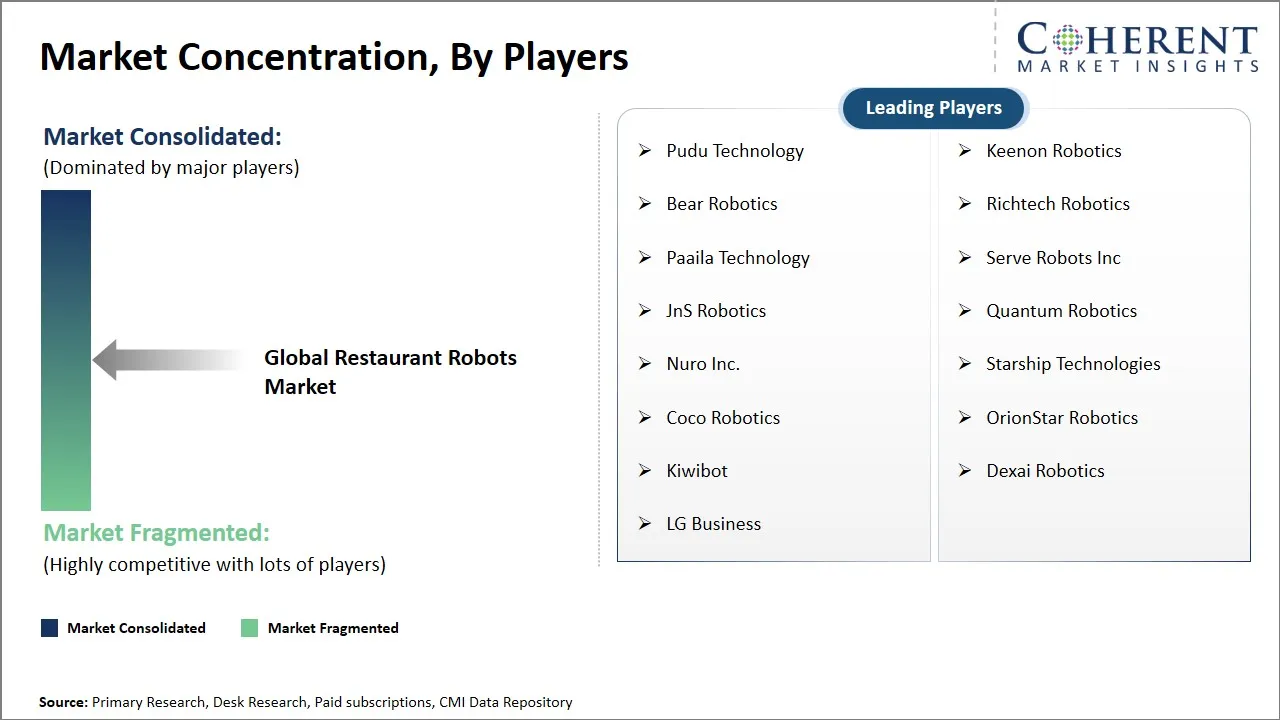
| Companies covered: | Pudu Technology, Keenon Robotics, Bear Robotics, Richtech Robotics, Paaila Technology, Serve Robots Inc, JnS Robotics, Quantum Robotics, Nuro Inc., Starship Technologies, Coco Robotics, OrionStar Robotics, Kiwibot, Dexai Robotics, and LG Business | ||
| Growth Drivers: |
| ||
| Restraints & Challenges: |
| ||
Global Restaurant Robots Market Dynamics
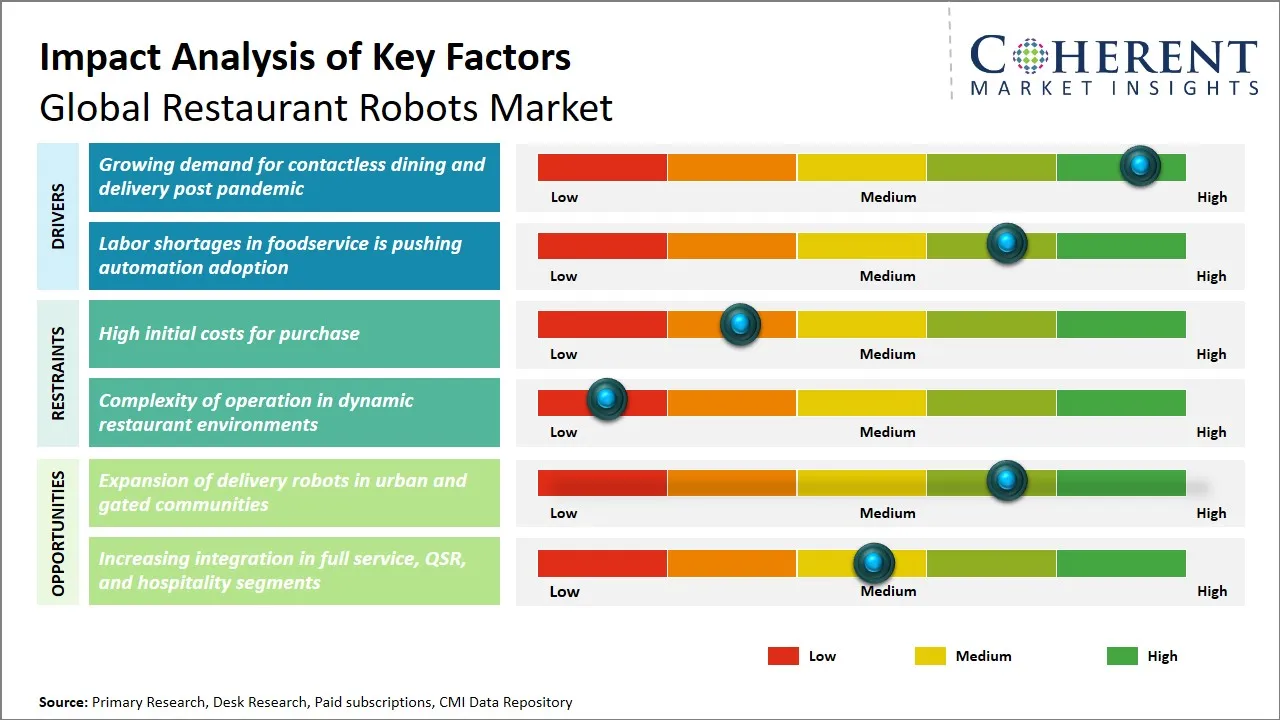
Global Restaurant Robots Market Driver - Growing demand for contactless dining and delivery post pandemic
Following the global health crisis, how people expect food services to operate has changed notably, pushing businesses toward methods that limit physical closeness during ordering and receiving meals. Health concerns now weigh heavily on choices, leading many individuals to favor systems where fewer hands are involved in their meal journey from kitchen to table and food display cabinets.
With less face-to-face contact desired, eateries have begun integrating automated machines capable of handling various roles once managed solely by staff members. Machines assist with collecting orders, cooking processes, transporting dishes, even bringing items directly to diners’ tables or packaging them securely off-site. Introducing mechanical helpers does more than lower chances of spreading illness - it brings steadier performance across daily functions without fluctuation due to fatigue.
Global Restaurant Robots Market Opportunity - Expansion of delivery robots in urban and gated communities
Growth in robot deliveries across city neighborhoods and secured residential zones opens new paths for fast food, QSRs and fine dining restaurant robots worldwide. As fewer people want physical contact during drop-offs - a trend strengthened by recent health crises, more eateries look toward automated systems that improve final-leg transport. Places where homes cluster tightly, entry is managed, and inhabitants embrace technology often suit self-driving carriers well.
Moving through intricate walkways becomes possible without constant oversight, cutting time while limiting person-to-person exchanges, which some customers appreciate. When digital shopping rises alongside app-based meal orders in large cities, pressure builds to find consistent, affordable ways to deliver goods; machines begin appearing as practical options among dining franchises and outside courier networks alike.
Analyst Opinion (Expert Opinion)
- Progress unfolds quietly in dining spaces worldwide as robotic systems become more common. Where staffing grows difficult and pay demands rise, machines offer steady performance without pauses. Through smarter algorithms and improved sensing abilities, devices now move independently, carry meals, prepare ingredients, or clean up afterward. One after another, responsibilities once handled by people shift toward automated solutions. Mistakes decline when repetition defines the work. Attention shifts - not lost, but redirected - toward moments where human presence matters most. Regions like North America and parts of Asia see quicker integration, especially among quick-service brands and mid-tier eateries. What began as small tests now expands into broader use across locations.
- Although possibilities exist, growth today faces distinct constraints. High initial costs discourage widespread adoption among providers. Merging with older systems creates complications when processes differ across sites. Where routines are irregular, progress slows unexpectedly. A portion of users shows little interest, which alters market feedback in specific areas. Hesitation tends to linger within smaller operations, unlike their larger counterparts. Acceleration may arrive solely once prices reflect actual spending limits. As time passes, links to checkout systems gain importance steadily. From practical cases, visible monetary gains start appearing slowly. Across areas, ongoing strain on labor costs fuels growing attention. Machines matter less for show, more where steadiness counts. With change in motion, their purpose bends toward protecting space.
Speak to the analyst
Want personalized insights?
Take the findings above to one of our principal consultants, or have the report rebuilt around the segments, geographies and competitors you actually track.
Market Segmentation
- Type Insights (Revenue, USD Bn, 2021 - 2033)
- Meal Delivery Robot
- Food Making Robot
- Application Insights (Revenue, USD Bn, 2021 - 2033)
- Restaurant
- Kitchen
- Regional Insights (Revenue, USD Bn, 2021 - 2033)
- North America
- U.S.
- Canada
- Latin America
- Brazil
- Argentina
- Mexico
- Rest of Latin America
- Europe
- Germany
- U.K.
- Spain
- France
- Italy
- Russia
- Rest of Europe
- Asia Pacific
- China
- India
- Japan
- Australia
- South Korea
- ASEAN
- Rest of Asia Pacific
- Middle East
- GCC Countries
- Israel
- Rest of Middle East
- Africa
- South Africa
- North Africa
- Central Africa
- North America
- Key Players Insights
- Pudu Technology
- Keenon Robotics
- Bear Robotics
- Richtech Robotics
- Paaila Technology
- Serve Robots Inc
- JnS Robotics
- Quantum Robotics
- Nuro Inc.
- Starship Technologies
- Coco Robotics
- OrionStar Robotics
- Kiwibot
- Dexai Robotics
- LG Business
Sources
Primary Research Interviews
- Restaurant chain executives and franchise owners
- Restaurant automation technology providers and manufacturers
- Food service industry consultants and analysts
- Restaurant equipment distributors and suppliers
Databases
- Euromonitor International Database
Magazines
- Restaurant Business Magazine
- QSR Magazine (Quick Service Restaurant)
- Nation's Restaurant News
- Food Service Director Magazine
Journals
- International Journal of Hospitality Management
- Journal of Foodservice Business Research
- Food Quality and Preference Journal
Newspapers
- Restaurant Hospitality News
- Food & Beverage Marketing
- Hospitality Technology News
- Nation's Restaurant Business
Associations
- National Restaurant Association (NRA)
- International Food Service Executives Association (IFSEA)
- Robotics Industries Association (RIA)
- Food and Beverage Marketing Association
Public Domain Sources
- U.S. Bureau of Labor Statistics (Restaurant Industry Data)
- FDA Food Service Guidelines and Regulations
- International Federation of Robotics (IFR) Reports
- World Health Organization Food Safety Publications
Proprietary Elements
- CMI Data Analytics Tool
- Proprietary CMI Existing Repository of information for last 8 years
Get access to 250+ pages report
Every segment, forecast, competitor profile and data table behind the analysis above — available for instant download.
- ESOMAR Member
- ISO 9001:2015 Certified
- D-U-N-S Registered
- GDPR & CCPA Compliant
Missing comfort of reading report in your local language? Find your preferred language:
Transform your Strategy with Exclusive Trending Reports
Frequently Asked Questions
The global restaurant robots market is estimated to stand at USD 2 Bn in 2026 and is projected to reach USD 6 Bn by 2033.
The CAGR of global restaurant robots market is projected to be 18% from 2026 to 2033.
Growing demand for contactless dining and delivery post pandemic and labor shortages in foodservice is pushing automation adoption are the major factors driving the growth of the global restaurant robots market.
High initial costs for purchase and complexity of operation in dynamic restaurant environments are the major factors hampering the growth of the global restaurant robots market.
In terms of type, meal delivery robot is estimated to dominate the market revenue share in 2026.
They typically augment staff rather than fully replace workers, shifting humans to customer-facing roles.
Pudu Technology, Keenon Robotics, Bear Robotics, Richtech Robotics, Paaila Technology, Serve Robots Inc, JnS Robotics, Quantum Robotics, Nuro Inc., Starship Technologies, Coco Robotics, OrionStar Robotics, Kiwibot, Dexai Robotics, and LG Business are the major players.