

Roofing Tiles Market Size and Trends
The roofing tiles market is estimated to be valued at USD 14.80 Bn in 2026 and is expected to reach USD 22.97 Bn by 2033, exhibiting a compound annual growth rate (CAGR) of 6.5% from 2026 to 2033.
Key Takeaways
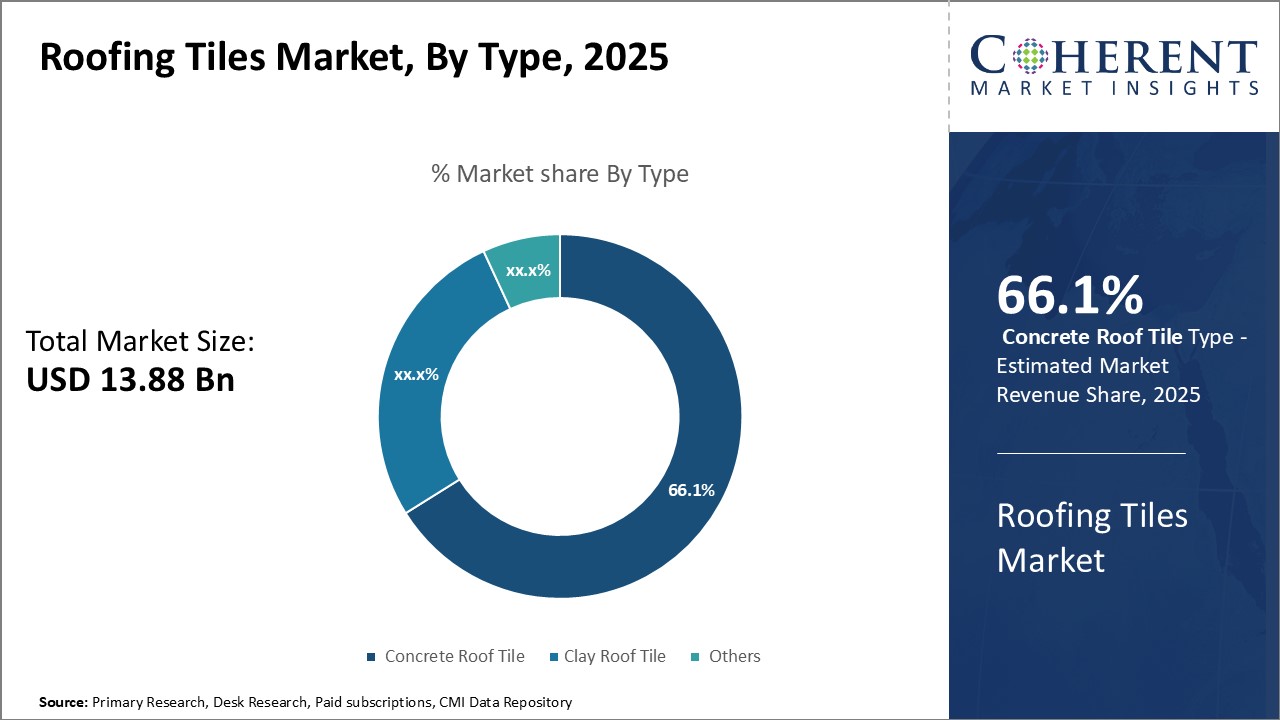
- Based on Type, the Concrete Roof Tile segment leads the market holding an estimated share of 67.1% in 2026, supported by its durability and versatility.
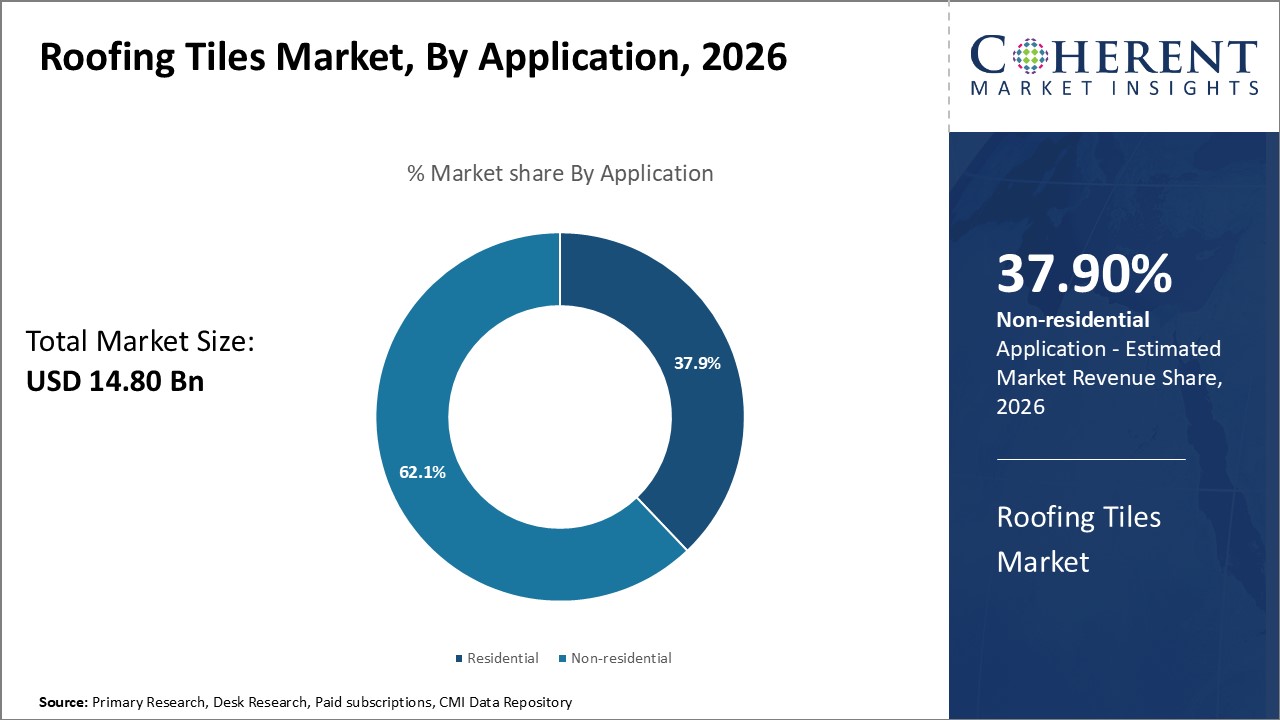
- Based on Application, the Residential segment is expected to dominate the market with 36.95 share in 2026, owing to re-roofing cycles and housing renovations.
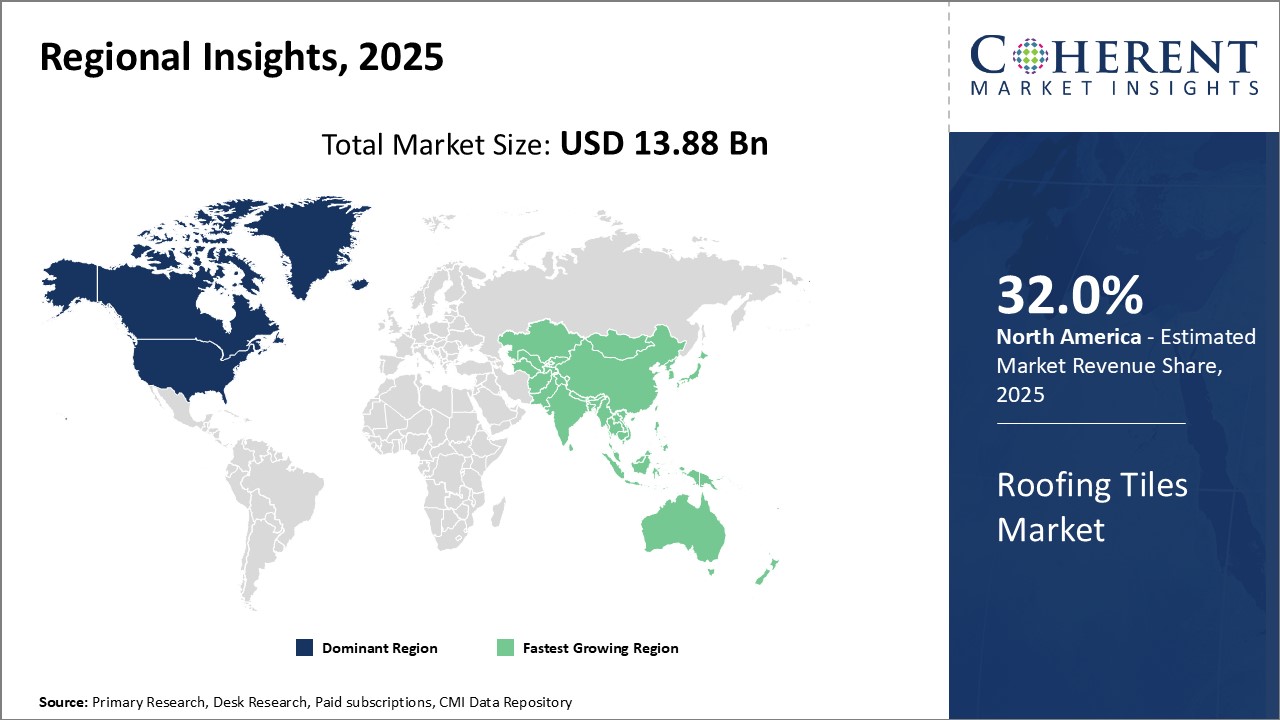
- Based on Region, North America is estimated to lead the market with a share of 32.0% in 2026, owing to the growing construction industry. While, Asia Pacific is expected to be the fastest growing region during the forecast period.
Market Overview
The demand for roofing tiles is expected to grow due to the rising infrastructure development activities across the globe. Rapid urbanization and growing construction of both residential and commercial buildings will drive the market growth during the forecast period. Furthermore, repair and renovation of old buildings also contribute significantly to the roofing tiles market growth. Various government initiatives towards the development of sustainable infrastructure and buildings are further expected to provide potential opportunities for market players. However, availability of alternative materials for roofing and fluctuations in raw material prices may hamper the market growth. Overall, rapid economic development and improvement in lifestyle standard across developed and emerging countries will drive the global roofing tiles market.
Current Event and their Impact on the Roofing Tiles Market
Current Events | Description and its Impact |
Climate Resilience-Driven Market Transformations |
|
Mega-Project Influences |
|
Role of Artificial Intelligence (AI) in Roofing Tiles Market
The integration of artificial intelligence into roofing industry has transformed the roofs by detecting damage and automating inspections to smart roofing system and improved the design. AI-powered tools are helping roofers automate tasks, reduce costs, and enhance the overall performance of roofing systems. With the help of AI-powered technology, roofers can obtain high-resolution images of the entire roof surface, including hard-to-reach areas. This eliminates the need for AI-powered tools are helping roofers automate tasks, reduce costs, and enhance the overall performance of roofing systems.
In May 2025, Flat roofing specialist TaperedPlus has embarked on a groundbreaking £270,000 artificial intelligence (AI) project in collaboration with Teesside University, aiming to transform the technical design processes within the roofing industry. The company seeks to digitize and automate TaperedPlus's manual design workflows by integrating advanced AI technologies, including natural language processing (NLP) and deep learning.
- Current Industry Events of 2026
- Market Size Estimation
- Regional Breakdown
- Competitive Landscape
- Customer Intelligence
- Segmental Analysis
- Pricing Analysis
- Key Market Drivers, Challenges & Future Trends
- Customized Insights Section
Pricing Analysis of Roofing Tiles
- Clay Tiles
- Price: $10 to $18 per square foot
- Pros: Durable, fire-resistant, great for hot climates, classic look
- Cons: Heavy, expensive installation, brittle in freezing climates
- Concrete Tiles
- Price: $9 to $14 per square foot
- Pros: Affordable alternative to clay, durable, versatile styles
- Cons: Heavy, requires strong roof structure
- Slate Tiles
- Price: $15 to $30+ per square foot
- Pros: Extremely durable, natural stone look, long lifespan
- Cons: Very heavy, costly installation and materials
- Metal Tiles (Steel, Aluminum, Copper)
- Price: $7 to $12 per square foot
- Pros: Lightweight, long-lasting, energy efficient
- Cons: Can dent, sometimes noisier in rain
- Synthetic/Composite Tiles
- Price: $6 to $12 per square foot
- Pros: Lightweight, affordable, mimic natural materials
- Cons: Less proven durability compared to natural tiles
Segmental Analysis
Roofing Tiles Market Insights, By Type
Concrete Roof Tile Dominates the Overall Market Owing to its Durability and versatility
In terms of type, concrete roof tile is expected to contribute 67.1% share of the market in 2026. Concrete roof tiles have emerged as one of the leading segments in the roofing tiles market. Their widespread popularity can be attributed to the material's exceptional strength and longevity. Concrete formulations have undergone rapid advancements, resulting in roof tiles that can withstand heavy rains, winds, UV exposure, and extreme temperature variations with minimal degradation for decades. With proper installation techniques, concrete tiles form a very sturdy and weatherproof roof assembly far superior to other materials like wood or normal clay tiles.
In addition to strength, concrete tiles are extremely versatile in terms of styles, sizes, and placements. Manufacturers offer a diverse range of textures, colors, and profiles that allow homes to incorporate concrete tiles as architectural statement pieces complementing their design language. Their modularity also permits various innovative laying patterns compared to singularly shaped clay tiles. Furthermore, pre-treated concrete surfaces are stain and mold resistant, reducing maintenance needs. They can withstand harsh environments for long periods without replacement. This is a significant factor for use in regions prone to natural disasters like flooding or forest fires.
In December 2024, Russel Roof Tiles launched Bute3®, the UK's first triple interlocking concrete roof tile, marking a significant advancement in roofing technology. This innovative product is the result of over five years of research and a £2 million investment, aiming to enhance installation efficiency and aesthetic versatility. This launch showcases Russell Roof Tiles' commitment to innovation and sustainability in the construction industry. This is further accelerating the roofing tiles market share.
Roofing Tiles Market Insights, By Application
Re-roofing cycles and housing renovations Dominates the Overall Market
Based on application, the residential segment is expected to contribute 37.9% of the market share in 2026. The residential construction industry accounts for the maximum demand in the roofing tiles market globally due to consistent re-roofing cycles and housing renovation activities. Most households require replacement of worn-out roofing systems anywhere between 15 and 25 years depending on local climate conditions and quality of original installation. Also, more than half of American homeowners intend to renovate this year, according to the Houzz study. This recurring replacement spending acts as a steady demand driver for roof tiles over the long term, even outpacing new construction volumes at times. According to reports from the Joint Center for Housing Studies of Harvard University (JCHS) Leading Indicator of Remodeling Activity (LIRA).
Additionally, housing renovation projects involving reroofing are witnessing a major boom. Rising incomes are allowing homeowners to invest more frequently in functional upgrades of rooftops alongside other interior and exterior refreshes. Advanced roofing materials that replicate the aesthetics of traditional styles are highly popular in such renovation scopes. Changing demographics like growing nuclear families also necessitate residential remodeling or extension works involving re-roofing on a large scale, homeowners invested USD 463 billion in house renovation in the first quarter of 2024.
Regional Insights
North America Roofing Tiles Market Analysis and Trends
The North America region currently dominates the global roofing tiles market. The region is expected to account for over 32.0% of the market share in 2026. The large market size can be attributed to several factors. The region has a well-established construction industry, with continuous new housing projects as well as repair and replacement activities in the commercial and industrial sectors, driving the tiles consumption. Apart from this, the government across the region are also investing in housing infrastructure is also contributing to the roofing tiles market share. For example, in April 2024, Prime Minister Justin Trudeau announced a C$6 billion Canada Housing Infrastructure Fund aimed at speeding up the development and renovation of housing.
Many major players in roofing materials have their origins in North America, giving local brands greater brand visibility and market penetration. Changing weather conditions over the years have also raised awareness about more durable tile roofing options among homeowners and architects. With its advanced economic conditions, the region is able to afford premium tile products made from high grade raw materials.
Asia Pacific Roofing Tiles Market Analysis and Trends
The Asia Pacific region has witnessed the fastest growth in the roofing tiles market over the last decade. The region's growth stems from the massive housing construction activities in developing economies like China and India due to their large populations and rapid urbanization levels. This has created a huge demand for residential tiles. Government initiatives supporting rural developments and affordable housing projects have further boosted the market growth.
Along with the residential sector, rising commercial construction is also propelling tiles usage. There are 5,577 active construction projects in the residential sector in Hong Kong, which is worth for approximately 1.52 trillion HKD and 5,010 active construction projects in Indonesia worth 195.89 trillion IDR. Moreover, tile imports have increased significantly in developing Asian countries who do not have adequate local production capabilities yet. This import dependence indicates further market potential as local manufacturing capacities get strengthened through foreign investments. The presence of cost-effective labor also helps in maintaining competitive pricing of roofing tiles, making them affordable for customers across regions. Going forward, the Asia Pacific market is expected to play a greater role in the global roofing tiles market.
Roofing Tiles Market Outlook Country-wise
The United States Roofing Tiles Market Trends
The United States acquires the prominent share in the roofing tiles market, due to the composite and solar integrated solution. The rising adoption of solar integrated roofing tiles is driven by California’s Title 24 building energy efficiency standards. After the innovation of Tesla’s Solar Roof and GAF Energy’s DecoTech, the traditional tile manufacturers are under pressure to develop compostable roofing system to maintain competition in the market.
Germany Roofing Tiles Market Trends
Germany’s roofing tiles market is facing challenges with preservation laws favoring traditional clay tiles and national policies promoting decarbonization through solar roofing. In 2023, new legislation mandated solar installations on most new and renovated rooftops in Baden-Württemberg and Bavaria. The clay tile manufactures are now developing solar underlay infrastructure. With this, at present 30% of the Germany’s sloped roof consists on solar modules.
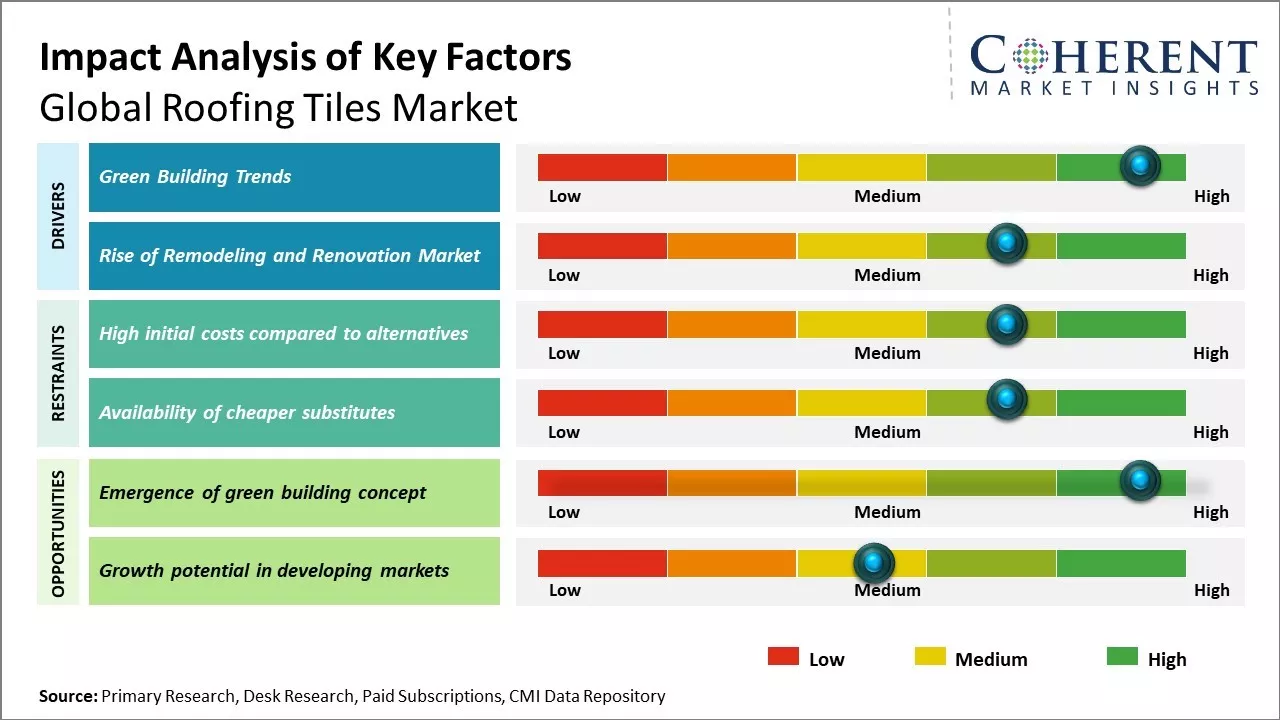
Roofing Tiles Market Driver
Green Building Trends
With growing emphasis on eco-friendly and sustainable construction practices, there has been a marked rise in demand for green roofing materials across both the residential and commercial sectors globally. Several property owners and builders have started preferring roofing tiles that are produced from recyclable materials or those that provide better insulation. This reduces heating and cooling costs of the building and lowers carbon footprint over the lifespan of the building. Some major benefits of roofing tiles produced from clay and concrete include better reflectivity, heat resistance, noise protection, and ability to withstand wind loads. They are also highly durable and require lesser maintenance compared to other conventional materials. With consumers and builders prioritizing energy efficiency, aesthetics and eco-friendly attributes in construction, natural clay and concrete tiles have gained widespread acceptance. Their green and sustainable qualities are expected to continue driving augmented sales of roofing tiles worldwide.
In May 2025, Solartag has launched a new solar tile for pitched roofs. The 71 W solar tiles, weighs 14.2kg/m2 and has a power coversion efficiency of 16%. This new product relies on black PERC cells and is standardized for mass production. This is ideally used by private homeowners, architects, and developers across Northern Europe who value sustainable energy without compromising design.
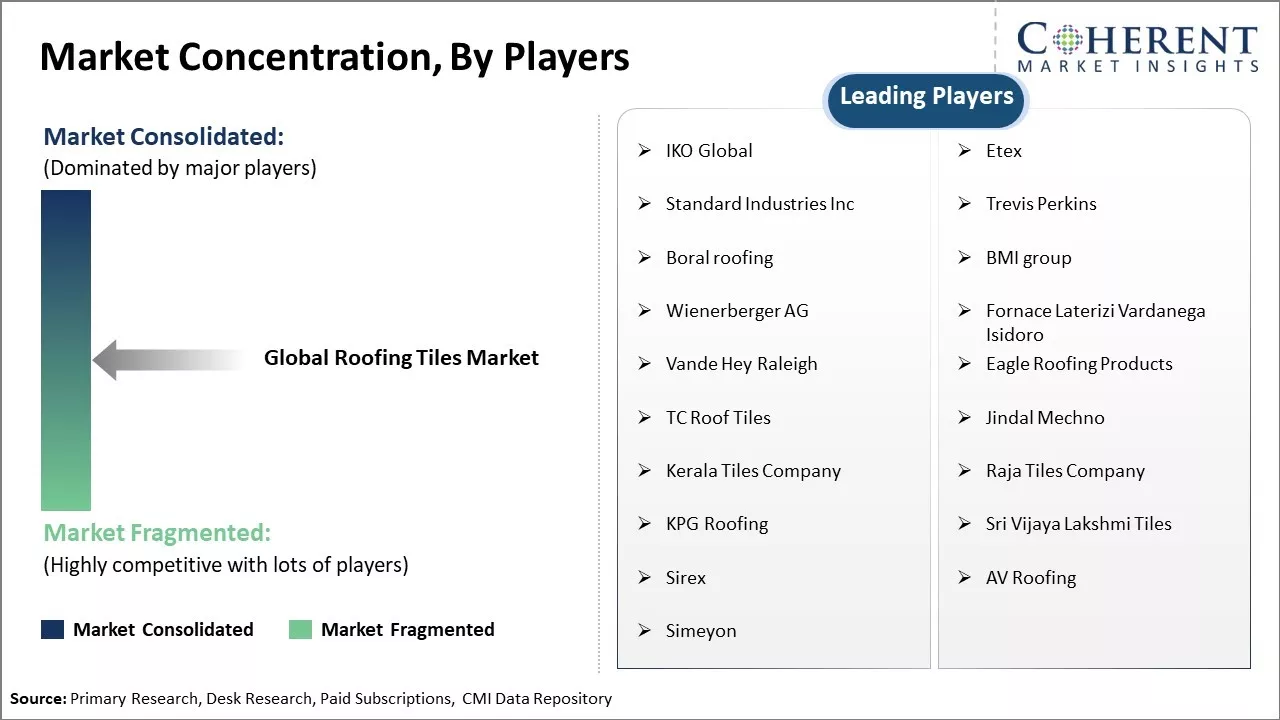
Market Concentration and Competitive Landscape
Key Developments
- In May 2025, the Fraunhofer Institute for Solar Energy Systems ISE formed a strategic alliance with Swiss solar roof manufacturer Freesuns to establish a pilot line for PV roof tiles at its Module Technology Evaluation Center (Module-TEC) in Freiburg. This project will be a part of its Sustainable Photovoltaics Integration in Buildings and Infrastructure (SPHINX) research project.
- In May 2025, SCG launched its LumaX Series, the latest metal roofing system in Thailand. The LumaX Series roofing system was developed to address modern design requirements with its standout feature of allowing installation at low incline angles of just 0.3 degrees without requiring additional materials to conceal the roof or risking future leakage issues.
- In April 2025, Russell Roof Tiles inaugurated its first dedicated Training & Innovation Hub, marking a significant investment in workforce development and sustainable roofing solutions. The facility, located in Burton-on-Trent, aims to provide comprehensive training programs and foster innovation in roofing technologies.
- In March 2024, the Breedon Group, a leading construction materials company, introduced of its unique solar roof tile in collaboration with a team of innovative engineers and designers. This groundbreaking product is set to transform the roofing industry by combining advanced solar technology with a sleek and seamless design.
Market Dynamics
Rise of Remodeling and Renovation Market
The worldwide remodeling and renovation market has seen tremendous growth over the last decade due to aging building stock, rising disposable incomes, changing design preferences, and real estate investments. Homeowners are now continuously upgrading and improving their spaces with modern amenities, fixtures, and styling. In 2024, Americans are estimated to have spent USD 603 billion on home remodeling. Also, developers are repositioning and rejuvenating outdated commercial properties to boost occupancy rates and rental yields. Both the residential and non-residential segments have contributed to the vibrant remodeling industry across developed as well as developing economies, which is further proliferating the roofing tiles market share.
Roofing Tiles Market Opportunities
Emergence of green building concept
The emergence of green building materials is an excellent opportunity for growth in the global roofing tiles market. In the recent years, there has been a heightened awareness regarding environment protection and sustainability among builders, developers as well as consumers. More and more construction projects are opting for green certifications which require the use of eco-friendly materials. Roofing tiles manufactured using recycled content or from natural materials meet the criteria for green building and are seeing higher demand.
Several governments around the world are also incentivizing the use of sustainable roofing solutions through their policies and regulations. For example, according to the United Nations Environment Programme, over 130 countries have introduced eco-friendly building codes and standards to promote resource-efficient green constructions. This policy support is encouraging the adoption of roof tiles that have lower carbon footprint and are produced with minimal environmental impact. Many tile manufacturers have started developing product portfolios specialized for green building projects. This is further propelling the roofing tiles market demand.
Market Report Scope
Roofing Tiles Market Report Coverage
| Report Coverage | Details | ||
|---|---|---|---|
| Base Year: | 2025 | Market Size in 2026: | USD 14.80 Bn |
| Historical Data for: | 2020 To 2024 | Forecast Period: | 2026 To 2033 |
| Forecast Period 2026 to 2033 CAGR: | 6.5% | 2033 Value Projection: | USD 22.97 Bn |
| Geographies covered: |
| ||
| Segments covered: |
| ||
| Companies covered: | IKO Global, Etex, Standard Industries Inc, Trevis Perkins, Boral roofing, BMI group, Wienerberger AG, Fornace Laterizi Vardanega Isidoro , Vande Hey Raleigh , Eagle Roofing Products, TC Roof Tiles, Jindal Mechno, Kerala Tiles Company, Raja Tiles Company, KPG Roofing, Sri Vijaya Lakshmi Tiles, Sirex, AV Roofing, and Simeyon | ||
| Growth Drivers: |
| ||
| Restraints & Challenges: |
| ||
Analyst Opinion (Expert Opinion)
- The global roofing tiles market is standing on a threshold, one side offering legacy-driven comfort in traditional clay and concrete, and the other ushering in performance-driven disruption from composite and solar-integrated alternatives. In my view, unless traditional roofing tile manufacturers aggressively adopt innovation and sustainability standards, they will be squeezed out of relevance in under a decade.
- Take Western Europe, for instance, once a fortress for terracotta tiles due to strict heritage preservation codes and aesthetic preferences. Today, countries like Germany and Netherlands are pivoting toward solar-integrated tiles, driven by aggressive decarbonization mandates. In 2023 alone, over 28% of new pitched roofs in Germany were integrated with some form of building-applied photovoltaics (BAPV), a figure unimaginable even five years ago. Legacy tile makers that fail to engineer compatible underlayment and fastening systems for these solar units are now sidelined in major public and residential tenders.
- In India and Southeast Asia, where urban sprawl demands cost-effective and thermally efficient roofing, concrete tiles, especially lightweight aerated variants, have shown regional traction. Yet, they face mounting pressure from metal and plastic composites that offer easier installation, lower labor dependency, and high cyclonic resistance, an increasingly critical factor as climate volatility escalates. For example, Tamil Nadu's post-2023 cyclone rebuild programs saw state-endorsed use of composite tiles over traditional ones due to the latter's poor wind-uplift resistance metrics.
- The tile industry’s biggest Achilles’ heel, however, is water absorption and heat retention, both increasingly critical in climate-sensitive urban planning. Traditional clay tiles can absorb up to 10–15% of their weight in water, leading to mold, frost damage, and weight-load failures on aging structures. Yet, leading manufacturers have done little to push forward low-porosity surface innovations. Meanwhile, startups in the U.S. and Australia are rolling out nano-ceramic-coated polymer tiles with <1% water absorption and built-in UV reflectivity, effectively flipping the traditional performance-cost paradigm.
- There is also a branding crisis in the roofing tile space. Tile makers have consistently failed to reposition their products beyond utility into the realm of functional aesthetics and modular smart architecture. Compare this to firms like Tesla and GAF Energy, which have elevated roofing into a sustainability and technology narrative. Roofing tile producers are still marketing products based on durability and tradition—a tone-deaf approach in an age where LEED certifications and ESG disclosures dictate procurement.
- In summary, the roofing tiles market, as it stands, is operating on a decades-old playbook. Incremental change will not be enough. The winners in this industry will be those who redefine tiles not just as shelter, but as sustainable infrastructure, highly functional, climate-adaptive, and digitally integrated. Without this shift, roofing tiles risk becoming the vinyl records of the construction sector: loved by a few, but sidelined by utility.
Speak to the analyst
Want personalized insights?
Take the findings above to one of our principal consultants, or have the report rebuilt around the segments, geographies and competitors you actually track.
Market Segmentation
- Type Insights (Revenue, USD Bn, 2021 - 2033)
- Clay Roof Tile
- Concrete Roof Tile
- Others
- Application Insights (Revenue, USD Bn, 2021 - 2033)
- Residential
- Non-residential
- Regional Insights (Revenue, USD Bn, 2021 - 2033)
- North America
- U.S.
- Canada
- Latin America
- Brazil
- Argentina
- Mexico
- Rest of Latin America
- Europe
- Germany
- U.K.
- Spain
- France
- Italy
- Russia
- Rest of Europe
- Asia Pacific
- China
- India
- Japan
- Australia
- South Korea
- ASEAN
- Rest of Asia Pacific
- Middle East & Africa
- GCC Countries
- Israel
- Rest of Middle East & Africa
- North America
- Key Players Insights (Revenue, USD Bn, 2021 - 2033)
- IKO Global
- Etex
- Standard Industries Inc
- Trevis Perkins
- Boral roofing
- BMI group
- Wienerberger AG
- Fornace Laterizi Vardanega Isidoro
- Vande Hey Raleigh
- Eagle Roofing Products
- TC Roof Tiles
- Jindal Mechno
- Kerala Tiles Company
- Raja Tiles Company
- KPG Roofing
- Sri Vijaya Lakshmi Tiles
- Sirex
- AV Roofing
- Simeyon
Sources
Primary Research Interviews from the following stakeholders:
Stakeholders:
- Interviews with roofing tile manufacturers, building contractors, construction material distributors, project managers, facility managers, architects, and procurement leads across major global construction markets.
Specific stakeholders:
- Procurement managers at residential and commercial real estate developers (e.g., DLF, Lennar, China Vanke)
- Architects and design consultants at infrastructure and architectural firms
- Project heads at construction companies (e.g., Skanska, Larsen & Toubro, Bouygues Construction)
- Municipal building code officials and city planning authorities
- Facilities and maintenance managers in the hospitality and institutional sectors
- Product managers at roofing material OEMs and component suppliers (e.g., ceramic tile producers, clay and concrete suppliers)
Databases:
- UN Comtrade Database
- World Bank – Building Materials Statistics
- OECD Construction Statistics
- Eurostat – Construction and Building Materials
- U.S. Geological Survey (USGS) – Mineral Industry Surveys: Clays and Ceramics
- IndiaStat – Construction and Housing Sector Data
- China National Bureau of Statistics – Building Material Reports
- Statistics Canada – Building Permits and Construction Materials
- Ministry of Housing and Urban Affairs (MoHUA), India
Magazines:
- Construction Week
- Architectural Record
- Building Design + Construction
- Roofing Contractor
- Professional Builder
- Tile Today (Asia-Pacific)
- Design Middle East – Roofing & Façade Section
- World Construction Network
Journals:
- Journal of Construction and Building Materials
- Cement and Concrete Composites
- Journal of Architectural Engineering
- Journal of Building Engineering
- International Journal of Construction Management
- Journal of Cleaner Production (Construction Materials focus)
Newspapers:
- The Economic Times – Infrastructure & Realty
- Business Standard – Construction and Urban Planning
- Financial Times – Property & Construction Reports
- The Times of India – Housing & Real Estate
- Construction News (UK)
- Globe and Mail – Real Estate & Building Sector
Associations:
- National Roofing Contractors Association (NRCA)
- European Roof Tile Association (ERTA)
- International Federation for the Roofing Trade (IFD)
- Construction Specifications Institute (CSI)
- Federation of Indian Chambers of Commerce & Industry (FICCI) – Building Materials Panel
- Terra Tile Industry Association
- Construction Products Association (CPA) – UK
Public Domain Sources:
- Ministry of Housing, Communities & Local Government (UK)
- Central Public Works Department (India) – Building Materials Specifications
- Department of Commerce (U.S.) – Construction Sector Reports
- Ministry of Economy, Trade and Industry (METI), Japan – Building Materials Overview
- European Construction Sector Observatory
- India Construction Portal – Government Tender Insights
- Reserve Bank of India (RBI) – Infrastructure Sector Reports
- World Bank – Urban Infrastructure and Housing Projects Database
Proprietary Elements:
- CMI Data Analytics Tool, and Proprietary CMI Existing Repository of information for last 8 years
*Definition: The roofing tiles market consists of the manufacturing and sales of roof tiles that are used to cover the roof of the residential, commercial, and industrial buildings. Roof tiles are typically made from materials such as concrete, clay, slate, metal, asphalt, or other composite materials. They provide weather resistance and protection to the roof structure from sun, rain, snow, and other elements. Key players in the roofing tiles market offer a variety of design and installation services for tiles suited for both new construction and re-roofing projects.
Get access to 250+ pages report
Every segment, forecast, competitor profile and data table behind the analysis above — available for instant download.
- ESOMAR Member
- ISO 9001:2015 Certified
- D-U-N-S Registered
- GDPR & CCPA Compliant
Missing comfort of reading report in your local language? Find your preferred language:
Transform your Strategy with Exclusive Trending Reports
Frequently Asked Questions
The Roofing Tiles Market is estimated to be valued at USD 14.80 Bn in 2026, and is expected to reach USD 22.97 Bn by 2033.
The CAGR of the Roofing Tiles Market is projected to be 6.5% from 2026 to 2033.
Green building trends and rise of remodeling and renovation market are the major factors driving the growth of the global roofing tiles market.
High initial costs compared to alternatives and availability of cheaper substitutes are the major factors hampering the growth of the global roofing tiles market.
In terms of type, concrete roof tile is estimated to dominate the market revenue share in 2026.
IKO Global, Etex, Standard Industries Inc, Trevis Perkins, Boral roofing, BMI group, Wienerberger AG, Fornace Laterizi Vardanega Isidoro, Vande Hey Raleigh, Eagle Roofing Products, TC Roof Tiles, Jindal Mechno, Kerala Tiles Company, Raja Tiles Company, KPG Roofing, Sri Vijaya Lakshmi Tiles, Sirex, AV Roofing, and Simeyon are the major players.
North America is expected to lead the global roofing tiles market.