

Global Seaplanes Market Size and Forecast – 2026-2033
The Global Seaplanes Market is estimated to be valued at USD 1.92 Bn in 2026 and is expected to reach USD 2.72 Bn by 2033, exhibiting a compound annual growth rate (CAGR) of 5.1% from 2026 to 2033.
Key Takeaways of the Seaplanes Market
- The floatplane segment leads the market holding an estimated share of 46.1 % in 2026.
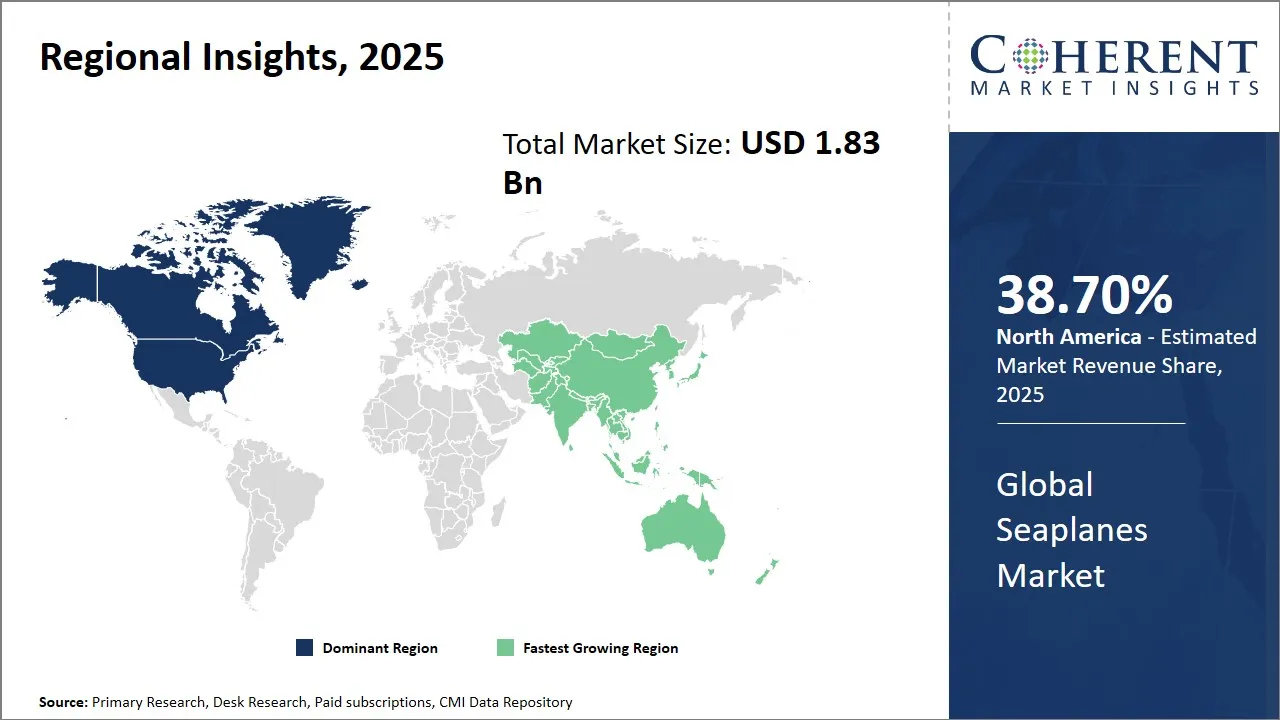
- North America is estimated to lead the market with a share of 38.7 % in 2026.
- Asia Pacific, holding a share of 30.3% in 2026, is projected to be the fastest growing region.
Market Overview
The market is seeing a rising preference for eco-friendly and versatile aviation solutions, with manufacturers working on using advanced materials and fuel-efficient engines to reduce environmental impact. Additionally, government initiatives promoting regional connectivity and sustainable travel options are propelling the demand. Increasing investments in seaplane infrastructure, such as floating terminals and water aerodromes, also add to the market expansion, positioning seaplanes as an important segment within the broader aviation industry.
Current Events and Its Impact
Current Events | Description and Impact |
Geopolitical and Trade Developments |
|
Environmental Regulations and Green Policies |
|
Defense & Security Modernization |
|
Segmental Insights
- Current Industry Events of 2026
- Market Size Estimation
- Regional Breakdown
- Competitive Landscape
- Customer Intelligence
- Segmental Analysis
- Pricing Analysis
- Key Market Drivers, Challenges & Future Trends
- Customized Insights Section
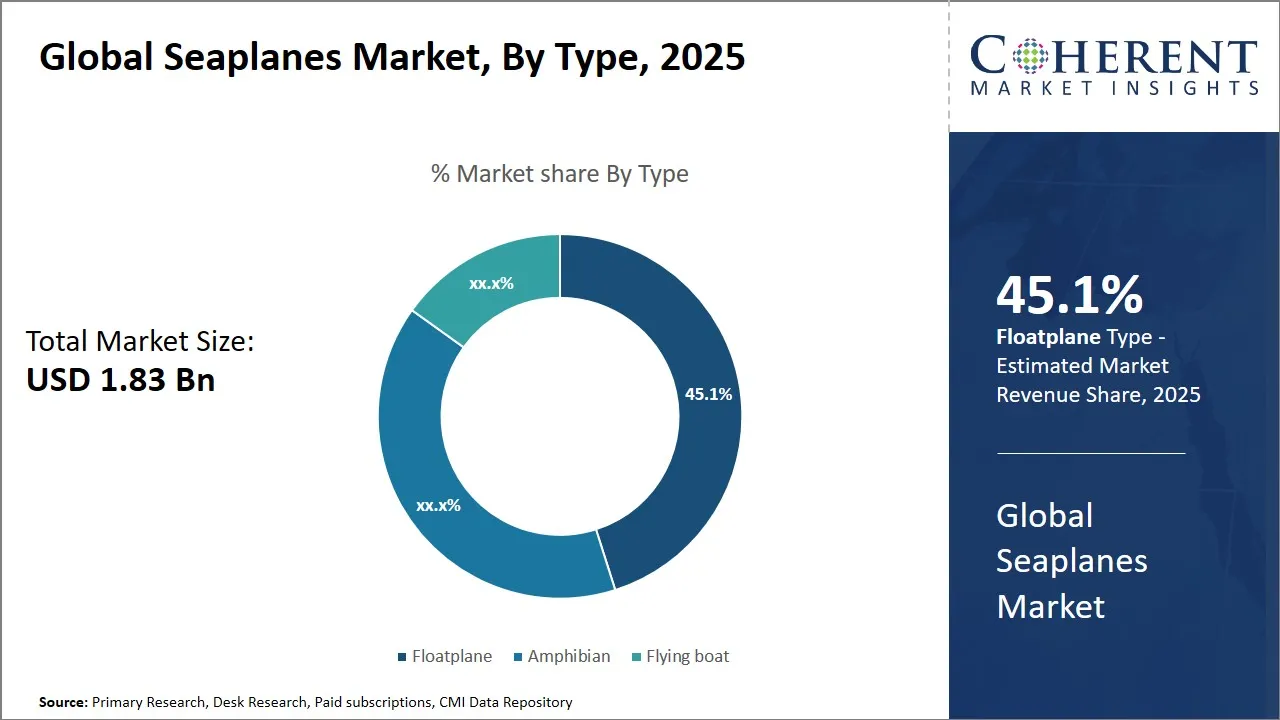
Global Seaplanes Market Insights, by Type – Floatplanes Lead Due to Preference for Operational Flexibility and Accessibility
Floatplane is expected to contribute the highest share of 46.1% in the market in 2026. Floatplanes are made with pontoons or floats attached to their fuselage, allowing them to take off and land on water bodies with ease. This makes them useful in regions where runway infrastructure is limited or non-existent, such as remote islands and lakeside communities.
Floatplanes are extensively used for tourism, offering scenic flights over water-rich terrains and connecting travelers to secluded resorts or fishing lodges. Their ability to access remote natural attractions heightens the appeal for adventure tourism and eco-tourism markets. Additionally, floatplanes play a vital role in emergency services and humanitarian missions, where quick access to isolated areas is essential for medical evacuations or delivery of supplies.
Technological advancements in materials and avionics have also enhanced the performance and safety of floatplanes, contributing to increased operator confidence and customer acceptance. Modern floatplanes are equipped with lightweight, corrosion-resistant materials and efficient engines, reducing maintenance requirements and improving fuel efficiency. This has broadened their usability, making them a cost-effective mode of water-based air transportation compared to other seaplane types.
Furthermore, environmental considerations are influencing segment growth. Floatplanes offer a lower environmental footprint in certain contexts because they can utilize natural water bodies without the need for extensive infrastructure development, minimizing ecological disturbance. Their contribution to sustainable regional connectivity aligns well with the growing global emphasis on environmentally responsible transportation solutions.
Impact of AI on the Seaplanes Market
- AI-powered avionics systems are being integrated into modern seaplanes to assist with automated takeoff and landing on dynamic water surfaces, real-time route optimization, and predictive weather analytics. These capabilities are especially vital in remote or unpredictable maritime environments where traditional flight operations pose higher risk.
- AI is also enabling more accurate maintenance forecasting by monitoring engine performance, hull stress, and component wear—ultimately reducing downtime and operational costs.
- Dornier Seawings has begun integrating advanced AI-based flight assistance systems in its upcoming Seastar CD2 amphibious aircraft. These systems provide automated stability control and optimized fuel management during maritime operations.
Regional Insights
North America Seaplanes Market Analysis and Trends
North America, holding a share of 38.7% in 2026, is expected to dominate the global seaplanes market, driven by a well-established aerospace ecosystem, extensive coastline infrastructure, and high demand for seaplane services in remote and coastal areas. The U.S. and Canada, in particular, benefit from government policies supporting regional connectivity and eco-tourism development.
The presence of major aerospace and defense companies, such as Textron Aviation and Viking Air, further solidifies North America’s leading position. These firms are continuously innovating with advanced seaplane models designed for both commercial and recreational use, supported by strong trade links and skilled labor. REGENT's all-electric seagliders, such as the Viceroy model, are designed for high-speed coastal transport. By flying just above the water surface, these aircraft reduce drag and offer high efficiency with zero emissions. Additionally, North America’s regulatory environment facilitates certification and operation of seaplanes, encouraging industry expansion.
Asia Pacific Seaplanes Market Analysis and Trends
The Asia Pacific, holding an estimated share of 30.3% in 2026, exhibits the fastest growth in the seaplanes market, fueled by increasing investments in tourism infrastructure, growing demand for regional connectivity, and government initiatives to develop water-based transportation networks. Countries like India, Indonesia, and Australia are focusing on expanding domestic travel capabilities in archipelagic and remote regions where conventional runways are scarce. The growing middle class and rising disposable incomes are also driving higher demand for luxury and leisure seaplane services.
Key players such as Aviation Industry Corporation of China (AVIC) and Mahindra Aerospace are actively entering the market with new aircraft models suited for the unique demands of the Asia Pacific region. Trade liberalization and partnerships with international players help accelerate market penetration here. AVIC’s AG600 is designed for firefighting, maritime search and rescue, and military operations. With a range of over 4,500 km and the ability to take off and land on both land and water, it's a strategic asset in disaster response and coastal security.
Seaplanes Market Outlook for Key Countries
U.S. Seaplanes Market Analysis and Trends
The U.S. seaplanes market remains a cornerstone of the global industry, supported by a vast network of lakes, coastal waterways, and dedicated seaplane bases. Prominent companies like Textron Aviation and Progressive Aerodyne have contributed significantly through innovative models such as the Cessna Caravan Amphibian and the SeaRey. The U.S. government supports regional air connectivity and disaster relief operations that often rely on seaplanes, strengthening their operational relevance. Advanced manufacturing capabilities and established supply chains also provide the U.S. with a competitive edge in seaplane production and export.
Canada Seaplanes Market Analysis and Trends
Canada’s rugged geography with numerous lakes and remote communities has created a perennial demand for seaplane transportation. Viking Air, a major player based in Canada, produces a range of amphibious aircraft and maintains a strong portfolio with its Twin Otter series, widely used for passenger and cargo transport in hard-to-reach areas. Canadian governmental policies promoting regional development and environmental sustainability also enhance seaplane utility. Additionally, the tourism sector benefits from seaplane access to national parks and wilderness resorts, making Canada a crucial market in North America.
India Seaplanes Market Analysis and Trends
India seaplanes market is emerging rapidly, propelled by government plans under the UDAN (Ude Desh ka Aam Naagrik) scheme, focusing on enhancing regional connectivity and promoting tourism via seaplane operations in states like Goa, Lakshadweep, and the Andaman & Nicobar Islands. The entry of indigenous aircraft manufacturers like Mahindra Aerospace, alongside foreign players, is fostering local innovation and infrastructure development. Strategic partnerships with international experts and pilot training programs are facilitating faster adoption and safety compliance, making India a key growth hub in Asia Pacific.
Australia Seaplanes Market Analysis and Trends
Australia’s vast coastal areas and island territories provide an ideal environment for seaplane operations, particularly for tourism and freight transport. The government actively supports regional aviation services, and private operators such as Seawings and Sydney Seaplanes are expanding personalized travel experiences. Australia's established aerospace service sector also supports maintenance and certification processes, encouraging fleet modernization. The strong demand for eco-tourism and adventure tourism has positioned Australia as a key market in the Asia Pacific region’s seaplane ecosystem.
Indonesia Seaplanes Market Analysis and Trends
Indonesia leverages its archipelagic geography, with thousands of islands requiring reliable inter-island transport solutions. The government’s focus on improving connectivity via seaplanes aligns with national development plans. Local operators and international collaborators work together to supply seaplanes tailored for tropical and marine environments. Manufacturers like Indonesian Aerospace (PT Dirgantara Indonesia) are enhancing fleet availability, while tourism growth in destinations such as Bali and Raja Ampat drives demand. Trade relations within ASEAN help facilitate technology transfer and regional market integration for the seaplane industry.
Market Players, Key Development, and Competitive Intelligence
Key Developments
- In June 2025, China’s home-grown AG600, the world’s largest amphibious aircraft, was given the green light for mass production, marking a step forward in building an independent and globally competitive aviation industry.
- In February 2025, a Letter of Intent (LOI) was signed between Tidal Flight and Tropic Ocean Airways to introduce Tidal’s Polaris hybrid-electric seaplane to Tropic Ocean Airways’ fleet. Announced at the Future Opportunities for Seaplanes and Amphibious Aviation 2025 (FOSAA25) conference in Miami, U.S. the LOI features 20 Polaris Amphibian aircraft and is valued at over USD 100 million.
- In February 2023, the Pentagon’s emerging technologies research arm, the Defense Advanced Research Projects Agency (DARPA), awarded two aviation companies contracts to develop seaplanes that would fly less than 100 feet off the ground and carry 90 tons of cargo more than 6,500 nautical miles. General Atomics, working with Maritime Applied Physics Corporation, and Aurora Flight Sciences, working with Gibbs & Cox and ReconCraft, each won contracts to start design and development work for a prototype Liberty Lifter cargo aircraft.
- In February 2022, Australian company, Amphibian Aerospace Industries (AAI), started building a new version of the legendary Albatross flying boat. Named G-111T, the “new Albatross” which was to feature new Pratt & Whitney PT6A-67F engines, providing substantially improved performance, fuel economy, and reliability
Top Strategies Followed by Seaplanes Market Players
- Established market leaders primarily invest heavily in research and development (R&D) to innovate and produce high-performance seaplanes that meet evolving customer demands for safety, efficiency, and environmental compliance.
- Dornier Seawings is heavily investing in R&D for its Seastar CD2, an advanced amphibious aircraft integrating composite airframe construction and state-of-the-art digital avionics.
- Mid-level players in the seaplanes market generally concentrate on delivering cost-effective yet reliable solutions that strike a balance between quality and affordability.
- Viking Air (Canada), the OEM behind the Twin Otter Series 400, provides refurbished and new-build aircraft known for reliability and cost-efficiency. These aircraft are widely used by regional operators in Southeast Asia, Africa, and island nations for tourism and utility transport due to their affordability and versatility.
- Small-scale players in the global seaplanes market often adopt niche strategies to thrive amid stiff competition from larger firms. These companies focus on catering to specialized market segments by developing innovative features such as amphibious capabilities, compact designs for easier docking, or advanced avionics tailored to specific applications like search and rescue or ecological surveying.
- Elfly Group (Norway), though small, is developing "NoEmi", an all-electric seaplane optimized for quiet, zero-emission flights in fjords and protected coastal regions.
Market Report Scope
Seaplanes Market Report Coverage
| Report Coverage | Details | ||
|---|---|---|---|
| Base Year: | 2025 | Market Size in 2026: | USD 1.92 Bn |
| Historical Data for: | 2020 To 2024 | Forecast Period: | 2026 To 2033 |
| Forecast Period 2026 to 2033 CAGR: | 5.1% | 2033 Value Projection: | USD 2.72 Bn |
| Geographies covered: |
| ||
| Segments covered: |
| ||
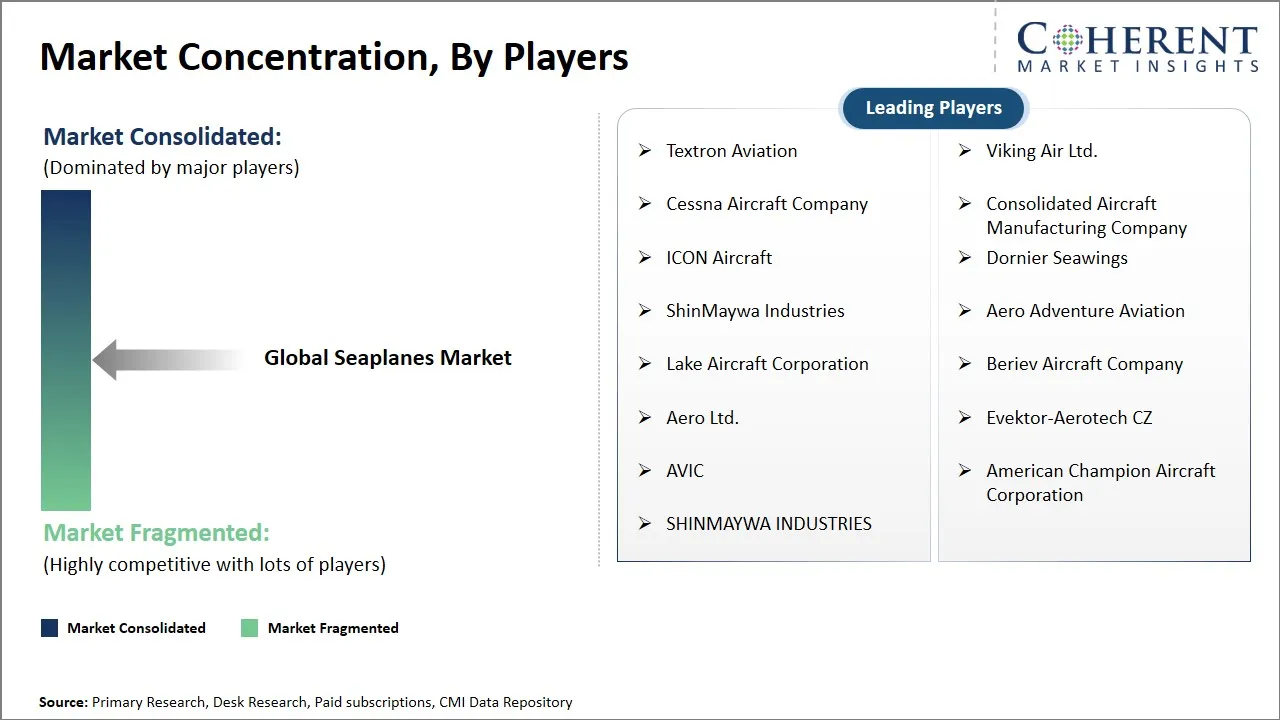
| Companies covered: | Textron Aviation, Viking Air Ltd., Cessna Aircraft Company, Consolidated Aircraft Manufacturing Company, ICON Aircraft, Dornier Seawings, ShinMaywa Industries, Aero Adventure Aviation, Lake Aircraft Corporation, Beriev Aircraft Company, Aero Ltd., Evektor-Aerotech CZ, AVIC, American Champion Aircraft Corporation, and SHINMAYWA INDUSTRIES | ||
| Growth Drivers: |
| ||
| Restraints & Challenges: |
| ||
Market Dynamics
Global Seaplanes Market Driver - Tourism & Leisure Demand
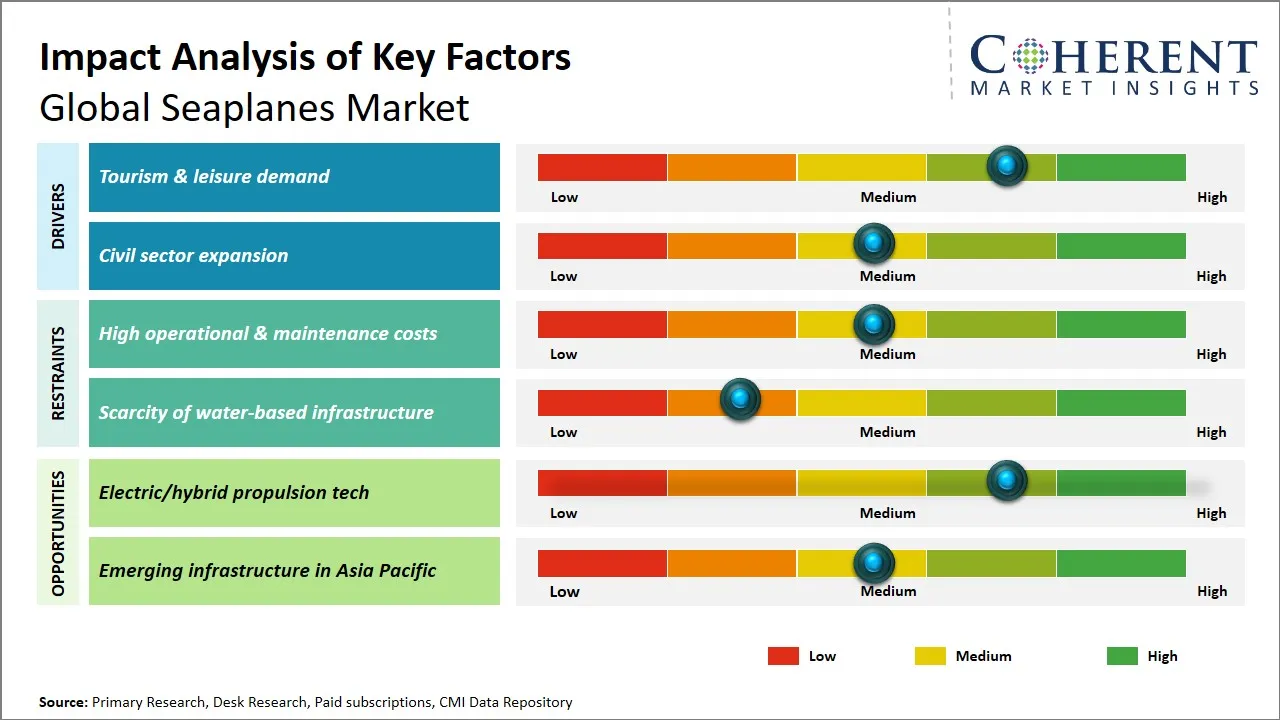
The increasing popularity of experiential travel and the rising preference for scenic and remote destinations have significantly bolstered the demand for seaplanes in the tourism and leisure sectors. Travelers increasingly seek unique and efficient modes of transportation that provide direct access to island resorts, coastal regions, and other hard-to-reach locations, which traditional aircraft and ground transport cannot easily serve. Seaplanes offer the advantage of landing on water, thereby opening up vast opportunities for leisure trips across archipelagos, lakes, and waterfront tourist hotspots.
Trans Maldivian Airways (TMA) operates the world’s largest seaplane fleet, primarily serving luxury island resorts in the Maldives. In response to rising tourism demand, especially post-pandemic, TMA added multiple De Havilland Twin Otter floatplanes in 2024 to expand inter-island connectivity.
Additionally, luxury tourism operators are incorporating seaplane rides as an exclusive experience, enhancing the appeal of their offerings by combining transportation with sightseeing. This synergy between travel convenience and recreation drives increased adoption.
Global Seaplanes Market Opportunity – Advancements in Electric and Hybrid Propulsion Technologies
As environmental regulations become increasingly stringent worldwide, and there is growing demand for sustainable transportation alternatives, the integration of electric and hybrid engines in seaplanes addresses both ecological concerns and operational efficiency. These propulsion systems offer reduced greenhouse gas emissions, lower noise pollution, and enhanced fuel efficiency compared to traditional combustion engines, making seaplanes more attractive to eco-conscious consumers, government agencies, and commercial operators.
Additionally, electric and hybrid propulsion can lower operating costs through decreased fuel consumption and maintenance requirements, potentially broadening the market by enabling more competitive pricing and extended service ranges. Technological innovations in battery energy density and hybrid power management systems continue to improve flight durations and payload capacities, overcoming some of the traditional limitations faced by seaplanes. In 2025, REGENT Craft (USA) and Ocean Glider (New Zealand) announced a USD 145 million deal to deploy hybrid-electric wing-in-ground-effect seagliders across New Zealand's coastal regions. As investments in infrastructure for electric aircraft, such as charging stations at waterfront airports and seaplane bases, increase, the adoption rate of these advanced propulsion technologies is expected to accelerate.
Analyst Opinion (Expert Opinion)
- Luxury island resorts and adventure travel destinations remain the primary drivers of seaplane adoption, with operators expanding fleets to serve exclusive, remote locations—especially in the Maldives, Indonesia, and the Caribbean.
- Heightened geopolitical activity and maritime surveillance needs are prompting governments—particularly in the Indo-Pacific—to invest in long-range, amphibious aircraft for patrol, SAR (search and rescue), and naval logistics.
- Coastal cities are beginning to explore seaplanes for short-haul, inter-city transport. Electrification and hybrid propulsion are unlocking potential for quiet, low-emission operations, aligning with urban air mobility (UAM) goals and sustainable coastal infrastructure plans.
Speak to the analyst
Want personalized insights?
Take the findings above to one of our principal consultants, or have the report rebuilt around the segments, geographies and competitors you actually track.
Market Segmentation
- Type Insights (Revenue, USD Bn, 2021 - 2033)
- Floatplane
- Amphibian
- Flying boat
- Regional Insights (Revenue, USD Bn, 2021 - 2033)
- North America
- U.S.
- Canada
- Latin America
- Brazil
- Argentina
- Mexico
- Rest of Latin America
- Europe
- Germany
- U.K.
- Spain
- France
- Italy
- Russia
- Rest of Europe
- Asia Pacific
- China
- India
- Japan
- Australia
- South Korea
- ASEAN
- Rest of Asia Pacific
- Middle East
- GCC Countries
- Israel
- Rest of Middle East
- Africa
- South Africa
- North Africa
- Central Africa
- North America
- Key Players Insights
- Textron Aviation
- Viking Air Ltd.
- Cessna Aircraft Company
- Consolidated Aircraft Manufacturing Company
- ICON Aircraft
- Dornier Seawings
- ShinMaywa Industries
- Aero Adventure Aviation
- Lake Aircraft Corporation
- Beriev Aircraft Company
- Aero Ltd.
- Evektor-Aerotech CZ
- AVIC
- American Champion Aircraft Corporation
- SHINMAYWA INDUSTRIES
Sources
Primary Research Interviews
Stakeholders
- Commercial Seaplane Operators (e.g., AquaJet Airways, TropicFly Aviation)
- Seaplane OEMs and Component Suppliers (e.g., Aeromarine Systems, SkyFloat Aero)
- Aerospace Engineers and Naval Aviation Experts
- Tourism Infrastructure Developers and Resort Transport Planners
- Coastal Airport Authorities and Civil Aviation Officials
- Electric Propulsion System Startups and Marine Aviation Consultants
Databases
- North American Seaplane Fleet Analytics (NASFA)
- Global Amphibious Aircraft Operations Database (GAAOD)
- World Coastal Mobility Index (WCMI)
Magazines
- AeroMaritime Monthly
- Waterborne Aviation News
- Future Flight Horizons
- Coastal Air Transport Digest
Journals
- Journal of Amphibious Aviation and Engineering
- Maritime Aircraft Systems & Technology Review
- Journal of Hybrid Aerospace Propulsion
- International Journal of Seaplane Transport & Logistics
Newspapers
- Aviation Herald Asia
- The Global Air Mobility Post
- Seacoast Aviation Times
- Marine & Air Transport Chronicle
Associations
- Global Seaplane Operators Alliance (GSOA)
- International Coastal Aviation Association (ICAA)
- Electric Aviation Advancement Consortium (EAAC)
- Amphibious Aircraft Manufacturers Guild (AAMG)
- Marine Air Transport Federation (MATF)
Public Domain Sources
- International Civil Aviation Organization (ICAO) Reports
- United Nations World Tourism Barometer
- World Bank Coastal Infrastructure Outlook
- Transport Canada Aviation Statistics
- Open Aviation Data Library (OADL)
Proprietary Elements
- CMI Data Analytics Tool, Proprietary CMI Existing Repository of information for last 8 years
Get access to 250+ pages report
Every segment, forecast, competitor profile and data table behind the analysis above — available for instant download.
- ESOMAR Member
- ISO 9001:2015 Certified
- D-U-N-S Registered
- GDPR & CCPA Compliant
Missing comfort of reading report in your local language? Find your preferred language:
Transform your Strategy with Exclusive Trending Reports
Frequently Asked Questions
The global seaplanes market is estimated to be valued at USD 1.92 billion in 2026 and is expected to reach USD 2.72 billion by 2033.
The CAGR of the global seaplanes market is projected to be 5.1% from 2026 to 2033.
Tourism & leisure demand and civil sector expansion are the major factors driving the growth of the global seaplanes market.
High operational & maintenance costs and scarcity of water-based infrastructure are the major factors hampering the growth of the global seaplanes market.
In terms of type, floatplane is estimated to dominate the market revenue share in 2026.
Amphibious seaplanes differ from standard floatplanes in that they are equipped with retractable wheels, allowing them to take off and land on both water and land, offering greater operational flexibility.
In tourism, seaplanes provide fast, scenic access to remote islands, resorts, and coastal destinations, enhancing the travel experience while enabling connectivity where traditional airports are unavailable.