

Global Semiconductor Filters Market Size and Forecast – 2026 To 2033
The global semiconductor filters market is expected to grow from USD 1.40 Bn in 2026 to USD 3 Bn by 2033, registering a compound annual growth rate (CAGR) of 8.7% from 2026 to 2033. The growth of the global semiconductor filters market is driven by advancements in chip fabrication and production to support innovations such as 5G networks and AI systems.
For instance, on January 12, 2026, SK Hynix announced that it will invest USD 12.9 billion to build a new advanced packaging plant, as it expands production to meet rising demands tied to artificial intelligence.
(Source: CNBC)
Key Takeaways of the Global Semiconductor Filters Market
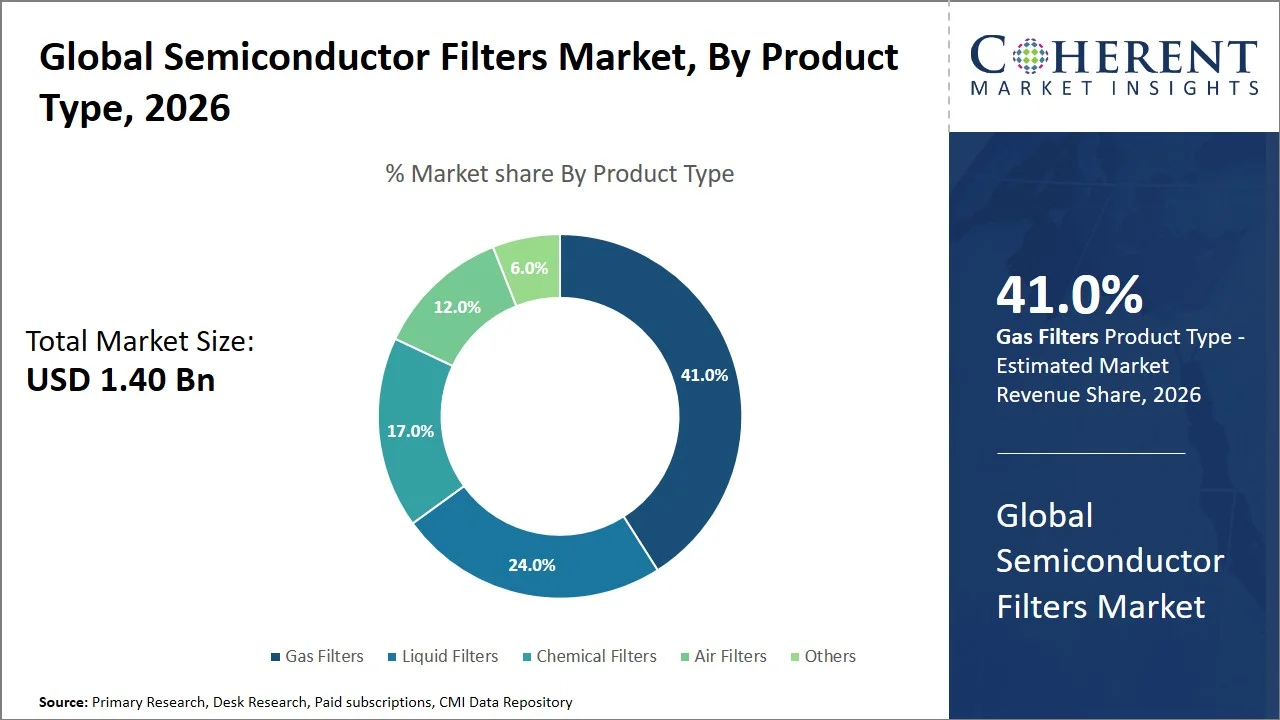
- The gas filters segment is expected to account for 41% of the global semiconductor filters market share in 2026. Gas filters for semiconductors are gaining demand in Asia Pacific as advanced chip fabrication at nodes like 5 nanometer process requires ultra-pure process gases, where even trace contaminants can cause defects, forcing fabs to adopt highly efficient gas filtration systems to maintain yield and reliability. On August 22, 2025, Air Liquide signed a binding agreement with Macquarie Asia-Pacific Infrastructure Fund 2, for the acquisition of DIG Airgas, a leading national player in South Korea. It is expected to close in the first semester of 2026. (Source: AirLiquide)
- The surface acoustic wave filters segment is estimated to capture 36% of the market share in 2026. As 4G and 5G mobile devices become more widespread, the need for precise radio frequency filtering rises. Such demand fuels interest in surface acoustic wave technology. Growth emerges not only from volume but also from performance requirements. For instance, in July 2024, Murata Manufacturing Co., Ltd. announced the mass production and commercial shipment of the world’s first high-frequency filter using XBAR technology. These features are critical for the latest wireless technologies, including 5G, Wi-Fi 6E, Wi-Fi 7, and emerging 6G technologies. (Source: Nasdaq)
- The semiconductor foundry manufacturing segment is projected to hold 39% of the semiconductor filters market share in 2026. Semiconductor foundry manufacturing is gaining prominence in North America largely due to government incentives like the CHIPS and Science Act, which are driving massive investments from companies, such as Intel and Taiwan Semiconductor Manufacturing Company, to build advanced fabs and strengthen domestic chip supply chains.
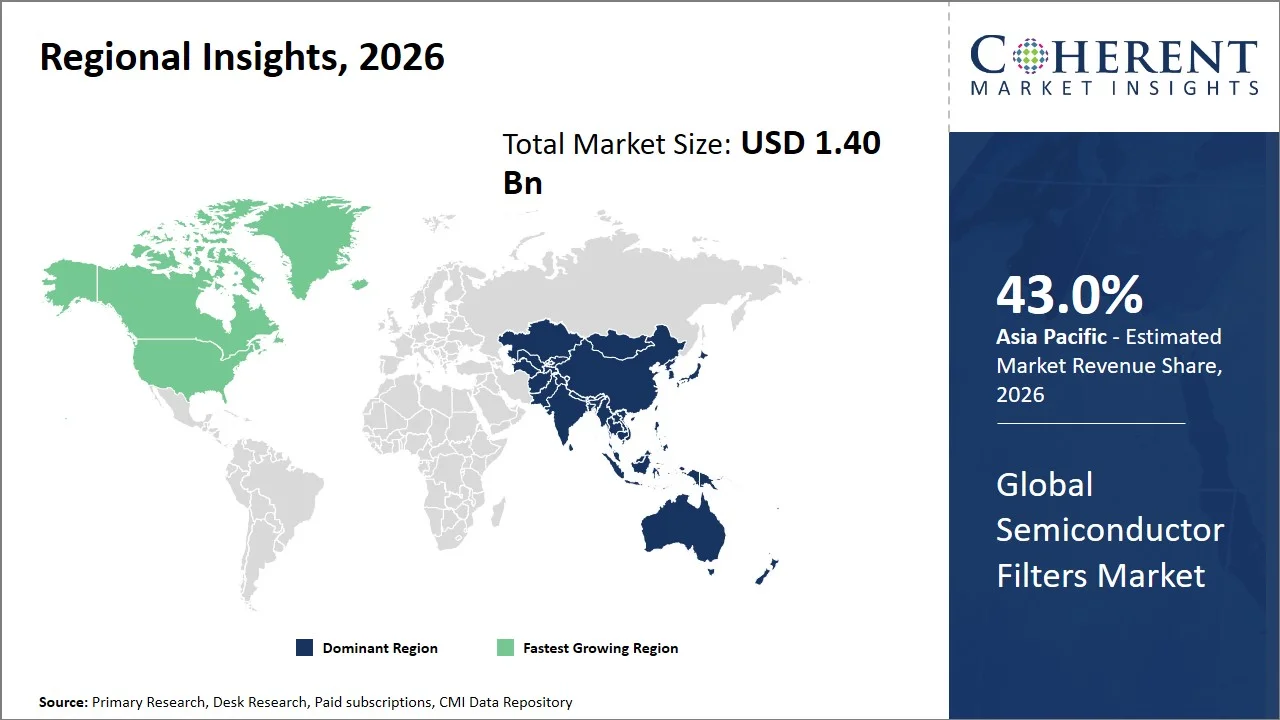
- Asia Pacific is expected to dominate the semiconductor filters market in 2026 with a market share of 43%. Asia Pacific is home to companies like Taiwan Semiconductor Manufacturing Co. (TSMC), which accounts for more than 50% of the global semiconductor industry in general. Moreover, the presence of firms like Samsung and Intel drive the dominance of the region even further. (Source: eu)
- North America is expected to account for 26% share in 2026 and is projected to record the fastest growth over the forecast period. Now emerging more visibly, semiconductor fabrication in North America advances as public funding shifts occur. Major firms redirect resources toward constructing state-level production sites. Localized chip networks grow stronger under these conditions. Taiwan Semiconductor Manufacturing Co. committed USD 100 billion for three new fabrication plants in Phoenix, Arizona, U.S, two advanced packaging facilities, and a research center. Micron revealed plans for a USD 200 billion investment across Idaho, New York, and Virginia for semiconductor manufacturing plants and research facilities. (Source: JamesMoore)
- Advanced logic & memory fabs: The shift toward leading-edge semiconductor nodes is significantly increasing filtration requirements on a per-wafer basis, especially in EUV lithography and high-aspect-ratio etching processes. TSMC is ramping up 3 nm production and preparing for 2 nm manufacturing while expanding fabrication capacity in Arizona and Japan, while Samsung Electronics is advancing its gate-all-around (GAA) technology. Both developments necessitate ultra-high purity gas and liquid filtration systems to maintain molecular contamination control at parts-per-trillion levels.
- Advanced packaging & chiplet ecosystems: The increasing adoption of chiplet-based architectures and high-density packaging technologies is generating additional demand for advanced filtration solutions beyond traditional front-end fabrication processes. Facilities such as Amkor Technology’s advanced packaging campus in Arizona and TSMC’s CoWoS (Chip-on-Wafer-on-Substrate) expansion require highly controlled cleanroom conditions and stringent chemical purity standards, thereby driving greater utilization of specialized gas-phase and liquid filtration systems.
Segmental Insights
Why Do Gas Filters Dominate the Global Semiconductor Filters Market?
The gas filters segment is expected to account for 41% of the global semiconductor filters market share in 2026. Growth mainly comes along owing to the need for preserving exact gas cleanliness in semiconductor fabrication. Within these environments, optimal conditions must exist since minor contaminants may disrupt function or lower efficiency. As unwanted elements such as water vapor, dust, and trace chemicals pose risks, customized filtration systems are used. Though accuracy is central when success relies on uncontaminated materials, hidden variables frequently influence outcomes beyond regulated enclosures.
In February 2026, Thermo Fisher published a study emphasizing the necessity of maintaining strict gas purity in semiconductor manufacturing is driven by the fact that even trace-level contaminants (at parts-per-trillion levels) in process gases can cause nanoscale defects and reduce chip yield—for example, modern fabs use ultra-high-purity gas filtration because even minute impurities in etching and deposition gases can alter film properties and compromise transistor performance at advanced nodes.
(Source: ThermoFisher)
- Current Industry Events of 2026
- Market Size Estimation
- Regional Breakdown
- Competitive Landscape
- Customer Intelligence
- Segmental Analysis
- Pricing Analysis
- Key Market Drivers, Challenges & Future Trends
- Customized Insights Section
Why are Surface Acoustic Wave Filters the Most Preferred Technology Type?
The surface acoustic wave filters segment is expected to account for 36% of the global semiconductor filters market share in 2026. As Surface Acoustic Wave (SAW) filters handle high frequencies precisely, stay compact, while serving widely across radio frequency applications, their adoption has grown. Where rapid response counts, these components often appear. Modern wireless systems depend on such behavior, particularly inside integrated circuit architectures. Moreover, the rapid adoption of 5G networks worldwide is also driving the demand for SAW filters.
5G subscription uptake continues apace and the total reached 2.9 billion at the end of 2025, accounting for one-third of all mobile subscriptions. The highest 5G subscription penetration at the end of 2025 was in North America with 79%, followed by North East Asia at 61% and Western Europe and the Gulf Cooperation Council (GCC) countries, both at 55%. Globally, 5G is anticipated to overtake 4G as the dominant mobile access technology by subscription by the end of 2027, nine years after launch.
(Source: Ericsson)
Semiconductor Foundry Manufacturing Segment Dominates the Global Semiconductor Filters Market
The semiconductor foundry manufacturing segment is expected to account for 39% of the global semiconductor filters market share in 2026. Now driving much of chip production worldwide, semiconductor foundries grow fast through tighter circuit designs and wider global reach. With operations spreading beyond traditional hubs, TSMC pushes ahead at 3 nanometers, eyes set on 2 nm, even as factories rise in Arizona and Japan. Instead of following, Samsung accelerates development of gate-all-around transistors, adding space in Texas for larger output. Not left behind, Intel returns to contract manufacturing using its IDM 2.0 plan, anchoring large projects across the United States and Europe.
For instance, on February 11, 2026, Semiconductor Manufacturing International Corporation (SMIC) announced that it is expanding wafer capacity by 40,000 12‑inch equivalents through 2026 to meet domestic and broader chip demand, which directly scales filtration needs for gas and liquid delivery systems, tool environments, and UPW systems.
(Source: Reuters)
Currents Events and their Impact
Current Events | Description and its Impact |
Pall Corporation’s New Facility Inauguration in Singapore |
|
U.S. CHIPS and Science ACT |
|
(Source: hai.stanford.edu, Pall Corporation)
Semiconductor Filters Market Dynamics
Market Drivers
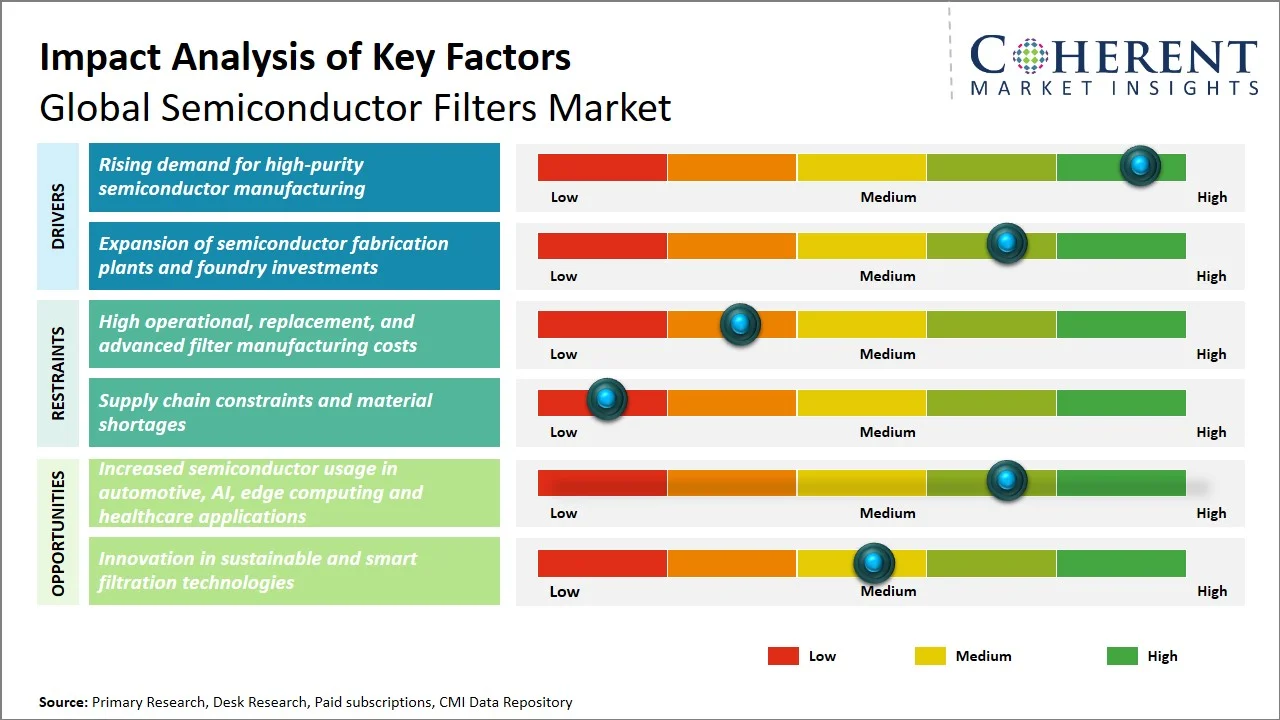
- Rising Demand for High-Purity Semiconductor Manufacturing: Owing to rising needs for spotless manufacturing spaces, the global market for semiconductor filters expands. As technology becomes tinier and complex, perfect purity in materials decides whether systems function properly. These specialized filters remove impurities from fluids and gases inside cleanrooms, blocking particles that might disrupt nanoscale structures. As sectors like mobile technology, vehicles, and network infrastructure advance chip capabilities rapidly, filtration systems must match higher precision requirements. Purity control throughout manufacturing directly affects yield rates and product consistency across mass production cycles. For instance, on November 25, 2025, FUJIFILM Corporation announced the successful completion of a new building for the development and evaluation of semiconductor materials at the Shizuoka Factory of FUJIFILM Electronic Materials Co., Ltd. (FFEM), the core company that leads Fujifilm’s semiconductor materials business. (Source: Fujifilm)
- Expansion of Semiconductor Fabrications Plants and Foundry Investments: The construction of new chip production facilities is showing an upward trend globally. Fueled not just by national agendas but also company plans, work grows sharper to secure steady supplies of microelectronics. Demand climbs due to smarter machines, advanced mobile connections, and electronics inside automobiles. As a result, laws like the CHIPS and Science Act now apply. This makes large-scale funding possible - construction starts on advanced production sites by Intel and Taiwan Semiconductor Manufacturing Company. Air filtration systems are used in sterile zones designed to block microscopic pollutants essential for chip fabrication. For example, TSMC disclosed spending between USD 52 billion and USD 56 billion, preparing several fresh plants across Taiwan, the U.S., and Japan due to rising needs tied to AI workloads.
Emerging Trends
- Shift toward ultra-high purity: Semiconductor manufacturing is increasingly moving toward ultra-high purity requirements, as advanced nodes developed by TSMC, Samsung Electronics, and Intel necessitate contamination control at parts-per-trillion levels to avoid yield degradation in EUV lithography and complex etching processes. Consequently, this trend is accelerating the adoption of advanced gas and liquid filtration systems, enhanced materials management practices, and real-time monitoring technologies throughout the semiconductor fabrication ecosystem.
- Expansion of semiconductor fabs globally: The semiconductor industry collectively had plans to start 18 new fab construction projects in 2025, according to SEMI's latest quarterly World Fab Forecast report. The new projects include three 200mm and fifteen 300mm facilities, the majority of which are expected to begin operations from 2026 to 2027. (Source: SEMI)
Regional Insights
Why is Asia Pacific a Strong Market for Semiconductor Filters?
Asia Pacific is expected to account for a market share of 43% in 2026. Growth originates largely due to strong industrial infrastructure, rising demand for electronic devices, coupled with consistent government support for integrated circuit development. Major suppliers of chips and signal filters (TSMC, Intel and Samsung) span countries such as Japan, Taiwan, South Korea, and China. Within these regions, collaboration in science and efficient supply systems allow widespread integration of semiconductor-driven filters into automobiles, telecom equipment, and handheld technology. In 2025, South Korea approved large-scale semiconductor capacity expansion, including new foundry and memory fabs focused on AI chips and high-bandwidth memory (HBM). (Source: Reuters)
Why Does North America Semiconductor Filters Market Exhibit High Growth?
North America is expected to account for a market share of 26% in 2026 and is expected to register the fastest growth rate over the forecast period. Progress moves forward in military systems, air travel tech, fifth-generation communication grids, together with advancements in transportation equipment, fueling growth. Across North America, large digital companies (NVIDIA and Qualcomm) working beside new small enterprises create fast development in processor architecture. Policies focused on self-reliance in microelectronics, including legislation like the CHIPS Act, have drawn substantial spending into local production and research. A capable labor pool together with strong protections for inventions supports market vitality, pulling consistent investment from both enterprises and financial backers.
For instance, on January 2026, Cerebras signed a USD 10 billion agreement with OpenAI to provide 750 megawatts of AI computing capacity for training and inference workloads. By April 2026, reports indicate the deal has expanded to over USD 20 billion over three years, making it one of the largest AI infrastructure contracts in the industry. (Source: Reuters)
Why is China Emerging as a Major Hub in the Semiconductor Filters Market?
Driven by vast consumer electronics demand, China sees growth in its semiconductor filters sector. Government strategies emphasizing domestic chipmaking capability shape industry direction. Production expansion emerges through collaboration between homegrown firms and overseas allies. Advancements in filter performance respond to needs tied to 5G networks alongside vehicle-based electronic systems. HiSilicon, linked to Huawei, plays a notable role in component innovation within the region. SMIC also supports progress in local semiconductor technology creation. Strength in internal development enhances China's standing in worldwide supply networks.
Is the U.S. the Next Growth Engine for the Semiconductor Filters Market?
Fueled by demand from defense and aerospace, the U.S. maintains momentum in semiconductor filter development through targeted innovation. Instead of relying on broad trends, firms like Qorvo, Skyworks Solutions, and Broadcom prioritize research into emerging filter systems that align with shifting wireless protocols alongside expanding IoT needs Instead of chasing global trends, growth comes through targeted investment in know-how, shaping how nations build their own chips.
Japan Semiconductor Filters Market Analysis and Trends
Japan holds a prominent position in the global semiconductor filters market. Owing to firms, such as Murata Manufacturing and Taiyo Yuden, precise ceramic components reach critical industries. These parts support accurate signal handling within communication networks and vehicle electronics. Progress continues through long-term research focus, paired with strong ties between companies and universities. As a result, enhancements in filter efficiency and system compatibility occur regularly over time.
Strength in South Korea's chip sector emerges not just from scale, but from tightly structured production systems led by corporations such as Samsung Electronics and SK Hynix. As expertise grows in memory and logic semiconductors, demand expands for precision filters, especially in applications requiring swift data transfer alongside stable wireless links. Still moving forward, progress draws energy from both corporate initiative and state-funded studies refining how chips are made.
Global Semiconductor Filters Market - Multi-Band & Reconfigurable Filter Penetration
Category | Multi-Band Filter Penetration | Reconfigurable Filter Penetration |
Smartphones (4G/5G/5G-A) | Very High (70–85%) | Moderate (20–35%) |
IoT Devices (LPWAN, NB-IoT, Wi-Fi 6/7) | Moderate (35–50%) | Low–Moderate (10–20%) |
Automotive (V2X, ADAS Radar) | Moderate (40–55%) | Low (5–15%) |
Base Stations (5G/6G Infrastructure) | High (60–75%) | Moderate–High (30–45%) |
Defense & Aerospace | Moderate (45–60%) | High (40–60%) |
Industrial Wireless Systems | Moderate (30–45%) | Low–Moderate (10–25%) |
Wearables & Consumer Electronics | High (55–70%) | Low (5–15%) |
How is Increased Semiconductor Usage in Automotive, AI, Edge Computing and Healthcare Applications Creating New Growth Opportunities in the Semiconductor Filters Market?
Worldwide expansion of the semiconductor filter sector ties directly to increasing demands from rapidly advancing areas such as automotive systems, artificial intelligence, edge computing, and healthcare devices. As vehicles grow more electronic, precision filtering becomes essential - driven by wider adoption of ADAS, electric vehicle components, and vehicle-to-everything communication, where undisturbed signal transfer plays a critical role. With AI depending on dense computational workloads, consistent performance emerges through stable circuit behavior made possible by selective frequency control. Instead of broad trends, focus shifts toward precision, especially when handling interference from overlapping bands in compact designs. Even so, reliability under variable loads remains a quiet requirement behind every advancement seen in the modern landscape.
For instance, on January 5, 2026, AMD introduced the AMD Ryzen AI Embedded processors, a new portfolio of embedded x86 processors designed to power AI-driven applications at the edge. From automotive digital cockpits and smart healthcare to physical AI for autonomous systems, including humanoid robotics, the new P100 and X100 Series processors provide OEMs, tier-1 suppliers and system and software developers in automotive and industrial markets with high performance and efficient AI compute.
(Source: AMD)
Market Players, Key Development, and Competitive Intelligence
Key Developments
- On March 4, 2025, TSMC announced its intention to expand its investment in advanced semiconductor manfacturing in the United States by an additional USD 100 billion. Building on the company’s ongoing USD 65 billion investment in its advanced semiconductor manufacturing operations in Phoenix, Arizona, TSMC’s total investment in the U.S. is expected to reach USD 165 billion. The expansion includes plans for three new fabrication plants, two advanced packaging facilities and a major R&D team center, solidifying this project as the largest single foreign direct investment in U.S. history.
- On September 9, 2024, Wolfspeed, Inc unveiled a silicon carbide module designed to transform the renewable energy, energy storage, and high-capacity fast-charging sectors through improved efficiency, durability, reliability, and scalability.
Competitive Landscape
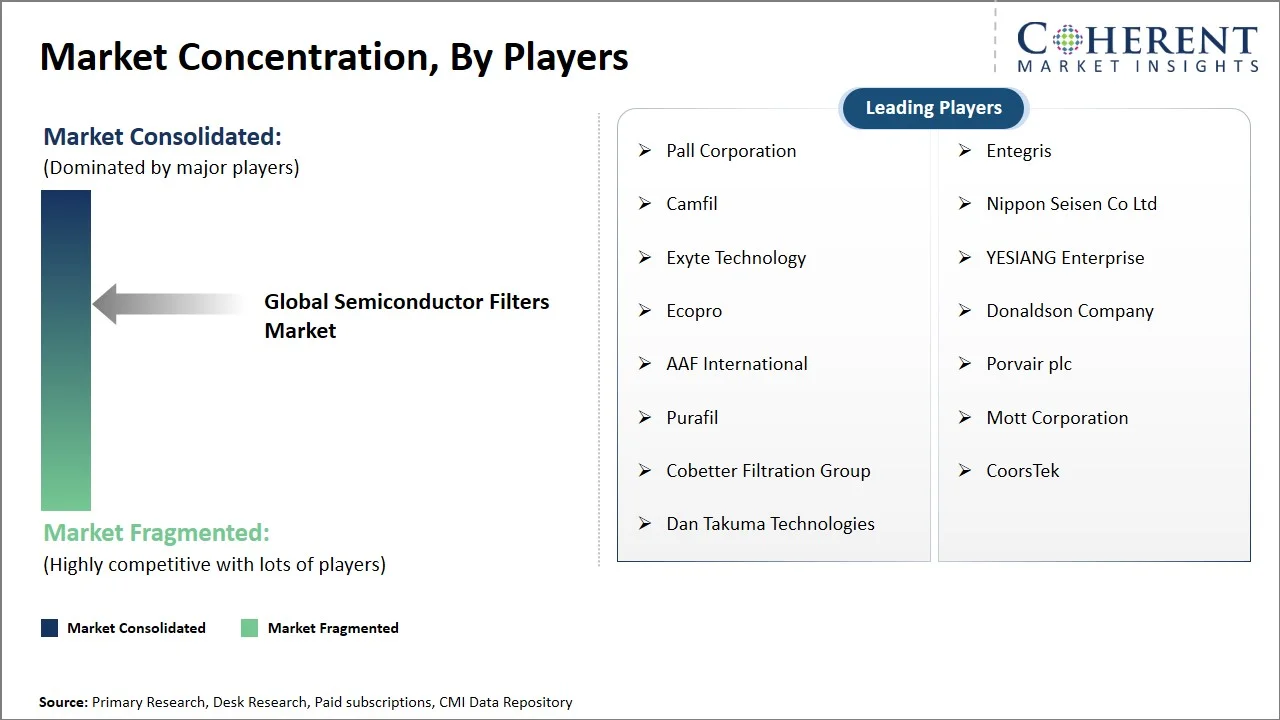
Worldwide, companies within the semiconductor filters industry operate under intense competition, varying by size and strategic focus. Though a few emphasize sustained growth over time, different players reshape their approaches to gain distinction. Major companies often channel significant investment into R&D efforts. This enables steady progress in creating efficient, dependable filtering components. Such parts serve shifting needs within industries ranging from mobile networks to vehicles and handheld devices. Progress unfolds unevenly, shaped by technical capability and access to specialized knowledge. Key focus areas include:
- Point-of-use filters connect straight to manufacturing equipment, cutting contamination chances.
- Mergers appear alongside acquisition activity as part of broader positioning. Growth across regions shapes presence overseas. Direction shifts follow long-term positioning goals.
Market Report Scope
Semiconductor Filters Market Report Coverage
| Report Coverage | Details | ||
|---|---|---|---|
| Base Year: | 2025 | Market Size in 2026: | USD 1.40 Bn |
| Historical Data for: | 2020 To 2024 | Forecast Period: | 2026 To 2033 |
| Forecast Period 2026 to 2033 CAGR: | 8.7% | 2033 Value Projection: | USD 3 Bn |
| Geographies covered: |
| ||
| Segments covered: |
| ||
| Companies covered: | Pall Corporation, Entegris, Camfil, Nippon Seisen Co Ltd, Exyte Technology, YESIANG Enterprise, Ecopro, Donaldson Company, AAF International, Porvair plc, Purafil, Mott Corporation, Cobetter Filtration Group, CoorsTek, and Dan Takuma Technologies | ||
| Growth Drivers: |
| ||
| Restraints & Challenges: |
| ||
Analyst Opinion (Expert Opinion)
- Steady growth appears likely within the worldwide semiconductor filters sector, fueled by rising needs in chip production for artificial intelligence, fifth-generation networks, vehicle-based electronics, and powerful computing platforms. With circuit features now dropping under five nanometers, alongside broader adoption of extreme ultraviolet patterning techniques, cleanliness standards during manufacturing grow tighter. Such conditions lead producers to prioritize highly effective purification methods, handling gases, fluids, and ambient air, to maintain nearly flawless operational settings.
- Despite steady structural optimism, expansion plans face hurdles tied to shifting demand cycles. Next-phase chip designs bring added intricacy, requiring more refined production inputs. Pressure builds as major fabrication units push cost reductions, affecting supplier margins. Innovation in filtration materials offers some firms an edge over peers. Longer-lasting components, resistant to aggressive chemistries, are gaining relevance. Alliances with top-tier manufacturers may offset regional disruptions. Geopolitical shifts now shape where and how facilities operate.
- The semiconductor filters market is poised for sustained growth as the transition to sub-3 nm and emerging 2 nm process nodes by TSMC, Samsung Electronics, and Intel significantly increases filtration requirements per wafer, driven by heightened sensitivity in EUV resists, tighter etch tolerances, and more stringent molecular contamination thresholds. This demand is expected to be further reinforced by the expansion of advanced packaging technologies, the regionalization of fabrication capacity across the U.S. and Europe, and the growing deployment of point-of-use filtration systems with integrated real-time monitoring, collectively shifting the industry toward higher-value, application-specific solutions over standardized offerings.
Speak to the analyst
Want personalized insights?
Take the findings above to one of our principal consultants, or have the report rebuilt around the segments, geographies and competitors you actually track.
Market Segmentation
- Product Type Insights (Revenue, USD Billion, 2021 - 2033)
- Gas Filters
- Liquid Filters
- Chemical Filters
- Air Filters
- Others
- Technology Type Insights (Revenue, USD Billion, 2021 - 2033)
- Surface Acoustic Wave Filters
- Bulk Acoustic Wave Filters
- MEMS Filters
- Active Filters
- Passive Filters
- Application Insights (Revenue, USD Billion, 2021 - 2033)
- Semiconductor Foundry Manufacturing
- Memory Manufacturing
- Solar Semiconductor Manufacturing
- Telecommunications Infrastructure
- Consumer Electronics Systems
- Automotive Electronics Systems
- Regional Insights (Revenue, USD Billion, 2021 - 2033)
- North America
- U.S.
- Canada
- Latin America
- Brazil
- Argentina
- Mexico
- Rest of Latin America
- Europe
- Germany
- U.K.
- Spain
- France
- Italy
- Russia
- Rest of Europe
- Asia Pacific
- China
- India
- Japan
- Australia
- South Korea
- ASEAN
- Rest of Asia Pacific
- Middle East
- GCC Countries
- Israel
- Rest of Middle East
- Africa
- South Africa
- North Africa
- Central Africa
- North America
- Key Players Insights
- Pall Corporation
- Entegris
- Camfil
- Nippon Seisen Co Ltd
- Exyte Technology
- YESIANG Enterprise
- Ecopro
- Donaldson Company
- AAF International
- Porvair plc
- Purafil
- Mott Corporation
- Cobetter Filtration Group
- CoorsTek
- Dan Takuma Technologies
Sources
Primary Research Interviews
- Semiconductor Filter Manufacturers and Suppliers
- Electronics Component Distributors
- Telecommunications Equipment Manufacturers
- Automotive Electronics System Integrators
Magazines
- Semiconductor Today
- Electronic Design Magazine
- Electronic Design News (EDN)
- Microwave & RF Magazine
Journals
- IEEE Transactions on Microwave Theory and Techniques
- Journal of Semiconductor Technology and Science
- Solid-State Electronics Journal
Associations
- Semiconductor Industry Association (SIA)
- Electronic Components Industry Association (ECIA)
- Institute of Electrical and Electronics Engineers (IEEE)
- Global Semiconductor Alliance (GSA)
Public Domain Sources
- U.S. Securities and Exchange Commission (SEC) Filings
- Company Annual Reports and Investor Relations
- Government Trade Statistics and Import/Export Data
- Patent Databases (USPTO, WIPO)
Proprietary Elements
- CMI Data Analytics Tool
- Proprietary CMI Existing Repository of information for last 10 years
Get access to 250+ pages report
Every segment, forecast, competitor profile and data table behind the analysis above — available for instant download.
- ESOMAR Member
- ISO 9001:2015 Certified
- D-U-N-S Registered
- GDPR & CCPA Compliant
Missing comfort of reading report in your local language? Find your preferred language:
Transform your Strategy with Exclusive Trending Reports
Frequently Asked Questions
The global semiconductor filters market is expected to stand at USD 1.40 Bn in 2026 and is expected to reach USD 3 Bn by 2033.
The CAGR of the global semiconductor filters market is projected to be 8.7% from 2026 to 2033.
Rising demand for high-purity semiconductor manufacturing and expansion of semiconductor fabrication plants and foundry investments are the major factors driving the growth of the global semiconductor filters market.
High operational, replacement, and advanced filter manufacturing costs and supply chain constraints and material shortages are the major factors hampering the growth of the global semiconductor filters market.
In terms of product type, gas filters are estimated to dominate the market revenue share in 2026.
As chip nodes shrink, stricter purity requirements increase the need for high-performance filtration systems.
EUV lithography requires ultra-clean environments, increasing the demand for advanced filtration solutions.