

Global Smart Pole Market and Forecast – 2026-2033
Coherent Market Insights estimates that the global smart pole market stood at USD 13 Bn in 2025 and will expand to USD 45 Bn by 2033, registering a CAGR of 15% between 2026 and 2033.
Key Takeaways of the Smart Pole Market
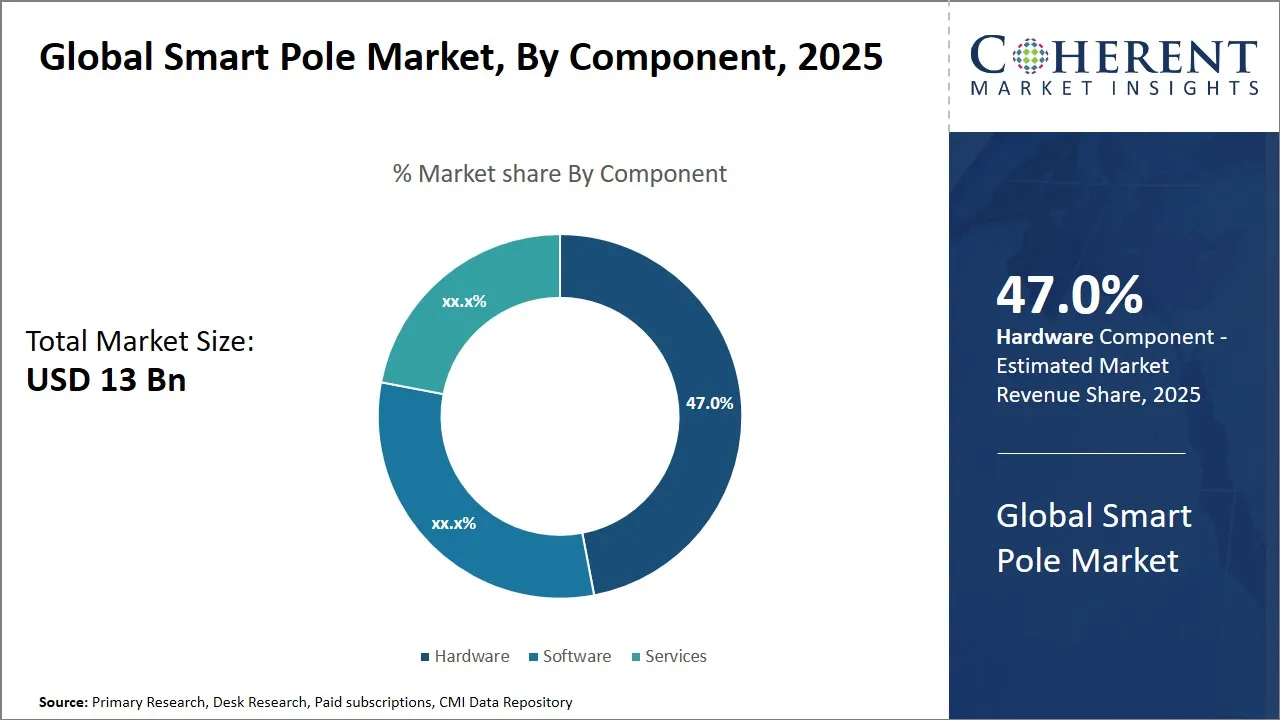
- The hardware segment accounted for 47% of the smart pole market share in 2025.
- The new installation segment accounted for 58% of the market share in 2025.
- Highways and roadways segment accounted for 51% share in 2025.
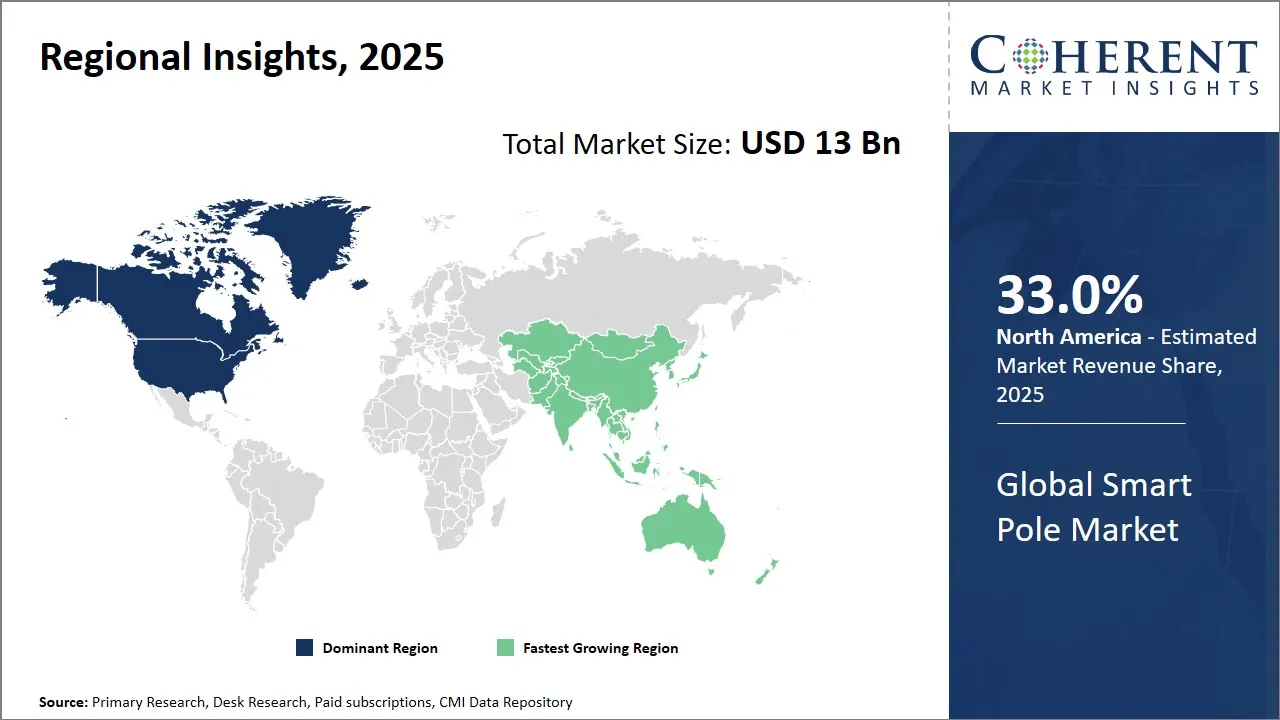
- North America dominated the smart pole market in 2025 with a 33% market share.
- Asia Pacific held 26% market share in 2025 and is expected to record the fastest growth over the forecast period.
Current Events and Its Impact
Current Events | Description and its Impact |
O2 and Telefonica Major Rollout Plan Announcement |
|
Segmental Insights
- Current Industry Events of 2026
- Market Size Estimation
- Regional Breakdown
- Competitive Landscape
- Customer Intelligence
- Segmental Analysis
- Pricing Analysis
- Key Market Drivers, Challenges & Future Trends
- Customized Insights Section
Why Did the Hardware Segment Dominate the Global Smart Pole Market in 2025?
The hardware segment accounted for 47.0% of the global smart pole market in 2025. This dominance stems largely from physical equipment establishing the base layer for smart poles, making possible a range of operations vital to current city and transit settings. Driving this lead role is the steady addition of sophisticated capabilities directly into the devices themselves, examples include light-emitting diode fixtures, visual recording units, detection instruments, data transmission parts, along with energy regulation mechanisms.
For instance, on December 4, 2025, Ubicquia announced a major expansion of its intelligent streetlighting ecosystem, introducing a coordinated suite of next-generation solutions designed to help utilities and municipalities modernize streetlight networks with unmatched asset management, operational efficiencies, and AI-driven analytics.
New Installation Segment Dominates the Global Smart Pole Market
The new installation segment accounted for 58.0% of the global smart pole market in 2025. Most of this growth comes from faster building activity in cities along with broad adoption of high technology urban programs. Fresh builds make it easier to add intelligent lighting columns right from the start instead of retrofitting later. From the start, these systems allow designs that fit coming urban demands at no added expense later on.
For instance, on January 12, 2023, Iveda introduced a new initiative valued at USD 1.5 million. This effort centers on deploying Utilus Smart Pole systems across the port metropolis of Kaohsiung, Taiwan.
(Source: iveda.com)
Why are Highways and Roadways the Most Widespread Application of Smart Pole?
The highways and roadways segment accounted for 51.0% of the global smart pole market in 2025. A crucial element behind widespread adoption lies in how these systems improve vehicle coordination, guide flow efficiently, while enabling steady communication networks. Functioning well above simple lighting tasks, modern roadside units respond dynamically to increasing congestion levels, safeguard those on foot, meanwhile facilitating swift information transfer across travel corridors.
For instance, on April 3, 2025, the Alabama Department of Transportation for EasyStreet Systems’ composite smart poles to be installed in highway right-of-way clear zones. With this decision, progress emerges toward more affordable, code-adhering frameworks for telecom and urban technology setups.
Pricing Analysis
Basic Smart Poles | Intermediate Smart Poles | Advanced Multi-Functional Smart Poles |
|
|
|
Regional Insights
North America Smart Pole Market Analysis and Trends
North America accounted for a market share of 33% share in 2025. With each leap in technology, city growth follows paths shaped by updated rules and smart planning methods. With connectivity tools obtaining support, networks built for coming demands start spreading.
Safety-centered planning shapes how nearby regions evolve. Joint contributions from groups and firms guide financial backing, allowing digital frameworks to expand step by step. Firms located in these zones draw on specialized expertise, updating services while reaching further into cities. Near dense neighborhoods where industries gather, environmental awareness remains embedded. Progress on integrated lighting continues steadily forward.
Asia Pacific Smart Pole Market Analysis and Trends
Asia Pacific accounted for a market share of 26% in 2025 and is expected to register the fastest growth rate over the forecast period. Urban expansion fuels growth, while government attention turns toward intelligent urban systems alongside stronger communication networks. In nations such as China, India, Japan, and South Korea, digital change moves quickly due to heavy funding in advanced tools meant for safer streets, smoother transport flows, improved air quality tracking.
Because regulations support progress, programs including Beijing’s New Infrastructure strategy and Delhi’s Smart Cities effort help spread connected lighting units. Firms including Huawei, ZTE, and Samsung push new designs into wide use, using affordable production settings and crowded city layouts so installations grow fast from one metro to another.
Global Smart Pole Market Outlook for Key Countries
Why is the U.S. Emerging as a Major Hub in the Smart Pole Market?
Advanced technology systems define the U.S. smart pole market, supported through initiatives including the Smart Cities Challenge. Collaboration drives progress as firms like Siemens and Verizon develop unified smart poles equipped with 5G, adaptive lighting, along with surveillance components. Innovation paired with environmental responsibility shapes urban experimentation here. Pilot efforts emerge frequently across cities, resulting in real-world testing of evolving smart pole capabilities.
Is China the Next Growth Engine for the Smart Pole Market?
Progress continues across the area as China invests deeply in metropolitan improvements and advanced communication infrastructure. With support from strategic directives, companies such as Huawei and ZTE develop intelligent lighting units equipped with visual recognition tech and air quality sensors, along with accelerated data links. Momentum builds where state priorities align with large-scale urban development, driven by sustained technological vision instead of passing fads. Movement unfolds through tightly packed communities rapidly adopting networked settings unlike most elsewhere.
India Smart Pole Market Analysis and Trends
Across India, expansion of the smart pole market follows initiatives tied to smarter city development, focusing on greener infrastructure and stronger network links. Involvement from companies including Reliance Jio and L&T introduces customized systems suited for differing metropolitan demands. Support through policy-driven benefits encourages progress by targeting safer streets, reduced power consumption, ways to ease vehicle movement. Growth gains strength as priorities align around long-term urban functionality beyond temporary trends.
Germany Smart Pole Market Analysis and Trends
Across Germany, smart city efforts strongly influence economic choices, linked directly to environmental care. Precision engineering drives companies such as Siemens and Bosch, advancing poles equipped with sensors, responsive lighting, also systems that monitor movement patterns. Because strict green regulations exist, alongside long-term urban planning, demand rises steadily for connected infrastructure solutions. Growth persists without sudden shifts, shaped by consistent policy support.
South Korea Smart Pole Market Analysis and Trends
Throughout recent years, technology networks have evolved across South Korea, driven by consistent investment in high-speed communication and interconnected devices. Companies like Samsung and KT Corporation play a key role in deploying smart light posts equipped with modern detection tools and data links. As city planning shifts toward future-ready models, municipalities rely more heavily on these installations during routine functions. Gradually, such elements integrate deeper into initiatives aimed at transforming urban living spaces.
Market Players, Key Development, and Competitive Intelligence

Key Developments
- On April 17, 2025, LG CNS signed its first official contract with a U.S. government agency to build smart city infrastructure in Hogansville, Georgia. This agreement calls for LG CNS to install smart poles and an integrated control system, leveraging its leadership in AI transformation.
- On April 2, 2025, Digicomm International completed the acquisition EasyStreet Systems, a pioneering manufacturer of smart composite poles and intelligent infrastructure solutions. The move accelerates the deployment of next-generation smart city and telecom networks.
Top Strategies Followed by Global Smart Pole Market Players
Player Type | Strategic Focus | Example |
Established Market Leaders | Business Collaboration and Platform Launch | On February 27, 2024, Huawei and Unilumin co-launched the Smart Pole Site Joint Solution to accelerate smart city transformation through ICT, at MWC Barcelona 2024. |
Mid-Level Players | Product Launch | On August 2, 2024, CU Phosco announced the launch of a ground breaking new product, Connected Urban, which they believe will become the next evolution in smart city infrastructure. |
Small-Scale Players | Deployment of Smart Poles | On September 23, 2025, Viper Networks and Apollo completed the pilot deployment of the company’s smart city infrastructure in the Kingdom of Saudi Arabia. The implementation highlights the flexibility of Viper’s Community product line, which includes its most advanced smart poles and Apollo smart lighting systems. |
Market Report Scope
Smart Pole Market Report Coverage
| Report Coverage | Details | ||
|---|---|---|---|
| Base Year: | 2025 | Market Size in 2025: | USD 13 Bn |
| Historical Data for: | 2020 To 2024 | Forecast Period: | 2026 To 2033 |
| Forecast Period 2026 to 2033 CAGR: | 15% | 2033 Value Projection: | USD 45 Bn |
| Geographies covered: |
| ||
| Segments covered: |
| ||
| Companies covered: | Cree Inc, Eaton, Echelon, General Electric, Siemens, Signify Holding, Silver Spring Networks Inc, Telensa, Wipro Limited, Zumtobel Group, Huawei Technologies, Leica Geosystems, Guangzhou DSPPA Audio Co Ltd, Sunna Design, and Schreder | ||
| Growth Drivers: |
| ||
| Restraints & Challenges: |
| ||
Global Smart Pole Market Dynamics
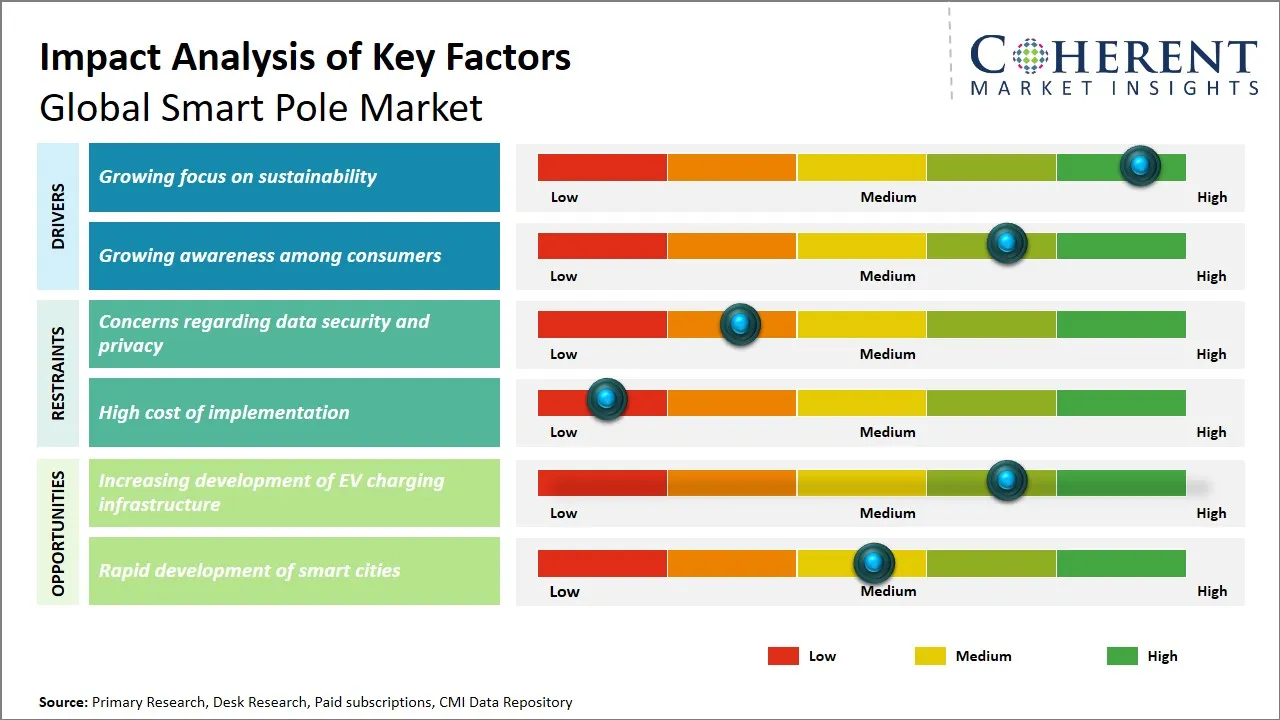
Global Smart Pole Market Driver - Growing Focus on Sustainability
Growing attention toward environmental responsibility drives cities to adopt intelligent street fixtures. With goals of cutting emissions and using power wisely, smart cities find value in multifunctional light structures. Fitted with efficient lamps, sunlight collectors, and detection devices, these units track surroundings while reducing electricity demand. Because they host connected technologies, functions like flow control, pollution tracking, and trash handling improve gradually.
Their role in modern infrastructure supports long-term ecological balance within populated zones. With increasing focus on sustainability, public authorities and corporate entities now place stronger emphasis on low-impact urban systems, smart poles have emerged as one such element supporting smarter metropolitan frameworks.
Global Smart Pole Market Opportunity - Increasing Development of EV Charging Infrastructure
Despite growing interest in electric vehicles, cities face challenges expanding charging access without cluttering public spaces. Because urban areas must balance multiple needs, new designs now combine lighting, data links, and power delivery within single structures. Instead of placing separate units across streets, some regions install shared columns that serve several functions at once. These unified systems often require fewer permits, less groundwork, and reduced maintenance than individual devices. Since energy demands shift throughout the day, embedded sensors help regulate output based on real-time conditions.
Analyst Opinion (Expert Opinion)
- Across cities, smart poles have moved past trials into wider network roles. Driven by funding shifts toward digital urban frameworks, their deployment aligns with 5G rollout and modernized transport corridors. Municipalities and power operators no longer view them just as lamp posts. Instead, illumination shares space with signal relay tasks. Sensors track air quality over time. Surveillance components link through shared mounts. At the same time, groundwork emerges for charging compatibility with battery-powered transportation.
- Future patterns show division through rivalry: large firms focus on complete system cycles together with shared structural projects. Smaller and streamlined efforts move forward using focused upgrades, combined pole designs, city-based smart computing, solar-integrated forms, units that fit into current frameworks. The path unfolding depends not on wide reach but precise deployment - key transit lanes, tightly packed metropolitan paths, integrated 5G points, simpler approvals for edge-of-road installation - where Pacific Coast and Gulf zones build volume, while Northern American and European markets stress sophisticated connections and layered networks.
Speak to the analyst
Want personalized insights?
Take the findings above to one of our principal consultants, or have the report rebuilt around the segments, geographies and competitors you actually track.
Market Segmentation
- Component Insights (Revenue, USD Billion, 2021 - 2033)
- Hardware
- Software
- Services
- Installation Type Insights (Revenue, USD Billion, 2021 - 2033)
- New Installation
- Retrofit Installation
- Application Insights (Revenue, USD Billion, 2021 - 2033)
- Highways and Roadways
- Commercial Public Places
- Railways and Harbors
- Regional Insights (Revenue, USD Billion, 2021 - 2033)
- North America
- U.S.
- Canada
- Latin America
- Brazil
- Argentina
- Mexico
- Rest of Latin America
- Europe
- Germany
- U.K.
- Spain
- France
- Italy
- Russia
- Rest of Europe
- Asia Pacific
- China
- India
- Japan
- Australia
- South Korea
- ASEAN
- Rest of Asia Pacific
- Middle East
- GCC Countries
- Israel
- Rest of Middle East
- Africa
- South Africa
- North Africa
- Central Africa
- North America
- Key Players Insights
- Cree Inc
- Eaton
- Echelon
- General Electric
- Siemens
- Signify Holding
- Silver Spring Networks Inc
- Telensa
- Wipro Limited
- Zumtobel Group
- Huawei Technologies
- Leica Geosystems
- Guangzhou DSPPA Audio Co Ltd
- Sunna Design
- Schreder
Sources
Primary Research Interviews
- Smart pole manufacturers and suppliers
- Municipal government officials and urban planners
- Smart city solution providers and system integrators
- Telecommunications infrastructure companies
Databases
- Bloomberg Terminal Database
- Global Market Database (GMD)
Magazines
- Smart Cities World Magazine
- IEEE Smart Grid Magazine
- Municipal World Magazine
- Smart City Press Magazine
Journals
- IEEE Transactions on Smart Grid
- Journal of Urban Technology
- Smart and Sustainable Built Environment Journal
Newspapers
- Financial Times
- The Wall Street Journal
- Reuters Business News
- Bloomberg News
- The Economic Times
Associations
- International Association of Smart Cities (IASC)
- Smart Cities Council
- Institute of Electrical and Electronics Engineers (IEEE)
- International Telecommunication Union (ITU)
- Global Smart Cities Alliance
Public Domain Sources
- Government municipal planning websites
- World Bank Smart Cities publications
- United Nations Habitat reports
- OECD Smart Cities and Inclusive Growth reports
- European Innovation Partnership on Smart Cities and Communities
Proprietary Elements
- CMI Data Analytics Tool
- Proprietary CMI Existing Repository of information for last 8 years
Get access to 250+ pages report
Every segment, forecast, competitor profile and data table behind the analysis above — available for instant download.
- ESOMAR Member
- ISO 9001:2015 Certified
- D-U-N-S Registered
- GDPR & CCPA Compliant
Missing comfort of reading report in your local language? Find your preferred language:
Transform your Strategy with Exclusive Trending Reports
Frequently Asked Questions
The global smart pole market stood at USD 13 Bn in 2025 and is expected to reach USD 45 Bn by 2033.
The CAGR of global smart pole market is projected to be 15% from 2026 to 2033.
Growing focus on sustainability and growing awareness among consumers are the major factors driving the growth of the global smart pole market.
Concerns regarding data security and privacy and high cost of implementation are the major factors hampering the growth of the global smart pole market.
In terms of component, hardware is estimated to dominate the market revenue share in 2025.
Cities adopt smart poles to reduce infrastructure clutter while enabling digital services such as traffic monitoring, public Wi-Fi, and adaptive lighting.
Common integrations include LED lighting, IoT sensors, CCTV, environmental monitoring, and wireless communication modules.