

Global Smart TV Chip Market and Forecast – 2026-2033
Coherent Market Insights estimates that the global smart TV chip market is expected to reach USD 1.55 Bn in 2026 and will expand to USD 2.90 Bn by 2033, registering a CAGR of 6% between 2026 and 2033.
Key Takeaways of the Smart TV Chip Market
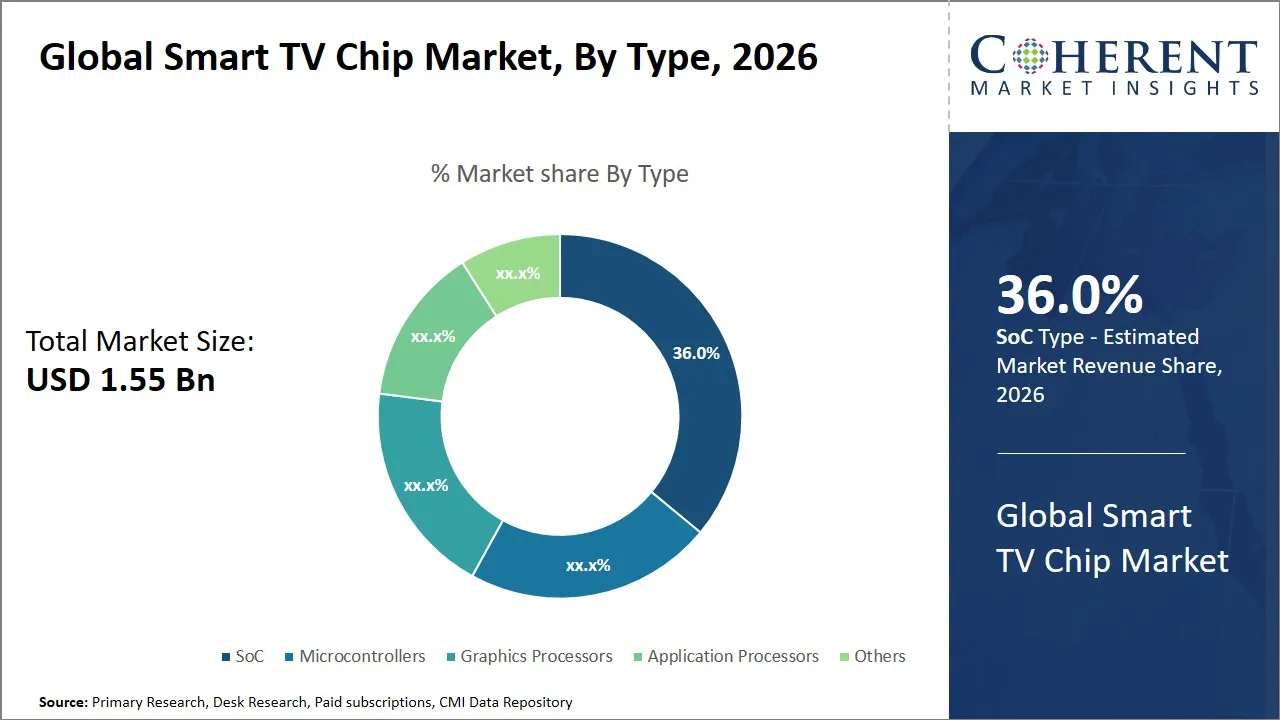
- The SoC segment is expected to account for 36% of the smart TV chip market share in 2026.
- The HD segment is estimated to capture 42% of the market share in 2026.
- The OEM segment is projected to represent 63% of the global smart TV chip market share in 2026.
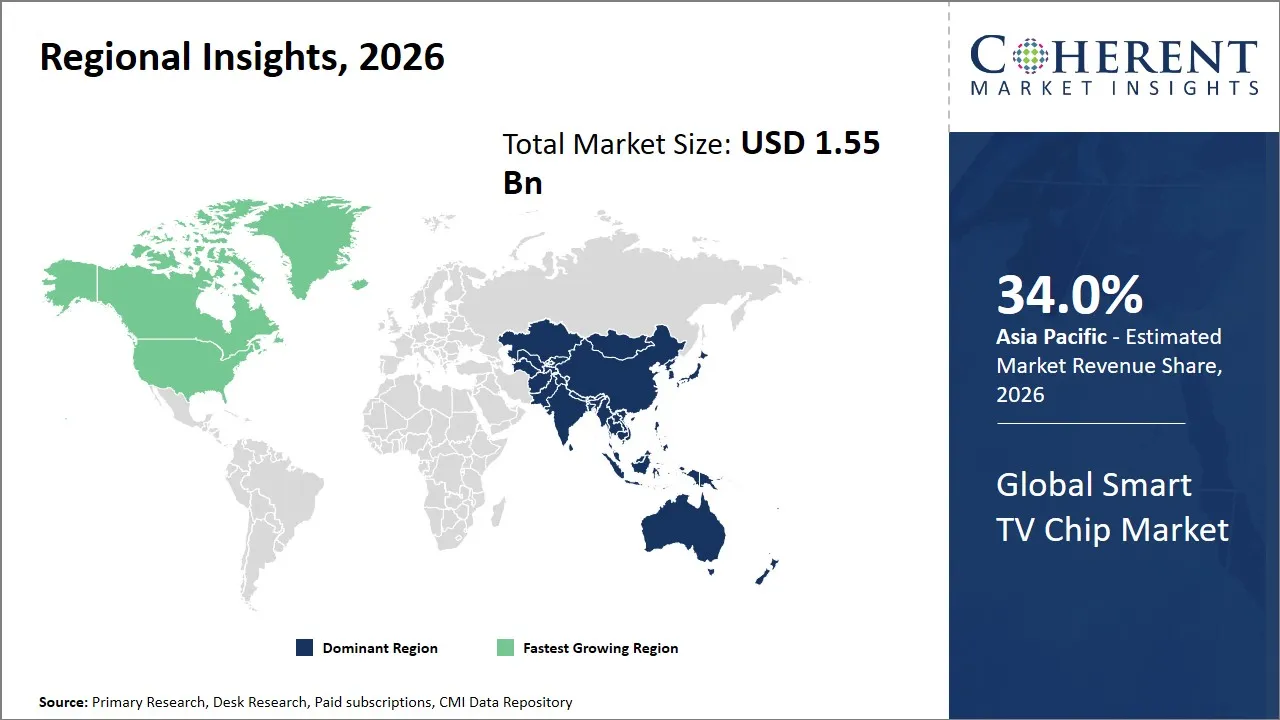
- Asia Pacific is expected to dominate the smart TV chip market in 2026 with a 34% share.
- North America is expected to account for 23% share in 2026 and is projected to record the fastest growth over the forecast period.
Currents Events and their Impact
Current Events | Description and its Impact |
MediaTek Pentonic 800 Launch |
|
Segmental Insights
- Current Industry Events of 2026
- Market Size Estimation
- Regional Breakdown
- Competitive Landscape
- Customer Intelligence
- Segmental Analysis
- Pricing Analysis
- Key Market Drivers, Challenges & Future Trends
- Customized Insights Section
Why Does the SoC Segment Dominate the Global Smart TV Chip Market in 2026?
The SoC segment is expected to account for 36% of the global smart TV chip market share in 2026. Growth stems mainly from strong integration potential alongside efficient operation. Within one chip, system-on-chips house elements like processors, graphics units, memory management, also interface systems, and this setup delivers space-saving, economical options for makers of intelligent televisions. By merging functions, power demand drops sharply; so does physical size when contrasted with separate circuitry. As a result, these integrated circuits become favorable under strict energy constraints found in modern television designs.
For instance, on August 11, 2025, Sony announced that Realtek-based TVs received a major Android 14 update (including models like X75K and 77L), indicating ongoing product support for Realtek SoC-powered TVs that often include HD/Full HD consumer lines in Sony’s portfolio.
(Source: tomsguide.com)
HD Segment Dominates the Global Smart TV Chip Market
The HD segment is projected to account for 42% of the smart TV chip market share in 2026. A primary reason HD remains common lies in low cost, wide support across devices, yet still delivers clear enough images for most people. Even though sharper formats such as 4K UHD or 8K UHD exist, older standard holds ground due to practical benefits. Where money matters, basic models satisfy daily demands without excess. In developing areas, access often depends on simpler technology staying available. Picture clarity might lack extreme precision, however function outweighs flaw for many households.
Why is OEM the Most Crucial End User in the Global Smart TV Chip Market?
The OEM segment is expected to account for 63% of the global smart TV chip market share in 2026. This dominance stems mainly from how OEMs shape smart TV development, aligning hardware precisely with each brand's standards. As these manufacturers work closely with chipset makers, custom silicon becomes feasible, enhancing core functions like responsiveness, energy use, and media handling. Despite broader market shifts, such collaborations remain central to product differentiation and technical refinement.
Global Smart TV Chip Market - AI/ML Integration
Function | Typical AI Model Type | NPU Performance (TOPS) | CPU/GPU Requirement | Memory Requirement | Latency |
AI-Based UI Personalization | Deep Neural Networks (DNN), Collaborative Filtering | 0.5 – 1.5 TOPS | Quad-core ARM Cortex-A55/A76 + Mali GPU | 2–4 GB DDR4/DDR5 | <50 ms response time |
AI Content Recommendation Engine | Edge AI inference models | 1 – 2 TOPS | Multi-core CPU + Integrated GPU | 3–4 GB RAM | 30–60 ms |
AI 4K Upscaling (HD to 4K) | CNN-based Super Resolution | 2 – 4 TOPS | High-performance GPU (600–900 MHz) | 4 GB RAM | <10 ms per frame |
AI HDR & Scene Detection | Scene classification ML models | 1 – 3 TOPS | ISP + GPU acceleration | 2–4 GB | <5 ms |
AI 8K Upscaling | GAN-based models | 4 – 8 TOPS | Advanced GPU (1 GHz+) | 4–8 GB RAM | <8 ms per frame |
Voice Recognition (On-Device) | NLP models, Transformer-lite | 0.5 – 2 TOPS | DSP + Low-power NPU | 1–2 GB | <100 ms |
Far-field Voice Processing | Acoustic AI models | 0.5 – 1 TOPS | Dedicated Audio DSP | 1–2 GB | <50 ms |
Facial Recognition Login | Biometric ML models | 1 – 3 TOPS | Secure AI enclave + ISP | 2–4 GB | <500 ms |
Regional Insights
Asia Pacific Smart TV Chip Market Analysis and Trends
Asia Pacific is expected to account for a market share of 34% share in 2026. Growth emerges from multiple overlapping causes. In nations including Japan, China, Taiwan, and South Korea, strong foundations in semiconductor production shape much of the supply for high-level chips used in smart televisions. Policies that support progress come frequently from state bodies within those regions, along with funding aimed at research and building local chip-making strength.
Large-scale producers of electronic goods, Samsung and LG Electronics from South Korea and Sony based in Japan, help sustain consistent need for newer television processors. Integrated supply networks support the area, while consumer electronics output remains substantial, contributing to growth in smart television semiconductors. Trade patterns tilt toward this zone because export pathways are long standing, with agreements easing transit of parts and completed goods across borders. Movement of components flows smoothly, given regional pacts that reduce barriers. Large local demand adds momentum, reinforcing industry expansion without reliance on external regions.
For instance, on July 24, 2025, MediaTek unveiled the world’s first 15,000+ zone RGB mini-LED local dimming chip technology powered by its Pentonic platform, aimed at improving picture performance in large display TVs, a development targeted at Asia Pacific OEMs embracing premium display features.
(Source: mediatek.com)
North America Smart TV Chip Market Analysis and Trends
North America is expected to account for a market share of 23% in 2026 and is expected to register the fastest growth rate over the forecast period. Expansion follows rising demand for smart televisions, fueled by wealthier buyers alongside strong digital networks. Leading the area, the U.S. enables progress via steady funding for chip development and research efforts. Policies focused on high-tech industry growth and domestic semiconductor capacity have strengthened regional fabrication projects.
Notably, major firms such as Qualcomm, Intel, and NVIDIA operate across North America are crafting advanced chips tailored for internet-connected screens. With cooperation among chip creators, device builders, and streaming services like Netflix or Amazon, smarter television systems emerge. Because of shifting trade conditions, North American development in local tech has increased, shaping new needs for custom chips used in modern televisions.
Global Smart TV Chip Market Outlook for Key Countries
Why is South Korea Emerging as a Major Hub in the Smart TV Chip Market?
Driven by global demand, South Korea's electronics sector thrives through firms like Samsung and LG, known for internal chip design that supports progress in television technology. Instead of relying on outside suppliers, these companies focus on self-developed semiconductors, ensuring control over performance and features. Samsung’s chip unit operates at scale, using refined manufacturing techniques to produce processors tailored for modern TVs. Rather than lag behind competitors, local efforts align with national policies aimed at expanding domestic fabrication capacity.
Is U.S. the Next Growth Engine for the Smart TV Chip Market?
Still dominant, the U.S. draws strength from firms such as Qualcomm and Intel - creators of powerful chips built specifically for smart television features including artificial intelligence-based visuals and network linking. Rather than hardware production, emphasis falls on intellectual property, circuit layout, and digital coordination meant to improve how people interact with their televisions. Support from federal programs aims at renewing domestic chip fabrication, lessening reliance on parts sourced from Asia Pacific regions.
China Smart TV Chip Market Analysis and Trends
Thriving begins in China’s smart TV chip sector, driven by immense consumer electronics production alongside a fast-growing internal marketplace. Notable local developers including HiSilicon - linked to Huawei - and TCL push progress through cost-conscious designs meant for wide reach. Backing arrives via national strategy; initiatives resembling “Made in China 2025” prioritize homegrown chip capacity, guiding funds toward research and factory expansion. Even under pressure from global export controls, momentum builds as domestic supply networks take shape, fostering quicker iterations in television processors. Demand swells from sheer numbers of people, compounded by increasing household incomes that favor connected living solutions. Growth continues, shaped less by slogans than by scale and steady technical refinement.
Japan Smart TV Chip Market Analysis and Trends
Despite global shifts, Japan's position in tech remains firm due to key players advancing core components for modern televisions. Among them, Renesas Electronics delivers vital microcontrollers and circuitry that enable advanced functionality within these devices. Meanwhile, Sony applies a tightly controlled production approach, allowing swift integration of new semiconductor designs into actual products. Backed by state investment in exacting industrial methods and material research, national capabilities continue evolving. High regard for durability and technical excellence drives consistent need for powerful television processors across local and international buyers.
India Smart TV Chip Market Analysis and Trends
Shaped by rising city populations and wider internet access, India’s developing market for smart TV chips sees stronger interest. With affordability a key concern, homegrown and nearby businesses now prioritize budget-friendly options. Backed by programs such as "Make in India" and dedicated production zones, efforts grow to nurture local chipmaking capabilities. Foreign tech providers, noticing potential, increase their presence through expanded facilities. Youth numbers, paired with better connectivity, suggest steady momentum ahead for these devices.
Market Players, Key Development, and Competitive Intelligence
Key Developments
- On January 5, 2026, BOE Technology Group and RT-RK revealed a next-generation Android TV platform powered by Qualcomm’s Dragonwing QCS8550 processor. This collaborative effort combines display innovation, cutting-edge silicon, and world-class embedded software engineering to deliver a premium, AI-enhanced smart TV experience for global markets.
- On May 9, 2025, UGOOS announced the launch of UGOOS SK2, a 4K Google TV (Android TV 12) box powered by a Realtek RTD1325 quad-core Cortex-A55 SoC with 4GB LPDDR4 RAM, 32GB eMMC flash, 100 Mbps Ethernet, and WiFi 6 connectivity.
Top Strategies Followed by Global Smart TV Chip Market Players
Player Type | Strategic Focus | Example |
Established Market Leaders | Rockchip Product Launch | On July 18, 2025 Rockchip unveiled RK3668 (16 TOPS NPU) at its developer conference. Rockchip’s strategy is to push integrated AI compute to attract OEMs building next-gen smart displays/TV-adjacent devices. |
Mid-Level Players | Tanix TV Product Launch | On December 12, 2024, Tanix TV unveiled the Tanix TX5, the latest 4K Android TV Box featuring the powerful Amlogic S905Y5 chip, WiFi 5 support, and the latest Android 14 operating system. Designed to elevate entertainment experience, the Tanix TX5 brings cutting-edge technology and innovative features. |
Small-Scale Players | Business Collaboration | On December 12, 2024, SEI Robotics announced a partnership with HD PLUS. In their inaugural partnership, they successfully co-launched the world's first Google -certified S905Y5 Android TV 14 IPTV Stick in just three months. |
Market Report Scope
Smart TV Chip Market Report Coverage
| Report Coverage | Details | ||
|---|---|---|---|
| Base Year: | 2025 | Market Size in 2026: | USD 1.55 Bn |
| Historical Data for: | 2020 To 2024 | Forecast Period: | 2026 To 2033 |
| Forecast Period 2026 to 2033 CAGR: | 6% | 2033 Value Projection: | USD 2.90 Bn |
| Geographies covered: |
| ||
| Segments covered: |
| ||
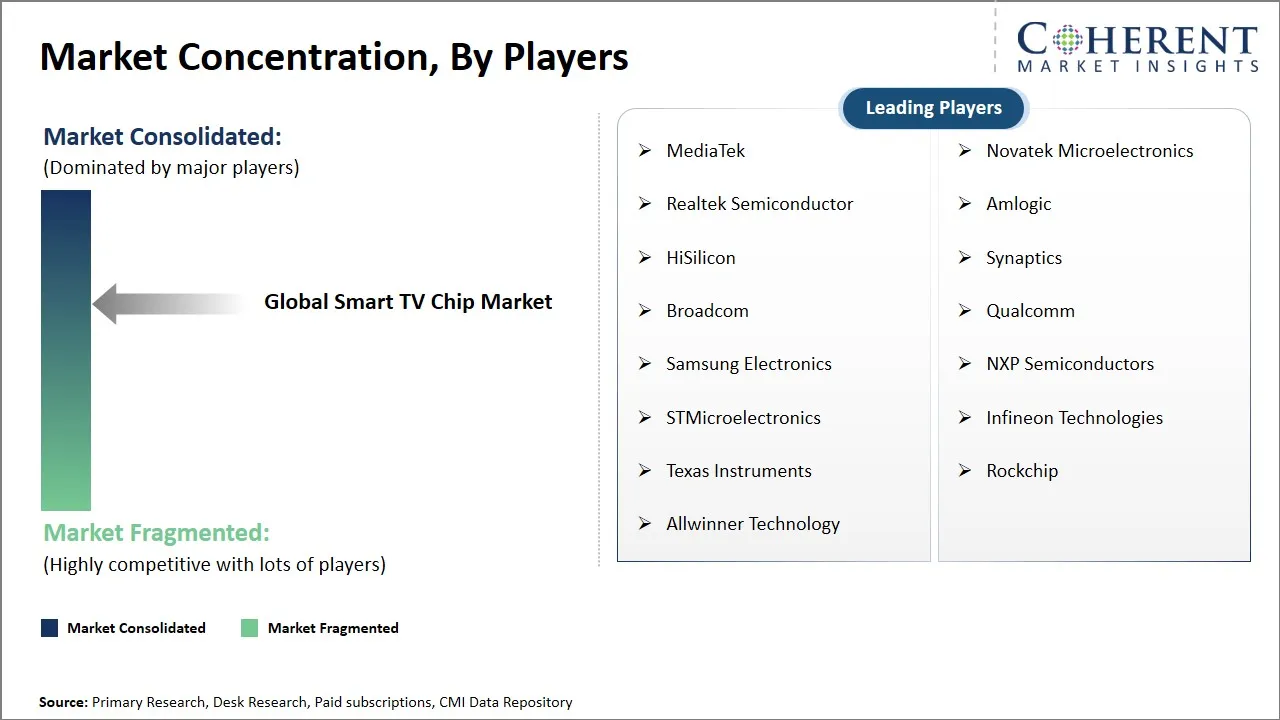
| Companies covered: | MediaTek, Novatek Microelectronics, Realtek Semiconductor, Amlogic, HiSilicon, Synaptics, Broadcom, Qualcomm, Samsung Electronics, NXP Semiconductors, STMicroelectronics, Infineon Technologies, Texas Instruments, Rockchip, and Allwinner Technology | ||
| Growth Drivers: |
| ||
| Restraints & Challenges: |
| ||
Global Smart TV Chip Market Dynamics
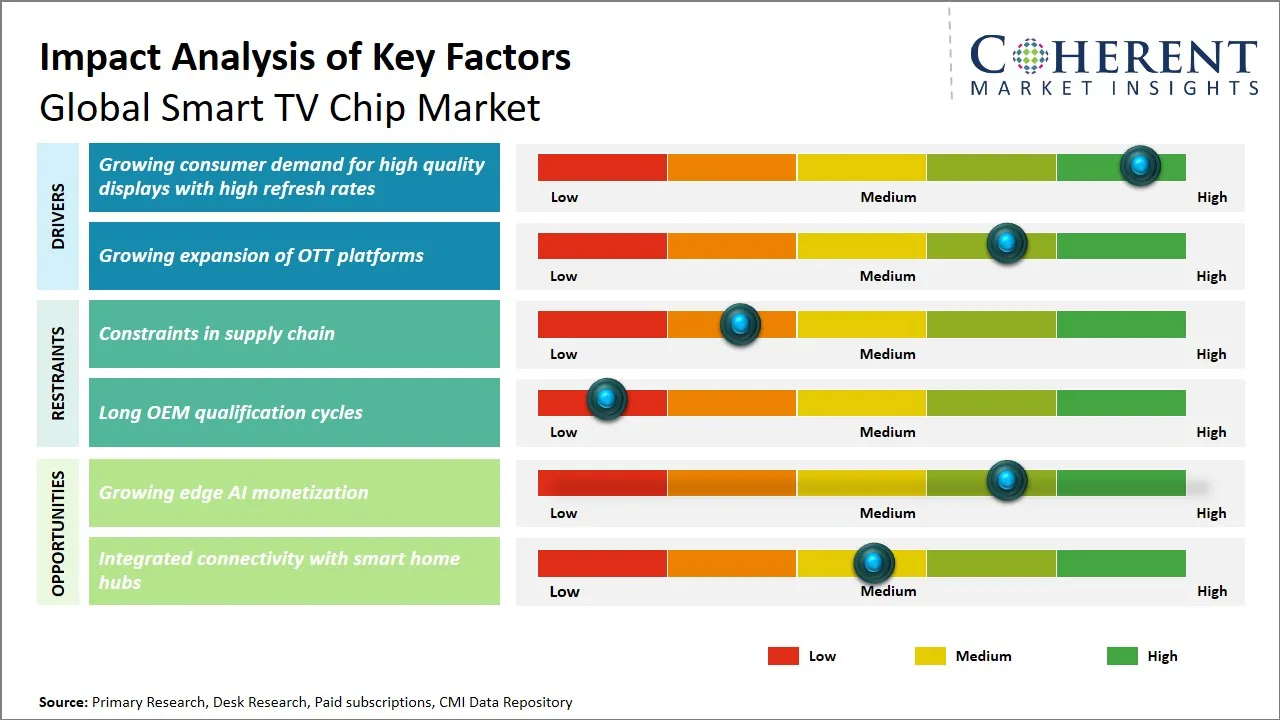
Global Smart TV Chip Market Driver - Growing Consumer Demand for High Quality Displays with High Refresh Rates
Driven by rising demand for enhanced visuals, the worldwide market for smart TV chips continues to evolve. As modern audiences prioritize displays with vivid color reproduction, alongside crisp image detail, manufacturers adapt accordingly. Where once basic functionality sufficed, now seamless movement across scenes matters greatly. Especially noticeable during rapid sequences, higher refresh capabilities reduce distortions that disrupt immersion. As people consume more 4K and HD material, performance expectations shift without announcement.
For instance, on December 23, 2025, LG Display announced that it will debut the world’s first 27-inch 4K OLED panel for monitors featuring an RGB stripe structure and a 240Hz refresh rate at CES 2026, the world’s largest IT and consumer electronics exhibition.
(Source: lgcorp.com)
Global Smart TV Chip Market Opportunity - Growing Edge AI Monetization
With edge AI moving into smart TVs, the worldwide market for smart TV chips gains new momentum. Instead of depending on distant servers, these televisions handle heavy tasks internally, thanks to built-in intelligence. As a result, actions like understanding spoken words or suggesting shows happen faster. Performance improves because decisions are made inside the device, not through external connections. Chips now need greater strength and smarter architecture to manage learning-based functions smoothly. Therefore, manufacturers seek components that include dedicated parts for AI, such as NPUs.
For instance, on May 16, 2025, Qualcomm Technologies, Inc. and e& announced a strategic collaboration to help drive technological development and commercialization across a broad range of advanced connectivity, 5G and edge AI technologies in an effort to accelerate the digital transformation for the government, enterprise and industrial sectors.
(Source: qualcomm.com)
Analyst Opinion (Expert Opinion)
- A shift toward higher-resolution displays shapes how new television chips evolve. With more users valuing sharp visuals and smooth interaction, development centers on compact systems delivering strong graphic handling, low power use, through varied codec support. Instead of just boosting speed, emphasis now lies in intelligent scaling, real-time responses via built-in learning modules. Driven not only by video quality but also home network links, these units adapt using localized data computation rather than relying solely on external servers. Growth in online streaming services along with interactive media formats adds pressure to refine internal processing logic over time.
- Pressure mounts among makers of chips for smart televisions, where distinction comes via faster performance, sharper visuals, or lower costs suited to widespread use. Instead of just speed, focus shifts toward how well images appear on screen, especially when budgets constrain choices. Growth in television chip sales finds roots mainly across regions like Asia Pacific, parts of Latin America, and areas within Africa - places where new buyers enter the market steadily. Meanwhile, wealthier zones such as North America and Western Europe emphasize quality, favoring advanced displays including OLED, QLED, and those using mini-LED technology. Such preferences shape what kind of chipsets gain traction at higher price points.
Speak to the analyst
Want personalized insights?
Take the findings above to one of our principal consultants, or have the report rebuilt around the segments, geographies and competitors you actually track.
Market Segmentation
- Type Insights (Revenue, USD Billion, 2021 - 2033)
- SoC
- Microcontrollers
- Graphics Processors
- Application Processors
- Others
- Resolution Type Insights (Revenue, USD Billion, 2021 - 2033)
- HD
- Full HD
- 4K UHD
- 8K UHD
- End User Insights (Revenue, USD Billion, 2021 - 2033)
- OEM
- Aftermarket
- Regional Insights (Revenue, USD Billion, 2021 - 2033)
- North America
- U.S.
- Canada
- Latin America
- Brazil
- Argentina
- Mexico
- Rest of Latin America
- Europe
- Germany
- U.K.
- Spain
- France
- Italy
- Russia
- Rest of Europe
- Asia Pacific
- China
- India
- Japan
- Australia
- South Korea
- ASEAN
- Rest of Asia Pacific
- Middle East
- GCC Countries
- Israel
- Rest of Middle East
- Africa
- South Africa
- North Africa
- Central Africa
- North America
- Key Players Insights
- MediaTek
- Novatek Microelectronics
- Realtek Semiconductor
- Amlogic
- HiSilicon
- Synaptics
- Broadcom
- Qualcomm
- Samsung Electronics
- NXP Semiconductors
- STMicroelectronics
- Infineon Technologies
- Texas Instruments
- Rockchip
- Allwinner Technology
Sources
Primary Research Interviews
- Smart TV chip manufacturers and suppliers
- Television OEMs and brand representatives
- Semiconductor industry executives
- Technology integrators and distributors
Databases
- Semiconductor Industry Association (SIA) Database
- Omdia Consumer Electronics Database
Magazines
- Electronic Design Magazine
- EE Times Magazine
- Semiconductor Today Magazine
- Consumer Electronics Magazine
- TV Technology Magazine
Journals
- IEEE Transactions on Consumer Electronics
- Journal of Display Technology
- Microelectronics Reliability Journal
Newspapers
- Financial Times
- Wall Street Journal
- Electronics Weekly
- Asian Electronics News
- Semiconductor Industry Observer
Associations
- Consumer Technology Association (CTA)
- Semiconductor Industry Association (SIA)
- International Display Working Group (iDWG)
- Smart TV Alliance
- Global Semiconductor Alliance (GSA)
Public Domain Sources
- Company annual reports and SEC filings
- Patent databases and technology publications
- Government statistics and trade data
- Industry conference proceedings and presentations
Proprietary Elements
- CMI Data Analytics Tool
- Proprietary CMI Existing Repository of information for last 8 years
Get access to 250+ pages report
Every segment, forecast, competitor profile and data table behind the analysis above — available for instant download.
- ESOMAR Member
- ISO 9001:2015 Certified
- D-U-N-S Registered
- GDPR & CCPA Compliant
Missing comfort of reading report in your local language? Find your preferred language:
Transform your Strategy with Exclusive Trending Reports
Frequently Asked Questions
The global smart TV chip market is expected to stand at USD 1.55 Bn in 2026 and is expected to reach USD 2.90 Bn by 2033.
The CAGR of global smart TV chip market is projected to be 6% from 2026 to 2033.
Growing consumer demand for high quality displays with high refresh rates and growing expansion of OTT platforms are the major factors driving the growth of the global smart TV chip market.
Constraints in supply chain and long OEM qualification cycles are the major factors hampering the growth of the global smart TV chip market.
In terms of type, SoC is estimated to dominate the market revenue share in 2026.
Higher resolutions require more powerful processors and advanced graphics capabilities.
Modern Smart TV chips are designed to balance high performance with lower power consumption.