

Global Smart TV Terminal Market Size and Forecast – 2026 To 2033
The global smart TV terminal market is expected to grow from USD 270 Bn in 2026 to USD 672 Bn by 2033, registering a compound annual growth rate (CAGR) of 14% from 2026 to 2033. The global smart TV terminal market is driven by rapid growth in online content consumption. On June 3, 2026, YouTube overtook Netflix in average daily viewing among users around the world. Average daily usage per YouTube account rose from 87.2 minutes in 2024 to 99.1 in 2025 and the figure for Netflix dropped from 100.5 to 93.4 minutes. (Source: The Guardian)
Key Takeaways of the Global Smart TV Terminal Market
- The Android TV segment is expected to account for 44.0 % of the global smart TV terminal market share in 2026. Growing integration of Android TVs with IoT ecosystems is a key factor driving the growth of the segment. On August 25, 2025, Samsung Electronics announced the expansion of its proprietary One UI platform to its home appliance lineup, delivering a unified and intuitive software experience across smartphones, TVs and now smart appliances. As a part of this initiative, smart appliances will be receiving software updates for 7 years after launching, starting from 2024. (Source: Samsung)
- The LED segment is estimated to capture 34.0 % of the market share in 2026. Growing demand of LED gaming panels is a primary factor for the segmental growth. On March 24, 2026, Samsung Electronics America announced the debut of its latest Neo QLED 4K models and an all-new Mini LED TV lineup. The TVs come with Motion Xcelerator 144Hz that synchronizes the TV with the game’s frame rate, reducing stutter and screen tearing. (Source: Samsung)
- The HD segment is estimated to capture 31.0 % of the market share in 2026. Growing consumer preference for high quality video content consumption is driving the growth of the HD segment. On February 27, 2026, Disney+ reinstated Dolby Vision HDR and Dolby Atmos support for Premium subscribers in 2025 after technical and licensing adjustments.
- Asia Pacific is expected to dominate the smart TV terminal market in 2026 with a market share of 41.0 %. Growing expansion of Free Ad-Supported Streaming TV (FAST) services is primarily driving the growth of the smart TV terminal market in Asia Pacific. On October 31, 2025, Indian media company, Swastik Productions launched Swastik Stories, described as India’s first cultural storytelling FAST channel, distributed via platforms like JioTV and smart TV ecosystems including LG and Xiaomi TV. (Source: The Hindu)
- North America is expected to account for 25.0 % share in 2026 and is projected to record the fastest growth over the forecast period. Growth in 4K and 8K television adoption is a major factor driving the growth of the regional market. On March 26, 2025, Samsung Electronics America announced the availability of its 2025 Samsung Neo QLED 8K and Samsung Neo QLED 4K TV series. The new lineup offers stunning visuals and immersive sound, and are the first to feature Samsung Vision AI with smarter, adaptive features that reimagine what Samsung TVs can do. (Source: Samsung)
- Integration of Artificial Intelligence (AI) and Voice Assistants: Smart TVs are increasingly integrating artificial intelligence (AI) powered features such as personalized content recommendations, smart picture and sound adjustments and voice control through assistants such as Google Assistant, Amazon Alexa and Apple Siri. These qualities allow for a more convenient user experience and more interactive entertainment experiences.
- Growth of Connected Home Ecosystems: Smart TV terminals are becoming major control centers for smart home technologies. Consumers may even watch security cameras, control lights, change thermostats and control linked gadgets through their TVs. This convergence is making smart TVs an increasingly strategic component of the larger Internet of Things (IoT) ecosystem.
Segmental Insights
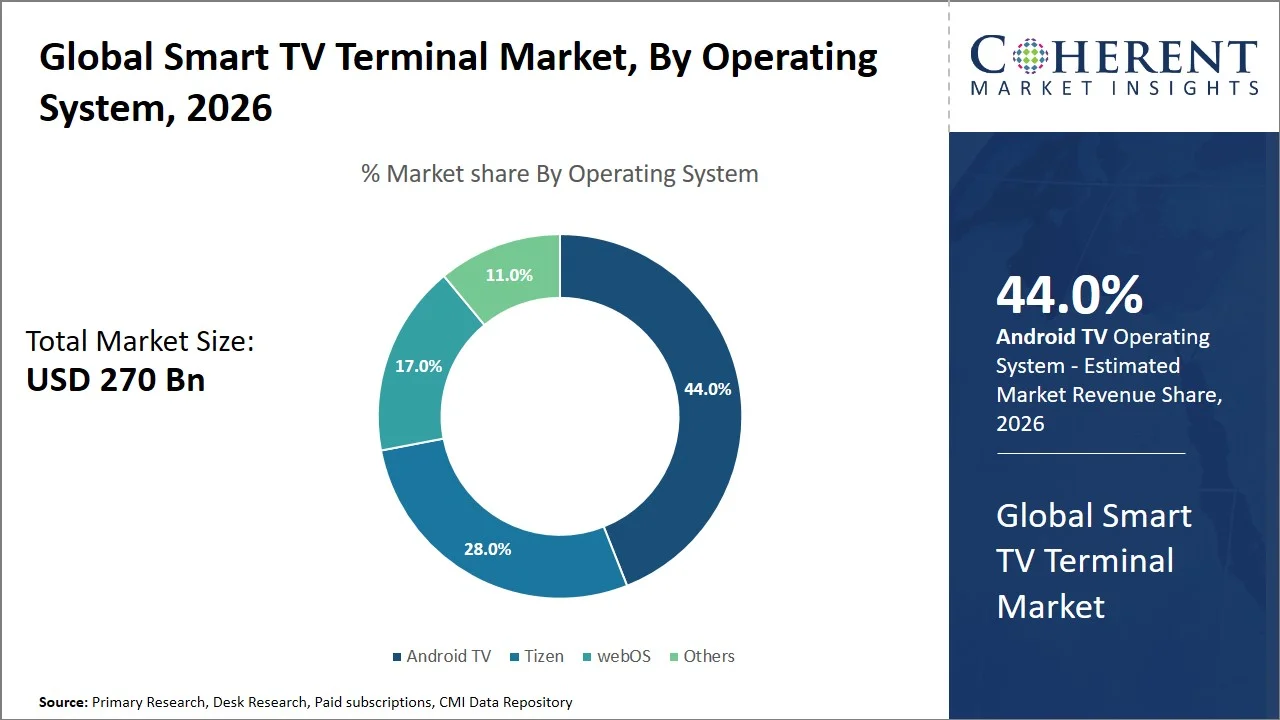
Why Does Android TV Dominate the Global Smart TV Terminal Market?
The Android TV segment is expected to account for 44.0% of the global smart TV terminal market share in 2026. The open and highly customizable ecosystem of the operating system is an important reason for the dominance of Android TV in the global smart TV terminal market. Android TV allows TV manufacturers to modify the user interface, embed local and worldwide streaming services and minimize development costs compared to creating proprietary platforms. This adaptability has led to its adoption by many TV brands in both premium and affordable categories, resulting in a wide device range and strong penetration in worldwide markets. Furthermore, the Google Play Store ecosystem offers consumers a wide variety of applications and entertainment services, which further strengthens Android TV’s position in the market.
On June 5, 2026, Xiaomi launched its FX Mini LED Smart TV series (2026) in India with Fire TV/Android-based smart interface, integrated streaming apps, and deep Google ecosystem compatibility via Play Store apps support in its TV lineup strategy. (Source: Times of India)
- Current Industry Events of 2026
- Market Size Estimation
- Regional Breakdown
- Competitive Landscape
- Customer Intelligence
- Segmental Analysis
- Pricing Analysis
- Key Market Drivers, Challenges & Future Trends
- Customized Insights Section
Why is LED the Most Preferred Technology?
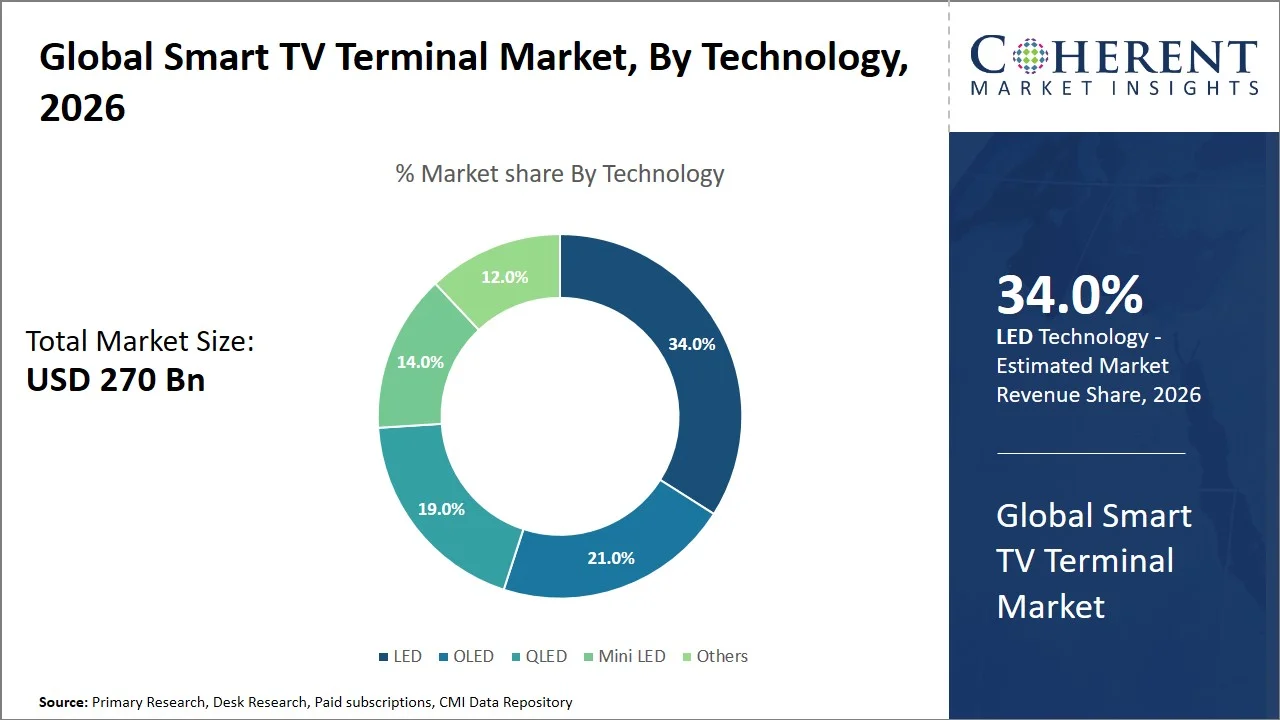
The LED segment is expected to account for 34.0% of the global smart TV terminal market share in 2026. LED is the most common technology in the smart TV terminal market mainly for its better cost performance ratio. LED TVs offer good picture quality, energy efficiency, durability and vast screen-size options at comparatively lower prices than advanced technologies like OLED and Mini-LED. This cost advantage puts LED TVs within reach of a wider user base notably in price sensitive and developing markets, ensuring their continued dominance in worldwide sales. On May 9, 2026, Haier launched a new budget LED TV lineup, the K85 series, aimed at price-sensitive consumers, alongside mid-range QLED and premium variants. (Source: Haier)
HD Dominates the Global Smart TV Terminal Market
The HD segment is expected to account for 31.0% of the global smart TV terminal market share in 2026. HD is cost-effective and extensively compatible, which is one of the reasons why it dominates the global market of smart TV terminals. HD-resolution smart TVs are ideal for everyday watching, and are significantly less expensive than Full HD, 4K and 8K equivalents. This makes HD TVs especially attractive to developing economies and price-sensitive consumer segments, maintaining their enormous installed base and continued market dominance. On January 24, 2026, Thomson introduced a 32-inch smart TV running JioTele OS, targeting entry-level households and secondary-room TV usage in India. (Source: Time of India)
Currents Events and their Impact
Current Events | Description and its Impact |
European Union Digital Services Act (DSA) |
|
United States CHIPS and Science Act |
|
(Source: European Commission, Congress)
Global Smart TV Terminal Market - Revenue Per Active Smart TV Device
Company / Ecosystem | ARPU (USD per active device) |
Roku | USD 41.49 |
TiVo OS (Xperi) | USD 8.75 |
FAST / AVoD avg | USD 13.75 – USD 14.95 |
Global ad-supported OTT | USD 51.57 |
Subscription streaming | USD 81.33 – USD 83.69 |
Global CTV platforms | USD 30 – USD 50 |
Samsung / LG / OEM OS stack | USD 5 – USD 20 |
Roku / Amazon / Samsung / LG / Apple | USD 20 – USD 45 |
Smart TVs with default FAST | USD 10 – USD 25 |
Samsung Tizen / LG webOS (Premium) | USD 35 – USD 60 |
Global Smart TV Terminal Market - Installed Base by TV Operating System
TV Operating System | Estimated Installed Base (Million Units) |
Android TV / Google TV | ~400–460 Mn |
Samsung Tizen OS | ~200–230 Mn |
LG webOS | ~120–150 Mn |
Roku OS | ~70–120 Mn |
Amazon Fire TV OS | ~70–100 Mn |
VIDAA OS | ~60–90 Mn |
Apple tvOS | ~35–60 Mn |
Xiaomi PatchWall / MIUI TV | ~30–55 Mn |
Xumo OS | ~10–25 Mn |
Global Smart TV Terminal Market - Connected TV Advertising Revenue by Platform
Platform / Ecosystem | Estimated CTV Ad Revenue (USD, Annual) |
Roku | USD 5.0 Bn – USD 5.3 Bn |
Amazon Fire TV / Prime Video | USD 3.5 Bn – USD 4.0 Bn |
Samsung (Tizen / Samsung Ads) | USD 2.8 Bn – USD 3.3 Bn |
YouTube (CTV / Smart TV screens) | USD 6 Bn – USD 7.5 Bn |
LG webOS | USD 1.0 Bn – USD 1.4 Bn |
Google TV / Android TV ecosystem | USD 4.0 Bn – USD 5.5 Bn |
Apple tvOS | USD 1.2 Bn – USD 1.8 Bn |
Smart TV Terminal Market Dynamics
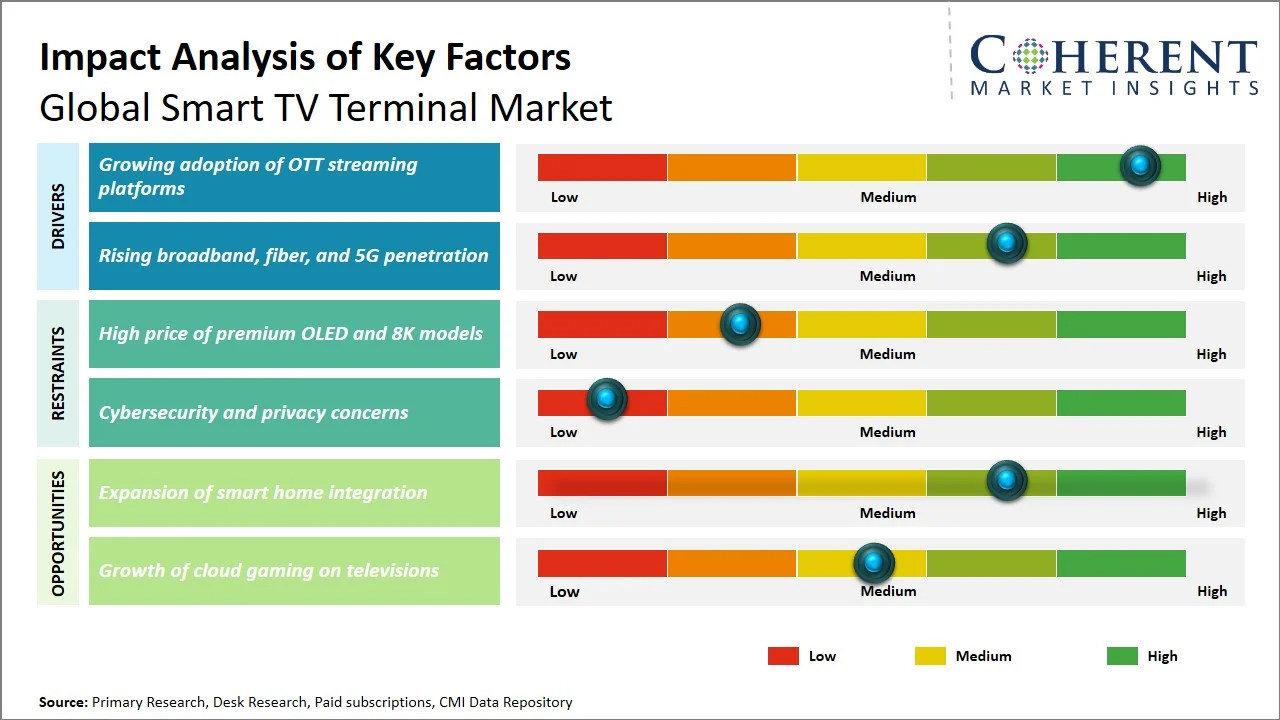
Market Drivers
- Growing adoption of OTT streaming platforms: Growing penetration of Over-The-Top (OTT) streaming services is one of the major factors driving the growth of the global smart TV terminal market. Consumers are migrating away from traditional cable and satellite TV in favor of digital on-demand programming. Netflix, Amazon Prime Video and Disney+ are expanding their global subscriber base by offering flexible watching options, unique content and access on multiple devices. This is forcing customers to smart TVs that offer more processing power, higher resolution screens and built-in app ecosystems for a better streaming experience. This is in turn directly driving demand for advanced smart TV terminals and transforming the overall television viewing environment.
- On May 11, 2026, Amazon became the latest streaming giant to add short-form vertical video feed called Clips to its platform after rivals like Netflix and Disney+. The feature aims to change how users discover their next favorite movie or binge-worthy series directly from their phones. (Source: Times of India)
- Rising broadband, fiber, and 5G penetration: Growing penetration of broadband, fiber and 5G is a crucial factor for the growth of the worldwide smart TV terminal market. It enables faster, consistent and high capacity internet connectivity to broadcast information seamlessly. As high-speed fiber networks grow and 5G services roll out, people can watch high-definition and 4K/8K video on smart TVs with less buffering and more consistency. This improved digital infrastructure is especially important for streaming services such as Netflix and YouTube, which need a lot of bandwidth to deliver content in high quality. The growing cost and accessibility of connectivity is boosting the smart TV sector, improving the overall user experience in urban and rising locations.
- On March 10, 2026, AT&T announced an investment of more than USD 250 billion in the future of U.S. advanced connectivity, building the high-speed networks and resilience required for the next era of innovation and economic growth. (Source: AT&T)
Emerging Trends
- Rising Adoption of Advanced Display Technologies: Manufacturers are making substantial investments in premium display technologies including OLED, QLED, and Mini-LED panels. These developments allow for higher brightness, contrast, color accuracy and energy economy to stimulate consumer upgrades and development in the premium market.
- Expansion of Streaming and Cloud-Based Entertainment Services: The rapid growth of streaming platforms is pushing the demand for smart TV terminals with powerful processors, enhanced connection and integrated content ecosystems. Traditional cable and satellite television services are becoming less necessary due to the growing popularity of smart TVs for high definition streaming, cloud gaming and Over-the-Top (OTT) applications.
Regional Insights
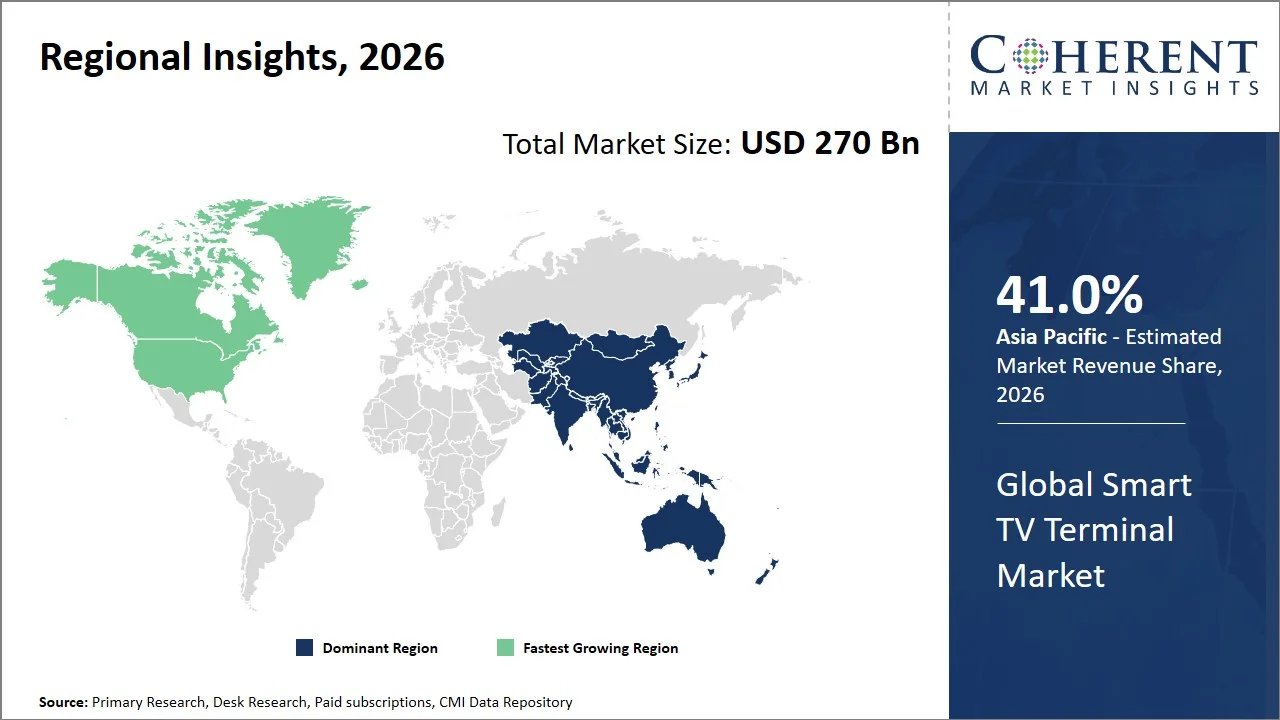
Why is Asia Pacific a Strong Market for Smart TV Terminal?
Asia Pacific is expected to account for a market share of 41.0% in 2026. Massive-scale manufacturing and extremely price-sensitive demand are shaping the Asia Pacific industry, with nations such as India, Indonesia and Vietnam driving high-volume sales of LED and Android TVs. Indian brands like Xiaomi and realme fight aggressively with South Korean and Chinese brands by delivering smart TVs with extensive features in the mid-range pricing strongly packed with OTT apps like YouTube and regional streaming services like Hotstar (Disney+ Hotstar). The region also has strong panel production hubs in China and Taiwan, which keeps hardware costs low and promotes adoption of large-screen smart TVs in urban households. Moreover, integration of AI with smart TVs is further driving the growth of the regional market. On May 26, 2026, Samsung India announced the launch of its full 2026 Vision AI TV lineup, spanning Micro RGB, OLED, Neo QLED, The Frame, Mini LED and UHD TVs. With this launch, Samsung is expanding AI-powered features across all its models, bringing smarter picture, sound and personalized viewing experiences to more consumers in India. (Source: Samsung)
Why Does the North America Smart TV Terminal Market Exhibit High Growth?
North America is projected to account for 25.0% of the global smart TV terminal market and is expected to register the fastest growth. In North America, premium smart TV uptake and high average revenue per user streaming usage dominates with significant integration of ecosystem driven platforms. For example, Samsung and LG Electronics’ smart TVs are used along with streaming ecosystems like Netflix, Hulu and Disney+, often as a substitute for cable subscriptions. The region also witnesses a significant demand for advanced features such as voice control with Amazon Alexa and high-end display technologies such as OLED and QLED in mid-to-premium categories. On April 2, 2026, Vizio launched a 65-inch Mini-LED 4K Smart TV in 2026 priced around USD 398, targeting mass-market consumers in the U.S. with Dolby Vision and 120Hz gaming support. (Source: Vizio)
Global Smart TV Terminal Market Outlook for Key Countries
Why is China Emerging as a Major Hub in the Smart TV Terminal Market?
China is the world's biggest market for the manufacture and use of smart TV terminals, led by local giants like as TCL, Hisense and Xiaomi. The market is deeply connected with local ecosystems like iQIYI, Tencent Video and Youku, which dominate content consumption rather than Western OTT platforms. China is also taking the lead in hardware innovation, especially in developing Mini-LED and large-screen 4K/8K TVs, with strong backing from Chinese panel makers such as BOE Technology. On March 16, 2026, Xiaomi launched the REDMI Smart TV A50 2026, a 50-inch 4K TV with up to 140Hz refresh rate and Surge OS. (Source: Xiaomi)
Is the U.S. the Next Growth Engine for the Smart TV Terminal Market?
The U.S. smart TV terminal market is platform-driven, and smart TV operating systems such as Roku OS and Amazon Fire TV are the deciding factor in device selection. Smart TVs often serve as the main entertainment hub, and consumers are largely dependent on streaming services like Netflix, HBO Max and Disney+. Market is driven by the rapid cord cutting trends, adoption of 4K OLED TVs and strong integration with smart home ecosystems led by Amazon and Google.
South Korea Smart TV Terminal Market Analysis and Trends
South Korea is a sophisticated smart TV market with global display and electronics heavyweights like Samsung and LG Electronics, which are key global exporters of OLED and QLED panels. In addition to significant game-driven TV consumption caused by high adoption of consoles and cloud gaming, streaming services such as Wavve and TVING are well established inside the domestic ecosystem. South Korea is also in the forefront of early adoption of future generation display technologies like MicroLED and ultra-high refresh rate panels. On December 12, 2025, LG Electronics announced that it is bringing updates to its webOS smart TV platform to deliver faster, smarter and more engaging ways to explore news content. With news being one of the most accessed types of content on TVs, LG is dedicated to providing streamlined access to free news channels, podcasts and more through the News Portal and web browser on its convenient webOS platform. (Source: LG Electronics)
Japan Smart TV Terminal Market Analysis and Trends
The Japan smart TV market is characterized by a robust domestic electronics innovation and high desire for premium display quality. The market is dominated by high-end OLED and Bravia XR models from companies like Sony, optimized for cinematic viewing and gaming interaction with platforms such as PlayStation. Japanese customers also have a heavy dependence on domestic streaming ecosystems such as NHK Plus and U-NEXT, while tiny, energy-efficient TVs continue to be in strong demand due to the limits of urban housing.
Taiwan Smart TV Terminal Market Analysis and Trends
The market for smart TV terminals in Taiwan is not large, but it is strategically important as Taiwan is the world’s leader in semiconductors and display manufacturing. The smart TV supply chain is global in nature with companies like ASUS and panel suppliers like Innolux playing major roles rather than big domestic consumption. Local usage is heavily impacted by streaming platforms such as Netflix and local ones such as Catchplay. The country’s main contribution is in the supply of advanced chipsets and display parts used in the creation of smart TV products globally.
Global Smart TV Terminal Market - Data Collection Technology Integrated Into Smart TV Terminals
The global smart TV terminal market is driven by several integrated data-collection technologies that support advertising, personalization, and platform monetization. The systems work at the OS + hardware level, doing real-time analysis of watching behavior across apps, HDMI inputs and broadcast signals, to create user profiles for ad targeting and analytics.
- Automatic Content Recognition (ACR): Integrated into TVs from Samsung, LG, Roku and others; records audio/video fingerprints of what is on screen (Netflix, cable, HDMI, gaming) and matches it to content databases for viewer profiling.
- Viewing Behavior Tracking (OS-level telemetry): Smart TV operating systems (Tizen, webOS, Google TV) gather app usage, viewing time, navigation patterns, and content preferences for recommendation engines and ad targeting.
- Ad ID + Cross-device Linking: TVs generate or synchronize advertising identifiers to connect viewing behavior to mobile and web activities for the purpose of creating consolidated household profiles for advertisers.
- Programmatic Ad Exposure Tracking: CTV platforms measure ad impressions, frequency, and completion rates on FAST channels and streaming applications for real-time ad bidding systems.
- ACR + Second-party data sharing: TV manufacturers share anonymized (or pseudonymized) watching statistics with ad-tech partners and measurement organizations to enable audience segmentation and retargeting.
Global Smart TV Terminal Market - ACR Data Monetization Revenue, Monthly Active Users by Smart TV Platform
Smart TV Platform | Monthly Active Users (Million Units) | Estimated ACR-Eligible Devices | Annual ACR Data Monetization Revenue (USD Bn) |
Samsung Tizen (Samsung Ads) | ~85–110 | ~200M+ TVs | 2.8 – 3.5 |
LG webOS (LG Ad Solutions) | ~60–80 | ~150M+ TVs | 1.2 – 1.8 |
Roku OS | ~85–95 | ~120M devices | 5.0 – 5.3 |
Amazon Fire TV OS | ~75–90 | ~110M devices | 3.5 – 4.2 |
Google TV / Android TV (YouTube ecosystem) | ~250–300 | ~400M+ devices | 6 – 8 |
Vizio (SmartCast / ACR-heavy OEM) | ~20–25 | ~40M TVs | 1.0 – 1.4 |
Hisense (VIDAA OS) | ~35–50 | ~70M TVs | 0.6 – 1.0 |
Xiaomi PatchWall / MIUI TV | ~30–45 | ~60M TVs | 0.4 – 0.8 |
How is Expansion of Smart Home Integration Creating New Growth Opportunities in the Smart TV Terminal Market?
With the rise of smart home integration, smart TVs are turning into the control centers of linked home ecosystems, bringing enormous development prospects for the smart TV terminal industry. Modern smart TVs are increasingly connected with IoT devices such as smart lighting, security cameras, thermostats and voice-enabled appliances, letting consumers control their entire home environment from a single interface. Not limited to just entertainment, smart TVs are becoming increasingly interactive and utility-driven with seamless voice-controlled automation through platforms like Google Assistant and Amazon Alexa. This convergence is raising the dependence of consumers on smart TVs as a core household appliance, pushing the acceptance of more modern models with superior connectivity capabilities and increasing long-term demand in both mature and growing economies.
On April 9, 2025, Samsung Electronics announced an update to its global connected living platform, SmartThings, further enhancing the AI Home experience. SmartThings introduces new features and improvements each quarter to deliver a more convenient and seamlessly connected lifestyle for users. (Source: Samsung)
Market Players, Key Development, and Competitive Intelligence
Key Developments
- On January 4, 2026, LG Electronics unveiled its latest OLED lineup, headlined by the return of an icon: the LG OLED evo W6, True Wireless Wallpaper TV. The W6 revives LG’s Wallpaper Design, first introduced in 2017, now combined with True Wireless connectivity and the company’s most advanced picture innovation yet, Hyper Radiant Color Technology.
- On January 4, 2026, Samsung unveiled a full AI TV lineup that provides an entirely new way for users to interact with their TV. The center of the display lineup is the 130-inch Micro RGB, which represents a monumental leap in scale and picture quality. The 130-inch Micro RGB marks a new era of color, featuring the widest and most detailed spectrum ever seen in Samsung TVs while its Timeless Frame design minimizes distractions and allows the picture to take center stage with understated elegance.
Competitive Landscape
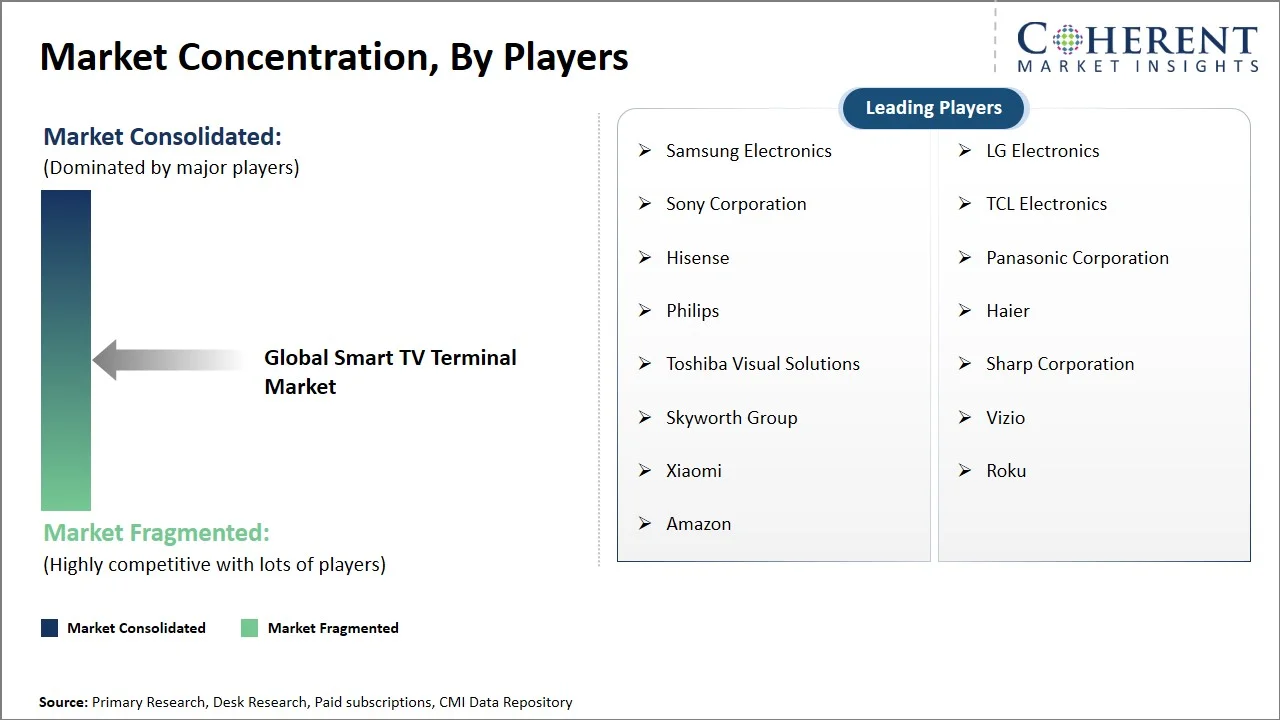
The global smart TV terminal market is highly competitive and relatively consolidated with a mix of established electronics manufacturers and fast-growing regional businesses dominating the landscape. Samsung, LG Electronics, Sony, TCL and Xiaomi are some of the firms that have a strong position in the market, competing with each other by constantly innovating display technology, smart operating systems and price. The intensity of competition is fueled by fast product differentiation in OLED, QLED and Mini-LED categories and the incorporation of streaming ecosystem such as Netflix and YouTube. Regional strengths are impacting market share, with Chinese manufacturers quickly expanding into price-sensitive sectors, while South Korean and Japanese firms continue to lead in premium areas.
Market Report Scope
Smart TV Terminal Market Report Coverage
| Report Coverage | Details | ||
|---|---|---|---|
| Base Year: | 2025 | Market Size in 2026: | USD 270 Bn |
| Historical Data for: | 2020 To 2024 | Forecast Period: | 2026 To 2033 |
| Forecast Period 2026 to 2033 CAGR: | 14% | 2033 Value Projection: | USD 672 Bn |
| Geographies covered: |
| ||
| Segments covered: |
| ||
| Companies covered: | Samsung Electronics, LG Electronics, Sony Corporation, TCL Electronics, Hisense, Panasonic Corporation, Philips, Haier, Toshiba Visual Solutions, Sharp Corporation, Skyworth Group, Vizio, Xiaomi, Roku, and Amazon | ||
| Growth Drivers: |
| ||
| Restraints & Challenges: |
| ||
Analyst Opinion (Expert Opinion)
- The smart TV terminal market is a continually growing segment with high growth attributed to rising OTT consumption, improved broadband infrastructure and increasing smart home adoption. Industry observers are seeing a move away from traditional broadcast systems to internet-based streaming ecosystems and that is boosting device updates. Continuous innovation in display technology and operating systems is perceived as a critical factor to sustain long-term competitiveness. But pricing pressure and supply chain concerns are being cited as continuous difficulties impacting profitability across several regions.
- The future of the smart TV terminal industry will be driven via deeper integration with AI-driven personalization, immersive watching technologies and wider IoT connectivity. Faster adoption of innovative display technologies like MicroLED and next-generation Mini-LED panels, leading to better picture quality and improved energy efficiency is expected in the upcoming years. Growth is predicted to be spurred by rising adoption of cloud gaming services and next-generation streaming platforms, along with wider penetration in emerging economies. Moreover, the industry is likely to develop into fully integrated smart home systems with Smart TVs as the digital control centers for entertainment and home management.
Speak to the analyst
Want personalized insights?
Take the findings above to one of our principal consultants, or have the report rebuilt around the segments, geographies and competitors you actually track.
Market Segmentation
- Operating System Insights (Revenue, USD Billion, 2021 - 2033)
- Android TV
- Tizen
- webOS
- Others
- Technology Insights (Revenue, USD Billion, 2021 - 2033)
- LED
- OLED
- QLED
- Mini LED
- Others
- Resolution Insights (Revenue, USD Billion, 2021 - 2033)
- HD
- Full HD
- 4K UHD
- 8K UHD
- Screen Size Insights (Revenue, USD Billion, 2021 - 2033)
- Below 32 Inches
- 32 to 45 Inches
- 46 to 55 Inches
- 56 to 65 Inches
- Above 65 Inches
- Application Insights (Revenue, USD Billion, 2021 - 2033)
- Residential
- Commercial
- Regional Insights (Revenue, USD Billion, 2021 - 2033)
- North America
- U.S.
- Canada
- Latin America
- Brazil
- Argentina
- Mexico
- Rest of Latin America
- Europe
- Germany
- U.K.
- Spain
- France
- Italy
- Russia
- Rest of Europe
- Asia Pacific
- China
- India
- Japan
- Australia
- South Korea
- ASEAN
- Rest of Asia Pacific
- Middle East
- GCC Countries
- Israel
- Rest of Middle East
- Africa
- South Africa
- North Africa
- Central Africa
- North America
- Key Players Insights
- Samsung Electronics
- LG Electronics
- Sony Corporation
- TCL Electronics
- Hisense
- Panasonic Corporation
- Philips
- Haier
- Toshiba Visual Solutions
- Sharp Corporation
- Skyworth Group
- Vizio
- Xiaomi
- Roku
- Amazon
Sources
Primary Research Interviews
- Smart TV Terminal Manufacturers
- Component Suppliers and Technology Providers
- Retail Channel Partners and Distributors
- Streaming Service Providers
Magazines
- Consumer Electronics Magazine
- Digital TV Europe
- TV Technology Magazine
- Connected World Magazine
Journals
- IEEE Transactions on Consumer Electronics
- International Journal of Digital Television
- Journal of Broadcasting & Electronic Media
Associations
- Consumer Technology Association (CTA)
- Society of Motion Picture and Television Engineers (SMPTE)
- Digital TV Research Association
- International Association of Broadcasting Manufacturers (IABM)
Public Domain Sources
- Federal Communications Commission (FCC) Reports
- European Broadcasting Union (EBU) Publications
- International Telecommunication Union (ITU) Statistics
- World Intellectual Property Organization (WIPO) Database
Proprietary Elements
- CMI Data Analytics Tool
- Proprietary CMI Existing Repository of information for last 10 years
Get access to 250+ pages report
Every segment, forecast, competitor profile and data table behind the analysis above — available for instant download.
- ESOMAR Member
- ISO 9001:2015 Certified
- D-U-N-S Registered
- GDPR & CCPA Compliant
Missing comfort of reading report in your local language? Find your preferred language:
Transform your Strategy with Exclusive Trending Reports
Frequently Asked Questions
The global smart TV terminal market is expected to stand at USD 270 Bn in 2026 and is expected to reach USD 672 Bn by 2033.
The CAGR of the global smart TV terminal market is projected to be 14% from 2026 to 2033.
Growing adoption of OTT streaming platforms and rising broadband, fiber, and 5G penetration are the major factors driving the growth of the global smart TV terminal market.
High price of premium OLED and 8K models and cybersecurity and privacy concerns are the major factors hampering the growth of the global smart TV terminal market.
In terms of operating system, the Android TV segment is estimated to dominate the market revenue share in 2026.
Broadband enables smooth streaming and is essential for accessing high-quality OTT content on smart TVs.
AI improves smart TVs by enabling personalized recommendations, voice control, and picture optimization.