

Global Soil Remediation Market Size and Forecast – 2026 To 2033
The Global Soil Remediation Market is estimated to be valued at USD 49,201.4 Mn in 2026 and is expected to reach USD 78,491.3 Mn by 2033, exhibiting a compound annual growth rate (CAGR) of 6.9% from 2026 to 2033. This significant growth reflects increasing investments in environmental cleanup, stricter regulatory frameworks, and rising awareness about soil pollution and its impact on human health, groundwater quality, agricultural productivity, and ecosystems.
Market expansion is further supported by the need to restore contaminated industrial sites, mining areas, petroleum-affected land, and brownfield assets for safe redevelopment and reuse. For instance, under India’s Environment Protection (Management of Contaminated Sites) Rules, 2025, CPCB identified 103 contaminated sites, while remediation activities had been initiated at seven sites, creating a formal regulatory pathway for contaminated land assessment and cleanup. (Source: Press Information Bureau)
Key Takeaways of the Global Soil Remediation Market
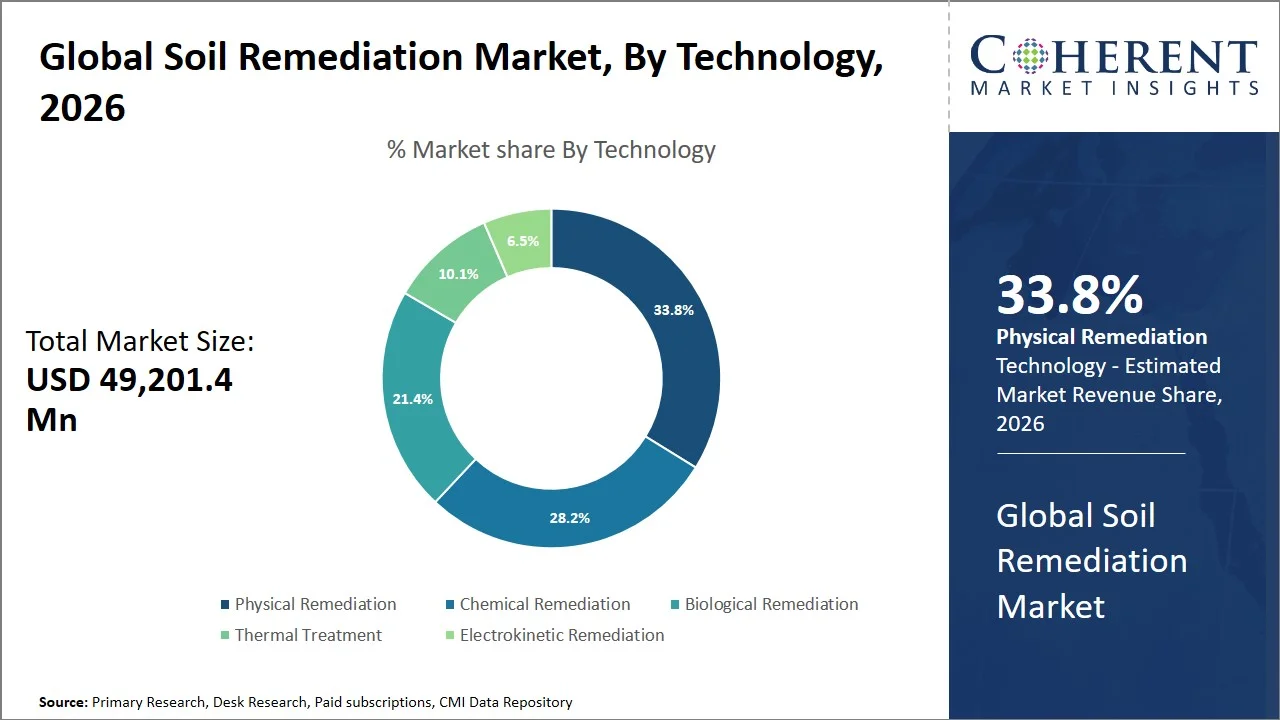
- Physical remediation is expected to dominate the technology segment with 33.8 % of the market share in 2026, supported by its suitability for shallow, high-risk contamination where excavation, off-site disposal, containment, and land restoration offer faster exposure control. In June 2026, Environmental Protection Agency (EPA) proposed excavating arsenic- and lead-contaminated soil at 55 Kil-Tone Superfund floodplain properties in New Jersey, U.S. (Source: U.S. Environmental Protection Agency)
- Heavy metals are expected to lead the contaminant type segment with 36.4 % of the market share in 2026, owing to their persistence in soil, food-chain transfer risk, and long-term liability for mining, industrial, and agricultural landowners. In April 2025, American Association for the Advancement of Science (AAAS) reported that 14–17% of global cropland, around 242 million hectares, is contaminated by at least one toxic metal. (Source: American Association for the Advancement of Science (AAAS))
- Industrial land is expected to account for 39.6 % share in 2026, as legacy factories, refineries, warehouses, and brownfield assets require cleanup before redevelopment or reuse. In November 2025, GARBE Industrial highlighted the Dortmund Westfalenhütte project, where around 45 hectares of former steelworks land was converted into over 225,000 m² of logistics and commercial space. (Source: GARBE Industrial GmbH & Co. KG)
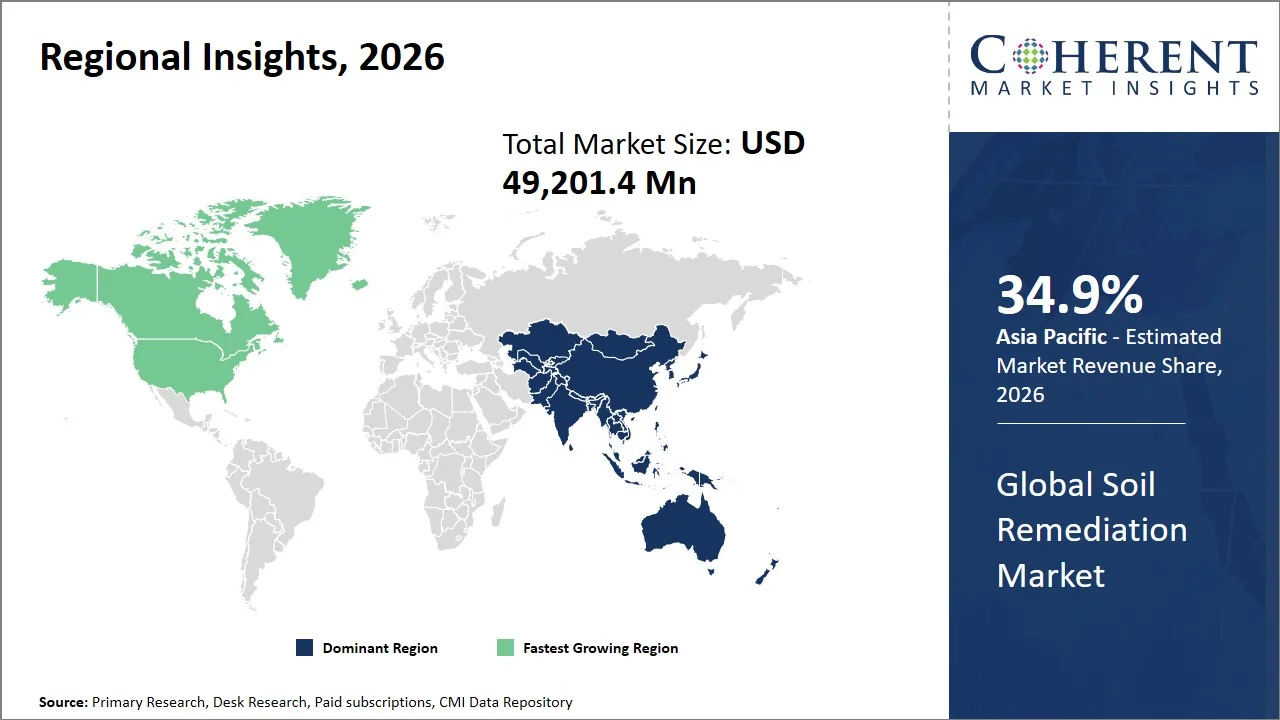
- Asia Pacific is expected to dominate the market with 34.9 % share in 2026, supported by industrial expansion, mining activity, urban redevelopment, and stricter soil pollution controls in China and India. In November 2024, China announced a soil pollution source-control action plan through 2027, covering industrial and mining enterprises, construction land safety, and ecological restoration investment mechanisms. (Source: State Council of China)
- North America is expected to hold 27.6 % share in 2026 and emerge as the fastest-growing region, supported by mature cleanup programs, brownfield reuse, and contaminated-site funding pipelines. Canada’s Federal Contaminated Sites Action Plan Phase V runs from 2025 to 2030, backed by USD 1.48 billion in Budget 2024 funding for priority contaminated sites.(Source: Environment and Climate Change Canada)
- Regulation-led Cleanup Pipeline: Soil remediation demand is shifting from case-by-case cleanup toward structured compliance programs, as governments formalize contaminated-site inventories, monitoring, and land-risk management. The EU Soil Monitoring Law entered into force on December 16, 2025, requiring member states to monitor soil health and address the long-standing issue of contaminated sites, strengthening future remediation pipelines. (Source: European Commission)
- Climate-Driven Soil Degradation Increases Remediation Needs: Rising floods, droughts, wildfires, and extreme weather events are worsening soil erosion, pollutant mobility, and contamination spread, pushing demand for advanced soil stabilization, bioremediation, containment, and restoration solutions across industrial, agricultural, and urban redevelopment sites.
Segmental Insights
Why Does the Physical Remediation Segment Dominate the Global Soil Remediation Market?
Physical remediation is expected to dominate the global soil remediation market with 33.8% share in 2026, as it provides direct, measurable, and faster control of contaminated soil through excavation, removal, containment, capping, backfilling, and soil separation. Demand is strong from industrial owners, municipalities, and brownfield developers that need visible cleanup progress before land reuse, construction approval, or liability closure. On the supply side, physical methods benefit from mature contractor networks, established equipment availability, and compatibility with heavily contaminated or mixed-contaminant sites where slower biological treatments may not be sufficient. This segment is highly relevant for refinery sites, smelter-affected areas, old manufacturing zones, and redevelopment projects. In March 2026, the U.S. EPA proposed removing lead-contaminated soil from around 160 properties at the Federated Metals Superfund site in Indiana, including excavation, clean backfill, and yard restoration. (Source: European Commission)
- Current Industry Events of 2026
- Market Size Estimation
- Regional Breakdown
- Competitive Landscape
- Customer Intelligence
- Segmental Analysis
- Pricing Analysis
- Key Market Drivers, Challenges & Future Trends
- Customized Insights Section
Why Does the Heavy Metals Segment Represent the Largest Contaminant Type Segment in the Market?
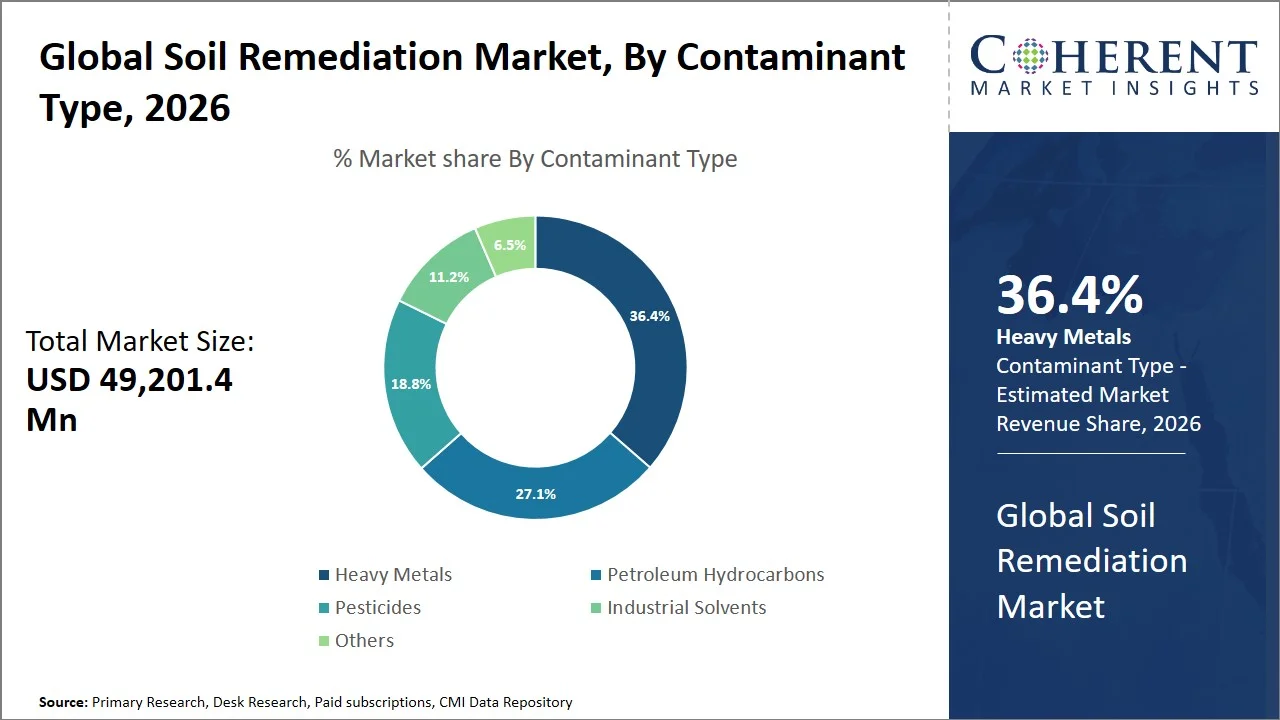
Heavy metals are expected to represent the largest contaminant type segment with 36.4% share in 2026, as metals such as lead, arsenic, cadmium, chromium, zinc, and mercury are persistent, non-biodegradable, and difficult to eliminate once accumulated in soil. Unlike petroleum hydrocarbons or some solvents, heavy metals generally require isolation, immobilization, stabilization, phytoremediation, or excavation rather than natural degradation. Demand is concentrated across mining belts, smelting clusters, battery recycling zones, industrial estates, and agricultural land affected by long-term contamination. Technology suppliers are increasingly combining microbial, mineralization, and plant-based approaches to reduce bioavailability and crop uptake. In March 2025, an RSC Advances study on soil near China’s Qixia Mountain lead–zinc mine found serious heavy metal pollution and showed that amaranth/Bacillus velezensis-induced mineralization reduced the Nemerow pollution index from 4.5 to about 1.0. (Source: The Royal Society of Chemistry)
Why Does the Industrial Land Segment Dominate the Soil Remediation Market?
Industrial land is expected to dominate the application segment with 39.6% share in 2026, as legacy factories, chemical plants, metal processing units, refineries, storage terminals, and waste-handling sites commonly leave behind complex soil contamination. Demand is supported by brownfield redevelopment, industrial land recycling, ESG-linked asset cleanup, and regulatory pressure to make sites safe for intended future use. This application also generates higher remediation value because industrial sites often require multi-stage assessment, contaminant mapping, excavation, stabilization, groundwater linkage review, and post-remediation monitoring. For developers, cleanup can unlock land value and reduce legal uncertainty before logistics, housing, infrastructure, or commercial reuse. In July 2025, the U.K. government opened a consultation on Land Remediation Relief, which incentivizes cleanup and redevelopment of contaminated and derelict land and supports brownfield development policy. (Source: HM Treasury)
Global Soil Remediation Market Dynamic
Key Market Drivers
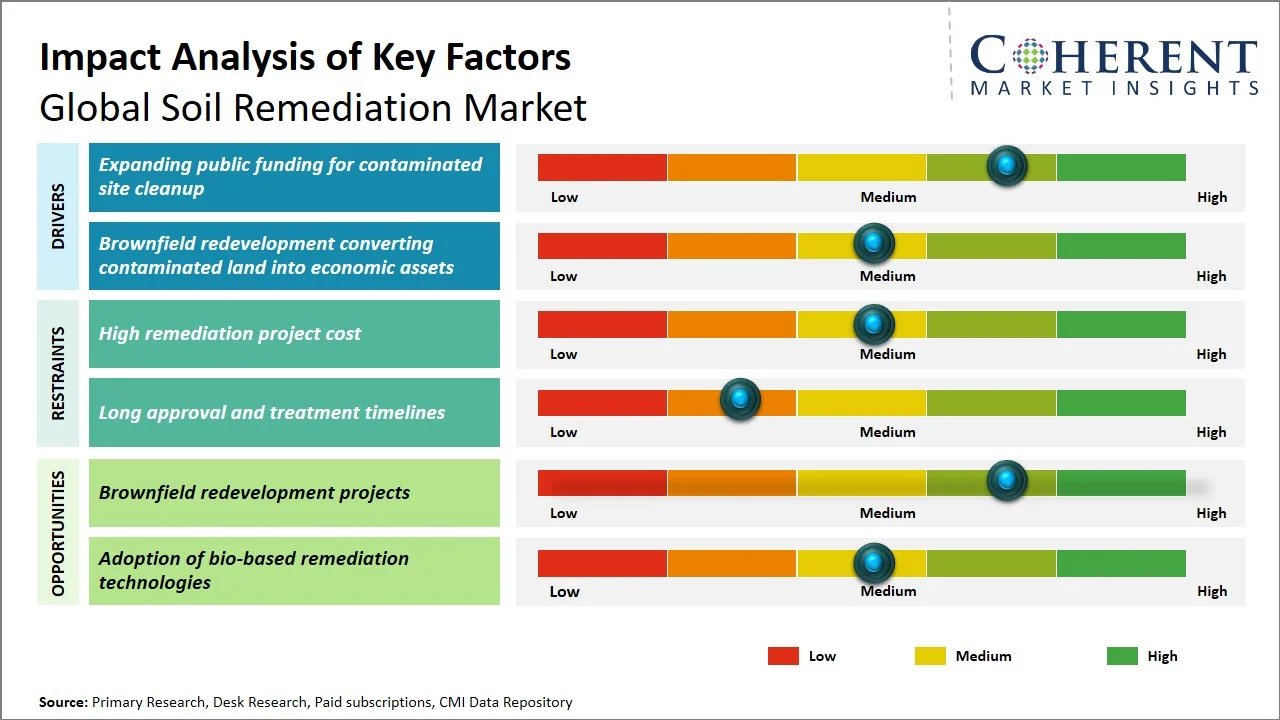
- Expanding Public Funding for Contaminated Site Cleanup: Government-backed remediation funding is becoming a major commercial growth driver for the soil remediation market, as public agencies are directly financing assessment, excavation, treatment, risk management, and long-term monitoring of contaminated sites. This improves project visibility for engineering contractors, environmental consultants, laboratory testing firms, and remediation technology providers. Funding-led cleanup programs also reduce delays for high-liability sites where private owners may lack sufficient capital. In Canada, the Federal Contaminated Sites Action Plan has received USD-equivalent multi-billion support since 2005, including USD 1.05 billion announced in Budget 2024 for Phase V from 2025 to 2030, targeting high-priority federal contaminated sites and reducing environmental and health risks. (Source: Government of Canda)
- Brownfield Redevelopment Converting Contaminated Land into Economic Assets: Brownfield redevelopment is accelerating soil remediation demand by linking environmental cleanup with housing, logistics, commercial redevelopment, industrial reuse, and local job creation. Contaminated land is increasingly being treated not only as an environmental liability but also as a monetizable real estate and infrastructure asset once remediation is completed. This is creating steady demand for site assessment, soil excavation, stabilization, groundwater interface review, and compliance documentation. In May 2025, the U.S. EPA announced USD 267 million in Brownfields Grants to clean up and revitalize contaminated properties, including USD 42 million in supplemental Revolving Loan Fund support for communities with viable cleanup and redevelopment projects. (Source: EPA Press Office)
Emerging Market Trends
- PFAS and Mixed-Contaminant Sites Driving Technology Diversification: The market is shifting toward contaminant-specific and combined remediation approaches as PFAS, heavy metals, hydrocarbons, chlorinated solvents, and mixed industrial residues require different treatment pathways. This is encouraging vendors to move beyond single-method remediation and offer integrated solutions involving stabilization, sorption, excavation, thermal treatment, chemical oxidation, and long-term monitoring. Commercially, this trend supports higher-value consulting, pilot testing, technology selection, and performance verification services. It also increases demand for specialized contractors capable of managing complex regulatory and technical risk. PFAS remediation is particularly important because many conventional methods are less effective due to PFAS persistence, mobility, and chemical resistance, pushing the market toward advanced treatment design and lifecycle site management. (Source: Interstate Technology & Regulatory Council (ITRC))
- Digital Site Characterization Improving Remediation Planning: Soil remediation is increasingly moving toward data-led decision-making through remote sensing, geospatial mapping, proximal soil sensing, AI-supported contaminant prediction, and digital site-risk models. These tools help identify contamination hotspots more accurately, reduce unnecessary excavation, optimize sampling plans, and improve project cost control. For remediation companies, digital characterization creates opportunities to offer higher-margin advisory, monitoring, and predictive analytics services alongside physical cleanup.
Regional Insights
Why Does the Asia Pacific Region Dominate the Global Soil Remediation Market?
Asia Pacific is expected to dominate the global soil remediation market with 34.9% share in 2026, supported by large-scale industrial activity, mining operations, intensive agriculture, rapid urban redevelopment, and tightening environmental governance across China, India, Australia, Japan, and Southeast Asia. The region’s demand is strongly linked to contaminated industrial land, heavy metal pollution, petroleum contamination, and pesticide residues in agricultural soils. Large brownfield inventories and expanding infrastructure projects are also increasing demand for site assessment, excavation, stabilization, bioremediation, and long-term monitoring services. A recent regional signal came in December 2025, when FAO Asia Pacific highlighted rising soil degradation and pollution pressure across rapidly growing cities in the region, reinforcing the commercial need for soil health restoration and contamination management.
(Source: FAO Asia Pacific)
Why is North America Emerging as the Fastest-Growing Region in the Global Soil Remediation Market?
North America is expected to emerge as the fastest-growing region with 27.6% share in 2026, supported by mature environmental liability frameworks, brownfield redevelopment funding, PFAS site investigations, and strong public-sector cleanup programs. The U.S. and Canada have well-established contaminated-site inventories, technical consulting capabilities, and remediation contractor ecosystems, allowing faster conversion of regulatory obligations into active cleanup projects. Demand is also increasing from federal land cleanup, industrial redevelopment, infrastructure reuse, and community revitalization programs. In Canada, the Federal Contaminated Sites Action Plan was renewed through Phase V, 2025–2030, with USD 1.05 billion announced in Budget 2024 for high-priority federal contaminated sites, strengthening long-term remediation opportunities for contractors, testing labs, and technology providers.
(Source: Government of Canada)
Global Soil Remediation Market Outlook for Key Countries
Why is China a Core Growth Engine in the Soil Remediation Market?
China remains one of the most important countries in the soil remediation market due to its large industrial base, legacy mining contamination, chemical manufacturing clusters, and significant construction-land redevelopment activity. The country’s market demand is closely tied to heavy metals, industrial solvents, petroleum residues, and agricultural soil pollution. Stronger regulation is converting soil pollution control from a compliance option into a structured business requirement for industrial parks, mining enterprises, and urban redevelopment authorities. China is also important because environmental cleanup is being linked with high-quality development, land safety, and ecological restoration investment. In November 2024, China announced an action plan to strengthen prevention and control of soil pollution sources through 2027, with focus on industrial and mining enterprises, construction land safety, and ecological environmental quality improvement. (Source: State Council of China)
Why is the U.S. Leading Brownfield Cleanup and Remediation Investment?
The U.S. is a major country in the soil remediation market because of its extensive brownfield inventory, Superfund framework, petroleum-contaminated sites, PFAS investigations, and strong redevelopment-linked cleanup funding. Demand is supported by municipalities, industrial owners, developers, and federal agencies seeking to convert contaminated land into housing, logistics, commercial, and community infrastructure assets. The country also has a mature ecosystem of environmental consultants, excavation contractors, laboratory testing providers, and remediation technology suppliers.
Why is India Becoming an Important Soil Remediation Market?
India is becoming increasingly important in the soil remediation market due to its large industrial clusters, mining belts, legacy hazardous waste sites, pesticide-intensive agriculture, and growing regulatory focus on contaminated land. Demand is expected to rise as state pollution control boards, local authorities, and responsible entities move toward formal remediation planning and site-level accountability. The market opportunity is particularly relevant for heavy metal removal, industrial waste-affected land, chemical contamination, landfill-linked soil pollution, and groundwater-connected sites.
Why ss Germany Significant for Industrial Land Remediation and Soil Reuse?
Germany is a significant country in the soil remediation market due to its strong manufacturing base, historic industrial regions, strict soil protection framework, and emphasis on brownfield redevelopment over greenfield land consumption. Soil remediation demand is closely linked to former steel, chemicals, logistics, and infrastructure sites where contamination must be managed before redevelopment. The country’s market also benefits from advanced engineering capabilities, specialized contractors, and growing interest in safe soil reuse to reduce landfill pressure and construction material waste. In April 2025, Bauer Resources reported a brownfield remediation project in Duisburg where specialists carried out large-diameter borehole operations from February to May 2025 to replace contaminated soil, including 167 vertical boreholes and additional inclined boreholes. (Source: Bauer Group)
Why is Australia Advancing PFAS and Defense-Site Remediation?
Australia is a key country in the soil remediation market because of its strong contaminated-site governance, mining activity, urban redevelopment needs, and growing PFAS remediation workload linked to airports, defense bases, and firefighting foam use. Demand is shifting toward specialist remediation, including soil stabilization, excavation, activated carbon treatment, water treatment, and long-term monitoring. The country’s market is also shaped by strict environmental management expectations and increasing polluter-accountability actions. In May 2026, the Australian Government commenced legal proceedings against 3M Australia Pty Ltd and 3M Company to recover costs related to PFAS contamination at 28 Defence bases across Australia, highlighting the scale of remediation liabilities and future demand for advanced PFAS soil and water treatment. (Source: Australian Attorney-General’s)
Technology Adoption Landscape - Soil Remediation Market
Technology / Adoption Area | Current Adoption Level | Key Use Cases | Why It Is Being Adopted | Commercial / Market Relevance |
Physical Remediation | High | Excavation, soil removal, soil replacement, capping, containment, soil washing, and land restoration | Physical remediation is widely adopted because it provides direct and visible cleanup results. It is suitable for shallow contamination, redevelopment-linked sites, and projects requiring faster regulatory closure. | Strong demand from industrial land, brownfield redevelopment, construction projects, mining sites, and public cleanup programs. It supports faster land reuse and reduces contamination liability. |
Chemical Remediation | Moderate to High | In-situ chemical oxidation, reduction, stabilization, solidification, and contaminant immobilization | Chemical remediation is preferred where excavation is costly or technically difficult. It helps treat petroleum hydrocarbons, solvents, heavy metals, and mixed industrial contaminants with lower site disturbance. | Relevant for oil & gas, chemicals, industrial land, and manufacturing sites. It creates opportunities for specialty chemical suppliers, remediation contractors, and site engineering firms. |
Biological Remediation / Bioremediation | Moderate | Bioaugmentation, biostimulation, landfarming, composting, phytoremediation, and microbial degradation | Bioremediation is gaining adoption due to its lower cost, lower environmental impact, and suitability for organic contaminants such as petroleum hydrocarbons and pesticide residues. | Important for agricultural land, petroleum-contaminated soil, low-to-moderate contamination sites, and sustainability-focused remediation projects. Adoption is slower where rapid cleanup is required. |
Thermal Treatment | Selective but growing | Thermal desorption, in-situ thermal treatment, incineration, and treatment of VOCs, SVOCs, petroleum hydrocarbons, and PFAS-impacted soils | Thermal treatment is adopted for high-risk or persistent contaminants where faster mass removal or contaminant destruction is needed. It is preferred when regulatory and liability risks are high. | Used in complex industrial, petroleum, defense, and hazardous waste sites. Higher cost limits adoption, but premium pricing is justified for high-risk remediation projects. |
Electrokinetic Remediation | Emerging / Niche | Heavy metal removal, ionic contaminant movement, fine-grained soil treatment, and low-permeability clay remediation | Electrokinetic remediation is useful where excavation is difficult and contaminants are present in dense or low-permeability soils. Adoption remains limited due to technical complexity and monitoring needs. | Future opportunity exists in urban sites, restricted-access locations, and heavy-metal-contaminated land. Wider adoption will depend on pilot validation and cost reduction. |
How are technological advancements in remediation technologies creating new growth opportunities in the global soil remediation market ?
Technological advancements in in-situ soil remediation, PFAS treatment, digital site characterization, bioremediation, and thermal treatment are creating new growth opportunities in the global soil remediation market. These advanced solutions help reduce excavation requirements, lower waste disposal costs, shorten cleanup timelines, and improve treatment precision for complex contaminants such as PFAS, petroleum hydrocarbons, heavy metals, and industrial solvents. The shift from conventional dig-and-dispose methods toward targeted, low-disruption remediation is increasing adoption among industrial landowners, oil & gas companies, mining firms, airports, defense sites, and brownfield developers. For instance, in April 2024, REGENESIS launched SourceStop, an in-situ PFAS remediation solution designed to treat PFAS contamination at the source. The company stated that pairing SourceStop with PlumeStop creates an end-to-end in-situ PFAS remediation approach, supporting long-term contaminant control in soil and groundwater. This development highlights how next-generation remediation technologies are expanding treatment options and improving project economics in contaminated land cleanup. (Source: Regenesis Bioremediation)
Market Players, Key Development, and Competitive Intelligence
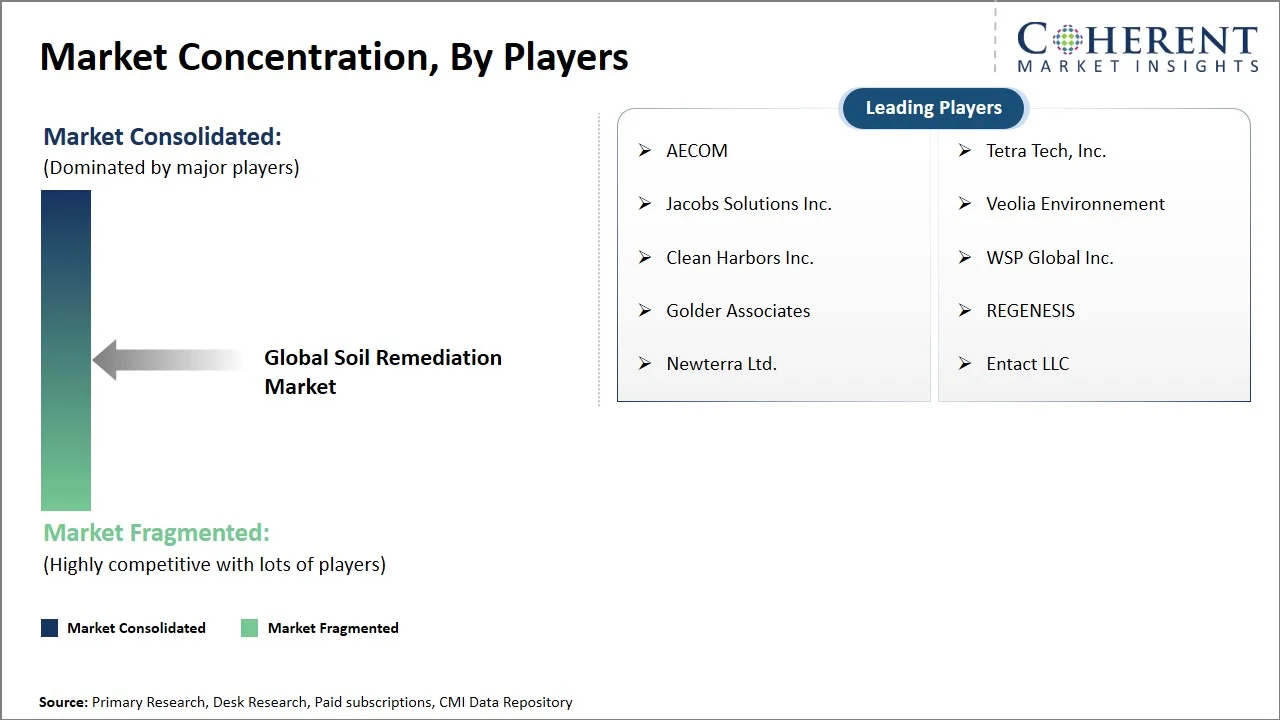
Key Developments
- In January 2025, Arcadis secured a five-year environmental engineering services contract with the U.S. Army Corps of Engineers Tulsa District. The contract includes PFAS investigations, hazardous, toxic, and radioactive waste studies, remedial investigations, and design support across the Continental U.S. and U.S. territories. This directly aligns with rising North American demand for PFAS and contaminated soil remediation services.
- In April 2024, REGENESIS launched SourceStop, an in situ PFAS remediation solution for source-zone soil and groundwater contamination. The company stated that pairing SourceStop with PlumeStop creates an end-to-end in situ PFAS remediation approach, relevant for industrial manufacturing sites, airports, and defense locations where PFAS contamination must be treated without large-scale excavation.
- In December 2025, Cumberland Council awarded a USD 2.64 million contracts for demolition and land remediation at the Port of Workington and Oldside in the U.K. The project covers design, approvals, demolition, and remediation to deliver land free of major contaminants and ready for development, showing active European demand for brownfield soil remediation projects.
Competitive Landscape
The global soil remediation market is moderately fragmented, with competition spread across environmental consulting firms, remediation contractors, hazardous waste management companies, engineering service providers, and specialized technology developers. Companies compete based on remediation technology capability, regulatory expertise, project execution scale, contaminant-specific solutions, geographic coverage, and long-term monitoring services. Large engineering and environmental service firms are strengthening their position through public-sector cleanup contracts, brownfield redevelopment projects, PFAS remediation capabilities, and integrated soil and groundwater treatment offerings. Technology-focused companies are also gaining traction by offering in-situ treatment, bioremediation, chemical oxidation, stabilization, and sorption-based solutions for complex contaminants.
Key focus areas include
- Expansion of integrated soil and groundwater remediation services for industrial land, brownfield redevelopment, mining sites, petroleum-contaminated locations, and public-sector cleanup programs.
- Development of advanced in-situ remediation technologies such as chemical oxidation, reduction, adsorption, bioremediation, stabilization, and PFAS-specific treatment systems to reduce excavation and disposal requirements.
- Growing focus on PFAS, heavy metals, petroleum hydrocarbons, and mixed-contaminant treatment, as regulatory scrutiny and liability exposure increase across industrial, defense, airport, and manufacturing sites.
- Use of digital site characterization and monitoring tools, including geospatial mapping, contaminant modeling, remote sensing, and real-time monitoring to improve remediation planning, cost control, and regulatory reporting.
- Expansion of hazardous waste handling, transportation, landfill, and treatment capabilities to support large-scale physical remediation and excavation-led cleanup projects.
- Strategic partnerships and government remediation contracts to strengthen project pipelines, especially in North America, Europe, and Asia Pacific where contaminated-site programs and brownfield redevelopment policies are expanding.
- Sustainability-led remediation practices, including green remediation, on-site treatment, lower-carbon cleanup approaches, soil reuse, and reduced waste transportation to align with ESG and circular land-use goals.
Market Report Scope
Soil Remediation Market Report Coverage
| Report Coverage | Details | ||
|---|---|---|---|
| Base Year: | 2025 | Market Size in 2026: | USD 49,201.4 Mn |
| Historical Data for: | 2020 To 2024 | Forecast Period: | 2026 To 2033 |
| Forecast Period 2026 to 2033 CAGR: | 6.9% | 2033 Value Projection: | USD 78,491.3 Mn |
| Geographies covered: |
| ||
| Segments covered: |
| ||
| Companies covered: | AECOM, Tetra Tech, Inc., Jacobs Solutions Inc., Veolia Environnement, Clean Harbors Inc., WSP Global Inc., Golder Associates, REGENESIS, Newterra Ltd., and Entact LLC | ||
| Growth Drivers: |
| ||
| Restraints & Challenges: |
| ||
Analyst Opinion (Expert Opinion)
- The global soil remediation market is expected to grow steadily over the long term due to rising soil pollution, stricter environmental rules, and growing cleanup needs across industrial land, mining sites, oil & gas facilities, agricultural land, and brownfield redevelopment projects. Governments and companies are increasingly focusing on restoring contaminated land to protect public health, groundwater, food safety, and ecosystems. This is expected to support wider adoption of physical, chemical, biological, thermal, and electrokinetic remediation technologies.
- The strongest opportunities are likely to emerge from industrial land remediation, heavy metal contamination, petroleum hydrocarbon cleanup, and brownfield redevelopment projects. Asia Pacific is expected to remain the leading region due to rapid industrialization, mining activity, urban expansion, and rising environmental compliance in countries such as China and India. North America is expected to grow faster, supported by strong government cleanup funding, PFAS investigation, brownfield reuse, and mature remediation contractor networks.
- To gain a competitive advantage, market players should focus on advanced in-situ remediation, PFAS treatment, bioremediation, soil stabilization, digital site characterization, and integrated soil and groundwater cleanup solutions. Companies that can offer cost-effective, faster, regulation-compliant, and sustainable remediation services will be better positioned to win contracts from government agencies, industrial companies, oil & gas operators, mining firms, construction developers, and environmental consultants.
Speak to the analyst
Want personalized insights?
Take the findings above to one of our principal consultants, or have the report rebuilt around the segments, geographies and competitors you actually track.
Market Segmentation
- Technology Insights (Revenue, USD Mn, 2021 - 2033)
- Physical Remediation
- Chemical Remediation
- Biological Remediation
- Thermal Treatment
- Electrokinetic Remediation
- Contaminant Type Insights (Revenue, USD Mn, 2021 - 2033)
- Heavy Metals
- Petroleum Hydrocarbons
- Pesticides
- Industrial Solvents
- Others
- Application Insights (Revenue, USD Mn, 2021 - 2033)
- Industrial Land
- Agricultural Land
- Residential Land
- Mining Sites
- Commercial Sites
- End-use Industry Insights (Revenue, USD Mn, 2021 - 2033)
- Oil & Gas
- Chemicals
- Mining
- Agriculture
- Construction
- Regional Insights (Revenue, USD Mn, 2021 - 2033)
- North America
- U.S.
- Canada
- Latin America
- Brazil
- Argentina
- Mexico
- Rest of Latin America
- Europe
- Germany
- U.K.
- Spain
- France
- Italy
- Russia
- Rest of Europe
- Asia Pacific
- China
- India
- Japan
- Australia
- South Korea
- ASEAN
- Rest of Asia Pacific
- Middle East
- GCC Countries
- Israel
- Rest of Middle East
- Africa
- South Africa
- North Africa
- Central Africa
- North America
- Key Players Insights
- AECOM
- Tetra Tech, Inc.
- Jacobs Solutions Inc.
- Veolia Environnement
- Clean Harbors Inc.
- WSP Global Inc.
- Golder Associates
- REGENESIS
- Newterra Ltd.
- Entact LLC
Sources
Primary Research Interviews
- Environmental remediation consultants and contaminated site assessment specialists
- Soil remediation technology providers and in-situ treatment solution experts
- Environmental engineers involved in soil and groundwater cleanup projects
- Brownfield redevelopment consultants and land restoration project managers
- Hazardous waste management and soil treatment service providers
- Executives and project managers from environmental engineering and remediation companies
Stakeholders
- Soil remediation service providers
- Environmental consulting and engineering firms
- Hazardous waste treatment and disposal companies
- Soil testing laboratories and environmental monitoring service providers
- Brownfield redevelopment companies and construction developers
- Mining, oil & gas, chemical, and industrial landowners
End-use Sectors
- Oil & gas companies
- Chemical and petrochemical companies
- Mining companies
- Agriculture and agrochemical companies
- Construction and real estate developers
- Industrial manufacturing facilities
- Municipal authorities and public infrastructure agencies
- Defense, airport, and transportation site operators
Regulatory & Environmental Bodies
- U.S. Environmental Protection Agency (EPA)
- European Environment Agency (EEA)
- European Commission – Soil Monitoring Law
- Environment and Climate Change Canada
- Ministry of Ecology and Environment, China
- Ministry of Environment, Forest and Climate Change (MoEFCC), India
- Central Pollution Control Board (CPCB), India
- Environment Agency, UK
- Federal Environment Agency (UBA), Germany
- Department of Climate Change, Energy, the Environment and Water, Australia
Databases
- U.S. EPA Superfund Enterprise Management System
- U.S. EPA Brownfields Program Database
- European Environment Agency Environmental Data Centre
- FAO Global Soil Partnership Database
- World Bank Environment Indicators Database
- OECD Environmental Statistics
- UNEP Environmental Data Explorer
- WHO Global Health Observatory
- Government contaminated sites registries
- National soil pollution and land contamination databases
Magazines
- Environmental Science & Engineering Magazine
- Waste Management World
- Environmental Business Journal
- Pollution Engineering
- Ground Engineering
- Environmental Protection Magazine
- Remediation Technology News
- Water & Wastewater Asia
Journals
- Journal of Hazardous Materials
- Environmental Science & Technology
- Chemosphere
- Science of the Total Environment
- Environmental Pollution
- Journal of Environmental Management
- Soil and Sediment Contamination: An International Journal
- Remediation Journal
- Applied Soil Ecology
- Environmental Geochemistry and Health
Newspapers
- Financial Times
- The New York Times
Associations
- International Solid Waste Association (ISWA)
- Interstate Technology and Regulatory Council (ITRC)
- Environmental Business Council
- Association of Environmental & Engineering Geologists (AEG)
- International Society of Soil Science
- Soil Science Society of America (SSSA)
- European Federation of Soil Science Societies (EUSS)
- British Society of Soil Science
- Australasian Land & Groundwater Association (ALGA)
- National Ground Water Association (NGWA)
Public Domain Sources
- U.S. Environmental Protection Agency (EPA) – Superfund, Brownfields, and remediation technology guidance
- Food and Agriculture Organization (FAO) – Global Soil Partnership and soil pollution reports
- United Nations Environment Programme (UNEP) – pollution and land restoration data
- World Health Organization (WHO) – environmental health and pollution impact data
- European Commission – Soil Monitoring Law and contaminated land policy
- European Environment Agency (EEA) – soil, land use, and contamination data
- World Bank – environmental indicators and land management statistics
- OECD – environmental policy and pollution control statistics
- Government of Canada – Federal Contaminated Sites Action Plan
- Central Pollution Control Board (CPCB), India – contaminated sites and environmental compliance data
Proprietary Elements
- CMI Data Analytics Tool, Proprietary CMI Existing Repository of information for last 10 years.
Get access to 250+ pages report
Every segment, forecast, competitor profile and data table behind the analysis above — available for instant download.
- ESOMAR Member
- ISO 9001:2015 Certified
- D-U-N-S Registered
- GDPR & CCPA Compliant
Missing comfort of reading report in your local language? Find your preferred language:
Transform your Strategy with Exclusive Trending Reports
Frequently Asked Questions
The CAGR of the global soil remediation market is projected to be 6.9% from 2026 to 2033.
The global soil remediation market is estimated to be valued at USD 49,201.4 Mn in 2026 and is expected to reach USD 78,491.3 Mn by 2033.
Physical remediation dominates the global soil remediation market with an estimated 33.8% share in 2026.
Heavy metals hold the largest share in the global soil remediation market with an estimated 36.4% share in 2026.
In terms of technology, physical remediation is estimated to dominate the market revenue share in 2026.
Rising industrial soil contamination and strict environmental cleanup regulations are the major factors driving the growth of the global soil remediation market.
Physical remediation is most preferred due to its wide use in excavation, soil washing, containment, and treatment of highly contaminated sites.