

Global Specialty Cheese Market Size and Forecast – 2026 To 203 3
The Global Specialty Cheese Market is estimated to be valued at USD 63,850.4 Mn in 2026 and is expected to reach USD 101,860.9 Mn by 2033, exhibiting a compound annual growth rate (CAGR) of 6.9% from 2026 to 2033. Market growth is supported by increasing consumer preference for gourmet, artisanal, flavored, and premium cheese varieties across retail, foodservice, snacking, and home-cooking applications.
Premium cheese brands are introducing differentiated flavors to capture evolving taste preferences and higher-margin demand. For instance, in March 2024, Cracker Barrel Cheese launched Truffle Cheddar and Dill Havarti artisan flavors in block format across select U.S. retailers, highlighting rising commercial focus on premium and specialty cheese innovation. (Source: Lactalis Heritage Dairy)
Key Takeaways of the Global Specialty Cheese Market
- Mozzarella is expected to lead in global specialty cheese market by type with 26.8 % of the market share in 2026, anchoring the USD 63,850.4 Mn market base and supporting a 6.9% CAGR through 2033. Its melt, stretch, and familiarity make it central to pizza and prepared foods. In March 2025, Domino’s launched Parmesan Stuffed Crust made with 100% real mozzarella. (Source: Domino’s Pizza)
- Cow milk is expected to command 67.5 % of the global specialty cheese market share in 2026, reflecting its broad availability, standardized processing suitability, and cost-efficient scale for mass cheese production. Eurostat reported that in 2024, the EU used 59.9 million tons of whole milk and 17.0 million tons of skimmed milk to produce 10.8 million tons of cheese. (Source: Eurostat)
- Food service in global specialty cheese market is expected to account for 39.2 % of the market share in 2026, as QSRs, pizzerias, cafés, and institutional kitchens require consistent melt, texture, and flavor performance at scale. Pizza Hut’s 2026 Crispy Parm Pan highlights this direction, offering baked parmesan crust and availability across carryout, delivery, and dine-in formats. (Source: Pizza Hut India)
- Europe in global specialty cheese market is expected to dominate in global specialty cheese market with 34.7 % share in 2026, supported by mature cheese consumption, protected-origin products, and deep dairy-processing infrastructure. In April 2025, Arla Foods and DMK Group announced a proposed merger to create Europe’s largest dairy cooperative, combining over 12,000 farmers and USD 21.87 billion in pro forma revenue. (Source: Arla Foods amba)
- North America in the global specialty cheese market is expected to be the fastest-growing region with 29.8 % share in 2026in global specialty cheese market, supported by product renovation across mainstream retail and high-velocity snacking formats. In May 2026, Kraft Natural Cheese launched a lactose-free line including Mild Cheddar Shreds, Mozzarella Shreds, and Mozzarella String Cheese for U.S. retailers. (Source: Business Wire, Inc)
- Clean-Label Reformulation: Simplified ingredient decks and “real cheese” positioning are becoming stronger purchase triggers, pushing brands to improve melt, aroma, texture, and flavor without heavy processing cues. In March 2025, Sargento debuted Natural American Cheese made with 100% natural cheese and five ingredients, reinforcing premiumization through cleaner formulation and stronger retail differentiation. (Source: Sargento Foods)
- Sustainable Portion Packaging in specialty cheese market: Packaging circularity is emerging as a board-level growth lever, especially for single-serve cheese formats where convenience must align with waste-reduction expectations. Bel announced the global rollout of recyclable paper packaging for Babybel, with the U.S., Canada, and Northern Europe rollout in 2026 and 100% responsibly sourced paper coverage targeted by 2027. (Source: Bel Group)
Segmental Insights
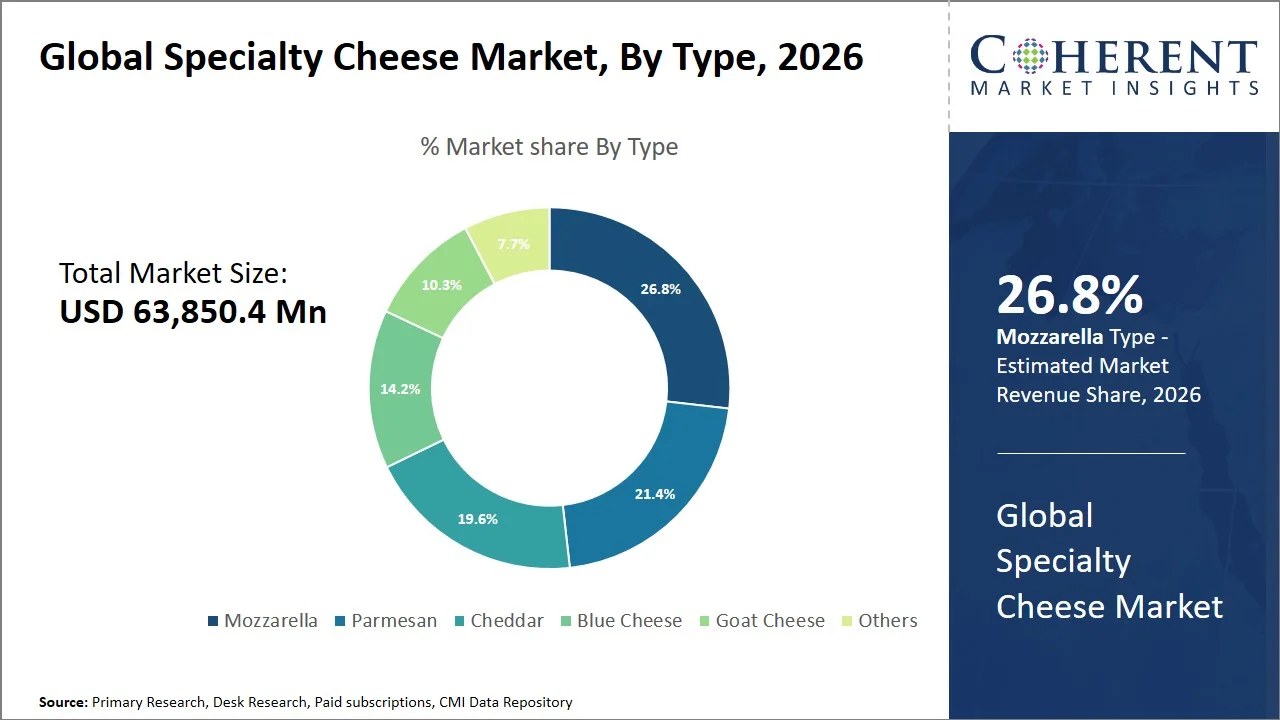
Why Does the Mozzarella Segment Dominate the Global Cheese Market?
Mozzarella in the specialty cheese market is expected to dominate with 26.8% of the market share in 2026 due to its strong functional fit across pizza, pasta, sandwiches, frozen snacks, and ready-to-cook meals. Unlike sharper cheese varieties, mozzarella offers a neutral flavor profile, high meltability, stretch, and browning performance, making it suitable for both mass foodservice and retail-packaged formats. Demand is supported by high-frequency consumption in QSR pizza chains, home cooking, frozen meals, and snack portions. On the supply side, producers can manufacture mozzarella in shreds, slices, chunks, and snack packs, improving product flexibility across end uses. In March 2024, Tillamook launched a whole milk mozzarella range including shreds, slices, snack portions, and chunks, highlighting continued brand investment in functional mozzarella formats. (Source: Cision US Inc)
- Current Industry Events of 2026
- Market Size Estimation
- Regional Breakdown
- Competitive Landscape
- Customer Intelligence
- Segmental Analysis
- Pricing Analysis
- Key Market Drivers, Challenges & Future Trends
- Customized Insights Section
Why Does the Cow Milk Segment Represent the Largest Source Segment in the Market?
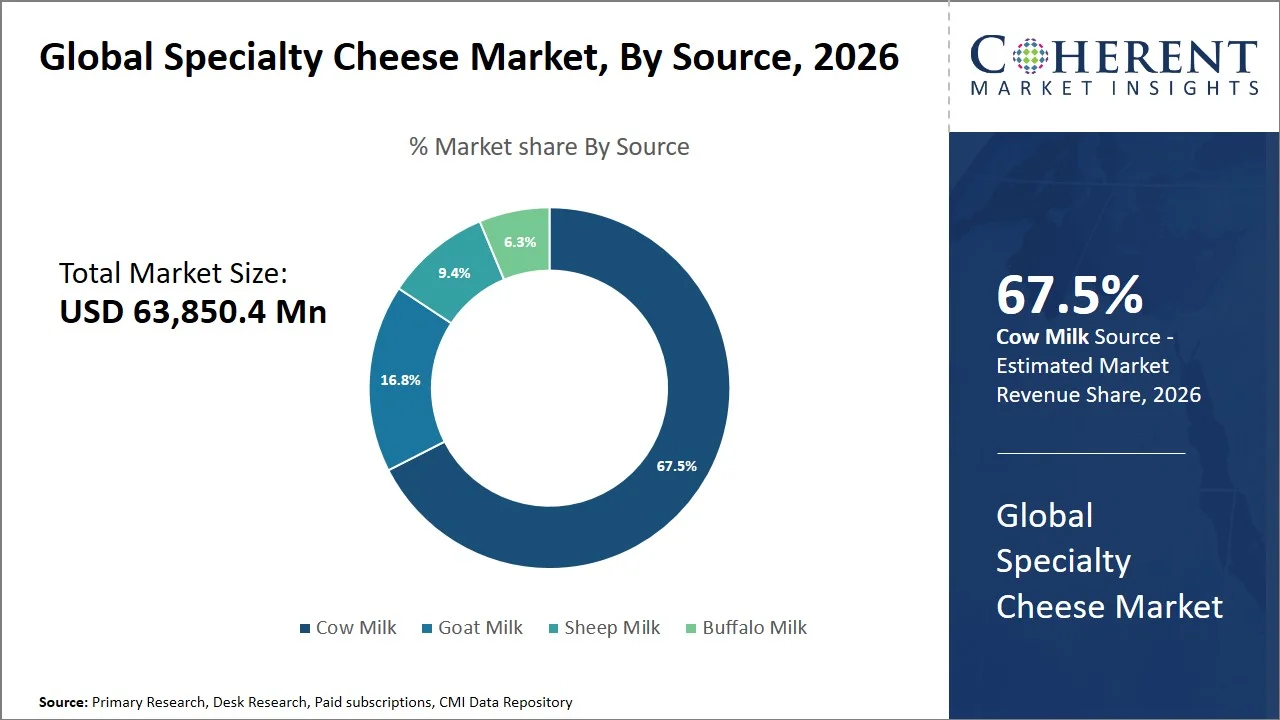
Cow milk is expected to represent the largest source segment with 67.5% in global specialty cheese market share in 2026, as it offers the most scalable, standardized, and commercially viable raw material base for cheese manufacturing. Its balanced protein, fat, and casein structure supports consistent coagulation, yield, texture, and flavor development across mozzarella, cheddar, parmesan, and processed cheese applications. Demand-side strength comes from mainstream consumer acceptance and lower price sensitivity compared to goat, sheep, or buffalo milk cheeses. Supply-side dominance is reinforced by large cooperative procurement systems, chilled milk logistics, and established dairy processing infrastructure. In February 2026, Arla reported record 2025 milk intake of 14.3 billion kg, supporting branded dairy, foodservice, and ingredient businesses through a large-scale farmer-owned supply platform. (Source: Arla Foods amba)
Why Does the Food Service Segment Dominate the Global Cheese Market?
Food service is expected to dominate with 39.2% of the market share in 2026, as restaurants, QSRs, cafés, bakeries, and institutional kitchens use cheese as a core ingredient for menu differentiation and repeat consumption. The segment benefits from bulk procurement, predictable specification requirements, and high usage intensity in pizzas, burgers, baked dishes, sandwiches, sauces, and appetizers. Demand is shaped by operators seeking cheese with consistent melt, stretch, portion control, and flavor delivery under high-volume kitchen conditions. Suppliers support this segment through customized shreds, blends, blocks, and chef-focused application support. In March 2026, the California Milk Advisory Board launched its eighth Real California Pizza Contest for professional chefs and culinary students, requiring California mozzarella in key recipe categories, showing direct foodservice-led cheese innovation. (Source: The California Dairy Press Room & Resources)
Currents Events and their Impact
Current Events | Description and its Impact |
European Union Updates Geographical Indication Rules for Agri-food Products (May 2024 onward) |
|
India Tightens Labelling and Inspection of Cheese Analogues (April 2026 onward) |
|
U.S. FDA Advances Cheese Standards of Identity Modernization (2025 onward) |
|
(Source: AGRINFO, Food Safety and Standards Authority of India, U.S. Food & Drug Administration)
Global Specialty Cheese Market Dynamics

Key Market Drivers
- Premiumization of Artisanal and Origin-led Cheese: Rising demand for premium and artisanal dairy products is strengthening the global specialty cheese market as consumers increasingly associate specialty cheese with authenticity, craft production, regional identity, and superior sensory quality. This supports higher price realization for aged, flavored, ripened, smoked, and non-cow milk cheeses, especially across modern retail, gourmet stores, and premium food platforms. The driver is also improving opportunities for small-scale cheesemakers and dairy cooperatives to move beyond commodity dairy into value-added products. A relevant recent instance is the First India Cheese Festival 2025, organized under the guidance of India’s Department of Animal Husbandry & Dairying, which showcased 59 cheese varieties from dairy cooperatives, startups, and artisanal cheesemakers, supporting innovation, value addition, and export potential in cheese. (Source: The Indian National Committee)
- Expansion of Foodservice and Gourmet Dining Usage: Growing food service and gourmet dining consumption is a major commercial driver for specialty cheese, as restaurants, cafés, bakeries, pizzerias, hotels, and catering operators use cheese to enhance menu differentiation, indulgence, and perceived meal value. Specialty cheese enables chefs to upgrade pizzas, burgers, pasta, sandwiches, charcuterie boards, baked dishes, and premium appetizers without completely redesigning menus. This raises bulk procurement demand for mozzarella, parmesan, cheddar, blue cheese, goat cheese, and cheese blends. The channel also supports customized formats such as blocks, shreds, slices, cubes, sauces, and portion packs. In 2025, the National Restaurant Association projected U.S. foodservice sales at US$ 1.5 trillion, while 90% of fine dining operators and 87% of casual dining operators prioritized building on-premises traffic, reinforcing demand for premium menu ingredients (Source: National Restaurant Association)
Emerging Market Trends
- Precision Cultures and Controlled Ripening: Specialty cheese manufacturers are increasingly using advanced starter cultures, adjunct cultures, protective cultures, microbial coagulants, and process-control tools to maintain consistency while preserving differentiated taste and texture. This trend is important because specialty cheese is not sold only on volume; it competes on identity, ripening profile, mouthfeel, aroma, rind development, and safety. As producers scale artisanal-style products, they must manage seasonal milk variation, phage risk, contamination, shelf-life stability, and batch-to-batch consistency. Culture-led innovation also supports premium cheese variants such as blue cheese, washed-rind cheese, goat cheese, and soft-ripened cheese, where microbial performance directly determines commercial quality. This is shifting specialty cheese production from purely craft-based know-how toward a more science-led model that improves yield, reduces waste, and protects brand reputation.
- Sustainability-led Packaging and Traceability: Sustainability is becoming a stronger strategic trend in specialty cheese, especially because premium products often require protective packaging to preserve aroma, texture, moisture balance, and shelf life. Producers are under pressure to balance product protection with recyclable, responsibly sourced, and lower-waste packaging formats. This trend is commercially important because specialty cheese buyers are often more attentive to provenance, clean labels, responsible sourcing, and environmental claims than mass-market cheese consumers. Packaging innovation can also support portion control, premium presentation, food waste reduction, and stronger shelf differentiation in retail and foodservice channels. The European Dairy Association notes that sustainable packaging should optimize environmental performance, protect the product through its life cycle, meet performance and cost criteria, and be efficiently sorted, recycled, or recovered after use. (Source: European Dairy Association (EDA))
Regional Insights
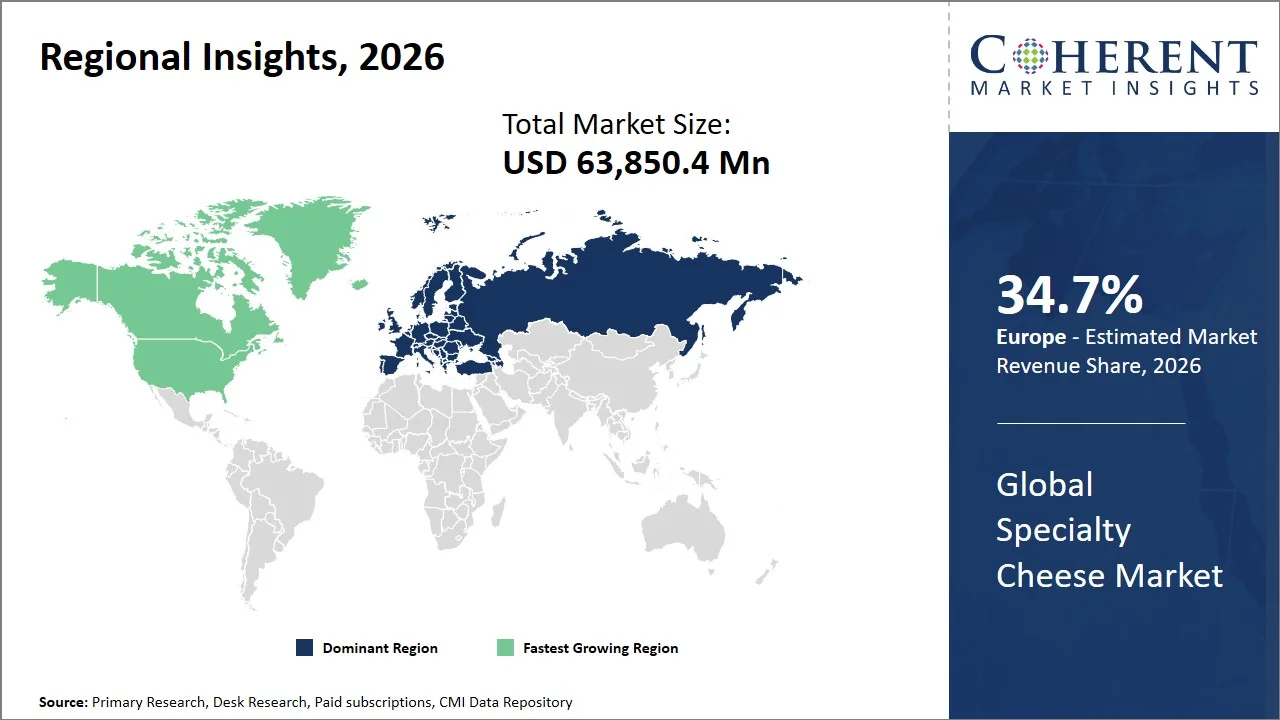
Why Does Europe Dominate the Global Specialty Cheese Market?
Europe is expected to dominate the global specialty cheese market with 34.7% share in 2026, supported by long-established cheese consumption, strong dairy cooperatives, protected geographical indication systems, and a mature premium food culture. The region has a deep production base for mozzarella, parmesan-style hard cheeses, blue cheese, goat cheese, and aged regional varieties, supported by advanced milk processing, quality control, aging facilities, and export-oriented dairy infrastructure. Europe’s leadership is also reinforced by consumer willingness to pay for origin-certified, artisanal, and premium cheeses across retail, foodservice, and gourmet dining. A recent example highlighting regional strength is CONO Kaasmakers’ Beemster Royaal Grand Cru from the Netherlands being named World Champion Cheese 2026, scoring 98.68 out of 100 and outperforming 3,375 entries from 25 countries, reflecting Europe’s continued leadership in high-quality specialty cheese production. (Source: CONO Kaasmakers)
Why is North America Emerging as the Fastest-Growing Region in the Global Specialty Cheese Market?
North America is expected to emerge as the fastest-growing region with 29.8% share in 2026, supported by strong cheese usage in foodservice, premium snacking, home cooking, and ready-to-eat meal formats. The region benefits from large-scale cheese manufacturing, refrigerated retail infrastructure, strong QSR penetration, and rapid product innovation across shredded, sliced, clean-label, flavored, snack, and convenience-led cheese formats. Consumer demand is shifting from only conventional cheddar and mozzarella toward specialty, functional, transparent-label, and premium cheese products. In March 2026, Sargento highlighted its Natural American Cheese slices, made with only five ingredients and positioned as a 100% natural cheese alternative delivering familiar taste, texture, and melt, showing how North American brands are expanding specialty and clean-label cheese innovation. (Source: PR NewsWire)
Global Specialty Cheese Market Outlook for Key Countries
Why is France a Global Reference Point for Premium and Protected Specialty Cheese?
France remains a major country in the global specialty cheese market due to its strong regional cheese culture, premium dairy heritage, and globally recognized protected cheese varieties such as Brie, Camembert, Roquefort, Comté, and goat cheese. The country’s importance lies in its ability to link cheese with terroir, traditional production, culinary tourism, foodservice usage, and export value. French producers benefit from a mature ecosystem of affineurs, specialty retailers, chefs, dairy cooperatives, and protected-origin frameworks that support premium pricing. France also acts as a global showcase for cheese innovation and quality benchmarking. In 2025, the Mondial du Fromage in Tours presented nearly 1,900 cheeses to a jury of about 320 international professionals, highlighting France’s role as a global platform for specialty cheese recognition and trade engagement. (Source: Mondial du Fromage)
Why Does Italy Lead in Protected Designation of Origin (PDO) Hard Cheese and Export-Oriented Specialty Cheese?
Italy is highly important in the global specialty cheese market because of its strong Protected Designation of Origin PDO cheese ecosystem, export capability, and worldwide recognition of cheeses such as Parmigiano Reggiano, Grana Padano, Gorgonzola, Pecorino Romano, and mozzarella-based specialties. Italian specialty cheese benefits from strict production specifications, aging expertise, and strong alignment with global foodservice applications such as pasta, pizza, salads, sauces, and gourmet ready meals. The country’s cheese sector also gains from organized consortia that protect origin, quality, and brand value in international markets. In 2025, Grana Padano reported 6.0 million wheels produced and 2.7 million wheels exported worldwide, showing Italy’s strong scale in protected specialty cheese and its continued relevance in global cheese trade. (Source: Grana Padano Consortium)
Why is China Becoming an Important Growth Market for Specialty Cheese?
China is becoming an important growth market for specialty cheese as cheese consumption expands beyond Western restaurants into bakery, snacks, family meals, cafés, pizza chains, and convenience retail. The country still has relatively low traditional cheese penetration, but younger urban consumers are increasingly adopting cheese through softer, snackable, spreadable, and localized formats. This makes China commercially attractive for both domestic dairy companies and international specialty cheese brands seeking long-term volume growth. The market’s development is also supported by product localization, where cheese is positioned for bread, bagels, children’s snacks, desserts, and home meals rather than only traditional European-style usage. In August 2025, Mengniu’s Milkground launched Mini Cheese Triangles, Cloud Cheese Mousse, and spreadable cream cheese, expanding cheese options for Chinese family consumption. (Source: Mengniu Dairy)
Why is the U.S. Driving Scale, Innovation, and Trade in Specialty Cheese?
The U.S. is a key country in the global specialty cheese market due to its large cheese production base, strong foodservice demand, advanced cold-chain distribution, and high rate of product innovation. Cheese is deeply integrated into U.S. consumption through pizzas, burgers, sandwiches, baked foods, snacking, salads, and prepared meals, creating high-volume demand across both retail and foodservice channels. The country also supports specialty cheese growth through flavored, shredded, sliced, organic, lactose-free, artisanal, and export-ready formats. U.S. cheese producers are increasingly competitive in global trade due to scale, pricing, and improved manufacturing capacity. In February 2026, the U.S. Dairy Export Council reported that U.S. cheese exports exceeded 50,000 MT in eight of 12 months in 2025, a level not reached before 2025. (Source: U.S. Dairy Export Council)
Why is India Emerging as a High-Potential Specialty Cheese Market?
India is emerging as a high-potential market for specialty cheese due to rising urban foodservice consumption, premium grocery expansion, growing café and bakery culture, and increasing acceptance of mozzarella, cheddar, processed cheese, goat cheese, and artisanal varieties. While paneer remains the country’s traditional fresh dairy base, specialty cheese adoption is increasing through pizzas, burgers, sandwiches, baked products, gourmet retail, hotels, and modern restaurants. India also has a strong milk production base, which creates long-term supply potential for localized cheese manufacturing. Startups, cooperatives, and artisanal producers are beginning to introduce differentiated cheese products suited to Indian taste preferences and premium dining. In September 2025, the First India Cheese Festival showcased 59 cheese varieties from cooperatives, startups, and artisanal cheesemakers, highlighting India’s evolving specialty cheese ecosystem. (Source: Press Information Bureau, Government of India)
Technology Adoption Landscape in the Global Specialty Cheese Market
Technology | Key Features | Clinical Advantage | Market Relevance | |
Advanced Starter Culture Technology | Uses selected bacterial cultures to control flavor, texture, acidity, aroma, and ripening behavior. | Improves product consistency, digestibility, safety, and sensory quality. | Highly relevant for premium cheeses such as mozzarella, parmesan, blue cheese, goat cheese, and aged specialty varieties. | |
Controlled Ripening & Aging Systems | Automated humidity, temperature, airflow, and microbial control during cheese maturation. | Enhances flavor development, reduces spoilage, and improves batch-to-batch quality. | Supports premium pricing for aged, artisanal, and origin-led specialty cheese products. | |
Ultrafiltration & Membrane Processing | Concentrates milk proteins and solids before cheesemaking, improving yield and standardization. | Helps maintain nutritional quality and improves texture and protein concentration. | Widely adopted by large producers to improve production efficiency and reduce raw material loss. | |
Automated Cheese Cutting, Shredding & Portioning | Uses precision equipment for slicing, shredding, cubing, and portion packs. | Supports hygiene, portion control, and consistent serving quality. | Important for retail packs, foodservice supply, snack cheese, and ready-to-use specialty cheese formats. | |
Modified Atmosphere Packaging (MAP) | Replaces oxygen with protective gas mixtures to extend shelf life. | Maintains freshness, limits microbial spoilage, and preserves flavor and texture. | Strong relevance in premium retail cheese, export packaging, and chilled distribution channels. | |
High Pressure Processing (HPP) | Applies high pressure to reduce microbial load without high heat treatment. | Improves food safety while preserving natural flavor, moisture, and texture. | Useful for fresh, soft, and minimally processed specialty cheeses with shorter shelf life. | |
Digital Traceability & QR-based Provenance Systems | Tracks milk origin, farm details, batch history, certification, and distribution journey. | Builds consumer trust and supports quality assurance and recall management. | Highly relevant for PDO/PGI cheeses, organic cheese, artisanal products, and export-oriented premium brands. | |
How is technology-led specialty cheese production creating new growth opportunities?
Technological advancements in specialty cheese production are creating new growth opportunities by helping manufacturers improve product consistency, production yield, hygiene, shelf-life stability, and scalability across mozzarella, cheddar, parmesan, fresh cheese, goat cheese, and other premium cheese formats. Automation, membrane processing, advanced heat treatment, controlled curd handling, and digital process monitoring allow producers to scale specialty cheese output while maintaining texture, meltability, moisture balance, and flavor performance. This is especially important for foodservice and export channels, where buyers require standardized quality across large volumes. For instance, in April 2025, Tetra Pak launched the 2025 edition of its Dairy Processing Handbook, featuring updated research, technological developments, and processing know-how for dairy manufacturers. Tetra Pak also offers cheese production solutions for mozzarella, semi-hard cheese, cheddar, and fresh cheese, supporting process optimization and industrial-scale cheese manufacturing. (Source: Tetra Pak International S.A)
Market Players, Key Development, and Competitive Intelligence
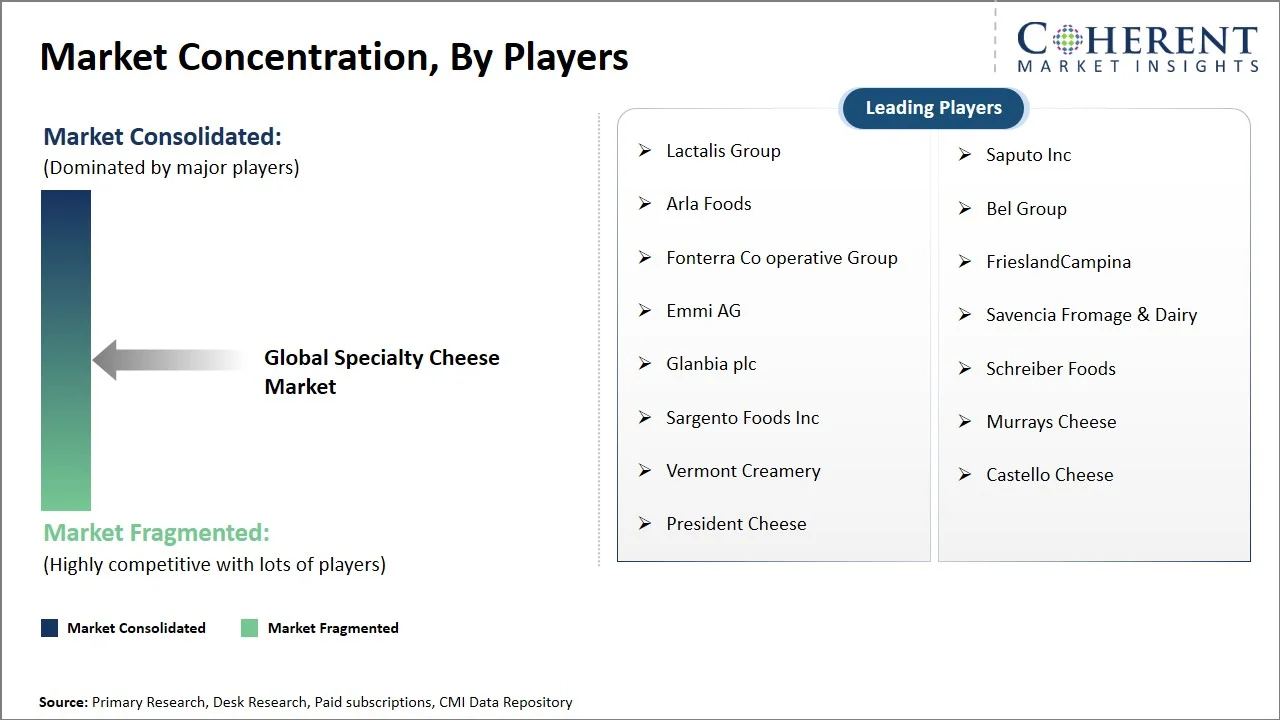
Key Developments
- In June 2025, Lactalis USA invested over US$ 75 million to upgrade its Walton and Buffalo, New York facilities, including expanded production of Galbani Ricotta, Mozzarella, and Provolone. This strengthened cheese manufacturing capacity, improved supply reliability, and supported rising retail and foodservice demand for Italian-style specialty cheese products
- In August 2025, Arla Foods invested US$ 58.60 million in its Bahrain production site to expand Puck spreadable cheese glass jar capacity by around 30%. This expanded regional cheese production capacity, strengthened branded spreadable cheese supply, and improved Arla’s ability to serve retail and foodservice channels.
- In April 2023, Bel Group partnered with Climax Foods to develop AI-powered plant-based cheese products across brands such as The Laughing Cow, Kiri, Boursin, Babybel, and Nurishh. This broadened Bel’s plant-based cheese portfolio, supported product diversification, and strengthened its position in premium alternative dairy and flexitarian cheese segments.
Competitive Landscape
The global specialty cheese market is highly competitive and moderately fragmented, with both large dairy companies and regional artisanal producers competing on product quality, flavor innovation, origin-based positioning, clean-label claims, and foodservice partnerships. Key players are focusing on premium cheese varieties, advanced processing, improved shelf life, sustainable packaging, and wider retail and foodservice distribution. Strong demand for mozzarella, parmesan, cheddar, goat cheese, and flavored specialty cheeses is encouraging companies to expand capacity and strengthen brand differentiation.
Key focus areas include
- Development of premium and artisanal cheese varieties with improved taste, texture, and melt performance
- Expansion of organic, lactose-free, clean-label, and plant-based specialty cheese portfolios
- Investment in advanced ripening, packaging, and cold-chain technologies to improve quality and shelf life
- Strengthening partnerships with foodservice operators, gourmet retailers, hotels, and QSR chains
- Geographic expansion through exports, local production, and wider distribution in emerging markets
- Focus on PDO/PGI, regional origin claims, and sustainability-led branding to support premium pricing
Market Report Scope
Specialty Cheese Market Report Coverage
| Report Coverage | Details | ||
|---|---|---|---|
| Base Year: | 2025 | Market Size in 2026: | USD 63,850.4 Mn |
| Historical Data for: | 2020 To 2024 | Forecast Period: | 2026 To 2033 |
| Forecast Period 2026 to 2033 CAGR: | 6.9% | 2033 Value Projection: | USD 101,860.9 Mn |
| Geographies covered: |
| ||
| Segments covered: |
| ||
| Companies covered: | Lactalis Group, Saputo Inc, Arla Foods, Bel Group, Fonterra Co operative Group, FrieslandCampina, Emmi AG, Savencia Fromage & Dairy, Glanbia plc, Schreiber Foods, Sargento Foods Inc, Murrays Cheese, Vermont Creamery, Castello Cheese, and President Cheese | ||
| Growth Drivers: |
| ||
| Restraints & Challenges: |
| ||
Analyst Opinion (Expert Opinion)
- The global specialty cheese market is expected to witness steady long-term growth due to rising demand for premium, artisanal, clean-label, and origin-based dairy products. Consumers are increasingly shifting from regular processed cheese to differentiated varieties such as mozzarella, parmesan, cheddar, blue cheese, goat cheese, and flavored cheeses. Growing use in home cooking, snacking, gourmet retail, and premium foodservice is expected to support wider market adoption.
- The strongest opportunities are likely to emerge from foodservice, gourmet dining, bakery, and ready-to-eat meal applications, where specialty cheese is used to improve taste, texture, meltability, and menu value. Europe is expected to remain the leading region due to its strong cheese heritage, protected-origin products, and mature dairy industry, while North America is expected to grow faster with rising demand for premium, lactose-free, organic, and convenient cheese formats.
- To gain a competitive advantage, market players should focus on product innovation, advanced ripening technologies, sustainable packaging, clean-label positioning, and wider cold-chain distribution. Companies offering consistent quality, longer shelf life, strong flavor differentiation, and customized formats for retail and foodservice customers will be better positioned to capture demand in the specialty cheese market.
Speak to the analyst
Want personalized insights?
Take the findings above to one of our principal consultants, or have the report rebuilt around the segments, geographies and competitors you actually track.
Market Segmentation
- Type Insights (Revenue, USD Mn, 2021 - 2033)
- Mozzarella
- Parmesan
- Cheddar
- Blue Cheese
- Goat Cheese
- Others
- Source Insights (Revenue, USD Mn, 2021 - 2033)
- Cow Milk
- Goat Milk
- Sheep Milk
- Buffalo Milk
- Application Insights (Revenue, USD Mn, 2021 - 2033)
- Food Service
- Retail
- Bakery & Confectionery
- Ready to Eat Meals
- Others
- Distribution Channel Insights (Revenue, USD Mn, 2021 - 2033)
- Direct
- Indirect
- Regional Insights (Revenue, USD Mn, 2021 - 2033)
- North America
- U.S.
- Canada
- Latin America
- Brazil
- Argentina
- Mexico
- Rest of Latin America
- Europe
- Germany
- U.K.
- Spain
- France
- Italy
- Russia
- Rest of Europe
- Asia Pacific
- China
- India
- Japan
- Australia
- South Korea
- ASEAN
- Rest of Asia Pacific
- Middle East
- GCC Countries
- Israel
- Rest of Middle East
- Africa
- South Africa
- North Africa
- Central Africa
- North America
- Key Players Insights
- Lactalis Group
- Saputo Inc
- Arla Foods
- Bel Group
- Fonterra Co operative Group
- FrieslandCampina
- Emmi AG
- Savencia Fromage & Dairy
- Glanbia plc
- Schreiber Foods
- Sargento Foods Inc
- Murrays Cheese
- Vermont Creamery
- Castello Cheese
- President Cheese
Sources
Primary Research Interviews
- Dairy processors and specialty cheese manufacturers
- Artisanal cheesemakers and premium cheese brand owners
- Foodservice procurement managers, hotel chefs, QSR sourcing heads, and gourmet restaurant operators
- Retail category managers from supermarkets, hypermarkets, specialty cheese stores, and online grocery platforms
- Cheese distributors, importers, exporters, cold-chain logistics providers, and dairy ingredient suppliers
- Packaging technology providers, starter culture suppliers, enzyme manufacturers, and dairy processing equipment companies
Stakeholders
- Specialty cheese manufacturers and dairy cooperatives
- Artisanal and farmstead cheese producers
- Contract manufacturers and private-label cheese suppliers
- End-use Sectors
- Foodservice chains and QSR operators
- Hotels, restaurants, cafés, and catering companies
- Supermarkets, hypermarkets, and specialty food retailers
- Bakery and confectionery manufacturers
- Ready-to-eat meal and frozen food producers
- Online grocery and gourmet food platforms
- Regulatory & Food Safety Bodies
- U.S. Food and Drug Administration (FDA)
- U.S. Department of Agriculture (USDA)
- European Food Safety Authority (EFSA)
- European Commission – Geographical Indications and Food Safety
- Food Safety and Standards Authority of India (FSSAI)
- Codex Alimentarius Commission
- Canadian Food Inspection Agency (CFIA)
- Food Standards Australia New Zealand (FSANZ)
Databases
- FAOSTAT – Milk and dairy production statistics
- USDA Economic Research Service (ERS)
- USDA National Agricultural Statistics Service (NASS)
- Eurostat Dairy Statistics
- UN Comtrade Database
- ITC Trade Map
- OECD-FAO Agricultural Outlook
- World Bank Food and Agriculture Indicators
- European Commission Agriculture and Rural Development Database
Magazines / Trade Publications:
- Dairy Foods Magazine
- DairyReporter
- Cheese Market News
- Food Business News
- FoodNavigator
- The Grocer
- Food Engineering Magazine
- Dairy Industries International
Journals
- Journal of Dairy Science
- International Dairy Journal
- Dairy Science & Technology
- Foods Journal
- Journal of Food Science
- LWT – Food Science and Technology
- Food Control
- Comprehensive Reviews in Food Science and Food Safety
Newspapers
- The Economic Times
- Business Standard
- The Hindu Business Line
- Financial Times
Associations
- International Dairy Federation (IDF)
- International Dairy Foods Association (IDFA)
- European Dairy Association (EDA)
- American Cheese Society (ACS)
- National Milk Producers Federation (NMPF)
- U.S. Dairy Export Council (USDEC)
- Dairy Farmers of Canada
- Specialist Cheesemakers Association, UK
- Centre National Interprofessionnel de l'Économie Laitière (CNIEL), France
Public Domain Sources
- Food and Agriculture Organization (FAO) – Dairy production and food supply data
- USDA – Dairy market, cheese production, and consumption data
- European Commission – Dairy policy, PDO/PGI, and food safety regulations
- Eurostat – EU milk and cheese production statistics
- FDA – Cheese standards of identity and food labeling regulations
- FSSAI – Dairy product standards and food safety regulations in India
- Codex Alimentarius – International dairy and cheese product standards
- UN Comtrade – Global cheese import and export trade data
- World Bank – Agriculture, income, and consumption indicators
Proprietary Elements
- CMI Data Analytics Tool, Proprietary CMI Existing Repository of information for last 10 years.
Get access to 250+ pages report
Every segment, forecast, competitor profile and data table behind the analysis above — available for instant download.
- ESOMAR Member
- ISO 9001:2015 Certified
- D-U-N-S Registered
- GDPR & CCPA Compliant
Missing comfort of reading report in your local language? Find your preferred language:
Transform your Strategy with Exclusive Trending Reports
Frequently Asked Questions
The CAGR of the global specialty cheese market is projected to be 6.9% from 2026 to 2033.
The global specialty cheese market is valued at USD 63,850.4 million in 2026 and is expected to reach USD 101,860.9 million by 2033.
Mozzarella dominates the global specialty cheese market by type with an expected 26.8% share in 2026.
Rising demand for premium and artisanal dairy products and growing food service and gourmet dining consumption are the major factors driving the growth of the global specialty cheese market.
High production and raw material costs and stringent food safety and import regulations are the major factors hampering the growth of the global specialty cheese market.
In terms of type, mozzarella is estimated to dominate the market revenue share in 2026.
Europe is expected to lead the global specialty cheese market in 2026.