

Global Specialty Vehicles Market Size and Forecast – 2026-2033
The global specialty vehicles market is estimated to be valued at USD 116.89 Bn in 2026 and is expected to reach USD 149.73 Bn by 20B32, exhibiting a compound annual growth rate (CAGR) of 3.6% from 2026 to 2033.
Key Takeaways of the Specialty Vehicles Market
- The municipal service trucks segment leads the market holding an estimated share of 25.1 % in 2026.
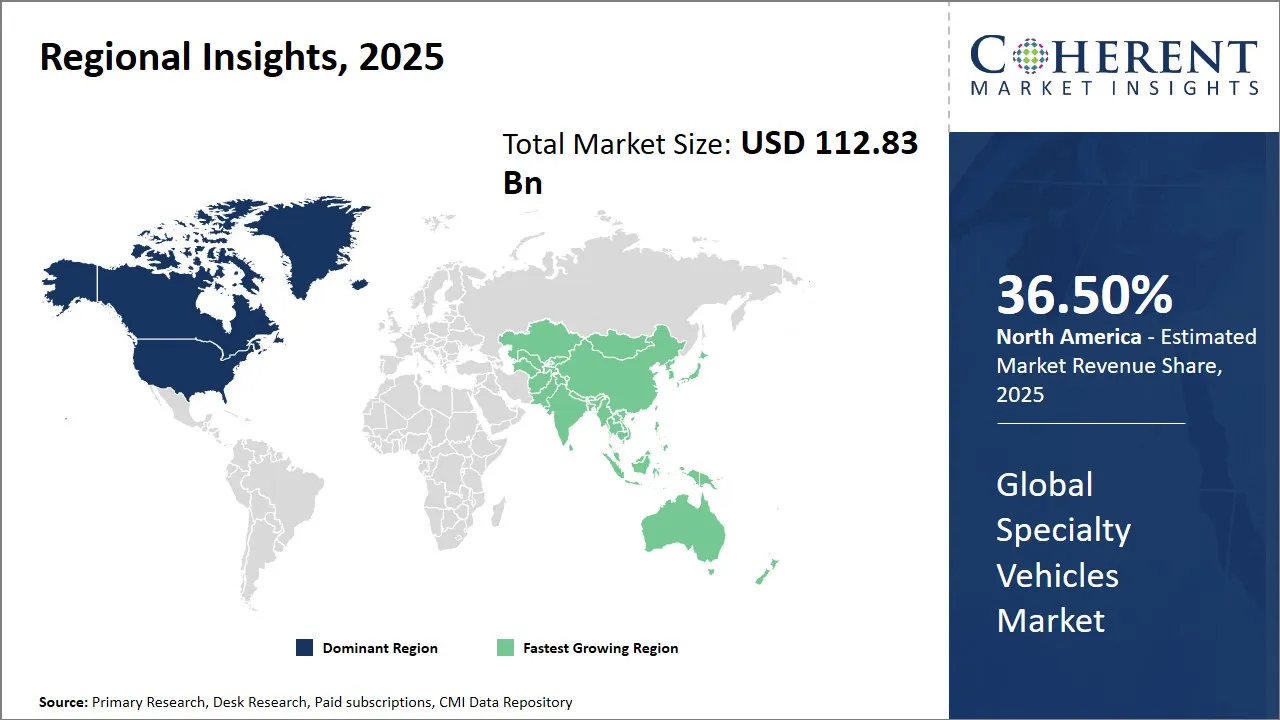
- North America is estimated to lead the market with a share of 36.5 % in 2026.
- Asia Pacific, holding an estimated share of 27.4 % in 2026, and it is projected to be the fastest growing region.
Market Overview
The market trends indicate a rising focus on electric and hybrid specialty vehicles as manufacturers align with global environmental regulations and consumer preferences for greener transportation solutions. Additionally, advancements in autonomous technologies and connectivity features are reshaping specialty vehicle functionalities, enhancing efficiency and safety. Growing urbanization and infrastructural developments also contribute to expanding specialty vehicle adoption, especially in logistics, construction, and emergency services.
Current Events and Its Impact
Current Events | Description and Its Impact |
Geopolitical and Trade Developments |
|
Economic and Infrastructure Trends |
|
Segmental Insights
- Current Industry Events of 2026
- Market Size Estimation
- Regional Breakdown
- Competitive Landscape
- Customer Intelligence
- Segmental Analysis
- Pricing Analysis
- Key Market Drivers, Challenges & Future Trends
- Customized Insights Section
Global Specialty Vehicles Market Insights, by Vehicle Type – Increasing Urbanization and Infrastructure Development are Driving Municipal Service Trucks Segment Growth
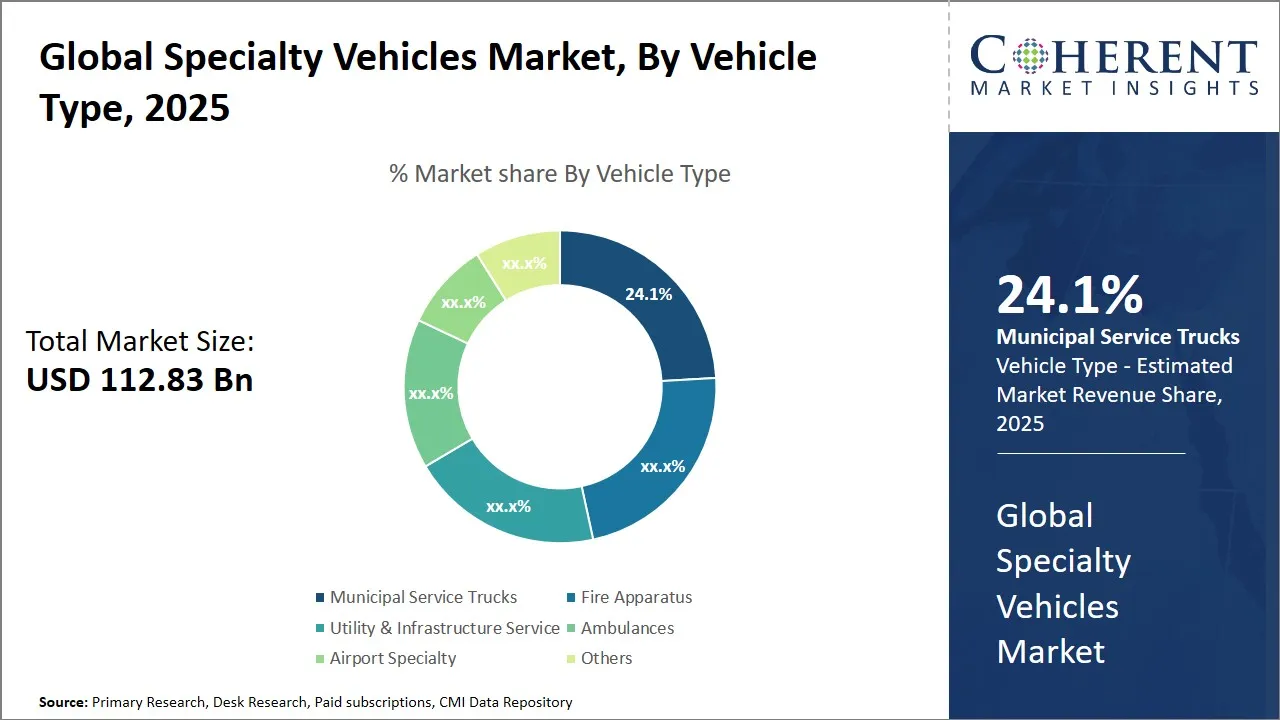
The municipal service trucks segment leads the market holding an estimated share of 25.1% in 2026. Rapid urban expansion has placed tremendous pressure on city administrations to maintain cleanliness, waste management, and public infrastructure maintenance, which are critical for improving the quality of urban living. Municipal service trucks, such as garbage trucks, street sweepers, and sanitation vehicles, play a pivotal role in meeting these demands effectively. The governments worldwide are investing heavily in modern municipal fleets equipped with advanced technology, aiming to enhance operational efficiency and reduce environmental impact. The adoption of electric and hybrid-powered municipal trucks is gaining traction, propelled by stringent emission regulations and increasing public awareness about sustainability.
In 2023, New York City Department of Sanitation (DSNY) deployed all-electric Mack LR Electric garbage trucks as part of its fleet modernization program. This was a significant step under NYC’s broader Clean Fleet and Zero-Emission Vehicle mandates, aimed at reducing emissions and improving sustainability in municipal services.
Furthermore, infrastructure upgrades and maintenance projects in both developed and developing countries have increased the deployment of municipal service trucks. These vehicles are indispensable for roadway cleaning, snow removal, drainage maintenance, and other public works tasks, ensuring smooth urban functionality. The digitization and automation of municipal services, incorporating GPS and IoT technologies into these trucks, have enhanced route optimization, fleet management, and real-time monitoring, which enhances productivity and reduces operational expenses.
Municipal service trucks also benefit from supportive government policies and funding programs aimed at modernizing public service fleets. Increasing budget allocations for urban infrastructure development and smart city initiatives are pushing municipal authorities to replace aging vehicles with newer, more capable models that can handle diverse municipal functions efficiently.
Pricing Analysis of the Specialty Vehicles Market
Vehicle Type | Estimated Price Range (2024–2025) |
Fire Truck (New) | USD 1,000,000 – USD 2,000,000 |
Fire Truck (Used) | USD 60,000 – USD 500,000 |
Ambulance (New) | USD 120,000 – USD 300,000+ |
Rescue Truck (New) | USD 315,000 – USD 425,500 |
Service/Municipal Truck (New) | USD 200,000 – USD 400,000 |
ARFF Vehicle (Oshkosh P-19R) | Approx. USD 1,170,000 per unit |
Armored Multi-Purpose Vehicle | Up to USD 1,800,000 per vehicle |
Regional Insights
North America Specialty Vehicles Market Analysis and Trends
North America, holding an estimated share of 36.5% in 2026, is driven by a mature market ecosystem characterized by well-established automotive and specialty vehicle manufacturers, strong consumer demand for customized vehicles, and extensive infrastructure supporting electric and specialty vehicle adoption. Robust government policies promoting environmental sustainability and incentives for electric and low-emission vehicles have accelerated innovation and the market penetration.
The presence of industry leaders such as Polaris Industries, Arctic Cat, and Can-Am (BRP) has fostered a competitive and technologically advanced landscape. Furthermore, North America's well-developed supply chains and trade agreements facilitate efficient distribution and innovation. Advanced research and development capabilities and a high rate of disposable income among consumers also contribute to sustained dominance in specialty vehicles.
Asia Pacific Specialty Vehicles Market Analysis and Trends
The Asia Pacific region, holding an estimated share of 27.4% in 2026, exhibits the fastest growth in the global specialty vehicles market, driven by rapid industrialization, urbanization, and increased consumer spending on recreational and utility vehicles. The governments in countries like China, India, and Japan have introduced policies encouraging electric vehicle adoption and advanced safety standards, creating a favorable regulatory environment. Rising awareness around recreational vehicles and increasing disposable income among the middle class are expanding market opportunities.
The region’s expanding manufacturing base, especially in China, supports a diverse range of specialty vehicles, both for commercial and consumer use. Notable companies like Yamaha Motor Co., Ltd., Tata Motors, and Mahindra & Mahindra are active participants, offering innovative products tailored to local preferences and market conditions. Additionally, growing infrastructure development and participation in international trade agreements have enhanced supply chain efficiencies and the market accessibility.
Global Specialty Vehicles Market Outlook for Key Countries:
U.S. Specialty Vehicles Market Analysis and Trends
The U.S. is highly dynamic with a strong presence of leading specialty vehicle manufacturers such as Polaris Industries and Textron Specialized Vehicles. The U.S. benefits from supportive government regulations that encourage emissions reductions and the adoption of electric specialty vehicles. High consumer demand for Recreational Off-highway Vehicles (ROVs), All-Terrain Vehicles (ATVs), and Utility Task Vehicles (UTVs) sustains the market growth. The U.S. specialty vehicles market also leads in technological innovation and product customization, driven by extensive R&D investments and close collaboration between industry and research institutions.
China Specialty Vehicles Market Analysis and Trends
China specialty vehicles market is rapidly evolving, supported by the government initiatives promoting new energy vehicles and stricter automotive safety standards. Domestic manufacturers like BYD, Wuzheng Group, and Yadea are significantly contributing to market growth through electric specialty vehicle production tailored for urban and rural applications. The country’s significant manufacturing capabilities and initiatives such as the “Made in China 2026” strategy strengthen industry presence. Additionally, expanding infrastructure and logistics improvements enhance distribution channels across vast geographic areas.
Japan Specialty Vehicles Market Analysis and Trends
Japan continues to lead in specialty vehicle technology and innovation, with influential companies such as Yamaha Motor Co., Honda Motor Co., and Mitsubishi Motors driving market advancements. Strong government backing for environmentally friendly vehicles and meticulous safety regulations create an environment fostering development of electric and hybrid specialty vehicles. The country’s mature automotive industry ecosystem supports collaborative initiatives between manufacturers and technology providers, emphasizing quality and efficiency.
India Specialty Vehicles Market Analysis and Trends
India specialty vehicles market is expanding rapidly due to rising disposable incomes, growing rural electrification, and increasing demand for agricultural and utility specialty vehicles. Key players like Tata Motors, Mahindra & Mahindra, and Eicher Motors are leveraging their manufacturing expertise and wide distribution networks to introduce versatile vehicles tailored to Indian terrains and usage patterns. Government programs aimed at rural development and sustainable transportation further facilitate the market access. Increasing infrastructure development also supports expansion into remote areas, enhancing the vehicle reach and utility.
Germany Specialty Vehicles Market Analysis and Trends
Germany specialty vehicles market is distinguished by a strong industrial base with players such as MAN Truck & Bus, Mercedes-Benz, and STIHL contributing to the commercial and recreational segments. The country boasts stringent environmental standards and government policies that promote electric mobility, pushing manufacturers to invest in innovative specialty vehicles that meet emission regulations. Germany’s proficiency in engineering and high-quality manufacturing, along with a comprehensive dealer network, supports sustained market presence and technological leadership in the Europe.
Market Players, Key Development, and Competitive Intelligence
Key Developments
- In July 2025, Oshkosh Airport Products, an Oshkosh Corporation business, announced the delivery of three advanced Striker Aircraft Rescue and Fire Fighting (ARFF) vehicles to Kansas City International Airport (MCI) in Kansas City, Missouri, U.S. This addition to the airport’s fleet demonstrates a major commitment to safety and ensuring top-tier emergency response performance.
- In July 2025, Pierce Manufacturing Inc., an Oshkosh Corporation business, announced Cary Fire Department in North Carolina, U.S., introduced into service a Pierce Volterra electric pumper, it is the first to be delivered on the East Coast. The order, secured by Pierce dealer Atlantic Emergency Solutions, reinforces Cary’s commitment to innovative and sustainable firefighting solutions.
- In July 2025, Oshkosh Airport Products, an Oshkosh Corporation business, announced the delivery of three new Striker 8x8 Aircraft Rescue and Firefighting (ARFF) vehicles to serve Minneapolis–St. Paul International Airport (MSP). The addition of these state-of-the-art vehicles strengthens MSP’s emergency response capabilities as it supports more than 37 million passengers and over 340,000 aircraft operations each year.
- In March 2025, Horton Emergency Vehicles, a brand of REV Group Inc.’s subsidiary Halcore Group, Inc, and a leader in ambulance safety, partnered with IMMI to introduce the Horton Occupant Protection System (HOPS) featuring MBrace in the ambulance attendant seat.
Top Strategies Followed by Specialty Vehicles Market Players
- Established players dominate the market through significant investments in research and development (R&D), striving to innovate and produce high-performance specialty vehicles that meet evolving consumer demands and stringent regulatory standards.
- Oshkosh Corporation (North America) introduced the Pierce Volterra electric fire truck and McNeilus Volterra ZFL electric refuse truck (CES 2025), showcasing EV, AI collision-avoidance, and robotic bin handling. This reflects strong R&D spend to stay ahead in electrification and autonomy.
- In contrast, mid-level players in the specialty vehicles market adopt a more cost-sensitive approach to remain competitive.
- NAFFCO builds standardized yet affordable ambulances and firefighting vehicles, widely adopted in developing markets. Its competitive pricing and modular build approach help it win contracts in cost-sensitive regions.
- Small-scale players in the specialty vehicles arena distinguish themselves by focusing on niche markets and highly specialized product attributes.
- TATRA Trucks produces all-terrain specialty chassis for firefighting and rescue operations in extreme environments.
Market Report Scope
Specialty Vehicles Market Report Coverage
| Report Coverage | Details | ||
|---|---|---|---|
| Base Year: | 2025 | Market Size in 2026: | USD 116.89 Bn |
| Historical Data for: | 2020 To 2024 | Forecast Period: | 2026 To 2033 |
| Forecast Period 2026 to 2033 CAGR: | 3.6% | 2033 Value Projection: | USD 149.73 Bn |
| Geographies covered: |
| ||
| Segments covered: |
| ||
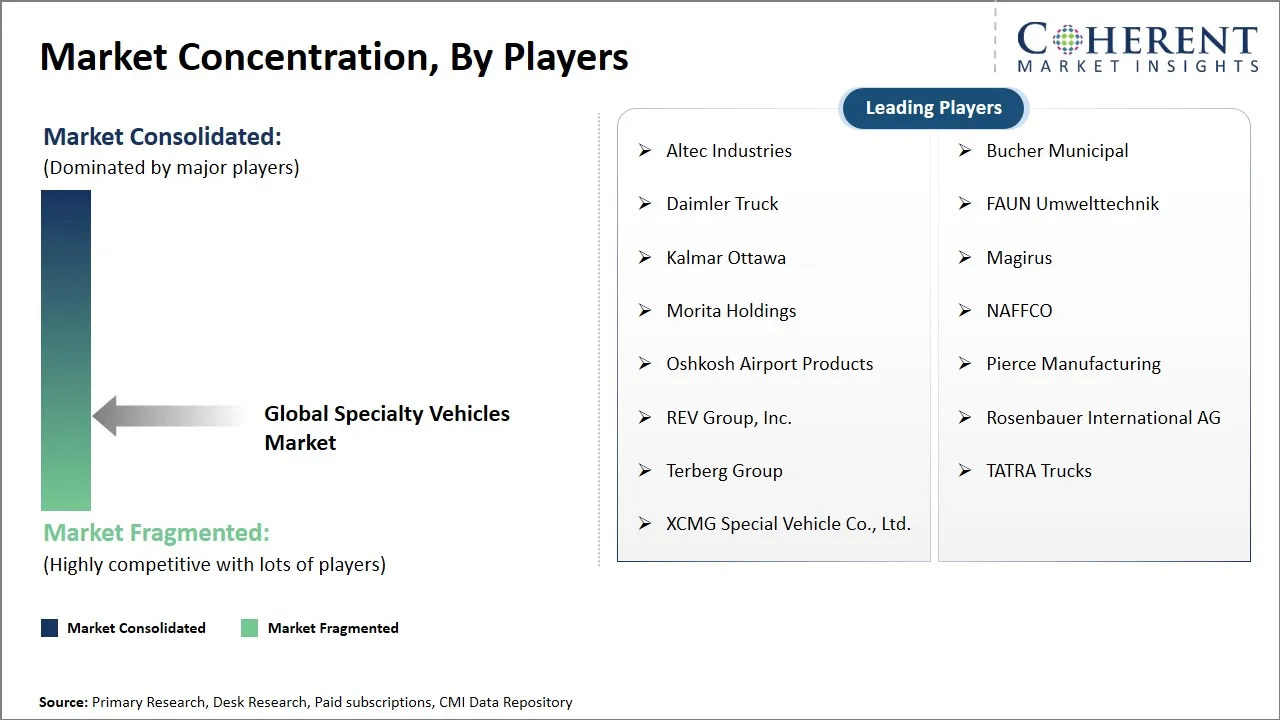
| Companies covered: | Altec Industries, Bucher Municipal, Daimler Truck, FAUN Umwelttechnik, Kalmar Ottawa, Magirus, Morita Holdings, NAFFCO, Oshkosh Airport Products, Pierce Manufacturing, REV Group, Inc., Rosenbauer International AG, Terberg Group, TATRA Trucks, and XCMG Special Vehicle Co., Ltd. | ||
| Growth Drivers: |
| ||
| Restraints & Challenges: |
| ||
Market Dynamics
Global Specialty Vehicles Market Driver – Municipal Fleet Replacement Cycles & Safety/Regulatory Upgrades
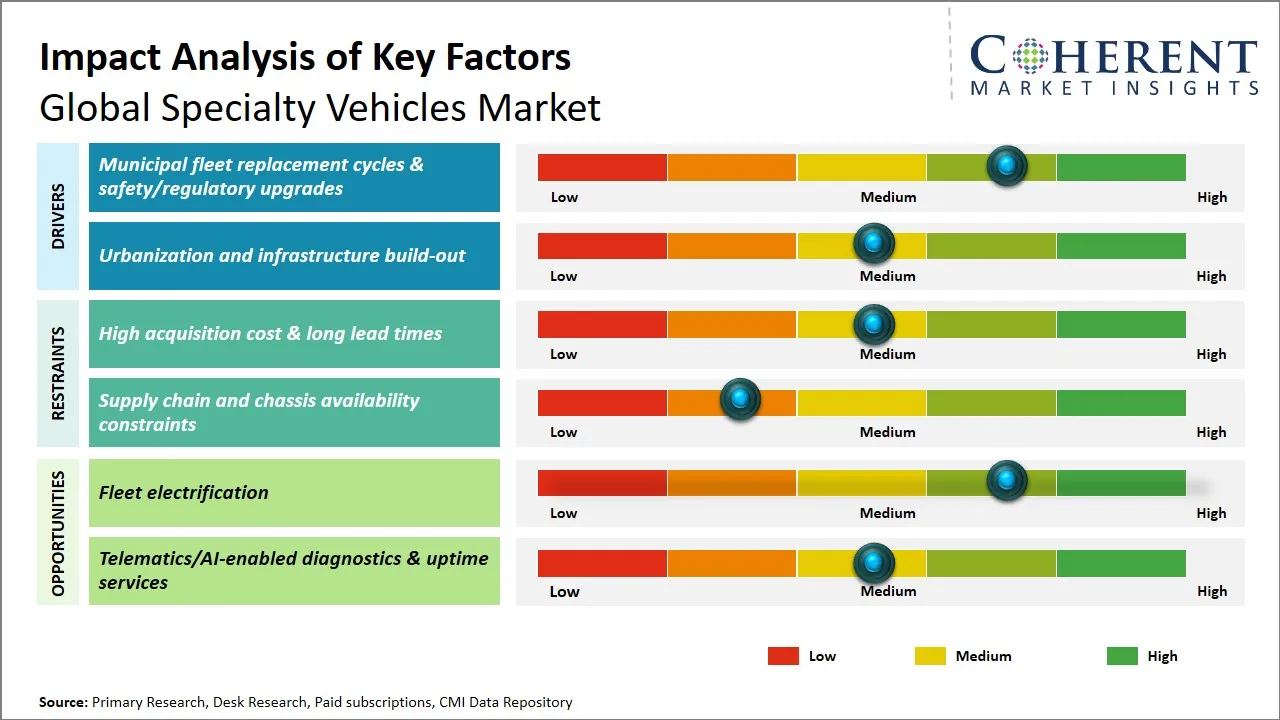
Municipal fleet replacement cycles play a pivotal role in driving demand within the specialty vehicles market, as government agencies are mandated to regularly update their fleets to maintain operational efficiency and comply with evolving safety standards. Many municipalities adopt systematic replacement schedules to minimize downtime and reduce maintenance costs associated with aging vehicles. In addition, increasing emphasis on regulatory compliance, including stringent emission norms and advanced safety requirements, compels local authorities to invest in newer specialty vehicles equipped with the latest technologies. In 2024, the City of New York Fire Department (FDNY) placed orders for new E-ONE and Ferrara fire trucks (REV Group brands) to replace aging fleets and comply with updated NFPA safety standards.
These upgrades often encompass enhancements such as improved braking systems, advanced driver assistance features, and environmentally friendly powertrains, aligning with public safety objectives and sustainability targets. The intersection of these replacement cycles and regulatory mandates ensures continuous procurement activities while fostering innovation within the specialty vehicle segment.
Global Specialty Vehicles Market Opportunity – Fleet Electrification
Governments across key regions are imposing rigorous emission reduction targets, incentivizing the adoption of electric vehicles (EVs) in commercial fleets. Specialty vehicles, including utility trucks, airport ground support equipment, and emergency response vehicles, are prime candidates for electrification due to their high usage intensity and operational cost sensitivity. Electrifying these fleets not only helps operators comply with environmental regulations but also offers substantial benefits such as lower total cost of ownership, reduced fuel expenses, and minimized maintenance requirements. In July 2025, Oshkosh/Pierce delivered the Volterra electric fire truck to Cary, North Carolina – the first fully operational electric fire truck on the U.S. East Coast.
Additionally, advancements in battery technology and charging infrastructure are steadily overcoming previous limitations related to range anxiety and downtime, making electric specialty vehicles more viable for diverse applications. Major market players are increasingly investing in developing tailored electric models with enhanced performance, durability, and safety features suited for demanding specialty vehicle operations. Furthermore, rising consumer and corporate awareness regarding carbon footprint reduction amplifies the market readiness for electrified fleets.
Analyst Opinion (Expert Opinion)
- Battery-electric and hybrid specialty vehicles are moving beyond pilots to early adoption—particularly in fire apparatus, ambulances, and refuse trucks. Municipal sustainability mandates are making the EV integration not only a regulatory necessity but also a cost-saving driver through reduced fuel and maintenance expenses.
- Emerging use-cases such as AI-enabled collision avoidance systems, IoT-based telematics, and smart monitoring dashboards are transforming how municipalities manage fleets. These technologies improve uptime, enhance operator safety, and allow predictive maintenance, directly reducing Total Cost of Ownership (TCO).
- Robotics and semi-autonomous features, such as autonomous refuse collection units (HARR-E by Oshkosh) or remote-controlled firefighting vehicles (used in hazardous response in Asia Pacific), are carving new operational use-cases. These innovations expand the specialty vehicle role from traditional transport into mission-critical, high-risk environments where human safety is paramount.
Speak to the analyst
Want personalized insights?
Take the findings above to one of our principal consultants, or have the report rebuilt around the segments, geographies and competitors you actually track.
Market Segmentation
- Vehicle Type Insights (Revenue, USD Bn, 2021 - 2033)
- Municipal Service Trucks
- Fire Apparatus
- Utility & Infrastructure Service
- Ambulances
- Airport Specialty
- Others
- Regional Insights (Revenue, USD Bn, 2021 - 2033)
- North America
- U.S.
- Canada
- Latin America
- Brazil
- Argentina
- Mexico
- Rest of Latin America
- Europe
- Germany
- U.K.
- Spain
- France
- Italy
- Russia
- Rest of Europe
- Asia Pacific
- China
- India
- Japan
- Australia
- South Korea
- ASEAN
- Rest of Asia Pacific
- Middle East
- GCC Countries
- Israel
- Rest of Middle East
- Africa
- South Africa
- North Africa
- Central Africa
- North America
- Key Players Insights
- Altec Industries
- Bucher Municipal
- Daimler Truck
- FAUN Umwelttechnik
- Kalmar Ottawa
- Magirus
- Morita Holdings
- NAFFCO
- Oshkosh Airport Products
- Pierce Manufacturing
- REV Group, Inc.
- Rosenbauer International AG
- Terberg Group
- TATRA Trucks
- XCMG Special Vehicle Co., Ltd.
Sources
Primary Research Interviews
Stakeholders
- Municipal Fleet Managers and Procurement Officers
- Specialty Vehicle Manufacturers and Suppliers
- Emergency Services Directors (Fire, EMS, Airport Rescue & Firefighting)
- Airport and Port Authorities (Ground Support Vehicle Managers)
- Utility & Infrastructure Service Providers (Electric, Water, and Waste Management Companies)
- Sustainability Experts and EV Fleet Consultants (focused on green fleet transition)
Databases
- U.S. Department of Transportation Fleet Data
- Eurostat (Municipal Vehicle Registrations)
- OECD Transport Database
- Global Fleet Insight Database
- Asia Pacific Transport Authority Statistics
Magazines
- Fleet & Mobility Today
- Emergency Vehicle World
- Municipal Equipment Review
- Utility Fleet Professional
- Airport Ground Support Magazine
Journals:
- Journal of Transportation Engineering & Fleet Management
- International Journal of Emergency Vehicle Technology
- Urban Transport & Infrastructure Journal
- Journal of Cleaner Production (Fleet Electrification Focus)
- Journal of Intelligent Transportation Systems
Newspapers
- Transport Topics
- Fleet News (U.K.)
- The Economic Times (India)
- The Guardian (U.K.)
- Asia Fleet Daily
Associations
- National Association of Fleet Administrators (NAFA, U.S.)
- European Emergency Vehicle Association (EEVA)
- Asia-Pacific Municipal Transport Association (APMTA)
- Airport Services Association (ASA)
- International Association of Fire Chiefs (IAFC)
Public Domain Sources
- U.S. Census Bureau – Transportation Equipment Data
- EUROSTAT – Vehicle Production and Registration
- World Bank – Urban Infrastructure Investment Data
- United Nations Economic Commission for Europe (UNECE) – Vehicle Regulations
- ResearchGate – Academic Papers on Specialty Vehicle Innovation
Proprietary Elements
- CMI Data Analytics Tool
- Proprietary CMI Existing Repository of information for last 8 years
Get access to 250+ pages report
Every segment, forecast, competitor profile and data table behind the analysis above — available for instant download.
- ESOMAR Member
- ISO 9001:2015 Certified
- D-U-N-S Registered
- GDPR & CCPA Compliant
Missing comfort of reading report in your local language? Find your preferred language:
Transform your Strategy with Exclusive Trending Reports
Frequently Asked Questions
The global specialty vehicles market is estimated to be valued at USD 116.89 billion in 2026 and is expected to reach USD 149.73 billion by 2033.
The CAGR of the global specialty vehicles market is projected to be 3.6% from 2026 to 2033.
Municipal fleet replacement cycles & safety/regulatory upgrades and urbanization and infrastructure build-out are the major factors driving the growth of the global specialty vehicles market.
High acquisition cost & long lead times and supply chain and chassis availability constraints are the major factors hampering the growth of the global specialty vehicles market.
In terms of vehicle type, the municipal service trucks segment is estimated to dominate the market revenue share in 2026.
Vehicles designed for specific applications such as firefighting, rescue, ambulances, refuse collection, utility service, and airport ARFF.
Between USD 1 million and USD 2 million for new models; and used units range from USD 60,000 upwards.