

Global Sports Car Market Size and Forecast – 2026-2033
The global sports car market is estimated to be valued at USD 29.19 Bn in 2026 and is expected to reach USD 36.89 Bn by 2033, exhibiting a compound annual growth rate (CAGR) of 3.4% from 2026 to 2033.
Key Takeaways of the Global Sports Car Market
- The coupe sports cars segment leads the market holding an estimated share of 50.6 % in 2026.
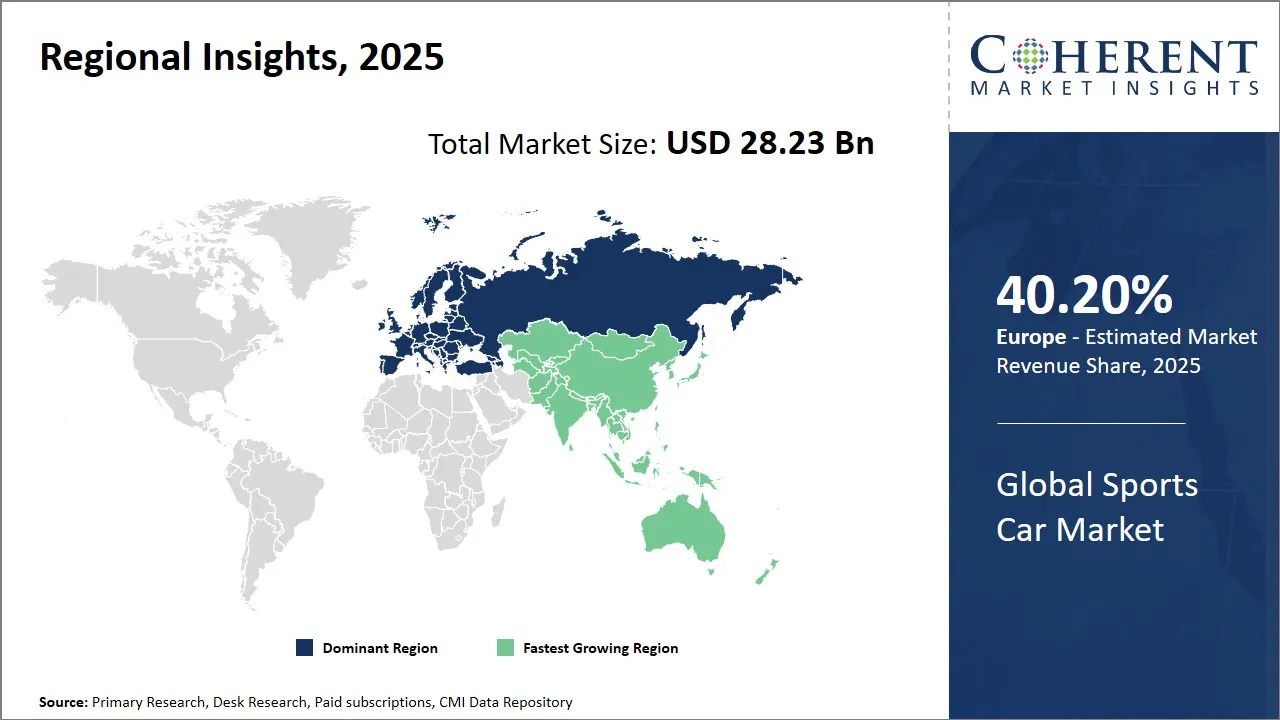
- Europe is estimated to lead the market with a share of 40.2 % in 2026.
- Asia Pacific, holding an estimated share of 19.5 % in 2026, and it is projected to be the fastest growing region.
Market Overview
A market trends indicate a growing emphasis on integrating sustainable technologies within sports cars, including hybrid and electric powertrains, to meet stricter emission regulations and evolving customer preferences. Additionally, the incorporation of advanced materials and lightweight components is enhancing vehicle performance and fuel efficiency, while digital connectivity features and autonomous driving capabilities are becoming key differentiators for market players aiming to attract tech-savvy consumers.
Current Events and Its Impact
Current Events | Description and its impact |
Product Launches & Technology |
|
Corporate Strategies & M&A |
|
Segmental Insights
- Current Industry Events of 2026
- Market Size Estimation
- Regional Breakdown
- Competitive Landscape
- Customer Intelligence
- Segmental Analysis
- Pricing Analysis
- Key Market Drivers, Challenges & Future Trends
- Customized Insights Section
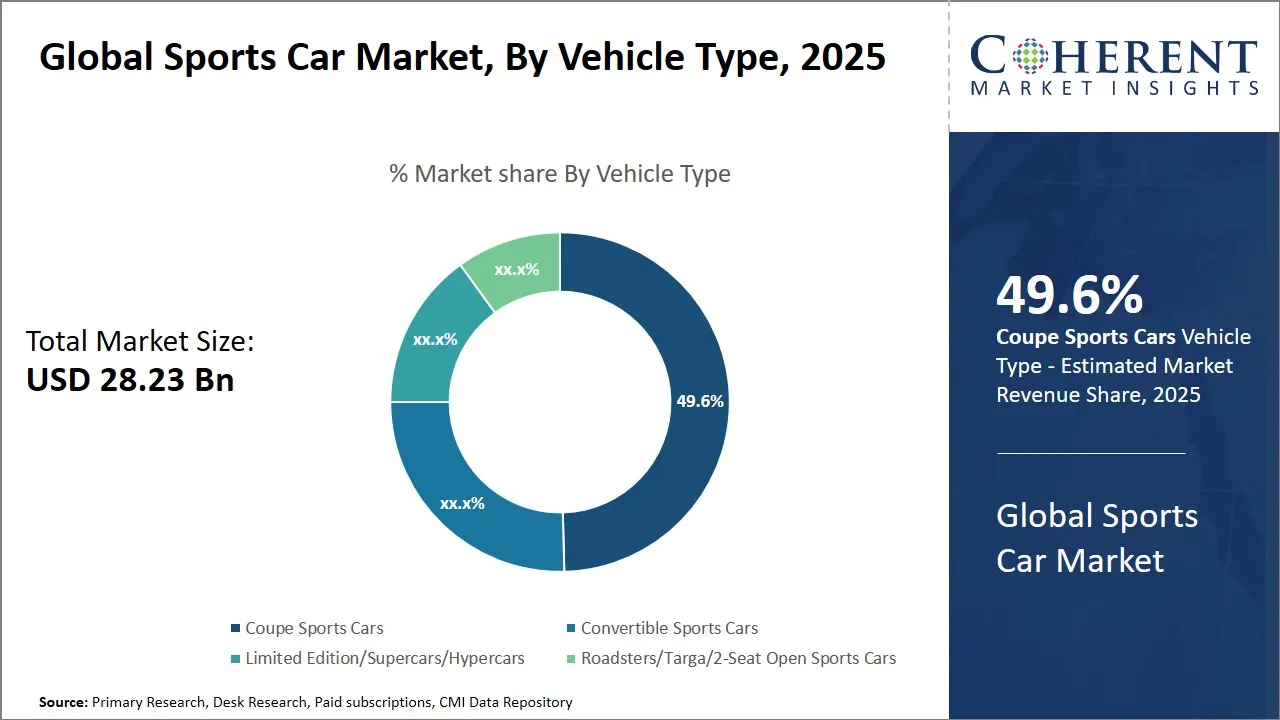
Global Sports Car Market Insights, by Vehicle Type – Coupe Sports Cars Segment Leads Owing to their Blend of Performance, Style, and Practicality
The coupe sports cars segment is projected to account for 50.6% share in 2026. The primary growth driver is their perfect balance between high-performance capabilities and everyday usability. Unlike more niche or specialized sports car variants, coupes typically feature a fixed roof and a two-door design that offers better structural rigidity, resulting in enhanced driving dynamics and superior handling on both urban roads and highways.
Another important factor fueling the demand for coupe sports cars is their distinctive aesthetic appeal. The sleek, aggressive silhouette combined with aerodynamic designs attracts enthusiasts who value both form and function. This design elegance resonates especially well with younger professionals and luxury car buyers who seek a statement vehicle that reflects status, ambition, and a passion for driving.
Technological advancements also contribute significantly to the growth of this segment. Many coupe sports cars now incorporate cutting-edge features such as turbocharged engines, advanced suspension systems, and lightweight materials, which improve performance without compromising fuel efficiency. Additionally, the integration of modern infotainment and driver-assistance technologies enhances the driving experience, making these vehicles more accessible and appealing to a broader audience.
The versatility of coupe sports cars further strengthens their market position. While they are performance-oriented, these vehicles often provide better cabin comfort and space compared to convertibles or roadsters, making them suitable for daily use or longer trips. This practical aspect increases their appeal beyond traditional sports car enthusiasts to include consumers who desire both sports car excitement and functional transportation.
Moreover, manufacturers’ strategic focus on expanding the lineup with varied engine options, including hybrid and electric powertrains, is attracting environmentally conscious buyers without sacrificing sporty performance. In May 2024, Porsche unveiled the 911 Carrera GTS Hybrid, the first production hybrid in the iconic 911 lineup. This responsiveness to evolving consumer preferences and regulatory landscapes supports sustained demand in the coupe sports car segment.
Pricing Analysis of the Sports Car Market
Model | Starting Price (USD) |
Mazda MX-5 Miata (2024 base) | USD 30,150 |
BMW Z4 (2025 base sDrive30i) | USD 55,045 |
Chevrolet Corvette E-Ray (2025) | USD 108,795 |
Chevrolet Corvette Z06 (2025) | USD 116,995 |
Porsche 911 (2025 base) | USD 122,095 |
Maserati GranTurismo (2025) | USD 159,495 |
Maserati GranTurismo Folgore (Electric) | USD 199,690 |
Porsche 911 GT3 / GT3 RS (2025) | USD 224,495 |
Porsche 911 Turbo (2025) | USD 206,295 |
McLaren Artura (2025) | USD 254,100 |
Aston Martin Vantage (2025) | USD 194,086 |
Rezvani Beast X | USD 325,000 |
Ferrari 849 Testarossa (Coupe) | USD 540,000 |
Regional Insights
Europe Sports Car Market Analysis and Trends
Europe region is projected to lead the market with a 40.2% share in 2026, driven by the region's strong automotive heritage, advanced manufacturing capabilities, and a well-established ecosystem of luxury and performance carmakers. Europe boasts several key hubs—Germany, Italy, and the United Kingdom—that foster innovation in design, engineering, and technology integration for sports cars. Government policies in many European countries support automotive R&D through subsidies and tax incentives, fueling continuous product development.
Additionally, stringent environmental regulations have pushed manufacturers to invest in hybrid and electric sports car technologies, enhancing the market’s competitiveness. Europe also benefits from well-established supply chains and trade agreements within the EU, facilitating smooth distribution. Notable companies such as Ferrari (Italy), Porsche (Germany), McLaren (U.K.), and Lamborghini (Italy) have cemented Europe’s place as the leader by consistently launching performance-focused and technologically sophisticated sports cars that appeal to affluent consumers worldwide.
Asia Pacific Sports Car Market Analysis and Trends
The Asia Pacific region, holding an estimated share of 19.5% in 2026, exhibits the fastest growth in the global sports car market, propelled by rising disposable incomes and expanding luxury consumer bases in emerging economies such as China and India. This region’s growth is supported by improving infrastructure, expanding urbanization, and increasing interest in premium and luxury lifestyles. Governments in countries like China have implemented various incentives to support electric vehicle adoption, which has encouraged sports car manufacturers to pivot toward electric and hybrid models tailored specifically for the Asia Pacific.
The burgeoning middle and upper class and the rise of car enthusiast communities contribute to growing the demand. Furthermore, Asia Pacific is experiencing increased investments by both legacy European sports car makers and emerging local players establishing production or assembly units in the region. Companies like Nissan (Japan), Toyota’s luxury performance division Lexus (Japan), and imports from Ferrari and Porsche collectively stimulate market expansion.
Global Sports Car Market Outlook for Key Countries:
Germany Sports Car Market Analysis and Trends
Germany sports car market benefits from the presence of world-renowned manufacturers such as Porsche, BMW’s M division, and Mercedes-AMG, which play critical roles in advancing innovation and performance standards. The country's robust automotive infrastructure, skilled labor force, and collaborative research institutions underpin a sophisticated ecosystem focused on engineering excellence. German manufacturers prioritize a combination of traditional combustion engines and next-generation electrified powertrains. Regulatory frameworks favor sustainable mobility, further encouraging technologically advanced sports car offerings. Germany’s position as both a manufacturing powerhouse and a major consumer market fosters continuous advancement in aerodynamics, lightweight materials, and connectivity in sports cars.
Italy Sports Car Market Analysis and Trends
Italy carries a legendary reputation in the sports car market dominated by iconic brands like Ferrari, Lamborghini, and Maserati. Italian manufacturers excel in combining exquisite design with high-performance engineering, maintaining strong brand loyalty globally. The government’s support for automotive innovation, though less pronounced than in Germany, is evident through various regional initiatives promoting luxury manufacturing and export. Italy’s craftmanship tradition and highly specialized automotive supply chain contribute significantly to the global sports car market by offering bespoke customization and limited-edition models. Export-oriented production and participation in motorsport activities further solidify Italy’s critical influence.
U.S. Sports Car Market Analysis and Trends
The U.S. sports car market is shaped by major manufacturers such as Chevrolet (Corvette), Ford (mustang Shelby and GT), and Tesla, which have pioneered advancements in muscle car culture as well as electric sports cars. The U.S. sports car market ecosystem is fueled by high consumer demand, a vast network of dealers, and a culture deeply rooted in muscle and performance vehicles. Government policies increasingly incentivize electric vehicle development, which Tesla leverages effectively, impacting the sports segment profoundly. Additionally, American specialty sports car makers and aftermarket tuners contribute to innovation and customization trends. The strong domestic market, coupled with international exports, ensures the U.S. remains a pivotal player.
China Sports Car Market Analysis and Trends
China sports car market expansion is underpinned by rapid urbanization, rising incomes, and growing enthusiasm for luxury vehicles among wealthy consumers. Government initiatives targeting Electric Vehicles (EVs) have made China a critical battleground for electric and hybrid sports cars. Companies including domestic players such as NIO and BYD, alongside established foreign brands like Porsche and Ferrari, are actively capitalizing on new EV regulations and incentives. Rising local R&D centers and manufacturing capabilities further enhance the competitive landscape. Moreover, China’s trade and tariff policies support the import of luxury sports cars while fostering joint ventures for localized production, enabling broader the market penetration.
Japan Sports Car Market Analysis and Trends
Japan continues to lead with a unique niche in the sports car market, anchored by high-performance brands such as Nissan (GT-R), Toyota (GR Supra), and Honda (NSX). Known for technical precision and reliability, Japanese manufacturers focus heavily on blending advanced engineering with user-friendly sports performance. Industrial collaboration with motorsports and export strategies help deepen Japan’s influence globally. The government’s balanced approach to environmental regulations fosters development in hybrid and electric sports vehicles without sacrificing performance. Japan’s advanced supply chain, skilled workforce, and innovative R&D efforts significantly contribute to both domestic and international sports car markets.
Market Players, Key Development, and Competitive Intelligence
Key Developments
- On September 10, 2025, Ferrari unveiled the new 849 Testarossa, a plug-in hybrid supercar, in Milan. The model pays tribute to the original 1980s Testarossa. Available in both coupe and Spider variants, it replaces the SF90 Stradale as Ferrari’s flagship.
- On September 4, 2025, Ferrari confirmed plans to launch its first all-electric vehicle in fall 2026. The move marks a historic turning point for the Italian automaker, which has built its reputation on roaring engines and track-bred technology.
- In April 2025, CYVN Holdings completed its acquisition transaction of McLaren’s Automotive business and a non-controlling stake in McLaren’s Racing business.
- In March 2023, Lamborghini introduced Revuelto, the first super sports V12 hybrid plug-in HPEV (High Performance Electrified Vehicle). An output of 1015 CV is delivered from the combined power of an entirely new combustion engine together with three electric motors, alongside a double-clutch gearbox that makes its debut on a 12-cylinder Lamborghini for the first time.
Top Strategies Followed by Sports Car Market Players
- Established brands, often synonymous with luxury and performance, invest heavily in research and development (R&D) to push the boundaries of automotive technology.
- Ferrari is investing over USD 4.69 billion (€4 billion) through 2026 to launch its first all-electric model (scheduled October 2025) and multiple new hybrid drivetrains, ensuring leadership in high-performance electrification.
- Mid-level players in the sports car market adopt a different approach, targeting a more price-sensitive consumer base that seeks a balance between quality and affordability.
- Mazda continues to refine the MX-5 Miata platform, keeping the 2024 model’s starting price around USD 30,000 while adding incremental tech (lightweight chassis, improved infotainment), appealing to enthusiasts seeking affordable sports performance.
- Small-scale players in the global sports car market carve out niche positions by concentrating on specialized features and innovative product offerings that differentiate them from larger competitors.
- Rimac Automobili focuses exclusively on ultra-high-performance electric hypercars and proprietary battery/e-axle systems, and supplies this technology to Bugatti for the new Tourbillon hybrid hypercar, differentiating itself as a tech leader rather than a mass producer.
Market Report Scope
Sports Car Market Report Coverage
| Report Coverage | Details | ||
|---|---|---|---|
| Base Year: | 2025 | Market Size in 2026: | USD 29.19 Bn |
| Historical Data for: | 2020 To 2024 | Forecast Period: | 2026 To 2033 |
| Forecast Period 2026 to 2033 CAGR: | 3.4% | 2033 Value Projection: | USD 36.89 Bn |
| Geographies covered: |
| ||
| Segments covered: |
| ||
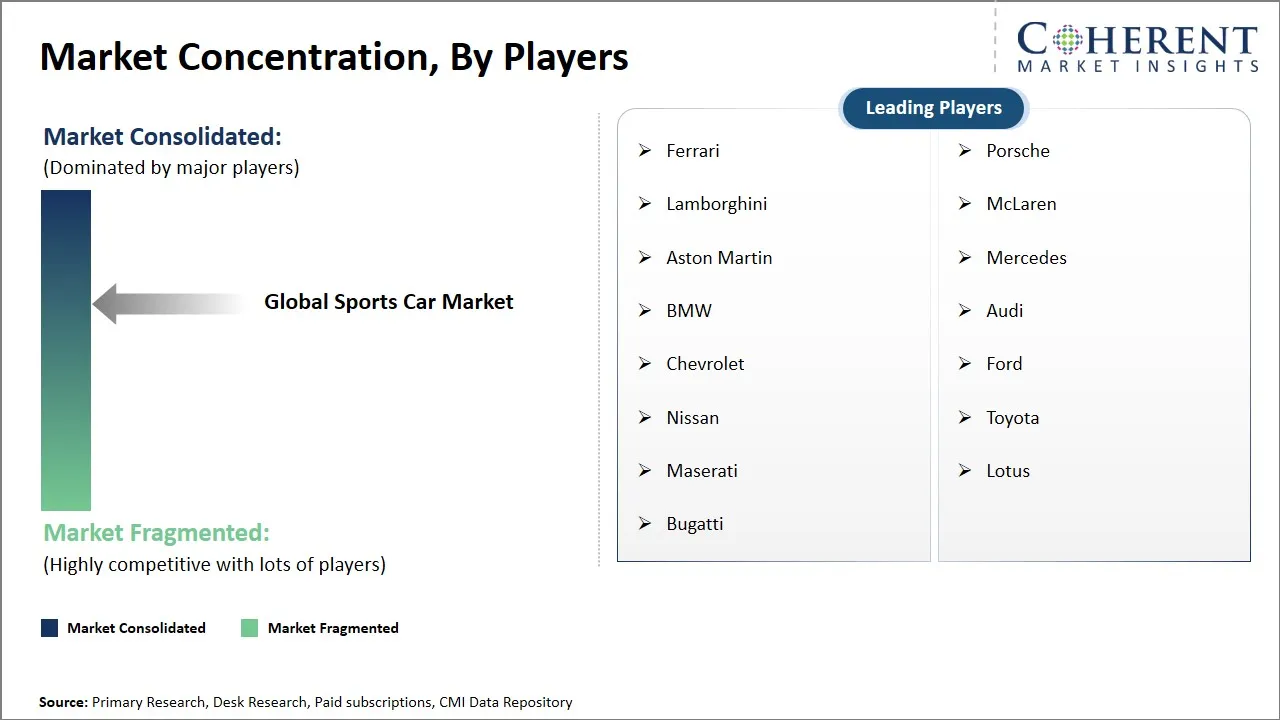
| Companies covered: | Ferrari, Porsche, Lamborghini, McLaren, Aston Martin, Mercedes, BMW, Audi, Chevrolet, Ford, Nissan, Toyota, Maserati, Lotus, and Bugatti | ||
| Growth Drivers: |
| ||
| Restraints & Challenges: |
| ||
Market Dynamics
Global Sports Car Market Driver – Increasing Disposable Income and Luxury Demand for High-Performance Vehicles
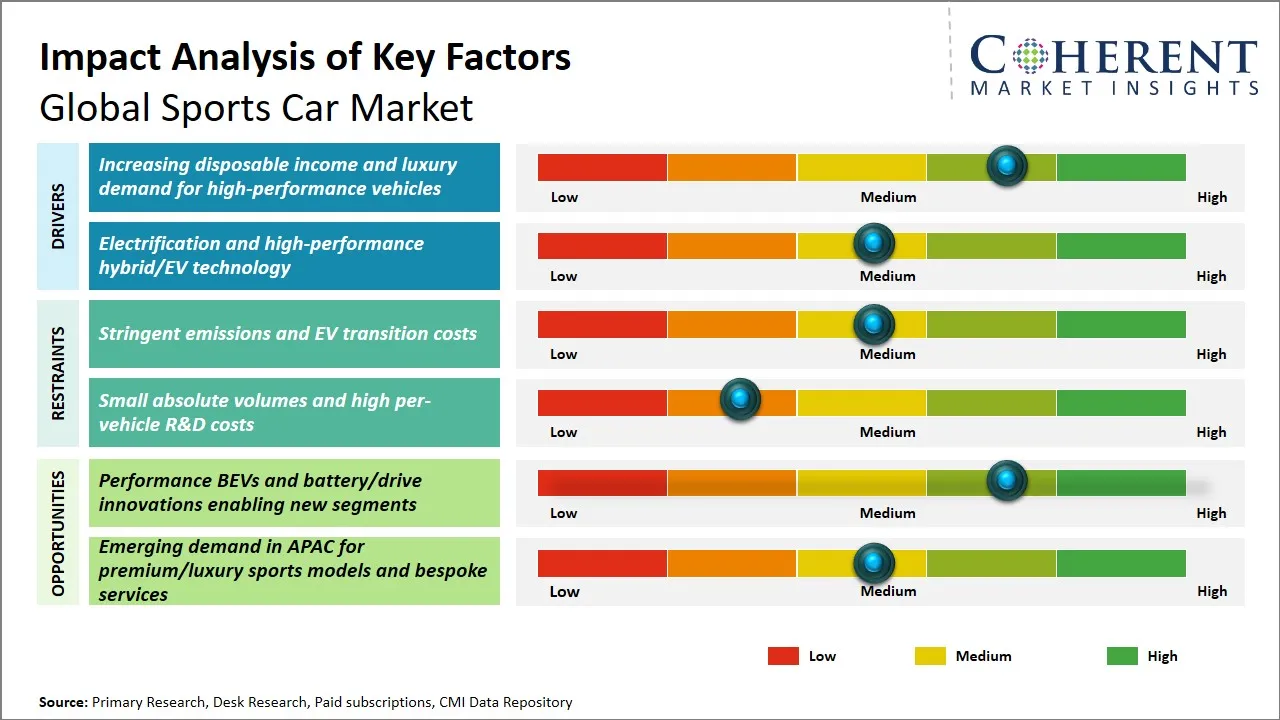
Affluent consumers are prioritizing premium, technologically advanced vehicles that not only offer superior speed and handling but also serve as status symbols reflecting their lifestyle and success. This surge in purchasing power enables a growing segment of buyers to indulge in expensive, performance-oriented models from prestigious automotive brands. For instance, Ferrari reported double-digit growth in Greater China for 2024, citing “strong demand from newly affluent buyers” as a key contributor to its global revenue increase.
Moreover, evolving consumer preferences toward exclusive and customized driving experiences are encouraging manufacturers to innovate and introduce sophisticated features, thereby further attracting luxury car enthusiasts. The convergence of enhanced financial capacity and an aspirational mindset is creating a robust market environment where sports car makers can capitalize on consumers’ willingness to pay a premium for cutting-edge performance, design, and exclusivity.
Global Sports Car Market Opportunity - Performance BEVs and Battery/Drive Innovations Enabling New Segments
The emergence of performance Battery Electric Vehicles (BEVs) coupled with advancements in battery and drive technologies presents a significant growth opportunity in the global sports car market. Traditionally dominated by Internal Combustion Engine (ICE) vehicles, the sports car segment is witnessing a transformative shift as manufacturers leverage BEVs to deliver unparalleled acceleration, torque, and overall driving dynamics that meet or exceed those of conventional sports cars. Innovations in high-density battery cells, faster charging capabilities, and efficient thermal management systems are enabling longer range and reduced downtime, addressing previous limitations associated with electric vehicles.
Additionally, the development of advanced drive systems such as dual and tri-motor configurations, torque vectoring, and electronically controlled all-wheel-drive enhance vehicle agility and performance, thereby attracting enthusiasts seeking both speed and sustainability. Porsche Taycan and the upcoming Ferrari BEV (launching October 2025) showcase next-generation 800-volt battery architecture and high-output electric drivetrains, opening a premium all-electric sports-car category that attracts both traditional performance enthusiasts and new EV buyers. Furthermore, regulatory pressures and growing consumer environmental awareness are accelerating the adoption of performance BEVs, bolstering OEM investments in research and development.
Analyst Opinion (Expert Opinion)
- Leading OEMs such as Porsche (Taycan) and Ferrari (upcoming BEV) are investing in 800-volt battery systems and silicon-carbide inverters. These technologies reduce charging times and heat losses, enabling sustained high-power output critical for track-ready electric sports cars.
- Continuous R&D into carbon-fiber reinforced plastics, 3D-printed titanium components, and active aero surfaces allows manufacturers like McLaren and Lamborghini to offset EV battery mass while improving downforce and efficiency—key for maintaining the handling precision enthusiasts expect.
- Sports cars are rapidly adopting over-the-air (OTA) performance tuning, adaptive suspension algorithms, and AI-based telemetry. These features let brands deliver post-sale power upgrades and personalized driving dynamics, creating new revenue streams and deeper customer engagement.
Speak to the analyst
Want personalized insights?
Take the findings above to one of our principal consultants, or have the report rebuilt around the segments, geographies and competitors you actually track.
Market Segmentation
- Vehicle Type Insights (Revenue, USD Bn, 2021 - 2033)
- Coupe Sports Cars
- Convertible Sports Cars
- Limited Edition/Supercars/Hypercars
- Roadsters/Targa/2-Seat Open Sports Cars
- Regional Insights (Revenue, USD Bn, 2021 - 2033)
- North America
- U.S.
- Canada
- Latin America
- Brazil
- Argentina
- Mexico
- Rest of Latin America
- Europe
- Germany
- U.K.
- Spain
- France
- Italy
- Russia
- Rest of Europe
- Asia Pacific
- China
- India
- Japan
- Australia
- South Korea
- ASEAN
- Rest of Asia Pacific
- Middle East
- GCC Countries
- Israel
- Rest of Middle East
- Africa
- South Africa
- North Africa
- Central Africa
- North America
- Key Players Insights
- Ferrari
- Porsche
- Lamborghini
- McLaren
- Aston Martin
- Mercedes
- BMW
- Audi
- Chevrolet
- Ford
- Nissan
- Toyota
- Maserati
- Lotus
- Bugatti
Sources
Primary Research Interviews
Stakeholders
- Sports Car Manufacturers & Performance Divisions
- Tier-1 Automotive Suppliers (battery, drivetrain, lightweight materials)
- Luxury Car Dealership Owners and Sales Managers
- High-Net-Worth Individual (HNWI) Car Collectors and Enthusiast Clubs
- Motorsport Team Engineers & Racing Event Organizers
- Automotive Technology Start-ups specializing in EV powertrains and composites
Databases
- Eurostat
- U.S. Census Bureau – Vehicle Sales & Income Data
- OECD Automotive & Transport Statistics
- World Bank Global Income & Urbanization Data
- International Energy Agency (IEA) EV & Battery Market Data
Magazines
- Automotive News
- Car and Driver
- Top Gear Magazine
- Road & Track
- Autocar
Journals
- Journal of Automotive Engineering
- SAE International Journal of Alternative Powertrains
- Journal of Power Sources (Battery Technology)
- IEEE Transactions on Vehicular Technology
- International Journal of Vehicle Design
Newspapers
- The Guardian (UK)
- The Economic Times (India)
- The Wall Street Journal – Automotive Section
- Nikkei Asia – Mobility/EV Desk
- The New York Times – Business Automotive
Associations
- European Automobile Manufacturers Association (ACEA)
- Society of Automotive Engineers (SAE International)
- International Organization of Motor Vehicle Manufacturers (OICA)
- Electric Drive Transportation Association (EDTA)
- Automotive Component Manufacturers Association of India (ACMA)
Public Domain Sources
- United Nations Economic Commission for Europe (UNECE) Transport Statistics
- U.S. Department of Energy – Vehicle Technologies Office
- ResearchGate (peer-reviewed automotive technology papers)
- EUROSTAT Vehicle Registration Data
- World Bank Global Economic Indicators
Proprietary Elements
- CMI Data Analytics Tool, Proprietary CMI Existing Repository of information for last 8 years
Get access to 250+ pages report
Every segment, forecast, competitor profile and data table behind the analysis above — available for instant download.
- ESOMAR Member
- ISO 9001:2015 Certified
- D-U-N-S Registered
- GDPR & CCPA Compliant
Missing comfort of reading report in your local language? Find your preferred language:
Transform your Strategy with Exclusive Trending Reports
Frequently Asked Questions
The global sports car market is estimated to be valued at USD 29.19 billion in 2026 and is expected to reach USD 36.89 billion by 2033.
The CAGR of the global sports car market is projected to be 3.4% from 2026 to 2033.
Increasing disposable income and luxury demand for high-performance vehicles and electrification and high-performance hybrid/EV technology are the major factors driving the growth of the global sports car market.
Stringent emissions and EV transition costs and small absolute volumes and high per-vehicle R&D costs are the major factors hampering the growth of the global sports car market.
In terms of vehicle type, the coupe sports cars segment is estimated to dominate the market revenue share in 2026.
Sports car is a high-performance two-door coupe or convertible designed for superior acceleration, handling, and driving dynamics.
Hybrids and battery-electric sports cars already represent around 35% of value combined and are climbing as emissions rules tighten.