

Global Starter Culture Market Size and Forecast – 2026-2033
The Global Starter Culture Market is estimated to be valued at USD 1,756.3 Mn in 2026 and is expected to reach USD 2,747.3 Mn by 2033, exhibiting a compound annual growth rate (CAGR) of 6.60% from 2026 to 2033. This growth reflects increasing demand driven by the rising consumption of fermented products across the globe, supported by advancements in biotechnology and growing awareness around health benefits associated with starter cultures.
For instance, in October 2025, Lesaffre highlighted that professional bakers are increasingly using selected sourdough starters combining yeast and lactic acid bacteria to create consistent flavor, texture, acidity, and shelf-life performance across breads, pizzas, pastries, and other bakery products, strengthening starter culture adoption beyond dairy applications. (Source: Lesaffre International)
Key Takeaways of the Global Starter Culture Market
- Bacteria is expected to remain the leading microorganism type, accounting for 61.8% of the market share in 2026, as food processors prioritize predictable acidification, safety, and sensory consistency. In October 2025, APC Microbiome Ireland/UCC reported PNAS-published work mapping 13 lactococcal antiphage systems, reinforcing resilient bacterial cultures for cheese, yogurt, and probiotic production.
- Freeze dried starter cultures are expected to dominate by form, with 48.7% of the market share in 2026, supported by longer shelf life, simplified dosing, and lower cold-chain complexity. In July 2025, NDDB inaugurated India’s first Ready-to-Use Culture plant to localize fermented dairy culture production, while NDDB technical resources identify freeze-dried cultures for dahi and misti doi.
- Acidification is expected to lead by function, representing 34.8% of the market share in 2026, as processors require tight pH control to standardize fermentation speed, texture, taste, and safety across large batches. In September 2025, dsm-firmenich launched four Dairy Safe culture rotations for cheese, highlighting consistent acidification, phage robustness, controlled eye formation, and enhanced flavor development.
- Europe is expected to remain the dominant regional market, accounting for 32.6% of the market share in 2026, backed by mature cheese production, advanced dairy processing, and strong culture supplier networks. In November 2025, Eurostat reported EU raw milk production of 161.8 Mn tons in 2024 and 10.8 Mn tons of cheese output, underscoring Europe’s scale for starter culture demand.
- Asia Pacific is expected to be the fastest-growing region, with 28.7% share in 2026, as processors expand fermented dairy, beverage, and localized product innovation capabilities. In July 2025, IFF launched an Immersive Experience Hub at its Singapore Innovation Center to support customers in conceptualizing, testing, and refining food and beverage products, thereby strengthening commercialization capabilities across Asia Pacific.
- Precision Culture Engineering: Starter culture development is moving from broad microbial supply toward application-specific strain systems that deliver controlled fermentation, phage resilience, and repeatable quality under industrial processing conditions. This increases supplier differentiation, raises switching costs for manufacturers, and supports premium pricing for culture platforms that reduce batch variability and protect production economics.
- Clean-label Bioprotection: Manufacturers are increasingly using cultures as functional tools for freshness, spoilage control, and shelf-life management rather than relying only on conventional preservatives. This strengthens the strategic role of starter cultures in reformulation, supports simpler ingredient declarations, and helps brands balance consumer trust, operational efficiency, and waste reduction across chilled and fermented food categories.
Segmental Insights
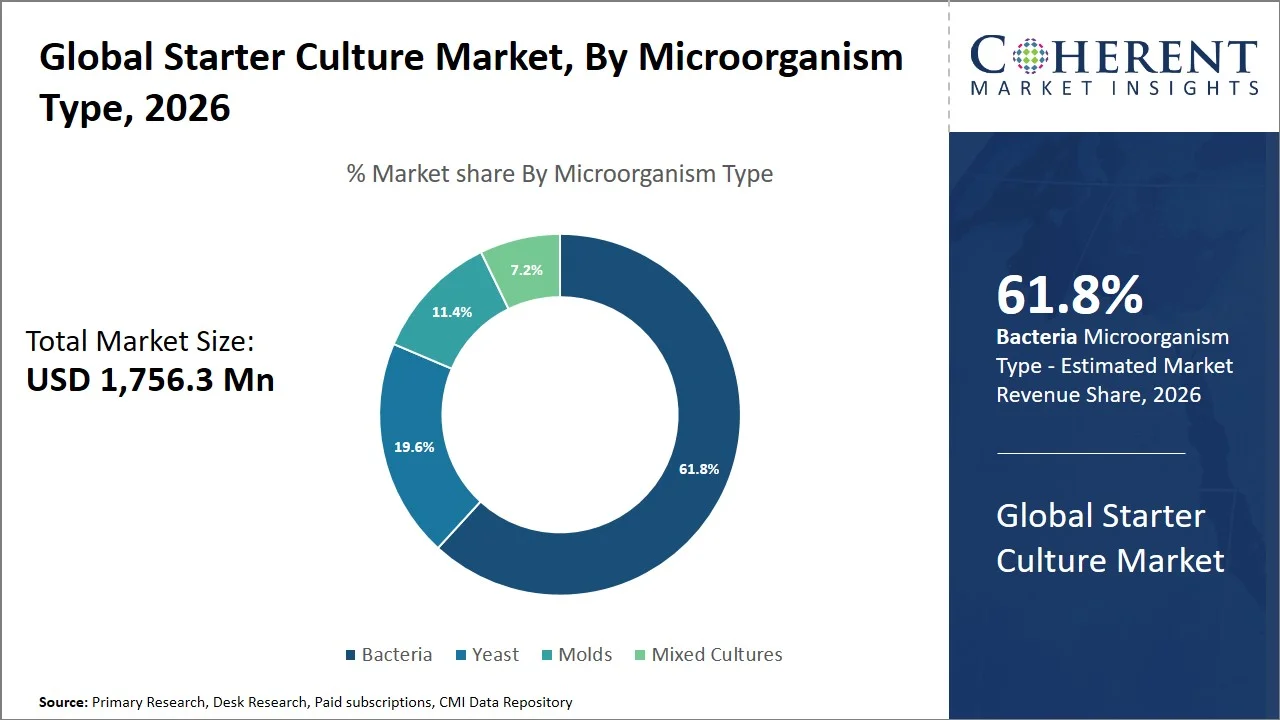
Why Does Bacteria Dominate the Global Starter Culture Market?
Bacteria is expected to dominate the global starter culture market with 61.8% share in 2026, as bacterial cultures provide the core biological functionality required in cheese, yogurt, fermented meats, sour cream, buttermilk, and plant-based fermented products. Their leadership is linked to broad end-use flexibility, predictable fermentation behavior, and strong compatibility with industrial-scale food manufacturing. Demand is reinforced by processors seeking repeatable taste, color, safety, and texture outcomes across large batches. On the supply side, bacterial strain selection, rotation systems, and protective culture development have improved process control and reduced fermentation failures. In July 2025, Nordmann highlighted Sacco System’s Lyocarni meat starter cultures, including selected Lactobacillus, Pediococcus, and Staphylococcus strains for salami, sausage, hamburgers, and matured meat products. (Source: Nordmann, Rassmann GmbH)
- Current Industry Events of 2026
- Market Size Estimation
- Regional Breakdown
- Competitive Landscape
- Customer Intelligence
- Segmental Analysis
- Pricing Analysis
- Key Market Drivers, Challenges & Future Trends
- Customized Insights Section
Why Do Freeze Dried Starter Cultures Represent the Largest Form Segment in the Global Starter Culture Market?
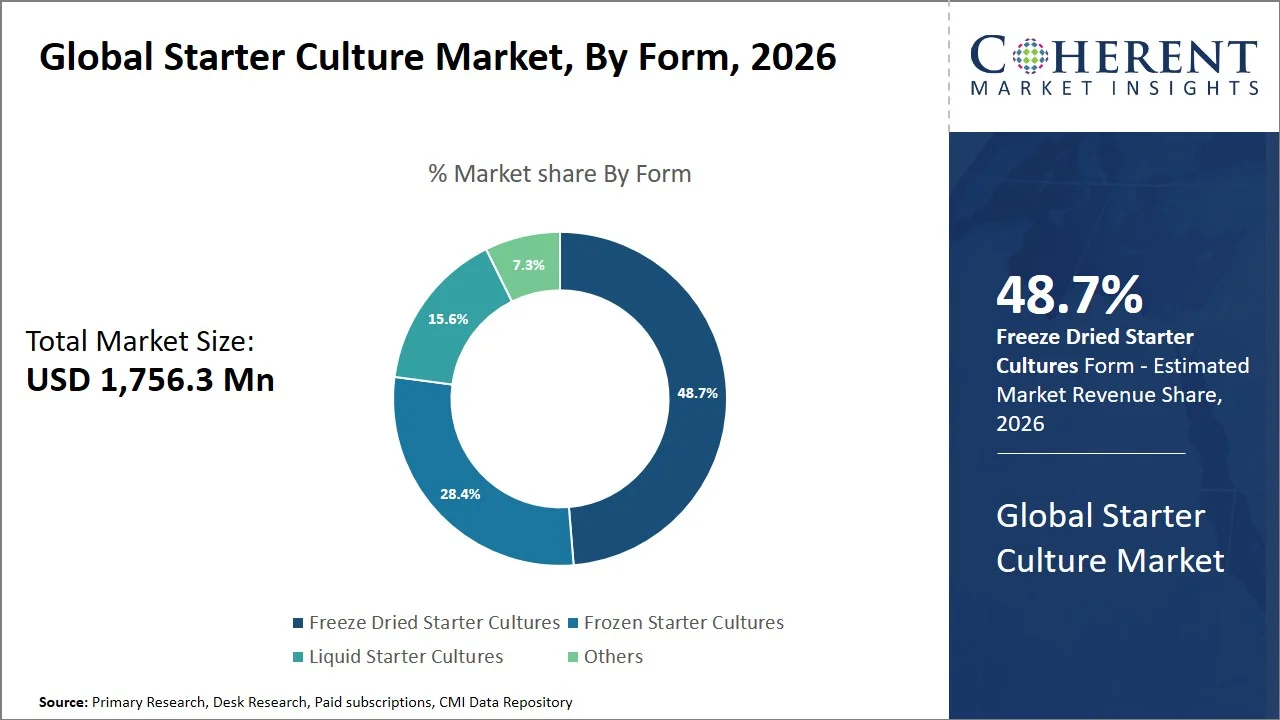
Freeze dried starter cultures are expected to represent the largest form segment, accounting for 48.7% of the market share in 2026, because they support direct-to-vat use, easier transport, controlled dosing, and better inventory planning for food manufacturers. Their dominance is especially important for global dairy and fermented food companies that operate multiple production sites and require standardized culture performance without maintaining complex in-house propagation systems. Demand is the strongest in yogurt, kefir, cheese, sour cream, and functional fermented beverages where consistency and microbial viability are commercially critical. Supply-side gains come from lyoprotectant optimization, microbial stabilization, and strain-blend customization. In October 2025, Frontiers in Microbiology published a study showing freeze-dried kefir starter cultures could recreate fresh-culture fermented kefir with comparable microbial counts, organic acid profiles, and volatile profiles. (Source: Frontiers Media SA)
Why Does Acidification Dominate the Global Starter Culture Market?
Acidification is expected to dominate the global starter culture market with 34.8% share in 2026, as it is the primary functional step that converts raw substrates into stable fermented foods. In dairy processing, controlled acid development supports curd setting, whey separation, rennet efficiency, flavor base formation, and microbial safety. Controlled acid development aids in curd setting, whey separation, rennet efficiency, flavor base formation and microbiological safety during the dairy processing. It is a function that has a direct impact on processing time, reduction of defects, uniformity of products and cost control for the manufacturers. The acidification curve needs to be consistent throughout changes in milk composition, seasonality and varying plant conditions, and this is why demand is high from industrial milk dairy processors and fermented food manufacturers alike. Technologically, strong culture blends are becoming more and more developed with the aim of better fermentation in less time, with less waste, and with more predictability. In July 2024, BDF Natural Ingredients launched specialized starter cultures for low-fat yogurt and sour cream, emphasizing enhanced fermentation control, stable texture, and scalable performance. (Source: BDF Ingredients)
Global Starter Culture Market Dynamics
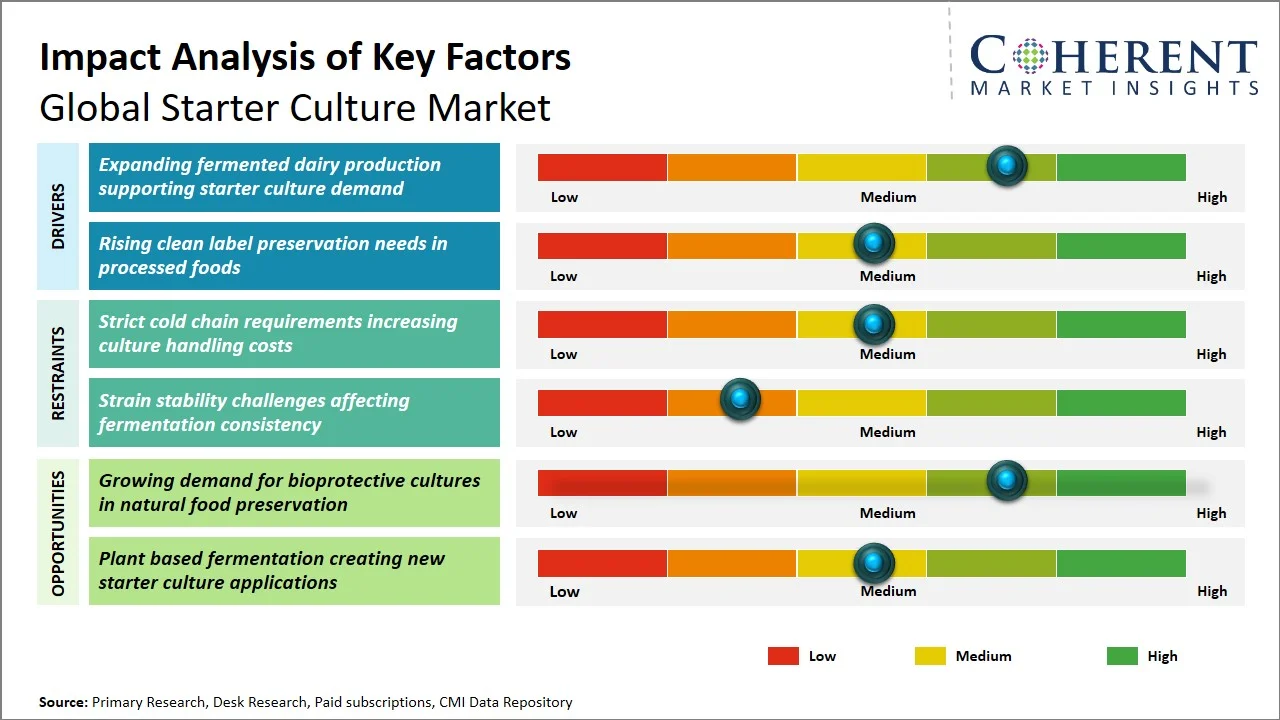
Key Market Drivers
- Expanding Fermented Dairy Production Supporting Starter Culture Demand
Standardized microbial performance is required for industrial production of fermented dairy which is the key demand base for starter cultures. Manufacturers are moving away from traditional back-slopping and towards systems that are defined to minimize batch failure, increase flavor consistency, control fermentation time and manage phage related production disruptions. Especially relevant for big dairy processors with many plants and recipes in several regions. In August 2025, Novonesis reported Q2 2025 launches including YoFlexSatya, a new dahi culture series for phage management and production stability, and Easy-SetA3000, phage-robust starter cultures for cheese production flexibility. (Source: Novonesis)
- Rising Clean-Label Preservation Needs in Processed Foods
Food companies are using starter and protective cultures as functional ingredients to satisfy the shelf-life, spoilage, and pathogen-control challenges without relying on artificial preservatives. This driver is particularly relevant in fermented meat, dairy, plant-based and ready-to-eat foods, where consumers are looking for simpler food and regulatory and retail requirements are tougher on the microbiological control. Culture-based preservation also has a significant benefit for processors in terms of fewer recalls, better cold-chain performance, and “natural” safety positioning. In March 2026, Lallemand Specialty Cultures highlighted bioprotective solutions for meat and dairy at CFIA 2026, including LALCULTProtect PA+ for dry fermented sausages and LALCULTProtect CM+ for fresh meat Listeria control. (Source: Lallemand Inc)
Emerging Market Trends
- Regionalization of Starter Culture Portfolios
Starter culture suppliers are increasingly creating culture systems for regional fermented foods products and not just global dairy or meat. Local products like dahi, drinking yogurt, specialty cheeses, fermented sausages, sourdough and plant-based fermented foods have varying acidification curves, flavor characteristics, texture attributes, and processing tolerances and hence commercial importance. Regional culture customization enhances consumer acceptance, provides a premium positioning and mitigates sensory mismatch between markets for the manufacturers. It also enables suppliers to establish greater customer loyalty by providing application support, pilot testing, as well as recipe-specific strain blends. The competition has changed from culture supply volume to technical service formulation partnerships.
- Multi-Functional Cultures Replacing Single-Purpose Fermentation Inputs
The market is transitioning to the use of starter cultures that provide more than acidification such as texture control, flavor and ripening support, shelf-life extension and even bioprotection. This trend lowers the need for several additive systems and simplifies formulation for food producers to enhance processing efficiencies. Multi-functional cultures are especially important for premium clean-label products, fermented meat and plant-based alternatives, or dairy products where sensory quality and safety have to be preserved at the same time. In a business sense, these cultures offer increased supplier profit margins, better production economics for end users and increased differentiation in mature food categories where basic fermentation performance is no longer sufficient.
Current Events and their Impact
Current Events | Description and its Impact |
January 2026 – EFSA Updated QPS List for Microorganisms |
|
August 2025 – FDA GRAS No-Questions Letter for Levilactobacillus brevis ATCC SD-7285 |
|
March 2026 – FSSAI Mandatory Registration/License Advisory for Milk Producers and Vendors |
|
Regional Insights
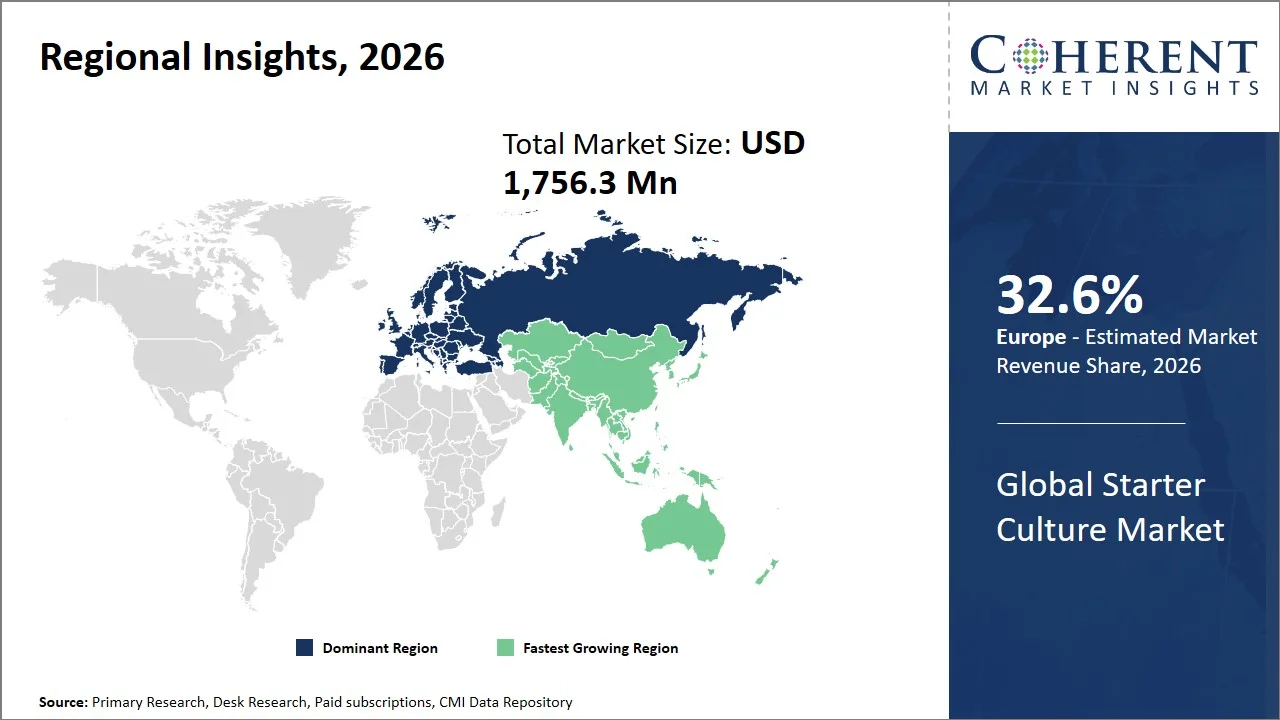
Why Does Europe Dominate the Global Starter Culture Market?
Europe is expected to dominate the global starter culture market with 32.6% share in 2026, supported by its mature cheese, yogurt, fermented milk, and specialty dairy ecosystem. The industry has solid roots in industrial dairy processors, high quality artisan cheese makers, microbial culture development and food traceability and quality control regulatory systems that support standardized quality and traceable food production. Europe has a diverse portfolio of fermented food products, with cultures playing a key role in the acidification, ripening, flavoring and safety aspects of these products, which enhances the demand for starter cultures. Suppliers also benefit from close collaboration with dairy associations, processors, and food technology networks. In March 2026, the European Dairy Association (EDA) published its Annual Report 2025/2026 covering key trade, regulatory, sustainability, and policy developments affecting the EU dairy industry. (Source: European Dairy Association)
Why is Asia Pacific Emerging as the Fastest-Growing Region in the Global Starter Culture Market?
Asia Pacific is expected to be the fastest-growing region, accounting for 28.7% share in 2026, as large consumer markets shift from traditional homemade fermentation toward packaged, standardized, and functional fermented foods. Growth is supported by rising demand for yogurt, dahi, fermented beverages, bakery applications, and modern convenience food formats. Industrial food manufacturers in China, India, Japan, South Korea, and Southeast Asia are increasingly using defined cultures to improve consistency, shelf life, and sensory quality. The region also benefits from expanding food processing infrastructure and faster commercialization of clean-label fermentation solutions. In April 2026, Angel Yeast’s Asia-Pacific business unit showcased protein, bakery, and beverage solutions at FHA Singapore, including yeast systems supporting stable fermentation and industrial bakery performance. (Source: AngelYeast Co., Ltd)
Global Starter Culture Market Outlook for Key Countries
Why is the U.S. a Key Market for the Global Starter Culture Market?
The U.S. is a key market for starter cultures due to its large-scale dairy processing base, strong cheese production, expanding yogurt category, and high use of standardized cultures in industrial food manufacturing. Culture demand is closely linked to cheese, yogurt, sour cream, frozen yogurt, and functional fermented dairy production, where processors require predictable acidification, texture control, and product safety. The country also has a strong regulatory and innovation ecosystem, enabling the commercialization of new microbial ingredients and high-protein fermented dairy formats. In April 2026, USDA NASS reported that U.S. February 2026 total cheese output reached 1.16 billion pounds, while plain and flavored yogurt production reached 447.0 million pounds, supporting strong culture demand across dairy applications.
Why is India Important in the Global Starter Culture Market?
India is important in the global starter culture market because fermented dairy is deeply embedded in daily consumption through dahi, lassi, chhaach, shrikhand, flavored yogurt, and probiotic dairy products. The country’s transition from household-level fermentation to organized dairy processing is increasing demand for reliable cultures that can deliver consistent texture, taste, acidity, and shelf life across regional product formats. Industrial adoption is also supported by quick-commerce, modern retail, and premium dairy brands targeting health-conscious consumers. In February 2026, Reuters reported that Milky Mist planned a 2026 IPO and was betting on premium products such as Greek yogurt and protein-enhanced cottage cheese, reflecting India’s move toward value-added fermented dairy formats.
Why Does China Support Growth in the Global Starter Culture Market?
China supports growth in the global starter culture market through its large dairy consumer base, growing preference for functional foods, and shift toward premium, high-protein, and low-sugar fermented dairy formats. While conventional ambient yogurt has faced pressure from health concerns over sugar and preservatives, this creates an opportunity for cleaner, better-controlled starter culture systems that support fresh, functional, and differentiated products. Local processors are also investing in product upgrades to move beyond basic drinking milk into cheese, yogurt, and health-positioned dairy. Agriculture and Agri-Food Canada’s 2026 sector trend analysis reported that Chinese dairy retail sales were valued at US$ 47.9 billion in 2025, with drinking milk and yogurt remaining the dominant categories, followed by cheese.
Why is Germany a Strategic Country in the Global Starter Culture Market?
Germany is a strategic country in the global starter culture market due to its advanced dairy manufacturing base, high food quality standards, and strong role in Europe’s processed dairy value chain. The country’s cheese, yogurt, sour cream, and fermented milk producers require highly reliable bacterial and mixed cultures to meet strict consistency, safety, labeling, and process-efficiency expectations. Germany is also important for culture suppliers because technology-driven dairy regulations push processors toward better documentation, standardized specifications, and traceable microbial inputs. In March 2025, Germany notified the European Commission of an ordinance adapting dairy product legislation to EU law and technological developments, replacing several dairy rules with a broader dairy product quality ordinance.
Why is France an Important Growth Market for the Global Starter Culture Market?
France is an important growth market for starter cultures because of its strong cheese heritage, broad dairy processing infrastructure, and premium fermented dairy positioning. The country’s culture demand is linked not only to industrial dairy output but also to protected-origin cheeses, specialty fermented milk, and premium products requiring controlled ripening, flavor development, and microbial safety. France also serves as a reference market for high-quality fermentation practices, where starter cultures support both standardization and sensory differentiation. In September 2025, Salon du Fromage cited CNIEL’s 2025 dairy economy report showing France had 23 billion liters of milk collected and processed across 740 sites, highlighting the scale of its dairy processing base.
Technology Adoption Landscape in the Global Starter Culture Market
Technology | Adoption Level | Key Application Area | Business Impact |
Freeze-drying / Lyophilization | High | Dairy, meat, bakery, and beverage starter culture production | Improves shelf life, global shipment feasibility, inventory control, and direct-to-vat usability. |
Direct-to-vat Culture Systems | High | Industrial dairy and cheese processing | Reduces in-house propagation risk, improves batch consistency, and shortens production preparation time. |
Whole-Genome Sequencing | Medium-High | Strain identification, safety screening, and regulatory documentation | Strengthens traceability, safety validation, and strain-level differentiation for premium suppliers. |
Phage Monitoring and Rotation Systems | Medium-High | Cheese, yogurt, dahi, and fermented milk production | Minimizes fermentation failure, protects production uptime, and improves culture resilience. |
Controlled Fermentation Bioreactors | High | Commercial culture biomass production | Supports scalable microbial production, tighter quality control, and lower batch-to-batch variability. |
Microencapsulation and Stabilization Systems | Medium | Probiotic, functional, and harsh-process fermented foods | Protects microbial viability, improves performance during storage, and supports premium product claims. |
How are Clean-Label Bioprotection and Regional Fermentation Platforms Creating New Growth Opportunities in the Global Starter Culture Market?
Clean-label bioprotection and regional fermentation platforms are creating attractive growth opportunities by expanding starter cultures beyond basic dairy fermentation into broader food safety, shelf-life, and product differentiation roles. Food manufacturers are under pressure to reduce synthetic preservatives while maintaining safety and commercial shelf life across chilled dairy, fermented meats, bakery, plant-based foods, and ready-to-eat products. This creates room for culture suppliers to offer application-specific microbial blends that control spoilage, improve sensory stability, and support simpler ingredient declarations. At the same time, regional fermentation platforms allow companies to serve local taste profiles and traditional food formats with industrial-grade consistency. Suppliers that combine strain libraries, application labs, regulatory documentation, and co-development support can capture higher-value contracts. The strongest opportunity lies in positioning starter cultures as strategic formulation tools rather than commodity fermentation inputs.
Market Players, Key Development, and Competitive Intelligence
Key Developments
- In September 2025, dsm-firmenich launched four new Dairy Safe culture rotations for semi-hard, hard, and continental-style cheese varieties. The all-in-one cultures focus on label-friendly bioprotection, stronger phage robustness, temperature resistance, controlled eye formation, consistent acidification, and enhanced flavor development, supporting clean-label cheese production.
- In June 2025, IFF launched CHOOZIT LIFT, a first-of-its-kind cheese culture for semi-hard cheese production. The culture eliminates the curd-washing step, helping reduce water and energy use while maintaining product quality, making it highly relevant for sustainable and cost-efficient cheesemaking.
Competitive Landscape
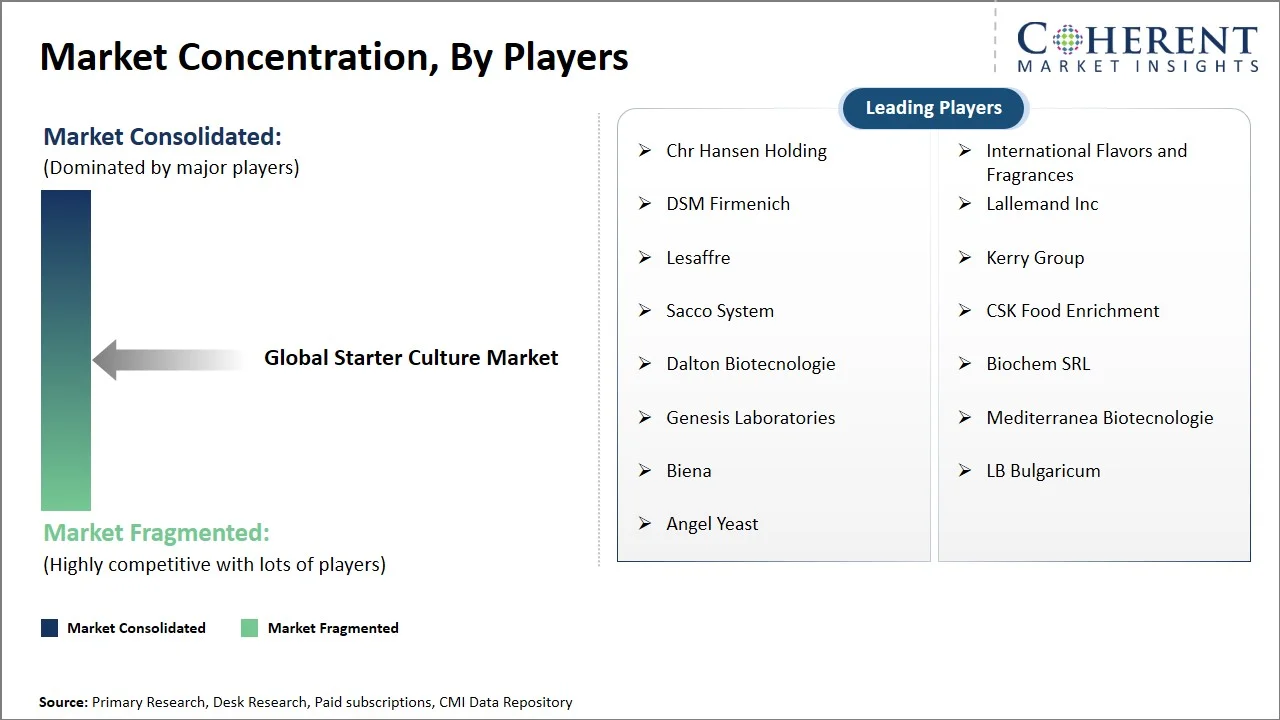
The global starter culture market is relatively consolidated at the technology and global supplier levels with regional and specialty culture niches fragmented. Strain libraries, application support, regulatory capabilities, and industrial-scale culture production are the factors on which large bioscience companies compete, while regional companies specialize in the specialty, dairy, meat, bakery and artisanal fermentation applications.
Key focus areas include
- Product quality and differentiation: Companies compete on strain performance, culture stability, flavor output, texture contribution, and safety functionality.
- Technology adoption and process efficiency: Suppliers with advanced fermentation, freeze-drying, phage-control, and strain-screening capabilities gain stronger customer retention.
- Pricing and cost competitiveness: Industrial food manufacturers evaluate cultures based on dose efficiency, batch reliability, and total production cost impact.
- Capacity expansion and supply reliability: Consistent supply of freeze-dried and frozen cultures is critical for multinational dairy and food processors.
- Certifications, compliance, and quality control: Regulatory documentation, traceability, halal, kosher, non-GMO, and allergen-related compliance influence supplier selection.
- Product format and specification differentiation: Freeze-dried, frozen, liquid, single-strain, mixed-strain, and protective culture formats support different end-use requirements.
- Partnerships and co-development: Application support, pilot trials, and formulation collaboration are becoming key competitive tools.
- Clean-label and specialty positioning: Bioprotection, organic-compatible cultures, plant-based fermentation, and regional food cultures are emerging as premium focus areas.
Market Report Scope
Starter Culture Market Report Coverage
| Report Coverage | Details | ||
|---|---|---|---|
| Base Year: | 2025 | Market Size in 2026: | USD 1,756.3 Mn |
| Historical Data for: | 2020 To 2024 | Forecast Period: | 2026 To 2033 |
| Forecast Period 2026 to 2033 CAGR: | 6.60% | 2033 Value Projection: | USD 2,747.3 Mn |
| Geographies covered: |
| ||
| Segments covered: |
| ||
| Companies covered: | Chr Hansen Holding, International Flavors and Fragrances, DSM Firmenich, Lallemand Inc, Lesaffre, Kerry Group, Sacco System, CSK Food Enrichment, Dalton Biotecnologie, Biochem SRL, Genesis Laboratories, Mediterranea Biotecnologie, Biena, LB Bulgaricum, and Angel Yeast | ||
| Growth Drivers: |
| ||
| Restraints & Challenges: |
| ||
Analyst Opinion (Expert Opinion)
- The global starter culture market is expected to maintain steady expansion as food manufacturers move toward standardized fermentation, cleaner labels, and microbial solutions that improve product consistency. The market outlook is the strongest where starter cultures deliver measurable operational value, such as reduced spoilage, faster fermentation, improved sensory quality, and lower batch failure risk.
- The strongest growth pockets are likely to emerge in freeze-dried cultures, bacterial starter systems, bioprotective cultures, plant-based fermented foods, regional dairy formats, and Asia Pacific food processing expansion. Industrial food manufacturers and dairy processors will remain the most commercially important end user due to scale, repeat purchase behavior, and high dependence on fermentation consistency.
- Key risks include phage contamination, strain-performance variability, regulatory uncertainty for novel microbial applications, cold-chain dependence for some formats, and pricing pressure from cost-sensitive processors. Market players should focus on application-specific culture blends, documented safety, technical service, regional formulation support, and clean-label bioprotection to gain competitive advantage.
Speak to the analyst
Want personalized insights?
Take the findings above to one of our principal consultants, or have the report rebuilt around the segments, geographies and competitors you actually track.
Market Segmentation
- Microorganism Type Insights (Revenue, USD Mn 2021 - 2033)
- Bacteria
- Yeast
- Molds
- Mixed Cultures
- Form Insights (Revenue, USD Mn 2021 - 2033)
- Freeze Dried Starter Cultures
- Frozen Starter Cultures
- Liquid Starter Cultures
- Others
- Function Insights (Revenue, USD Mn 2021 - 2033)
- Acidification
- Flavor Development
- Texture Enhancement
- Preservation and Bioprotection
- Ripening
- Others
- End User Insights (Revenue, USD Mn 2021 - 2033)
- Industrial Food Manufacturers
- Dairy Processors
- Bakery and Beverage Manufacturers
- Meat Processors
- Artisanal and Small Scale Producers
- Regional Insights (Revenue, USD Mn 2021 - 2033)
- North America
- U.S.
- Canada
- Latin America
- Brazil
- Argentina
- Mexico
- Rest of Latin America
- Europe
- Germany
- U.K.
- Spain
- France
- Italy
- Russia
- Rest of Europe
- Asia Pacific
- China
- India
- Japan
- Australia
- South Korea
- ASEAN
- Rest of Asia Pacific
- Middle East
- GCC Countries
- Israel
- Rest of Middle East
- Africa
- South Africa
- North Africa
- Central Africa
- North America
Sources
Primary Research Interviews
- Dairy processors and fermented milk product manufacturers
- Cheese, yogurt, kefir, sour cream, buttermilk, and dahi manufacturers
- Bakery and sourdough fermentation product manufacturers
- Meat processors using cultures for fermented sausages and cured meat products
- Beverage manufacturers producing fermented drinks and functional beverages
- Starter culture manufacturers and microbial ingredient suppliers
- Food technologists, fermentation scientists, microbiologists, and R&D heads
- Quality assurance managers and food safety officers in dairy, bakery, meat, and beverage companies
- Distributors and importers of freeze-dried, frozen, and liquid starter cultures
- Artisanal cheese makers, small-scale fermented food producers, and contract food manufacturers
Stakeholders
- Starter culture producers: Novonesis, International Flavors and Fragrances, dsm-firmenich, Lallemand Inc., Lesaffre, Kerry Group, Sacco System, CSK Food Enrichment, Dalton Biotecnologie, Biochem SRL, Genesis Laboratories, Mediterranea Biotecnologie, Biena, LB Bulgaricum, Angel Yeast
- Dairy processors and fermented dairy manufacturers producing cheese, yogurt, dahi, kefir, sour cream, and fermented milk products
- Bakery and sourdough manufacturers using yeast and lactic acid bacteria cultures
- Meat processors using cultures for fermented sausages, salami, dry-cured meats, and bioprotection
- Beverage manufacturers producing kombucha, fermented drinks, probiotic beverages, and functional dairy drinks
- End-use sectors: Dairy processing, bakery, meat processing, beverages, plant-based fermented foods, probiotics, and artisanal fermented food production
- Supporting ecosystem: Food ingredient distributors, cold-chain logistics providers, microbial testing laboratories, packaging companies, fermentation equipment suppliers, and contract manufacturing organizations
- Regulatory and certification bodies: FDA, EFSA, FSSAI, European Commission, Codex Alimentarius, FAO, WHO, USDA, Health Canada, Food Standards Australia New Zealand, and Japan MHLW
Databases
- FAOSTAT – dairy, milk, livestock, and food production data
- Eurostat – dairy production, milk collection, cheese, yogurt, and fermented dairy statistics
- USDA NASS – U.S. dairy products, cheese, yogurt, milk, and processed food production data
- USDA ERS – dairy, food processing, and consumption outlook data
- FDA GRAS Notices Inventory – microbial strains and food ingredient safety notices
- EFSA Qualified Presumption of Safety (QPS) List – safety assessment of microorganisms used in food and feed
- European Commission Food Safety Database – food additives, enzymes, microorganisms, and regulatory updates
- UN Comtrade Database – international trade data for yeasts, food cultures, enzymes, and microbial preparations
- ITC Trade Map – import/export flows of yeasts, microbial cultures, and fermentation ingredients
- OECD-FAO Agricultural Outlook – dairy, food consumption, and processed food demand outlook
- FSSAI Food Safety Compliance System – food safety, dairy, and fermented food regulatory information
- Health Canada List of Permitted Food Enzymes and Microbial Cultures
- PubMed / NCBI – scientific studies on starter cultures, lactic acid bacteria, yeast, molds, probiotics, and fermentation
Magazines / Industry Publications
- Dairy Foods
- Dairy Reporter
- Food Ingredients First
- Food Business News
- Food Engineering
- Food Manufacture
- FoodNavigator
- Dairy Industries International
- New Food Magazine
- Baking Business
- Meat + Poultry
- The World of Food Ingredients
- International Dairy Magazine
- Cheese Market News
- Food Technology Magazine
- Beverage Daily
Journals
- International Dairy Journal
- Journal of Dairy Science
- Food Microbiology
- International Journal of Food Microbiology
- Frontiers in Microbiology
- LWT – Food Science and Technology
- Food Control
- Journal of Food Science\Applied and Environmental Microbiology
- Miroorganisms
- Fermentation
- Foods
- Meat Science
- Food Research International
- Journal of Applied Microbiology
- Comprehensive Reviews in Food Science and Food Safety
Newspapers
- Financial Times – food ingredients, dairy, food processing, and supply chain trends
- The Wall Street Journal – packaged food, dairy, and food inflation developments• The Hindu BusinessLine – India dairy, food processing, and ingredient sector developments
- Economic Times – India food processing, dairy, and FMCG market updates
- Les Echos – Europe food industry and dairy sector developments
Associations
- International Dairy Federation
- European Dairy Association
- U.S. Dairy Export Council
- National Milk Producers Federation
- American Dairy Products Institu
- Dairy Management Inc.
- European Food and Feed Cultures Association
- International Probiotics Association
- Specialty Food Association
- Institute of Food Technologists
- International Association for Food Protection
- American Society for Microbiology
- Federation of European Microbiological Societies
- International Scientific Association for Probiotics and Prebiotics
- Codex Alimentarius Commission
- Global Dairy Platform
Public Domain Sources
- FDA – GRAS notices, food ingredient safety, microbial culture approvals, and food safety regulations
- EFSA – Qualified Presumption of Safety assessments, microbial safety opinions, and food safety guidance
- European Commission – food safety law, dairy standards, labeling rules, and food ingredient regulations
- FAO – dairy production, fermented foods, food security, and agriculture statistics
- WHO – food safety, nutrition, antimicrobial resistance, and foodborne disease information
- USDA – dairy production, cheese, yogurt, milk processing, and food manufacturing data
- USDA NASS – monthly and annual dairy product production statistics
- USDA ERS – dairy market outlook, food consumption, and processing industry analysis
- FSSAI – India food safety standards, dairy regulations, fermented food guidance, and licensing updates
- Health Canada – microbial food ingredient and probiotic regulatory information
- Food Standards Australia New Zealand – food standards, microbial safety, and fermented food regulation
- Japan Ministry of Health, Labour and Welfare – food safety, fermented food, and microbial ingredient regulations
- Codex Alimentarius – international food safety standards, hygiene codes, dairy standards, and labeling guidance
Proprietary Elements
- CMI Data Analytics Tool
- Proprietary CMI Existing Repository of information for the last 10 years
Get access to 250+ pages report
Every segment, forecast, competitor profile and data table behind the analysis above — available for instant download.
- ESOMAR Member
- ISO 9001:2015 Certified
- D-U-N-S Registered
- GDPR & CCPA Compliant
Missing comfort of reading report in your local language? Find your preferred language:
Transform your Strategy with Exclusive Trending Reports
Frequently Asked Questions
The CAGR of the global starter culture market is projected to be 6.60% from 2026 to 2033.
The global starter culture market is estimated to be valued at USD 1,756.3 Mn in 2026 and is expected to reach USD 2,747.3 Mn by 2033.
Starter cultures help control fermentation, improve flavor, texture, acidity, shelf life, and product safety in dairy, meat, bakery, and beverage applications.
Freeze-dried starter cultures are preferred due to longer shelf life, easy transportation, stable microbial viability, and suitability for large-scale industrial food production.
Clean-label demand is encouraging manufacturers to use starter and protective cultures as natural solutions for preservation, spoilage control, and product quality improvement.
Expanding fermented dairy production supporting starter culture demand and rising clean label preservation needs in processed foods are the major factors driving the growth of the global starter culture market.
Strict cold chain requirements increasing culture handling costs and strain stability challenges affecting fermentation consistency are the major factors hampering the growth of the global starter culture market.