

Global Sushi Making Machine Market Size and Forecast – 2026-2033
The global sushi making machine market is estimated to be valued at USD 169.8 Mn in 2026 and is expected to reach USD 267.3 Mn by 2033, exhibiting a compound annual growth rate (CAGR) of 6.7% from 2026 to 2033.
Key Takeaways of the Global Sushi Making Machine Market
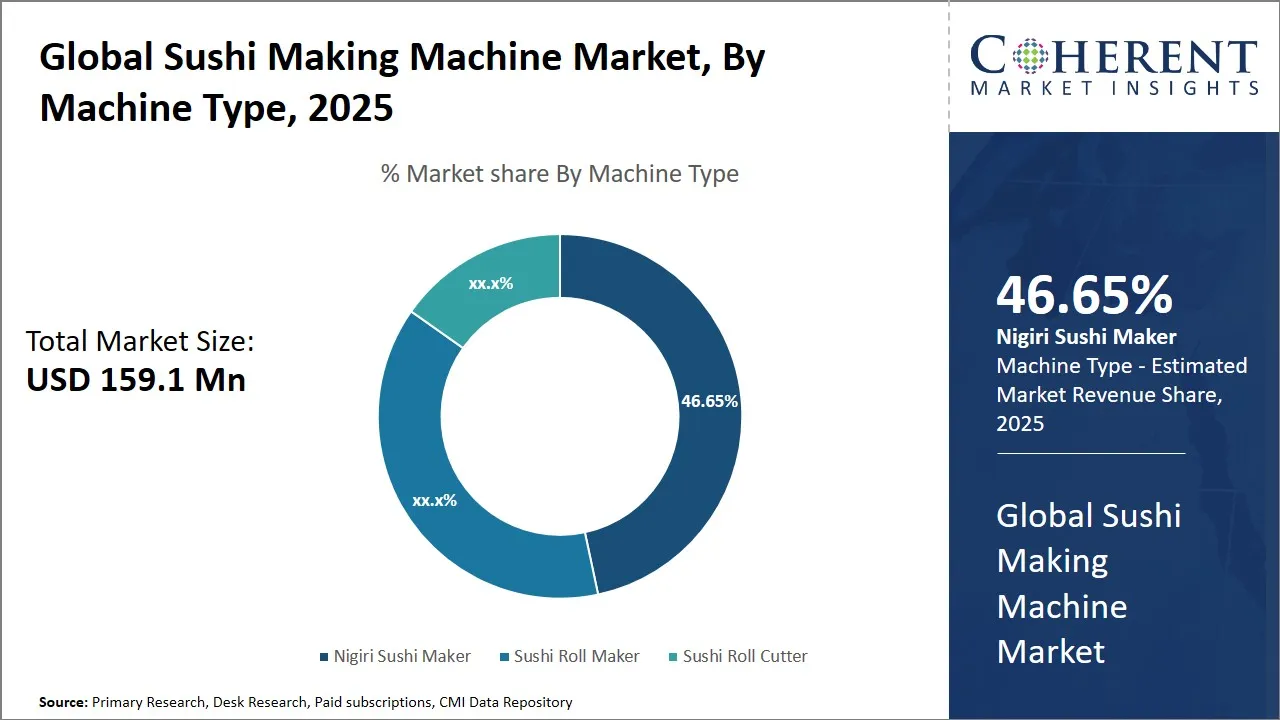
- The nigiri sushi maker segment leads the market holding an estimated share of 47.7 % in 2026.
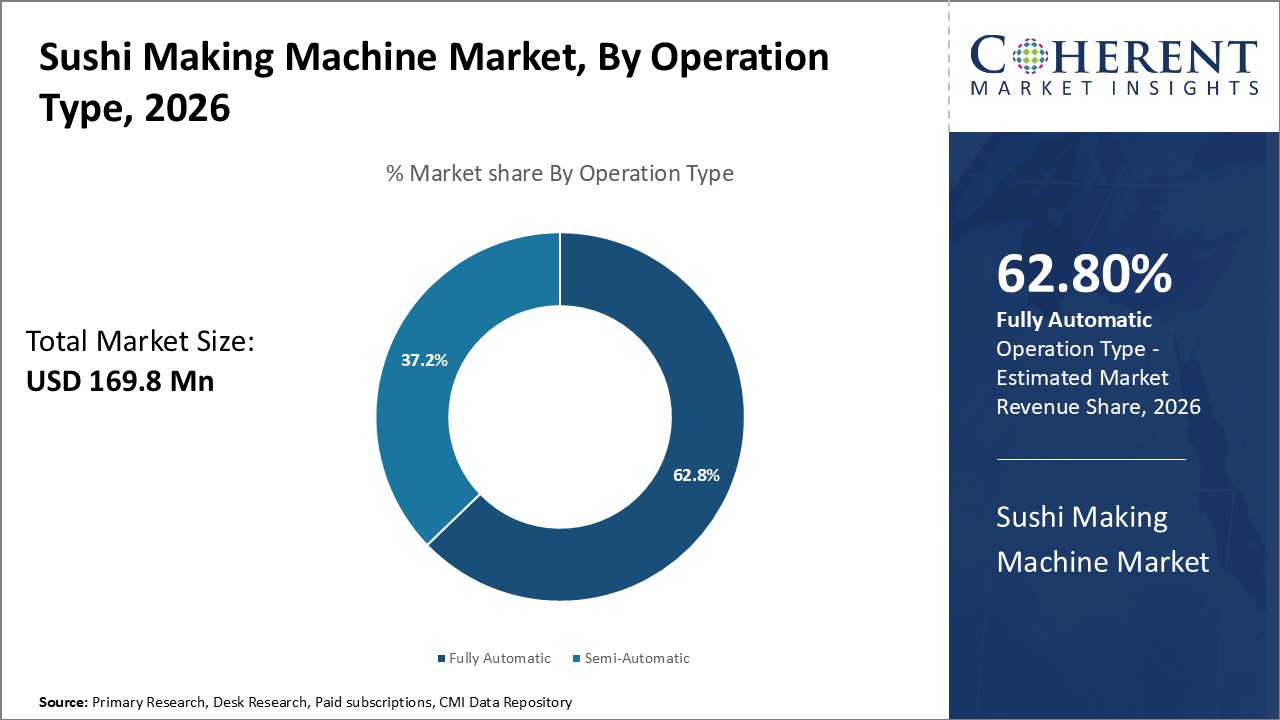
- The fully automatic segment is projected to dominate with a share of 62.8 % in 2026.
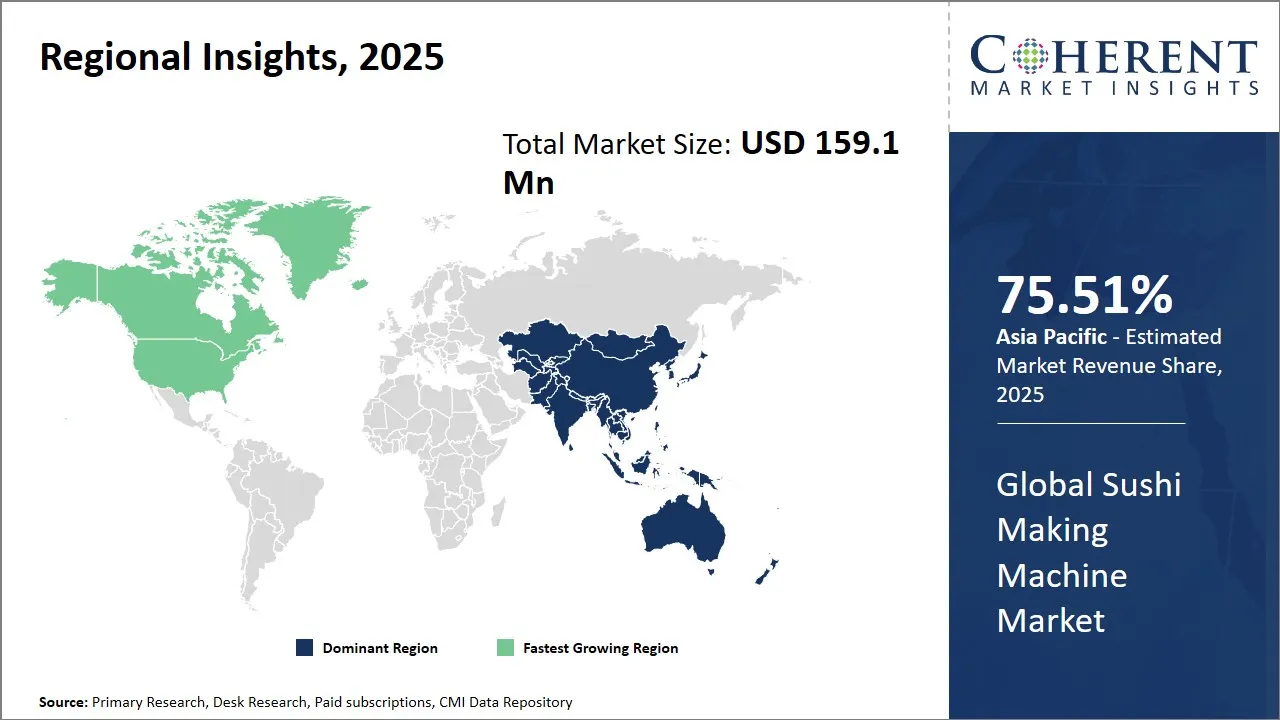
- Asia Pacific is estimated to lead the market with a share of 75.51 % in 2026.
- North America, holding an estimated share of 10.22% in 2026, and it is projected to be the fastest growing region.
Market Overview
The market is seeing the use of advanced robotics and AI technology in sushi making machines, improving precision and production speed and reducing labor costs. Also, growing health consciousness and demand for fresh, customizable sushi options are pushing manufacturers to innovate with automated machines that can meet different consumer preferences. Expansion in emerging markets and strategic collaborations between machine manufacturers and restaurant chains also add to sustained the market growth.
Current Events and Its Impact
Current Events | Description and its Impact |
Market Expansion in North America |
|
European Trade-Show Presence |
|
Supply-Chain and Component Cost Fluctuations |
|
Segmental Insights
- Current Industry Events of 2026
- Market Size Estimation
- Regional Breakdown
- Competitive Landscape
- Customer Intelligence
- Segmental Analysis
- Pricing Analysis
- Key Market Drivers, Challenges & Future Trends
- Customized Insights Section
Global Sushi Making Machine Market Insights, by Machine Type – Nigiri Sushi Maker Leads Because of its Specialized Functionality and Rising Consumer Demand for Authentic Sushi Experiences
The nigiri sushi makers segment is projected to account for 47.7% of the global sushi making machine market share in 2026. This is because of the growing popularity of nigiri sushi, which is one of the most traditional and favored sushi styles worldwide. Nigiri, consisting of hand-pressed rice topped with a slice of fish or seafood, needs precision and consistency to maintain its delicate texture and balance of flavors. Nigiri sushi makers are designed specifically to replicate the hand-pressing technique with high accuracy, offering uniformity in portion sizes and shape. This appeals strongly to sushi chefs and establishments that want to maintain quality while increasing efficiency. Also, the machine’s ability to improve hygiene standards by minimizing direct hand contact during preparation aligns with the heightened consumer awareness around food safety and cleanliness.
Also, restaurants and hospitality venues are adopting nigiri sushi makers to meet evolving consumer expectations for fresh, high-quality sushi presented with an artisanal touch. This shows a broader trend of premiumization in the foodservice sector, where diners show more willingness to pay for authentic and well-crafted dishes. The machine’s role in reducing labor-intensive processes while maintaining the craftsmanship associated with nigiri preparation makes it a valuable investment.
Global Sushi Making Machine Market Insights, by Operation Type – Fully Automatic Segment Lead Because of Demand for Automation, Efficiency, and Consistency in Sushi Production
The fully automatic segment is expected to hold the largest share of 62.8% in 2026, because of the increasing need to optimize kitchen operations amid labor shortages and growing demand for sushi products globally. Fully automatic machines offer end-to-end processing capabilities, handling everything from rice shaping to fish placement and cutting with minimal human intervention. This greatly reduces manpower requirements, lowering operational costs and allowing businesses to address frequent issues related to manual variability and fatigue. The ability to maintain consistent quality and speed in sushi production improves customer experience, especially in high-traffic environments where volume and precision are very important.
Also, the rise of fast-casual dining and quick service restaurant formats serving sushi has added to the adoption of fully automatic machines. These establishments look to provide fast service and need machinery that can churn out large quantities of sushi efficiently without compromising on presentation or taste. Fully automatic machines meet these expectations by combining precision engineering with programmable settings, making them adaptable for different sushi styles and portion sizes. The use of smart technology and user-friendly interfaces also supports operational control, minimizing errors and allowing easy maintenance.
Suzumo, a pioneer in sushi robotics, has partnered with major U.S. grocery chains like Whole Foods Market and Kroger to deploy fully automatic nigiri and maki roll machines. These machines handle rice molding, fish placement, and roll cutting with minimal staff, supporting high-volume production for in-store sushi counters and ready-to-eat food sections. Health and safety regulations also add to the preference for fully automatic machines in food preparation. With automated processes reducing direct human contact, the risk of contamination is lowered by a lot, an especially important consideration in light of recent global health concerns. This builds confidence in both consumers and regulatory bodies, encouraging broader adoption in different foodservice sectors.
Pricing Analysis of the Sushi Making Machine Market
Product/Typical model (category) | Typical price range (USD) |
Compact roll sushi machine (Suzumo SVR-BXA/SVR-NYA class) | USD 15,000 – USD 28,000 |
High-capacity/industrial roll machine (Suzumo/Chinese OEMs) | USD 9,000 – USD 35,000 |
AUTEC Maki maker (ASM890A) | USD 18,000 – USD 28,000 |
Fully/automated nigiri maker (Suzumo/other branded) | USD 6,000 – USD 20,000 |
Semi-automatic/on-demand nigiri & small robots (non-branded/CN suppliers) | USD 4,000 – USD 10,000 |
Onigiri/rice-ball makers (AUTEC ASM575A and similar) | USD 6,000 – USD 18,000 |
Roll cutter (automatic multi-blade cutters) | USD 1,200 – USD 8,000 |
Compact/“S-Cube” style entry model (compact assemblies & transfer units) | USD 8,000 – USD 20,000 (extrapolated) |
Kaiten/conveyor sushi systems (basic straight) | USD 3,000 – USD 10,000 |
Kaiten/advanced conveyor systems (suspended/smart, per line) | USD 15,000 – USD 60,000+ |
Low-end manual/benchtop molds & simple commercial onigiri makers | USD 600 – USD 1,200 |
Private-label/low-cost Chinese suppliers (Suzumo-style clones) | USD 8,000 – USD 15,000 |
Regional Insights
Asia Pacific Sushi Making Machine Market Analysis and Trends
Asia Pacific region is projected to hold the highest share of 75.51% in 2026, because of the deep-rooted cultural affinity for sushi and the presence of a mature food processing industry. Countries like Japan and South Korea see well-established ecosystems supporting the adoption of sushi making machinery, including strong supplier networks and technical expertise. Government policies in these countries often favor technological innovation in the food sector, giving subsidies and support for automation technologies that improve production efficiency.
Also, trade dynamics in Asia Pacific make possible seamless import and export of raw materials and machinery between neighboring countries, making regional supply chains stronger. Big companies like Suzumo, Mori Seiki, and Ishida add to innovation and product development, making Asia Pacific a hub for advanced sushi making solutions.
North America Sushi Making Machine Market Analysis and Trends
North America, holding an estimated share of 10.22% in 2026, show the fastest growth in the sushi making machine market because of increasing consumer interest in Japanese cuisine, expanding restaurant chains, and rising demand for automated food processing solutions. The market ecosystem here sees a mix of strong retail and foodservice sectors and a high adoption rate of automation technologies. Government incentives focusing on food safety, quality control, and labor optimization push restaurants and food producers to invest in sushi making machinery.
In North America, market participants like Autec and Sushi Machines Inc. contribute a lot by introducing machines tailored to local market needs, focusing hygiene and user-friendliness. The region’s trade policies support the import of Japanese-made machinery, adding to growth and development.
Global Sushi Making Machine Market Outlook for Key Countries
Japan Sushi Making Machine Market Analysis and Trends
Japan is the cornerstone of the sushi making machine market because of its culinary heritage and technological advancements. Japanese companies like Suzumo and Mori Seiki lead the industry by making highly specialized machines that cater to different sushi types, improving operational efficiency and consistency. Japan’s strong industrial base, supportive government policies for automation, and continuous innovation make a supportive environment for sustaining market leadership. Also, exporting sushi making machines from Japan plays a big role in maintaining its dominance on the global stage.
U.S. Sushi Making Machine Market Analysis and Trends
The U.S. sushi making machine market sees fast expansion because of the growing popularity of sushi and fast-casual dining formats. Key players like Autec and Sushi Machines Inc. are very important in driving innovation, offering versatile and scalable solutions suited for large restaurant chains and supermarkets. The U.S. sees favorable regulatory frameworks focusing on food safety, which aligns well with the automated production of sushi. Also, increasing investments in automation and robotics help address labor shortages, adding to market growth in the country.
South Korea Sushi Making Machine Market Analysis and Trends
South Korea sushi making machine market thrives because of the country’s dynamic food culture and growing consumer preference for sushi. Companies like Ishida have established themselves by delivering machines that balance speed and quality, meeting the demands of Korean convenience stores and foodservice outlets. Government initiatives promoting food technology innovation and export-oriented manufacturing also play a big role. Furthermore, South Korea’s strategic geographic location enables efficient supply chain operations across Asia Pacific, boosting its regional influence.
Germany Sushi Making Machine Market Analysis and Trends
Germany is the largest market in Europe sushi making machines because of increasing penetration of Japanese cuisine and advanced food manufacturing practices. The country has a strong machine manufacturing sector, complemented by the presence of distributors and service providers specializing in food automation technologies. German policies supporting Industry 4.0 and high manufacturing standards support the use of sushi making machines in food processing lines. Companies like Meiko and local subsidiaries of global players actively add to the market by customizing equipment to meet stringent European hygiene and quality standards.
Brazil Sushi Making Machine Market Analysis and Trends
Brazil stands out in Latin America as a promising sushi making machine market because of rising urbanization and growing interest in international cuisines. The expansion of Japanese restaurants and sushi chains in metropolitan areas adds to the demand for efficient production technologies. However, trade dynamics, including tariffs and import regulations, present challenges that manufacturers must navigate. Local distributors and global companies collaborate to provide machines adapted to Brazil sushi making machine market conditions. The government’s focus on food safety and quality assurance adds to the adoption in both foodservice and retail sectors.
Market Players, Key Development, and Competitive Intelligence
Key Developments
- In May 2025, Suzumo Machinery Co., Ltd. exhibited its products at the National Restaurant Association Show, the largest trade show for the restaurant and foodservice industry in the U.S. Japanese food culture, including sushi and onigiri, were showcased to restaurant and foodservice businesses through group synergy that combines the know-how and resources accumulated by SIC in North America and the expertise developed by SUZUMO through supporting the overseas expansion of Japanese companies.
- In June 2025, Suzumo Machinery Co., Ltd. exhibited at FOOMA JAPAN 2025, held at Tokyo Big Sight. The overseas version of the Super Compact Sushi Machine, "S-Cube", which was well received last year, was also exhibited and demonstrated.
- In January 2025, AUTEC, a Japan-based commercial sushi robot provider, announced the release of its new maki-maker robot, the ASM890A. The robot produces high-quality rice sheets of various thickness and size for various foods, including sushi rolls, burritos, pizza, tacos and more.
Top Strategies Followed by Sushi Making Machine Market Players
- Established companies dominate the landscape by making a lot of investments in research and development (R&D).
- Suzumo Machinery Co., Ltd., a global leader in sushi making machines, reported a consistent increase in R&D expenditures, reaching USD 2.1 million (¥313) million in 2025. This investment supports the development of advanced models like the SVR-BXA and SVR-NYA, which offer enhanced performance and efficiency.
- Mid-level players in the sushi making machine market use a more cost-conscious approach, wanting to capture price-sensitive yet quality-minded customers.
- AUTEC, known for its high-quality sushi robots, offers models like the ASM890A and ASM895A at competitive prices.
- Small-scale market entrants and niche manufacturers often focus on producing specialized or innovative sushi making machines suited for specific customer needs, like compact units for home use or machines that handle unconventional sushi varieties.
- Sushi Robo, a smaller player in the market, focuses on compact and specialized sushi making machines tailored for small restaurants and kiosks.
Market Report Scope
Sushi Making Machine Market Report Coverage
| Report Coverage | Details | ||
|---|---|---|---|
| Base Year: | 2025 | Market Size in 2026: | USD 169.8 Mn |
| Historical Data for: | 2020 To 2024 | Forecast Period: | 2026 To 2033 |
| Forecast Period 2026 to 2033 CAGR: | 6.7% | 2033 Value Projection: | USD 267.3 Mn |
| Geographies covered: |
| ||
| Segments covered: |
| ||
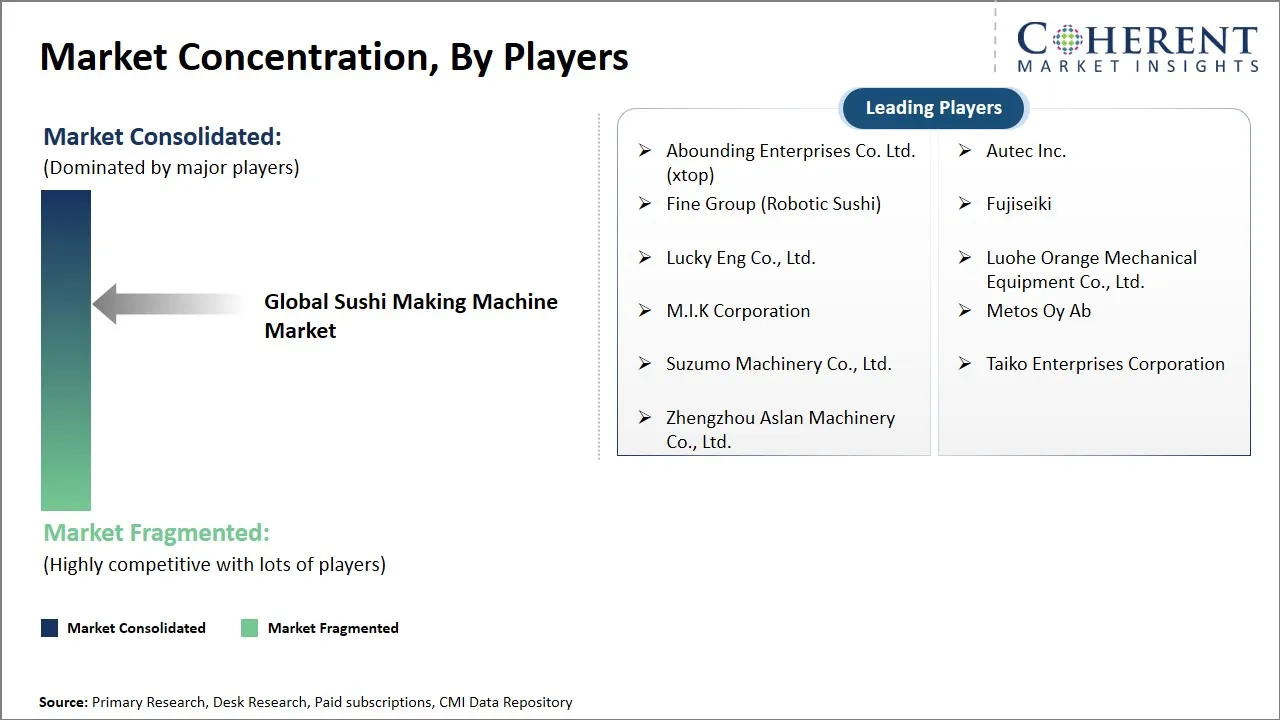
| Companies covered: | Abounding Enterprises Co. Ltd. (xtop), Autec Inc., Fine Group (Robotic Sushi), Fujiseiki, Lucky Eng Co., Ltd., Luohe Orange Mechanical Equipment Co., Ltd., M.I.K Corporation, Metos Oy Ab, Suzumo Machinery Co., Ltd., Taiko Enterprises Corporation, and Zhengzhou Aslan Machinery Co., Ltd. | ||
| Growth Drivers: |
| ||
| Restraints & Challenges: |
| ||
Market Dynamics
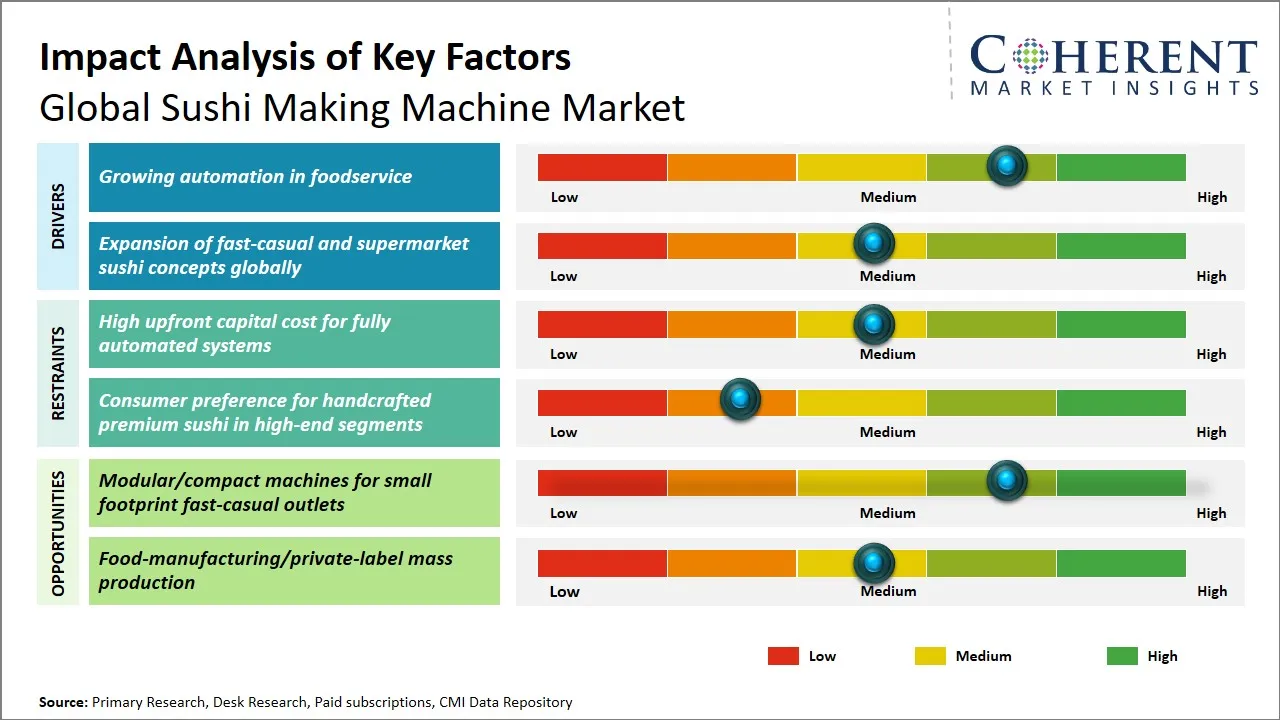
Global Sushi Making Machine Market Driver – Growing Automation in Foodservice
The increasing adoption of automation technologies in the foodservice industry is making a lot of demand for sushi making machines globally. As restaurants and catering services look to improve operational efficiency and maintain consistent quality, automated sushi machines give an effective solution by streamlining the labor-intensive sushi preparation process. These machines reduce the reliance on skilled chefs, whose availability can be limited and costly, but also make possible faster production rates, meeting the rising consumer demand for sushi in both traditional and non-traditional markets.
Also, with the growing focus on hygiene and food safety, automated systems help minimize human contact with food items, addressing health concerns that have become more important in recent years. The convenience provided by these machines helps foodservice providers scale their operations, reduce errors, and offer uniform product quality, reinforcing the appliance of automation as a key driver in shaping the contemporary sushi making landscape.
Global Sushi Making Machine Market Opportunity – Modular and Compact Sushi Making Machines for Small Footprint Fast-Casual Outlets
The rising popularity of sushi as a convenient and healthy dining option has created demand in fast-casual restaurant segments, making a big opportunity for modular and compact sushi making machines. Unlike traditional large-scale sushi preparation equipment used in full-service restaurants, modular machines can fit into smaller kitchen spaces, helping fast-casual outlets with limited footprints to efficiently produce high-quality sushi.
Also, compact machines are generally easier to add to existing kitchen layouts without needing extensive renovations or infrastructure investments. To add, advancements in automation technology embedded in these smaller units improve consistency and speed while minimizing reliance on skilled labor, addressing workforce challenges faced by many fast-casual operators. The use of user-friendly interfaces and programmable settings allows staff with limited culinary training to maintain product quality.
Analyst Opinion (Expert Opinion)
- Global migration and cross-cultural culinary exposure have brought sushi to regions outside Asia Pacific, like North America, Europe, and the Middle East. This makes demand for automated sushi-making solutions to meet rising consumer interest in fast-casual and supermarket sushi offerings.
- Migration has made multi-ethnic urban centers with different food preferences. Restaurants and QSRs need consistent product quality to cater to varied populations. Sushi machines that automate roll, nigiri, and onigiri production help maintain consistency while scaling operations efficiently.
- Globalization has facilitated the growth of cloud kitchens, pop-up sushi outlets, and delivery-focused businesses in new regions. Compact and semi-automated sushi machines are increasingly adopted to serve migrant populations looking for familiar cuisines, making a growth avenue for mid-level and specialized machine providers.
Speak to the analyst
Want personalized insights?
Take the findings above to one of our principal consultants, or have the report rebuilt around the segments, geographies and competitors you actually track.
Market Segmentation
- Machine Type Insights (Revenue, USD Mn, 2021 - 2033)
- Nigiri Sushi Maker
- Sushi Roll Maker
- Sushi Roll Cutter
- Operation Type Insights (Revenue, USD Mn, 2021 - 2033)
- Fully Automatic
- Semi-Automatic
- End User Insights (Revenue, USD Mn, 2021 - 2033)
- Restaurants & Hotels
- Quick Service Restaurants
- Cloud Kitchens
- Other
- Regional Insights (Revenue, USD Mn, 2021 - 2033)
- North America
- U.S.
- Canada
- Latin America
- Brazil
- Argentina
- Mexico
- Rest of Latin America
- Europe
- Germany
- U.K.
- Spain
- France
- Italy
- Russia
- Rest of Europe
- Asia Pacific
- China
- India
- Japan
- Australia
- South Korea
- ASEAN
- Rest of Asia Pacific
- Middle East
- GCC Countries
- Israel
- Rest of Middle East
- Africa
- South Africa
- North Africa
- Central Africa
- North America
- Key Players Insights
- Abounding Enterprises Co. Ltd. (xtop)
- Autec Inc.
- Fine Group.(Robotic Sushi)
- Fujiseiki
- Lucky Eng Co., Ltd.
- Luohe Orange Mechanical Equipment Co., Ltd.
- I.K Corporation
- Metos Oy Ab
- Suzumo Machinery Co., Ltd.
- Taiko Enterprises Corporation
- Zhengzhou Aslan Machinery Co., Ltd.
Sources
Primary Research Interviews
Stakeholders
- Sushi Machine Manufacturers
- Restaurant Chains and QSR Operators
- Foodservice Equipment Distributors and Dealers
- Supermarket and Retail Food Operations Managers
- Institutional Foodservice Managers (hospitals, universities, airports)
- Automation Engineers and Robotics Integrators for Food Processing
Databases
- Global Foodservice Equipment Database (GFED)
- International Restaurant Chain Insights (IRCI)
- Food & Beverage Market Analytics (FBMA)
- OECD – Food and Agriculture Division
Magazines
- Food Engineering Magazine
- Foodservice Equipment & Supplies (FE&S)
- Modern Restaurant Management (MRM)
- Automation Today: Food Processing Edition
Journals
- Journal of Food Engineering & Automation
- International Journal of Hospitality Management
- Robotics and Food Automation Journal
- Journal of Culinary Science & Technology
Newspapers
- The Food Business News
- Restaurant Insider
- The Guardian (UK) – Food & Drink Section
- The Economic Times (India) – FMCG & Hospitality Section
Associations
- International Foodservice Manufacturers Association (IFMA)
- National Restaurant Association (NRA, US)
- European Hospitality Equipment Association (EHEA)
- Food Processing Suppliers Association (FPSA)
- Robotics in Food Manufacturing Society (RFMS)
Public Domain Sources
- U.S. Census Bureau – Food & Hospitality Reports
- EUROSTAT – Food and Beverage Processing
- United Nations Food & Agriculture Organization (FAO)
- World Bank – Global Food & Retail Market Reports
- ResearchGate – Scholarly articles on food automation & robotics
Proprietary Elements
- CMI Data Analytics Tool, Proprietary CMI Existing Repository of information for last 8 years
Get access to 250+ pages report
Every segment, forecast, competitor profile and data table behind the analysis above — available for instant download.
- ESOMAR Member
- ISO 9001:2015 Certified
- D-U-N-S Registered
- GDPR & CCPA Compliant
Missing comfort of reading report in your local language? Find your preferred language:
Transform your Strategy with Exclusive Trending Reports
Frequently Asked Questions
The global sushi making machine market is estimated to be valued at USD 169.8 million in 2026 and is expected to reach USD 267.3 million by 2033.
The CAGR of the global sushi making machine market is projected to be 6.7% from 2026 to 2033.
Growing automation in foodservice and expansion of fast-casual and supermarket sushi concepts globally are the major factors driving the growth of the global sushi making machine market.
High upfront capital cost for fully automated systems and consumer preference for handcrafted premium sushi in high-end segments are the major factors hampering the growth of the global sushi making machine market.
In terms of machine type, the nigiri sushi maker segment is estimated to dominate the market revenue share in 2026.
A device that automates the production of sushi, including rolls (maki), nigiri, onigiri, and sometimes slicing and conveyor delivery.
QSRs, supermarkets, full-service restaurants, cloud kitchens, and food manufacturers are the main users of sushi machines.