

Global Swarm Robotics Market Size and Forecast – 2026-2033
The Global Swarm Robotics Market is estimated to be valued at USD 2.04 Bn in 2026 and is expected to reach USD 9.72 Bn by 2033, exhibiting a compound annual growth rate (CAGR) of 25.0% from 2026 to 2033.
Key Takeaways of the Swarm Robotics Market
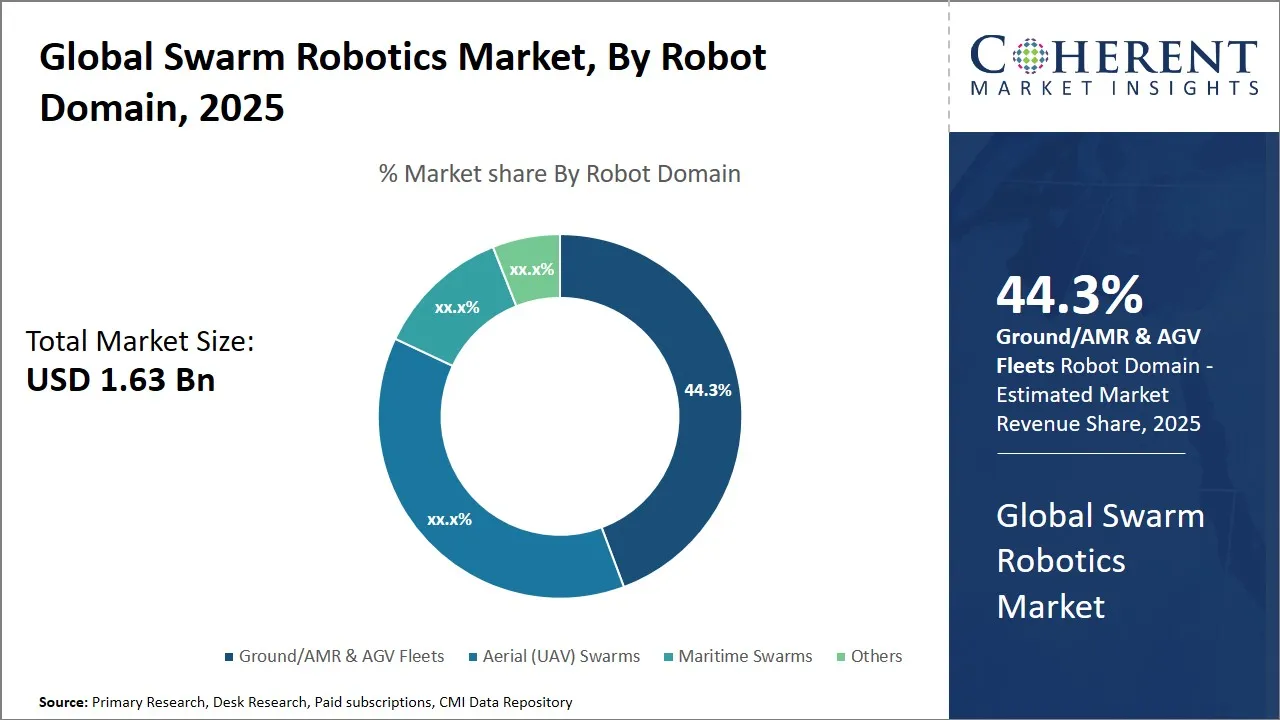
- The ground/AMR & AGV fleets segment leads the market holding an estimated share of 45.3 % in 2026.
- The logistics & warehousing segment leads the market holding an estimated share of 29.5 % in 2026.
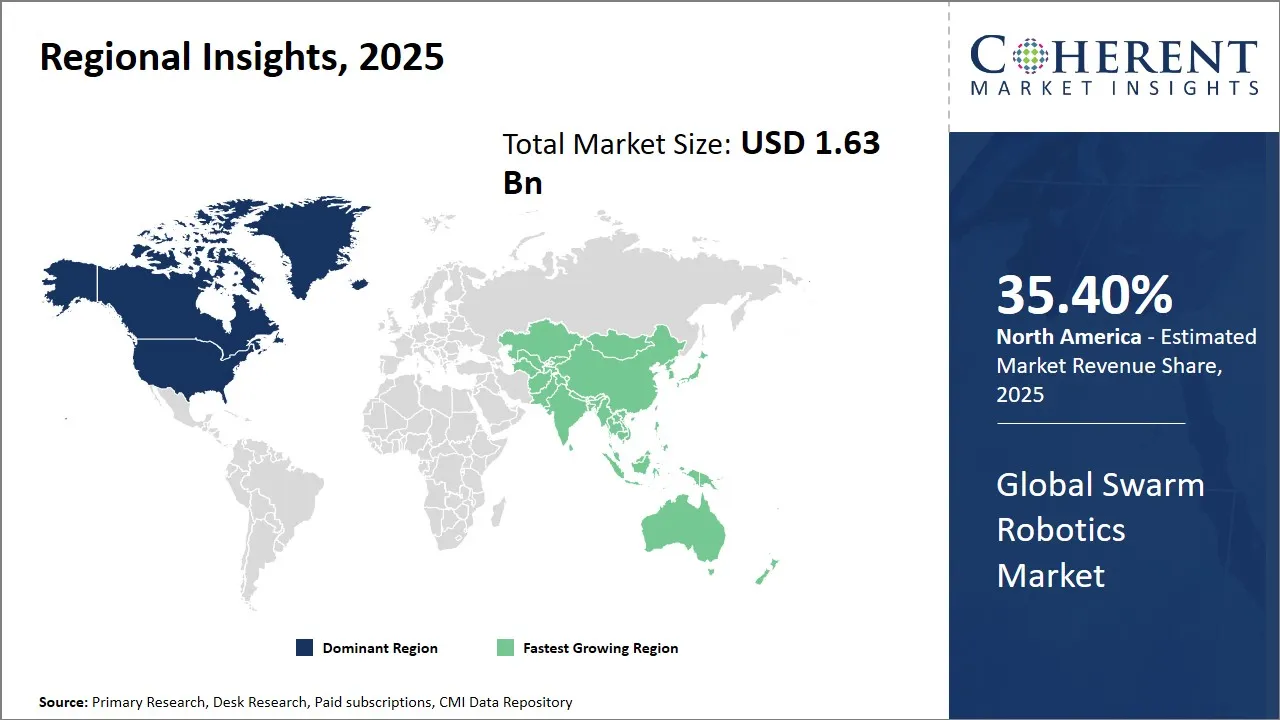
- North America is estimated to lead the market with a share of 35.4 % in 2026.
- Asia Pacific, holding a share of 33.2 % in 2026, is projected to be the fastest growing region.
Market Overview
A key market trend is the rising integration of swarm robotics in industries such as agriculture, defense, and logistics, where coordinated multi-robot systems enhance efficiency and operational capabilities. Additionally, ongoing innovations in communication protocols and decentralized control algorithms are enabling more adaptive and scalable swarm behaviors. This evolution is enabling swarm robotics to address challenges in hazardous monitoring, search and rescue, and precision farming, thereby fueling market demand and attracting substantial investments from both private and public sectors.
Current Events and Its Impact
Current Events | Description and its impact |
Geopolitical and Trade Developments |
|
Economic and Infrastructure Trends |
|
Segmental Insights
- Current Industry Events of 2026
- Market Size Estimation
- Regional Breakdown
- Competitive Landscape
- Customer Intelligence
- Segmental Analysis
- Pricing Analysis
- Key Market Drivers, Challenges & Future Trends
- Customized Insights Section
Global Swarm Robotics Market Insights, by Robot Domain – Ground/AMR & AGV Fleets Dominate Owing to their Transformative Impact on Automation and Operational Efficiency
Ground/AMRs and AGV fleets, holding an estimated share of 45.3% in 2026, form the backbone of the swarm robotics ecosystem across numerous industries, and their dominance in the market is driven by several critical factors. Primarily, the rapid adoption of Industry 4.0 principles and the increasing push towards smart manufacturing and logistics environments significantly propel the demand for these ground-based swarm robots. Ground Autonomous Mobile Robots (AMR) and AGV fleets excel in repetitive and physically intensive processes such as material handling, inventory movement, and just-in-time delivery across various sectors including automotive, consumer goods, and electronics manufacturing.
Additionally, technological advancements in navigation and sensing, such as LiDAR, computer vision, and real-time data analytics, have improved the safety, autonomy, and coordination among these fleets. Moreover, growing labor shortages and rising manpower costs worldwide encourage enterprises to invest in AMR and AGV fleets as cost-effective alternatives, ensuring continuity and scalability of operations. The modular and scalable nature of these solutions allows businesses to expand or reconfigure robotic fleets easily in response to changing operational demands, making them ideal for industries experiencing fluctuating volume or product variety.
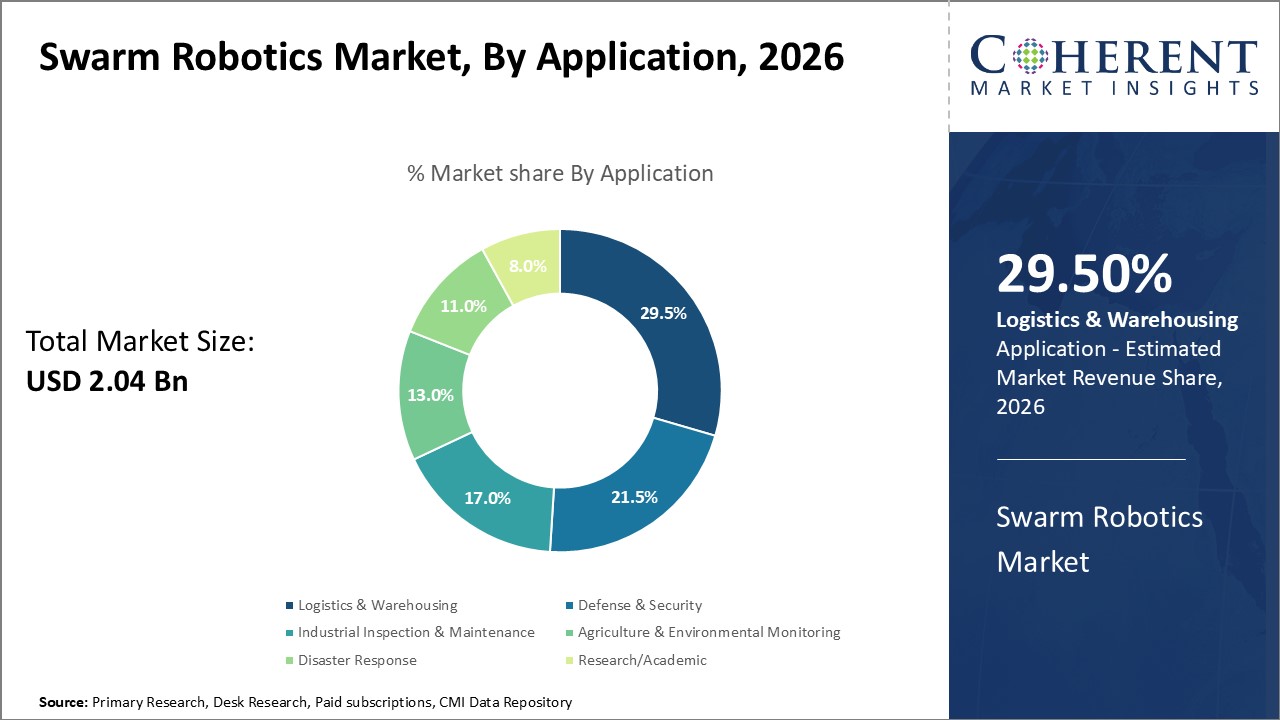
Global Swarm Robotics Market Insights, by Application – Logistics & Warehousing Dominate Driven by the Critical Need for Efficiency and Accuracy in Supply Chain Management
Logistics & warehousing, holding an estimated share of 29.5% in 2026, represent the most substantial application segment within the swarm robotics market. The rise of e-commerce, growing customer demand for same-day or next-day delivery, and the complexity of managing large inventories in often constrained spaces collectively stimulate the adoption of swarm robotics solutions tailored for warehouse automation. Swarm robotics in logistics allows for coordinated deployment of multiple robotic units that can simultaneously handle picking, sorting, packaging, and transportation tasks. By leveraging swarm intelligence, these robots communicate and collaborate to optimize task allocation, reduce bottlenecks, and ensure smooth coordination even in the face of dynamic changes such as sudden order surges or inventory restocking.
Another key factor accelerating growth in this application area is the ability of swarm robotic systems to ensure scalability and modularity. As logistics centers grow or experience seasonal peaks, robotic fleets can be rapidly expanded or adjusted without disrupting ongoing operations. Moreover, these robotic swarms increase safety within warehouses by navigating autonomously and avoiding collisions with humans or infrastructure, leveraging real-time sensor data and advanced path-planning algorithms. The reduction in workplace accidents and improvement in working conditions is an attractive proposition for logistics and warehousing operators aiming to comply with stringent safety regulations while maintaining productivity.
The integration of swarm robotics also supports data-driven decision-making through continuous monitoring and reporting of operational metrics. This actionable intelligence facilitates proactive maintenance, inventory tracking, and route optimization, further enhancing warehouse efficiency. Furthermore, the environmental impact of logistics operations is receiving heightened attention, and swarm robotics contributes positively by minimizing energy consumption through optimized movement and collaborative task execution. This aligns with corporate sustainability goals and regulatory requirements, reinforcing the growing preference for such technologies.
Impact of AI on the Swarm Robotics Market
Artificial intelligence is the backbone of swarm robotics, enabling robots to coordinate, self-organize, and execute tasks collectively without constant human oversight. Through machine learning and reinforcement algorithms, swarms can adapt to dynamic environments, optimize path planning, and balance workloads across large fleets of robots. AI also helps swarms operate resiliently under conditions such as GPS denial, limited connectivity, or rapidly changing terrain, making them ideal for both civilian and military applications.
A real-world instance of AI’s impact is Shield AI’s Hivemind software, which allows UAVs like the V-BAT 5.3 to operate autonomously in swarms during defense and security missions. In July 2025, the U.S. Coast Guard completed operational testing of the V-BAT 5.3, validating its ability to conduct autonomous maritime surveillance missions with minimal human input.
Regional Insights
North America Swarm Robotics Market Analysis and Trends
North America, holding a share of 35.4% in 2026, is expected to dominate the global swarm robotics market, stemming from a well-established technological ecosystem supported by robust government funding and strong industry collaborations. The region benefits from the presence of numerous leading robotics and automation companies that have been at the forefront of swarm robotics innovation. U.S.-based defense agencies and research institutions drive significant investment in swarm robotics for applications such as surveillance, search and rescue, and military operations.
Furthermore, advanced infrastructure and high R&D expenditure among universities and private enterprises foster rapid technology maturation. Key players including Boston Dynamics, Swarm Technologies, and SRI International contribute significantly through pioneering development and commercial deployments. Favorable government policies aimed at AI and autonomous system innovation also cement North America’s leading position in the market.
Asia Pacific Swarm Robotics Market Analysis and Trends
The Asia Pacific region, holding a share of 33.2% in 2026, is expected to exhibit the fastest growth in the swarm robotics market, driven by expanding industrial automation, smart manufacturing initiatives, and strategic government programs targeting robotics and AI proliferation. Countries like China, Japan, and South Korea are heavily investing in swarm robotics to enhance logistics, agriculture, and disaster management sectors. The region’s vast manufacturing base creates a strong demand pool for scalable and cost-effective swarm robotic solutions.
Additionally, Asia Pacific benefits from increasing collaborations between academia and industry, supported by government subsidies and favorable trade policies that encourage technology transfer and local production. Notable companies such as DJI (China), Hitec Robotics (South Korea), and FANUC (Japan) are integral to the region’s rapid market uptake, bringing innovations in robot coordination, swarm intelligence, and real-time data analytics.
Swarm Robotics Market Outlook for Key Countries
U.S. Swarm Robotics Market Analysis and Trends
The U.S. is fueled by robust defense and commercial sector involvement. Its well-established R&D infrastructure generates cutting-edge swarm algorithms and hardware. Companies like Boston Dynamics and Lockheed Martin dominate research and product innovation, focusing on military and industrial applications. The government’s support through DARPA’s swarm robotics programs accelerates technological breakthroughs, solidifying the country’s leadership in the field.
China Swarm Robotics Market Analysis and Trends
China is rapidly expanding due to strong governmental focus on smart manufacturing and AI-driven robotics. DJI plays a key role by integrating swarm robotics in drone fleets for agricultural monitoring and logistics. The Chinese government’s 5-year plans and substantial investments in technology hubs stimulate startups and research institutions to advance swarm robotics solutions, advancing the country’s position as a global manufacturing powerhouse digitizing operations.
Japan Swarm Robotics Market Analysis and Trends
Japan continues to lead with its strength in automation and electronics, leveraging swarm robotics to increase productivity in automotive assembly lines and warehouse management. FANUC and Cyberdyne spearhead deployments of swarm-enabled robots focusing on precision and collaborative work environments. Government incentives promoting robotics innovation and aging population challenges drive demand for autonomous robotic swarms in healthcare and eldercare sectors.
South Korea Swarm Robotics Market Analysis and Trends
South Korea emphasizes integration of swarm robotics in manufacturing and urban infrastructure management. Hitec Robotics and Doosan Robotics contribute through advanced swarm coordination systems utilized in factories and logistics. The government’s aggressive support for smart city initiatives and Industry 4.0 fosters adoption of swarm systems to improve operational efficiency and safety across sectors.
Germany Swarm Robotics Market Analysis and Trends
Germany remains robust, leveraging its automotive and industrial engineering strengths. Companies like KUKA and Bosch are innovating swarm robotics applications to optimize production lines and supply chain automation. Supportive government policies emphasizing Industry 4.0 and digital transformation encourage deeper R&D collaboration between industrial conglomerates and research institutions, enabling scalable swarm robotic systems tailored for European manufacturing needs.
Market Players, Key Development, and Competitive Intelligence
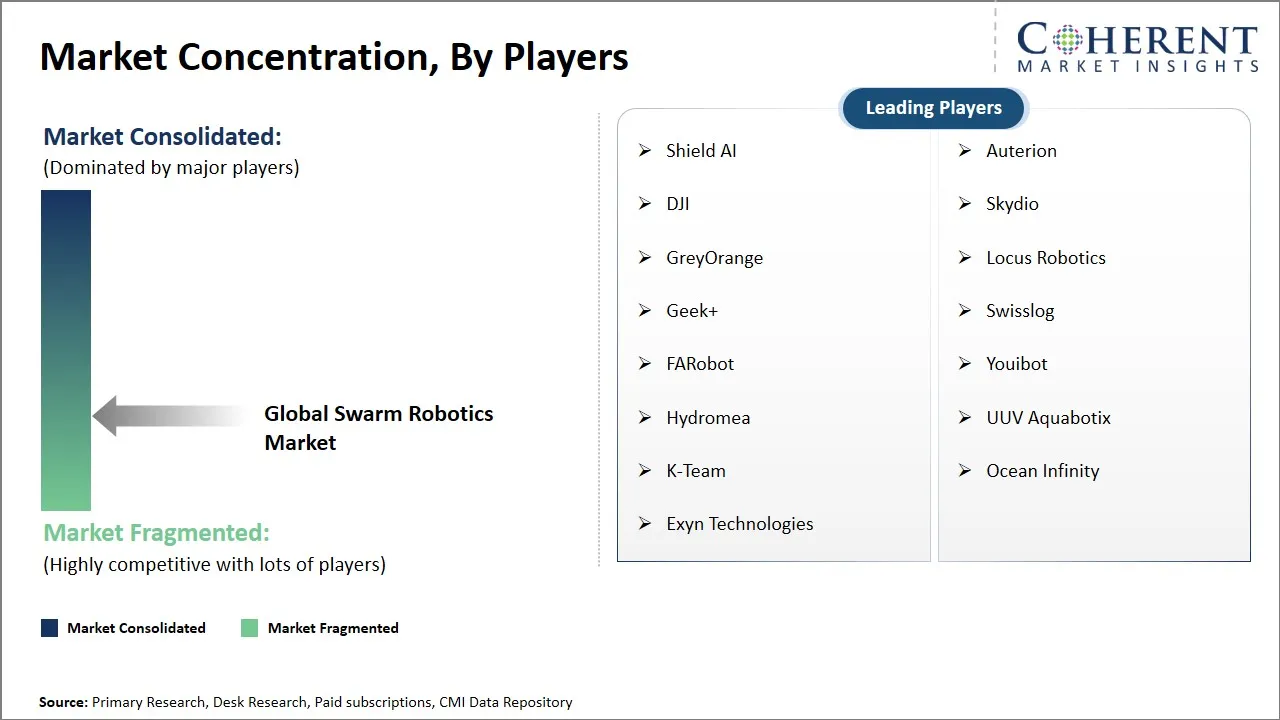
Top Strategies Followed by Swarm Robotics Market Players
- Established players in the market emphasize heavy investment in research and development (R&D) to innovate and deliver high-performance swarm robotic systems.
- Shield AI (U.S.) is investing heavily in advancing its Hivemind AI to enable UAVs like the V-BAT to operate autonomously in contested, GPS-denied environments.
- Mid-level players in the swarm robotics market adopt strategies that focus on delivering cost-effective yet reliable solutions, aiming to balance quality with affordability to attract price-sensitive customers.
- Geek+ (China), a leading AMR provider in Asia Pacific, is rolling out cost-efficient autonomous mobile robots for warehousing that can operate in large coordinated fleets.
- Small-scale players in the swarm robotics domain differentiate themselves by focusing on specialized features or innovative applications of swarm technology, often targeting specific industry needs or emerging use cases.
- Hydromea (Switzerland) is targeting the specialized underwater swarm robotics segment with its tetherless micro-AUVs for subsea inspection.
Key Developments
- On August 20, 2025, Airbus U.S. Space & Defense completed its first autonomous helicopter test flight utilizing Shield AI’s Hivemind autonomy package.
- On August 6, 2025, ZTE Corporation, a global leading provider of integrated information and communication technology solutions, showcased the transformative power of embodied intelligence through its 5G-A EasyOn·Robot private network at the 2025 World Artificial Intelligence Conference (WAIC).
- On August 5, 2025, Youibot announced the official launch of LEVER, the world’s first "One-Brain-Multi-Form" embodied AI humanoid robot, marking a revolutionary leap in industrial robotics. As the flagship model of the Origin Humanoid Family, LEVER redefines cross-scenario adaptability and collaborative intelligence, paving the way for human-robot symbiosis.
- In July 2025, Shield AI, the deep-tech company developing cutting-edge autonomy software and next-generation defense aircraft, announced that its new V-BAT 5.3 unmanned aircraft system (UAS) has successfully completed Operational Test & Evaluation (OT&E) with the U.S. Coast Guard.
Market Report Scope
Swarm Robotics Market Report Coverage
| Report Coverage | Details | ||
|---|---|---|---|
| Base Year: | 2025 | Market Size in 2026: | USD 2.04 Bn |
| Historical Data for: | 2020 To 2024 | Forecast Period: | 2026 To 2033 |
| Forecast Period 2026 to 2033 CAGR: | 25.0% | 2033 Value Projection: | USD 9.72 Bn |
| Geographies covered: |
| ||
| Segments covered: |
| ||
| Companies covered: | Shield AI, Auterion, DJI, Skydio, GreyOrange, Locus Robotics, Geek+, Swisslog, FARobot, Youibot, Hydromea, UUV Aquabotix, K-Team, Ocean Infinity, and Exyn Technologies | ||
| Growth Drivers: |
| ||
| Restraints & Challenges: |
| ||
Market Dynamics
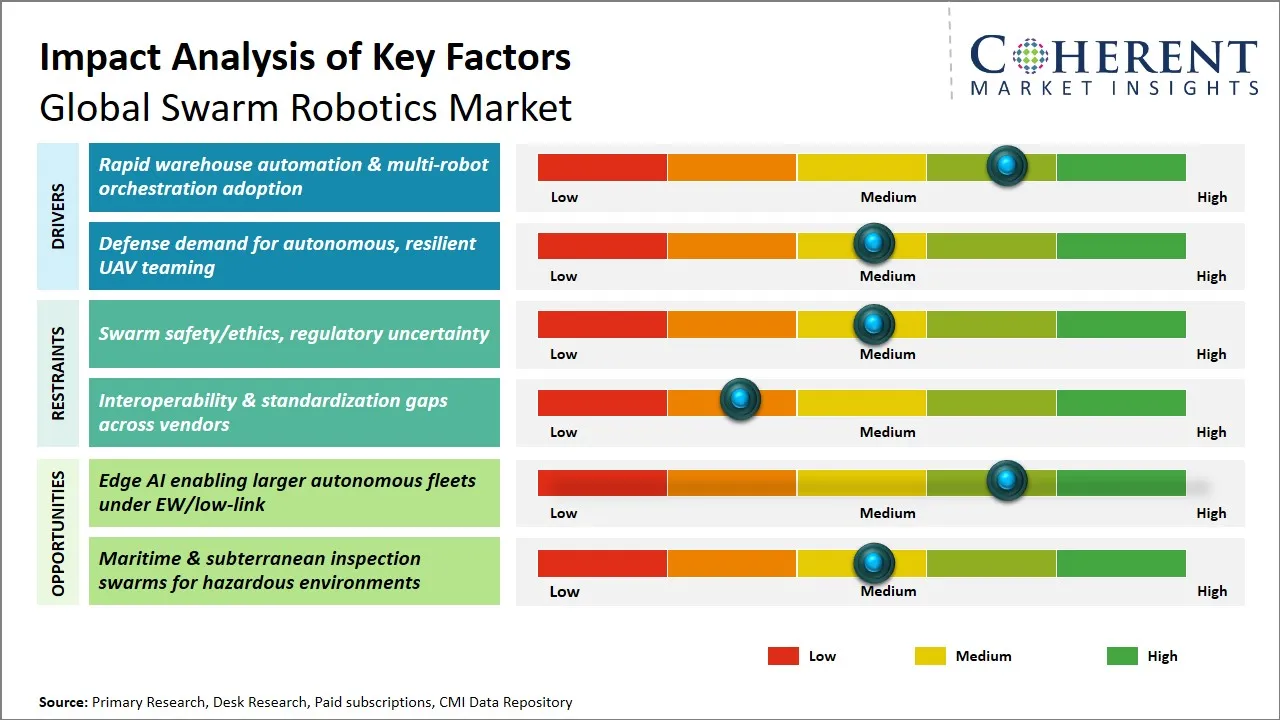
Global Swarm Robotics Market Driver – Rapid Warehouse Automation & Multi-Robot Orchestration Adoption
The escalating demand for efficient warehouse operations is catalyzing the adoption of swarm robotics, particularly through rapid warehouse automation and sophisticated multi-robot orchestration systems. As e-commerce and logistics sectors seek to enhance operational agility and reduce manual labor costs, swarm robotics offers the capability to coordinate numerous autonomous robots simultaneously within confined spaces, optimizing order fulfillment processes and inventory management. In June 2025, enVista launched enMotion, a warehouse orchestration platform powered by GreyOrange’s GreyMatter AI, to coordinate diverse robot fleets in fulfillment centers.
The intrinsic ability of swarm robotic systems to perform complex tasks collectively—such as sorting, packaging, and real-time inventory tracking—enables warehouses to handle increased throughput with minimal human intervention. Moreover, advancements in communication protocols and artificial intelligence have improved multi-robot coordination, allowing seamless collaboration among robotic units to avoid collisions and maximize workflow efficiency.
Global Swarm Robotics Market Opportunity – Edge AI Enabling Larger Autonomous Fleets Under Electronic Warfare (EW) and Low-Link Conditions
The integration of Edge AI technology presents a significant opportunity for the global swarm robotics market, particularly in enabling the deployment and management of larger autonomous fleets in challenging environments characterized by electronic warfare (EW) and low-link communication scenarios. Edge AI, by processing data locally on individual robotic units rather than relying on centralized cloud computing, reduces latency and enhances real-time decision-making capabilities, which is critical for swarm operations in contested or communication-denied environments. Shield AI’s Hivemind autonomy stack enables UAVs like the V-BAT 5.3 to operate collaboratively without GPS or constant communications—a critical capability in electronic warfare (EW) environments. This decentralized intelligence allows swarm robots to operate effectively even under jamming, signal interference, or limited connectivity, conditions often encountered in military, surveillance, and disaster response missions.
Analyst Opinion (Expert Opinion)
- The integration of edge AI is emerging as the single most critical enabler, allowing swarms to function in GPS-denied, low-connectivity, or EW (electronic warfare) environments. This will expand use-cases from defense to remote industrial inspection, where real-time centralized control is not feasible.
- Multi-robot orchestration in fulfillment centers is proving to be the first commercially scalable application. Partnerships like enVista + GreyOrange (2025) highlight how AI-driven fleet orchestration is moving from pilot projects to mainstream deployments.
- Beyond land and air, swarm robotics is gaining traction in maritime environments (e.g., Hydromea’s underwater swarms) and disaster response scenarios where coordinated fleets can cover large, high-risk zones quickly. These niche applications will be early differentiators for smaller innovators against established robotics giants.
Speak to the analyst
Want personalized insights?
Take the findings above to one of our principal consultants, or have the report rebuilt around the segments, geographies and competitors you actually track.
Market Segmentation
- Robot Domain Insights (Revenue, USD Bn, 2021 - 2033)
- Ground/AMR & AGV Fleets
- Aerial (UAV) Swarms
- Maritime Swarms
- Others
- Application Insights (Revenue, USD Bn, 2021 - 2033)
- Logistics & Warehousing
- Defense & Security
- Industrial Inspection & Maintenance
- Agriculture & Environmental Monitoring
- Disaster Response
- Research/Academic
- Regional Insights (Revenue, USD Bn, 2021 - 2033)
- North America
- U.S.
- Canada
- Latin America
- Brazil
- Argentina
- Mexico
- Rest of Latin America
- Europe
- Germany
- U.K.
- Spain
- France
- Italy
- Russia
- Rest of Europe
- Asia Pacific
- China
- India
- Japan
- Australia
- South Korea
- ASEAN
- Rest of Asia Pacific
- Middle East
- GCC Countries
- Israel
- Rest of Middle East
- Africa
- South Africa
- North Africa
- Central Africa
- North America
- Key Players Insights
- Shield AI
- Auterion
- DJI
- Skydio
- GreyOrange
- Locus Robotics
- Geek+
- Swisslog
- FARobot
- Youibot
- Hydromea
- UUV Aquabotix
- K-Team
- Ocean Infinity
- Exyn Technologies
Sources
Primary Research Interviews
Stakeholders
- Robotics Hardware Manufacturers (e.g., AMR and UAV OEMs, Fleet Managers)
- AI & Software Developers for Multi-Robot Orchestration
- Logistics & Warehousing Operators deploying autonomous fleets
- Defense Contractors & Security Agencies integrating swarm UAVs
- Agricultural Technology Firms exploring swarm-based monitoring
- Maritime Robotics Companies developing underwater swarm solutions
- Academic Researchers in Robotics & Artificial Intelligence
Databases
- Eurostat
- U.S. Census
- Robotics Business Review Database
- OECD
- IEEE Robotics Database
Magazines
- Robotics Business Review
- Autonomous Systems Today
- AI & Robotics Insider
- Robotics World
Journals
- Journal of Field Robotics
- Swarm Intelligence Journal
- IEEE Transactions on Robotics
- International Journal of Advanced Robotic Systems
- Autonomous Robots Journal
Newspapers
- Robotics News Network (RNN)
- TechCrunch Robotics Section
- The Guardian (UK) – Technology & AI
- The Economic Times (India) – Technology & Startups
- Nikkei Asia – Robotics & Automation
Associations
- IEEE Robotics & Automation Society
- Association for the Advancement of Artificial Intelligence (AAAI)
- International Federation of Robotics (IFR)
- Asia-Pacific Robotics Association (APRA)
- U.S. Robotics Industries Association (RIA)
Public Domain Sources
- U.S. Census Bureau
- EUROSTAT
- United Nations Economic Commission for Europe (UNECE)
- World Bank
- ResearchGate
Proprietary Elements
- CMI Data Analytics Tool
- Proprietary CMI Existing Repository of information for last 8 years
Get access to 250+ pages report
Every segment, forecast, competitor profile and data table behind the analysis above — available for instant download.
- ESOMAR Member
- ISO 9001:2015 Certified
- D-U-N-S Registered
- GDPR & CCPA Compliant
Missing comfort of reading report in your local language? Find your preferred language:
Transform your Strategy with Exclusive Trending Reports
Frequently Asked Questions
The global swarm robotics market is estimated to be valued at USD 2.04 billion in 2026 and is expected to reach USD 9.72 billion by 2033.
The CAGR of global swarm robotics market is projected to be 25.0% from 2026 to 2033.
Rapid warehouse automation & multi-robot orchestration adoption and defense demand for autonomous, resilient UAV teaming are the major factors driving the growth of the global swarm robotics market.
Swarm safety/ethics, regulatory uncertainty and interoperability & standardization gaps across vendors are the major factors hampering the growth of the global swarm robotics market.
In terms of robot domain, the ground/AMR & AGV fleets segment is estimated to dominate the market revenue share in 2026.
It is the coordination of multiple robots working collectively using decentralized intelligence and AI.
Maritime inspection, disaster response, agriculture, and environmental monitoring are some of the emerging use-cases for the market.