

Global Tabletop Games Market Size and Forecast – 2026 To 2033
The Global Tabletop Games Market is estimated to be valued at USD 19.64 Bn in 2026 and is expected to reach USD 32.58 Bn by 2033, growing at a compound annual growth rate (CAGR) of 7.5% from 2026 to 2033. This growth outlook reflects increasing consumer engagement with tabletop entertainment, expanding player communities, and the growing role of tabletop games as social, recreational, and hobby-based experiences.
Market expansion is further supported by product innovation, community-led development models, and improved accessibility through online retail channels. In July 2025, the Global Game Jam introduced a dedicated Tabletop Committee to support tabletop creators, publishers, and community leaders, highlighting the increasing industry focus on strengthening the tabletop gaming ecosystem and creator networks.
Key Takeaways of the Global Tabletop Games Market
- Board Games are projected to register an estimated CAGR of 8.0% and account for 41.6 % of the global tabletop games market in 2026, supported by their broad appeal across families, hobby communities, and strategic players seeking social interaction. In October 2025, SPIEL Essen recorded 220,000 visitors and 948 exhibitors, highlighting continued global engagement with board gaming.
- Card Games are expected to achieve an estimated CAGR of 8.4% and represent 24.8 % of the market in 2026, benefiting from collectible mechanics, competitive communities, and the integration of physical and digital experiences. In October 2025, Pokémon expanded Pokémon Trading Card Game Pocket with the Mega Rising expansion, strengthening digital card collection and player engagement worldwide.
- Role Playing Games (RPGs) are anticipated to grow at an estimated CAGR of 7.9% and capture 14.7 % share of the global tabletop games market in 2026, supported by immersive narratives, long-form campaigns, and strong player communities built around collaborative storytelling. RPG publishers continue expanding accessibility through organized play, digital support tools, and new content ecosystems. In March 2025, Paizo announced Pathfinder and Starfinder organized play updates, strengthening structured RPG participation and supporting continued engagement among dedicated tabletop role-playing communities.
- North America is forecast to achieve an estimated CAGR of 6.9% and hold 36.8 % of the global tabletop games market in 2026, supported by a mature publishing ecosystem, strong specialty retail presence, and established consumer communities across board games, card games, and role-playing formats. The region benefits from active creator networks and large-scale gaming events that support product discovery. In June 2025, the Game Manufacturers Association (GAMA) hosted Origins Game Fair, bringing together publishers, designers, retailers, and players to strengthen the commercial tabletop gaming ecosystem in North America.
- Europe is expected to record an estimated CAGR of 8.2% and account for 31.4 % of the market in 2026, driven by deep-rooted gaming cultures, specialized events, and strong consumer participation across hobby communities. In August 2025, SPIEL Essen announced expectations for over 200,000 visitors, reinforcing Europe’s position as a major hub for tabletop discovery, publishing, and player engagement.
Segmental Insights
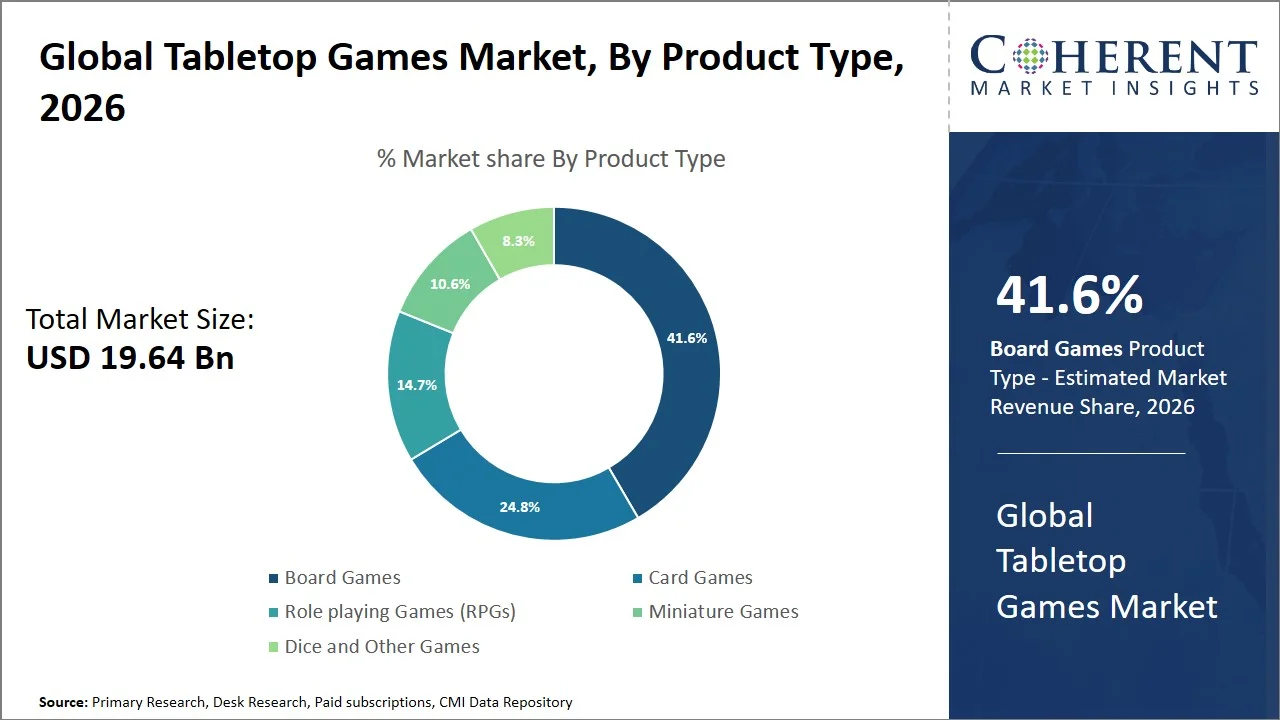
Why Do Board Games Dominate the Global Tabletop Games Market?
Board Games are expected to account for 41.6% of the global tabletop games market in 2026, supported by their strong revenue contribution across family entertainment, hobby gaming, and retail channels. The segment maintains market leadership due to its broad product portfolio ranging from strategy-based titles to family-oriented formats, enabling publishers to target diverse consumer groups. Established manufacturing ecosystems, extensive distribution networks, and recurring demand for new editions, expansions, and licensed titles further strengthen commercial opportunities for game developers and retailers. Board games also benefit from their role as social entertainment products, making them relevant across households, gaming communities, and educational environments. In March 2025, Ravensburger launched new additions to its Disney Lorcana trading card and board gaming portfolio, strengthening its presence in premium tabletop entertainment and expanding consumer engagement opportunities
- Current Industry Events of 2026
- Market Size Estimation
- Regional Breakdown
- Competitive Landscape
- Customer Intelligence
- Segmental Analysis
- Pricing Analysis
- Key Market Drivers, Challenges & Future Trends
- Customized Insights Section
Why Do Strategy Games Represent the Largest Game Theme Category in the Global Tabletop Games Market?
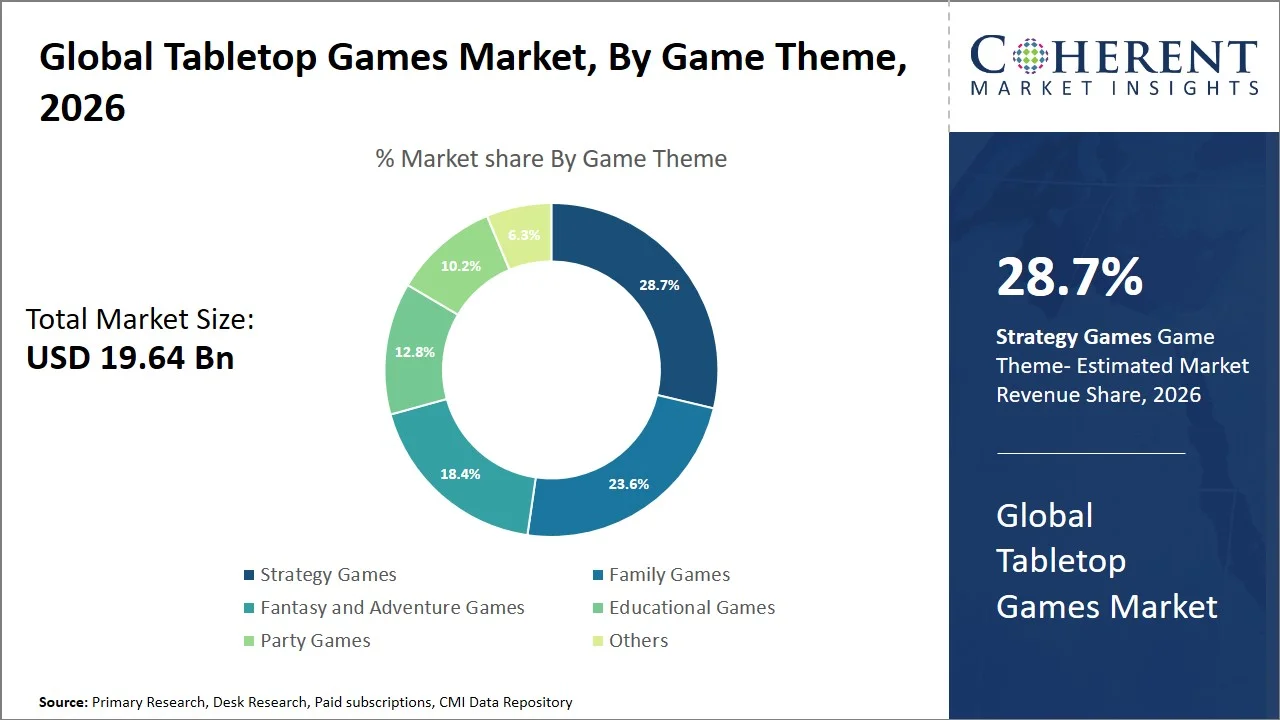
Strategy Games are expected to contribute 28.7% of the global tabletop games market in 2026, supported by strong monetization potential through premium gameplay formats, expansion content, and dedicated enthusiast communities. The segment holds a leading position within game themes due to its ability to deliver deeper engagement through tactical planning, resource management, competitive mechanics, and long-duration gameplay experiences. Publishers benefit from higher customer retention as players frequently invest in expansions, accessories, and upgraded versions of established titles. Strategy games also maintain strong relevance among hobby gamers, gaming clubs, and organized play communities that support recurring demand. In September 2025, CMON expanded its crowdfunding campaign activities for strategic tabletop titles, demonstrating continued commercial interest in community-backed strategy game development.
Why Do Adults Dominate the Player Type Category of the Global Tabletop Games Market?
Adults are expected to represent 38.6% of the global tabletop games market in 2026, driven by higher purchasing capacity, preference for premium gaming experiences, and participation in hobby-based entertainment communities. This player group contributes significantly to market value through purchases of advanced board games, role-playing games, collectible products, expansions, and accessories. Publishers and retailers increasingly prioritize adult consumers through specialized product lines, community events, and enthusiast-focused distribution channels, as this audience typically demonstrates stronger engagement and repeat purchasing behavior. Adult players also support the growth of complex tabletop formats requiring longer play sessions and strategic involvement. In January 2025, Games Workshop announced updates to its Warhammer community ecosystem, reinforcing continued engagement among dedicated adult tabletop gaming audiences.
Current Events and their Impact
Current Event | Description and Its Impact |
European Union Ecodesign for Sustainable Products Regulation (ESPR) – July 2024 |
|
United States Consumer Product Safety Commission Toy Safety Compliance Updates – 2025 |
|
United Kingdom Digital Markets, Competition and Consumers Act – May 2024 |
|
Global Tabletop Games Market Dynamics
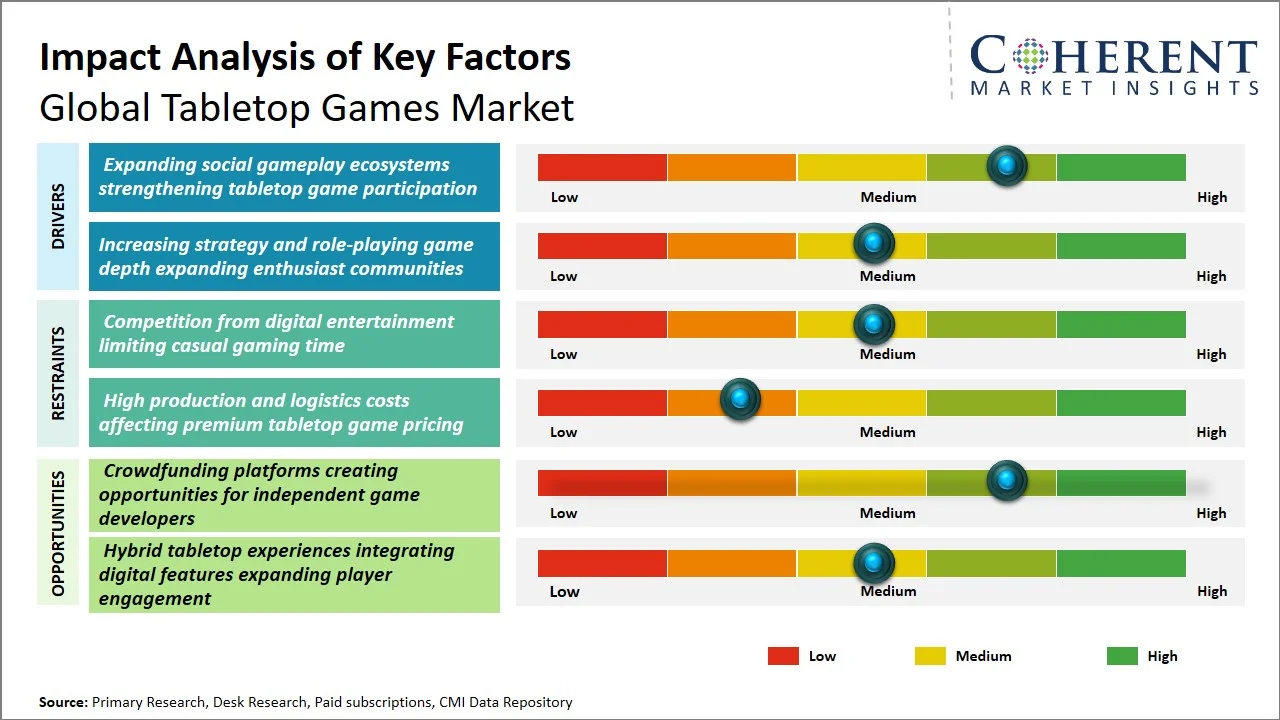
Key Market Drivers
- Expanding Social Gameplay Ecosystems Strengthening Tabletop Game Participation: Social interaction, community-led gaming activities, and in-person entertainment formats are strengthening tabletop game participation by increasing consumer engagement beyond individual purchases. Publishers, retailers, and event organizers benefit from stronger player communities that encourage repeat purchases, organized gameplay, and brand loyalty. Gaming cafés, local clubs, and dedicated tabletop events are becoming important channels for product discovery and customer retention. In January 2025, the Toy Association announced updates for The Toy Fair New York event, highlighting continued industry participation from toy and game companies to showcase new entertainment products and connect with buyers, retailers, and consumers.
- Increasing Strategy and Role-Playing Game Depth Expanding Enthusiast Communities: Strategy and role-playing games are increasing the commercial value of tabletop gaming through advanced gameplay mechanics, immersive narratives, and sustained player engagement. These formats encourage recurring purchases through expansion packs, campaign-based content, accessories, and community-driven activities. Publishers benefit from highly engaged player groups that support premium pricing, franchise development, and long-term customer relationships. In August 2025, Games Workshop announced updates to its Warhammer: Age of Sigmar and Warhammer 40,000 product ecosystem, introducing new content and gaming experiences that strengthened participation among miniature and strategy-focused tabletop communities.
Emerging Market Trends
- Integration of Digital Companion Features with Physical Tabletop Experiences: Tabletop game developers are increasingly combining traditional physical gameplay with digital companion applications, online tools, and interactive platforms. This shift is changing how players access rules, track progress, manage campaigns, and participate in communities. Publishers are likely to prioritize connected experiences that extend engagement beyond the game box while preserving the social value of physical gameplay. Companies with capabilities in software integration, content management, and community platforms may gain stronger competitive positioning as hybrid gaming models mature.
- Premiumization of Thematic and Collectible Tabletop Products: The global tabletop games market is moving toward premium tabletop experiences featuring enhanced artwork, limited editions, collectible components, and specialized themes. Consumers are showing greater willingness to purchase higher-value products that provide deeper immersion and long-term replayability. This trend benefits publishers capable of developing strong intellectual properties and differentiated designs, while lower-cost generic manufacturers may face pressure. Over the forecast period, customization, collector-focused releases, and franchise-based tabletop products are expected to influence product development strategies and pricing models.
Consumer Purchase Behavior & Market Engagement Landscape
Consumer Factor | Market Observation | Business Implication |
Social & Group-Based Purchasing | Tabletop games are increasingly purchased for family gatherings, hobby groups, gaming clubs, and social events where shared participation is a key buying motivation. | Publishers can strengthen customer retention through community events, organized play programs, and multiplayer-focused product development. |
Premium & Collector Buying Behavior | Adult enthusiasts increasingly seek limited editions, upgraded components, franchise-based titles, and highly detailed game formats. | Companies can improve margins through premium editions, collectible releases, and differentiated product portfolios. |
Community-Driven Product Discovery | Gaming communities, conventions, online forums, and creator platforms influence product awareness and purchasing decisions. | Strong community engagement helps publishers reduce customer acquisition costs and build long-term brand loyalty. |
Expansion & Repeat Purchase Patterns | Dedicated players often purchase expansions, accessories, additional scenarios, and upgraded content after initial game adoption. | Creates recurring revenue opportunities beyond the initial product sale and supports lifecycle-based monetization strategies. |
Online Research & Purchase Influence | Consumers increasingly use online platforms, reviews, crowdfunding campaigns, and gaming communities before purchasing tabletop products. | Strengthens the importance of digital marketing, direct-to-consumer channels, and online customer engagement strategies. |
How Are Hybrid Digital-Physical Gaming Experiences Creating New Growth Opportunities in the Global Tabletop Games Market?
Hybrid digital-physical gaming experiences represent an emerging opportunity for tabletop game companies seeking to increase engagement and create differentiated product offerings. Integrating companion applications, digital rule systems, online communities, and interactive content can help publishers attract younger consumers while retaining traditional tabletop audiences. Opportunities exist across board games, role-playing games, educational games, and collectible formats where digital tools can enhance accessibility and replay value. Companies can capture this opportunity by developing proprietary software capabilities, forming technology partnerships, and designing products that balance physical ownership with digital interaction. Established publishers may benefit from existing intellectual property, while smaller developers can compete through specialized experiences and innovative gameplay concepts. Successful adoption will require investment in user experience design, platform maintenance, and cross-channel distribution capabilities.
Regional Insights
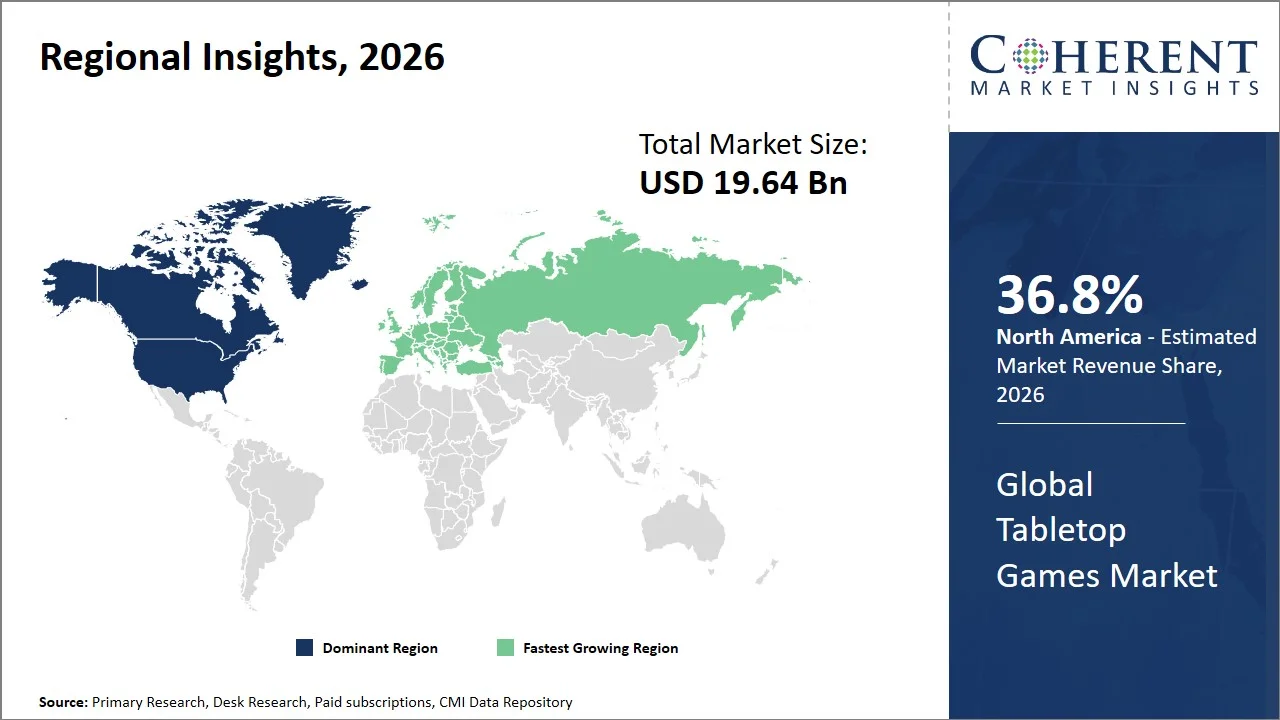
Why Does North America Dominate the Global Tabletop Games Market?
North America is expected to contribute 36.8% of the global tabletop games market in 2026, supported by its established publishing ecosystem, high-value consumer base, and extensive commercial infrastructure for tabletop entertainment. The region benefits from the presence of established tabletop game developers, extensive specialty retail networks, and large communities of board game, card game, and role-playing game enthusiasts. The U.S. and Canada also have strong convention ecosystems that enable publishers to launch new titles and engage directly with consumers. Growth is further supported by crowdfunding platforms that allow independent creators to commercialize innovative tabletop concepts. In June 2025, Game Manufacturers Association (GAMA) expanded its industry initiatives through Origins Game Fair, reinforcing North America’s role as a central hub for tabletop gaming communities and businesses.
Why Is Europe Emerging as the Fastest-Growing Region in the Global Tabletop Games Market?
Europe is projected to be the fastest-growing region and is expected to represent 31.4% in the global tabletop games market, driven by strong board game traditions, rising participation in hobby gaming, and increasing consumer interest in strategy-based and social entertainment formats. Countries such as Germany, France, and the United Kingdom have well-established gaming communities, specialized retailers, and internationally recognized tabletop events. The region’s preference for premium-quality games, complex gameplay mechanics, and family-oriented entertainment continues to expand the addressable consumer base. European publishers also benefit from strong design capabilities and export opportunities across global markets. In October 2025, Spiel Essen, one of the world’s largest tabletop gaming exhibitions held in Germany, continued attracting international publishers and gaming audiences, highlighting Europe’s growing influence in the sector.
Global Tabletop Games Market Outlook for Key Countries
Why Is the U.S. a Key Market for the Global Tabletop Games Market?
The U.S. represents one of the most important markets for the global tabletop games market due to its extensive player base, strong hobby gaming culture, and concentration of leading tabletop publishers. The country has significant demand across board games, collectible card games, role-playing games, and miniature gaming segments, supported by specialized retailers, online platforms, and gaming conventions. Consumer interest in social entertainment experiences and community-driven gameplay continues to expand tabletop adoption among adults and families. The U.S. also serves as a major innovation center where publishers introduce new formats and digitally integrated gaming experiences. In August 2025, Wizards of the Coast announced new Dungeons & Dragons initiatives to broaden player engagement, demonstrating continued investment in the U.S. tabletop ecosystem.
Why Is India Important in the Global Tabletop Games Market?
India is emerging as an important growth market for the global tabletop games market, supported by increasing urbanization, expanding disposable incomes, and growing interest in social and educational gaming formats. The country’s young population base provides opportunities for family games, strategy games, and learning-oriented tabletop products. Growth is also supported by increasing availability of international tabletop brands through e-commerce platforms and specialty gaming communities in metropolitan cities. Domestic creators are gradually developing localized games based on Indian themes, history, and cultural elements, improving market accessibility. In December 2024, the Government of India highlighted the expansion of the AVGC-XR sector through policy initiatives, supporting broader gaming and creative industries that contribute to the development of interactive entertainment ecosystems.
Why Does China Support Growth in the Global Tabletop Games Market?
China supports the expansion of the global tabletop games market through its large consumer base, advanced manufacturing capabilities, and growing participation in hobby-based entertainment. The country has a strong production ecosystem for tabletop components, including cards, miniatures, game boards, and accessories, enabling cost-efficient manufacturing for domestic and international brands. Increasing interest among younger consumers in strategy games, collectible games, and community-based entertainment is also strengthening domestic demand. China’s expanding e-commerce infrastructure provides additional channels for tabletop game distribution and consumer discovery. In July 2025, Tencent Holdings continued expanding its gaming ecosystem investments, reflecting broader growth in China’s interactive entertainment sector and supporting adjacent gaming communities.
Why Is Germany a Strategic Country in the Global Tabletop Games Market?
Germany holds strategic importance in the global tabletop games market due to its strong board game heritage, internationally recognized publishers, and highly developed hobby gaming culture. The country is considered a major center for tabletop innovation, particularly in strategy games, family games, and Euro-style board games that emphasize mechanics, planning, and replay ability. Germany also benefits from strong manufacturing standards, specialized retailers, and large-scale gaming events that connect publishers with global audiences. The presence of established companies and creative communities supports continuous product development and international exports. In October 2025, Spiel Essen in Germany brought together global publishers, designers, and players, reinforcing the country’s position as a key marketplace and networking platform for tabletop gaming.
Why Is Brazil an Important Growth Market for the Global Tabletop Games Market?
Brazil represents an emerging opportunity in the global tabletop games market due to its large consumer population, expanding entertainment spending, and growing interest in family-oriented and social gaming experiences. The country’s tabletop market is supported by increasing online retail penetration, local gaming communities, and greater awareness of international board games among younger consumers. Brazilian publishers and distributors are also contributing to market development by introducing localized Portuguese-language versions of popular titles, improving accessibility. Growth opportunities exist across strategy games, educational games, and party games due to their suitability for group-based entertainment. In September 2025, Abrin continued showcasing toy and gaming products in Brazil, supporting industry networking and consumer awareness for recreational products.
Market Players, Key Development, and Competitive Landscape
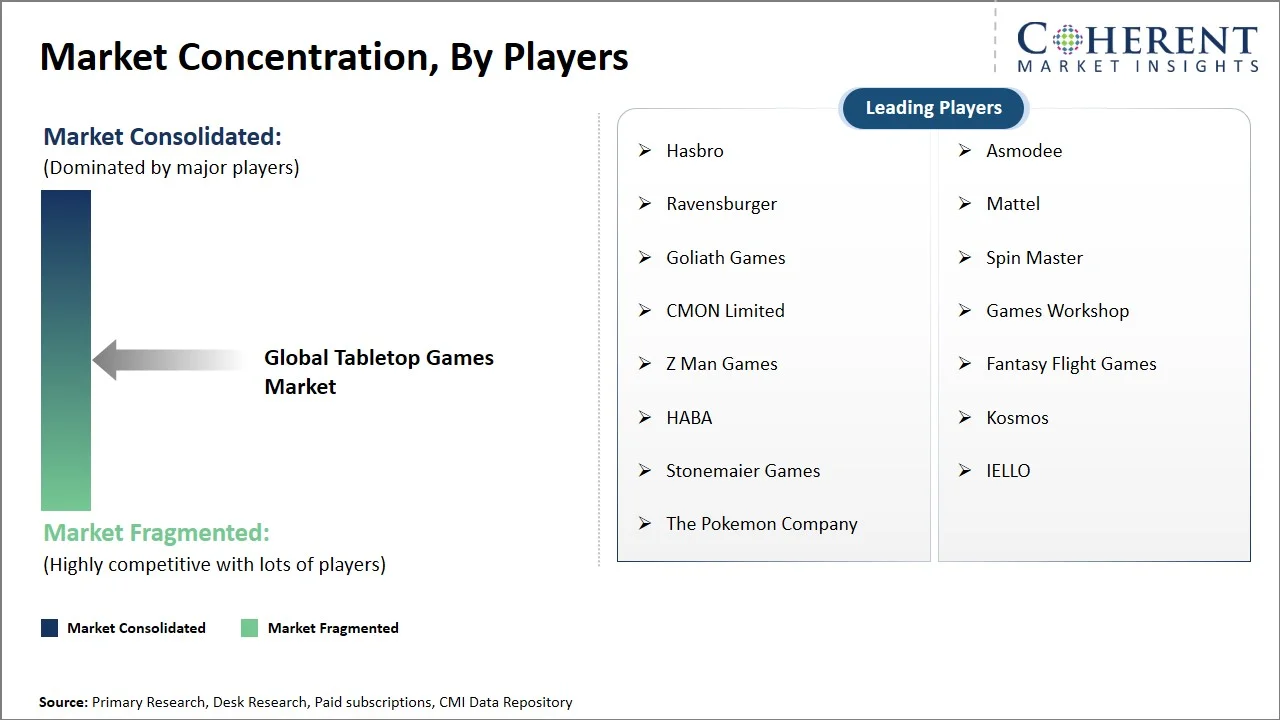
Key Developments
- In April 2026, Wizards of the Coast announced the official Dungeons & Dragons “Dungeon Masters” actual play series. This initiative strengthens RPG community engagement by combining storytelling content with tabletop participation, supporting broader audience adoption of role-playing game experiences.
- In October 2025, Hasbro reported strong performance from Wizards of the Coast, supported by continued momentum in Magic: The Gathering and digital gaming activities. This development highlights the growing importance of premium tabletop intellectual properties and connected gaming ecosystems for future market expansion.
- In February 2025, Asmodee became an independent publicly listed tabletop gaming company following its separation from Embracer Group. This development strengthens Asmodee’s strategic focus on board games, card games, and global tabletop distribution while supporting continued expansion across publishing and licensing activities.
Competitive Landscape
The global tabletop games market is moderately consolidated, with major international publishers competing alongside specialized designers and independent creators. Competition is shaped by intellectual property strength, gameplay innovation, product quality, distribution networks, and community engagement capabilities. Regional publishers maintain influence through localized content and niche expertise, while larger companies leverage established brands and global retail access.
Key focus areas Include
- Product differentiation through unique gameplay mechanics and immersive themes
- Strong intellectual property development and franchise expansion
- Community-building through tournaments, conventions, and organized play programs
- Distribution expansion through online retail and specialty gaming stores
- Premium components, collectible formats, and customized product offerings
- Digital integration through companion applications and online platforms
- Efficient manufacturing and supply-chain management for cost control
Market Report Scope
Tabletop Games Market Report Coverage
| Report Coverage | Details | ||
|---|---|---|---|
| Base Year: | 2025 | Market Size in 2026: | USD 19.64 Bn |
| Historical Data for: | 2020 To 2024 | Forecast Period: | 2026 To 2033 |
| Forecast Period 2026 to 2033 CAGR: | 7.5% | 2033 Value Projection: | USD 32.58 Bn |
| Geographies covered: |
| ||
| Segments covered: |
| ||
| Companies covered: | Hasbro, Asmodee, Ravensburger, Mattel, Goliath Games, Spin Master, CMON Limited, Games Workshop, Z Man Games, Fantasy Flight Games, HABA, Kosmos, Stonemaier Games, IELLO, The Pokemon Company | ||
| Growth Drivers: |
| ||
| Restraints & Challenges: |
| ||
Analyst Opinion (Expert Opinion)
- The global tabletop games market is likely to transition from a product-centered model toward experience-driven ecosystems where publishers compete through communities, content extensions, organized play, and long-term player relationships. Companies that successfully combine physical products with engagement platforms may create stronger customer retention than those relying only on standalone game releases.
- The next major shift in tabletop gaming may come from the convergence of entertainment franchises, digital tools, and personalized gameplay. Traditional publishers may face pressure from creators that use community-led development and digital distribution models to launch specialized experiences faster and build highly targeted audiences.
- Market participants should prioritize distinctive game design, sustainable production practices, and direct customer relationships. Companies should avoid overdependence on single franchises or temporary trends and instead invest in adaptable product portfolios, localized content strategies, and scalable distribution networks to maintain competitiveness.
Speak to the analyst
Want personalized insights?
Take the findings above to one of our principal consultants, or have the report rebuilt around the segments, geographies and competitors you actually track.
Market Segmentation
- Product Type Insights (Revenue, USD Bn, 2021 - 2033)
- Board Games
- Card Games
- Role playing Games (RPGs)
- Miniature Games
- Dice and Other Games
- Game Theme Insights (Revenue, USD Bn, 2021 - 2033)
- Strategy Games
- Family Games
- Fantasy and Adventure Games
- Educational Games
- Party Games
- Others
- Player Type Insights (Revenue, USD Bn, 2021 - 2033)
- Adults
- Families
- Children
- Hobby and Enthusiast Gamers
- Distribution Channel Insights (Revenue, USD Bn, 2021 - 2033)
- Online Retail
- Specialty Game Stores
- Supermarkets and Hypermarkets
- Hobby Stores
- Others
- Regional Insights (Revenue, USD Bn, 2021 - 2033)
- North America
- U.S.
- Canada
- Latin America
- Brazil
- Argentina
- Mexico
- Rest of Latin America
- Europe
- Germany
- U.K.
- Spain
- France
- Italy
- Russia
- Rest of Europe
- Asia Pacific
- China
- India
- Japan
- Australia
- South Korea
- ASEAN
- Rest of Asia Pacific
- Middle East
- GCC Countries
- Israel
- Rest of Middle East
- Africa
- South Africa
- North Africa
- Central Africa
- North America
- Key Players Insights
- Hasbro
- Asmodee
- Ravensburger
- Mattel
- Goliath Games
- Spin Master
- CMON Limited
- Games Workshop
- Z Man Games
- Fantasy Flight Games
- HABA
- Kosmos
- Stonemaier Games
- IELLO
- The Pokemon Company
Sources
Primary Research Interviews
- Tabletop game publishers, board game manufacturers, card game developers, role-playing game creators, miniature game producers, distributors, retailers, and gaming community organizers
- Game designers, product development specialists, hobby gaming experts, convention organizers, tabletop influencers, and industry consultants
Stakeholders
- Board game publishers, tabletop gaming companies, component manufacturers, printing and packaging suppliers, licensing companies, and digital gaming solution providers
- Specialty game stores, online retailers, crowdfunding platforms, gaming cafés, distributors, and organized play event operators
End-use Sectors
- Family entertainment and recreational gaming
- Hobby and enthusiast gaming communities
- Educational institutions and learning environments
- Social gaming events, tournaments, and conventions
- Online and offline gaming communities
Regulatory and Industry Bodies
- Consumer product safety authorities
- Toy safety and product compliance organizations
- Intellectual property and licensing authorities
- Environmental and packaging compliance organizations
- International standards organizations
Databases
- UN Comtrade and ITC Trade Map – Tabletop games, toys, gaming accessories, and entertainment product trade analysis
- Government import-export databases and customs records
- Company annual reports, investor presentations, product catalogues, and corporate disclosures
- Gaming industry databases, crowdfunding platforms, and tabletop market intelligence sources
Magazines and Journals
- Tabletop Gaming Magazine
- ICv2
- BoardGameGeek
- Polygon
- Dicebreaker
Associations
- Game Manufacturers Association (GAMA)
- Toy Association
- International Toy Industry Association
- Entertainment Software Association (ESA)
- Tabletop gaming communities and industry organizations
Public Domain Sources
- Gaming industry development reports, convention updates, and publishing trends
- Tabletop gaming product launches, design innovations, and digital integration developments
- Consumer product safety guidelines and toy compliance updates
- Trade statistics and entertainment industry publications related to tabletop products
Key Standards and Regulations
- Toy safety and consumer product compliance standards
- Product labeling and age-appropriateness requirements
- Intellectual property and licensing regulations
- Packaging sustainability and material compliance standards
- Quality management standards for manufacturing processes
Proprietary Elements
- CMI Data Analytics Tool, Proprietary CMI Existing Repository of information for the last 10 years
Get access to 250+ pages report
Every segment, forecast, competitor profile and data table behind the analysis above — available for instant download.
- ESOMAR Member
- ISO 9001:2015 Certified
- D-U-N-S Registered
- GDPR & CCPA Compliant
Missing comfort of reading report in your local language? Find your preferred language:
Transform your Strategy with Exclusive Trending Reports
Frequently Asked Questions
The CAGR of global tabletop games market is projected to be 7.5% from 2026 to 2033.
The global tabletop games market is estimated to be valued at USD 19.64 billion in 2026 and is expected to reach USD 32.58 billion by 2033.
The report is beneficial for tabletop game manufacturers, publishers, distributors, retailers, investors, and strategic decision-makers seeking insights into market positioning, competitive intelligence, expansion opportunities, and industry developments to support informed business decisions.
Yes, the report includes competitive analysis covering major market participants, business strategies, product portfolios, market positioning, and recent developments to help companies evaluate their competitive environment and identify potential growth areas.
Expanding social gameplay ecosystems strengthening tabletop game participation and Increasing strategy and role-playing game depth expanding enthusiast communities are the major factor driving the growth of global tabletop games market.
Competition from digital entertainment limiting casual gaming time and High production and logistics costs affecting premium tabletop game pricing are the major factor hampering the growth of global tabletop games market.
In terms of product type, board games are estimated to dominate the market revenue share 2026.