

Global Folding Furniture Market Size and Forecast – 2026 To 2033
The global folding furniture market is expected to grow from USD 4.87 Bn in 2026 to USD 9.37 Bn by 2033, registering a compound annual growth rate (CAGR) of 9.8%. Globally, retrofit and renovation projects have increased by approximately 20–25% over the past five years, particularly in urban markets where space optimization is critical. For instance, in the U.S. and Europe, renovation activity now constitutes a dominant share of construction.
In developed regions such as Europe, renovation activity is becoming structurally dominant due to aging building stock and sustainability mandates. Notably, around 35% of buildings in the EU are over 50 years old, highlighting the scale of refurbishment demand and the growing focus on upgrading existing structures rather than new construction.
(Source: European Commission)
Key Takeaways of the Global Folding Furniture Market
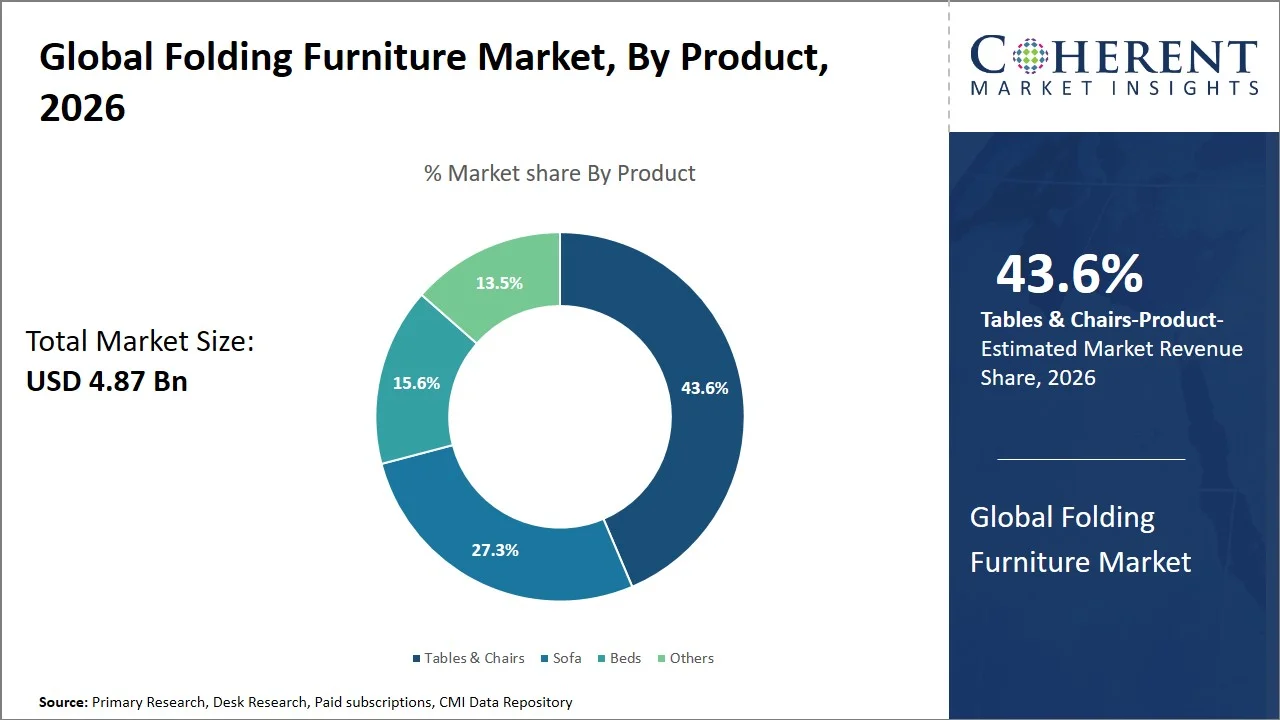
- Tables & chairs are the leading product segment with a share of 43.6 % of the global folding furniture market in 2026. They are widely used in homes, businesses, and events. For example, large event organizers and hospitality businesses like banquet halls and conference centers are frequent bulk purchasers of folding chairs and tables. They are easy to store and very quick to set up. In the U.S. event rental business, folding chairs and tables make up the bulk of rental inventory because they are in high demand for repeat use. Folding tables come in various shapes and sizes (round, rectangular, and square) catering to different event setups and client preferences. The most popular choices are 60” round and 72” rectangular tables, as they suit a wide range of events.
- Offline is expected to account for 58.6 % of the market share in 2026, making it the dominant distribution channel. Folding furniture is a big purchase that will benefit from a physical inspection. For example, folding furniture still sells well in stores at retailers like IKEA and Walmart. Municipal and school-level furniture procurement in India, where vendors supply folding desks and benches in bulk batches of 500–2,000 units, with inspection-based acceptance at delivery to ensure durability standards.
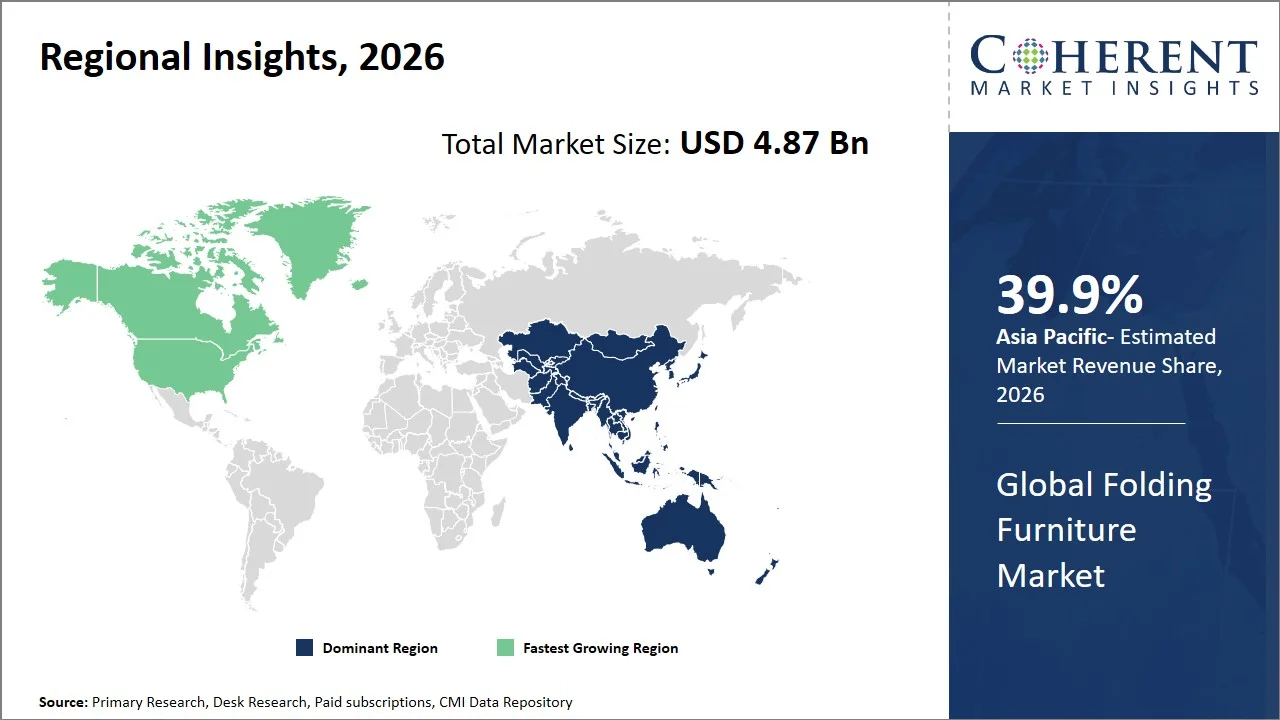
- Asia Pacific is the largest market and is expected to hold 39.9 % share in 2026. This is driven by rapid urbanization and growing demand for smaller homes. For example, the demand for space-saving furniture is rising in India and China. In China, over 60% of the population already lives in urban areas, and rapid city expansion has led to the widespread adoption of compact housing units, especially in tier-1 and tier-2 cities where demand for modular and multifunctional furniture is accelerating sharply, where more urban apartments are being built. Government-supported housing projects, for example, affordable housing initiatives in India, further boost the demand for multifunctional and foldable furniture solutions.
- North America is the fastest growing regional market with a projected 19.3 % share in 2026. The growth is driven by evolving lifestyles and increasing demand for multi-functional furniture. For instance, the emergence of remote work and the home improvement trend in the U.S. have resulted in a higher demand for portable desks and foldable workstations. Sales data of Home Depot and Lowe’s from the big home improvement stores show that the sales of foldable desks and outdoor folding furniture have jumped since 2023, as more people work in hybrid mode.
- Space-Efficiency Driven Demand: Folding furniture adoption is strongly aligned with rising urban density and shrinking living spaces, particularly in micro-apartments (often <700 sq. ft.) across Asia Pacific and major global metros. This structural shift is pushing demand for convertible and multi-functional custom furniture such as wall-mounted tables, foldable beds, and stackable seating.
- Hybrid Lifestyle & Work-from-Home Catalyst: The expansion of hybrid work models is accelerating demand for portable and foldable home and office furniture. Products such as collapsible desks, adjustable workstations, and compact storage-integrated units are increasingly preferred by urban professionals who require flexible living-work setups without permanent space allocation.
- Profitability Outlook: Higher margins are concentrated in premium folding furniture segments that combine design aesthetics with multi-functionality and durability. Brands focusing on engineered materials (lightweight metals, engineered wood composites) and smart space-saving mechanisms are capturing stronger pricing power, especially in urban premium hospitals and home furnishing.
Segmental Insights
Why Does Tables & Chairs Segment Dominate the Global Folding Furniture Market ?
The tables & chair segment is expected to hold 43.6% of the global folding furniture market share in 2026, due to their widespread usage and flexible functionality across residential, commercial, and institutional environments. In contrast to category specific pieces like beds or cabinets that are only necessary for certain environments, folding tables and chairs can be used in nearly every space, at home, in the workplace, at schools, and during events within hospitality venues or on outdoor setups. Because of this broad-based need, there is a steady high demand for these items.
For example, large-scale event management and education infrastructure use: a single mid-sized conference venue or university auditorium can require hundreds of folding chairs and tables per event cycle, with schools and training centers regularly rotating setups for exams, seminars, and functions. Similarly, banquet halls and catering services depend heavily on collapsible furniture because they must scale seating from 50 to 500+ guests within hours, making permanent furniture impractical.
- Current Industry Events of 2026
- Market Size Estimation
- Regional Breakdown
- Competitive Landscape
- Customer Intelligence
- Segmental Analysis
- Pricing Analysis
- Key Market Drivers, Challenges & Future Trends
- Customized Insights Section
Why is Offline the Most Preferred Distribution Channel?
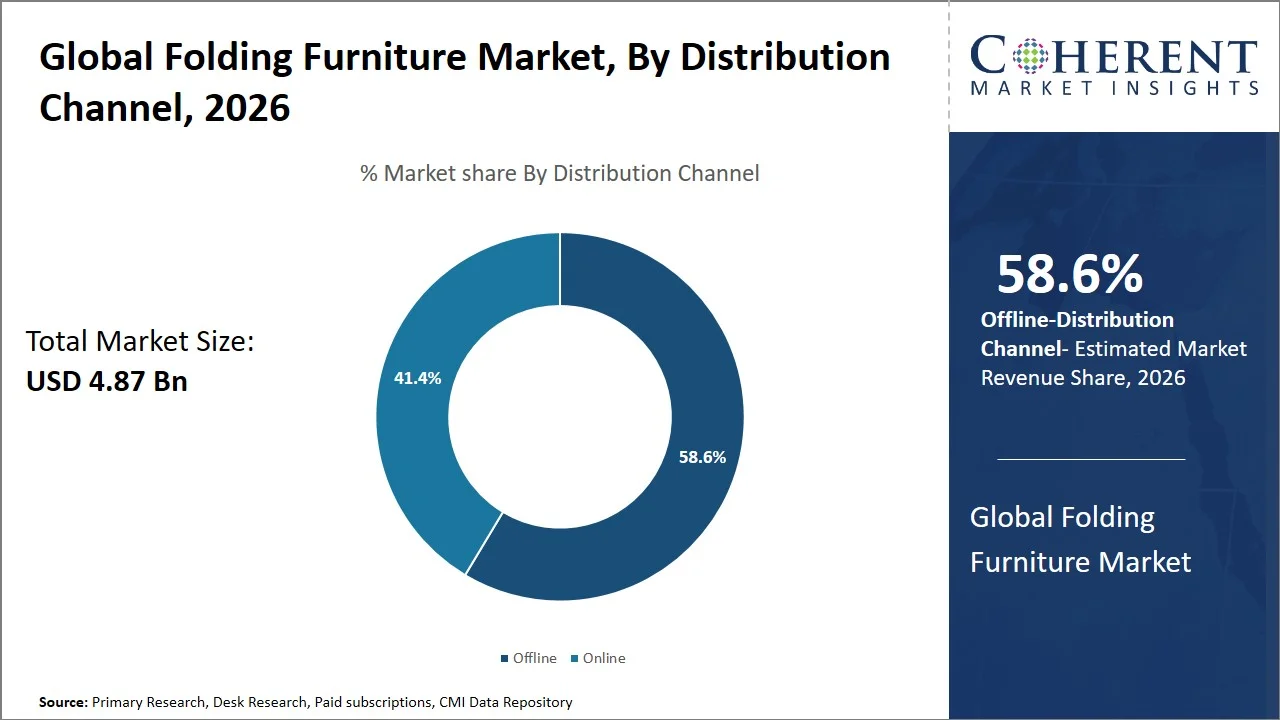
Offline segment is expected to dominate with 58.6% of the market share by 2026, largely due to strong customer preference for offline evaluation of furniture, including folding variants, prior to purchase. For folding furniture such as chairs and tables, the need for assessment of key factors such as durability, joint integrity, locks, quality of materials, and load bearing capacity requires tactile confirmation difficult to achieve online.
For example, even online-led furniture players such as Pepperfry and Urban Ladder have expanded physical experience centers because a large share of customers still prefer to inspect products in-store before final purchase. In the case of folding furniture, this behavior becomes more pronounced as buyers actively test durability, joint strength, locking mechanisms, material finish, and load-bearing capacity before committing.
Currents Events and their Impact
Current Events | Description and its Impact |
Rapid Urban Micro-Housing Expansion in Mega Cities (Asia Pacific, North America, Europe) |
|
Geopolitical Trade Realignment & China+1 Manufacturing Shift |
|
Global Folding Furniture Market Dynamics
Market Drivers
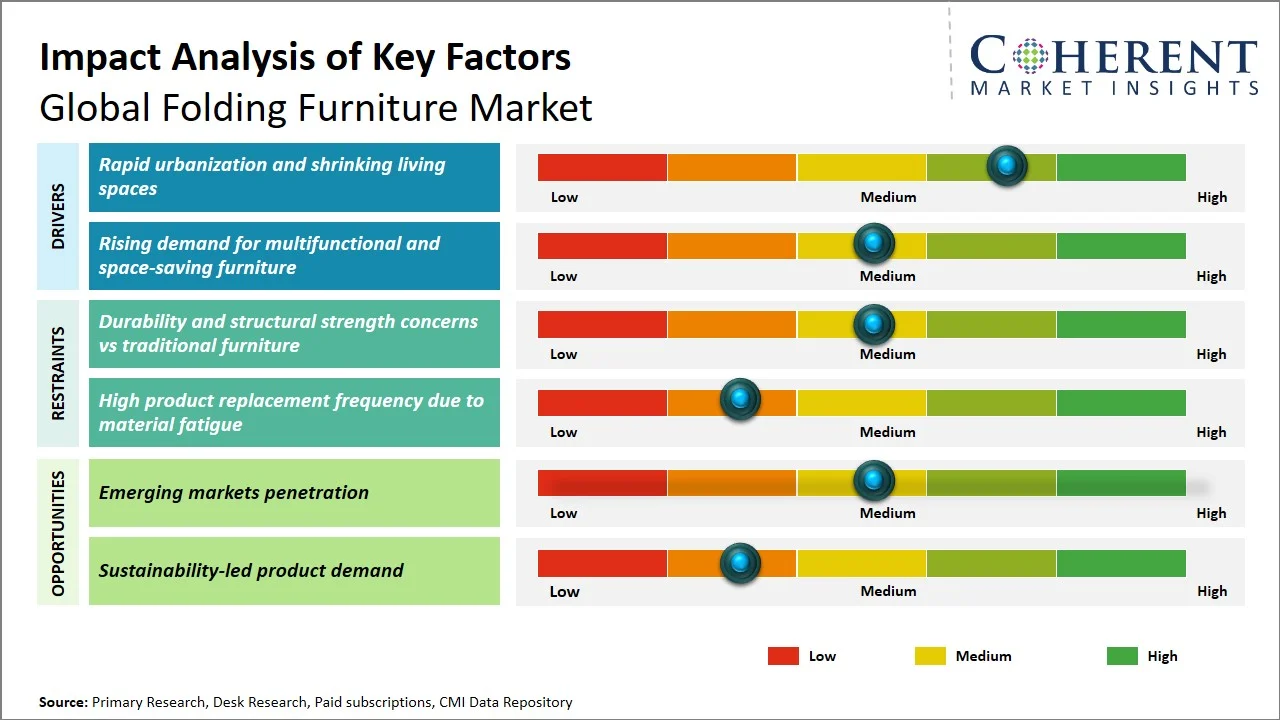
- Rapid urbanization and shrinking living spaces: Global urbanization is putting structural pressure on the space available per person, thus leading to increased demand for folding furniture. As per estimates, by 2050, close to 68% of the world's population will reside in urban locations. With an already limited amount of space in densely packed locations such as Hong Kong (~470 – 484 sq ft apartments on average), Tokyo (~600 – 700 sq ft in centrally located apartments), Shanghai, and Mumbai, there arises a need for space-saving furniture.
- Rising demand for multifunctional and space saving furniture: The demand for multifunctional furniture has grown substantially in recent years, driven mainly by limited available space and cost savings. Over 50–55% of new furniture introductions globally now incorporate multifunctional or convertible designs, including sofa beds, portable study tables with storage drawers, and collapsible dining tables that can be folded and stored against walls. In urban furniture markets such as India, Southeast Asia, and major U.S. cities, consumers increasingly prefer products that can be easily assembled, disassembled, and relocated to optimize limited living space For instance, IKEA’s modular furniture systems (such as its sofa beds and foldable dining sets) are widely adopted in compact apartments in cities like Mumbai and Singapore, where residents prioritize space efficiency and frequent reconfiguration of living areas.
Emerging Trends
- Rising Demand for Space-Saving and Multifunctional Designs: The demand for wall beds, collapsible tables, and stackable chairs is being driven by an increase in urbanization & shrinking apartment sizes. Consumers in metropolitan areas and small housing markets want multi-functional pieces that maximize utility without needing a permanent footprint, which is in keeping with the growing trend toward both residential and micro-apartment living.
- Innovation in Folding Mechanism Technology and Materials: New materials (e.g., lightweight alloys, engineered wood composites, and high strength polymers) and designs of foldable furniture (e.g., hydraulic assisted folding systems) are being utilized by manufacturers to create more user friendly and durable furniture with sufficient structural integrity to be used commercially (i.e., office, hotel) or in residential settings.
Regional Insights
Why is Asia Pacific a Robust Market for Folding Furniture?
The Asia Pacific leads the folding furniture market accounting for an estimated 39.9% share in 2026, due to structural urban constraints, high population density, and smaller average home sizes (with over 50% of the region’s urban population living in high-density cities such as Tokyo, Mumbai, Shanghai, and Jakarta, where per-capita living space is often below 30–40 sq. meters in major metros). Close living spaces are the norm in countries such as China, India and Japan. This creates a direct need for foldable beds, tables, chairs, etc. For example, urban apartments in China are often below ~800 sq. ft., while cities in India such as Mumbai and Bangalore are experiencing rapid growth in micro-apartments due to migration and affordability constraints.
Why is the Folding Furniture Market Witnessing High Growth in North America?
The North America folding furniture market is expected to exhibit the fastest growth with an estimated contribution of 19.3% share to the market in 2026, driven by lifestyle changes and not just space constraints. The region has witnessed a high adoption of hybrid and remote work models, which has led to an increased demand for foldable desks, modular workstations, and convertible home-office furniture. And in cities like New York, San Francisco, and Toronto, urban housing is becoming more compact and co-living and rental-based housing models are growing.
Global Folding Furniture Market Outlook by Major Countries
What Puts the U.S. at the Forefront of Innovation and Adoption in the Folding Furniture Market?
North America’s innovation and adoption are powered by the U.S., with its premium furniture ecosystem and high design differentiation. Demand is concentrated in home-office furniture, multifunctional living spaces, and suburban households, where folding desks, wall-mounted beds, and convertible furniture systems are popular. In the U.S. market, there is also a strong consumer willingness to pay for durable and design-led products, with folding furniture integrated into hybrid work lifestyles where furniture is actively reconfigured between work and leisure modes.
Is India a Viable Market for Folding Furniture Entry?
Rapid urbanization, growth of nuclear families, and decreasing size of apartments in metro cities are making India one of the fastest growing markets for folding furniture. The market is price sensitive, but structurally, it is expanding with strong demand coming in from tier-2 and tier-3 cities like Pune, Jaipur, Lucknow, and Hyderabad.
Is China Becoming a Critical Growth Hub for the Folding Furniture Market?
China is the largest structural hub for production and consumption of folding furniture. It is one of the largest global unit volumes, According to CSIL, furniture production in China amounts to nearly USD 170 billion. On a global level, China ranks 1st for furniture production and exports. Approximately one-third of China’s furniture output is exported, highlighting the country’s integral role in global supply chains, driven by dense megacities such as Beijing, Shanghai, and Shenzhen. The country’s dominance is related to the fast-growing urban housing expansion, where compact apartments are the dominant residential supply. Folding furniture is widely used to maximize floor efficiency in apartments, which are often less than 650 sq. ft. Wall-mounted dining tables and collapsible storage systems are common.
Is Japan Folding Furniture Market Growing?
Japan is a mature but very developed market for folding furniture, influenced by extreme space limitations and cultural minimalism. Tokyo is approximately 65.9 square meters (Source: Interac Inc.). Of the 65.9 sqms, only 41 sqm accommodates living space, such as a sleeping area, kitchen, and dining and leisure area, but in dense city centers, usable living space can be significantly lower. Folding beds, collapsible tables, and modular storage systems are essential household components. Japan is the best at designing furniture to be ultra-compact and multifunctional, often incorporating advanced engineering mechanisms to make the most out of the space available.
Urban Living Space Constraint Index - Interpretation for Folding Furniture Market
Component | What It Indicates | Direct Impact on Folding Furniture Demand |
Average Urban Living Space per Household | Lower values = tighter housing conditions (apartments, micro-housing, rented units) | Lower space → higher demand for compact, foldable, wall-mounted, and multi-use furniture |
Average Rural Living Space per Household | Usually significantly higher than urban | Acts as a baseline showing urban space pressure intensity |
Urban vs Rural Space Ratio | Lower ratio = stronger urban space constraint | Strong predictor of urban-centric folding furniture adoption |
How is demand for space-efficient, multi-functional and durable furniture driving new growth opportunities in the global folding furniture market?
Growing demand for space-saving living solutions and flexible interior design is creating major opportunities in the folding furniture market. Rapid urbanization, rising real estate prices, and the development of micro-apartments are pushing consumers and businesses to look for furniture that provides maximum utility in minimum space. This trend is pushing manufacturers to look beyond traditional folding chairs and tables to highly engineered, multifunctional systems that include storage, mobility, and adaptability.
The optimization of urban residential space is a nascent key growth opportunity as consumers are increasingly replacing fixed furniture with foldable beds, wall-mounted desks, expandible dining sets, and modular seating systems. This trend is especially prevalent in high-density cities where floor space is scarce and at a premium, leading to an ongoing demand for premium compact furniture solutions. For example, the average size of homes in major Indian cities is much larger, but widely varying, with aggregated data averaging around 500 sq. ft. for smaller units in some datasets, and larger urban averages depending on income bracket and city tier.
Market Players, Key Development, and Competitive Intelligence

Key Developments
- In July 2024, Ashley Furniture Industries, a leading home furnishing and furniture manufacturer, announced its plan to invest USD 80 million to expand its two manufacturing sites in Lee County, Mississippi.
- Dorel Home is focusing on high-performing, core product lines—including Cosco folding furniture—while scaling back on other ready-to-assemble products. These changes will be facilitated by a reduced product line focusing on profitable categories and the elimination of the domestic manufacturing operations based in Cornwall, Ontario.
Competitive Landscape
The global folding furniture market is highly competitive owing to the growing need for space-efficient and multi-purpose living solutions. The big players win on the basis of scale and distribution strength, while smaller firms compete on design innovation and pricing flexibility. The main areas of focus are:
- Rugged, easy to use products
- Expansion of product diversification and modular design
- Strategic partnerships, acquisitions, and omni-channel expansion
Market Report Scope
Folding Furniture Market Report Coverage
| Report Coverage | Details | ||
|---|---|---|---|
| Base Year: | 2025 | Market Size in 2026: | USD 4.87 Bn |
| Historical Data for: | 2020 To 2024 | Forecast Period: | 2026 To 2033 |
| Forecast Period 2026 to 2033 CAGR: | 9.8% | 2033 Value Projection: | USD 9.37 Bn |
| Geographies covered: |
| ||
| Segments covered: |
| ||
| Companies covered: | Flexsteel Industries, Inc., Haworth, Inc., Meco Corporation, Dorel Industries, Inc., Murphy Wall Beds Hardware, Inc., Ashley Furniture Industries, La-Z-Boy, Inc., Leggett & Platt, Inc., Resource Furniture, Sauder Woodworking Company, and Inter IKEA Systems B.V. | ||
| Growth Drivers: |
| ||
| Restraints & Challenges: |
| ||
Analyst Opinion (Expert Opinion)
- The folding furniture business is undergoing a structural transition from a consumer discretionary category to an embedded urban infrastructure solution. Future demand will be driven primarily by continued urban densification, shrinking per capita living space, and the rapid rise of rental-led and shared housing models. This will lead to a gradual shift of folding furniture from independent retail products to integrated space-saving systems designed in the architectural planning phase of residential and institutional projects.
- The biggest opportunity is in high density urban housing ecosystems, especially in Asia Pacific. Demand for foldable beds, wall-mounted desks, and convertible sofas targeted at affordable housing, mid-income apartments and co-living spaces in cities like Mumbai, Bengaluru, and Delhi NCR will make India a key growth driver. Demand in China will stay robust in Tier 1 and Tier 2 cities, with the preference for modular storage solutions and space-efficient, multi-functional furniture to cater to the folding furniture market.
- Institutional adoption, not individual consumer purchase, will define the next phase of competitive advantage. The demand drivers will primarily be the co-living operators, student housing developers, hospitality groups, and real estate funds. This will move the procurement from fragmented retail channels to project-based bulk adoption. This structural change will forever alter go-to-market models in the industry.
Speak to the analyst
Want personalized insights?
Take the findings above to one of our principal consultants, or have the report rebuilt around the segments, geographies and competitors you actually track.
Market Segmentation
- Product Insights (Revenue, USD Bn, 2021 - 2033)
- Tables & Chairs
- Sofa
- Beds
- Others
- Distribution Channel Insights (Revenue, USD Bn, 2021 - 2033)
- Offline
- Online
- Regional Insights (Revenue, USD Bn, 2021 - 2033)
- North America
- U.S.
- Canada
- Latin America
- Brazil
- Argentina
- Mexico
- Rest of Latin America
- Europe
- Germany
- U.K.
- Spain
- France
- Italy
- Russia
- Rest of Europe
- Asia Pacific
- China
- India
- Japan
- Australia
- South Korea
- ASEAN
- Rest of Asia Pacific
- Middle East
- GCC Countries
- Israel
- Rest of Middle East
- Africa
- South Africa
- North Africa
- Central Africa
- North America
- Key Players Insights
- Flexsteel Industries, Inc.
- Haworth, Inc.
- Meco Corporation
- Dorel Industries, Inc.
- Murphy Wall Beds Hardware, Inc.
- Ashley Furniture Industries
- La-Z-Boy, Inc.
- Leggett & Platt, Inc.
- Resource Furniture
- Sauder Woodworking Company
- Inter IKEA Systems B.V.
Sources
Primary Research Interviews
- Folding furniture manufacturers (e.g., IKEA, Flexsteel, La‑Z‑Boy, Meco, Dorel Industries, Resource Furniture)
- Supply‑chain directors of home‑furnishings and modular‑furniture producers
- Product innovation / R&D managers at space‑saving furniture brands (e.g., Murphy Wall Beds hardware, modular bed‑and‑desk systems)
- Sustainability officers from furniture‑industry associations or green‑certification bodies
Stakeholders
- Manufacturers of folding furniture (e.g. Inter IKEA Systems B.V., Flexsteel Industries, Inc.)
- End-use Sectors
- Residential furniture retailers and multi-family housing developers adopting compact / studio style furniture
- Co-working space operators and flexible office providers using folding tables, desks, and partitions
- Outdoor and contract furniture clients (event venues, campuses, hospitality) sourcing folding tables and chairs
- Regulatory & Certification Bodies: ICC (building codes), ENERGY STAR (efficiency), ASTM International (performance standards).
- E‑commerce platforms and furniture‑focused marketplaces (Amazon, Wayfair, Houzz‑style showrooms)
- Specialty furniture and modular living online retailers offering 3D planning tools and folding furniture configurators
Databases
- International Council of Furniture Manufacturers (ICFM) – global furniture industry standards and trade
- American Home Furnishings Alliance (AHFA) – U.S. furniture sector advocacy and best practices
- Forest Stewardship Council (FSC) / PEFC – sustainable wood fiber sourcing for folding wood furniture
- International Standards Organization (ISO) – furniture safety, durability, and ergonomics standards (e.g., ISO 7170, ISO 7173)
Magazines
- UN Comtrade Database (HS Code 9403 for “furniture and parts thereof”) – folding furniture exports/imports by country
- India Import Export (EXIM) Database – India specific furniture trade, including folding types
- U.S. International Trade Commission (USITC) DataWeb – U.S. imports of furniture and related products
- Eurostat trade statistics – European Union level furniture and household goods trade flows
- U.S. Census Bureau / Eurostat / national statistics offices – retail trade and furniture sales data
- U.S. Department of Energy / EPA – material sustainability and VOC emission guidelines indirectly affecting furniture manufacturing
Journals
- Journal of Building Engineering – research on building space optimization and space saving interior systems (relevant for compact living typologies)
- Building and Environment – studies on thermal comfort and space efficiency in small / micro apartments using folding furniture layouts
- Construction and Building Materials – material performance work on composites and panels used in lightweight furniture
Newspapers
- The Wall Street Journal – housing‑density trends, micro‑apartments, and demand for space‑saving furniture
- Business Standard (India) – growth of compact‑housing projects and furniture demand in Indian urban markets
- Construction Dive – coverage of micro‑apartments, co‑living, and flexible‑space projects that drive folding‑furniture adoption
Associations
- Business & Institutional Furniture Manufacturers Association (BIFMA)
- International Council of Furniture Manufacturers (ICFM)
- American Home Furnishings Alliance (AHFA)
- Furniture Industry Sustainability Coalition (FISC / FFSC type bodies)
- Indian Furniture Industry Association (IFIA / similar trade bodies)
Public Domain Sources
- U.S. Environmental Protection Agency (EPA)
- American National Standards Institute (ANSI) / BIFMA
- Bureau of Indian Standards (BIS)
- U.S. Department of Energy / national housing‑policy agencies
Proprietary Elements
- CMI Data Analytics Tool, Proprietary CMI Existing Repository of information for last 10 years.
Get access to 250+ pages report
Every segment, forecast, competitor profile and data table behind the analysis above — available for instant download.
- ESOMAR Member
- ISO 9001:2015 Certified
- D-U-N-S Registered
- GDPR & CCPA Compliant
Missing comfort of reading report in your local language? Find your preferred language:
Transform your Strategy with Exclusive Trending Reports
Frequently Asked Questions
The global folding furniture market is estimated to be valued at USD 4.87 Bn in 2026 and is expected to reach USD 9.37 Bn by 2033.
The CAGR of global folding furniture market is projected to be 9.8% from 2026 to 2033.
Rapid urbanization and shrinking living spaces and rising demand for multifunctional and space-saving furniture are the major factors driving the growth of the global folding furniture market.
Durability and structural strength concerns vs traditional furniture and high product replacement frequency due to material fatigue are the major factors hampering the growth of the global folding furniture market.
In terms of product, tables & chairs are estimated to dominate the market revenue share in 2026.
Flexsteel Industries, Inc., Haworth, Inc., Meco Corporation, Dorel Industries, Inc., Murphy Wall Beds Hardware, Inc., Ashley Furniture Industries, La-Z-Boy, Inc., Leggett & Platt, Inc., Resource Furniture, Sauder Woodworking Company, and Inter IKEA Systems B.V. are the major players.
Asia Pacific is expected to lead the global folding furniture market in 2026.