

Global Temporary Clinical Workforce Services Market Size and Forecast – 2026 To 2033
The global temporary clinical workforce services market is expected to grow from USD 80.0 Bn in 2026 to USD 122.9 Bn by 2033, registering a compound annual growth rate (CAGR) of 6.3% from 2026 to 2033. The market for global temporary clinical workforce services is poised for significant expansion, fueled by the persistent shortages of qualified healthcare professionals, which are increasing reliance on flexible staffing solutions.
The U.S. Health Resources and Services Administration projects an 8% shortage of registered nurses in 2028, underscoring the continuing need for flexible staffing solutions.
Key Takeaways of the Global Temporary Clinical Workforce Services Market
- Travel nurse staffing is projected to hold 29.7 % of the global temporary clinical workforce services market share in 2026, making it dominant type segment, across North America, where persistent nursing workforce shortages sustain demand for travel-based clinical staffing. For instance, the U.S. Health Resources and Services Administration identifies significant nursing workforce shortfalls and notes that some hospital vacancies have historically been covered by traveling nurses.
- Staffing gaps are projected to hold 22.6 % of the global temporary clinical workforce services market share in 2026, making it dominant application segment, particularly in Europe, where healthcare systems continue to experience workforce shortages across nursing and allied health professions. For instance, NHS England reported 100,165 NHS vacancies at the end of 2025, including 22,559 vacancies among registered nursing staff, reinforcing the need for supplemental workforce solutions.
- Hospitals and clinics are projected to hold 25.1 % of the global temporary clinical workforce services market share in 2026, making it dominant end user segment, across Europe particularly the UK and other European healthcare systems, where temporary staffing is used to manage fluctuating demand and workforce shortages. For instance, NHS England’s workforce planning identifies temporary staffing as an important mechanism for filling service gaps and maintaining staffing capacity across National Health Service organizations.
- North America market maintains dominance with an expected share of 54.0 % in 2026, bolstered by region’s established use of flexible clinical staffing to manage workforce shortages. For instance, the U.S. Agency for Healthcare Research and Quality note that healthcare systems use agency nurses, float nurses, and travel nurses to compensate for nursing shortages and maintain appropriate staffing levels.
- Asia Pacific is expected to exhibit the fastest growth in the global temporary clinical workforce services market, registering an estimated CAGR of 7.1 % during 2026–2033, propelled by workforce shortages and increasing efforts to expand clinical capacity. For instance, Australia recorded 16,622 internationally qualified nurses registering to practice in 2023–24, reflecting strong demand for additional clinical workforce capacity.
Segmental Insights
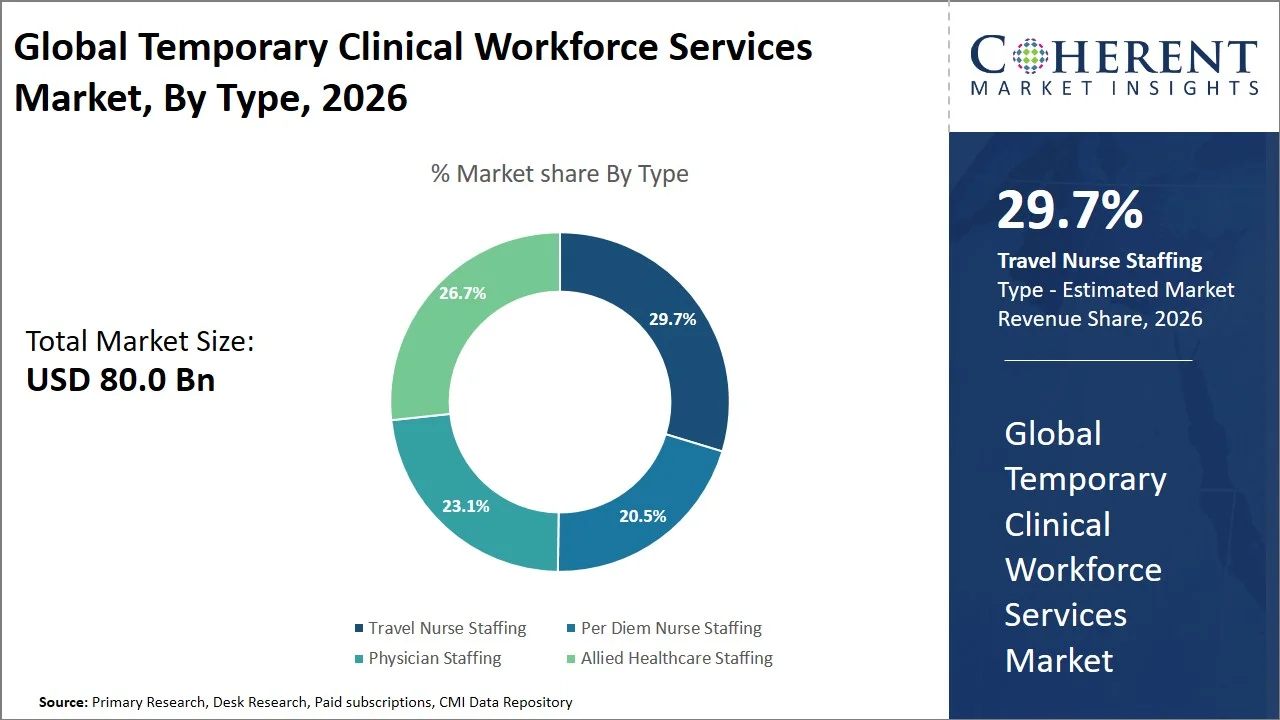
Why Do Travel Nurse Staffing Dominate the Global Temporary Clinical Workforce Services Market?
Travel nurse staffing is projected to hold the market share of 29.7% in 2026, since it permits healthcare facilities to fill nursing shortages at various hospital settings and restricted geographic locations quickly, without interruption in care. In addition, nurses specialized in unique clinical skills are needed to fulfill high demand units such as critical care and the emergency department is contributing to the segment. For instance, according to the American Hospital Association, FTEs of travel nurses per patient day grew by more than 183.4% from 2019 to 2022, indicating provider dependency on the readily available nature of temporary nursing ability.
- Current Industry Events of 2026
- Market Size Estimation
- Regional Breakdown
- Competitive Landscape
- Customer Intelligence
- Segmental Analysis
- Pricing Analysis
- Key Market Drivers, Challenges & Future Trends
- Customized Insights Section
Why Does Staffing Gaps Represent the Largest Application Segment in the Temporary Clinical Workforce Services Market?
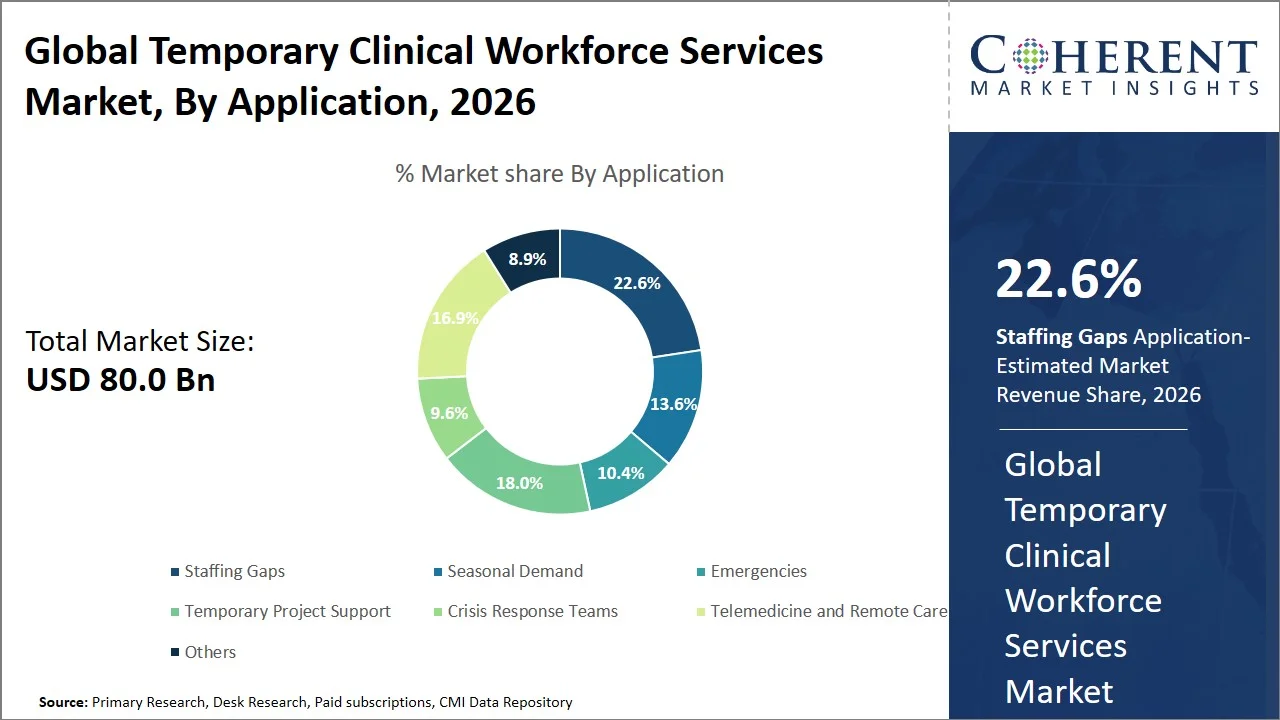
Staffing gaps are projected to hold a market share of 22.6% in 2026, due to the ability of temporary clinical workforce services for immediate access to quality clinical staff whenever shortages, turnover, absence, or delays with hiring will cause workforce shortages. On-going shortages create continuous demand regardless of short-term seasonal needs. For instance, according to NHS England, the modelling estimates that the starting shortfall between demand and supply for NHS staff is approximately 150,000 full-time equivalents (FTEs), a gap that is filled with temporary staffing.
Hospitals and Clinics Segment Dominates the Global Temporary Clinical Workforce Services Market
The hospitals and clinics segment is projected to hold a market share of 25.1% in 2026, due to their constant need for care delivery. This inherently generates demand for a consistent workflow of nurses, physicians and allied health professionals. Due to variations in patient volumes, unplanned staffing shortfalls, staff turnover and specialty demand, temporary staffing serves as a way to sustain operations. For instance, according to the American Hospital Association, hospital dependency on contract labor grew significantly post the pandemic, reflecting ongoing reliance on temporary clinical staff during busy hospital periods.
Currents Events and their Impact
Current Events | Description and its Impact |
All Star Healthcare Solutions Acquired Cross Country Healthcare’s Locums Division (July 2026) |
|
Barton Associates Acquired Locums Collective to Expand Workforce Solutions (May 2026) |
|
SnapCare and connectRN Merged to Expand Flexible Clinical Staffing (April 2026) |
|
Temporary Clinical Workforce Services Market Dynamics
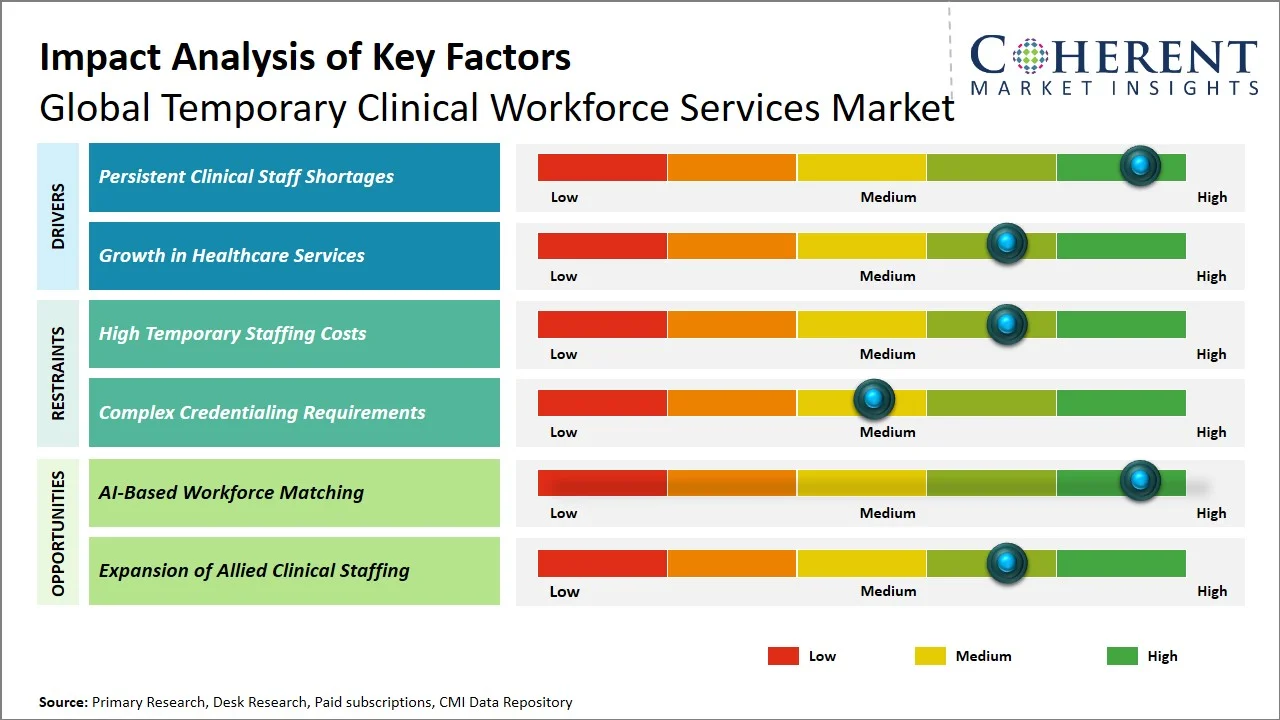
Market Drivers
- Persistent Clinical Staff Shortages: The persistent shortage and uneven distribution of healthcare professionals are increasing healthcare providers’ reliance on temporary clinical workforce services to maintain adequate staffing and service continuity. Temporary staffing enables hospitals and other care settings to quickly access qualified clinicians when permanent recruitment cannot meet immediate workforce requirements. For instance, the World Health Organization projects a global shortage of 11.1 million health workers by 2030, underscoring the continuing need for flexible workforce solutions.
- Growth in Healthcare Services: The expansion of healthcare services is increasing demand for physicians, nurses, and allied clinical professionals, creating greater need for flexible workforce capacity across hospitals, clinics, and other care settings. As healthcare systems expand service delivery and respond to rising care needs, temporary staffing enables providers to scale clinical capacity without relying solely on permanent recruitment. For instance, the OECD (Organisation for Economic Co-operation and Development) reported that health and social care employment across OECD countries increased by 30% between 2013 and 2023, twice the pace of overall employment growth.
- Rising Demand for Specialized Clinical Skills: Increasing complexity of healthcare delivery is creating demand for specialized nurses, physicians, and allied health professionals, particularly across acute, critical-care, and community settings. Temporary workforce services enable providers to access specialized skills without making permanent hires for every short-term or fluctuating requirement. For instance, the World Health Organization’s 2026 workforce report highlights continuing disparities in health-worker availability and identifies population ageing and health-workforce ageing as important factors shaping future workforce requirements.
Emerging Trends
- Shift toward internal and hybrid staffing models: Healthcare providers are increasingly combining permanent teams, internal float pools, and external temporary clinicians rather than relying exclusively on staffing agencies. This is encouraging staffing companies to offer more integrated and managed workforce solutions.
- Growing use of vendor management systems (VMS): Healthcare organizations are increasingly adopting vendor management systems (VMS) platforms to centralize temporary clinician sourcing, assignment management, reporting, and vendor coordination. This is making contingent workforce management more standardized and data-driven.
- Temporary staffing becoming part of long-term workforce planning: Locum tenens and other temporary staffing models are increasingly being incorporated into strategic workforce planning rather than being used only for emergency vacancies. Providers are using temporary clinicians to maintain service continuity, support new service lines, and manage transitions while permanent recruitment continues.
Regional Insights
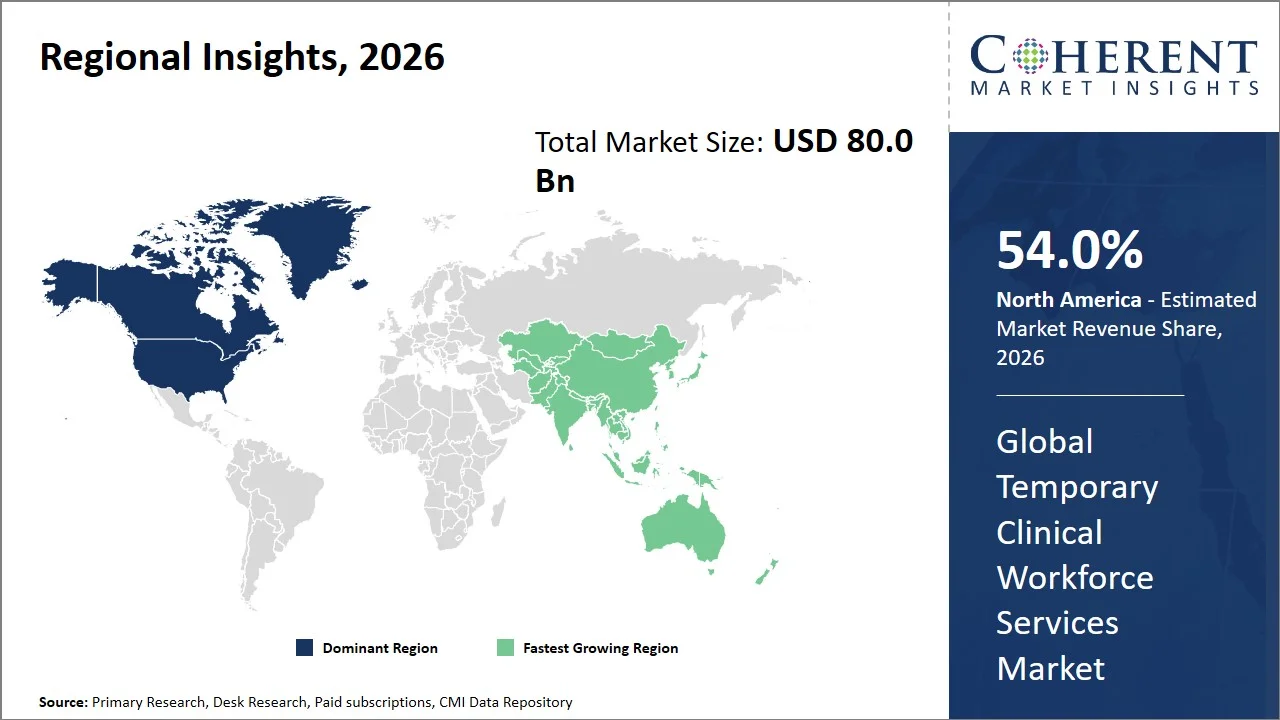
Why is North America a Strong Market for Temporary Clinical Workforce Services?
North America leads the global temporary clinical workforce services market, accounting for an estimated 54.0% share in 2026, driven by the presence of well-developed healthcare infrastructure, the increasing expenditure on healthcare as a percentage of the total GDP and the presence of an optimized infrastructure in the forms of a dedicated health ecosystem. North America's long chain of interconnected hospitals and out-patient clinics, has enabled for a consistent demand for temporary clinical workforce to cater for varied demands of patient pool to employee ratio on time and meet demand for skilled workforce or backfill roles.
Furthermore, regulatory norms established in line with labor policies that govern healthcare services and governmental grants to encourage staffing efficiency further boost the market. For instance, the U.S. Department of Health and Human Services (HRSA), in the fiscal year 2025 granted approximately USD 1.2 billion in health professions education funding to boost the healthcare workforce in meeting present and future needs. Moreover, most of the healthcare institutions that follow standardized practices have already inculcated innovative platforms of digital workforce for their staffing-on-demand functions
Why Does Asia Pacific Temporary Clinical Workforce Services Market Exhibit High Growth?
Asia Pacific is expected to exhibit the fastest growth in the global temporary clinical workforce services market, registering an estimated CAGR of 7.1% during 2026–2033. The region is projected to account for approximately 17.1% of the global market in 2026, driven by a booming health infrastructure coupled by increasing investments and growing need for clinical experts. The escalating number of clinics and specialized units are fuelling need for the usage of mobile staffing solutions for filling staffing voids and for varied service demands.
With the initiatives of governments on enhancing patient-access and digitizing the health sector, the region is in fact expanding new care delivery solutions for optimal workforce usage, and cross border movement & digital staffing solutions will enhance job flexibility of clinician and hasten the market in APAC region. For instance, the Australian Government developed the National Allied Health Digital Uplift Plan to enhance the digital capacity of the allied health workforce and promote integrated, digitally enabled care delivery which can enable allied health professionals to be deployed more effectively across care settings.
Global Temporary Clinical Workforce Services Market Outlook for Key Countries
Why is the U.S. Leading Innovation and Adoption in the Temporary Clinical Workforce Services Market?
The U.S. dominates the temporary clinical workforce services market driven by fast uptake in technology enabled staffing platforms, with digital clinician marketplaces, mobile scheduling, automated credentialing and AI-powered workforce matching dominating the market. The US temporary staffing ecosystem is evolving rapidly from pure staffing to integrated workforce solutions, unifying travel, per diem, locum and allied health staffing. It leads in terms of accelerated clinician deployments and effective solutions for complex staffing needs.
Is Japan a Favorable Market for Temporary Clinical Workforce Services Market?
Japan is one of the most promising markets for the temporary clinical workforce services market as healthcare staff availability differs by locality and clinical setting. The greatest opportunity exists within the home care sector, the community care sector and rural facilities, where flexible staff would greatly supplement localized workforce shortages and contribute to continued operations within these sectors.
Is China Emerging as a Key Growth Hub for the Temporary Clinical Workforce Services Market?
China is positioned as a key growth hub in the global temporary clinical workforce services market as hospitals, home healthcare, and elderly care services develop further. It offers an attractive opportunity particularly for geriatric, rehabilitation, intensive-care and home-based nursing. The demand for niche workforce models is growing for specialized workforces required in these areas. For instance, at the end of 2025, China’s National Health Commission reported having 6.06 million registered nurses working in the healthcare system and predicted continued development and expansion of home-based nursing services, therefore fueling demand for more flexible workforce models.
Why Does Germany Top the European Temporary Clinical Workforce Services Market?
Germany leads the European temporary clinical workforce services market due to its substantial base of healthcare workers and ongoing supply and demand for flexible staffing by shortages in nursing and care professions. Germany's Federal Ministry of Health considers that there are already shortages in all nursing occupation, and the new workforce-monitoring approach will now predict healthcare staffing needs. In 2014, Germany also employed almost 6.2 million healthcare staff and this constitutes a substantial clinical employment network, for temporary workforce providers.
Is Temporary Clinical Workforce Services Market Developing in India?
India is a high-potential market for temporary clinical workforce services specifically for temporary nursing and allied health staffing in tandem with overall growth in healthcare infrastructure. The Government of India data confirms that in June 2025, 77,874 nurses and 93,034 allied and healthcare workers were already staffed on a contract basis by the National Health Mission, thus showing existing demand for flexible clinical workforces’ models. The market spans public healthcare institutions, new tertiary-care expansion sites and underserved areas where deployment is uneven and flexible workforces may prove to be valuable to cover the gap.
Temporary Clinical Staffing Indicators in Selected Healthcare Systems, 2023–2025
Country | Temporary Clinical Staffing Indicator |
U.S. | Temporary/agency clinical staffing demand |
Canada | Hospital hours supplied by private staffing agencies |
U.K. | NHS agency staffing expenditure |
Australia | Agency staffing costs in residential aged care |
Germany | Temporary/agency healthcare staffing |
How are the AI-based workforce matching creating new growth opportunities in the temporary clinical workforce services market?
AI staffing platforms can streamline the deployment of the temporary clinical workforce by identifying appropriate clinical staffing for shifts based on their specialty, qualifications, availability, location and facility needs. Automation is also applied in the process to fill shifts in real-time and verify compliance with certifications, lessening the need for time-intensive recruiting and administrative work. For instance, in July 2023, Aya Healthcare announced the acquisition of Polaris AI, its first machine-learning product focused on the prediction of volume trends and demand for health care professionals and clinical staff. This technology will further enhance AI-driven workforce planning and optimization by demonstrating how to best utilize prediction and analytics to plan for and place health care staffing.
Market Players, Key Development, and Competitive Landscape
Key Developments
- In August 2026, Xpress Health launches Next-Generation Staffing Platform in Sydney: Xpress Health expanded its digital shift-booking platform across New South Wales, connecting registered nurses and nursing assistants directly with healthcare providers for temporary and flexible shifts. The platform uses technology-enabled matching and real-time shift booking to help healthcare facilities address short-term workforce requirements.
- In January 2026, Adecco acquires Advantis Medical Staffing: Adecco announced the acquisition of Advantis Medical Staffing, a U.S.-based healthcare staffing company specializing in travel nursing and allied health. The acquisition strengthens Adecco’s technology-enabled healthcare staffing capabilities and expands its ability to provide scalable temporary workforce solutions across the U.S.
- In October 2025, Enabli Health launched a workforce solution to help healthcare providers address growing shortages of allied health professionals, particularly medical assistants and other entry-level clinical roles. The model provides a turnkey workforce alternative to conventional contingent staffing, helping providers strengthen care-team capacity and improve operational efficiency.
Competitive Landscape
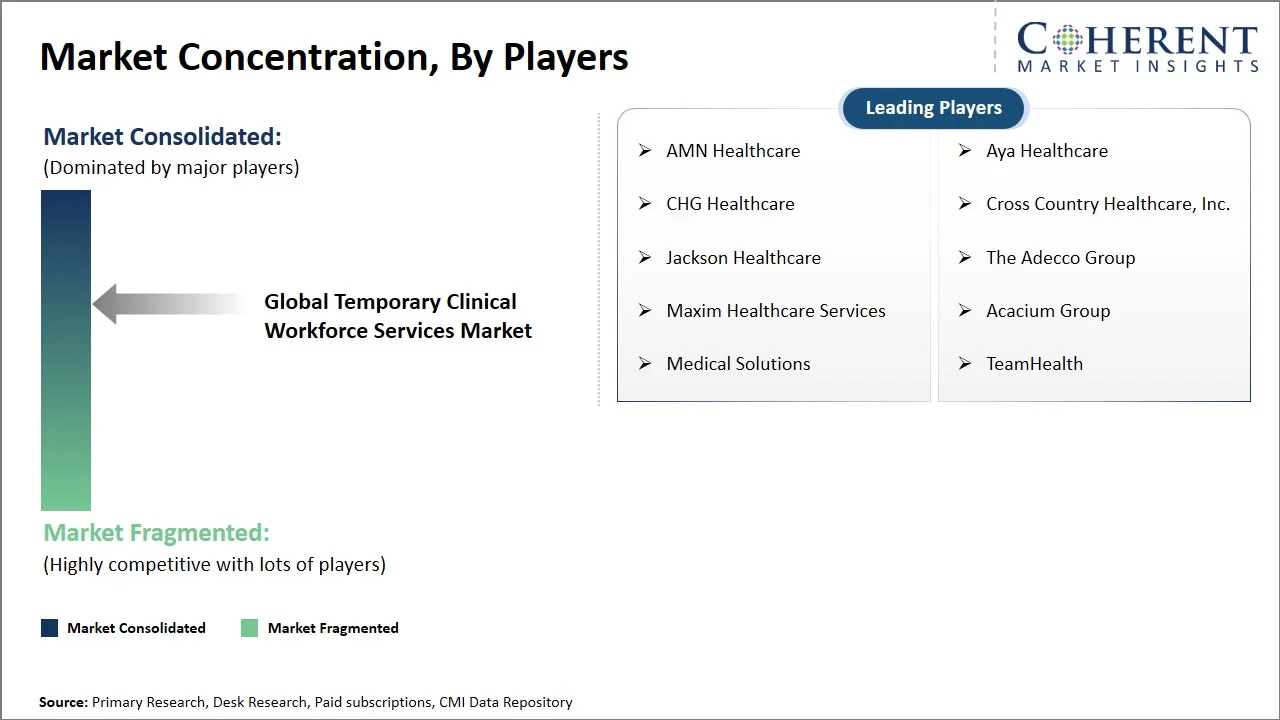
The global temporary clinical workforce services market is moderately competitive, with providers differentiating through clinician availability, placement speed, credentialing efficiency, and coverage across nursing, locum tenens, and allied health roles. Key focus areas include digital workforce-matching platforms, faster credential verification, flexible shift and assignment models, and expansion of specialized clinical staffing networks. Key focus areas include:
- Expansion of digital staffing platforms to accelerate clinician–facility matching and shift fulfillment
- AI-enabled credentialing and workforce management to reduce administrative delays and improve deployment efficiency
- Broader specialized staffing networks covering travel nurses, locum physicians, and allied healthcare professionals
- Flexible on-demand staffing models to address short-term staffing gaps, fluctuating patient volumes, and emergency workforce requirements
Market Report Scope
Temporary Clinical Workforce Services Market Report Coverage
| Report Coverage | Details | ||
|---|---|---|---|
| Base Year: | 2025 | Market Size in 2026: | USD 80.0 Bn |
| Historical Data for: | 2020 To 2024 | Forecast Period: | 2026 To 2033 |
| Forecast Period 2026 to 2033 CAGR: | 6.3% | 2033 Value Projection: | USD 122.9 Bn |
| Geographies covered: |
| ||
| Segments covered: |
| ||
| Companies covered: | AMN Healthcare, Aya Healthcare, CHG Healthcare, Cross Country Healthcare, Inc., Jackson Healthcare, The Adecco Group, Maxim Healthcare Services, Acacium Group, Medical Solutions, TeamHealth | ||
| Growth Drivers: |
| ||
| Restraints & Challenges: |
| ||
Analyst Opinion (Expert Opinion)
- The global temporary clinical workforce services market is expected to witness sustained growth as healthcare providers increasingly shift toward flexible workforce models to manage fluctuating staffing requirements, short-term vacancies, and specialized clinical skill shortages. Digital staffing platforms, on-demand scheduling, and streamlined clinician deployment are likely to become increasingly central to workforce management.
- The maximum opportunities will probably exist within travel nurse staffing for staffing-gap applications in the U.S. The combination of recurring nursing requirements, short-duration assignments, and demand for rapid workforce deployment creates strong potential for temporary staffing providers that can efficiently connect qualified clinicians with healthcare facilities.
- In order to obtain a competitive advantage, market participants should focus on building specialized clinician networks, accelerating credentialing and onboarding, and strengthening digital matching and scheduling capabilities. Providers that can reduce placement time while maintaining credentialing, compliance, and clinician quality are likely to differentiate themselves in an increasingly service- and technology-driven market.
Speak to the analyst
Want personalized insights?
Take the findings above to one of our principal consultants, or have the report rebuilt around the segments, geographies and competitors you actually track.
Market Segmentation
- Type Insights (Revenue, USD Bn, 2021 - 2033)
- Travel Nurse Staffing
- Per Diem Nurse Staffing
- Physician Staffing
- Allied Healthcare Staffing
- Application Insights (Revenue, USD Bn, 2021 - 2033)
- Staffing Gaps
- Seasonal Demand
- Emergencies
- Temporary Project Support
- Crisis Response Teams
- Telemedicine and Remote Care
- Others
- End User Insights (Revenue, USD Bn, 2021 - 2033)
- Hospitals and Clinics
- Nursing Homes
- Ambulatory Surgical Centers
- Hospice Care Centers
- Government Healthcare Facilities
- Rehabilitation Centers
- Others
- Regional Insights (Revenue, USD Bn, 2021 - 2033)
- North America
- U.S.
- Canada
- Latin America
- Brazil
- Argentina
- Mexico
- Rest of Latin America
- Europe
- Germany
- U.K.
- Spain
- France
- Italy
- Russia
- Rest of Europe
- Asia Pacific
- China
- India
- Japan
- Australia
- South Korea
- ASEAN
- Rest of Asia Pacific
- Middle East
- GCC Countries
- Israel
- Rest of Middle East
- Africa
- South Africa
- North Africa
- Central Africa
- North America
- Key Players Insights
- AMN Healthcare
- Aya Healthcare
- CHG Healthcare
- Cross Country Healthcare, Inc.
- Jackson Healthcare
- The Adecco Group
- Maxim Healthcare Services
- Acacium Group
- Medical Solutions
- TeamHealth
Sources
Primary Research Interviews
- Hospital workforce managers and nurse administrators responsible for temporary staffing and workforce planning
- Human resources and talent-acquisition executives managing contract, per-diem, and travel clinical staffing
- Staffing-agency executives specializing in travel nursing, locum tenens, and allied health placements
- Clinical department managers involved in temporary clinician recruitment and deployment
- Healthcare workforce consultants and credentialing specialists
Stakeholders
- Temporary clinical workforce staffing agencies
- Hospitals, health systems, and outpatient healthcare providers
- Travel nurse and locum tenens organizations
- Healthcare workforce technology and staffing-platform providers
- Clinical credentialing and compliance service providers
- Healthcare human resources and workforce-management departments
- End-use Sectors
- Hospitals and health systems
- Outpatient and ambulatory care centers
- Long-term care and skilled nursing facilities
- Home healthcare and hospice providers
- Specialty clinics and medical centers
- Emergency and urgent-care facilities
- Regulatory & Health Bodies
- U.S. Bureau of Labor Statistics (BLS)
- Health Resources and Services Administration (HRSA)
- Centers for Medicare & Medicaid Services (CMS)
- U.S. Department of Health and Human Services (HHS)
- World Health Organization (WHO)
- Organisation for Economic Co-operation and Development (OECD)
- Joint Commission — Health Care Staffing Services
Databases
- U.S. Bureau of Labor Statistics – Occupational Employment and Wage Statistics
- U.S. Bureau of Labor Statistics – Employment Projections
- HRSA Health Workforce Projections
- National Center for Health Workforce Analysis (NCHWA)
- WHO Global Health Observatory
- OECD Health Statistics
- U.S. National Practitioner Data Bank (NPDB)
Magazines
- Healthcare Executive
- Modern Healthcare
- Becker's Hospital Review
- Healthcare Dive
- HealthLeaders
Journals
- Human Resources for Health
- Health Affairs
- Journal of Nursing Administration
- Nursing Outlook
- BMC Health Services Research
Associations
- American Hospital Association (AHA)
- American Nurses Association (ANA)
- National Association of Locum Tenens Organizations (NALTO)
- Association of Staff Physician Recruiters (ASPR)
- National League for Nursing (NLN)
- American Medical Association (AMA)
Public Domain Sources
- World Health Organization (WHO) – Global Health Workforce Data and Workforce 2030 Resources
- U.S. Bureau of Labor Statistics (BLS) – Healthcare Occupation and Employment Projections
- Health Resources and Services Administration (HRSA) – National Center for Health Workforce Analysis
- U.S. Department of Health and Human Services (HHS) – Health Workforce Resources
- OECD – Health Workforce and International Health Professional Mobility Data
- Joint Commission – Health Care Staffing Services Certification
Proprietary Elements
- CMI Data Analytics Tool, Proprietary CMI Existing Repository of information for last 10 years.
Get access to 250+ pages report
Every segment, forecast, competitor profile and data table behind the analysis above — available for instant download.
- ESOMAR Member
- ISO 9001:2015 Certified
- D-U-N-S Registered
- GDPR & CCPA Compliant
Missing comfort of reading report in your local language? Find your preferred language:
Transform your Strategy with Exclusive Trending Reports
Frequently Asked Questions
The global temporary clinical workforce services market is estimated to be valued at USD 80.0 Bn in 2026 and is expected to reach USD 122.9 Bn by 2033.
Travel nurse staffing dominates due to the recurring need to fill short-term nursing shortages, cover staffing fluctuations, and provide qualified nurses for multi-week assignments across healthcare facilities.
Temporary clinical workforce services provide qualified healthcare professionals, such as nurses, physicians, and allied health workers, to healthcare facilities for short-term or contract-based assignments.
The CAGR of global temporary clinical workforce services market is projected to be 6.3% from 2026 to 2033.
Temporary staffing fills short-term or flexible workforce requirements, whereas permanent staffing supports long-term employment positions.
Nurses, physicians, allied health professionals, and other specialized clinical personnel are commonly supplied through temporary staffing services.
Travel nurse staffing helps healthcare facilities address short-term nursing shortages, fluctuating patient volumes, and location-specific workforce requirements.