

Global Thresher Market Size and Forecast: 2026 to 2033
The global thresher market is estimated to be valued at USD 76.88 Bn in 2026 and is expected to reach USD 114.09 Bn by 2033, exhibiting a compound annual growth rate (CAGR) of 5.8% from 2026 to 2033.
Key Takeaways of the Thresher Market
- The spike-tooth type segment is expected to capture 33.5% of the market share in 2026.
- The wheat segment is projected to account for 25.6% of the global thresher market share in 2026.
- Mechanical threshers are expected to dominate the global thresher market in 2026, capturing a 46.7% share.
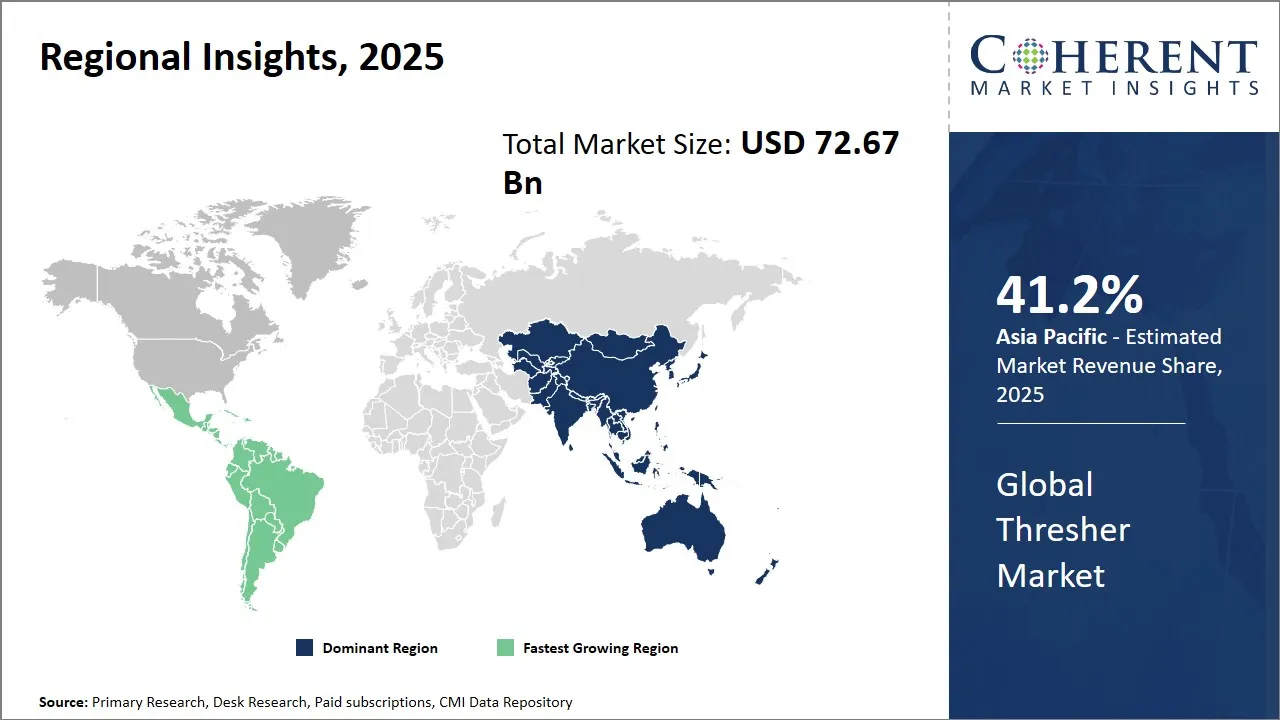
- Asia Pacific is projected to lead the global thresher market in 2026 with a 41.2% share. Latin America, with a 19.5% share, will be the fastest-growing region.
Market Overview
One of the major market trends is the increased use of modern technologies of threshing that are more productive and less likely to cause losses after harvesting. Also, the transition to environmentally responsible and energy-efficient machines is prompting manufacturers to be creative and add intelligent capabilities to them, including automation and Internet connectivity. The increasing investments in agricultural infrastructure in developing countries drive the market further as demand rises and the market is set to grow steadily against the changing sustainable farming practices.
Currents Events and Its Impact
Current Events | Description and its Impact |
Surge in global demand for mechanized farming & smart agriculture adoption (2024–2025 reports) |
|
Government subsidy & farm‑mechanization programmes in emerging economies (especially Asia Pacific) |
|
Segmental Insights
- Current Industry Events of 2026
- Market Size Estimation
- Regional Breakdown
- Competitive Landscape
- Customer Intelligence
- Segmental Analysis
- Pricing Analysis
- Key Market Drivers, Challenges & Future Trends
- Customized Insights Section
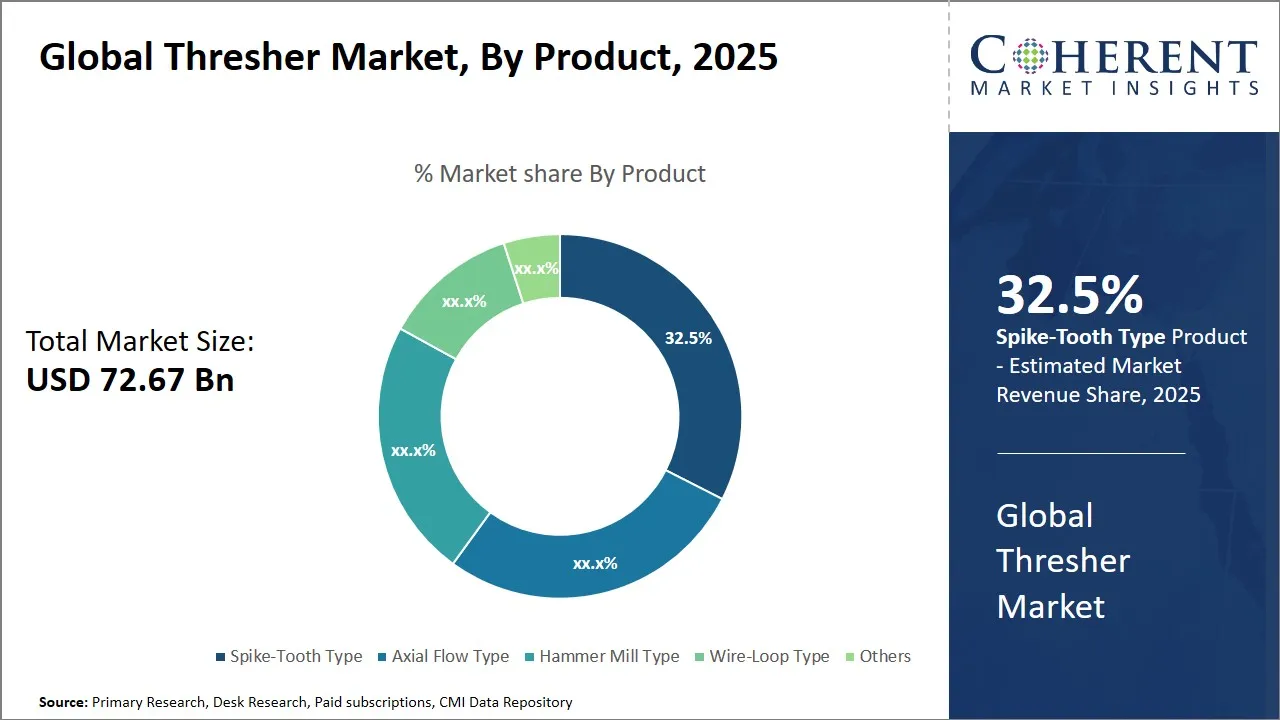
Thresher Market Insights, By Product - Spike-Tooth Type Segment Dominates the Market due to its Superior Threshing Efficiency and Adaptability
The thresher market remains split, with an estimated 33.5% of the market share being given to the spike-tooth type segment in 2026, as it is highly efficient and effective in pulling out the grain, stalk and husk. This product segment has been outstanding in providing effective threshing even to crops with moisture content variability which is a fundamental consideration to the end users who undertake various types of farming conditions.
It is designed with sharp and hard spike-tooth elements which enables a superior mechanical contact with the crop, consequently leading to low grain breakage and low grain losses. The reason why it is preferred by farmers and agribusinesses is that it will result in cleanliness of the threshed grain and therefore less post-threshing cleaning and processing will be required.
For example, in Punjab (India) spike-tooth threshers have been extensively embraced by farmers in harvesting their wheat and paddy crops due to the fact that the threshers ensure high output even when the crops are not fully developed with reference to moisture. This stability in changing field environments has made spike-tooth models the standard of a large proportion of big-scale farms.
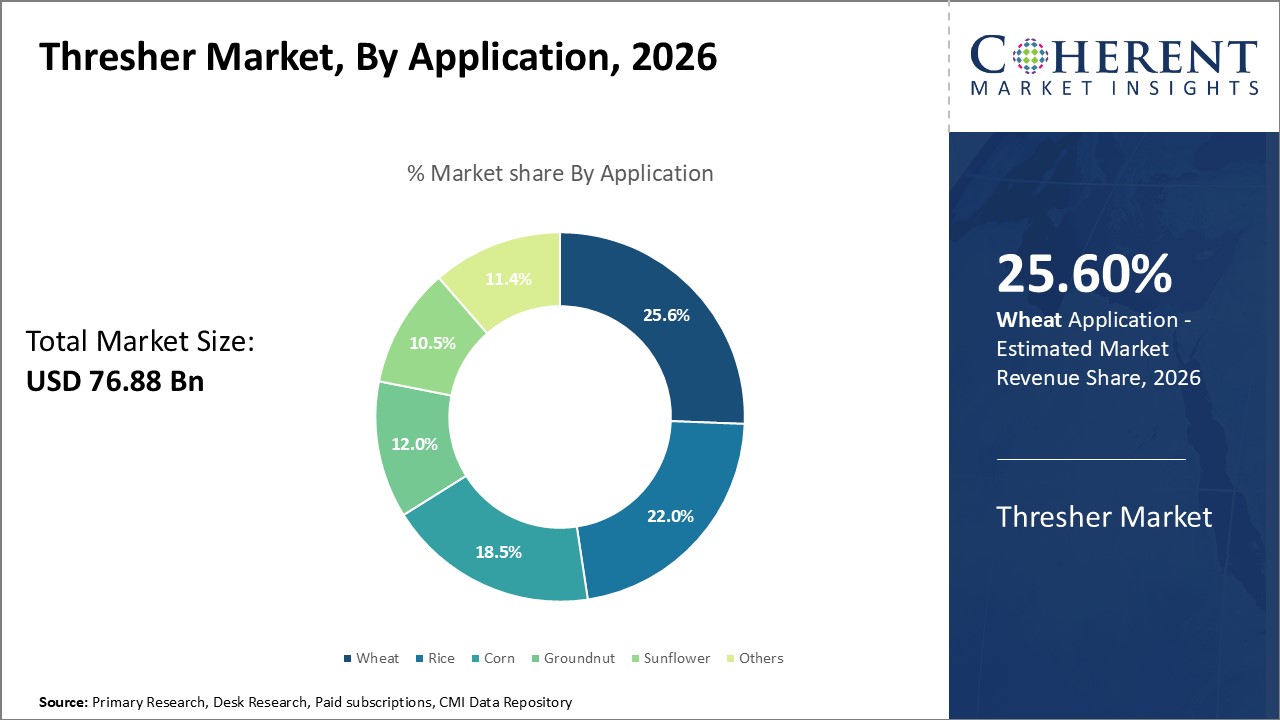
Thresher Market Insights, By Application – Wheat Segment Dominates the Market due to its Global Cultivation Scale and the Requirement for Specialized Threshing Solutions
Wheat segment is expected to contribute 25.6% of the thresher market share in 2026, driven by its status as one of the most widely grown cereal crops across multiple continents. The massive production of wheat requires the use of very effective threshers which are specifically designed to suit the nature of the wheat such as size of the grain, moisture level at harvest time, and weakness of the wheat kernels. The need for higher operational efficiency during wheat harvesting pushes farmers and agribusinesses to purchase threshers specifically engineered for wheat. Modern threshers are designed to protect grain quality and maximize throughput, with newer technologies tailored to the physical properties of wheat to reduce breakage and improve overall yield. Also, agri-support programs and government programs in significant wheat-producing nations have also promoted the use of machinery, which has advantageously affected the application segment that relates to wheat.
Thresher Market Insights, By Mechanism - Mechanical Threshers Segment Dominates the Market due to their Scalability, Operational Ease, and Technological Advancements
Mechanical threshers are anticipated to hold 46.7% of the market share in 2026, supported by their ability to provide scalable and efficient threshing performance for diverse farm sizes. As compared to manual or hydraulic systems, mechanical threshers exploit engine-based systems, which could be diesel or electric, to allow round-the-clock use and improve productivity. This will be the solution not only to the problem of labor shortages in agricultural communities but also to the need to harvest in a shorter and faster manner.
The ease of operation that mechanical threshers provide makes them quite appealing to farmers who have shifted to the modern systems but are yet to be in a position to invest more capital and specialized skills in maintenance that are a requirement of full automated and hydraulic machinery. Mechanical threshers will normally have user-friendly interface and robust designs that can be adjusted to different crops in different environments. This has been further enhanced by constant design advancements like noise reduction, fuel efficiency and portability that have increased their appeal.
Dealer Network Density & Accessibility Index Overview
Dealer network density measures the concentration of thresher distributors per agricultural area or population, while the accessibility index evaluates factors like proximity to farms, service availability, and logistics in regions. Asia Pacific leads globally due to vast farmlands and government-backed mechanization, with India featuring high density in key states from numerous local dealers. North America and Europe follow with advanced networks supporting mechanized farming.
Asia Pacific (Highest Density)
- India dominates with 20+ listed distributors in states like Maharashtra, Gujarat, Haryana, Tamil Nadu, Rajasthan, Madhya Pradesh, and Karnataka, enabling dense coverage in wheat/rice belts; cities like New Delhi, Mumbai, Kolkata, and Chennai host prime hubs.
- China boosts regional index via policies promoting machinery, contributing to Asia Pacific's largest market share.
North America (Strong Accessibility)
- High dealer density in consolidated farms with telematics-enabled networks; U.S. and Canada hold 28.6% global share from advanced uptime guarantees and warranties.
- Accessibility excels due to contractor ecosystems and precision platforms, minimizing downtime in large-scale operations.
Regional Insights
Asia Pacific Thresher Market Analysis and Trends
The Asia Pacific region is projected to lead the market with a 41.2% share in 2026, driven by the region’s vast agricultural landscape and the high demand for mechanization to boost crop productivity. In the countries like India, China, and Japan, agriculture has been developed to a significant degree and is largely dependent on the use of a threshing to improve the efficiency of post-harvest processing. The huge availability of large manufacturers such as Mahindra & Mahindra and Kubota Corporation supports the market ecosystem by offering technologically advanced and cost-effective threshers that are specific to different crop varieties.
Government efforts to encourage modern agriculture and subsidies on mechanized equipments have also been helpful in accelerating adoption rates. The trade relationship in the region predisposes to exporting both agricultural equipment and machinery, enhancing the chain of supply and creating the need to collaborate between domestic and foreign markets.
Latin America Thresher Market Analysis and Trends
The Latin America region is expected to exhibit the fastest growth in the market contributing 19.5% share in 2026, due to increasing investment in modern agricultural practices and rising awareness about mechanization benefits among small and medium-scale farmers. Countries such as Brazil, Argentina, and Mexico are in the process of agricultural transformation, which is underpinned by positive government policies that promote modernization and export agriculture.
Local manufacturing strength—supported by companies such as AGCO Corporation and Jacto—is driving innovation and improving the regional supply ecosystem. The region also benefits from strong trade ties with North America and Europe, which accelerates technology transfer and ensures access to advanced machinery components. Additionally, the rising adoption of mechanized threshers is driven by the need to boost labor productivity in rural areas where manual labor is becoming scarce due to demographic shifts.
Global Thresher Market Outlook for Key Countries
India Thresher Market Trends
The India thresher market is based on the arid agrarian economy of the country and variety of crop profiles, which require different threshing services. The market is led by companies such as Mahindra & Mahindra and Escorts Group that provide a wide range of threshers that are optimized to suit wheat, rice and pulses. Adoption of machinery is triggered by programmes like the PM-Kisan scheme by government and subsidies on farming equipments. The industry enjoys a well-developed dealer network and increasing rural purchasing power which is favoring the spread of mechanized threshers even in remote areas.
China Thresher Market Trends
China has held the top position in thresher market because of the incorporation of cutting-edge technology and mass production. Local players like YTO Group and Lovol Heavy Industry are influential in providing threshers with a high level of efficiency to serve large grain farms. The national policies of modernizing agriculture and investing in R&D in Chinas enhance the innovation of products. In addition, the large production capacity of the country helps it not only to cater to the domestic market, but also to the international market boosting international market dynamics.
Brazil Thresher Market Trends
Brazil thresher market is influenced by the fact that it is one of the largest agricultural exporters. The manufacture of agricultural machinery such as AGCO and Jacto is well represented and offers new threshers that the soybean, corn, and sugarcane crops. Favored government policies like sustainable agriculture policies and equipment financing policies help in increasing the market penetration.
U.S. Thresher Market Trends
The U.S. has a well-developed thresher market, characterized by a high level of mechanization and the use of advanced technologies across agricultural operations. Major players such as John Deere and CNH industrial lead with state-of-the-art threshers that have been fitted with digital monitoring devices. The agricultural sectors are efficiency-based and sustainability-based that leads to incessant innovations and uptake of high-performance machinery. The market is further supported by government programs designed to develop the rural area and infrastructure, and further value is added by strong supply chains and aftermarket services.
Russia Thresher Market Trends
The market in Russia for threshers depicts the desire by the government to modernize agriculture by undertaking mega projects and subsidizing farm mechanization. Domestic manufacturers such as Rostselmash, along with foreign competitors, supply threshers to the market. Their presence shapes competition by offering machines designed to match the country’s specific climate conditions and crop requirements. Technologies such as precision controls and automation has been exchanged through strategic import policies and partnerships that have made machines reliable and efficient. The growth in agricultural activities and larger export aspirations are the basis of demand.
Aftermarket & Maintenance Cost Comparison
- High Maintenance Challenges: Excessive use of threshers leads to overheating, engine damage, and wear on components, reducing lifespan and increasing aftermarket repair needs; operational downtime from breakdowns adds financial losses for farmers.
- Operating Cost Breakdown: Fuel and labor dominate operating costs (e.g., multi-crop thresher annual costs ~Birr 62,458 actual, rising to Birr 90,129 at full capacity), with maintenance at ~15% of capital costs annually (e.g., USD 150/yr for certain models).
- Equipment Lifespan and Repairs: Threshers have ~10-year/5,000-hour life with 0.7 repair coefficient; total equipment cost ~USD 12.50/ha (12% of grain value), including depreciation and 15% maintenance allocation.
Market Players, Key Development, and Competitive Intelligence
Key Developments
- In August 2024, the Pan-Africa Bean Research Alliance (PABRA-Africa) and Imara Tech (Imara Tech) launched a new initiative, “Scaling Multi-Crop Threshing Machines for Women and Youth Empowerment project in Tanzania,” in the Singida region. This initiative aims to reduce labor for women and youth by providing machines that can thresh, shell, and winnow different crops, such as maize, sorghum, sunflower, millet, green grams, finger millet, pigeon peas, lablab, and beans.
- In May 2022, John Deere acquired an algorithm package from AI firm Light to accelerate the transition to automated farming. The acquisition will allow Deere to automate its agricultural equipment and deploy multi-array camera technology. They intend to incorporate AI into their product line to improve equipment speed and safety while reducing the need for human intervention. John Deere has made significant progress toward fully autonomous farming by utilizing cutting-edge algorithms.
- CIMMYT's Feed the Future Mechanization and Extension Activity, funded by USAID, aims to address challenges in small grain processing and provide farmers with new market opportunities, therefore they launched a thresher in Zimbabwe in March 2024. The launch of this multi-crop thresher not only reduces the physical strain of manual threshing but also improves the overall quality of small-grain products. This innovation is a critical step toward increasing small grain production and consumption in Zimbabwe, thereby contributing to food security and improved farmer livelihoods.
Top Strategies Followed by Global Thresher Market Players
- The thresher market is highly competitive worldwide, and the established players have a multidimensional approach in maintaining or improving their position. The major players in this industry spend a lot of funds in research and development (R&D) in an effort to innovate in high-performance threshers. The goals of these investments include efficiency, durability and ease of use so that their products are in line with the changing needs of agriculture.
- As an example, John Deere, which is a market leader, spends a lot of money in the research and development to keep on enhancing its products. John Deere S700 Series Combine Harvesters is a good illustration of innovation. Such machines are characterized by the latest technology such as the HarvestSmart that automatically adjusts the settings of the combine to maximize grain harvesting and to save a lot of time and minimize losses of grains.
- The global thresher market players in the middle level approach have a very different strategy, as they are basically focused on providing some cost-effective offerings, which balance between quality and price. The target market of these companies is the price-sensitive market segment which consists of smallholder farmers and agricultural businesses that have smaller budgets. In order to stay competitive, middle-level players tend to be involved into the collaborations and joint venture to increase their production capacities, implement better manufacturing technologies and increase their market presence overall.
- For example, Mahindra Tractors offers Mahindra Arjun 605 which is affordable in terms of price, and targeting small to mid-sized farms. Mahindras machines are priced-sensitive as they come with characteristics that focus on providing convenience, reliability and fuel efficiency. Moreover, Mahindra also employs strategic partnership with local distributors and service providers, which will increase its coverage in the new markets.
- One of the key features of small players in the global thresher market is that they can market to niche markets, and they can oftentimes be specialty in their particular product features to satisfy a given user need. To keep up with the competition of larger competitors, they take advantage of innovative technologies like smart sensors, integration of the Internet of Things, and sustainable sources of power. Furthermore, these companies establish strong local partnerships with startups, local manufacturers, and local cooperatives, and it allows them to make a market entry and increase the visibility in a specific regional market.
- For example, DICKEY-john is a manufacturer of farming machinery and advanced sensors of small-scale threshers. Its HarvestMaster Grain Testing Systems have smart sensors that are used to give real-time feedback on the quality and moisture content of the grain during the harvesting process. Small-scale players who are keen with precision in grain harvesting will benefit best with this technology.
Market Report Scope
Thresher Market Report Coverage
| Report Coverage | Details | ||
|---|---|---|---|
| Base Year: | 2025 | Market Size in 2026: | USD 76.88 Bn |
| Historical Data for: | 2020 To 2024 | Forecast Period: | 2026 To 2033 |
| Forecast Period 2026 to 2033 CAGR: | 5.8% | 2033 Value Projection: | USD 114.09 Bn |
| Geographies covered: |
| ||
| Segments covered: |
| ||
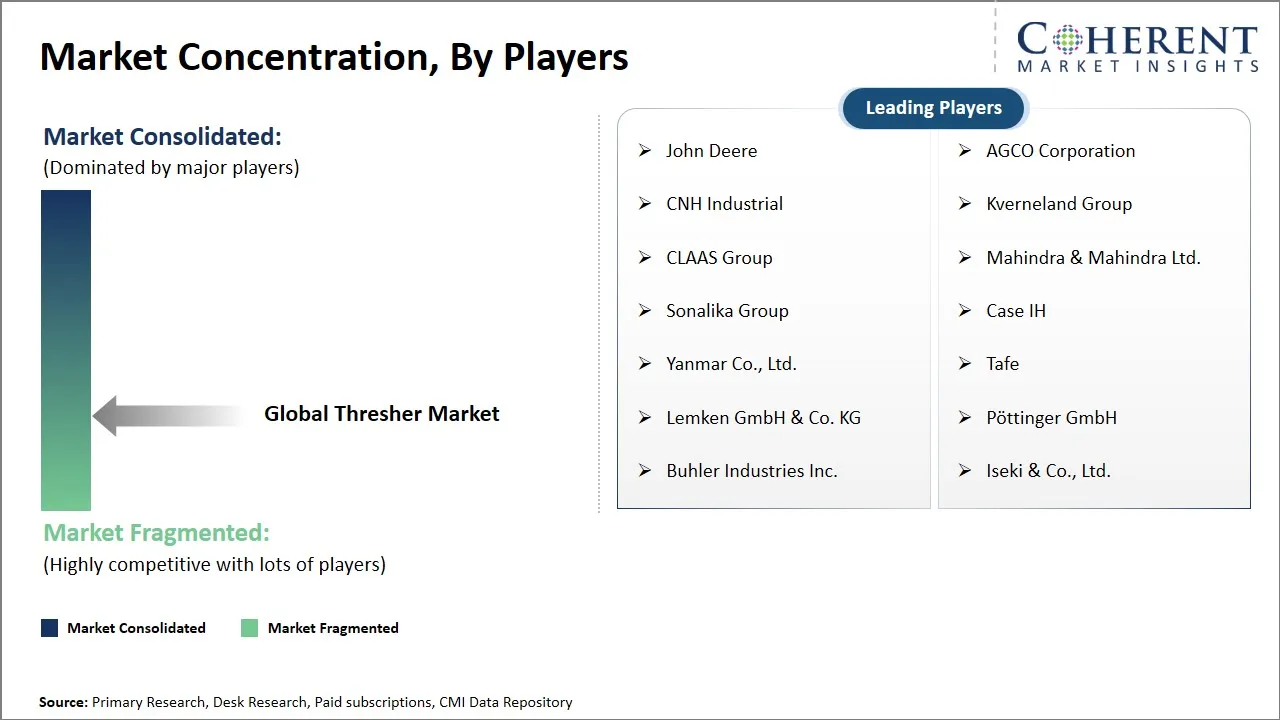
| Companies covered: | John Deere, AGCO Corporation, CNH Industrial, Kverneland Group, CLAAS Group, Mahindra & Mahindra Ltd., Sonalika Group, Case IH, Yanmar Co., Ltd., Tafe, Lemken GmbH & Co. KG, Pöttinger GmbH, Buhler Industries Inc., and Iseki & Co., Ltd. | ||
| Growth Drivers: |
| ||
| Restraints & Challenges: |
| ||
Thresher Market Dynamics
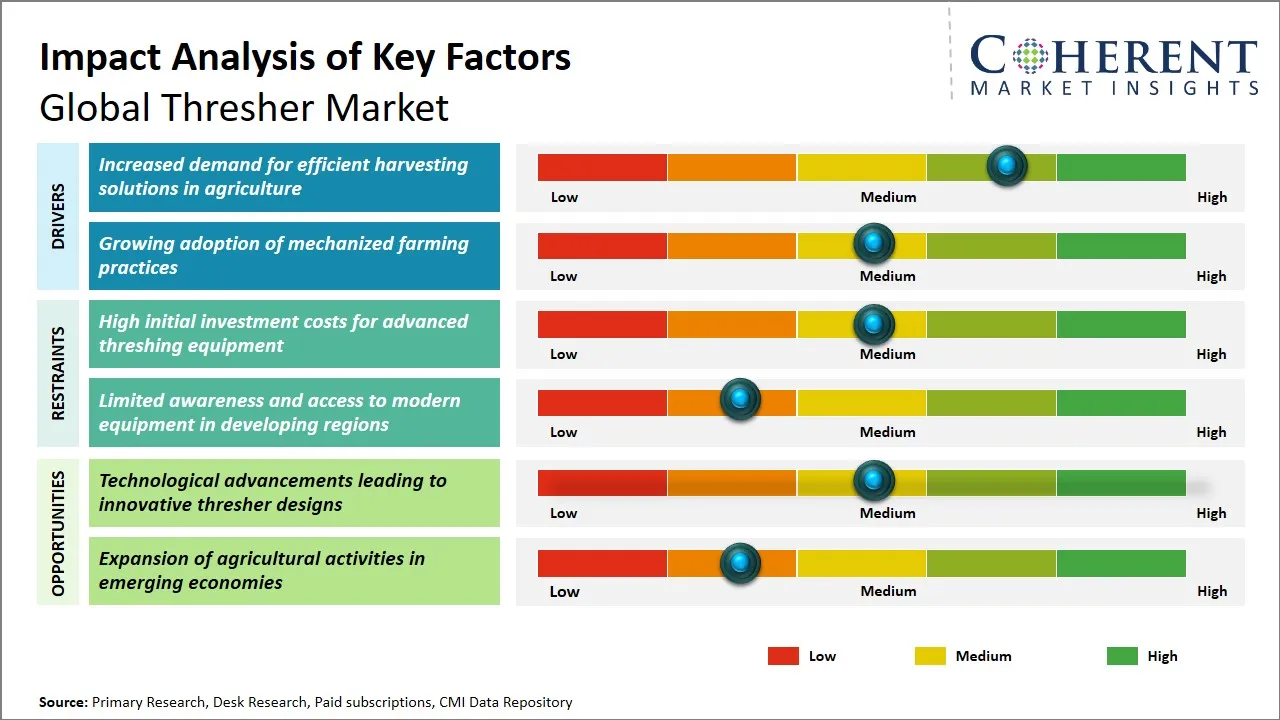
Thresher Market Driver - Increased Demand for Efficient Harvesting Solutions in Agriculture
The increasing demands of high productivity and efficiency in agricultural activities are playing a significant role in the use of threshers in the farming societies of the world. The use of machinery in agriculture, e.g., threshers is becoming essential as farmers are struggling with the issues of human shortage, unsteady crop production, the need to minimize after-harvest losses. The machines are used to separate grains and stalks in a faster and better way, therefore, harvesting in time before the harvest can be damaged.
One such trend is evident in John Deere which is a pioneer agricultural machinery maker. Its John Deere 9600 Combine Harvester incorporates modern threshing technology which enables it to be very efficient in harvesting activities. This model has found a lot of traction in farmers across the world by reducing the number of losses realized after harvest. The harvester will be beneficial to the increase in productivity in the farming operations with automated crop flow, intelligent moisture sensing, and fewer women needed to operate it in reduced labor shortages and variable crop yields.
Thresher Market Opportunity - Technological Advancements Leading to Innovative Thresher Designs
The thresher market world is also experiencing high growth potentials due to high rate of technological advancements that are bringing up innovative designs of threshers. Modern types of agriculture require greater efficiency, less labor intensity, and operational precision farming, which is being fulfilled by the introduction of the most high-tech technologically advanced threshing machines. Through automation, sensor technology and smarter control systems, threshers are being developed that provide a better throughput, much reduced grain loss and the ability to work across different crop varieties and field regimes.
The invention of Case IHs Axial-Flow Combine Harvesters is one of the examples of how technology is improving the designs of threshers. These machines have Advanced Automation Systems that enable it to be having a precise control in the threshing process. The combination of sensors and GPS based technology guarantees better separation of grain with less damage to the grain
Analyst Opinion (Expert Opinion)
- Thresher market is undergoing a very drastic evolution due to growing demand of efficient production methods in agriculture to satisfy the food production demand of the world. The international Agricultural Machinery Exhibition (2023) and the Global Farming Conference (2022) also brought up the innovative development, with such companies as AGCO Corporation and John Deere being on the forefront of creating high-efficiency threshing systems.
- The fact that AGCOs new multi-crop thresher, which allows the company to reduce the wastage of grain and maximize harvest, represents the active measures aimed at improving the productivity of agriculture and, at the same time, solving the problem of labor shortage. The talks at these conferences reiterated the significance of automation and intelligent technology, including adding IoT integration, to realize data-driven choices in crop management. Nevertheless, the challenges encountered like the high start-up investment costs and the requirement of having in-depth training on new technologies were mostly raised as reasons of not adopting them especially in the developing markets.
- Companies that focus on affordable financing options and farmer education programs will likely capture a larger market share. Ultimately, the growth of the thresher market will depend on its ability to innovate while balancing efficiency, sustainability, and the economic realities faced by farmers globally.
Speak to the analyst
Want personalized insights?
Take the findings above to one of our principal consultants, or have the report rebuilt around the segments, geographies and competitors you actually track.
Market Segmentation
- Product Insights (Revenue, USD Bn, 2021 - 2033)
- Spike-Tooth Type
- Axial Flow Type
- Hammer Mill Type
- Wire-Loop Type
- Others
- Application Insights (Revenue, USD Bn, 2021 - 2033)
- Wheat
- Rice
- Corn
- Groundnut
- Sunflower
- Others
- Mechanism Insights (Revenue, USD Bn, 2021 - 2033)
- Mechanical Threshers
- Manual Threshers
- Hydraulic Threshers
- Regional Insights (Revenue, USD Bn, 2021 - 2033)
- North America
- U.S.
- Canada
- Latin America
- Brazil
- Argentina
- Mexico
- Rest of Latin America
- Europe
- Germany
- U.K.
- Spain
- France
- Italy
- Russia
- Rest of Europe
- Asia Pacific
- China
- India
- Japan
- Australia
- South Korea
- ASEAN
- Rest of Asia Pacific
- Middle East
- GCC Countries
- Israel
- Rest of Middle East
- Africa
- South Africa
- North Africa
- Central Africa
- North America
- Key Players Insights
- John Deere
- AGCO Corporation
- CNH Industrial
- Kverneland Group
- CLAAS Group
- Mahindra & Mahindra Ltd.
- Sonalika Group
- Case IH
- Yanmar Co., Ltd.
- Tafe
- Lemken GmbH & Co. KG
- Pöttinger GmbH
- Buhler Industries Inc.
- Iseki & Co., Ltd.
Sources
Primary Research Interviews
- R&D Director – Leading Thresher Manufacturer
- Procurement Manager – Major Agricultural Equipment Retailer
- Product Development Head – Prominent Combine Harvester Brand
- Sustainability Manager – Farm Machinery Certification Body
Stakeholders
- Manufacturers
- End-use Sectors:
- Grain Processing Facilities
- Commercial Farming Operations
- Smallholder Farmers and Cooperatives
- Regulatory & Certification Bodies
- Agricultural Equipment Dealers and Distributors
- Technology Integration Players: Precision agriculture and IoT providers for harvesting equipment
Databases
- UN Comtrade Database
- India Import Export (EXIM) Database
- FAO Agricultural Machinery Statistics
- World Bank Agricultural Equipment Trade Data
Magazines
- Farm Machinery Digest – Trends in threshing and harvesting equipment
- Agriculture Today – Innovations in grain threshers
- Tractor & Farm Equipment – Market updates on threshers
- Crop Tech Magazine – Advances in post-harvest machinery
Journals
- Journal of Agricultural Engineering – Thresher design and performance studies
- Biosystems Engineering – Efficiency of mechanical threshers
- Agricultural Mechanization in Asia – Regional thresher adoption trends
- Journal of Terr mechanics – Durability in thresher components
Newspapers
- The Financial Times – Global market growth of agricultural threshers
- The Guardian – Sustainability trends in farm machinery
- Asia Farming News – Thresher demand in Asia-Pacific
- Farm Journal – Regulatory shifts in harvesting equipment
Associations
- American Society of Agricultural and Biological Engineers (ASABE)
- International Commission of Agricultural and Biosystems Engineering (CIGR)
- CropLife International
- International Federation of Agricultural Producers (IFAP)
- Food and Agriculture Organization (FAO)
Public Domain Sources
- USDA – Guidelines for agricultural machinery standards
- European Commission – Farm equipment regulations
- World Health Organization – Safety standards for farm implements (where applicable)
- OECD – Agricultural machinery assessments and trade data
Proprietary Elements
- CMI Data Analytics Tool
- Proprietary CMI Existing Repository of information for last 8 years.
Get access to 250+ pages report
Every segment, forecast, competitor profile and data table behind the analysis above — available for instant download.
- ESOMAR Member
- ISO 9001:2015 Certified
- D-U-N-S Registered
- GDPR & CCPA Compliant
Missing comfort of reading report in your local language? Find your preferred language:
Transform your Strategy with Exclusive Trending Reports
Frequently Asked Questions
The global thresher market is estimated to be valued at USD 76.88 Bn in 2026 and is expected to reach USD 114.09 Bn by 2033.
The CAGR of the global thresher market is projected to be 5.8% from 2026 to 2033.
Increased demand for efficient harvesting solutions in agriculture and growing adoption of mechanized farming practices are the major factors driving the growth of the global thresher market.
High initial investment costs for advanced threshing equipment and limited awareness and access to modern equipment in developing regions are the major factors hampering the growth of the global thresher market.
In terms of product, the spike-tooth type segment is estimated to dominate the market revenue share in 2026.
John Deere, AGCO Corporation, CNH Industrial, Kverneland Group, CLAAS Group, Mahindra & Mahindra Ltd., Sonalika Group, Case IH, Yanmar Co., Ltd., Tafe, Lemken GmbH & Co. KG, Pöttinger GmbH, Buhler Industries Inc., and Iseki & Co., Ltd. are the major players.
Asia Pacific is expected to lead the global thresher market in 2026.