

Global Tile Adhesive Market Size and Forecast: 2026-2033
According to Coherent Market Insights, the global tile adhesive market is estimated to be valued at USD 3.99 Bn in 2026 and is expected to reach USD 6.88 Bn by 2033, expanding at a compound annual growth rate (CAGR) of 8.1% from 2026 to 2033.
Key Takeaways of the Tile Adhesive Market
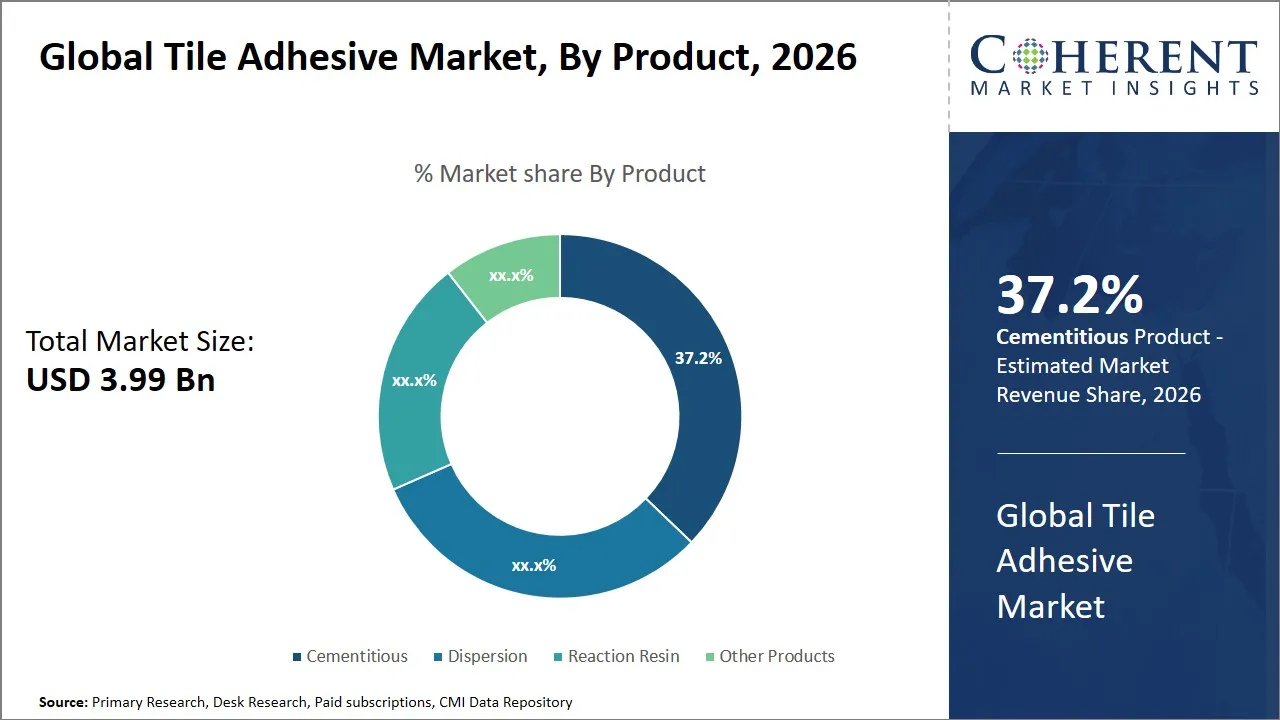
- The cementitious segment is expected to hold 37.2 % of the global tile adhesive market share in 2026.
- The residential segment is estimated to account for 45.7 % of the tile adhesive market share in 2026.
- The online retail segment is projected to capture 56.8 % of the market share in 2026.
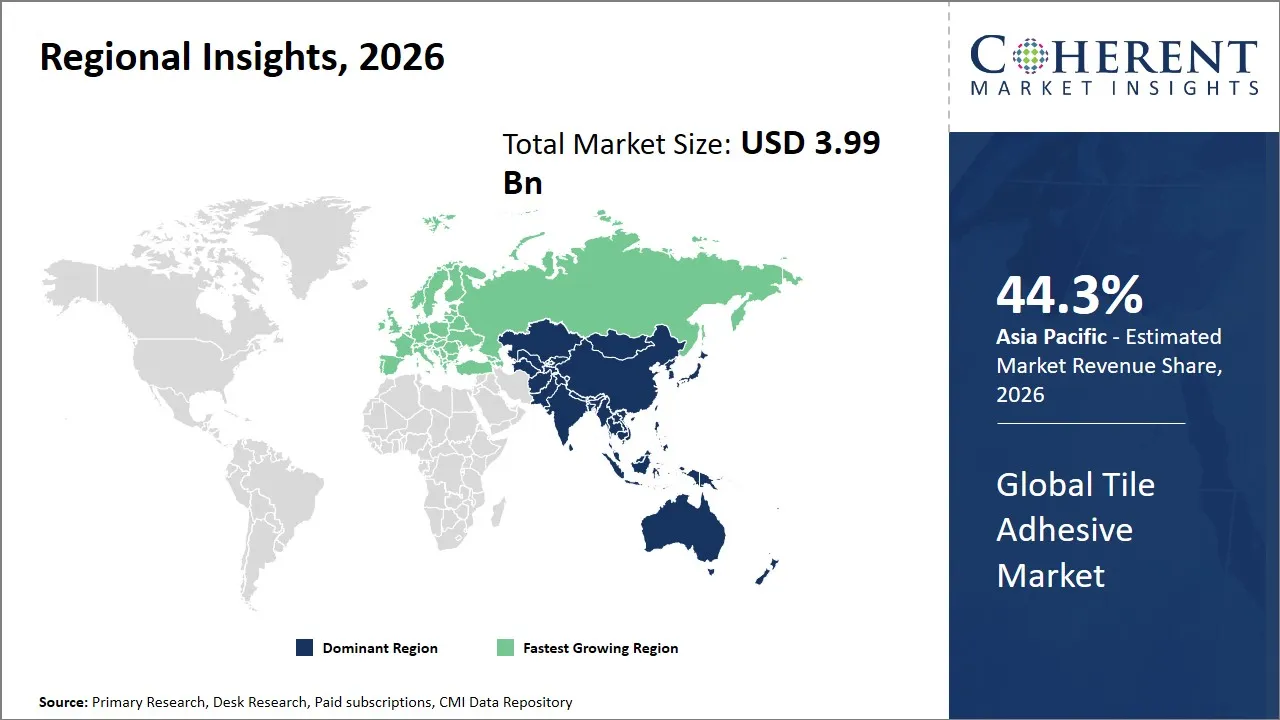
- The Asia Pacific region is expected to dominate the market with a 44.3 % share in 2026.
- Europe is projected to grow the fastest, capturing a 15.3% share in 2026, driven by strong demand in residential, commercial, and infrastructure construction
Market Overview
- A significant market trend is the growing preference for eco-friendly and sustainable tile adhesive products, as consumers and manufacturers prioritize environmental impact and regulatory compliance.
- Innovations in polymer technology have led to industrial adhesives with enhanced bonding strength, faster curing times, and improved resistance to moisture and temperature fluctuations.
- Additionally, the rising adoption of ready-to-use and easy-application adhesives is simplifying installation processes, attracting both professional contractors and DIY enthusiasts, thereby accelerating market growth.
Current Events and Its Impact
Current Events | Description and its Impact |
Expansion of Green Building Initiatives |
|
Technological Advancements in Adhesive Formulation |
|
Segmental Insights
- Current Industry Events of 2026
- Market Size Estimation
- Regional Breakdown
- Competitive Landscape
- Customer Intelligence
- Segmental Analysis
- Pricing Analysis
- Key Market Drivers, Challenges & Future Trends
- Customized Insights Section
Why Does the Cementitious Segment Dominate the Global Tile Adhesive Market in 2026?
The cementitious segment is expected to command 37.2% of the market share in 2026, driven by its inherent versatility, cost-effectiveness, and robust performance across diverse applications. Cementitious adhesives are mainly a mixture of cement, mineral fillers, and other synthetic polymers that unite to provide a high level of bonding ability that can be utilized in many types of tiles and substrate materials. Cementitious adhesives are also preferred in both residential and commercial projects due to their flexibility to various environments both indoor and outdoor.
A notable example of cementitious adhesives being widely used is in the installation of ceramic tiles in high-traffic commercial spaces like airports and shopping malls. Their cost-efficiency and strength make them an ideal choice for these large-scale projects, where both durability and ease of application are critical.
Why is the Residential Sector Dominating the Global Tile Adhesive Market?
The residential segment is projected to hold 45.7% in the global tile adhesive market share in 2026, which is supported by tremendous increase in construction and renovation of houses around the world. With the ever-growing urbanization, growing disposable incomes, and the inclination to residential projects characterized by consumers moving more toward aesthetical, durable, flooring and wall finishes, residential projects remain one of the key sources of the demand of using tile adhesives.
People are more and more willing to use tiles in their kitchens, bathrooms, living rooms, and even exteriors due to the durability, design flexibility, and maintenance simplicity of tiles. The trend increases the demand of tile adhesives that are specifically designed to suit the residential demands like tile that are sensitive to use, adhesive products which are easy to apply and contain strong adhesion in different conditions of the homes. Expansion of real estate market, especially in the emerging economies, has increased the pace of building of new residential units which has enhanced the use of the tile adhesives.
Online Retail Dominates the Global Tile Adhesive Market
Online retail segment is expected to hold 56.8% of the tile adhesive market share in 2026, driven by factors that include convenience, increased product variety, and improved consumer accessibility. The digitization of the procurement behavior of the contractors, architects, and do-it-yourselfers over the past few years has greatly changed the sourcing patterns of the past which used to be offline stores to online stores.
Among the leading factors that have led to the success of the online retail sector is the capability to provide a customer with a complete product catalogue which is available at any point and at any time. Customers are able to make comparisons of the brands, formulations, prices and technical specifications (just a couple of clicks) without the need to visit several physical stores. This is a feature that allows efficient decision-making and minimizes procurement lead times in critical-time construction projects.
Regional Insights
Asia Pacific Tile Adhesive Market Analysis and Trends
The Asia Pacific region is projected to lead the market with a 44.3% share in 2026, due to the massive urbanization, construction of infrastructures and the increasing residential and commercial construction demands. The high-level manufacturing ecosystem, particularly in such countries as China, India, and Japan gives the region a competitive edge allowing it to produce in large volumes and explore new technologies in adhesives. The growth of the market is further boosted by the supportive government policies like Make in India and Chinas investment in real estate and infrastructure.
Also, Asia Pacific has a well-developed network of supply chains and access to raw materials, which decreases the production costs and enhances the availability of products. International giants like MAPEI (Italian based, but with high presence), Fosroc International Ltd. (India) and Sika AG (Switzerland, significant operative presence in this region) have set up manufacturing facilities and research laboratories in this region to meet local market requirements and to have products tailored to various climatic and installation requirements.
Europe Tile Adhesive Market Analysis and Trends
The Europe region is expected to exhibit the fastest growth in the market contributing 15.3% share in 2026, due to high construction demand in the residential, commercial and infrastructure buildings. It concentrates on the high-performance, environmentally friendly adhesives because of the stringent environmental policies and the move toward the green building materials.
The developed markets such as Germany, the U.K. and France are the first to hit off whereas Eastern Europe is experiencing some growth as a result of urbanization. The major players such as BASF SE, Mapei and Saint-Gobain are spreading their wings where the products are considered to be of durability and sustainability. The market enjoys good manufacturing base, local suppliers and effective distribution networks.
Global Tile Adhesive Market Outlook for Key Countries
Is China the Key Driver for Growth in the Tile Adhesive Market?
The connection between the tile adhesive market in China and Asia Pacific is still a pivot as the country is characterized by its huge construction sector coupled with the government-supported infrastructure development. Major manufacturers such as Bostik (a subsidiary of Arkema) and MAPEI had invested dearly in local production plants and they were working on producing environmentally friendly and high performance tile adhesives which comply with strict Chinese environmental laws. Moreover, new cities and urbanization of housing contribute to the increase of the demand of new adhesives that have more strong bonding characteristics.
Is India the Next Growth Engine for the Tile Adhesive Market?
The tile adhesive industry in India can be described as having a high rate of urban decentralization and housing projects that are affordable, which leads to a good rate of demand both in urban and rural. Efforts by the government such as Housing for All campaign have promoted the residential development consequently enhancing the market of tile adhesive. Players such as Fosroc and Sika AG have a significant presence here and they are bringing new technology in waterproofing and rubbery glues which can be used in various Indian climatic conditions. Another area that is increasingly gaining attention by the local manufacturers is cost-competitive formulations, which help in supporting the price sensitive market.
U.S. Tile Adhesive Market Trends
The U.S. continues to lead as a mature market with advanced construction practices emphasizing quality and sustainability. The preference for durable and environmentally safe adhesives is high, supported by stringent building codes and certifications such as LEED. Laticrete International, MAPEI, and Custom-Building Products are the companies that prevail by enormous product innovation and expansive distribution networks. Again, the renovation industry is one of the major demand stimulators, and professional contractors need sophisticated adhesive solutions to various tile constructions.
Germany Tile Adhesive Market Trends
The market of Germany has a high industrialization level with a focus on the technological development and sustainability. The building codes and green construction standards in the country stimulate the use of low-VOC and green tile adhesives. Among the major participants, it is possible to distinguish BASF and Ardex GmbH which provide high-end products and appeal to commercial and residential building. Germany is also the center of innovation and export in Europe as well as the market trends in the whole region.
Brazil Tile Adhesive Market Trends
The market of tile adhesives in Brazil have the advantage of increased urban housing projects and increased demand of the construction material that are long-lasting, under different weather conditions. The local manufacturers and the local subsidiaries of the international corporations such as MAPEI and Weber Saint-Gobain modify products to fit the tropical climate and increasing environmental standards. Government incentives which are directed towards the urban renewal and infrastructural advancements have caused Brazil to rank among the lucrative market in Latin America in the tile adhesives. Moreover, more foreign direct capital in the construction industry contributes to the need of quality adhesives.
Raw Material & Cost Volatility Impact
Raw Material | Price Volatility Impact | Impact on Manufacturers | Cost-Effectiveness Strategies |
Cement | Fluctuating cement prices impact production costs. Cement is a primary component in tile adhesives. | Manufacturers may cut margins or increase prices to cover costs. | Sourcing from cheaper regions, improving production efficiency. |
Polymers & Resins | Cost volatility in polymers and resins (acrylics, vinyls) raises production costs. | Affects pricing strategy and profitability for manufacturers. | Investing in alternatives, negotiating long-term contracts. |
Additives & Fillers | Cost fluctuations in additives (e.g., thickeners, defoamers) lead to unpredictable pricing. | Competing for supply of premium-grade additives, impacting production timelines. | Exploring alternative suppliers or bulk purchasing. |
Market Players, Key Development, and Competitive Intelligence
Key Developments
- In July 2024, Magicrete launched a new ad campaign featuring actor Mr. Sumeet Vyas, promoting its tile adhesive over traditional cement-based methods. The campaign highlights the superior strength, durability, and ease of use of Magicrete's adhesive, addressing common issues with sand and cement, such as cracking and debonding.
- In January 2024, Omnicol launched a range of powdered tile adhesives, including the PL200 Omnicem, a highly flexible S2 adhesive suitable for various applications. Ideal for both walls and floors, indoors and outdoors, it supports recent cement screeds and reduces curing time from 90 to 28 days.
Top Strategies Followed by Global Tile Adhesive Market Players
Player Type | Strategic Focus | Example |
Established Market Leaders | Heavy investment in R&D and innovation | For example, MYK LATICRETE India, Inc. targets the development of the next-generation adhesives based on the concept of rapid curing and high bonding capacity to meet the requirements of both residential and commercial buildings. They are also dedicated to innovation and this is seen in the products such as Laticrete 254 Platinum, which is highly flexible and resistant to moisture thus ideal in applications that are highly stressed such as swimming pools and high traffic. |
Mid-Level Players | Balance cost and sustainability | For example, Bostik is a popular player, which manufactures cost-efficient adhesives, which appeal to DIY customers and local contractors. A competitive price of their Bostik Ceramic Tile Adhesive is the high bonding strength and the product has gained popularity among the contractors and homeowners seeking low cost and still high-quality adhesive products to be used in residential projects. |
Small-Scale Players | Niche specialization & innovative variants | For instance, EcoFix Adhesives is a small firm located in Europe that specializes in just one product, which is eco-friendly and biodegradable tile adhesives. With its natural materials, such as clay and organic resins, EcoFix is able to fill this emerging need in green building materials, which is desirable to eco-oriented builders and contractors, particularly in green building projects. |
Market Report Scope
Tile Adhesive Market Report Coverage
| Report Coverage | Details | ||
|---|---|---|---|
| Base Year: | 2025 | Market Size in 2026: | USD 3.99 Bn |
| Historical Data for: | 2020 To 2024 | Forecast Period: | 2026 To 2033 |
| Forecast Period 2026 to 2033 CAGR: | 8.1% | 2033 Value Projection: | USD 6.88 Bn |
| Geographies covered: |
| ||
| Segments covered: |
| ||
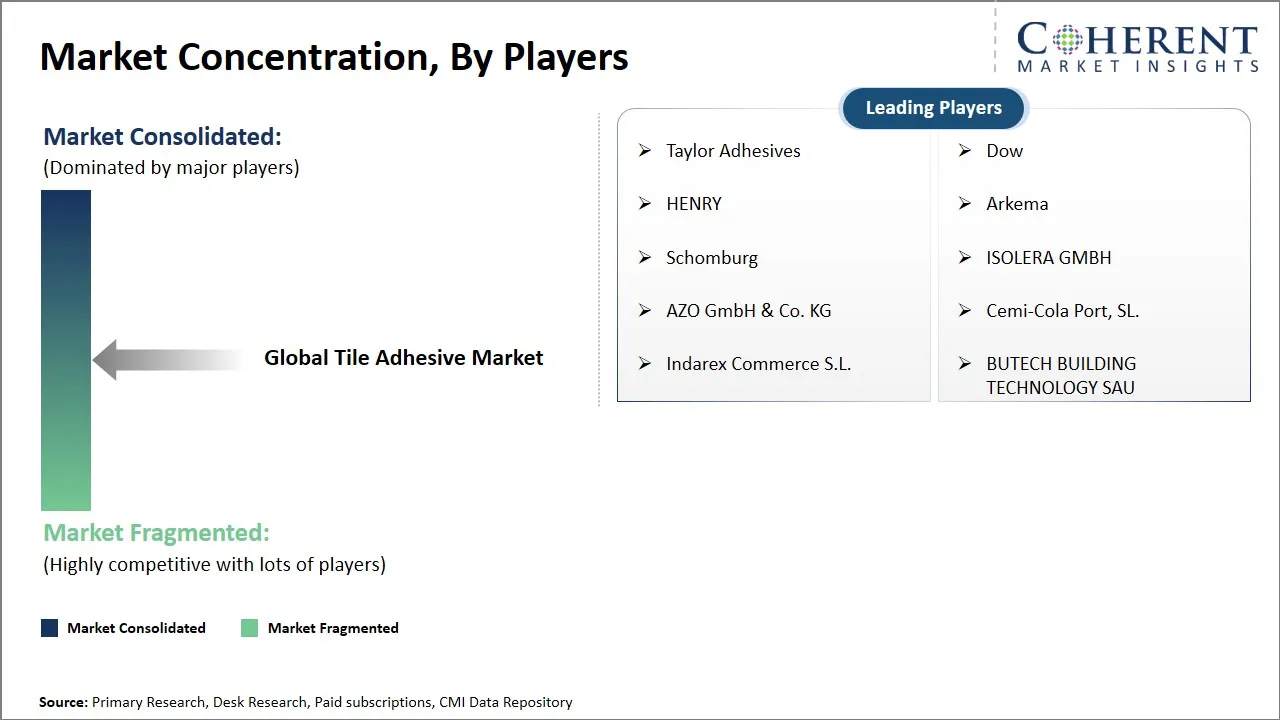
| Companies covered: | Taylor Adhesives, Dow, HENRY, Arkema, Schomburg, ISOLERA GMBH, AZO GmbH & Co. KG, Cemi-Cola Port, SL., Indarex Commerce S.L., and BUTECH BUILDING TECHNOLOGY SAU | ||
| Growth Drivers: |
| ||
| Restraints & Challenges: |
| ||
Tile Adhesive Market Dynamics
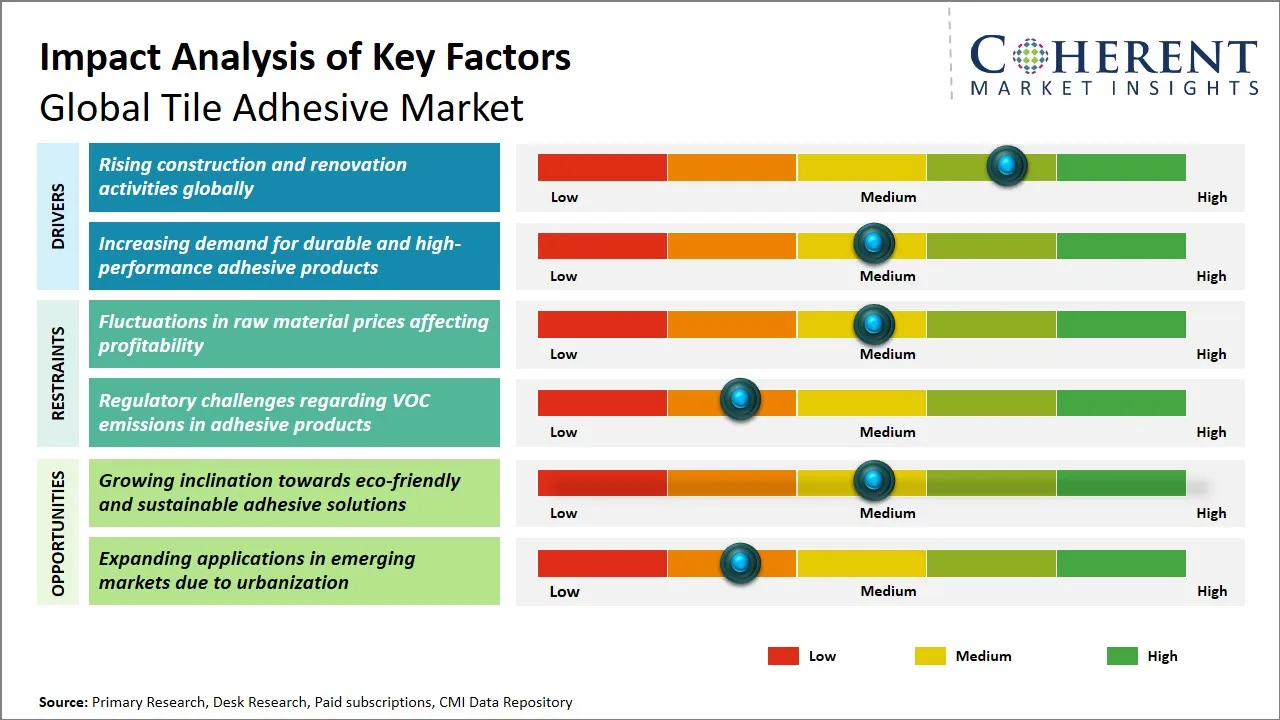
Tile Adhesive Market Driver - Rising Construction and Renovation Activities Globally
The rising rate of construction and renovation works in residential, commercial, and industrial buildings is playing a major role in increasing the demand of tile adhesives in the world. There is an increased pressure on the development of modern infrastructure, housing complexes, shopping centers, and office spaces that have a high demand on the use of durable and efficient installation of tiles. Also, the current remodeling and refurbishing trend of homes, particularly the mature markets, is another factor that adds to the consumption permanence of tile adhesives.
As an example, it has been reported by the National Association of Home Builders (NAHB) that home remodeling activity is expected to grow by 5% in 2025, and a nominal gain of 3% in 2026. More people are investing in flooring and surface installations, which directly increases the demand of tile adhesives.
Tile Adhesive Market Opportunity - Growing Inclination Towards Eco-Friendly and Sustainable Adhesive Solutions
The market global tile adhesive is experiencing great opportunities due to the rising demand of green and sustainable adhesive solutions. With the growing concern of the environment in the globalization, architects, constructors and end users are increasingly focusing on green construction materials that avoid the ecological impact to the greatest extent possible. The trend is supported by tight government regulations and industry standards to minimize carbon footprints and improve indoor air quality that is driving manufacturers to create and design adhesives with low volatile organic compounds (VOC) and non-toxic composites.
Indicatively, example, MAPEI which is a major producer in tile adhesive industry, introduced its Ultracare Eco line that is environmentally friendly and still has a high performance in the installation of tiles. Another one is the Ardex WPM 300, which is a green tile adhesive product, which is targeted at the projects participating in the Green Building Certification.
(Source: https://www.mapei.com/it/en/products-and-solutions/lines/cleaning-maintaining-protecting-surfaces)
Analyst Opinion (Expert Opinion)
- The tile adhesive market also is experiencing a strong growth owing to the construction and renovation industries that are performing well worldwide. The experiences gained at the International Exhibition for Tiling Solutions (2023) and the Construction Materials Conference (2022) demonstrated that the major breakthroughs were in durable and environmentally friendly adhesive solutions, with such companies as Henkel and MAPEI on the forefront.
- The new product line with solvent-free form of adhesive developed by Henkel meets the increasing concerns in the environment and is in line with the trend in the green building practice. The talks during these conferences highlighted the growing need to have high-performance adhesives that are more bonding and flexible, which is necessary in the current architectural designs.
- The fluctuation in the cost of raw materials and presence of substitute bonding options were the challenges that were often mentioned as the possible obstacles. Most of the companies that invest in R&D and create the latest adhesive technologies become more probable to improve their presence in the market through the partnering with contractors and architects. Finally, the tile adhesive market will grow based on its innovation capabilities as it advances in dealing with sustainability, performance and cost-effectiveness in the increasingly competitive environment.
Speak to the analyst
Want personalized insights?
Take the findings above to one of our principal consultants, or have the report rebuilt around the segments, geographies and competitors you actually track.
Market Segmentation
- Product Insights (Revenue, USD Bn, 2021 - 2033)
- Cementitious
- Dispersion
- Reaction Resin
- Other Products
- End User Insights (Revenue, USD Bn, 2021 - 2033)
- Residential
- Commercial
- Industrial & Institutional
- Distribution Channel Insights (Revenue, USD Bn, 2021 - 2033)
- Online Retail
- Offline Retail
- Construction Material Stores
- Home Improvement Stores
- Specialty Retailers
- Regional Insights (Revenue, USD Bn, 2021 - 2033)
- North America
- U.S.
- Canada
- Latin America
- Brazil
- Argentina
- Mexico
- Rest of Latin America
- Europe
- Germany
- U.K.
- Spain
- France
- Italy
- Russia
- Rest of Europe
- Asia Pacific
- China
- India
- Japan
- Australia
- South Korea
- ASEAN
- Rest of Asia Pacific
- Middle East
- GCC Countries
- Israel
- Rest of Middle East
- Africa
- South Africa
- North Africa
- Central Africa
- North America
- Key Players Insights
- Taylor Adhesives
- Dow
- HENRY
- Arkema
- Schomburg
- ISOLERA GMBH
- AZO GmbH & Co. KG
- Cemi-Cola Port, SL.
- Indarex Commerce S.L.
- BUTECH BUILDING TECHNOLOGY SAU
Sources
Primary Research Interviews
- CEO – Leading Tile Adhesive Manufacturer (e.g., Sika or Mapei equivalent)
- Supply Chain Director – Major Construction Chemicals Distributor
- Production Lead – Tile Installation Materials Producer
- Sustainability Officer – Tile Adhesives Certification Authority
Stakeholders
- Manufacturers
- End-use Sectors:
- Construction & Residential Builders (Flooring, Walls)
- Commercial & Institutional (Hospitals, Offices)
- Renovation & DIY Retailers
- Regulatory & Certification Bodies (e.g., EPA for adhesives, REACH compliance in EU)
- E-commerce Platforms and Retailers (Alibaba, Industrial Suppliers, Amazon Business)
- Technology Integration Players: Advanced polymer-modified adhesive producers
Databases
- UN Comtrade Database (HS codes for ceramic products/adhesives)
- India Import Export (EXIM) Database
- USITC/USGS Commodity Trade Data
- Eurostat Trade Statistics for Chemicals/Construction Materials
Magazines
- Tile Today Magazine – Trends in tile installation adhesives
- Construction Chemicals Magazine – Adhesives market dynamics
- Ceramics World Review – Tile bonding innovations
- Industrial Minerals & Adhesives – Supply chain for construction adhesives
Journals
- Journal of Materials Science – Tile adhesive bond strength
- Construction and Building Materials – Polymer tile adhesives durability
- Journal of Hazardous Materials – Environmental impact of adhesives
- International Journal of Research in Engineering – Green tile adhesive synthesis
Newspapers
- The Wall Street Journal – Global construction chemicals demand
- Business Standard (India) – Tile adhesive imports growth
- Chemical Week – Supply disruptions in adhesives
- Reuters – Price volatility in construction materials
Associations
- Tile Council of North America (TCNA)
- National Tile Contractors Association (NTCA)
- Ceramic Tile Distributors Association (CTDA)
- European Chemical Industry Council (Cefic)
- Green Chemistry Institute
Public Domain Sources
- EPA – Guidelines for industrial adhesives handling
- European Commission – REACH regulations on construction adhesives
- World Health Organization – Safety standards for chemical adhesives
- USGS/OECD – Chemicals trade and sustainability reports
Proprietary Elements
- CMI Data Analytics Tool
- Proprietary CMI Existing Repository of information for last 8 years.
Get access to 250+ pages report
Every segment, forecast, competitor profile and data table behind the analysis above — available for instant download.
- ESOMAR Member
- ISO 9001:2015 Certified
- D-U-N-S Registered
- GDPR & CCPA Compliant
Missing comfort of reading report in your local language? Find your preferred language:
Transform your Strategy with Exclusive Trending Reports
Frequently Asked Questions
The global tile adhesive market is estimated to be valued at USD 3.99 Bn in 2026 and is expected to reach USD 6.88 Bn by 2033.
The CAGR of global tile adhesive market is projected to be 8.1% from 2026 to 2033.
Rising construction and renovation activities globally and increasing demand for durable and high-performance adhesive products are the major factors driving the growth of the global tile adhesive market.
Fluctuations in raw material prices affecting profitability and regulatory challenges regarding VOC emissions in adhesive products are the major factors hampering the growth of the global tile adhesive market.
In terms of product, the cementitious segment is estimated to dominate the market revenue share in 2026.
Taylor Adhesives, Dow, HENRY, Arkema, Schomburg, ISOLERA GMBH, AZO GmbH & Co. KG, Cemi-Cola Port, SL., Indarex Commerce S.L., and BUTECH BUILDING TECHNOLOGY SAU are the major players.
Asia Pacific is expected to lead the global tile adhesive market in 2026.