

Global Tower Crane Market Size and Forecast: 2026-2033
The global tower crane market is estimated to be valued at USD 6.75 Bn in 2026 and is expected to reach USD 10 Bn by 2033, exhibiting a compound annual growth rate (CAGR) of 6.5% from 2026 to 2033. Growing demand from various industrial sectors, driven by expanding infrastructure projects and advancements in crane technology, is a major factor driving the tower crane market growth.
On October 28, 2025, DP World received two fully electric, Super Post Panamax quay cranes, featuring the longest reach of their kind in Ecuador, as part of the company’s ongoing USD 140 million berth expansion project at the Port of Posorja, Ecuador. (Source: DP WORLD)
Key Takeaways of the Global Tower Crane Market
- The hammerhead tower cranes segment is expected to account for 39.0 % of the global tower crane market share in 2026. Growing need for hammerhead cranes for heavy operations is a major factor driving the segment growth. On July 15, 2025, Cimolai Technology advanced turn-key construction of two Goliath cranes at Porto Val da Rio, Chioggia, Italy with delivery scheduled for 2026. (Source: Cimolai)
- The top slewing tower cranes segment is estimated to capture 56.0 % of the market share in 2026. The growing adoption of top slewing cranes for modernizing existing infrastructure is a key driver for the segment’s growth. In May 2025, Konecranes received a contract from Palm to modernize an automated paper roll warehouse at its Wörth facility in Germany. The project includes the delivery of four automated cranes equipped with vacuum lifters to replace existing units. (Source: Konecranes)
- The below 5 tons segment is estimated to capture 42.0 % of the market share in 2026. Many manufacturers are increasingly focusing on developing lightweight and sustainable crane options. On April 13, 2026, ArcelorMittal Europe announced that it will present their latest developments at Wire & Tube 2026, in Düsseldorf, Germany. The joint presence underlines ArcelorMittal’s commitment to customer proximity, sustainable steel-making and high-performance product solutions across key industries. (Source: ArcelorMittal)
- North America is expected to dominate the tower crane market in 2026 with a market share of 41%. Growing development initiatives by local manufacturers is a major factor driving the tower crane market growth in North America. On February 11, 2026, Terex reported strong 2025 results and highlighted continued investment in crane and lifting equipment operations tied to infrastructure and industrial growth across North America. (Source: Terex)
- Asia Pacific is expected to account for 25.0 % share in 2026 and is projected to record the fastest growth over the forecast period. The growing use of RMG cranes in the region is major push for the tower crane market in Asia Pacific. On January 29, 2026, Konecranes announced that an Indian container terminal operator has placed an order for two Konecranes Rail-Mounted Gantry (RMG) cranes for its new terminal in India. This follows its earlier investment in 30 Konecranes Rubber-Tired Gantry (RTG) cranes for the same location. (Source: Konecranes)
- Rapid Automation of Ports and Intermodal Terminals: Across Asia Pacific, North America, and Europe, ports and logistics hubs are increasingly deploying automated Rail-Mounted Gantry (RMG) cranes, AI-enabled crane controls, and remotely monitored lifting systems.
- Electrification and Sustainable Crane Operations: Industrial operators are accelerating the shift toward electric and hybrid cranes to reduce emissions and improve energy efficiency.
Segmental Insights
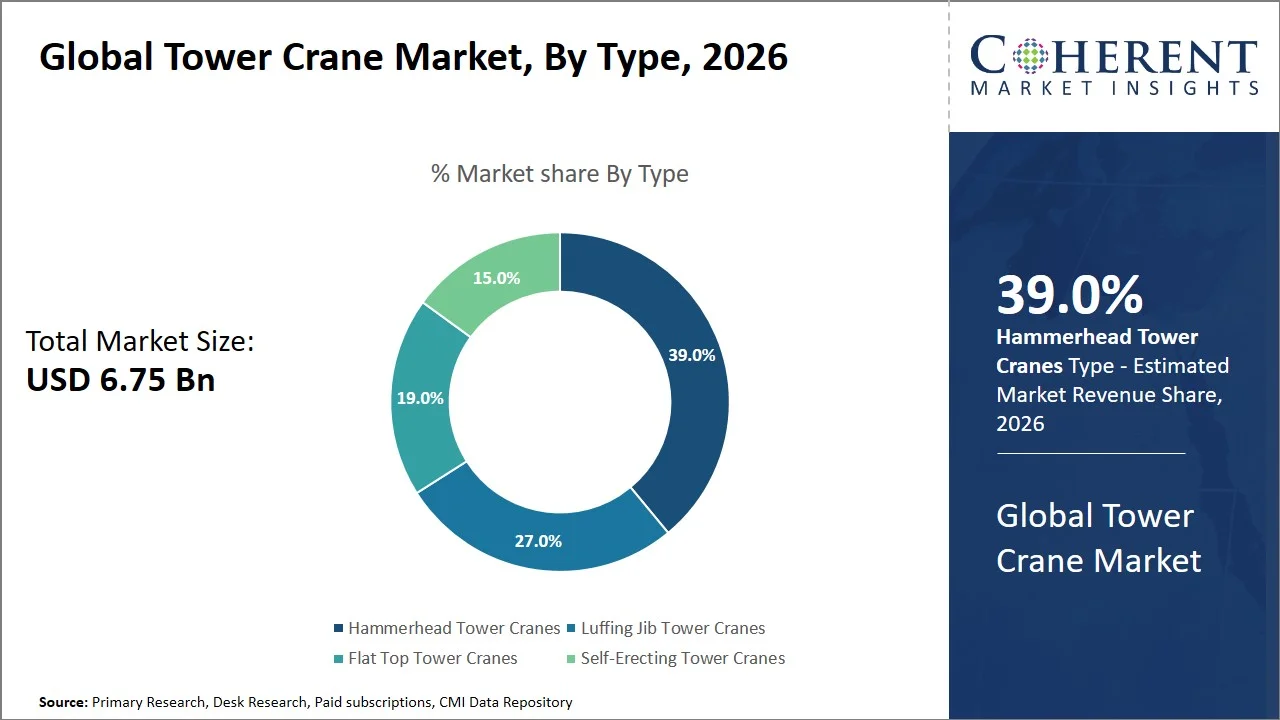
Why Does Hammerhead Tower Cranes Segment Dominate the Global Tower Crane Market ?
The hammerhead tower cranes segment is expected to account for 39.0% of the global tower crane market share in 2026. The increasing need of tower cranes for reliable heavy industrial operations is a major growth factor for the segment. On March 17, 2026, Cranex Limited achieved a historic milestone by securing a USD 382,000 order from BHEL-Bhopal for manufacturing and supplying a 220/80 ton double girder EOT crane. This marks the company's first high-capacity crane order in its 53-year history, demonstrating customer confidence in its engineering excellence and manufacturing capabilities, with delivery scheduled for February 2027.
(Source: ScanX)
- Current Industry Events of 2026
- Market Size Estimation
- Regional Breakdown
- Competitive Landscape
- Customer Intelligence
- Segmental Analysis
- Pricing Analysis
- Key Market Drivers, Challenges & Future Trends
- Customized Insights Section
Why are Top Slewing Tower Cranes the Most Preferred Design?
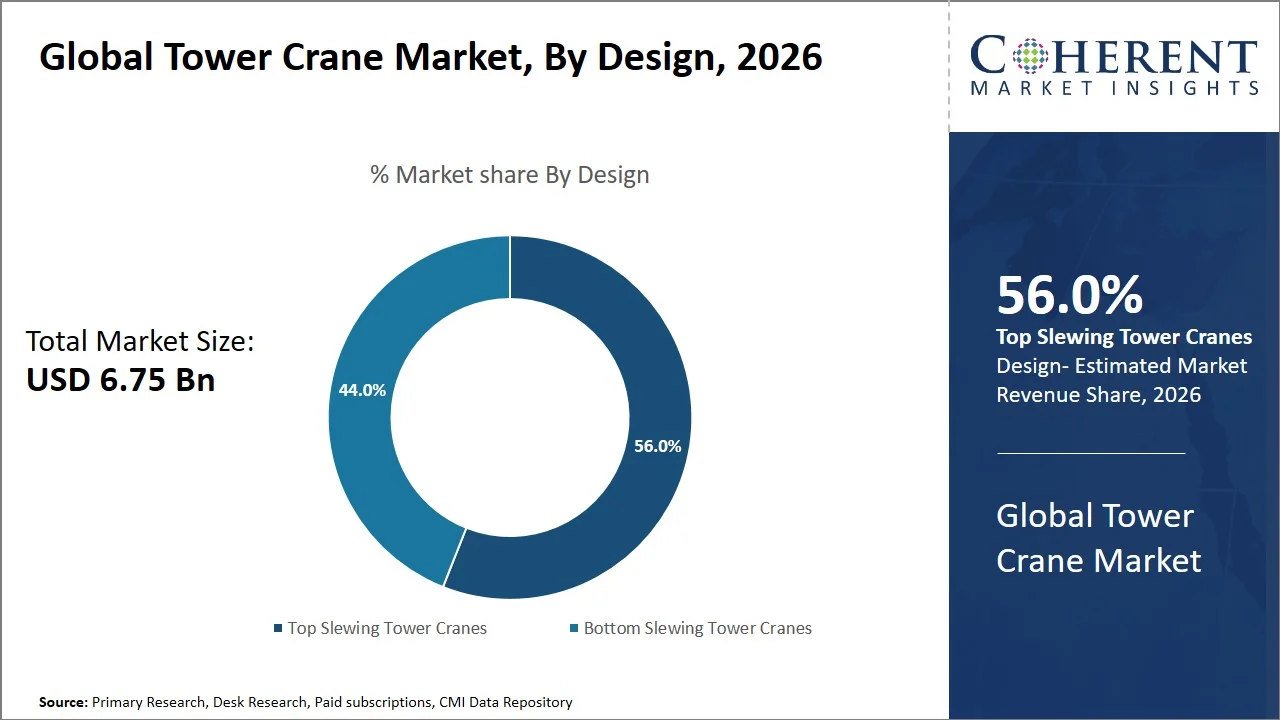
The top slewing tower cranes segment is expected to account for 56.0% of the global tower crane market share in 2026. Increasing need for advance lifting technologies in offshore activities is a key factor pushing the segment growth. On February 18, 2026, Huisman confirmed that it had received a first order for its newly designed process overhead crane, marking a major milestone in the company’s strategy to leverage its offshore expertise and expand into markets that require advanced handling and lifting technology. (Source: Huisman)
Below 5 Tons Segment Dominates the Global Tower Crane Market
The below 5 tons segment is expected to account for 42.0% of the global tower crane market share in 2026. The development of lightweight crane solutions for ease of access and maneuver capabilities in remote locations is driving the segment growth. On September 2, 2025, Manitowoc launched the new MCT 105 H5, expanding its range of topless tower cranes. The crane is bigger than the long-standing and popular MCT 85 F5, having the same 5 t maximum capacity but with the ability to lift that load to greater distances. It can also lift 1 t at the end of its 60 m jib. (Source: Manitowoc)
Currents Events and their Impact
Current Events | Description and its Impact |
European Union Machinery Regulation (EU) 2023/1230 |
|
(Source: OSHA)
Global Tower Crane Market Dynamics
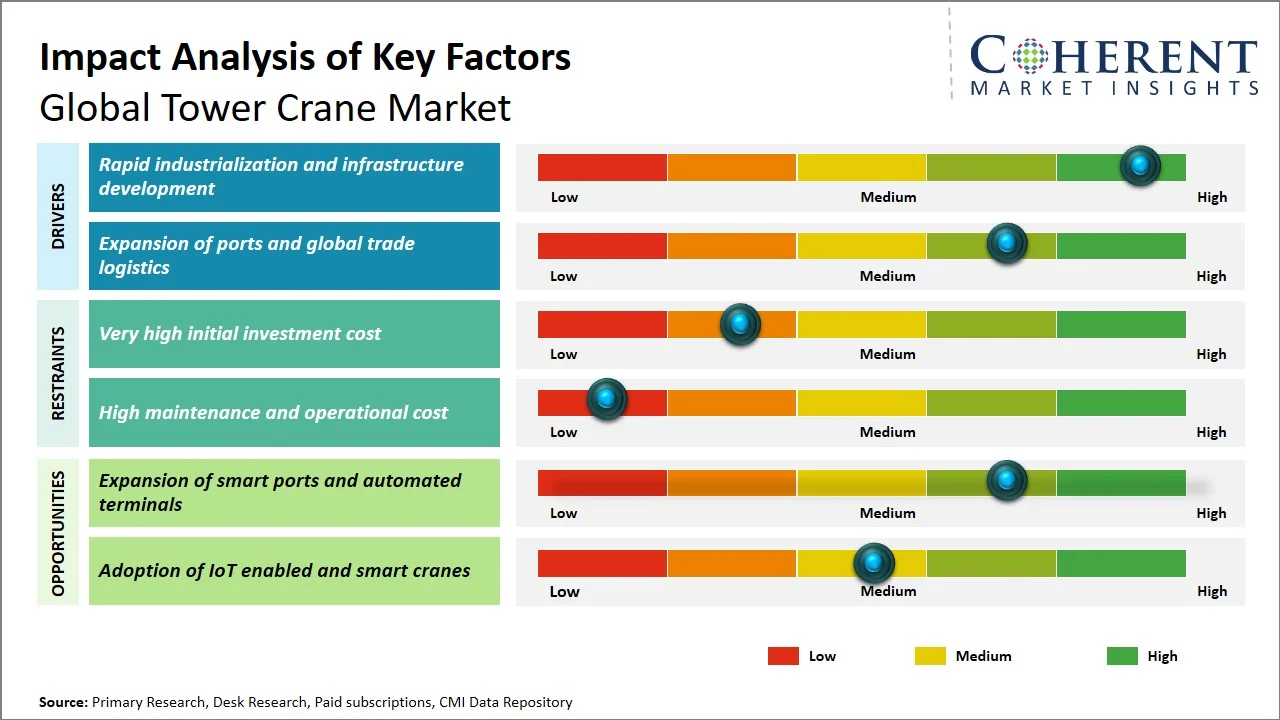
Market Drivers
- Rapid industrialization and infrastructure development: Fast-moving industrial growth in both new and mature markets push up interest in tower cranes. Because production, building work grows, better ways to move goods become necessary and overhead cranes fill that function. Large public works like shipping hubs, airfields, energy stations, city expansions depend on strong lifting technology. This reliance increases pressure on rail performance under intense weight and long-term usage demands. High durability becomes essential when operations run nonstop. Rail integrity influences overall system safety more than often acknowledged. Long spans require precise alignment support beneath moving equipment. On September 18, 2025, Liebherr and Transnet Port Terminals (TPT) entered a 10-year partnership to support the long-term reliability and performance of key port equipment across South Africa. The agreement includes ship-to-shore (STS), rubber-tyred gantry (RTG), rail-mounted gantry (RMG), and mobile harbor (LHM) cranes, backed by a 20-year asset management program. (Source: Port Technology)
- Expansion of ports and global trade logistics: Worldwide, port growth pushes need for better tower crane setups. As trade expands, so does pressure on existing infrastructure. Instead of simple upgrades, new systems appear - driven by size, volume, shift. Automated terminals rise - not just in number but scale. Intermodal links gain priority alongside deepwater handling zones. Bigger ships require rethought layouts beneath them. Firms like DP World adapt early; Konecranes follows close; ZPMC supplies at scale. Rail-mounted machines multiply where speed matters most. Smarter tools enter service under constant load. Efficiency emerges through movement patterns, not only power. Throughput improves when tracking blends with placement accuracy. Connectivity grows embedded within daily operations. Heavy rails now face stricter performance roles. On May 20, 2025, DP World announced plans to invest USD 2.5 billion to expand its global logistics network, launching major infrastructure projects across India, Africa, South America and Europe in response to rising demand for resilient, integrated supply chain solutions. (Source: DP World)
Emerging Trends
- Growth of Ultra-Heavy Lifting and Mega Infrastructure Project: Large-scale infrastructure developments, including offshore wind farms, petrochemical facilities, shipyards, metro rail systems, and modular construction projects, are increasing demand for ultra-heavy tower crane systems.
- Rising Demand for High-Strength and Smart Steel Tower Cranes: As crane capacities and operating cycles increase, the market is shifting toward higher-performance tower cranes with improved fatigue resistance, wear durability, and predictive maintenance capabilities.
Regional Insights
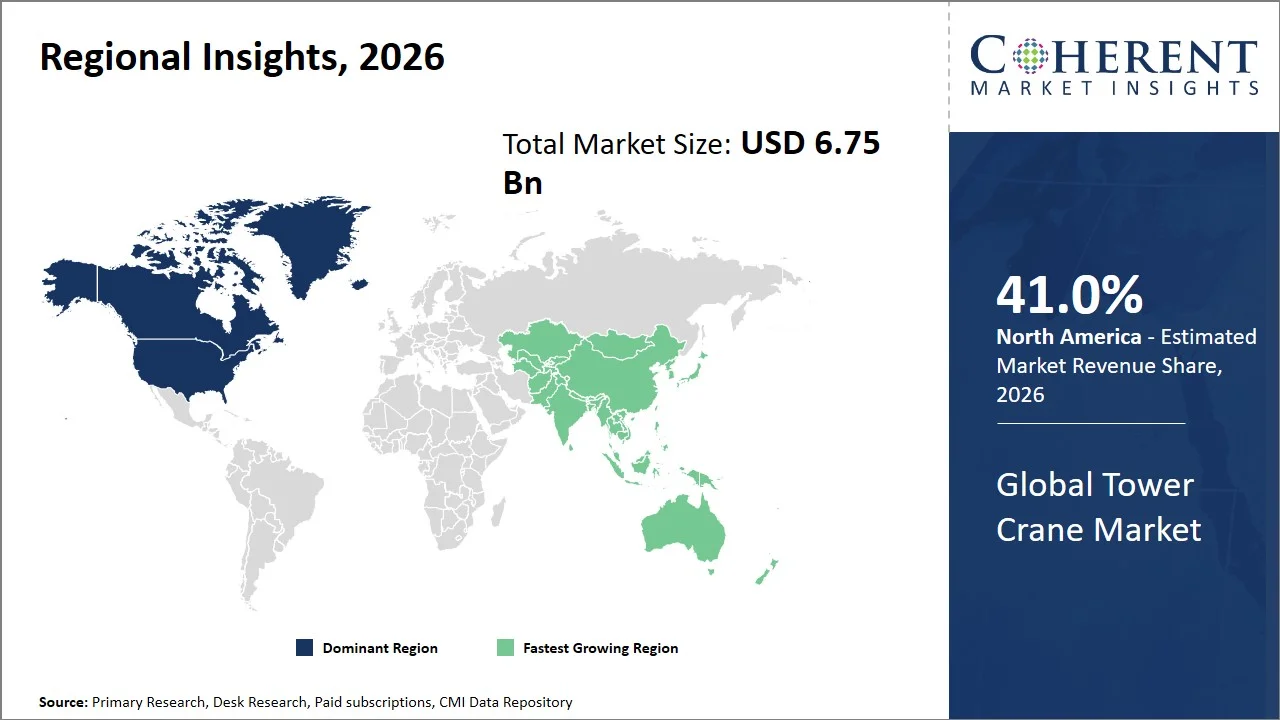
Why is North America a Strong Market for Tower Crane?
North America is expected to account for a market share of 41% in 2026. The North America tower crane market is steadily growing, driven by strong demand in high-rise residential construction, commercial redevelopment, and major infrastructure projects in cities like New York, Toronto, Los Angeles, and Chicago. The market is dominated by global manufacturers such as Liebherr, Manitowoc Company (Potain), and Zoomlion Heavy Industry Science & Technology, with rental companies playing a central role in fleet deployment.
Moreover, ongoing development of port facilities and offshore wind projects are expected to aid growth. On June 11, 2024, Equinor broke ground on construction at the South Brooklyn Marine Terminal (SBMT), kicking off the revitalization of the venerable port facility into a hub for offshore wind on the East Coast and a critical contributor to New York’s renewable energy ambitions. (Source: Equinor)
Why Does Asia Pacific Tower Crane Market Exhibit High Growth?
Asia Pacific is expected to account for a market share of 25% in 2026 and is expected to register the fastest growth rate over the forecast period. In the Asia Pacific region, dominance in the global tower crane market is driven primarily by rapid urbanization, extensive infrastructure projects, and significant industrialization, especially in countries like China, India, and Japan. This region benefits from a robust ecosystem comprising a vast network of construction firms, equipment manufacturers, and supportive supply chains. Government initiatives focusing on smart cities, transportation infrastructure, and affordable housing further amplify demand for tower cranes. On January 7, 2026, Konecranes introduced its new Konecranes X-series crane and S-series low headroom hoist to the Australian market during a launch event at its Smithfield facility. The introduction follows the full rollout of the X-series in EMEA and phased launches of the S-series hoist and X-series crane in other regions, supporting the company’s continued focus on providing advanced and reliable lifting solutions. (Source: Konecranes)
Why is U.S. Emerging as a Major Hub in the Tower Crane Market?
Despite global shifts, demand holds firm in U.S., where towers rise alongside offices and renewed public works. Leading names such as Manitowoc, Terex, and Potain shape supply through models built for precision under tighter ecological standards. Because rules tighten, engineering adapts - cranes evolve beyond lifting, focusing on cleaner performance. Through widespread support hubs, upkeep becomes seamless across regions where downtime matters. Wherever steel climbs skyward, readiness follows.
Is China the Next Growth Engine for the Tower Crane Market?
China holds strongest sway in tower crane production owing to steady city growth and state-backed construction initiatives. Not led by chance, major firms such as Zoomlion and Sany Heavy Industry shape progress through advanced designs for crowded metropolitan areas. Because they build at vast scale, prices stay low while support systems reach nearly every region. Such depth in output and service maintains their edge across international comparisons.
U.A.E. Tower Crane Market Analysis and Trends
Despite its desert climate, construction activity fuels demand for tower cranes across urban centers. Luxury developments contribute significantly to equipment needs in Dubai and Abu Dhabi. Major events, including world expos, trigger long-term infrastructure expansions requiring heavy lifting solutions. Oil remains a backdrop, though economic plans now emphasize broader industrial growth. Outside capital flows freely into designated trade zones with minimal restrictions. International manufacturers respond by establishing regional footholds through local partnerships.
Growth in real estate, transport, and industry marks India’s economic landscape, driven by national efforts including the Smart Cities initiative and broadening road networks. Among those supplying cranes are global players, represented locally through units like Liebherr and Terex, as well as newer domestic producers adding variety. A shift toward renting construction machinery has taken hold, expanding access to lifting equipment across different project scales. Firms of modest size now engage more readily, enabled by flexible equipment use rather than ownership.
Global Tower Crane Market - Automation & Smart Crane Penetration
Smart Feature | Estimated Global Penetration |
Telematics (fleet tracking, usage data, GPS, diagnostics) | 65% – 80% |
Remote Monitoring (real-time performance + fault alerts) | 50% – 70% |
Anti-sway / Load Stabilization Systems | 35% – 55% |
Semi-autonomous Controls (assisted lifting, smart assist modes) | 15% – 30% |
How is Expansion of Smart Ports and Automated Terminals Creating New Growth Opportunities in the Global Tower Crane Market?
Large ships moving more cargo make dockside speed essential. With automated systems spreading into port regions, global needs shift for rail-mounted cranes. Rather than rely on older techniques, several ports adopt linked control networks together with unmanned machinery. As sensor inputs feed constant updates, intelligent setups guide hoisting devices precisely along fixed paths. When mechanical motion must align perfectly, nothing matters more than accuracy. Should conditions remain unchanged, precision in placement still matters. When demands grow stronger, reliability becomes expected rather than chosen. On January 14, 2026, PSA International Pte Ltd announced it has set a new benchmark in global container handling, achieving a record of 105 million Twenty-foot Equivalent Units (TEUs) across its ports and terminals worldwide for the year ended December 31, 2025. (Source: PSA International)
Market Players, Key Development, and Competitive Intelligence
Key Developments
- On February 4, 2026, Columbus McKinnon Corporation announced that it had completed its acquisition of Kito Crosby Limited from funds managed by leading global investment firm, KKR.
- On January 5, 2026, Hiab completed the acquisition of the Brazilian crane manufacturer, ING Cranes, announced on November 26, 2025. The acquisition significantly enhances Hiab’s presence in Brazil, complementing its current portfolio in the market.
Competitive Landscape
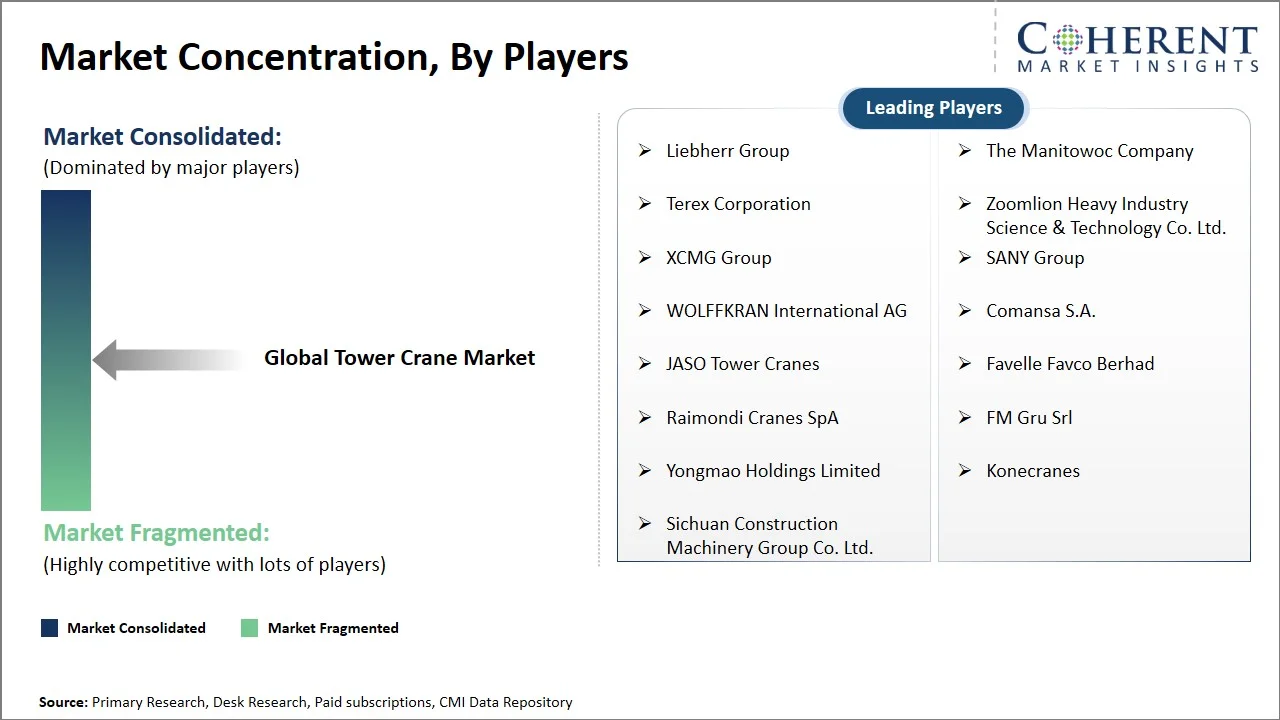
The global tower crane market is moderately consolidated, with a core group of OEMs—Liebherr, Manitowoc Company (Potain), Terex Corporation, Zoomlion Heavy Industry Science & Technology, XCMG Group, and SANY Group, controlling a large share of global revenue through wide product portfolios and global rental/dealer networks. European and North American firms compete mainly on premium engineering, safety systems, and lifecycle service support, while Chinese manufacturers continue gaining share via cost competitiveness, rapid production scaling, and aggressive expansion in Asia Pacific, Africa, and the Middle East.
Market Report Scope
Tower Crane Market Report Coverage
| Report Coverage | Details | ||
|---|---|---|---|
| Base Year: | 2025 | Market Size in 2026: | USD 6.75 Bn |
| Historical Data for: | 2020 To 2024 | Forecast Period: | 2026 To 2033 |
| Forecast Period 2026 to 2033 CAGR: | 6.5% | 2033 Value Projection: | USD 10 Bn |
| Geographies covered: |
| ||
| Segments covered: |
| ||
| Companies covered: | Liebherr Group, The Manitowoc Company, Terex Corporation, Zoomlion Heavy Industry Science & Technology Co. Ltd., XCMG Group, SANY Group, WOLFFKRAN International AG, Comansa S.A., JASO Tower Cranes, Favelle Favco Berhad, Raimondi Cranes SpA, FM Gru Srl, Yongmao Holdings Limited, Konecranes, and Sichuan Construction Machinery Group Co. Ltd. | ||
| Growth Drivers: |
| ||
| Restraints & Challenges: |
| ||
Analyst Opinion (Expert Opinion)
- The tower crane market is structurally strong but cyclically sensitive, anchored by long-term drivers like urbanization, infrastructure investment, and high-rise construction demand. Growth expectations remain steady (mid-single-digit CAGR range), but profitability is increasingly tied to rental fleet utilization, service contracts, and digital fleet management rather than pure equipment sales. They also highlight a widening gap between premium OEMs and low-cost manufacturers, with tier-1 players defending margins through innovation (IoT, automation, hybrid/electric cranes), while lower-cost competitors expand volume share in emerging markets.
- The future of the global tower crane industry is expected to be shaped by smart construction, sustainability, and urban densification. Demand will continue shifting toward compact, modular, and self-erecting cranes suited for dense cities, while large infrastructure and energy projects will sustain high-capacity crane demand. A major transformation is expected in automation and digitalization, including AI-assisted load control, predictive maintenance, and real-time fleet optimization. Electrification and hybrid power systems are also likely to expand as emissions regulations tighten, especially in Europe and developed markets.
Speak to the analyst
Want personalized insights?
Take the findings above to one of our principal consultants, or have the report rebuilt around the segments, geographies and competitors you actually track.
Market Segmentation
- Type Insights (Revenue, USD Bn, 2021 - 2033)
- Hammerhead Tower Cranes
- Luffing Jib Tower Cranes
- Flat Top Tower Cranes
- Self-Erecting Tower Cranes
- Design Insights (Revenue, USD Bn, 2021 - 2033)
- Top Slewing Tower Cranes
- Bottom Slewing Tower Cranes
- Lifting Capacity Insights (Revenue, USD Bn, 2021 - 2033)
- Below 5 Tons
- 5 to 20 Tons
- 20 to 50 Tons
- Above 50 Tons
- End User Insights (Revenue, USD Bn, 2021 - 2033)
- Construction Companies
- Rental Service Providers
- Industrial Contractors
- Government Infrastructure Agencies
- Regional Insights (Revenue, USD Bn, 2021 - 2033)
- North America
- U.S.
- Canada
- Latin America
- Brazil
- Argentina
- Mexico
- Rest of Latin America
- Europe
- Germany
- U.K.
- Spain
- France
- Italy
- Russia
- Rest of Europe
- Asia Pacific
- China
- India
- Japan
- Australia
- South Korea
- ASEAN
- Rest of Asia Pacific
- Middle East
- GCC Countries
- Israel
- Rest of Middle East
- Africa
- South Africa
- North Africa
- Central Africa
- North America
- Key Players Insights
- Liebherr Group
- The Manitowoc Company
- Terex Corporation
- Zoomlion Heavy Industry Science & Technology Co. Ltd.
- XCMG Group
- SANY Group
- WOLFFKRAN International AG
- Comansa S.A.
- JASO Tower Cranes
- Favelle Favco Berhad
- Raimondi Cranes SpA
- FM Gru Srl
- Yongmao Holdings Limited
- Konecranes
- Sichuan Construction Machinery Group Co. Ltd.
Sources
Primary Research Interviews
- Tower Crane manufacturers and suppliers
- Construction and infrastructure project managers
- Railway infrastructure contractors
- Port and harbor equipment operators
Magazines
- Railway Track & Structures Magazine
- Construction Equipment Magazine
- Port Technology International
- Heavy Lifting & Specialized Transport Magazine
Journals
- International Journal of Railway Technology
- Journal of Construction Engineering and Management
- Transportation Research Record
Associations
- International Association of Ports and Harbors (IAPH)
- Railway Industry Association (RIA)
- Construction Industry Institute (CII)
- International Crane and Specialized Transport Association
Public Domain Sources
- World Bank Infrastructure Database
- International Trade Centre (ITC) Market Analysis
- Government statistical offices and trade departments
- United Nations Industrial Development Organization (UNIDO)
Proprietary Elements
- CMI Data Analytics Tool
- Proprietary CMI Existing Repository of information for last 10 years
Get access to 250+ pages report
Every segment, forecast, competitor profile and data table behind the analysis above — available for instant download.
- ESOMAR Member
- ISO 9001:2015 Certified
- D-U-N-S Registered
- GDPR & CCPA Compliant
Missing comfort of reading report in your local language? Find your preferred language:
Transform your Strategy with Exclusive Trending Reports
Frequently Asked Questions
The global tower crane market is expected to stand at USD 6.75 Bn in 2026 and is expected to reach USD 10 Bn by 2033
The CAGR of global tower crane market is projected to be 6.5% from 2026 to 2033.
Rapid industrialization and infrastructure development and expansion of ports and global trade logistics are the major factors driving the growth of the global tower crane market.
Very high initial investment cost and high maintenance and operational cost are the major factors hampering the growth of the global tower crane market.
In terms of type, hammerhead tower cranes are estimated to dominate the market revenue share 2026.
Liebherr Group, The Manitowoc Company, Terex Corporation, Zoomlion Heavy Industry Science & Technology Co. Ltd., XCMG Group, SANY Group, WOLFFKRAN International AG, Comansa S.A., JASO Tower Cranes, Favelle Favco Berhad, Raimondi Cranes SpA, FM Gru Srl, Yongmao Holdings Limited, Konecranes, and Sichuan Construction Machinery Group Co. Ltd. are the major players.
North America is expected to lead the global tower crane market in 2026.