

Global Transparent Display Market and Forecast – 2026-2033
Coherent Market Insights estimates that the global transparent display market is expected to reach USD 6 Bn in 2026 and will expand to USD 52 Bn by 2033, registering a CAGR of 36% between 2026 and 2033.
Key Takeaways of the Transparent Display Market
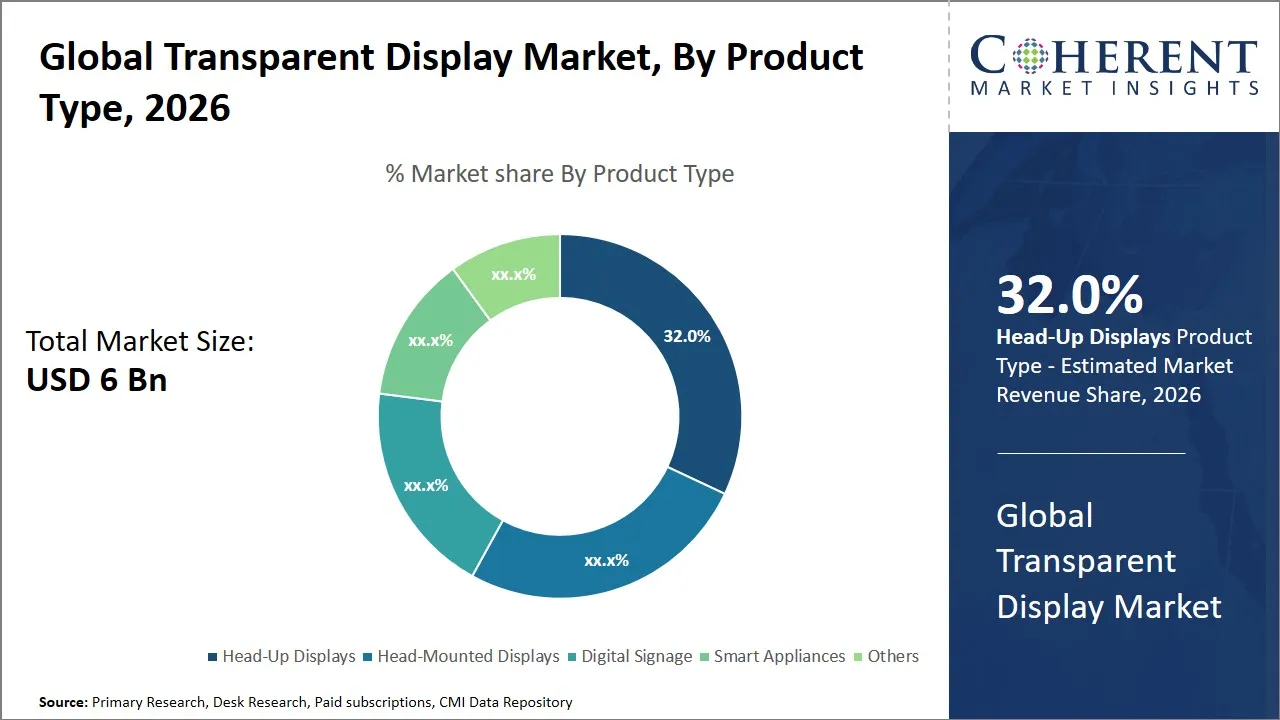
- The head-up displays segment is expected to account for 32% of the transparent display market share in 2026.
- The HD segment is projected to account for 41% of the market share in 2026.
- The consumer electronics segment is expected to hold 34% share in 2026.
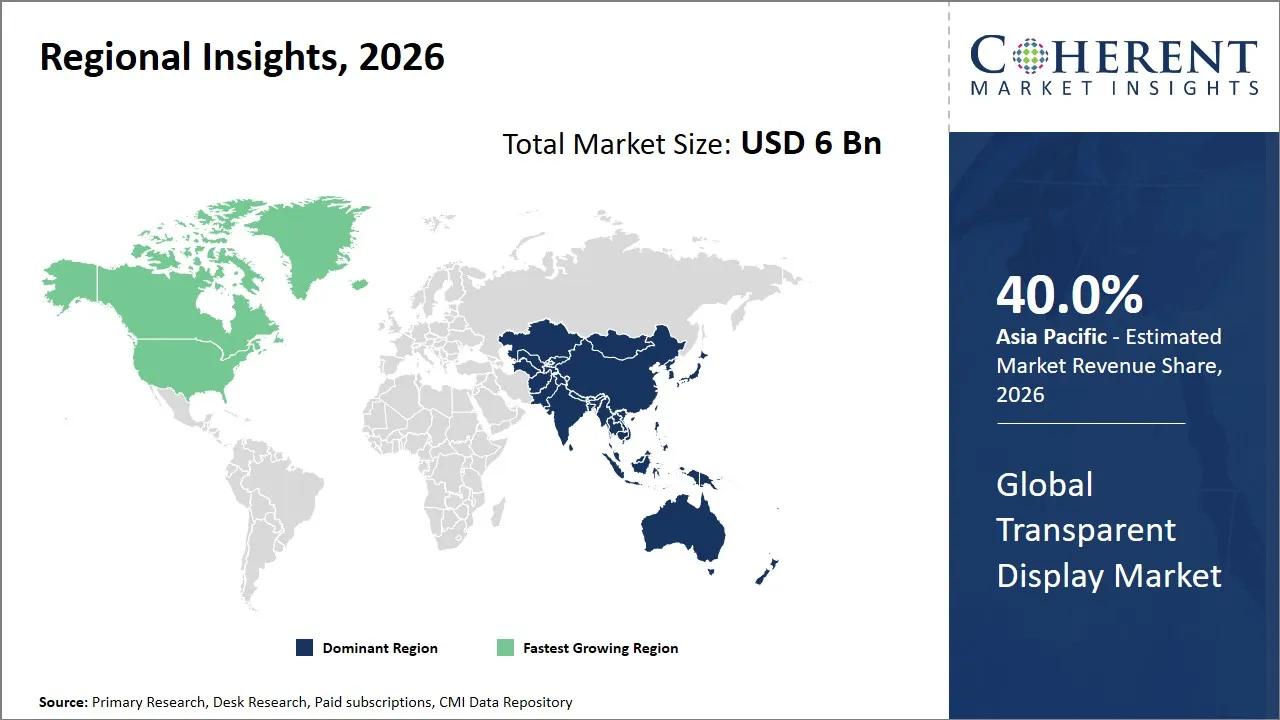
- Asia Pacific is expected to dominate the transparent display market in 2026 with a 40% market share.
- North America is projected to hold 25% of the market share in 2026 and is expected to record the fastest growth over the forecast period.
Current Events and Its Impact
Current Events | Description and its Impact |
LG Electronics Product Launch |
|
Segmental Insights
- Current Industry Events of 2026
- Market Size Estimation
- Regional Breakdown
- Competitive Landscape
- Customer Intelligence
- Segmental Analysis
- Pricing Analysis
- Key Market Drivers, Challenges & Future Trends
- Customized Insights Section
Why Does the Head-Up Displays Segment Dominate the Global Transparent Display Market in 2026?
The head-up displays segment is expected to account for 32.0% of the global transparent display market in 2026. The growth is driven primarily by their transformative impact on user experience and safety in various applications. Information appears in front of users through HUDs, keeping their focus on surroundings while viewing key details instantly. In aviation and automobiles, immediate visibility of data supports quicker decisions during operation. Growing use across vehicle types, not limited to premium versions, strengthens the role these systems now play. Displays showing route cues, current velocity, or warnings become familiar parts of daily driving experiences over time. What once seemed rare now integrates quietly into standard features seen everywhere.
HD Segment Dominates the Global Transparent Display Market
The HD segment is expected to account for 41.0% of the global transparent display market in 2026. The growth is attributable largely to their ideal balance of performance and affordability. Even with limited pixel count, HD displays provide acceptable clarity as well as clear viewing across different light environments. Low production costs mean such screens show up often in personal and professional tools alike. Thanks to the broad presence of HD content, moving files from one system to another seldom leads to issues. Given that nearly all online platforms accept this standard, product developers encounter less difficulty during creation phases.
Why is Consumer Electronics the Most Crucial End User in the Transparent Display Market?
The consumer electronics segment is expected to account for 34.0% of the global transparent display market in 2026. Advancement stems from swift technological changes along with evolving patterns in consumer behavior toward electronics. Smartphones, tablets, smartwatches, and automated home setups now feature see-through screens more often, aiming for sleeker designs while boosting interaction quality. Instead of hiding function behind form, these displays merge clarity with purpose - turning everyday surfaces into dynamic tools. Because appearance matters just as much as performance, transparency becomes a bridge between practicality and visual appeal. With time, what once seemed experimental fits naturally within daily routines.
For instance, on January 4, 2024, Samsung Electronics upleveled its leading transparent MICRO LED display to expand how users enjoy visual content. The company’s Transparent MICRO LED display was unveiled for the first time at Samsung First Look 2024, ahead of the Consumer Electronics Show (CES) 2024, the world’s largest consumer electronics and information technology exhibition.
(Source: news.samsung.com)
Cost Curve & Price Decline Trajectories
Technology Type | 2023 Avg Cost/ASP | 2026–28 Estimate | 2030 Estimate |
Transparent LCD | USD 45–USD 65 / sq. cm | ~USD 40–USD 60 (↓5–10%) | ~USD 30–USD 50 (↓15–25%) |
Transparent OLED | USD 80–USD 120 / sq. cm | ~USD 70–USD 100 (↓12–17%) | ~USD 50–USD 90 (↓25–40%) |
Large-format OLED display (55″–86″) | ~USD 2,460–USD 2,570 each | ~USD 2,000–USD 2,400 (↓6–15%) | ~USD 1,500–USD 2,200 (↓18–32%) |
Transparent LED film / mesh | ~USD 146–USD 189 / sq. m | ~USD 130–USD 175 (↓7–10%) | ~USD 100–USD 160 (↓15–25%) |
Transparent LED rigid high-end | ~USD 1,905–USD 2,880 / sq. m | ~USD 1,700–USD 2,600 (↓10–15%) | ~USD 1,300–USD 2,200 (↓25–35%) |
Transparent MicroLED (prototype/early) | ~USD 15,000–USD 30,000 / m² (very premium) | ~USD 12,000–USD 25,000 (↓15–20%) | ~USD 8,000–USD 18,000 (↓35–50%) |
Regional Insights
Asia Pacific Transparent Display Market Analysis and Trends
Asia Pacific is expected to account for a market share of 40% in 2026. Fueled by swift shifts in industry, rising need for electronic gadgets emerges as one force behind momentum, while policy pushes from governments add further weight. China, Japan, South Korea, followed closely by India, push forward with fresh commitments to cutting-edge screen methods, backed steadily by financial incentives and grants meant for technological advancement.
A dense web of production hubs defines the area, where trained workers meet emerging ventures alongside long-standing firms - including names such as BOE Technology Group, Japan Display Inc., and TCL Corporation - using see-through screens across phones, vehicle dash projections, and public information panels. With these changes unfolding, 5G availability widens across the area, linked steadily to growing networks of smart gadgets that bring see-through screens into common practice. Progress here does not stem from single actions; instead, it builds through combined forces guiding tech adoption in daily operations.
For instance, on February 19, 2024, BOE HC SemiTek completed the construction of its base for Micro LED Wafer Manufacturing, Packaging and Testing in Zhuhai, China.
(Source: ledinside.com)
North America Transparent Display Market Analysis and Trends
North America is projected to account for a market share of 25% in 2026 and is expected to register the fastest growth rate over the forecast period. Driven largely by a long-standing network of tech enterprises, notable participation from leading firms occurs alongside favorable governmental frameworks that encourage new developments. Despite differing origins, Samsung Display America leads alongside LG Display and eMagin Corporation in shaping functional transparent screens.
Forward movement happens not randomly, yet through focused work, clearly seen within technology centers such as Silicon Valley. Assistance comes quietly, government initiatives together with individual funders promote progress in augmented reality guidance, vehicle-based systems, and retail setups. Resilience here builds upon continued funding along with thorough scientific inquiry. Supply systems show high levels of organization; connections with Asian markets remain stable, enabling timely access to essential parts - this underpins faster creation and release cycles locally.
Global Transparent Display Market Outlook for Key Countries
Is U.S. the Next Growth Engine for the Transparent Display Market?
Still dominant globally, the U.S. marketplace fosters breakthroughs in see-through screens, mainly within augmented reality and vehicle systems. Firms such as eMagin Corporation focus on wearables that can view through, while HID Global advances transparency-based identification tools. Backed by elite universities and consistent investment flows, emerging firms explore novel ways to construct and link these visual interfaces. Support arrives also from federal initiatives aimed at modernizing cities and expanding digital capabilities, quietly shaping conditions where transparent visuals thrive. Leading-edge uses now emerge naturally from this layered ecosystem of effort and funding.
Why is China Emerging as a Major Hub in the Transparent Display Market?
Progress within China’s transparent display sector gains momentum, backed by significant funding from local enterprises such as BOE Technology Group and TCL Corporation. With emphasis shaped by the “Made in China 2025” policy, focus shifts toward intelligent production integrated with next-generation visual systems. Growth expands here, fueled by a well-established chain of electronics producers able to lower costs via high-volume production runs. Demand rises steadily, fueled by buyers seeking clear screens for phones, stores, and vehicles. Though often overlooked, collaboration across borders helps bring new techniques into local operations faster than before. Despite challenges, progress continues without pause under these conditions.
Japan Transparent Display Market Analysis and Trends
Despite global competition, progress flows steadily within Japanese labs. Where function takes shape, Japan Display Inc. turns transparent screens into practical tools. Through Sony Corporation’s clear OLEDs, daily life meets innovation - inside vehicles, inside homes.
For instance, on September 10, 2025, LG Electronics delivered its Transparent OLED Signage and ultra-high-definition Micro LED signage, LG MAGNIT, to NEWoMan TAKANAWA, a flagship complex opening near TAKANAWA Gateway Station in Tokyo.
(Source: lg.com)
South Korea Transparent Display Market Analysis and Trends
Amid South Korea’s rapid progress stands a network of powerful firms, among them Samsung Display and LG Display, driving developments in transparent OLED alongside LCD methods. Forward movement takes form wherever state strategies align with intelligent gadgets, mobility tech, and adaptable circuitry.
India Transparent Display Market Analysis and Trends
A surge in digital infrastructure spending now shapes how transparent displays gain ground across India. Driven partly by heightened public familiarity with advanced visual tools, adoption spreads quietly but steadily. Within Digital India initiatives, cities start using clear screens at public info centers. As towns upgrade, small chances appear for such displays in transport spots or announcement spaces.
For instance, on January 7, 2026, The Entertainment Companion zone at The First Look 2026 marked a new chapter in Samsung’s visual display evolution, building on two decades as the world’s No. 1 TV brand. The space was divided into art, gaming and entertainment sections, anchored by the world’s first 130-inch Micro RGB TV and the Vision AI Companion.
(Source: news.samsung.com)
Market Players, Key Development, and Competitive Intelligence
Key Developments
- On November 25, 2024, Smartkem, positioned to power the next generation of displays using its disruptive organic thin-film transistors (OTFTs), announced a partnership with AUO, the largest display manufacturer in Taiwan, to jointly develop the world's first advanced rollable, transparent microLED display using Smartkem's technology
- On January 8, 2024, Continental showcased its Crystal Center Display for the first time at the Consumer Electronics Show 2024. In a world-first, the premium automotive display is fully embedded in a stylish crystal housing, opening up completely new possibilities to integrate minimalist luxury into car interiors with its frameless and semi-transparent look. The 10-inch display is based on the latest microLED technology that enables unprecedented levels of brightness and contrast.
Top Strategies Followed by Global Transparent Display Market Players
- A fresh rhythm marks how companies engage across the global transparent display market, with players adopting unique paths to visibility and reach. While leading names invest heavily in research, progress unfolds slowly yet consistently in transparency tech. Brightness levels, clarity when viewed through, and durability undergo careful adjustments by major contributors, matching outputs to precise demands seen in automobiles, retail spaces, and handheld gadgets.
- Firms of moderate scale tend to prioritize straightforward display solutions that remain budget-friendly yet retain essential features. Since customers in sectors such as retail signage and daily-use products emphasize cost control, these providers target consistent production with balanced pricing. Progress grows quietly when working alongside those who build or produce. Rather than aiming for high-end labels, growth emerges from shared work that deepens presence and reliability over time.
- Within the transparent display field, smaller players tend to emphasize specialized areas, driven by unique features tailored to specific applications. Attention turns frequently to innovations such as flexible surfaces, blended physical-digital layers, or energy-efficient components. Even though smaller firms rely on innovation backed by small funds, the results are visible in their products which sometimes can compete with the best in the market.
Market Report Scope
Transparent Display Market Report Coverage
| Report Coverage | Details | ||
|---|---|---|---|
| Base Year: | 2025 | Market Size in 2026: | USD 6 Bn |
| Historical Data for: | 2020 To 2024 | Forecast Period: | 2026 To 2033 |
| Forecast Period 2026 to 2033 CAGR: | 36% | 2033 Value Projection: | USD 52 Bn |
| Geographies covered: |
| ||
| Segments covered: |
| ||
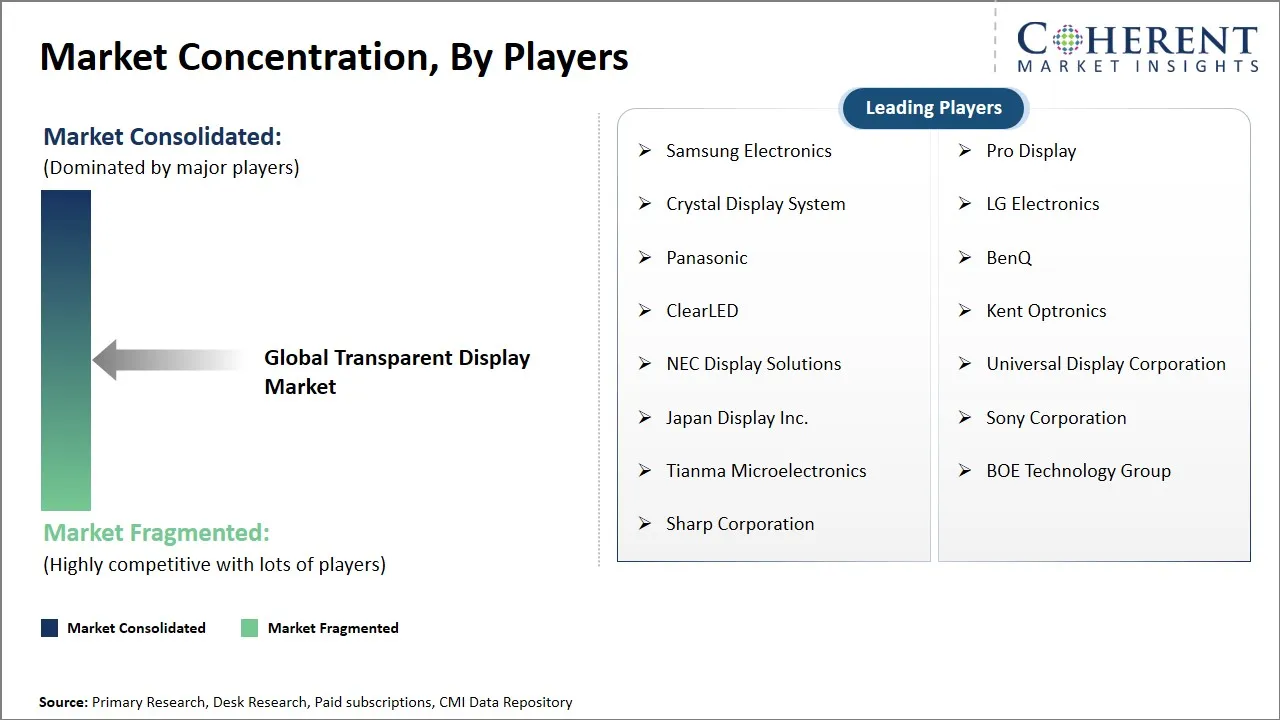
| Companies covered: | Samsung Electronics, Pro Display, Crystal Display System, LG Electronics, Panasonic, BenQ, ClearLED, Kent Optronics, NEC Display Solutions, Universal Display Corporation, Japan Display Inc., Sony Corporation, Tianma Microelectronics, BOE Technology Group, and Sharp Corporation | ||
| Growth Drivers: |
| ||
| Restraints & Challenges: |
| ||
Global Transparent Display Market Dynamics
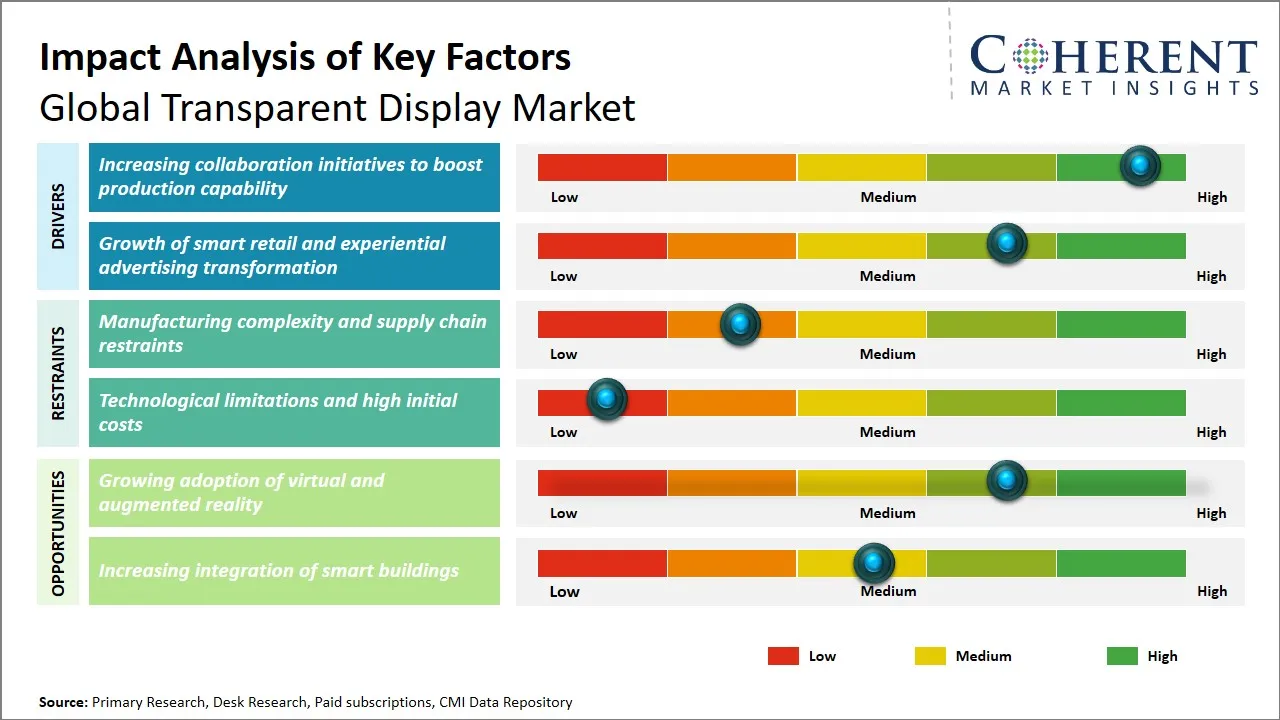
Global Transparent Display Market Driver - Increasing Collaboration Initiatives to Boost Production Capability
Growing cooperation within the transparent display sector strengthens output capacity while speeding up innovation. Together with such efforts, collaboration between creators and engineers, alongside university teams, fosters joint projects where insight flows freely, supply routes adjust smoothly. Owing to these connections, novel substances appear, advanced production techniques move faster, early models form rapidly, scaling soon follows.
For instance, on February 14, 2024, Gauzy Ltd. and LG Electronics ID Division executed a memorandum of understanding to extend their collaboration in advancing Transparent Organic Light Emitting Diode (T-OLED) displays with the use of Gauzy’s patented Suspended Particle Device (SPD) technology.
(Source: gauzy.com)
Global Transparent Display Market Opportunity - Growing Adoption of Virtual and Augmented Reality
Growing use of virtual and augmented reality alongside extended reality platforms in many fields opens clear paths for growth in the worldwide transparent screen sector. Essential to immersion, these screens place data over real-world views without breaking visual flow. Where sight guides interaction, transparency becomes key. Though often found in medical setups, retail spaces, vehicles, or handheld devices, their role stays consistent, enabling engagement without blocking view. With advancements in intelligent glasses, front displays, or enhanced instruments moving fast, developers now seek transparent displays that offer clarity, durability, along with unobstructed visual access.
For instance, on May 29, 2025, Anduril and Meta announced a partnership to design, build, and field a range of integrated XR products that provide warfighters with enhanced perception and enable intuitive control of autonomous platforms on the battlefield.
(Source: anduril.com)
Analyst Opinion (Expert Opinion)
- Emerging beyond mere curiosity, transparent displays gain ground through progress in OLED and micro-LED methods. Retail settings see clear interest, also automotive head-up interfaces, intelligent building designs, museums too - all places where openness serves purpose alongside visual appeal. Over time, thinner panels appear, along with increased luminance and reduced power draw, slowly overcoming past constraints. Manufacturing momentum holds firm across Asia Pacific, especially within South Korea, China, and Japan, where development pace remains steady.
- Despite potential, expansion faces hurdles due to expense, size limitations, along with reliability issues when exposed to sunlight or intense light. Growth remains slow under these conditions. Over the medium to long term, analysts expect gradual but sustained growth as yields improve and applications expand into smart cities and next-generation vehicles. Transparent displays are unlikely to replace conventional screens, but they are well-positioned to become a high-value, specialized segment with strong margins and strategic importance for display leaders.
Speak to the analyst
Want personalized insights?
Take the findings above to one of our principal consultants, or have the report rebuilt around the segments, geographies and competitors you actually track.
Market Segmentation
- Product Type Insights (Revenue, USD Billion, 2021 - 2033)
- Head-Up Displays
- Head-Mounted Displays
- Digital Signage
- Smart Appliances
- Others
- Resolution Type Insights (Revenue, USD Billion, 2021 - 2033)
- HD
- Full HD
- Ultra HD
- Others
- End User Insights (Revenue, USD Billion, 2021 - 2033)
- Consumer Electronics
- Automotive
- Healthcare
- Aerospace and Defense
- Transportation and Mobility
- Retail
- Advertising and Media
- Industrial
- Others
- Regional Insights (Revenue, USD Billion, 2021 - 2033)
- North America
- U.S.
- Canada
- Latin America
- Brazil
- Argentina
- Mexico
- Rest of Latin America
- Europe
- Germany
- U.K.
- Spain
- France
- Italy
- Russia
- Rest of Europe
- Asia Pacific
- China
- India
- Japan
- Australia
- South Korea
- ASEAN
- Rest of Asia Pacific
- Middle East
- GCC Countries
- Israel
- Rest of Middle East
- Africa
- South Africa
- North Africa
- Central Africa
- North America
- Key Players Insights
- Samsung Electronics
- Pro Display
- Crystal Display System
- LG Electronics
- Panasonic
- BenQ
- ClearLED
- Kent Optronics
- NEC Display Solutions
- Universal Display Corporation
- Japan Display Inc.
- Sony Corporation
- Tianma Microelectronics
- BOE Technology Group
- Sharp Corporation
Sources
Primary Research interviews
- Display Technology Manufacturers
- OLED and LCD Panel Suppliers
- Transparent Display System Integrators
- Retail and Automotive Industry End-users
Databases
- IDC Display Technology Database
Magazines
- Display Daily Magazine
- Electronic Design Magazine
- Touch Display Research Magazine
- Information Display Magazine
- OLED Info Magazine
Journals
- Journal of Display Technology
- IEEE Transactions on Electron Devices
- Applied Physics Letters
- Journal of Materials Chemistry C
Newspapers
- Financial Times Technology Section
- Wall Street Journal Tech News
- Reuters Technology Reports
- Bloomberg Technology News
- TechCrunch Display Technology Coverage
Associations
- Society for Information Display (SID)
- Display Industry Association
- International Display Technology Association
- Consumer Electronics Association (CEA)
- Flexible Display Center Association
Public Domain sources
- USPTO Patent Database for Display Technologies
- SEC Filings of Major Display Manufacturers
- Government Technology Research Publications
- International Trade Commission Reports
- World Intellectual Property Organization Database
Proprietary Elements
- CMI Data Analytics Tool
- Proprietary CMI Existing Repository of information for last 8 years
Get access to 250+ pages report
Every segment, forecast, competitor profile and data table behind the analysis above — available for instant download.
- ESOMAR Member
- ISO 9001:2015 Certified
- D-U-N-S Registered
- GDPR & CCPA Compliant
Missing comfort of reading report in your local language? Find your preferred language:
Transform your Strategy with Exclusive Trending Reports
Frequently Asked Questions
The global transparent display market is expected to stand at USD 6 Bn in 2026 and is expected to reach USD 52 Bn by 2033.
The CAGR of global transparent display market is projected to be 36% from 2026 to 2033.
Increasing collaboration initiatives to boost production capability and growth of smart retail and experiential advertising transformation are the major factors driving the growth of the global transparent display market.
Manufacturing complexity and supply chain restraints and technological limitations and high initial costs are the major factors hampering the growth of the global transparent display market.
In terms of product type, head-up displays are estimated to dominate the market revenue share in 2026.
Automakers use them mainly in head-up displays and smart windshields for driver information.
Micro-LED is expected to enable brighter, more durable transparent displays over the long term.