

Global Extended Reality Platform Market Size and Forecast – 2026-2033
The global extended reality platform market is estimated to be valued at USD 95.93 Bn in 2026 and is expected to reach USD 388.13 Bn by 2033, exhibiting a compound annual growth rate (CAGR) of 22.1% from 2026 to 2033.
Key Takeaways of the Global Extended Reality Platform Market
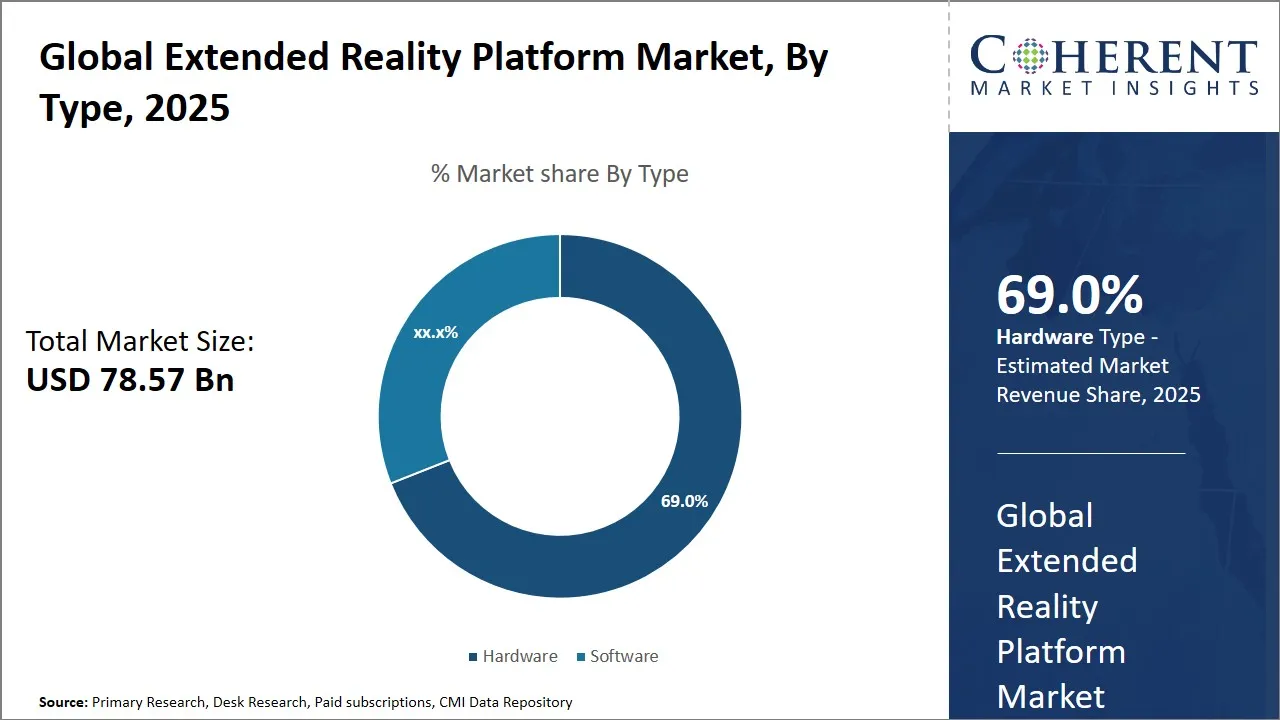
- The hardware segment leads the market holding an estimated share of 70.0 % in 2026.
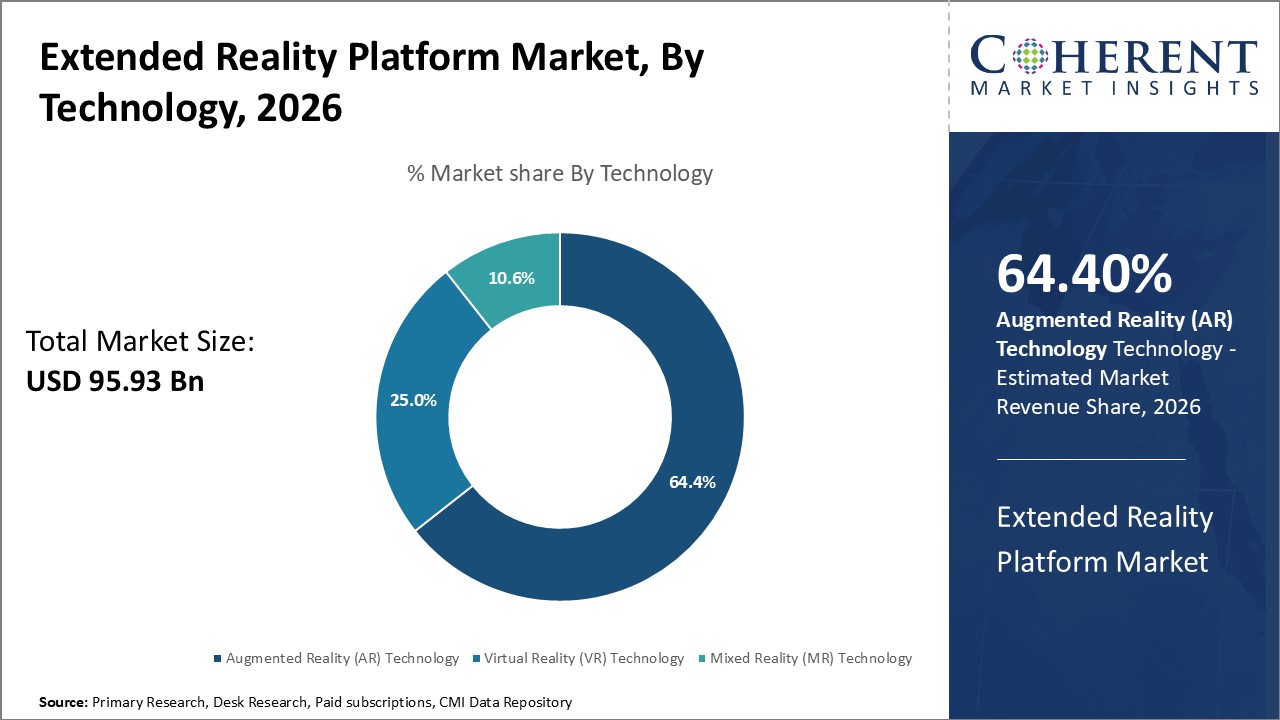
- The Augmented Reality (AR) technology segment is projected to dominate with a share of 64.4 % in 2026.
- The consumer engagement segment is estimated to lead the market with a share of 70.9 % in 2026.
- The manufacturing segment is projected to dominate with a share of 23.9 % in 2026.
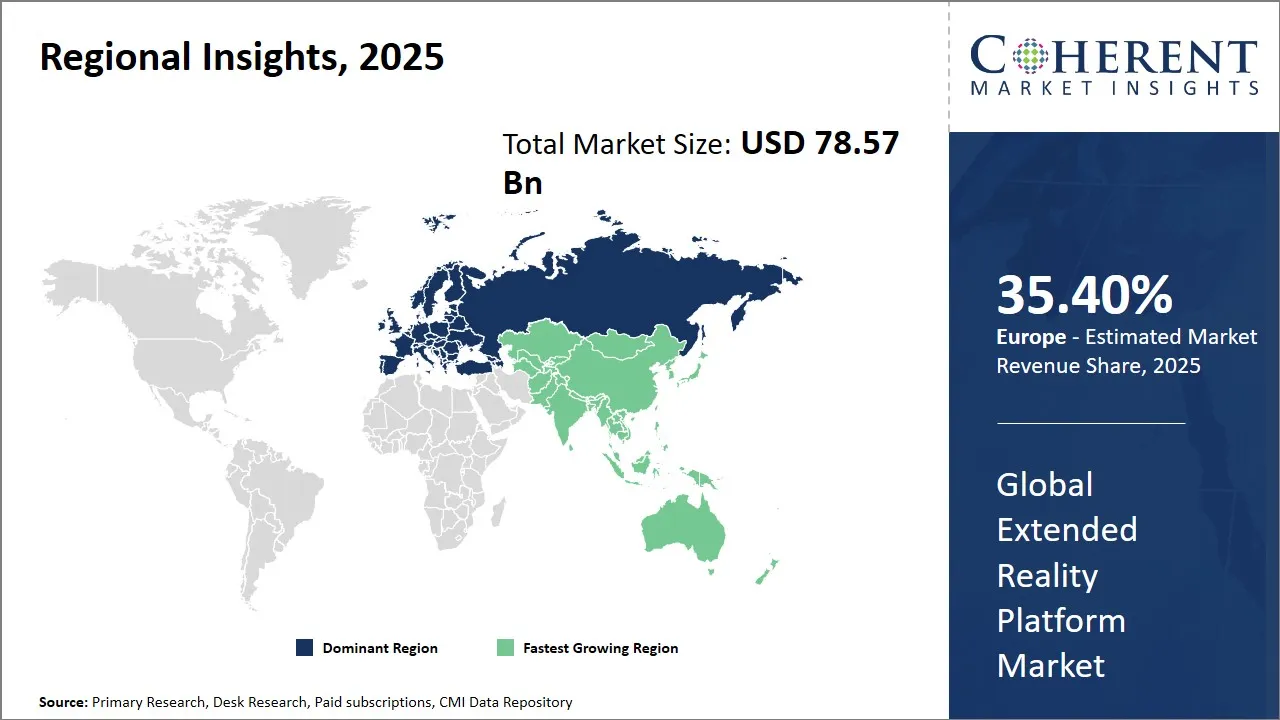
- Europe is estimated to lead the market with a share of 35.4 % in 2026. Asia Pacific, holding an estimated share of 23.4% in 2026, is projected to be the fastest growing region.
Market Overview
The market is seeing fast innovation in virtual, augmented, and mixed reality applications, with a strong focus on improving user interactivity and realism. The rising demand for Extended Reality (XR) in gaming, healthcare, education, and enterprise training, as well as evolving 5G infrastructure that makes possible seamless XR experiences, are adding to market growth. Also, the use of AI and IoT is adding to the development of more personalized and immersive platforms, making XR’s role stronger in the future digital ecosystem.
Current Events and their Impact
Current Events | Description and its Impact |
Strategic Partnerships |
|
Enterprise Collaboration Growth |
|
Regulatory & Privacy Discussions |
|
Segmental Insights
- Current Industry Events of 2026
- Market Size Estimation
- Regional Breakdown
- Competitive Landscape
- Customer Intelligence
- Segmental Analysis
- Pricing Analysis
- Key Market Drivers, Challenges & Future Trends
- Customized Insights Section
Global Extended Reality Platform Market Insights, by Type – Hardware Segment Leads the Market Acting as the Backbone of Extended Reality Platforms
The hardware segment is projected to account for 70.0% of the global extended reality platform market share in 2026 because of its big role in delivering immersive experiences. The hardware segment sees growth because of continual advancements in processing power, display technology, and sensor accuracy, which improve the user experience in Extended Reality (XR) environments. The demand for hardware like head-Mounted Displays (HMDs), smart glasses, sensors, cameras, and haptic devices is growing because these components are very important for the effective functioning of XR applications. Also, increasing investments in miniaturization and ergonomics have made hardware more user-friendly, adding to the adoption in consumer and business sectors.
Another big factor for the hardware segment growth is the rising adoption of 5G and improved wireless technologies, which makes possible smooth real-time data transmission needed for XR devices to operate without latency. This advancement allows for lightweight, untethered hardware designs, improving mobility and comfort for users. Moreover, the rise in application areas, ranging from gaming and entertainment to healthcare and industrial training, makes demand for specialized hardware tailored to specific use cases, adding to innovation and adoption in the segment. Strategic collaborations between hardware manufacturers and software developers also add to optimized device creation, making the hardware segment’s dominant position stronger in the XR platform ecosystem.
Global Extended Reality Platform Market Insights, by Technology – Augmented Reality (AR) Technology Segment Leads XR Through Real World Integration
The Augmented Reality (AR) technology segment is expected to capture 64.4% share in 2026 because of its capability to overlay digital content onto the real world, thereby improving user interactions without fully detaching them from their environment. AR technology’s versatility in different sectors like retail, healthcare, automotive, and education adds to its widespread adoption. The ability to deliver contextually relevant information into a user’s field of vision allows businesses to transform customer engagement and operational workflows effectively. The affordability of AR-enabled devices like smartphones and tablets makes possible easy accessibility for a broad user base compared to the more specialized, often costlier virtual reality hardware.
Also, ongoing improvements in AR software frameworks and cloud computing support sophisticated content rendering and interaction, making AR applications increasingly sophisticated and immersive. The rise in mobile AR applications, popularized by gaming and social media filters, also creates widespread consumer familiarity and acceptance. To add, enterprises are using AR technology for purposes like remote assistance, product visualization, and training, which improves productivity and reduces operational costs, adding to the technology’s importance in the extended reality platform market. For instance, IKEA’s “IKEA Place” AR application lets customers use a smartphone or tablet camera to virtually place true-to-scale 3D models of furniture and décor in their own rooms before purchasing.
Global Extended Reality Platform Market Insights, by Application – Consumer Engagement Segment Leads as Users Demand Interactive Content
The consumer engagement segment is projected to hold 70.9% of market share in 2026 because of direct impact on how end-users interact with digital content for entertainment, social interaction, and lifestyle enhancement. The high appeal of XR technologies in gaming, virtual concerts, immersive movie experiences, and social networking apps makes a dynamic landscape where consumer demand consistently adds to innovation and expansion in this segment.
The increasing penetration of smart devices that can support XR content opens access to a diverse and growing user base. Consumers’ desire for improved and personalized experiences pushes developers to produce immersive content that uses XR’s ability to mix real and virtual elements. Social media platforms adopting XR features like augmented reality filters and the popularity of virtual events and marketplaces add to continuous consumer interaction with XR platforms. The ongoing improvement in user interface design and ease of access further broadens appeal to non-technical consumers.
Impact of AI on the Extended Reality Platform Market
Artificial Intelligence (AI) is adding to innovation in the extended reality platform market by making immersive experiences more intelligent and adaptive. Generative AI tools can create high-fidelity 3D assets, environments, and characters at a fraction of the traditional cost, greatly reducing development time for XR content. Computer-vision models improve real-time tracking and spatial mapping, allowing platforms to render lifelike interactions and smooth mixed-reality overlays. AI-driven analytics also help XR platform providers personalize experiences, optimize performance, and deliver context-aware recommendations, which is especially important in enterprise training, healthcare simulations, and retail engagement.
A good example is Meta’s integration of AI-powered scene understanding into its Quest headsets and Horizon OS. Meta uses advanced machine-learning models to recognize room boundaries, detect objects, and predict user movements, allowing users to move naturally while the system dynamically adjusts virtual elements to the physical environment.
Regional Insights
Europe Extended Reality Platform Market Analysis and Trends
Europe, holding a projected share of 35.4% in 2026, dominates the global extended reality platform market because of its strong industrial base, commitment to digital innovation, and a regulatory framework that pushes safe adoption of immersive technologies. Countries like Germany, France, and the U.K. lead in enterprise XR applications for manufacturing, healthcare, and automotive design, using established Industry 4.0 initiatives and government-backed digitization programs.
The European Union’s investments in 5G rollout, cross-border research projects like Horizon Europe, and funding for creative industries make a collaborative environment for XR platform development. Leading companies like Siemens for industrial AR/VR integration, Ubisoft for interactive entertainment, and Varjo for high-fidelity mixed-reality hardware show the region’s diverse capabilities. Also, Europe’s focus on privacy and data protection through GDPR pushes platform providers to adopt secure, user-centric designs, differentiating the market and adding to steady growth in both consumer and enterprise segments.
Asia Pacific Extended Reality Platform Market Analysis and Trends
The Asia Pacific region, holding an estimated share of 23.4% in 2026, exhibits the fastest growth in the market because of growing digital economies, increasing smartphone and wearable adoption, and growing investments from both public and private sectors. Countries like China, Japan, and South Korea are using XR solutions in sectors like education, healthcare, entertainment, and manufacturing. Government initiatives focusing on smart cities, digital healthcare, and entertainment tech make supportive environments for XR platform deployments. Local tech giants like Tencent, Xiaomi, and Sony are actively developing XR hardware and software ecosystems, adding to adoption. Also, favorable trade policies and nurturing startup ecosystems in countries like India add to this fast expansion.
Extended Reality Platform Market Outlook for Key Countries:
U.S. Extended Reality Platform Market Analysis and Trends
The U.S. benefits from its leadership in technological innovation and strong presence of global tech giants. Microsoft’s Azure Mixed Reality Services and Meta Platforms’ Oculus VR products show American expertise in hardware-software integration. Federal government initiatives supporting AR/VR research and smart manufacturing add to growth and technology adoption.
China Extended Reality Platform Market Analysis and Trends
China extended reality platform market sees huge government investments in AI and digital infrastructure, which complement the country’s push towards the digital economy. Tencent and Huawei contribute a lot through development of XR software platforms and 5G-enabled XR experiences. Local consumer demand for immersive gaming and virtual commerce also supports fast technology penetration. Strategic partnerships between tech firms and educational institutions add to innovation, while regional policies supporting tech incubation bolster startups.
Japan Extended Reality Platform Market Analysis and Trends
Japan continues to lead in the integration of XR platforms for industrial applications, especially in manufacturing, automotive, and healthcare sectors. Sony’s advancements in VR hardware add to both consumer and commercial applications. Japan’s focus on robotics and XR integration improves its competitive advantage in developing sophisticated XR solutions.
South Korea Extended Reality Platform Market Analysis and Trends
South Korea extended reality platform market sees strong 5G infrastructure and government initiatives aimed at fostering digital content industries and immersive technologies. Companies like Samsung and LG are very important for producing cutting-edge XR devices, while startups innovate in gaming and education sectors. The government’s support through financial incentives and innovation clusters supports fast commercialization of XR applications. Collaborative industry-academic research adds to technological advancements.
India Extended Reality Platform Market Analysis and Trends
India extended reality platform market is growing fast because of increasing smartphone penetration, digital literacy, and government-backed initiatives under the Digital India program. Local startups focus on affordable XR solutions suited for education, retail, and healthcare. Multinational companies are also growing their presence through partnerships and local investments. The country’s huge consumer base and growing enterprise adoption prospects make India a big future player in the XR ecosystem, supported by ongoing improvements in digital infrastructure and policy frameworks adding to innovation.
Market Players, Key Development, and Competitive Intelligence
Key Developments
- In September 2025, At Beyond The Strand, a celebration of KOJIMA PRODUCTIONS 10th anniversary, Hideo Kojima was joined by a surprise guest, Niantic Spatial CEO, Mr. John Hanke. On stage the pair announced a new technology partnership that will use Niantic Spatial's geospatial AI technology to bring Hideo Kojima's iconic storytelling into the real world.
- In December 2024, Google, in collaboration with Qualcomm and Samsung, officially launched Android XR, a cutting-edge operating system designed for the new era of XR with AI at the core. This platform, along with its accompanying SDK, helps XR creators develop state-of-the-art experiences and use them in a variety of devices from glasses to headsets.
- In September 2024, Meta announced the USD 299 Quest 3S, the latest virtual reality headset to come out of the company’s Reality Labs division and a cheaper offering than its predecessor, the USD 499 Quest 3.
- In February 2024, Apple announced more than 600 new apps built for Apple Vision Pro. All-new spatial apps built for Apple Vision Pro joined more than 1 million compatible apps available on the App Store to deliver a wide array of breakthrough experiences.
Top Strategies Followed by Extended Reality Platform Market Players
- Established market leaders invest a lot in research and development (R&D) to add to the innovation of high-performance XR products that offer improved user experience, immersive capabilities, and smooth integration with other digital technologies.
- Meta’s Reality Labs division spent over USD 16 billion in 2023 on research and development, adding to advances in mixed-reality capabilities for its Quest headsets and the Horizon OS platform.
- Mid-level players in the extended reality platform market aim to balance affordability with acceptable quality, targeting price-sensitive segments that might be underserved by premium offerings.
- HTC focused its VIVE XR Elite and VIVE Focus 3 lines on competitive pricing and modular design.
- Small-scale players in the global extended reality platform market concentrate on specialized features or innovative product offerings that differentiate them from broader-market competitors.
- Varjo, a Finland-based XR company with a smaller global footprint, concentrates on ultra-high-fidelity mixed reality for professional markets like aviation simulation and advanced industrial design.
Market Report Scope
Extended Reality Platform Market Report Coverage
| Report Coverage | Details | ||
|---|---|---|---|
| Base Year: | 2025 | Market Size in 2026: | USD 95.93 Bn |
| Historical Data for: | 2020 To 2024 | Forecast Period: | 2026 To 2033 |
| Forecast Period 2026 to 2033 CAGR: | 22.1% | 2033 Value Projection: | USD 388.13 Bn |
| Geographies covered: |
| ||
| Segments covered: |
| ||
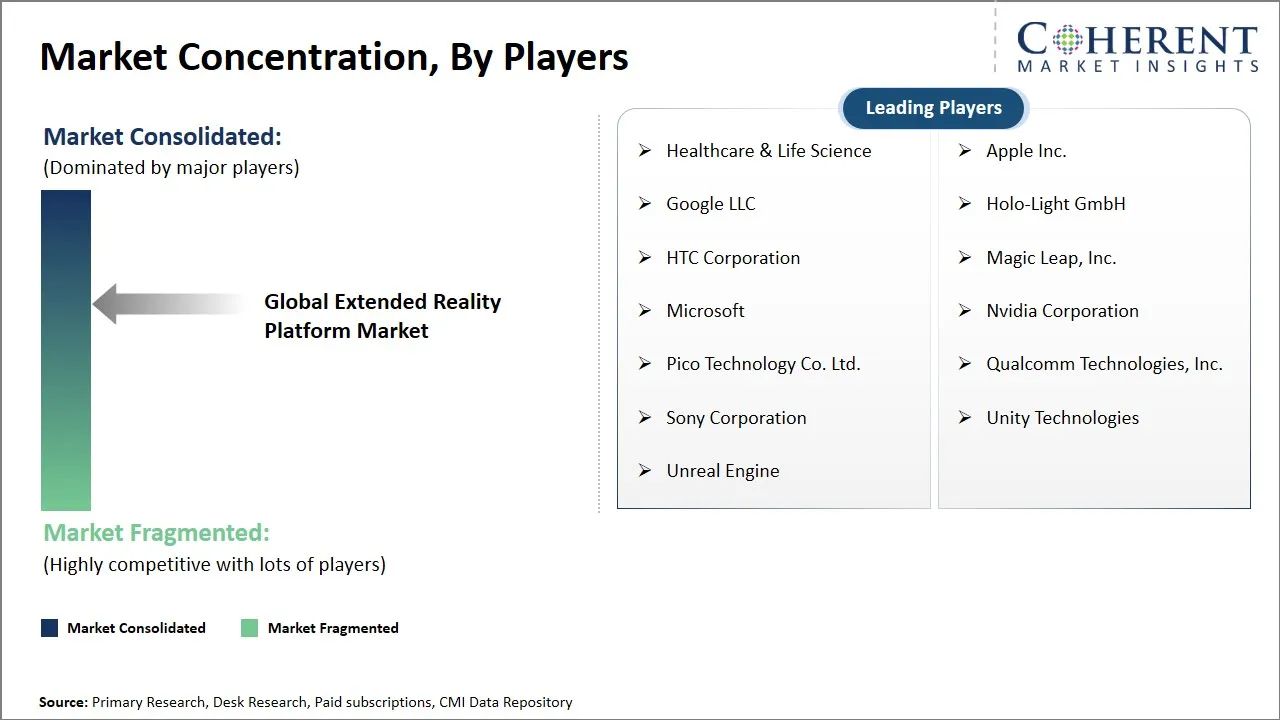
| Companies covered: | Healthcare & Life Science, Apple Inc., Google LLC, Holo-Light GmbH, HTC Corporation, Magic Leap, Inc., Microsoft, Nvidia Corporation, Pico Technology Co. Ltd., Qualcomm Technologies, Inc., Sony Corporation, Unity Technologies, and Unreal Engine | ||
| Growth Drivers: |
| ||
| Restraints & Challenges: |
| ||
Market Dynamics
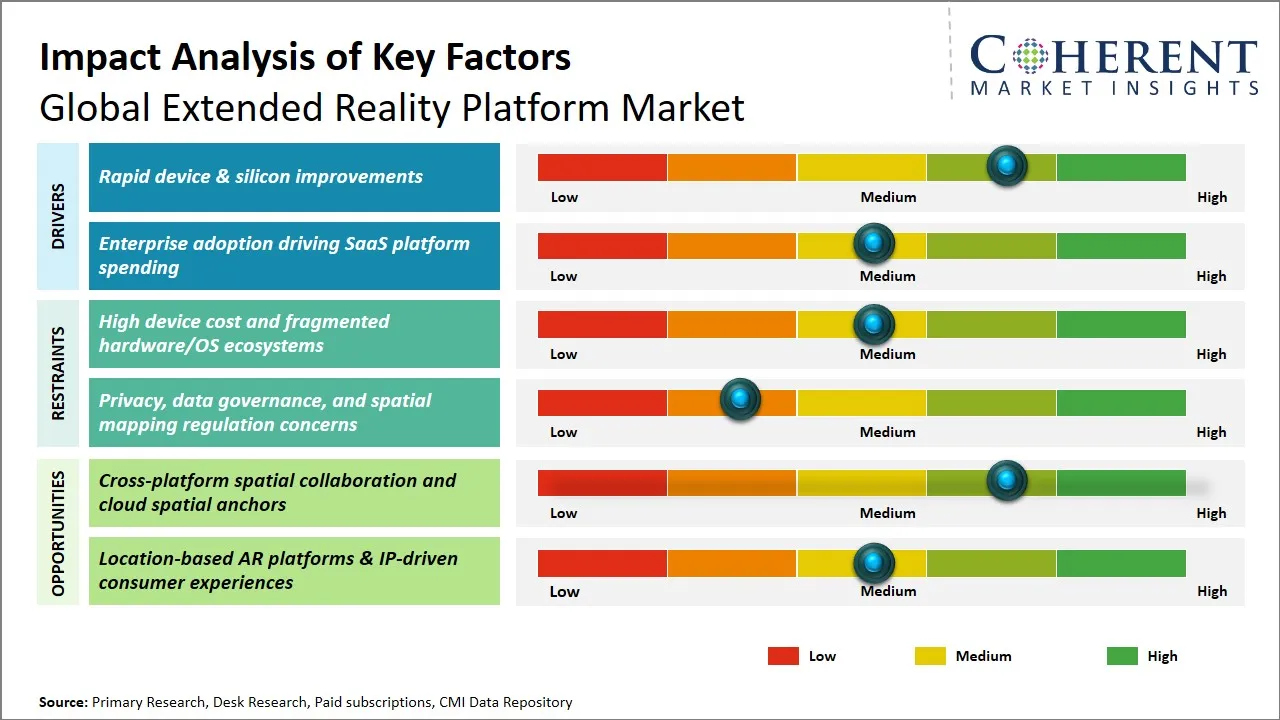
Global Extended Reality Platform Market Driver – Rapid Device & Silicon Improvements
The ongoing fats improvements in device capabilities and silicon technology have been very important in pushing the adoption and expansion of the global extended reality platform market. Innovations in semiconductor design, including more powerful processors and energy-efficient chips, allow XR devices to deliver higher resolution, lower latency, and improved graphics processing, improving user experience.
Also, improved silicon integration makes possible better power management and wireless connectivity, which adds to seamless and immersive XR environments. The evolution of Microelectromechanical Systems (MEMS) sensors and improved display technologies adds to the responsiveness and realism of XR applications.
Global Extended Reality Platform Market Opportunity – Cross-Platform Spatial Collaboration and Cloud Spatial Anchors
The advent of cross-platform spatial collaboration and cloud spatial anchors show a big growth opportunity in the global extended reality platform market. As organizations increasingly prioritize remote work and virtual teamwork, the demand for seamless, real-time collaboration in XR environments is growing. Cross-platform spatial collaboration allows users in different hardware ecosystems like Augmented Reality (AR) headsets, Virtual Reality (VR) devices, and Mixed Reality (MR) platforms to interact in shared virtual spaces, breaking down barriers created by device incompatibilities. This improves user experience and broadens the potential user base for XR applications in industries like healthcare, education, manufacturing, and entertainment.
Cloud spatial anchors, which allow persistent and shared digital content anchored to specific physical locations via cloud computing, add to this opportunity by providing continuity and context-aware interactions in sessions and devices. This technology makes possible collaborative workflows in real-world environments improved by spatial data, promoting widespread adoption in sectors relying on precise spatial referencing like architecture, engineering, and construction. The scalability and flexibility offered by cloud-based spatial anchoring allow developers and enterprises to build strong XR solutions that are both cost-effective and accessible globally, making an ecosystem of integrated XR applications and services.
Analyst Opinion (Expert Opinion)
- The integration of generative AI and advanced computer vision is changing XR development by making possible automated creation of 3D assets, real-time scene understanding, and adaptive virtual environments. Platforms that embed AI for predictive user interaction and spatial mapping are likely to gain a competitive advantage in enterprise training, healthcare, and entertainment.
- Emerging cloud-rendering and edge-compute technologies are reducing hardware constraints for XR devices. Streaming high-fidelity VR/AR experiences from powerful cloud servers allows lighter, standalone headsets to access graphics-intensive applications, expanding adoption in enterprises and remote collaboration without needing costly local hardware.
- Interoperable XR platforms using open standards like OpenXRa and WebXR are getting popular, allowing content and applications to work in multiple devices and ecosystems. This trend reduces fragmentation, lowers development costs, and adds to a broader developer and consumer base, adding to the market growth.
Speak to the analyst
Want personalized insights?
Take the findings above to one of our principal consultants, or have the report rebuilt around the segments, geographies and competitors you actually track.
Market Segmentation
- Type Insights (Revenue, USD Bn, 2021 - 2033)
- Hardware
- Software
- Technology Insights (Revenue, USD Bn, 2021 - 2033)
- Augmented Reality (AR) Technology
- Virtual Reality (VR) Technology
- Mixed Reality (MR) Technology
- Application Insights (Revenue, USD Bn, 2021 - 2033)
- Consumer Engagement
- Business Engagement
- End Use Industry Insights (Revenue, USD Bn, 2021 - 2033)
- Automotive
- BFSI
- Consumer Goods & Retail
- Government & Public Sector
- Healthcare & Life Science
- IT & Telecommunication
- Manufacturing
- Others
- Regional Insights (Revenue, USD Bn, 2021 - 2033)
- North America
- U.S.
- Canada
- Latin America
- Brazil
- Argentina
- Mexico
- Rest of Latin America
- Europe
- Germany
- U.K.
- Spain
- France
- Italy
- Russia
- Rest of Europe
- Asia Pacific
- China
- India
- Japan
- Australia
- South Korea
- ASEAN
- Rest of Asia Pacific
- Middle East
- GCC Countries
- Israel
- Rest of Middle East
- Africa
- South Africa
- North Africa
- Central Africa
- North America
- Key Players Insights
- Healthcare & Life Science
- Apple Inc.
- Google LLC
- Holo-Light GmbH
- HTC Corporation
- Magic Leap, Inc.
- Microsoft
- Nvidia Corporation
- Pico Technology Co. Ltd.
- Qualcomm Technologies, Inc.
- Sony Corporation
- Unity Technologies
- Unreal Engine
Sources
Primary Research Interviews
Stakeholders
- XR Hardware Manufacturers
- XR Software & Platform Developers
- Enterprise XR Solution Integrators
- Content Creators and Gaming Studios developing VR/AR titles
- Academic Researchers and XR Labs at universities focusing on spatial computing
- Corporate Training and Simulation Managers implementing XR platforms
Databases
- Global XR Device Registry (fictional)
- TechEcosystem Analytics Database
- OpenXR Market Tracker
- Digital Futures Platform
Magazines
- XR Today
- Augmented World Magazine
- Virtual Reality Insider
- Immersive Tech Review
Journals
- Journal of Virtual and Augmented Reality
- International Journal of Spatial Computing
- XR Applications & Enterprise Journal
- Journal of Mixed Reality and Immersive Systems
Newspapers
- TechCrunch AR/VR Section
- The Verge – XR Insights
- Wired – Emerging Immersive Technologies
- Financial Times – Tech & Innovation
Associations
- Immersive Technology Alliance (ITA)
- Global AR/VR Association (GAVA)
- Virtual Reality Society (VRS)
- Mixed Reality Developers Forum (MRDF)
- International Association of XR Professionals (IAXRP)
Public Domain Sources
- U.S. Patent & Trademark Office (USPTO) – XR-related patents
- European Patent Office (EPO) – Spatial computing patents
- United Nations Technology Innovation Database
- World Intellectual Property Organization (WIPO) – XR & AR/VR
- ResearchGate – XR & immersive computing publications
Proprietary Elements
- CMI Data Analytics Tool, Proprietary CMI Existing Repository of information for last 8 years
Get access to 250+ pages report
Every segment, forecast, competitor profile and data table behind the analysis above — available for instant download.
- ESOMAR Member
- ISO 9001:2015 Certified
- D-U-N-S Registered
- GDPR & CCPA Compliant
Missing comfort of reading report in your local language? Find your preferred language:
Transform your Strategy with Exclusive Trending Reports
Frequently Asked Questions
The global extended reality platform market is estimated to be valued at USD 95.93 billion in 2026 and is expected to reach USD 388.13 billion by 2033.
The CAGR of the global extended reality platform market is projected to be 22.1% from 2026 to 2033.
Rapid device & silicon improvements and enterprise adoption driving SaaS platform spending are the major factors driving the growth of the global extended reality platform market.
High device cost and fragmented hardware/OS ecosystems and privacy, data governance, and spatial mapping regulation concerns are the major factors hampering the growth of the global extended reality platform market.
In terms of type, the hardware segment is estimated to dominate the market revenue share in 2026.
A software and hardware ecosystem enabling AR, VR, and MR experiences, including development tools, content distribution, and runtime environments.
Market concentration is relatively high, dominated by a few large tech firms but with niche players in specialized segments.