

Global Urea Fertilizers Market Size and Forecast – 2026 To 2033
The Global Urea Fertilizers Market is estimated to be valued at USD 32.71 Bn in 2026 and is projected to reach USD 45.11 Bn by 2033, exhibiting a CAGR of 4.7% during 2026–2033. This steady growth reflects increasing agricultural activities worldwide, rising demand for nitrogen-based fertilizers, and expanding adoption of advanced farming techniques to enhance crop yield and soil fertility.
Urea remains preferred because of its high nitrogen content, large-scale availability, compatibility with field crop fertilization, and suitability for direct application as well as Fertilizers blending. Demand is also reinforced by government-backed fertilizer access programs in major agricultural economies and renewed investment in domestic nitrogen fertilizers capacity. For instance, in December 2025, Petrobras advanced the restart of its FAFEN-BA Fertilizers unit in Brazil, which is expected to produce ammonia, prilled urea, and ARLA-32, supporting Brazil’s national fertilizer production and reducing import dependence.
Key Takeaways of the Global Urea Fertilizers Market
- The granular urea segment is expected to account for 50.8 % of the market share in 2026, supported by bulk handling efficiency, high nitrogen concentration, and suitability for large-scale field application. For instance, Nutrien’s Urea 46-0-0 Granular Ag Grade Bulk is listed as a solid granular nitrogen Fertilizers from its Cars eland production site. (Source: Nutrien Ltd.)
- The cereals and grains segment is expected to account for 52.5 % share in 2026, as rice, wheat, and maize remain the largest nitrogen-consuming crop groups. In June 2026, the Food and Agriculture Organization’s Cereal Brief estimated global cereal production at 3,043 million tons in 2025 and utilization at 2,952 million tons for 2025/26, highlighting sustained Fertilizer demand from staple crop cultivation and reinforcing the need for urea-based nitrogen inputs. (Source: Food and Agriculture Organization)
- Uncoated and untreated urea is expected to hold 54.1 % share in 2026, as it remains the most economical, widely available, and bulk-traded nitrogen. Its dominance is supported by mature ammonia-urea production assets and price-sensitive farmer demand. In August 2025, Ethiopian Investment Holdings and Dangote Group signed a US$ 2.5 billion agreement for a 3 million metric tons urea fertilizer complex in Gode, Ethiopia.
- Asia Pacific is expected to lead with 43.5 % share in 2026, supported by high fertilizer usage in India, China, Indonesia, Pakistan, and Southeast Asian cereal systems. In March 2025, India approved the Namrup-IV ammonia-urea complex with 12.7 LMT annual urea capacity, strengthening domestic supply in eastern and northeastern agricultural belts. (Source: Press Information Bureau)
- Europe is expected to account for 18.6 % share in 2026 and remain a high-growth region, supported by Fertilizer security initiatives, import diversification strategies, and policy-backed measures aimed at strengthening supply resilience across the agricultural input value chain. In February 2026, the European Commission proposed temporary duty-free tariff-rate quotas for key nitrogen Fertilizers and inputs, including ammonia and urea, to improve affordability and availability.
- Enhanced efficiency urea adoption: Neem-coated urea is expected to represent 21.6% share in 2026, reflecting the shift toward nitrogen-use efficiency and lower nutrient loss. IFFCO’s Nano Urea Plus, notified under India’s Fertilizers Control Order on April 15, 2024, contains 16% nitrogen and can reduce traditional top-dressed granular or prilled urea use by up to 50%. (Source: IFFCO-Nanoventions.)
- Low-energy urea production trend: Energy-efficient urea manufacturing is becoming a strategic differentiator as producers manage natural gas exposure and carbon intensity. On December 19, 2025, Stamicarbon announced licensing and equipment supply for the Lianmeng Fertilizers complex in China using NX STAMI Urea Ultra-Low Energy technology, marking its tenth global application and eighth in China.
Segmental Insights
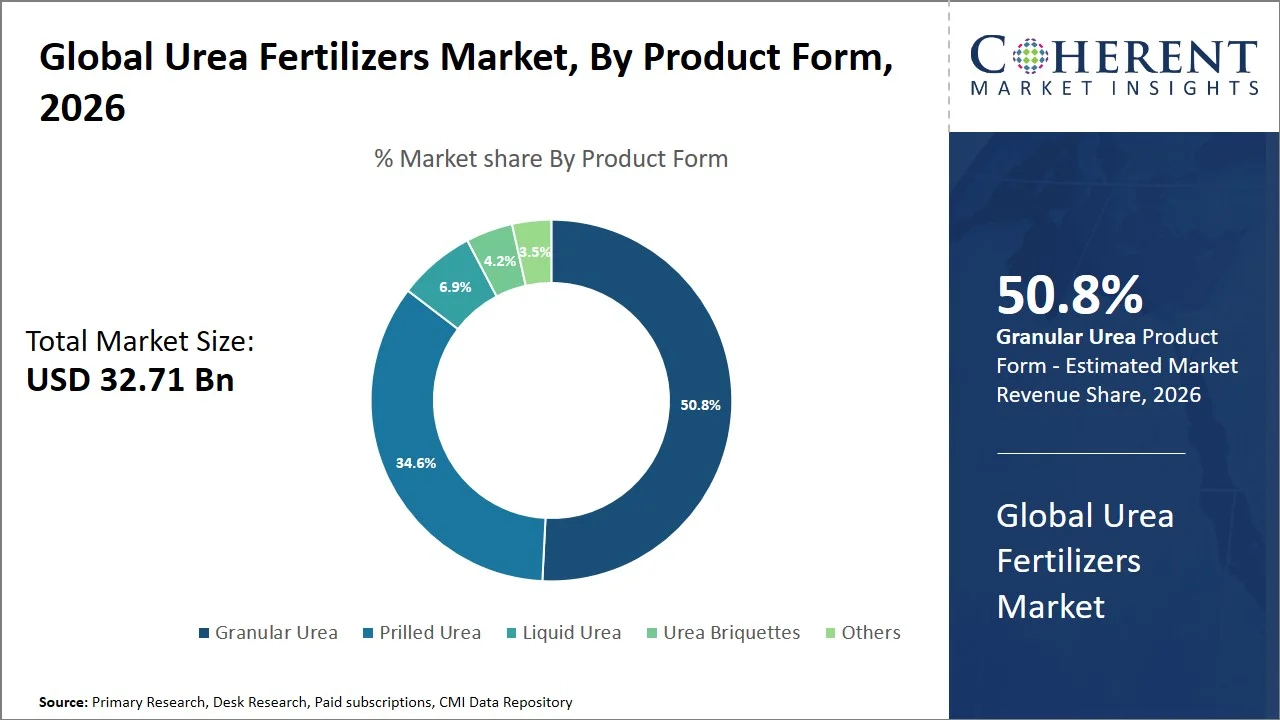
Why Does the Granular Urea Segment Dominate the Global Urea Fertilizers Market?
Granular urea is expected to dominate the global urea Fertilizers market with 50.8% share in 2026, as it offers better handling, storage stability, spreading uniformity, and compatibility with bulk fertilizers distribution systems. Demand is strongest among large field-crop growers and commercial farms that require high-volume nitrogen application across cereals, oilseeds, and commercial crops. From the supply side, granular urea is easier to transport in bulk and blend with phosphate and potash Fertilizer s, supporting its use in NPK and customized Fertilizers mixes.
CF Industries describes granular urea as a 46% nitrogen solid Fertilizers, suitable for direct soil application and mixing with phosphate or potash, highlighting why it remains the preferred physical form in global nitrogen Fertilizers trade. (Source: CF Industries Holdings, Inc.)
- Current Industry Events of 2026
- Market Size Estimation
- Regional Breakdown
- Competitive Landscape
- Customer Intelligence
- Segmental Analysis
- Pricing Analysis
- Key Market Drivers, Challenges & Future Trends
- Customized Insights Section
Why are the Cereals and Grains Segment the Most Used Crop Type in the Global Urea Fertilizers Market?
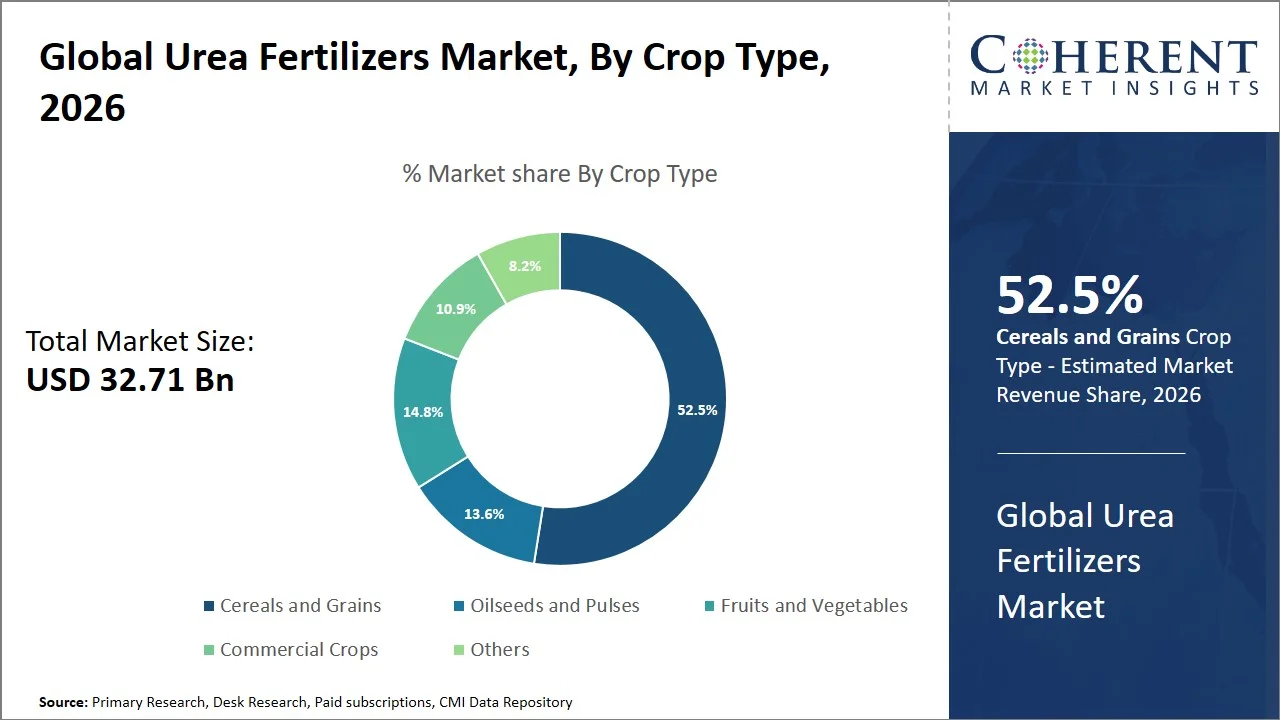
Cereals and grains are expected to account for 52.5% share in 2026, as rice, wheat, and maize represent the largest nitrogen-consuming crop base globally. Urea is highly relevant in these crops because nitrogen strongly influences tillering, vegetative growth, grain formation, and yield recovery after nutrient depletion. Demand is especially concentrated in Asia Pacific, where rice and wheat systems depend on affordable nitrogen inputs for food security. The segment also benefits from government procurement, subsidy mechanisms, and seasonal Fertilizers distribution linked to sowing calendars. USDA’s WASDE report provides annual forecasts for global wheat, rice, coarse grains, oilseeds, and cotton, reflecting the scale and monitoring intensity of grain supply chains that directly influence urea consumption planning. (Source: The World Agricultural Supply and Demand Estimates (WASDE))
Why is the Uncoated and Untreated Urea Fertilizers Technology segment gaining stronger value in the Global Urea Fertilizers Market?
Uncoated and untreated urea is expected to dominate with 54.1% share in 2026, mainly because it remains the lowest-cost and most widely produced nitrogen Fertilizers technology across commodity Fertilizers markets. The segment is preferred in price-sensitive farming systems where immediate nitrogen availability, bulk procurement, and established distribution infrastructure are more important than controlled-release performance. Supply-side dominance is supported by mature ammonia-urea production assets, standardized manufacturing routes, and strong international trade flows. For instance, in August 2025, Ethiopian Investment Holdings and Dangote Group agreement to develop a US$ 2.5 billion urea Fertilizers production complex in Gode, Ethiopia, with planned capacity of up to 3 million metric tons per annum, strengthening conventional urea supply in Africa. (Source: Ethiopian Investment Holdings and Dangote Group)
Currents Events and their Impact
Current Events | Description and Its Impact |
EU suspends customs tariffs on nitrogen Fertilizers including urea and ammonia (May 2026) |
|
Stamicarbon licenses ultra-low-energy urea technology for Lianmeng Fertilizers complex in China (December 2025) |
|
Dangote increases planned investment in Ethiopia Fertilizers project (May 2026) |
|
(Source: Council of the EU, Government of India for Namrup-IV)
Urea Fertilizers Market Dynamics
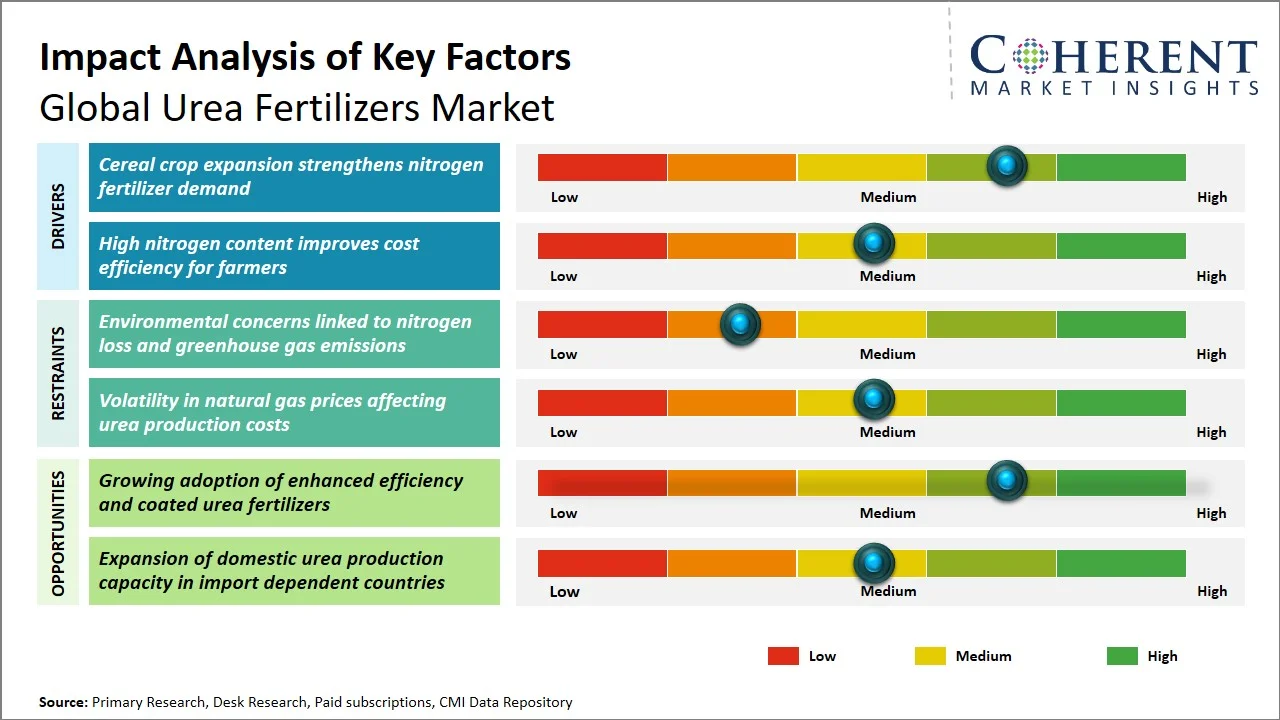
Market Drivers
- Cereal Crop Expansion Strengthens Nitrogen Fertilizers Demand: As the amount of food needed grows and cereals continue to be expanded, the demand for Urea Fertilizers will be further bolstered, as cereals have a strong demand for regular nitrogen application to sustain crop density, yield, grain filling and productivity. Urea has been popular nitrogen source in large-scale cereal cultivation because it is readily available, easy to apply and is compatible with existing fertilization practices. Food and Agriculture Organization (FAO) projected total cereal production in the world to be 3,040 million tons in May 2026, indicating the continued scope of cereal production and the need for a stable supply of nutrients in major agricultural economies. This helps in the sustained demand for urea fertilizers by farmers, cooperatives, urea distributors, and government procurement systems. (Source: Food and Agriculture Organization (FAO))
- High Nitrogen Content Improves Cost Efficiency for Farmers: Urea Fertilizers continues to gain preference because it contains around 46% nitrogen, making it one of the most concentrated solid nitrogen Fertilizers used in agriculture. This high nutrient density lowers the cost per unit of nitrogen delivered to crops and improves transport, storage, and field application efficiency. For price-sensitive farming regions, urea offers a practical balance between affordability and yield improvement, especially when Fertilizers prices remain volatile. In 2026, the World Bank highlighted that Fertilizers prices were projected to rise by more than 30%, reinforcing the importance of cost-effective nutrient sources. As a result, farmers and distributors continue to prioritize urea as a commercially viable nitrogen Fertilizers for broad-acre and intensive crop production.
Emerging Market Trends
- Enhanced-Efficiency Urea Products Gain Strategic Importance: Increased emphasis on nutrient-use efficiency, reduction of nitrogen losses, and better crop response leads to increasing importance of Enhanced-Efficiency Urea Products, such as coated, stabilized, and slow-released urea products. These products mitigate volatilization, leaching, and multiple Fertilizers applications, and are appealing to areas experiencing compliance concerns and higher input expenses. An example of this is ICL's biodegradable coating on controlled-release Fertilizers that was certified to the EU Fertilizing Products Regulation in July 2025. The certification is a sign of increasing regulatory and commercial demand for Fertilizers that perform as well as being environmentally responsible. This trend is likely to help product differentiation and premium positioning in the Urea Fertilizers market.
- Low-Carbon Nitrogen Fertilizers Create Premium Market Opportunities: Low-carbon Fertilizers are emerging as an important trend as Fertilizers producers, food companies, and retailers work to reduce emissions across agricultural supply chains. Urea and nitrogen Fertilizers production is energy-intensive, which is encouraging investment in renewable ammonia, carbon capture-based production, and lower-emission Fertilizer supply models. A recent instance is Yara’s partnership with PepsiCo Europe, under which Yara will supply up to 165,000 tons of Fertilizers per year by 2030, covering around 25% of PepsiCo Europe’s crop Fertilizers needs. The partnership includes lower-carbon Fertilizer s, crop nutrition advice, and digital farming tools to improve nutrient efficiency. This trend is creating opportunities for Fertilizers producers to build premium, sustainability-linked product portfolios.
Regional Insights
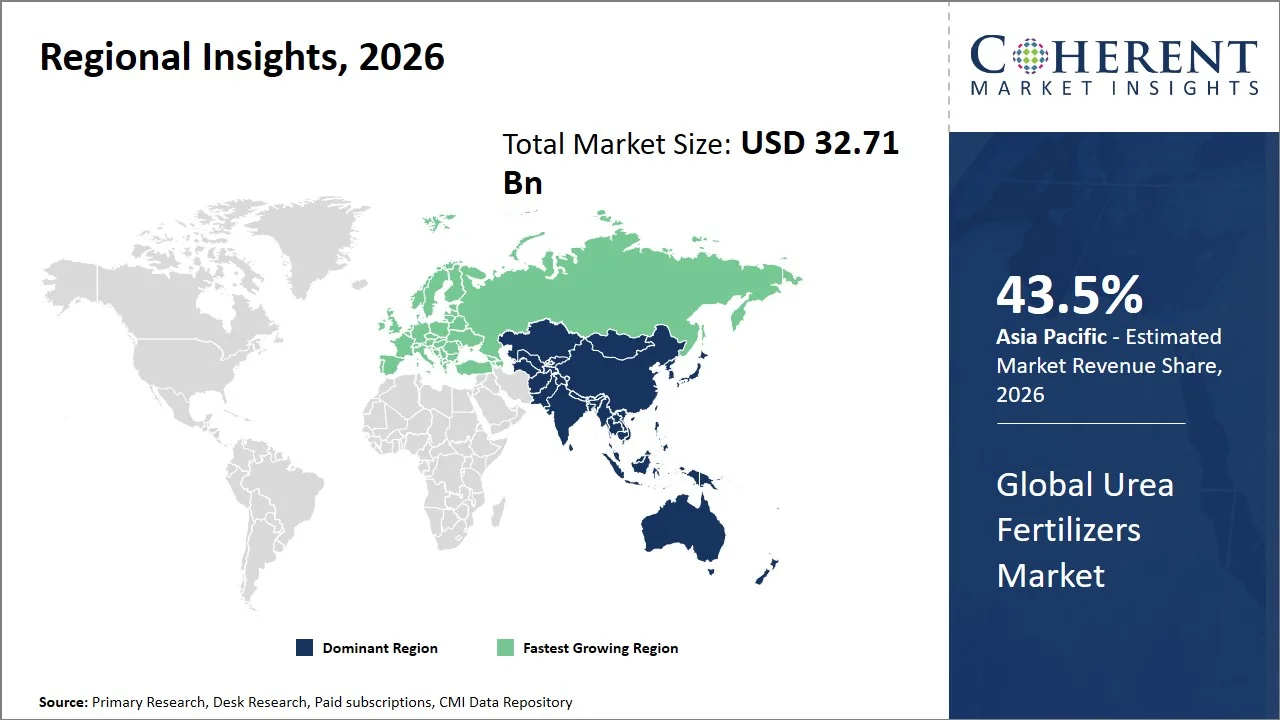
Why does Asia Pacific dominate the global urea fertilizers market?
Asia Pacific is expected to dominate the global urea fertilizers market with 43.5% share in 2026, supported by large cereal acreage, intensive nitrogen Fertilizers use, and strong production bases in China, India, Indonesia, Pakistan, and Southeast Asia. The region’s leadership is also linked to food security policies, subsidized Fertilizers access, and continued investment in domestic urea capacity. International Fertilizers Association IFA’s short-term Fertilizers outlook noted that global urea output was expected to reach a record level, with East Asia adding 2.8 Mt of urea output, driven by China’s production growth. Source: International Fertilizers Association.
Why is Europe the fastest-growing region in the global urea fertilizers market?
Europe is expected to emerge as the fastest growing region with 18.6% share in 2026, mainly due to Fertilizer supply security measures, import diversification, and policy support to reduce dependence on Russia and Belarus. The region remains structurally dependent on imported urea and ammonia for nitrogen Fertilizers production, making trade policy and input affordability highly important. In May 2026, the Council of the EU suspended customs tariffs for one year on key nitrogen-based Fertilizers and inputs, including urea and ammonia, to lower costs and improve supply access for European farmers.
Global Urea Fertilizers Market Outlook for Key Countries
How is India strengthening urea fertilizer security through subsidy-backed demand and domestic capacity expansion?
India is one of the most important countries in the global urea fertilizers market due to its large rice, wheat, sugarcane, and cereal cultivation base, along with strong government intervention in Fertilizers availability and pricing. Urea remains central to India’s nitrogen Fertilizers program because it supports small and marginal farmers and is distributed through a regulated subsidy-backed channel. The country is also investing in domestic capacity to reduce import dependence and improve regional supply security. In March 2025, India’s Union Cabinet approved the Namrup-IV brownfield ammonia-urea complex in Assam with 12.7 LMT annual urea capacity and an estimated project cost of US$ 111.10 Mn. (Source: Press Information Bureau, Government of India.)
What makes China a high-potential production and demand hub in the global urea fertilizers market?
China remains a critical market due to its large domestic Fertilizers consumption, coal-linked urea production base, and role in global nitrogen Fertilizers supply stability. The country’s urea industry benefits from integrated chemical manufacturing clusters, high agricultural demand, and continuous upgrades in energy efficiency. Technology-led plant revamps are becoming important as producers seek lower steam consumption, improved reliability, and higher output without building entirely new facilities. In January 2025, Stamicarbon was selected to provide a process design package for upgrading Hulunbeier New Gold Chemical’s urea plant in China, increasing capacity by about 26% to 3,600 metric tons per day while reducing high-pressure steam use by 15%. (Source: Stamicarbon)
How does the U.S. maintain its competitive position in nitrogen fertilizer production?
The U.S. is important in the Urea Fertilizers market because of its competitive natural gas feedstock position, large corn acreage, and strong nitrogen Fertilizers manufacturing base. Domestic producers supply farmers through ammonia-derived products such as granular urea and UAN, making the country less import-sensitive than many emerging agricultural markets. The U.S. also benefits from high plant utilization and established logistics around the Corn Belt. In 2026, CF Industries reported that its facilities operated at 97% gross ammonia utilization in 2025, and that these ammonia tons support American farmers as ammonia or ammonia-derived products such as granular urea and UAN. (Source: CF Industries)
What is making Brazil a strategic import-dependent demand center for urea fertilizers?
Brazil is a key urea Fertilizers market because of its large soybean, corn, sugarcane, and pasture-linked agricultural economy. However, the country remains highly exposed to imported nitrogen Fertilizer s, making domestic production revival strategically important. Urea demand is closely connected to Brazil’s export-oriented crop system, where Fertilizers cost and availability directly affect farm margins and planting decisions. Petrobras states that Brazil consumes approximately 8 million tons of urea per year, and with the resumption of Fertilizers production in 2026, the company aims to reduce import dependency and support rural producers. This makes Brazil a high-priority market for both global exporters and domestic capacity initiatives.
How is Egypt building its role as a regional export and low-carbon urea production hub?
Egypt is an important urea Fertilizers country due to its natural gas-based nitrogen Fertilizers production, export-oriented plants, and strategic location near Europe, Africa, and the Middle East. The country’s urea industry benefits from integrated ammonia-urea complexes and access to regional export routes through Mediterranean and Red Sea logistics. Egypt is also moving toward lower-carbon Fertilizers production as global buyers increasingly evaluate emissions intensity in ammonia and urea supply chains. In February 2025, thyssenkrupp Uhde was selected by MOPCO to enhance three existing ammonia and urea plants in Damietta with carbon capture and green ammonia solutions, targeting removal of up to 145,000 tons per year of CO₂ for use in urea production. (Source: thyssenkrupp Uhde)
Regulatory Incentives and Policy Landscape for the Global Urea Fertilizers Market
Country / Region | Key regulation / incentive program | Urea Fertilizers market relevance |
India | Urea Subsidy Scheme and urea pricing policy | Ensures subsidized farmer access to urea, supporting stable demand from rice, wheat, and field crops. The Government of India approved continuation of the Urea Subsidy Scheme to keep urea available to farmers at US$ 2.54 Mn per 45 kg bag, excluding taxes and neem-coating charges. |
European Union | Temporary customs tariff suspension on nitrogen Fertilizer s | Supports affordability and import availability of nitrogen Fertilizer s, including urea and ammonia. The Council suspended tariffs for one year to reduce farmer input costs and diversify Fertilizer supply away from Russia and Belarus. |
Brazil | National Fertilizers Plan | Encourages domestic Fertilizers production and reduced import dependence. The plan is aimed at developing Brazil’s Fertilizers industry over the lon g term, which is important because Brazil is a major agricultural economy and a large Fertilizers importer. |
U.S. | USDA NRCS Nutrient Management and 4R nutrient stewardship | Promotes efficient nitrogen use through the right source, rate, time, and place. This supports optimized urea application, lower nutrient losses, better crop productivity, and stronger adoption of precision nutrient management practices. |
Canada | Fertilizers emissions reduction target | Encourages improved nitrogen management rather than mandatory Fertilizer -use reduction. The policy focus includes enhanced efficiency Fertilizer s, reduced fall application, soil testing, and better nitrogen-use efficiency, which can influence urea application practices. |
China | Zero growth action plan for Fertilizers use | Encourages Fertilizer -use efficiency and reduced excessive chemical Fertilizers application. This supports demand for improved urea application practices, balanced nutrient management, and higher-efficiency nitrogen Fertilizers technologies. |
(Source: U.S. Department of Agriculture)
Market Players, Key Development, and Competitive Intelligence
Key Developments
- In December 2025, Stamicarbon, a part of NEXTCHEM, was awarded licensing process design package and proprietary equipment supply for a new urea project at the Lianmeng Fertilizers complex in China. The project will use NX STAMI Urea UltraLow Energy technology, marking the tenth global application of this technology and supporting lower energy consumption in large scale urea production.
- In April 2024, IFFCO Nano Urea Plus, classified under India’s Fertiliser Control Order as Nano Urea Liquid 16, represents an innovative advancement in the application of nitrogen fertilizers, offering higher efficiency and targeted nutrient delivery for crops. The product contains 16% nitrogen and is designed for foliar application supporting improved nitrogen use efficiency and reduced dependence on conventional granular or prilled urea in suitable crop conditions.
Competitive Landscape
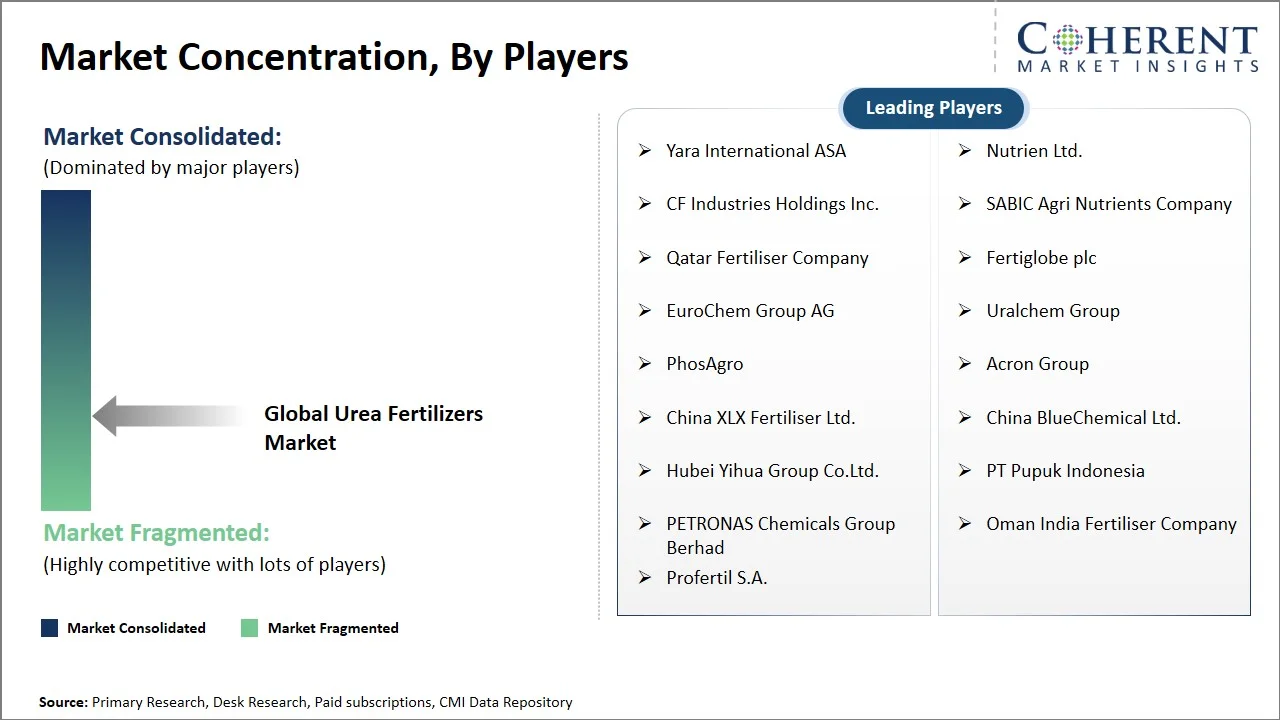
The global Urea Fertilizers market is moderately consolidated, with large nitrogen Fertilizers producers, gas-integrated chemical companies, state-backed Fertilizers manufacturers, and regional cooperatives competing across bulk agricultural supply, government procurement, dealer networks, and direct farm distribution. Key players differentiate through feedstock access, ammonia-urea integration, production cost efficiency, plant utilization, logistics strength, export reliability, and ability to supply granular, prilled, coated, and specialty urea products.
Key focus areas include
- Feedstock and Cost Competitiveness: Producers are focusing on natural gas availability, ammonia integration, energy-efficient urea plants, and high operating rates to manage production costs and margin volatility.
- Granular and Prilled Urea Supply Reliability: Companies are strengthening bulk production, storage, port access, and inland logistics to serve large-volume field crop fertilization demand.
- Enhanced Efficiency Fertilizers Portfolio: Manufacturers are expanding neem-coated, sulfur-coated, polymer-coated, stabilized, and controlled-release urea offerings to improve nitrogen-use efficiency and reduce nutrient losses.
- Government Procurement and Subsidy Alignment: Players in India, China, Indonesia, and other regulated markets are aligning production and distribution with subsidy programs, public procurement, and food security priorities.
- Export and Trade Positioning: Middle East, North America, Russia, China, and North Africa-based producers are competing through export availability, freight advantage, long-term contracts, and access to import-dependent markets.
- Sustainability and Low-Emission Production: Leading producers are investing in carbon capture, green ammonia, low-energy urea technology, and emission-reduction initiatives to meet evolving environmental and buyer requirements.
Market Report Scope
Urea Fertilizers Market Report Coverage
| Report Coverage | Details | ||
|---|---|---|---|
| Base Year: | 2025 | Market Size in 2026: | USD 32.71 Bn |
| Historical Data for: | 2020 To 2024 | Forecast Period: | 2026 To 2033 |
| Forecast Period 2026 to 2033 CAGR: | 4.7% | 2033 Value Projection: | USD 45.11 Bn |
| Geographies covered: |
| ||
| Segments covered: |
| ||
| Companies covered: | Yara International ASA, Nutrien Ltd., CF Industries Holdings Inc., SABIC Agri Nutrients Company, Qatar Fertiliser Company, Fertiglobe plc, EuroChem Group AG, Uralchem Group, PhosAgro, Acron Group, China XLX Fertiliser Ltd., China BlueChemical Ltd., Hubei Yihua Group Co.Ltd., PT Pupuk Indonesia, PETRONAS Chemicals Group Berhad, Oman India Fertiliser Company, and Profertil S.A. | ||
| Growth Drivers: |
| ||
| Restraints & Challenges: |
| ||
Analyst Opinion (Expert Opinion)
- Asia Pacific will remain the core demand anchor for the global urea fertilizers market, but the real opportunity is not just volume. The stronger opportunity lies in countries where urea demand is policy-backed, price-controlled, and linked to food security. India is the clearest example. Subsidized urea pricing protects farmer affordability and keeps consumption resilient even when global input prices fluctuate. For suppliers, this means demand visibility is high, but access depends on government alignment, domestic capacity, logistics, and compliance with subsidy-linked distribution frameworks.
- Europe should be viewed as a tactical growth and trade-access market rather than a purely consumption-led market. The region’s Fertilizers demand is mature, but supply security, high energy costs, and reduced dependence on Russia and Belarus are reshaping procurement patterns. Temporary tariff relief on nitrogen Fertilizers creates a favorable import window for cost-competitive producers from the Middle East, North Africa, and North America. Companies with reliable urea supply, ammonia integration, and low-carbon positioning may gain stronger buyer preference in Europe.
- The next margin opportunity in Urea Fertilizers is moving from basic commodity supply to efficiency-led and security-led positioning. Conventional urea will continue to dominate because of cost and availability, but coated urea, stabilized urea, low-energy production technology, and domestic capacity projects are becoming strategic differentiators. Brazil and Africa are especially attractive because import dependence exposes farmers to freight, gas price, and geopolitical shocks. Producers that can combine competitive pricing with local production, blending partnerships, or long-term supply contracts may capture higher strategic value.
Speak to the analyst
Want personalized insights?
Take the findings above to one of our principal consultants, or have the report rebuilt around the segments, geographies and competitors you actually track.
Market Segmentation
- Product Form Insights (Revenue, USD Bn, 2021 - 2033)
- Granular Urea
- Prilled Urea
- Liquid Urea
- Urea Briquettes
- Others
- Crop Type Insights (Revenue, USD Bn, 2021 - 2033)
- Cereals and Grains
- Oilseeds and Pulses
- Fruits and Vegetables
- Commercial Crops
- Others
- Fertilizers Technology Insights (Revenue, USD Bn, 2021 - 2033)
- Uncoated and Untreated Urea
- Neem Coated Urea
- Sulfur Coated Urea
- Polymer-Coated Urea
- Others
- End-use Application Insights (Revenue, USD Bn, 2021 - 2033)
- Field Crop Fertilization
- Horticulture Crop Fertilization
- Plantation Crop Fertilization
- Pasture and Forage Fertilization
- Fertilizers Blending
- Others
- Distribution Channel Insights (Revenue, USD Bn, 2021 - 2033)
- Direct Sales
- Indirect Sales
- Regional Insights (Revenue, USD Bn, 2021 - 2033)
- North America
- U.S.
- Canada
- Latin America
- Brazil
- Argentina
- Mexico
- Rest of Latin America
- Europe
- Germany
- U.K.
- Spain
- France
- Italy
- Russia
- Rest of Europe
- Asia Pacific
- China
- India
- Japan
- Australia
- South Korea
- ASEAN
- Rest of Asia Pacific
- Middle East
- GCC Countries
- Israel
- Rest of Middle East
- Africa
- South Africa
- North Africa
- Central Africa
- North America
- Key Players Insights
- Yara International ASA
- Nutrien Ltd.
- CF Industries Holdings Inc.
- SABIC Agri Nutrients Company
- Qatar Fertiliser Company
- Fertiglobe plc
- EuroChem Group AG
- Uralchem Group
- PhosAgro
- Acron Group
- China XLX Fertiliser Ltd.
- China BlueChemical Ltd.
- Hubei Yihua Group Co.Ltd.
- PT Pupuk Indonesia
- PETRONAS Chemicals Group Berhad
- Oman India Fertiliser Company
- Profertil S.A.
Sources
Primary Research Interviews
- Urea Fertilizers manufacturers
- Ammonia and urea plant operators
- Nitrogen Fertilizers distributors and wholesalers
- Agricultural cooperative procurement managers
- Large commercial farm input procurement heads
- Fertilizers blending unit managers
- Urea technology licensors and process engineering consultants
- Government Fertilizers procurement and subsidy program officials
- Port and bulk Fertilizers logistics operators
Stakeholders
- Manufacturers of urea and nitrogen Fertilizer s: Yara International, Nutrien, CF Industries, SABIC Agri-Nutrients, QAFCO, Fertiglobe, EuroChem, Uralchem, Acron Group, China XLX Fertiliser, China BlueChemical, IFFCO, KRIBHCO, National Fertilizers Limited, Chambal Fertilisers, RCF, GNFC, OMIFCO, Profertil
- End-use sectors
- Field crop growers
- Cereal and grain producers
- Oilseed and pulse growers
- Horticulture farms
- Plantation crop growers
- Pasture and forage farms
- Fertilizers blending companies
- Agricultural cooperatives
- Government Fertilizers distribution agencies
- Technology and engineering players: Stamicarbon, Saipem, Casale, thyssenkrupp Uhde, KBR, Topsoe, Toyo Engineering
- Regulatory and policy bodies: India Department of Fertilizer s, Ministry of Agriculture and Farmers Welfare India, European Commission, USDA, FAO, Brazil Ministry of Agriculture and Livestock, China Ministry of Agriculture and Rural Affairs
- Trade and logistics stakeholders: Fertilizers importers, port operators, bulk cargo handlers, commodity traders, inland Fertilizers transporters, agri-input retailers
Databases
- FAOSTAT Fertilizers by Nutrient Database
- IFASTAT Fertilizers Production and Trade Database
- UN Comtrade Database
- World Bank Commodity Markets Database
- World Bank Pink Sheet Fertilizers Price Data
- USGS Mineral Commodity Summaries – Nitrogen
- USDA National Agricultural Statistics Service
- USDA WASDE Reports
- Eurostat International Trade in Goods Database
- USITC DataWeb
- ITC Trade Map
- India Department of Fertilizers Dashboard and Annual Reports
- Brazil Fertilizers imports and agriculture statistics databases
Magazines
- World Fertilizers Magazine
- Fertilizers International
- Fertilizers Focus
- Nitrogen and Syngas Magazine
- AgriBusiness Global
- Farm Chemicals International
- Successful Farming
- The Furrow
- CropLife Magazine
- Progressive Farmer
Journals
- Nutrient Cycling in Agroecosystems
- Field Crops Research
- Agronomy Journal
- Soil Science Society of America Journal
- Agricultural Systems
- Journal of Plant Nutrition and Soil Science
- Journal of Cleaner Production
- Environmental Research Letters
- Agriculture, Ecosystems and Environment
- Precision Agriculture
Newspapers and News Sources
- Reuters
- Financial Times
- The Wall Street Journal
- The Economic Times
- Business Standard
- Agri-Pulse
- Feed and Grain
- Farm Progress
- Successful Farming News
Associations
- International Fertilizers Association
- The Fertilizers Institute
- Fertilizers Europe
- Fertilizers Canada
- Fertiliser Association of India
- Brazilian National Fertilizers Association
- International Fertiliser Society
- Arab Fertilizers Association
- African Fertilizers and Agribusiness Partnership
- International Plant Nutrition Institute Archive
Public Domain Sources
- Food and Agriculture Organization
- World Bank Commodity Markets
- U.S. Geological Survey
- U.S. Department of Agriculture
- European Commission Agriculture and Rural Development
- Council of the European Union
- Government of India Press Information Bureau
- India Department of Fertilizer s
- Brazil Ministry of Agriculture and Livestock
- China Ministry of Agriculture and Rural Affairs
- OECD-FAO Agricultural Outlook
- United Nations Comtrade
Proprietary Elements
- CMI Data Analytics Tool, Proprietary CMI Existing Repository of information for last 10 years.
Get access to 250+ pages report
Every segment, forecast, competitor profile and data table behind the analysis above — available for instant download.
- ESOMAR Member
- ISO 9001:2015 Certified
- D-U-N-S Registered
- GDPR & CCPA Compliant
Missing comfort of reading report in your local language? Find your preferred language:
Transform your Strategy with Exclusive Trending Reports
Frequently Asked Questions
The CAGR of the global urea fertilizers market is projected to be 4.7% from 2026 to 2033.
The global Urea Fertilizers market is estimated at USD 32.71 Bn in 2026 and is projected to reach USD 45.11 Bn by 2033.
Demand for urea Fertilizers is strong and steady, mainly from cereal, grain, and field crop fertilization because urea is a cost-effective high-nitrogen Fertilizer
China is the world’s largest urea producer, supported by its large coal-based nitrogen Fertilizers capacity and domestic agricultural demand.
Rising global food demand and expansion of cereal crop cultivation and high nitrogen content and cost effectiveness of Urea Fertilizers are the major factors driving the growth of the global urea Fertilizers market.
Environmental concerns linked to nitrogen loss and greenhouse gas emissions and volatility in natural gas prices affecting urea production costs are the major factors hampering the growth of the global urea Fertilizers market.
In terms of product form, the granular urea segment is estimated to dominate the market revenue share in 2026.